Channel Estimation Based on Compressive Sensing in OFDM
Systems
YuanHang Liu*, ZongGang Ye*, Shuai Peng*
*Chongqing Key Lab of Mobile Communications Technology, Chongqing University of Posts and Telecommunications, Chongqing 400065, P. R. China
Abstract
In OFDM systems, channel estimation is absolutely necessary for receiver design. Applying the theory of
compresssive sensing to channel estimation in OFDM systems can not only reduce the number of the using
pilots, but also improve the performance of channel estimation. an improved generalized orthogonal matching pursuit algorithm (IGOMP) is proposed for
channel estimation due to the low accuracy of channel estimation in the generalized orthogonal matching pursuit (GOMP) algorithm, the time of channel
estimation in the orthogonal matching pursuit (OMP) algorithm is long, and all need a priori information
with channel sparseness. The proposed algorithm which is used for channel estimation bring in a filtering mechanism to ensure the correctness of the currently
selected atoms, to determine the step size based on the variation of the residual value, and to use the noise
power to ensure the iteration stop threshold. Simulation results show that the proposed algorithm has a good channel estimation performance without
prior information of the sparsity with a short computation time, which compared with the least
square algorithm, the orthogonal matching pursuit algorithm and the generalized orthogonal matching pursuit algorithm.
Keywords: orthogonal frequency division multiplexing, compressive sensing, channel estimation
1.
Introduction
As a highly effective multi-carrier modulation
solution, OFDM technology has sound performance of
combating frequency selective fading and high bandwidth efficiency[1]. It is widely used in wireless communication
system currently. Channel estimation is a hotspot in the research of communication field, and its quality plays an important role in the property of the whole communication
system[2]. The pilot-assisted channel estimation algorithm in OFDM system is the most commonly used method[3],
therein exists an algorithm called Least Square[4], simple in structure and low in computational complexity, through a way of estimating the channel information from pilot
first and then refactoring the channel information of data sub-carriers through the interpolation method. This
method is applied to the dense channel, but not proper when there is less number of multipath for the channel. Compressive sensing theory shows a new method of signal
acquisition and processing. it sampling the compressible sparse signal in a way of far below the Nyquist rate and
regaining the original signal exactly[5].
With the development and maturity of the compressive sensing technology, it has been used in the OFDM sparse
channel estimation in the field of communication and signal by scholars at home and abroad. Due to the sparsity
characteristic of the wireless channel, which means that the tap coefficient close to zero elements or numerical zero elements is relatively more, the multipath parameters
needed to be estimated is decreased. Instead of getting the channel information on the data subcarrier by the
interpolation method, channel estimation based on compressive sensing can estimate the multipath parameters and reconstruct the information of the channel
via the information from the pilot. By doing this, the expenditure on the pilot is lowered down, therefore it can
system spectrum efficiency effectively. That is the reason why sparse channel estimation algorithm has always been
taken as a search hot point in the field of academic and industry[6]. In the paper [7], the author proposed that applying matching pursuit (MP) algorithm to OFDM
sparse channel estimation. In the paper [8], OFDM sparse channel estimation method based on the orthogonal
matching pursuit (OMP) algorithm was raised. According to literature [9], a generalized orthogonal matching pursuit (GOMP) algorithm is proposed. The GOMP algorithm
selected a few atoms that is the biggest multiplied with residual. OMP algorithm is a special GOMP algorithm. Compared to OMP algorithm, GOMP has a higher
computing speed.
2.
OFDM system model
Binary Information QPSK Modulation S/P Pilots Insertion IFFT CP Insertion P/S Data Receiving QPSK Demodulation Channel Estimation FFT CP Removing P/S S/P Channel Noise
Fig.1 OFDM system model
OFDM system diagram is shown in Figure 1, assuming OFDM system has N subcarriers, among which P subcarriers are used to convey the pilot information. The
1 ×
N dimension signal of the receiving end can be expressed as:
W XFh W
XH
Y = + = + (1)
Whereby, Matrix X of Dimension N×N in
Formula (1) can be expressed as
)) 1 ( ) 3 ( ) 2 ( ) 1 ( ) 0 ( ( −
= X X X X ...X N
X diag , , , , , , and
] [h0,h1,h2,...,hL−1
=
h ;
h
is the impulse response tothe discrete time-domain of the channel; H is the corresponding frequency domain response;
F
is N×Ldimension matrix; W is the Gaussian white noise of 1
×
N dimension vectors.
When the channel coherence time is far more than the OFDM symbol duration, the channel parameters in one
OFDM symbol can be considered constant, and the channel impulse response can be expressed as:
) ( ) ( 1 0 i L i i t h t
h =
∑
σ −τ −=
(2)
In formula (2), L is the total number of the tapped delay in the channel model, and hi is the complex gain of Tap i;
the sparsity of the channel is mainly shown in the number of several minority elements with relatively larger values or nonzero elements in [h0,h1,h2,...,hL−1] set; τi is
the delay of Tap i.
Set the selective matrix of P×N dimension as S
through which the N subcarriers will select out the P pilot positions, thus the corresponding signals received
from the receiving end of the P pilot signals can be expressed as: 1 P 1 L L P 1 P 1 L L P P P 1 p W h Α W h F X Y × × × × × × × × + = + = (3)
In formula (3), the formula 1 P
P SXS
X × = − for P×P dimension matrix presents the signals sent from pilot tones; WP×1=SW for the P×1 dimension vector presents the noises of the channel;
= − − − − − − × N c L j N c j N c L j N c j p N p N N N e e e e
N 2 0 2 ( 1)
) 1 ( 2 0
2 1 1
1 π π π π L P
F for the
L
P× dimension matrix is the fast fourier transform (FFT)
matrix at the corresponding P pilot, where N nl j nl e f π 2 − = , SY
YP×1= for the P×1 dimension vector present the
corresponding signals accepted at pilot from the receiving end, and the P×L dimension matrix AP×L=Xp×pFP×L is a
measurement matrix. Besides, YP×1,AP×L are all known
signals for the receiving end. It is a reconstruction problem of sparse signals to recover the hL×1 process according to formula (3), which can be resolved by compressive
sensing theory.
3.
An improved generalized orthogonal
matching pursuit algorithm
Generalized orthogonal matching pursuit (GOMP)
algorithm selected a few atoms that is the biggest multiplied with residual in each iteration. Compared with
OMP algorithm, GOMP have a higher running speed and its computation complexity is lower. GOMP algorithm process is as follows:
Input: M×N dimension measurement matrix A , 1
×
N dimension observation vector Y , initialize and each time choose S atoms, The value of the channel sparseness K.
Output: Estimation of the time domain impulse response of the channel hˆ
(1) Intialize r0 =Y, index value Λ0=
∅
, candidate set ∅=
0
Α , stage t=1;
(2) Calculate [ATrt 1] −
=abs
u , equals to calculate
N j≤
≤
−1, j ,1 t a
r , choose S biggest numeric in u, and
collect these values sequence number corresponded to A
into a J0 set.
(3) For Λt =Λt−1∪J0 , update index set j
1 t
t Α a
Α = − ∪ (j ∈J0).
(4) Determine the least square solution of Y=Αth:
h Α y
hˆ=argmin − t ; and update residual error
h Α y
rt = − tˆ.
(5) t=t+1, if t≤min(K,M/S) or rt−1 2 ≤α Where
α
is a small number, return to step (2); if not, stop iterating.From the steps above it can be seen that GOMP selected a few atoms that is the biggest multiplied with
residual in each iteration, wrong atoms would be chosen in the iteration. Secondly, GOMP algorithm can reconstruct
the signal accurately only if the sparseness of the channel is known in advance, however, the sparse degree always cannot be foreseen in practical condition. According to the
experiment and simulation, GOMP algorithm for channel estimation is not as effective as OMP algorithm.
Therefore, an improved generalized orthogonal matching pursuit (IGOMP) algorithm has been proposed for the characteristics of the GOMP algorithm. Under the
condition of unpredicted sparse degree, IGOMP can estimate channel information accurately and with a low bit error rate.
Compared with the GOMP algorithm, the IGOMP algorithm has the following differences
First, the GOMP algorithm chooses two or more atoms during each iteration, but the selected atoms may not be appropriate, which makes the iterative signal not be able to
approximate the original signal. Thus, at the end of each iteration, a filtering mechanism is introduced by comparing the quadratic norm r2 of the vector in the current iteration with the quadratic norm rt-12 of the
residual vector of the previous iteration. If rt-12≤ r2, it
means that the number of atoms selected this is not enough, it will increase the support set of atoms. Otherwise
iterates.
Secondly, in the GOMP algorithm, when the residual is less than a certain threshold, it indicates that the support
set may already be closer to the support set of the original signal, and the step size needs to be reduced. Therefore, in the improved algorithm, when r2≤exch∗Y 2, where exch is the variable step threshold parameter. in this paper, the value of
exch
is 0.3. The support set Lincrements by only 1, that is, by the time S is equal to 1 when the secondary norm of the residual is less than a
certain threshold.
Finally, the OMP algorithm and the GOMP algorithm can reconstruct the signal accurately when the sparsity of
the channel is known. However, in the actual environment, the sparseness of the channel is often unpredictable.
Therefore, the reconstruction algorithm of the channel needs to find a suitable threshold for determining whether the iteration should be terminated. If the channel can be
reconstructed accurately, the last remaining residual must satisfy the following conditions:
p p
p− ≤
=
2
2 Y Th
r (4)
Where p represents the power of Gaussian white
p
+
≤α
2
r , where
α
is a small constant.On this basis, the IGOMP algorithm steps are as
follows :
Input: M×N dimension measurement matrix
A
, 1×
N dimension observation vector Y , initialize and choose Satoms.
Output: Estimation of the time domain impulse
response of the channel hˆ
Step 1 : Intialize residual error r0 =Y, index value
0
Λ =∅, candidate setΑ0 =∅, initialize support set L=S,
stage t=1;
Step 2: Calculate [ATrt 1] −
=abs
u , equals to calculate
N j≤
≤
−1, j ,1
t a
r ,Where aj represents the column j
of the measurement matrix
A
. choose L biggest numeric in u , and collect these values sequence number corresponded to A into a J0 set.Step 3: For Λt=Λt−1∪J0, the number of elements in the index value Λt−1 is P. ΑΛ ={aj}(j∈Λ).
Step 4: Determine the least square solution of Y=Αth:
h Α y
hˆ=argmin − t ; and renewal the residual error
h Α y
rt= − tˆ.
Step 5: If rt-1 2≤ r 2, turn to step 6; if not, turn to step
8.
Step 6: If r2≤exch∗Y2, change the section value, step length, for L=L+1, carry on step 2; if not, turn to step 7.
Step 7: For L=L+S, carry on step 2.
Step 8: Update index set and residual error, Λ
=
Λt ,rt =r,t=t +1 , Carry on step 9.
Step9: If ≤α+p
2
r , stop iterating, output channel
time impulse response hˆ, Or else, enter the step 2.
4.
Simulation and performance analysis
In order to verify the effectiveness of the proposed
algorithm, the following simulation is taken in this paper, The simulation parameters are as follows in table 1.
Table 1: Simulation parameters
Parameters value
Bandwidth 48kHz
Sub-carrier Number 1024
Cyclic Prefix Length 256
Modulation and Demodulation 4PSK
Maximum Time Delay: 2ms
Maximum Doppler Shift : 1Hz
Channel Sparseness: 2
Channel Length: L 50
Signal-to-Noise Ratio 0-30dB
Simulation Number: m 1000
System simulation uses the bit error rate (BER) and
the normalized mean square error (MSE) as indicators, to make a comparison in the channel estimation performance
differences among the LS algorithm, the OMP algorithm, GOMP algorithm and IGOMP algorithm. The normalized mean square error (MSE) formula is:
2
1 2
1
/
∑
∑
= =
∧
−
= m
i i m
i i
i h h
h
MSE (5)
In the formula, m is the simulation number of times.
i
hˆ stands for the estimated value of the channel impulse response in the
i
simulation experiment. hˆi is the realvalue of the channel impulse response in the
i
simulationexperiment.
4.1 A comparison of the performance of MSE and BER
among different algorithms
0 5 10 15 20 25 30
10-5 10-4 10-3 10-2 10-1 100
SNR/dB
MS
E
LS algorithm ,K= 6 OMP algorithm ,K= 6 GOMP algorithm ,K= 6 IGOMP algorithm ,K= 6
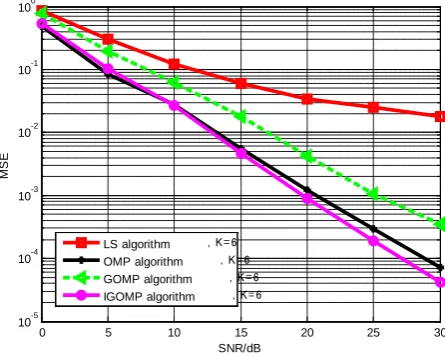
Fig.1 The MSE comparison of different algorithms
Channel reconstruction algorithms are all adopts 64 pilots. In order to make the contrast more permanent, LS
algorithm using a uniform pilot to make its performance achieve the best, and the reconstruction algorithm based on
compressive sensing adopts random pilot. The number of initialized atoms S of the GOMP algorithm and the IGOMP algorithm is 2. Simulation results are shown in
figure 1 and figure 2, they are comparison curves of mean square error and bit error rate from several different
algorithms.
0 5 10 15 20 25 30
10-4 10-3 10-2 10-1 100
SNR/dB
BER
LS algorithm ,K= 6
OMP algorithm ,K= 6 GOMP algorithm ,K= 6 IGOMP algorithm ,K= 6
Fig.2 The BER comparison of different algorithms
In the accordance with the results, with the increase of signal-to-noise(SNR) ratio, the mean square error and bit
error rate decreases in the OMP algorithm, GOMP algorithm and IGOMP algorithm. The LS algorithm is not
as good as the reconstruction algorithm based on compressive sensing. In the reconstruction algorithm based on compressive sensing, the channel reconstruction
performance of IGOMP algorithm and OMP algorithm is better than GOMP algorithm . GOMP algorithm channel
estimation performance is the worst, this is because the GOMP algorithm each time select two atoms, it may be mistaken for some extra atoms, resulting in channel
estimation performance is not good. The OMP algorithm only selects the most matching one at a time, so it is
superior to the GOMP algorithm in the reconstruction performance. When the SNR is relatively low, the channel
estimation performance of the IGOMP algorithm is slightly lower than that of the OMP algorithm. With the increase of SNR, the channel estimation performance of
IGOMP algorithm is gradually improved. In general, IGOMP algorithm performance is slightly better than
OMP algorithm, belonging to these algorithms in the best performance. This is due to the fact that IGOMP algorithm introduces a screening mechanism with an iteration stop
threshold when selecting atoms. Therefore, IGOMP algorithm performance is the best .
4.2 The effect of the initial step on MSE
In the processing of simulation, we need to study the effect of the original step of IGOMP algorithm to the
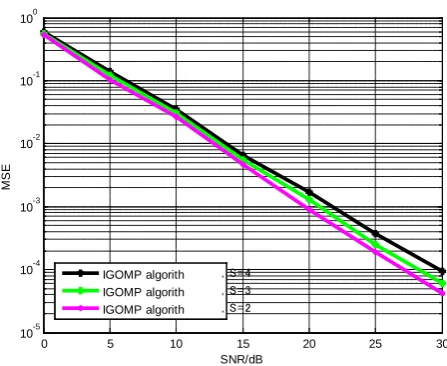
performance and running time of channel estimation. As is shown in figure 3, it compared the effect of IGOMP initial
step on MSE when S is 2, 3 and 4. The conclusion can be drown that the step S has an effect on the performance of channel estimation. With the increase of S, the normalized
mean squared error (MSE) is reduced gradually. This shows that when the initial step is different, the channel
estimation effect is different. As the initial step increases, the mean square error of the channel estimation increases gradually. However, when the initial step increases, the
number of atoms chosen each time increases, then the time required for channel reconstruction should also change.
The effect of the time required for channel reconstruction will be studied below when the initialization step takes different values.
0 5 10 15 20 25 30
10-5 10-4 10-3 10-2 10-1 100
SNR/dB
MS
E
IGOMP algorith ,S= 4 IGOMP algorith ,S= 3
Fig.3 The effect of IGOMP initial step on MSE
4.3 The effect of increasing sparseness on channel
estimation performance
When the value of sparseness is different, the IGOMP
algorithm is compared with the OMP algorithm. Both algorithms use 64 pilots, and the sparseness of the channels is 6 and 14, respectively. As shown in figure 4, it
can be seen that the performance of the mean square error of the two algorithms decreases when the sparseness K of
the channel increases from 6 to 14. This is because the sparseness of the channel increases and the number of pilot channels does not increase. So that no sufficient channel
condition information is obtained, resulting in an increase in the error of the channel estimation.. When the channel
sparseness is 6, the IGOMP algorithm has the same mean square error as the OMP algorithm when the SNR ratio is high. However, when the sparseness of the channel
becomes 14, the overall performance of the IGOMP algorithm is better than that of the OMP algorithm.This
means that with the increase of sparseness, IGOMP algorithm can better track the channel condition, so as to carry out channel estimation. However, the OMP
algorithm can not track the channel condition very well, resulting in the channel estimation performance is not very
good.
0 5 10 15 20 25 30
10-5 10-4 10-3 10-2 10-1 100 101
SNR/dB
MS
E
OMP algorithm ,K= 6
OMP algorithm ,K= 14
IGOMP algorithm ,K= 6
IGOMP algorithm ,K= 14
Fig.4 Comparison of MSE of two different sparseness
4.4 Comparison on running time of various reconstruction algorithms.
Here is a running time comparison in the algorithms of OMP, GOMP and IGOMP. The simulation computer
configuration is as follows.
Table2 computer configuration
Configuration Parameters
Processor
ROM
Operating system
Operating environment
Intel dual-core frequency
2.7GHz processor
2GB
Windows7
MATLAB R2012a
The table3 shows the average running time of several
reconstruction algorithms based on compressive sensing. By comparison and observation, we can see that the running time of IGOMP is shorter than that of OMP and
GOMP, in addition to that, along with the increase of the initial step, IGOMP running time decreases gradually.
Known from the analysis of theory, GOMP is to select the largest number of atoms with the residual inner product, update the index set, and then update the residual. As the
GOMP algorithm to select more atoms each time, in general, GOMP algorithm needs to be the number of
iterations will be less than OMP algorithm. therefore, compared with the OMP algorithm, GOMP algorithm has a higher computing speed. With the channel sparseness
increase, GOMP algorithm requires the number of iterations will be less.The IGOMP algorithm selects
several atoms with the largest inner product of the residuals, updates the index set, and then updates the residuals. If the iteration residual is greater than the last
iteration residual, the support set increases gradually. In this case, the number of atoms selected by the iteration is increased, which makes the algorithm run time shorter
than GOMP. In the IGOMP algorithm, when the initial step size increases, the run time is shortened due to the
increase in the number of atoms selected each time.
Table3 Running time for different algorithms
Algorithm Running Time
OMP
GOMP(S=2)
IGOMP(S=2)
IGOMP(S=3)
IGOMP(S=4)
0.0134
0.0094
0.0058
0.0050
0.0046
5.
Conclusion
In this paper, IGOMP algorithm is proposed for the
shortcomings of GOMP algorithm in OFDM channel estimation. When the number of pilot and the
signal-to-noise ratio is the same, adopting the IGOMP algorithm is not only good for channel reconstruction performance, but also for reconstruct the signal under
the condition of unpredicted sparseness, except of that, its running time is relatively short and has certain
practicality.
References
[1] DING Jing-xiao, WANG Ke-ren, CHEN Xiao-bo. Sparse Channel
Estimation Algorithm Based on OMP in OFDM Systems[J].
Communication Countermeasures, 2012, 31(1): 6-11.
[2] PENG Yu, HOU Xiao-yun, WEI Hao. Domain-Doppler Doubly
Selective Channel Estimation Using Compressed Sensing[J].
Journal of Signal Processing, 2014, 30(1): 119-126.
[3] Lang Tong, Sadler BM, Dong Min. Pilot-assisted wireless
transmissions: general model, design criteria, and signal
processing[J]. Signal Processing Magazine, IEEE, 2004, 21(6):
12-25.
[4] Lin, J-C. Least-squares channel estimation assisted by
self-interference cancellation for mobile pseudo-random-postfix
orthogonal-frequency division multiplexing applications[J].
Communications, IET, 2009, 3(12): 1907-1918.
[5] Davenport M.A, Boufounos P T, Wakin M B, et al. Signal
processing with compressive measurements[J]. IEEE Journal of
Selected Topics in Signal Processing, 2010, 4(2): 445-460.
[6] Chen Yu, Wei Yuan, Liang Yan, et al. High-Performance Sparse
Channel Estimator for OFDM System with IQ Imbalances[J].
Journal of Data Acquisition and Processing, 2014, 29(6): 986-991
[7] ZHU Xing-tao, LIU Yu-lin, XU Shun, et al. An OFDM sparse
channel estimation algorithm based on matching pursuit[J]. Journal
of Microwaves, 2008, 24 (2): 73-76.
[8] HE Xue-yun, SONG Rong-fang, ZHOU Ke-qin. Study of
compressive sensing based sparse channel estimation in OFDM
systems[J]. Journal of Nanjing University of Posts and
Telecommunications(Natural Science Edition), 2010, 30(2): 60-65.
[9] Wang J, Kwon S, Shim B. Generalized Orthogonal Matching
Pursuit[J]. IEEE Transactions on Signal Processing, 2012, 60:
6202—6216.
[10] Tong L, Sadler B M, Dong M. Pilot-assisted wireless
transmissions: general model, design criteria, and signal
processing[J]. Signal Processing Magazine IEEE, 2004, 21(6):
12-25.
YuanHang Liu, was born in Nanyang of Henan province in
1990. He is now a graduate student in Chongqing University of
Posts and Telecommunications. His research concerns mobile
communication techniques.
ZongGang Ye, was born in Xinyang of Henan province in
1989. He is now a graduate student in Chongqing University of
Posts and Telecommunications. His research concerns mobile
communication techniques.
Shuai Peng, was born in Nanchong of Sichuan province in
1991. He is now a graduate student in Chongqing University of
Posts and Telecommunications. His research concerns Mobile