VICTORIA
~UNIVERSITY
DEPARTMENT
OF
COMPUTER AND MATHEMATICAL
SCIENCES
The Zero Crossing Problem
A. Sofo
A. Jones (Department of Mathematics
La Trobe University)
(2'MATH{)
May 1993
TECHNICAL REPORT
VICTORIA UNIVERSITY OF TECHNOLOGY
BALLARAT ROAD (P 0 BOX 64) FOOTSCRAY
VICTORIA, AUSTRALIA 3011
TELEPHONE (03) 688-4249/4492
FACSIMILE (03) 687-7632
Campuses at
Footscray, Melton,
St Albans, Werribee
... ...
THE ZERO CROSSING PROBLEM
A. SOFO
DEPARTMENT OF COMPU1ER AND MA1HEMATICAL SCIENCES VICTORIA UNIVERSITY OF TECHNOLOGY,
MELBOURNE, AUSTRALIA
A.JONES
DEPARTMENT OF MA1HEMATICS LATROBE UNIVERSITY, MELBOURNE, AUSTRALIA
THE ZERO CROSSING PROBLEM
Abstract
We analyze a second order nonlinear differential equation that is useful in the zero crossing problem. We show that our calculated values are in agreement with the simulated values in the region of time 't, 0.1 < 't < 0.9.
Intro du ctj on
Consider a sample function of a random process as shown.
Researchers have been particularly interested in the statistics of the points where the sample function crosses the zero-axis, and in the probability density function of the intervals between these crossings.
Kac [1] in 1943 initiated some of the early investigations into this area, and more recently by Barnett [2]. Wong [3] has obtained some results based on approximate techniques.
The zero-crossing problem is a long standing one and it concerns the problem of determining the relevant statistics of the zero-crossings of random communication signals. This problem has relevance not only in communication theory, but also in the study of ocean waves, random vibrations, earthquakes, speech recognition, signal processing and frequency measurements.
Seumahu (4], through the application of the z-transformation has been able to derive a second order non-linear differential equation in the z-domain.
The Equation
Suppose that p0 is the probability that there are exactly n zero-crossings in a unit of time interval and that p is the generating function defined by
which is convergent for zE [-1, 1] and that p is twice differentiable term by term so that
then Seumahu [ 4 ], has derived the relation
" p
=
with
2 ( 2 '2) cµ P\~
-
pco
p(l)
=
~
p0=
1I
p(l)
=
~co
p(-1)
=
~
(-1)0
p0
=
rzE[-1, 1]
..•... (1)
... (2)
where c, µ,~are non-negative constants and r is a correlation coefficient such that rE [-1, 1].
Anahsis
One simple non-zero solution of (1) is obtained by inspection by noting that
(p')2 = ~2.
Note p(z) = 0 is trivial hence, using (2)
p(z)
=
~(z -1) + 1, where r=
1 -2~Now, a first integral of (1) can be obtained as follows:
p
=
q2 ( 2 2)
cµ p ~ -q
Consider w = p2 and x
=
~2 • q2'
dw -p
dx
=
--;-q
substitute for q, hence
now
so that
replace w and x
dw
dx
=
-µ\1 - w) + (1 - c)x 2
cµ x
d ( .1/c) _
- wx
-dx
(1-c)x.1/c
2 cµ
W = - X 1/c
- + l + B x 2
µ
- 1 .1/c
x
c
··· (3)
... (4)
B is a constant
... (5)
A is a new constant
Substitute into ( 4) and we have
p
=
qq =
µp
... (6)µp
or
provided that f}2 - q2 ,. 0 which is always the case if r ,. 1 - 2fl.
Also from the initial data, we can deduce that the constant A satisfies the inequality
~f3
2-q
2)
st ;
VzE(-1,1] ....•.... (7)More over, it follows that
(i) p(z) is a Convex function of z whenever p(z) is positive and
(ii) p(z) is a Concave function of z whenever p(z) is negative.
This leads to the following theorem.
1HEOREM
The constant of integration A, which appears in the first integral (5), of equation (1) has the
property that
and
A 2: O if r 2: r0
5.
PROOF
Consider A O!: 0, since the case A s 0 follows by reversing all the subsequent inequalities putting (5) into (1), we can write
"
p (z) =
2
µp
A 2 2
1--(f3
-qc
1
--1
) c
the inequality at (7) now suggests that
" 2 p (z) O!: µ p
multiplying by Cosh µz, we have
integrating w.r.t. z and using p1(1) =
f3,
we havef3
Cosh µ - µ Sinh µ O!: p' Cosh µz - µp Sinh µz( f3
Cosh µ - µ Sinhµ)
Sech2
µz O!:ci1z.
{p Sech µz} .Integrating w.r.t. z and using the boundary condition p(l)
=
1, yieldsp(z) :.
~~ ~
- [* -
tanhfl]
Sinh µ (1 -z)From the other boundary condition p(-1)
=
r, we have thatr
=
p(- 1) O!: Cosh 2 µ -1!.
Sinh 2 µ • r 0µ
The proof is now complete.
A parametric solution of (1) from the first integral (5) can be obtained as follows:
( 2 2)
lkp2
=
1-f3
~q
+
~(f32-q2)
.
write
Define
··· (8)
hence
' H(q) q
p
=
2qand
'
l = H (q) dq 2qJH(q)
dZ
since p
=
JH(q) .Given that p1(l) =
13
integrate, with respect to the variable z.q '
z = 1 +
I
H ( q) dqP 2q JH(q)
q
z
=
1+
J
!
! [
JH(x)]
dxx=~
z = 1 +
[ff{;5 -
/H(i)
+Jq
[fiW
dxq
~ x2x=P
...
From (8), H(l3)
=
1, so thatq
z
=
1 -~
+
[ff{;5
+
J
[fiW
dx.13
q x2x=P
For the special case of A • 0, the solution of (1) follows from (5)
' dp
J
2 2 2 2 q=
p= -
=13 -
µ+
µ pdz
f
dpz
=
Jnz
2 2 2Case (i) If
f3
= µ > 0p(z)
=exp( f3(z -
1)]
for xE [-1, 1]provided that r
=
exp(-2~).Case (ii) If
f3
> µ > 0l/2
( f32
2)
p(z)
=
-
µ Sinh µ(z - zo)
µ
where
provided that
z
0
=
1 -2....
2µ log (f3
f3 -
+ µµ)
r = r
0
=
Cosh 2µ -Ji
µ Sinh 2µ.[Note that the singular solution (3) corresponds to letting µ -. O]
Case (iii) If 0 <
f3
< µl/2
( 2 f32)
p(z)
=
µ - Coshµ(z - zo)
µ
where
2n
= 1 -2
~
log ( :~:)
provided that
Numerical Results
For 0 < c < 1, the right hand side of (6) is continuous in a neighbourhood of p
=
1, q=
13,
hence has a solution. Moreover, for 0
<
c<
±•
it is differentiable and hence there is aunique solution satisfying the given initial conditions. Thus the solution of the initial value problem
(1) is not unique. There is an infinite family of solutions, one for each choice of the constant A.
Thus we have two independent parameters c and A (regarding µ and
13
as fixed) to be detenninedfrom the one boundary condition p = r when
z
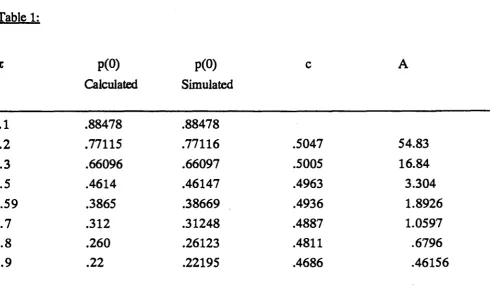
= -1.For 0.1<t<0.9, the following computer method has been used to estimate the constant A (but
unfortunately does not apply for larger values of 1:).
q
q(l) =
13
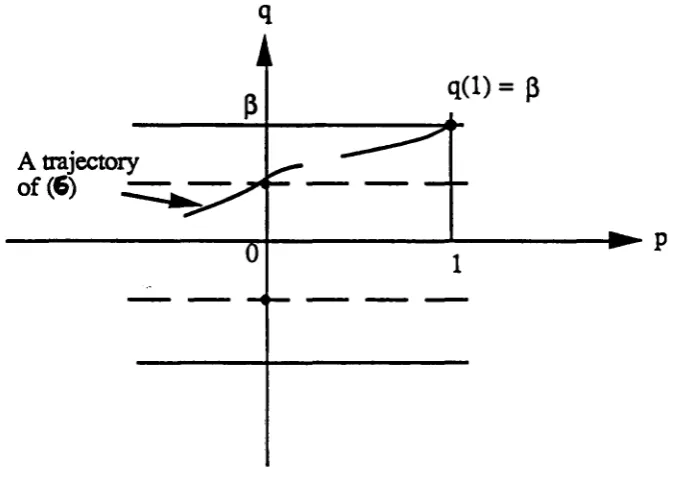
A trajectory
of(6)
1
Fig. 1: Singularities of the system (6)
A trajectory of the system (6) can only cross the singularities (dotted line - Fig. 1) at a point on the
q-axis. This gives the formula for A in terms of c.
l.1
(
~cA=c
Jl}
9.
Table 1:
p(O) p(O) c A
Calculated Simulated
.1 .88478 .88478
.2 .77115 .77116 .5047 54.83
.3 .66096 .66097 .5005 16.84
.5 .4614 .46147 .4963 3.304
.59 .3865 .38669 .4936 1.8926
.7 .312 .31248 .4887 1.0597
.8 .260 .26123 .4811 .6796
.9 .22 .22195 .4686 .46156
For larger values of "C we lose the singularities, hence there is no sensible way to determine A
in terms of c. We now have two parameters but only one boundary condition to determine them.
If t = 1.2
c
= .4~-}
p( -1) = .08063A = .145338 p(O)
=
.11996c
= .41,_
}
p(-1) = .08162 gives
p(O) .12622
A = .151324
=
c
= .42~v~}
p(-1) = .08026A = .157272 p(O) = .132186
c
= .43~v~}
p(-1) = .080319A = .163124 p(O) = .137866
c
= .44~v~}
p(-1) = .080752A = .169025 p(O) = .137866
c
= .45giv~}
p(-1) = .079568Fori: = 1.2, the simulated value ofp(O) is in fact .14019.
Hence the problem in hand is 'how do we determine the parameter A in terms of c
References
[1] Kac, M., 'On the average number of real roots of a random algebraic equation'
Bull. Amer. Math. Soc. Vol. 49, p314-320, 1943.
[2] Barnett, J.T., 'Zero-crossing rates of functions of Gaussian processes.' Transactions on information theory, Vol. 37, no. 4, p1188-1194, 1991.
11.
[3] Wong, E., 'The distribution of intervals between zeros for a stationary Gaussian process.' S.I.A.M. J. Appl Math. Vol. 18, p67-73, 1970.
(4] Seumahu, E., 'Solving the zero-crossing problem through the Z Transformation.'
LaTrobe University - Technical report 1981.
[5] Gopalsamy, K., and Lalli, B., ' Necessary and sufficient conditions for zero crossing in integrodifferential equations.'