A New Approach for Secure Data Communications for RFID
Systems
Dasari.Ramesh1, Sarika Parvathi 2 & Boggarapu Kantha Rao3
1Associate Professor, Medha Institute of Science& Technology for Women, Khammam,
2M-Tech, Medha Institute of Science& Technology for Women, Khammam,
3HOD & Assoc Prof, Medha Institute of Science & Technology for Women, Khammam,
Email: [email protected] & E-mail:- [email protected]
Abstract
Security aegis is the essential concern when
RFID applications are sent in our quotidian
lives. Because of the computational power
limitations of aloof labels,
non-encryption-predicated reenactment conventions have
been as of late created, in which remote
sticking is used. In any case, the subsisting
private label get to conventions without
shared insider facts depend on unfeasible
physical layer hypotheses, and hence they
are challenging to convey. To handle this
issue, we initially overhaul the design of
RFID framework by isolating a RF peruser
into two distinct creations, a RF activator
and a trusted shield contraption (TSD). At
that point, we propose a novel coding plan,
to be specific Arbitrary Flipping Desultory
Jamming (RFRJ), to forfend labels'
substance. Not at all like the past work, the
proposed singulation convention uses just
the physical layer methods that are as of
now executed. Examinations and recreation
comes about approve our dispersed
engineering with the RFRJ coding plan,
which defenses labels' security against
sundry foes including the erratic guessing
assault, relationship assault, phantom
and-bloodsucker assault, and listening in.
Key words: - RFID security, protection, RF
activator, coding.
1INTRODUCTION
Radio recurrence recognizable proof (RFID)
advancements empower an enormous
measure of utilizations, for example, store
network management,[1] electric movement
pay-ment, and distribution center operations.
Articles and their proprietors are
consequently distinguished by an attached
RF tag, which makes the protection danger
people and associations. Therefore, security
defense is the essential concern when RFID
applications are sent in our quotidian lives.
barren contraptions, encryption-predicated
secure recreations are not viable. In lieu of
depending on the conventional
[3]cryptographic operations, late works
utilize physical layer procedures i.e.,
sticking, to rampart labels' information.
With this approach, labels could be safely
distinguished without pre-traded shared
keys. The issue with the subsisting
arrangements, the security concealing,
randomized piece encoding (RBE), and
dynamic piece encoding (DBE)/advanced
DBE (ODBE), is the unrealistic places. In
these arrangements, every one of the bits
transmitted [4] by a tag are conceal (stuck)
under the hypothesis of an added substance
channel, where the collector can read
insignificantly just when 2 bits (the
information bit and veil bit) are
indistinguishably equivalent. At the point
when the 2 bits are distinctive, it is deduced
that the recipient can't recover the ruined
piece. In any case, this place is excessively
energetic since a per user ought to have the
capacity to recognize signals from two
distinct sources. In realness, a collector of an
information bit [2]will translate it as either 0
or 1 without kenning the bit impact. In the
event that there is insignificantly impact,
either the flag energy of information bits
from the tag is more vivacious than that of
the sticking bits, or the other way around. As
such, contingent upon the area of the per
user, it can either read every one of the
information bits or all the sticking bits. Also,
veiling requires the flawless synchronization
between information bits and cover bits,
which is exhausting to accomplish in
practice.[5] In add it amend to this, DBE and
ODBE have two downsides. One is
encoding crash, where two distinctive source
information bits could be encoded into the
same codeword. This causes the recreations
procedure to fizzle. The other disadvantage
is more serious. Labels' information encoded
by DBE or ODBE could in the long run be
split, should an enemy never-endingly
mindfully auricular recognize the rearward
channel (i.e., signals from a tag to a per
user). [7]This approach is known as the
connection assault. In addition, none of the
previously mentioned arrangements rampart
labels against phantom and-bloodsucker
assaults, i.e., pantomime of RF labels,
homogeneous to man-in-the-center assaults.
To handle these issues, we set forth a
nascent RFID design and a novel coding
plan for security defense against sundry
enemy models. The commitments of this
the framework engineering of the
non-encryption-predicated private label get to
where a RF per user is separated into a RF
activator and a TSD. The proposed design
can be worked by the current physical layer
technologies,[10] and accordingly our
propositions are substantially more
pragmatic than those of the subsisting
arrangements. The proposed circulated
RFID engineering physically ramparts labels
against apparition and-parasite assaults. We
propose a novel coding plan, designated
discretionary flipping and self-assertive
sticking (RFRJ), to for fend the rearward
channel from latent foes, i.e., the subjective
guessing assault, relationship assault, and
listening stealthily. [8]In our plan, a tag/TSD
subjectively flips/sticks imperceptibly in a
codeword and keeps the record of the these
bits in mystery. RFRJ ensures that the TSD
can instauration a label's substance with one
of the mysteries, yet a foe can't get the
substance of labels. Since the rearward
channel is bulwarked by the RFRJ coding
plan, we can defense the forward channel
(i.e., signals from a per user to a tag) by
having a RF activator questioning predicated
on encoded information (or pseudo ID)
space by RFRJ. We sum up the RFRJ
coding plan with the discretionary source
bits and codeword lengths. In additament,
we demonstrate the most extreme data rate
of our RFRJ plot that accomplishes the
immaculate mystery is 0.25. [6]We lead
hypothetical examinations for security of the
proposed plot, and demonstrate that RFRJ
gives idealize sponsorship against latent
assaults insofar as sticking is prosperous.
We assess our RFRJ coding plan with the
subsisting arrangements by broad
recreations, and delineate that the early
engineering and coding plan accomplish our
outline objectives. [9] whatever remains of
this paper is composed as takes after.
Segment 2 gives foundation knowledge to
this exploration. We outline an early RFID
engineering in Section 3, and propose the
RFRJ coding plan in Section 4. Speculation
of the RFRJ coding plan is talked about in
Section 5. Security investigations are given
in Section 6 and recreation comes about are
shown in Section 7. In Section 8, we audit
subsisting works for RFID security. Area 9
closes this paper.
2. RELEGATED WORK
2.1Existing System
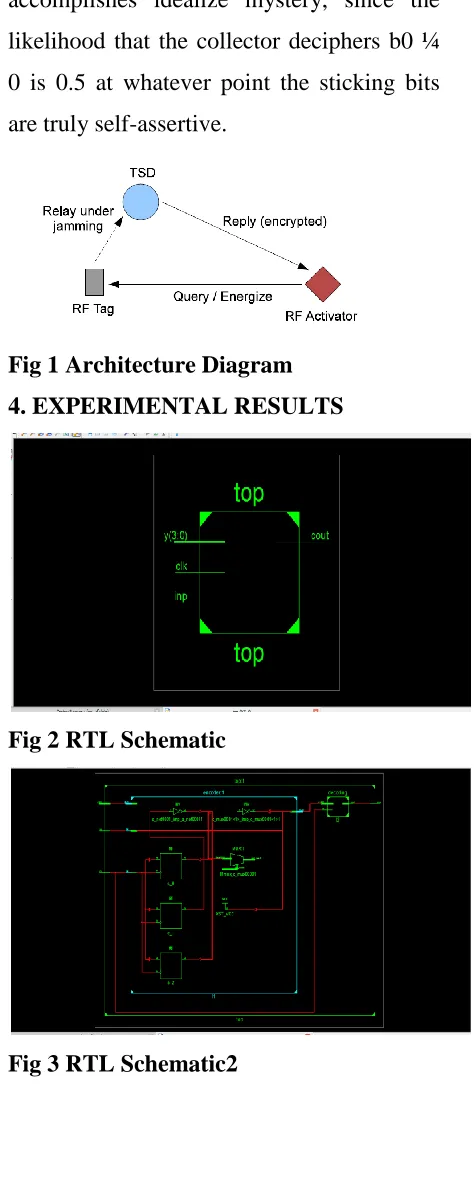
In the customary RFID framework, a RF
peruser has two segments, a transmitter (i.e.,
inquiry transmission/invigorating labels) and
observing a label's answer) as where a
precious stone speaks to the transmission
capacity of a peruser, a circle speaks to the
mindfully aurally seeing capacity of a
peruser, and a rectangle speaks to a tag. The
correspondence scope of the rearward
channel is substantially shorter than that of
the forward channel, and subsequently
perusers must be conveyed predicated on the
short-run rearward channel to get to all
labels in the district A current report
proposes Distributed RF Sensing model that
utilizes two sorts of contraptions (a solitary
RF transmitter and various RF audience
members). The model adds to cost lessening
of RFID framework organization. The
conventional RFID framework requires nine
transmitters and nine audience members,
while the appropriated RFID framework
requires one transmitter and nine audience
members.
2.2Proposed System
In this paper, we present an early coding
plan, to be specific aimless flipping
self-assertive sticking, for the rearward channel
rampart. A tag will send encoded
information (i.e., pseudo IDs) to a TSD
under the sticking condition. This hinders
foes from latent assaults, i.e., the random
guessing assaults, relationship assaults, and
listening stealthily. As we will indicate later,
the RFRJ coding plan learns that enemies
can't interpret the perfect label's ID from
deficient information because of sticking
while the TSD prosperously recovers the
information from blemished data. A TSD is
thoughtfully much the same as the trusted
covering invention in and a medicinal
creation shield executed in , however unique
in the accompanying capacities.
3. IMPLEMENTATION
3. 1 Physical Layer Security
Sticking is generally used for secure
interchanges at the physical layer level, in
which sticking signs degenerate accepting
signs. But this assigns a honest to goodness
beneficiary can't decipher got motions
because of sticking, the full-duplex method
of remote radio wires authorizes the
recipient to at the same time transmit
sticking signs and get information. This
should be possible by repealing
self-obstruction, in which transmitting signals
hinder accepting signs. As per , the present
execution can cancel self-impedance up to
45 dB crosswise over 40 MHz. Therefore,
with sticking procedures, a meddler can't
purloin interchanges unless it is in nearness
to a sticking source hub. It is kenned that
shared mysteries by debasing the flag at a
spy in respect to that at the honest to
goodness collector . In this manner, sticking
is a physical layer security method apt to
remote sensor systems where
encryption-predicated security frameworks are not
viable because of the puissance
requirements of sensor hubs.
3.2 Bit Level Jamming Models
Give b a chance to be a source bit, bj be a
sticking piece, and b0 be the result of
remotely b transmitted under sticking bj. In ,
sticking channel models are sorted as takes
after. Probabilistic flipping model—
regardless of what esteem bj has, the source
bit b flips with the likelihood pj, i.e., P½b0
6¼ b ¼ pj. What's more, channel display—
The beneficiary will decipher b0 ¼ 1 when
either b or bj is 1. Something else, b0 ¼ 0.
XOR channel demonstrate—The collector
will disentangle b0 ¼ 1 when b 6¼ bj.
Something else, b0 ¼ 0. It is kenned that
onetime cushion in this model can
accomplish consummate mystery if the
sticking bits are genuinely irregular in.
General model—In this model, P½b0 ¼ 0jb
¼ 0; bj ¼ 0 þ P½b0 ¼ 0jb ¼ 0; bj ¼ 1 ¼ 1
and P½b0 ¼ 0jb ¼ 1; bj ¼ 0 þ P½b0 ¼ 0jb
¼ 1; bj ¼ 1 ¼ 1. The likelihood that b0 ¼ 1
is homogeneous. This sticking model
accomplishes idealize mystery, since the
likelihood that the collector deciphers b0 ¼
0 is 0.5 at whatever point the sticking bits
are truly self-assertive.
Fig 1 Architecture Diagram
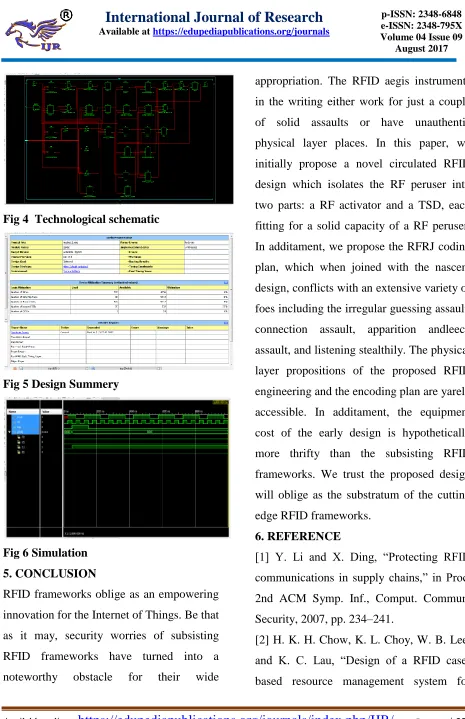
4. EXPERIMENTAL RESULTS
Fig 2 RTL Schematic
Fig 4 Technological schematic
Fig 5 Design Summery
Fig 6 Simulation
5. CONCLUSION
RFID frameworks oblige as an empowering
innovation for the Internet of Things. Be that
as it may, security worries of subsisting
RFID frameworks have turned into a
noteworthy obstacle for their wide
appropriation. The RFID aegis instruments
in the writing either work for just a couple
of solid assaults or have unauthentic
physical layer places. In this paper, we
initially propose a novel circulated RFID
design which isolates the RF peruser into
two parts: a RF activator and a TSD, each
fitting for a solid capacity of a RF peruser.
In additament, we propose the RFRJ coding
plan, which when joined with the nascent
design, conflicts with an extensive variety of
foes including the irregular guessing assault,
connection assault, apparition andleech
assault, and listening stealthily. The physical
layer propositions of the proposed RFID
engineering and the encoding plan are yarely
accessible. In additament, the equipment
cost of the early design is hypothetically
more thrifty than the subsisting RFID
frameworks. We trust the proposed design
will oblige as the substratum of the cutting
edge RFID frameworks.
6. REFERENCE
[1] Y. Li and X. Ding, “Protecting RFID
communications in supply chains,” in Proc.
2nd ACM Symp. Inf., Comput. Commun.
Security, 2007, pp. 234–241.
[2] H. K. H. Chow, K. L. Choy, W. B. Lee,
and K. C. Lau, “Design of a RFID
warehouse operations,” Expert Syst. Appl.,
vol. 30, no. 4, pp. 561–576, Feb. 2006.
[3] A. Juels,“RFID security and privacy: A
research survey,” IEEE J. Sel. Areas
Commun., vol. 24, no. 2, pp. 381–394,
2006.
[4] W. Choi, M. Yoon, and B.-h. Roh,
“Backward channel protection based on
randomized tree-walking algorithm and its
analysis for securing RFID tag information
and privacy,” IEICE Trans., vol. 91-B, no. 1,
pp. 172–182, 2008.
[5] T.-L. Lim, T. Li, and S.-L. Yeo,
“Randomized bit encoding for stronger
backward channel protection in RFID
systems,” in Proc. IEEE 6th Annu. Int. Conf.
Pervasive Comput. Commun.,
2008, pp. 40–49.
[6] K. Sakai, W.-S. Ku, R. Zimmermann,
and M.-T. Sun, “Dynamic bit encoding for
privacy protection against correlation attacks
in RFID backward channel,” IEEE Trans.
Comput., vol. 62, no. 1, pp. 112–123, Jan.
2013.
[7] L. Sang, “Designing physical primitives
for secure communication in wireless sensor
networks,” Ph.D. dissertation, Department
of Computer Science and Engineering, The
Ohio State University, 2010.
[8] M. Jain, J. L. Choi, T. M. Kim, D.
Bharadia, S. Seth, K. Srinivasan, P. Levis, S.
Katti, and P. Sinha, “Practical, real-time, full
duplex wireless,” in Proc. 17th Annu. Int.
Conf. Mobile Comput. Netw., 2011, pp.
301–312.
[9] A. D. Wyner,“The wire-tap channel,”
Bell Syst Tech. J., vol. 54, no. 8, pp. 1355–
1387, 1975.
[10] S. Gollakota, H. Hassanieh, B.
Ransford, D. Katabi, and K. Fu, “They can
hear your heartbeats: Non-invasive
securityfor implantable medical devices,”in
Proc.ACMSIGCOMMConf., 2011, pp. 2–
13.
AUTHOR-1
Dasari.Ramesh received his B.Tech in
Electronics and Communication
Engineering,and M.tech in Systems and
Signal Processing from the Dr.Paul Raj
Engineering College and Adams
Engineering College,JNTUH University in
Ph.D in Signal Processing in KL
University,Vijayawada.
In 2006 he joined in the Department of
Electronics and Communication
Engineering ,Adams Engineering
College,Palvancha,Khammam as an
Assistant Professor,presently he is working
as an Associate Professor in the Department
of Electronics and Communication
Engineering ,Medha Institute of Science and
Technology for Women,JNTUH
University,Khammam.
AUTHOR-2
Sarika Parvathi bearing Roll no
156C1D6816 in VLSI & Embedded
Systems branch
in Medha Institute Of Science And
Technology For Women
Mail id : [email protected]
AUTHOR-3
Boggarapu Kantha Rao, HOD & Assoc Prof,
Medha Institute Of Science & Technology
For Women,Khammam, B.KANTHA RAO
received his B.Tech degree in Electronics
And Communication Engineering from
Adams Engineering
College,Paloncha,JNTUH in 2006 and
M.Tech in EMBEDDED SYSTEMS from
Anurag Engineering College,kodad, JNTUH
in 2011,is a faculty member in the
Department of Electronics And
Communication Engineering, Medha
Institute Of Science& Technology For
Women, Khammam and presently working
as Associate Professor. His research
interests include Embedded Systems, VLSI