A Survey on Strategic Issues in Cloud Computing Adoption
Venkateswarlu Maniniti
Department of computer Science and Engineering Kurnool, AP, India
Abstract—The advent of cloud computing in recent years has sparked an interest from different organizations, institutions and users to take advantage of web applications. Cloud Computing is a paradigm shift in IT services delivery. This shift promises large gains in agility, efficiency and flexibility at a time when demands on data centers are growing exponentially. This is a result of the new economic model for the Information Technology (IT) department that cloud computing promises. The model promises a shift from an organization required to invest heavily for limited IT resources that are internally managed, to a model where the organization can buy or rent resources that are managed by a cloud provider, and pay per use. Cloud computing also promises scalability of resources and on-demand availability of resources.
Although, the adoption of cloud computing promises various benefits to an organization, a successful adoption of cloud computing in an organization requires an understanding of different dynamics and expertise in diverse domains. Currently, there are inadequate guidelines for adopting cloud computing and building trust. Therefore, this research project aims at developing a roadmap called ROCCA (Roadmap for Cloud Computing Adoption), which provides organizations with a number of steps for adopting cloud computing and building trust. An associated framework called ROCCA Achievement Framework (RAF) is also proposed. RAF is a framework that uses the criteria in the ROCCA to build a framework for measuring the adherence level to the proposed roadmap.
This research paper focuses on a range of strategic issues from a broad cross section of areas of
expertise required to ensure a successful cloud computing adoption. It presents in detail the technological factors key to a successful cloud computing adoption, and it introduces the technology underlying cloud computing, and describes different cloud computing delivery and deployment models.
It explains how an emphasis on collaboration between clients and vendor is essential for successful adoption of cloud computing. If the organization feels free, confident and secure to use cloud services then it is more likely that the adoption rate will increase. By following the guidelines outlined, organizations can ensure that their adoption of cloud computing are effective, efficient and provides a high degree of satisfaction. This dissertation also covers cloud computing from a business perspective, ensuring that cloud computing adoption projects are fully costed, and risks are properly understood.
Key words: Adoption, cloud, cloud computing, security, trust, ROCCA,
I. INTRODUCTION
costs. Cloud computing offers its benefits through three types of service or delivery models namely infrastructure-as-a-service (IaaS), platform-as-a-service (PaaS) and software-as-a-Service (SaaS). It also delivers its service through four deployment models namely, public cloud, private cloud, community cloud and hybrid cloud.
II. TRUST AND CHALLENGES IN CLOUD COMPUTING ADOPTION
Cloud computing adoption is faced with a number of challenges, these challenges are: security challenges, legal and compliance challenges and organizational challenges Linked to all these challenges is the issue of trust between clients and vendors, because cloud computing calls for organizations to trust vendors with the management of their IT resources and data.
Trust being a critical factor in cloud computing adoption, this research project will focus specifically in identifying the challenges facing organizations when seeking to adopt cloud computing. Of all the challenges, security has received more mention. This is because “security is both a feeling and a reality. And they are not the same.”
This means that the reality of security is tied to the probability of different risks and how effective are the strategies to mitigate the perceived risks are. Security is also a feeling in that; it is based on the psychological reactions to both the risks and the countermeasures.
Therefore, Cloud computing needs to appeal to both the feelings of the potential customers and address the reality of the risks associated with cloud computing in a way that customers will feel safe and secure to use cloud computing. This is what this project calls building customer trust. That is, the ability of cloud computing to appeal to both the feelings of potential customers and the reality of the security risks of cloud computing in a way that customers will feel safe and secure to use it.
In order to build trust, cloud computing trust models need to be able to address the different challenges that are raised by cloud computing. This address should be as holistic as possible covering the
different aspects of cloud computing. This means the trust model should address the different challenges raised in the different deployment and delivery models and provide a way for both customers and service providers to evaluate the trust level offered. A number of models exists that try to address the challenge in building trust between customer and cloud service providers. These models are the trusted computing platform (TCCP), Private virtual infrastructure, Cloud cube model among others.
III. RESEARCH PROBLEM
Research on the adoption of cloud computing and in particular the building of customer trust is minimal and profuse. Some work has been done on the models of trust and adoption strategies for cloud computing. Security is a topic that is receiving increasing focus as adoption of cloud computing is considered. Industry publication points to the financial benefits of adopting cloud computing and the costs of migrating to cloud computing. There is little published work on the legal and compliance considerations of adopting cloud computing, as well as, the organizational impact that cloud computing will have on the organization.
This research paper attempts to provide a suitable high-level roadmap, which will provide organizations with a strategy for cloud computing adoption project. It discusses the security considerations, legal and compliance considerations, and organizational issues. Adopting cloud computing requires broad knowledge across diverse disciplines. It is useful to have a roadmap of the diverse areas that must be addressed.
In order to explore the trust characteristics of the cloud vendors the following research questions are presented:
Question 1: what are the key barriers to cloud computing adoption?
Question 3: can a roadmap to address the challenges facing cloud-computing adoption and successfully adopt cloud computing be developed?
Moreover, the following hypothesis is put forward: by using the developed roadmap, the CTOs, CIOs will have a better understanding of the key issues involved in cloud computing Adoption and they will have a tool to guide the process for adoption.
Research objectives
The principal aim of this research paper is to investigate the primary strategic issues in adopting cloud computing in an organization. Following on from this research a roadmap will be developed that can be used to guide organizations through the process of successfully adopting or migrating to cloud computing. This roadmap will serve as a guide to the different strategic issues that can help in evaluating, planning and migration to cloud computing. It is seen that the roadmap will be of use to Chief Information Officers (CTO), technical managers and management in general as it will combine both the strategic factors from a number of disciplines, namely security, legal and organizational management.
IV. LITERATUREREVIEW
The advent of cloud computing in recent years has sparked interest from different stakeholders of Information Technology (IT) and Computer science, such as academicians, business organizations, institutions. With its promise of a new economic model for the
Computing/Communication and Information Technology (CIT) department of business organization, cloud computing brings about a shift in the way organization invest in their IT resources. The new economic model removes the need for the organization to invest a substantial sum of money for purchase of limited IT resources that are internally managed, but rather the organization can outsource its IT resource requirements to a cloud computing service provider and pay per use.
This new computing paradigm called cloud computing has also brought challenges to the organization seeking to adopt it. The challenges that are raised are: trust, security, legal, compliance and organizational challenge.
The first attempt at cloud computing were in 1999 when Marc Andreesen founded the
LoudCloud company which was to “build the web’s next power play: custom-designed, infinitely
scalable sites that blast off a virtual assembly line”
(Sheff, 2003). The company intended to be a managed service provider. It was the first company to offer services whichare now called Software as a Service (SaaS) using an Infrastructure as a Service model (IaaS) (Sheff, 2003). The company does not exist today. In 2000 Microsoft launched web services as SaaS offering, followed in 2001 by IBM with their Autonomic Computing Manifesto (Kephart and Chess, 2003, IBM, 2001) and in 2007 collaboration between IBM and Google launched research in cloud computing (Lohr, 2007).
Definition: Cloud Computing
The National Institute of Standards and Technology (NIST) defines cloud computing as “ a model for enabling convenient, on demand network access to a shared pool of configurable computing resources (e.g., network, servers, storage, applications and services) that can be rapidly provisioned and released with minimal management effort or service provider interaction. This cloud model promotes availability and is composed of five essential characteristics and three service models and four deployment models”.
Characteristics
Cloud computing has a number of characteristics that distinguishes it from other computing paradigms. These characteristics can be categorized as essential characteristics and common characteristic. The NIST has identified five essential characteristics (Plummer et al., 2009) and eight common characteristics of cloud computing (Grance, 2010, Mell and Grance, 2009a).The essential characteristics are:
On Demand Self-Service: allows for provisioning of computing resources automatically as needed.
Broad Network Access: access to cloud resources is over the network using standard mechanisms provided through thin or thick clients in a heterogeneous manner. For example through Smartphone’s, mobile phones and laptop computers.
Resource Pooling: the vendors’ resources are capable of being pooled to serve multiple clients using a multi-tenant model, with different physical and virtual resources in a dynamic way. The pooling and assigning of resources is done based on the changing needs of clients or consumers. Example of resources include; computation capabilities, storage and memory.
Rapid Elasticity: allows for rapid capability provisioning, for quick scaling out and scaling in of capabilities. The capability available for provisioning to the client seems to be unlimited and that it can be purchased as demanded.
Measured Service: allows monitoring, control and reporting of usage. It also allows for transparent between the provider and the client.
These characteristics make cloud computing attractive to business organizations and government agencies. The next sub-section looks on the different technologies that underlies cloud computing.
Service/Delivery and Deployment Models
Cloud computing has three delivery or service models and four deployment models that are popular.
Service/delivery models
There are three common service models for offering cloud-computing services. These models are Software-as-a-Service (SaaS), Platform-as-a-Service (PaaS) and Infrastructure-as-a-Platform-as-a-Service (IaaS).
In SaaS the organization outsources everything by renting remotely accessed services via the Internet. The client uses the provider’s applications or software through different client devices via a thin client interface such as a web browser. However, in this delivery model the client does not have control or manage the infrastructure through which the applications are running. Examples of SaaS providers are salesforce.com, NetSuite and Oracle
CRM on Demand.
In IaaS, the service model dedicated resources are offered to a single tenant or client and do not allow sharing of dedicated resources to unknown third parties. The model provides the customer with ability to deploy applications on the cloud infrastructure. The applications may include operating systems and other applications. However, the customer does not have control over the infrastructure but may control the deployed applications and operating systems, storage and selected network components.
Figure 2 shows the cloud taxonomy showing different types of offerings in the different delivery models.
Deployment models
There are four models for cloud computing service deployment, regardless of the service or delivery model (IaaS, PaaS, or SaaS) adopted. These deployment models may have different derivatives,
which may address different specific needs or situations.
The basic deployment models are public cloud, private cloud, community cloud and hybrid cloud.
Public cloud in this deployment the cloud infrastructure is accessible to public and shared in a pay as you go model of payment. The cloud resources are accessible via the internet and the provider is responsible for ensuring the economies of scale and the management of the shared infrastructure. In this model, clients can choose security level they need, and negotiate for service levels (SLA). The first and most used type of this offering is the Amazon Web Services EC2.
Figure 3 shows the structural formation of a public cloud.
In this type of cloud, the organization does not access or use the public cloud, which is accessible to the public.
Private cloud is another deployment model for cloud services. In this model, unknown third parties do not share the cloud resources. The cloud resources in this model may be located within the client organization premises or offsite. In this model, the client’s security and compliance requirements are not affected though this offering does not bring the benefits associated with reduced capital expenditure in IT infrastructure investments.
In this type of cloud the public does not have access to the private cloud neither does the organization use the public cloud.
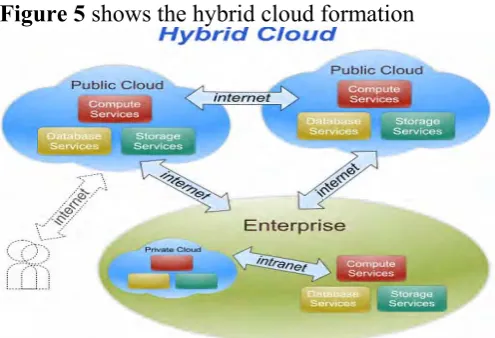
Hybrid cloud as its name implies is a model of deployment, which combines different, clouds for example the private and public clouds. In this model the combined clouds retains their identities but are bound together “by standardized or proprietary technology”.
Figure 5 shows the hybrid cloud formation
In this type of cloud, the public does not have access to the cloud, but the organization uses infrastructure in both the public and private cloud.
Community cloud is the fourth deployment model that can be used to deliver cloud-computing services. In this model, multiple organizations or institutions that have a shared concern or interest such as compliance share the cloud infrastructure
considerations, security requirements. This type of cloud may be managed by the organization or by a third party and may be located on-premises or off-premises.
Figure 6 shows the community cloud.
In this type of cloud both the public and the organizations forming the community cloud have access to the cloud services offered by the community cloud.
Drivers for adoption and benefits of cloud computing
Cloud computing with its different deployment and delivery models offers a number of benefits to businesses.
These benefits are such as economies of scale resulting in low-costs of IT infrastructure, low maintenance costs and low IT administration costs. Other benefits are, improved of performance because of having access to dynamic and scalable computing, memory and storage capabilities based on demand. Cloud computing also offers easier data monitoring, quick incident response, and low costs to undertake security measures. Easier group collaboration, universal access to computing resources and the removal for the need for specific devices or hardware in-house are also benefits that can be accrued from cloud computing.
of loss of business in case of data loss or cloud vendor filing for bankruptcy.
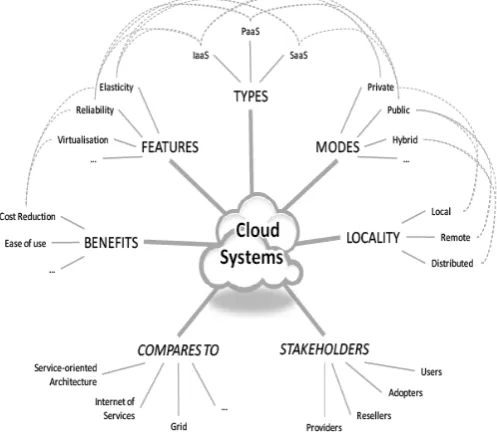
Figure 7 shows a summarized view of the cloud computing system, highlighting its stakeholders, locality of hosting, modes of delivery, types of cloud offering, its features, and benefits.
V. DATAANDMETHODOLOGY Research methodology
Extensive secondary research will be conducted. Acknowledged texts, standards documents, industry periodicals and white papers, analysts’ reports and conference journals will be referenced. A critical analysis of the secondary research is applied in the formulation of the roadmap and framework proposed.
The data for this research is collected from statements about privacy policy, acceptable use policy, terms of use and service level agreements available from the websites of the cloud vendors. In case of any such information missing from the websites, similar information will be sought via internet research of whitepapers, press releases and news articles of cloud computing in different IT magazines.
A set of cloud computing vendors will be chosen based on multiple online resources such as top 10
lists from Forrester research, focus, CIO’s Cloud computing vendors to watch, Top
10 SaaS providers’ awards and scores assigned to vendors.
The research will focus on three categories of cloud computing service models, the vendor size and vendor online traffic to explore the customer trust level of cloud computing vendors. The three cloud computing service models are Infrastructure-as-a-Service (IaaS), Platform-as-a-Infrastructure-as-a-Service (PaaS) and Software-as-a-Service (SaaS).
CLOUD COMPUTING ADOPTION ISSUES SURVEY
In understating of the Adoption Issue and problem from the practitioners point of view is invaluable. In order to achieve this, a survey conducted with the aim of understanding the challenges facing business managers and IT managers in their endeavor of adopting cloud computing. In order to get a proper understanding two types of questionnaire survey conducted. The first questionnaire survey focused on understanding the challenges facing organizations in adopting cloud computing, while the second questionnaire focused on understanding the information assurance practices of cloud vendors based on the results obtained from the first questionnaire survey. The survey undertaken, detailing the survey structure, respondent’s’ profile, their geo-location, mode of conduct and results of the survey. The key findings from the survey.
Audience
For the second survey, which aimed at understanding information assurance practices, vendors were selected based on lists of best performers in the industry from publicly available sources such as CIO.com and focus. The criteria in vendor selection included vendor size, reputation and type of cloud service offered.
The survey was based on two types of questionnaires, with two approaches. The first type of questionnaire focused on identifying the challenges facing cloud adoption as perceived by industry practitioners and was conducted using on-line surveys. The second type of questionnaire focused on understanding the information assurance practices of cloud vendors and was conducted offline.
The online survey was both effective and convenient. It was effective as it broadened the accessibility and reach of respondents, and convenient in that it did not require an immediate response from the respondent. It allowed respondent to fill in the questionnaire at his or her own pace.
For the offline survey, the researchers used publicly available information such as press releases, privacy policies, news articles and terms of service or contract terms in order to understand the information assurance practices of cloud vendors.
Questionnaire design
The first section of the survey questionnaire aimed at understanding the respondent responsibility, nature of their organization, their role in IT decision making, size of their organization and the geographical location.
The second section of the survey questionnaire aimed at understanding the drivers for adoption, perceived appropriate cloud service deployment and delivery model and the type of IT or business processes that organization are willing to outsource to cloud computing.
The third section of the survey aims at understanding the characteristics that are considered key to vendor selection, key concerns for vendor trustworthiness, and barriers to adopting cloud computing.
The offline questionnaire which aim at understanding vendors’ information security assurance in relation to privacy, disaster and business continuity, security practices and standards compliance, legal and compliance practices and SLAs (Service Legal Agreement) management.
Based on the survey analysis, an understanding of how vendors addresses these issues is crucial, as it helps in understanding why organizations are reluctant in adopting cloud computing and whether their perceived dangers of cloud computing are justifiable. These issues have been addressed in the proposed roadmap in the different phases.
RESULTS AND DISCUSSION
Survey results analysis
The findings from the data collected and their findings are presented together with their analysis.
Online questionnaire survey results
In this survey, 50 invitations to participate in the survey were sent. The survey lasted for three weeks, and received 25 responses, with 21 questionnaires fully completed.
For online survey used online survey tool provided
by surveyMonkey.com. This tool was useful to
researchers as it allowed for response collection and provided capabilities for analyzing the results.
The response was high with participants from all over the world, with this response rate, useful information can be obtained.
Respondents by Job title
other IT staff 32%, other IT management staff 4%, other business management staff 4%. The cross section of respondents shows the level of reliability of the results and thus provides for good inputs for the design of the roadmap.
Respondents by role in IT decisions
Based on the role of respondents in IT decision making the results are as follows: Evaluate/recommend vendor or solution 32%, determine IT needs 20% authorize purchase 16%, create IT strategy 16% and other 16%. These results show that the responds are personnel who know what their organizations needed in terms of IT resources, and have positions of influencing the final decisions.
Respondents by nature of organization
The nature of organization was to determine whether the organization was technical based or non-technical. The results obtained are as follows: Non-technical (education sector) 24%, technical (communications) 16%, technical (computer/networking) 16%, non-technical consultancy 8%, non-technical government 8%, technical e-commerce 4%, other technical 8% and other non-technical 12%. The cross section of respondents from different industry increases the reliability of the results. This is because the variety of respondents from different industries removes bias to the survey results output. Respondents by organization size
Base on the organization size the results were as follows: employees between 1-99 (40%),100 – 499 (32%), 500 - 999 (4%), 1000 – 4999 (12%) and above 5000 (12%). These results shows the level of complexity of adopting cloud computing.
Respondents by geo location
The importance of geographical location of a company is crucial in such issues as legal and Compliance The results to this question were: America (USA and Canada)16%, Africa 48%, Europe 32%, Asia 16% and other part of the world 4%.
These responses forms part of the first section of the online questionnaire and relate to issues related to organizational challenges and compliance Issues. The roadmap addresses these issues in its different phases.
The second section of the online survey yielded the following results:
Key drivers for adoption
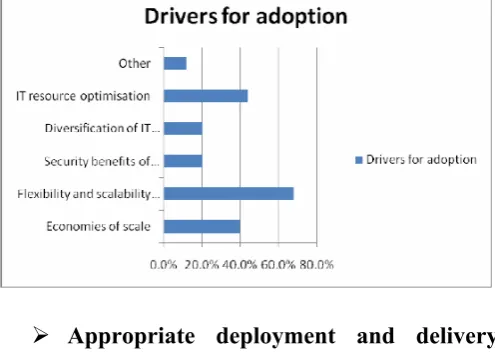
The results for on the different drivers for an organization to consider cloud computing revealed that, the need for flexible IT resources was important with 68%, followed by resource optimization at 44%, economies of scale 40%, security and resource diversification at 20% each and other reason which included back-up and efficiency for mobile and decentralized workforce at 12%. These results show that there is a slight change in the reasons for adoption from costs to the need to increase efficiency and resource optimization when compared to other research results.
Figure 8 shows the summary of the results.
Appropriate deployment and delivery model
The results in this question showed that the most favorable cloud platform was SaaS with 60% followed by PaaS and IaaS with 20% each. These results suggest that organizations are more likely to use cloud applications and software such as CRM (Cloud Reference Model).
For the type of IT and/or business processes that organization are willing to outsource to the cloud the results showed that application development is more likely with 66% of the responses. CRM, sales and marketing and research and development both scored 33.3%, human resource management 19% while other such as e-mail, calendars and file storage had 9.5%. However, in this question out of the 25 responses four questions were skipped. These results coincide with the conclusion drawn from the previous question on the application deployment model for cloud where SaaS received 60% as a favorable platform of choice.
The third section of the survey aimed at understanding the key characteristics for vendor selection, vendor trustworthiness criteria and barriers to cloud adoption. The results for questions in this section were as follows:
Key characteristics for vendor selection
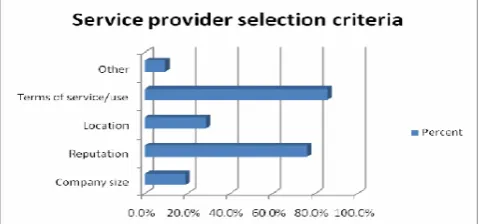
Terms of service received 85.7% as an important criterion for vendor selection. This may be because the terms of service determines a number of issues of concern such as security of applications and data, privacy and SLA. These results also confirm the security concerns as evidenced by our survey results and results from other research. Vendor reputation had 76.2%, vendor location 28.6% and this may be a results of many of the responses were from Africa where data protection legislation are not well developed. Vendors’ size 19% and other which included pricing and privacy issues 9.5%.
Figure 9 shows a summary of results.
Key concerns for vendor trustworthiness
Security practices with 90.5% was considered a very important aspect in determining trustworthiness, vendor reputation and terms of service had 47.6% each, compliance 42.9% information assurance practices 38.1% and other 4.8%.
Figure 10 summarizes the results.
Indicators of vendors’ trustworthiness
Security practices of the vendor and business continuity and disaster recovery had 71.4%, each followed by reputation at 57.1%, compliance 38.1% and other which included contract and terms of service at 9.5%.
Figure 11 shows a summary of results.
Barriers to cloud adoption
Security concerns top the list with 71.4% followed by integration issues with 61.9%, regulatory and compliance and governance issues 42.9%, availability and performance 28.6% and other 4.8%.
71.4%, IDC 87.5% (IDC, 2009), SAVVIS 52% (SAVVIS, 2010).
These results support the findings, which have identified a number of security issues facing organization in cloud adoption. As for the reason to adopting cloud computing this survey have found that scalability and flexibility of resources are key.
Figure 12 shows a summary of results.
Off line questionnaire survey results
In this survey, thirteen different cloud service providers were selected from the publicly available lists of best performers. The survey used publicly available information such as privacy policies of the service providers, press releases in order to understand the information assurance practices of the service providers. The survey focused on privacy, disaster recovery and business continuity, security practices, legal and compliance and SLA management.
Table 1 shows a summary of cloud service providers and the platform of their cloud offering.
Service Provider Company
Size Platform Type
Microsoft SQL Azure
Large IaaS
Google Docs Large SaaS
Google Apps Engine
Large PaaS
Amazon Large SaaS
Salesforce.com Large SaaS
Microsoft office live Large SaaS
Oracle Large PaaS
Accenture Large PaaS
Rackspace Small PaaS
Cloud9Analytics Small SaaS
Cloud works Small IaaS
Go grid Medium PaaS
The data collected from this offline survey of policy statements, press releases and other relevant documents including publicly available information from external sources, have shown the following:
Privacy: From the survey findings, PaaS service providers puts comparatively not as much of emphasis on privacy as IaaS and SaaS service providers. This finding suggests that, most of the organizations that are involved with processing of individual data or personal information prefer cloud offering that assures them of full control of the infrastructure. This means that for such organizations PaaS and IaaS offer options that are more suitable. Another finding is that most of the SaaS services offer their services to individual customers’; as a result, this imposes a responsibility of ensuring privacy of the individuals and their data.
Security practices and business integrity: Findings in this category reveal that, as the cloud services goes high up the stack from IaaS to SaaS, emphasis on security and business integrity decreases. This may be due to lack of agreed upon cloud standards, lack of portability and interoperability. Another reason may be the potential of application lock-in. However, service providers make security a priority in their information and tend to offer business integrity as a benefit service.
started to have their services certified as exemplified by salesforce.com.
SLA management: In SLA management, most of the service providers promise 99.9% availability in their policy statements. However, in these policy statements they make it clear that if things go wrong they will only pay back the customer a certain amount of money for the failure to meet the SLA.
The findings in this survey confirms the perceived reluctance of organization in adopting cloud computing. The findings show that most of the vendors do not provide for adequate security and compliance services that meet user or client’s requirements. The roadmap addresses these issues by encouraging collaboration between client and vendor in the whole process of cloud adoption.
Summary of findings
A summary of findings from the survey both the online and offline surveys have revealed a number of interesting facts. For example, depending on the nature of the respondent job and nature of the organizations, it was discovered that these two factors have effect on how the person perceives cloud computing, its drivers for adoption, barriers and trust issues.
Respondents profile
The respondents for the online survey were from both technical and non-technical job roles and organizations. A summary of this is given in table 2. This table shows the different types of respondents and the nature of their job titles and organizations.
Table 2 Respondent Profile Nature of
Job Nature Organizationof Response count
Percentage
IT
Management
Technical
IT
Management Technical
n-
Business
Management Technical
Business
Management Technical
n-
Total
Drivers for adoption
Findings from our research have revealed that, most of the organizations that have adopted cloud computing are currently using cloud services at upper stack of the platform as compared to the lower stack. However, majority of cloud services are still individuals as opposed to organizations. The biggest driver for cloud adoption for most organization has been found to be the need for flexible and scalable IT resources, followed by the need for resource optimization. The findings suggest that costs is not the biggest drive by itself but rather through the other benefits of adopting cloud computing costs may be reduced.
Barriers to adoption
The research findings have shown that personnel with technical understanding of technology as well as those without all consider security to be the most significant factor in cloud adoption. This may be due to the emphasis placed on security by technical personnel in the organization infrastructure as well as the security awareness programs and trainings. The second most important barrier identified was integration issues with existing systems and application. This was more a concern for organizations that were not technical in nature.
Trust
The findings on this issues as it relates to cloud adoption found that security practices and disaster recovery and business continuity were important from both technical and nontechnical organization and personnel.
of customer and service provider collaboration has been addressed and is emphasized in the roadmap. The last question concerned itself with identifying how organization can address the challenges facing cloud adoption and how to successfully adopt cloud computing. The answer to this question is the proposed roadmap. It was also, hypothesized that by the use of the proposed roadmap technical managers as well as business managers will have a better understanding of the key issues involved in cloud computing and a tool to guide the process of adopting cloud computing.
VI. ROADMAPANDEVALUATIONFRAMEWORK This roadmap integrates the critical issues into a roadmap for successful cloud computing adoption project. Managers can use this roadmap to address strategic issues at each stage of the project lifecycle. The roadmap is called ROCCA (Roadmap for Cloud Computing Adoption). Also included is the ROCCA Achievement Framework (RAF), it establishes the level of adherence to the proposals in the roadmap.
ROCCA (Roadmap for Cloud Computing Adoption)
The Fig. 13 shows the proposed cloud computing adoption roadmap. The roadmap proposes five (5) phases in the adoption of cloud computing project. These are: analysis, planning, adoption, migration and management.
The framework works as follows: in the analysis phase, the analysts works with users and conducts an analysis of the existing systems, applications and business processes, by using tools such as SWOT analysis, PESTLE analysis in order to ascertain the directions, an analysis of security, legal and
compliance issues, usability and accessibility issues, and analysis of impact to organization structure, and culture is done. This phase identifies the strengths and weakness of the existing systems, applications and business process, the impact of moving to cloud and identifies possible candidates for migration to cloud. The planning phase deals with benchmarking, choosing the platforms for deployment, the cloud infrastructure, finance plan, security, legal and compliance plan and the roll-out plan for the adoption project. This phase sets the objectives and the direction for the adoption of cloud computing. In the adoption phase the analyst and the project team works on application integration with cloud platforms and infrastructure, outsourcing strategies, works on SLAs, customer service management, security policies, legal and compliance management and a contract with vendor is developed and signed. This phase sets the stage for migration of the selected applications and systems to the cloud.
The migration phase ensures that application and data migration are carried out as specified in the rollout plan, which was developed in the planning phase. The phase also ensures the availability of users support in the whole process of migrating to the cloud and monitors and control the migration. In the last phase, that is management phase the project team works to ensure contracts are properly managed and that the project is signed off. Best practices and lessons learnt are documented, technical support is ensured for continual support of the systems and users and a review of the whole project is done. This roadmap is generic therefore can be applied to the Domain of cloud computing.
Table 3 provides a generalized summary of the main challenges that have been identified and where in the roadmap they are addresses.
Challenge Phase
Trust Analysis, Planning and migration, Adoption Security Analysis, Planning,
Migration Legal and
Compliance
Organizational Analysis, Planning, Migration and Adoption RAF (ROCCA Achievement Framework)
ROCCA provided a high-level roadmap for cloud
computing adoption project. This section proposes a framework, which can be used to establish achievement level based on the proposed roadmap. Therefore, the framework will be referred to as ROCCA achievement framework (RAF). The primary objective of the framework is as a tool for analyzing projects carried out based on the roadmap. The use of the framework should be helpful in determining how closely the roadmap was followed in adopting cloud computing. As the roadmap is based on research into challenges and best practices in adopting cloud computing, a project with high scores in the framework is more likely to succeed.
The framework is divided into five sections, corresponding to the five phases of the cloud computing adoption roadmap. Each section contains a series of questions, which should be answered on a scale of 1 to 5. indicates an unfavorable response to the question and 5 a strongly favorable response. Each response is then multiplied by a specific project-weighing factor. The weights to be applied are decided upon in advance by the project management team. Different projects may have different weights based on the perceived impacts of the response to the overall projects’ success. For example, SLA might have a lower weighting than compliance for a non-critical application. However if the application is critical SLA might be rated higher.
However, leaving this weighting process to project teams lead to the problem of possible subjectivity in assigning weights. However, based on this research findings from its literature review (chapters 2 to 5) and survey results, it is suggested that all questions related to security, legal and compliance be given a weight not less than .8 and a maximum of 1. Those related to requirements understanding a weighting not less than .5, system performance .7, finance .7 and SLAs .6. The various sections of RAF framework are outlined in tables 4 to 8.
Table 4: RAF - Analysis phase
Table 5: RAF - Planning phase
Table 6: RAF - Adoption phase
Table 6: RAF - Migration phase
Weighted totals from table 4 to table 7 are used as input score to table 8. This table provides a means for weighing each phase based on the phase impact on the overall projects’ success. The weights for each phase should be determined in advance by the project management team based on the overall impact of the phase to the particular project.
Table 8: RAF - Project phase totals
VII. CONCLUSION
This paper proposed ROCCA (Roadmap for Cloud Computing Adoption) and RAF (ROCCA Achievement Framework). ROCCA proposes a five-phase process. In the analysis phase strengths and weaknesses, opportunities and threats to organizations systems, applications and business process are identifies, legal, security and compliances policies and risks are identified, usability and accessibility risks and impact of moving out cloud to the organization culture, politics and structure are analyzed. The monetary implications of moving to the cloud are assessed and candidate applications and or systems are identified. In the planning phase, benchmarks are set for the project, the cloud infrastructure and
platform are selected, the financing plan is developed, security, legal and compliance plan is developed and the rollout plan for adoption is created.
The adoption phase ensures application and systems integration with selected cloud platform and infrastructure for candidate systems and applications, outsourcing strategy are developed and put in place, SLA and policies for cloud service use are developed and put in place, the contact with cloud vendor is developed and agreed upon. In the migration phase the roll-out plan is reviewed and implemented, application and system migration to cloud is carried out, support channels are created and support is offered to users during the migration phase, monitoring and control of the migration of data and application is conducted to ensure success. The management phase ensure project sign-off, contract management with vendor, documents best practices and lessons learnt, technical support management and training of users, also review of the project is conducted as this is an on-going phase of the project after the actual migration.
The ROCCA achievement framework’s (RAF) goal is as a tool for analyzing the success of cloud computing adoption project based on the proposed roadmap. By using the framework, project managers should be able to establish how closely the roadmap was followed. Based on the framework a project with high scores has a higher probability of success.
The framework has been divided into five phases of cloud computing adoption project. Each section is composed of a series of questions, with their corresponding weights. The weights to be applied are to be decided by the project management team in advance based on the perceived impact of the phase on the overall project success. Different projects will have to weigh each of these weights differently.
minimizing risks and increasing the probability of projects’ success.
REFERENCES
[1] Alcalde, B., Dubois, E., et al. (2009) Towards a decision model based on trust and security risk management. Information Security 2009, 61.
[2] Andert, D., Wakefield, R., et al. (2002) Trust Modeling for Security Architecture. Santa Clara, CA, Sun Microsystems, INC.
[3] Artz, D. & Gil, Y. (2007) A survey of trust in computer science and the Semantic Web. Journal of Web Semantics, 5,
58-71.
[4] Armbrust M., Fox A., Griffith R., Joseph A., Katz R., Konwinski A.,Lee G., Patterson D., Rabkin A, Stoica I, and Zaharia M. (2010) A view of Cloud Computing, Commun. ACM 53, 4, 50-58.
[5] Armbrust, M., Fox, A., et al. (2009): Above the clouds: A berkeley view of cloud computing [Technical Report]; University of California, Berkeley;
[6] Audun, J., Sang, et al. (2007) A survey of trust and reputation systems for online service provision. Decis. Support Syst., 43, 618-644.
[7] Bhattacharjee, R. (2009) An Analysis of the Cloud Computing Platform. System Design and Managemet. Massachussets, Massachussets Institute of Technology.
[8] Bisong A, Rahman S An Overview of the Security Concerns in Enterprise Cloud Computing. Journal-ref: International Journal of Network Security & Its Applications (IJNSA), Vol.3, No.1, January 2011.
[9] Bragg, R. (2008) Cloud Computing: When computers really rule. Tech News World.12/12/2009 12/12/2009.
[10] BSI (2008) BS ISO/IEC 27005:2008: Information Technology. Security Techniques. Information Security Risk Management. British Standards Institution.
[11] Chellapa, R. (1997) Intermediaries in Cloud-Computing: A new Computing Paradigm. Cluster:Electronic Commerce. [12] CSA (2009) Security Guidance for Critical Areas of Focus in Cloud Computing V2.1.Cloud Security Alliance [13] Doherty, E., Carcary, M. And Conway, G. (2012) Risk Management Considerations in Cloud Computing Adoption. [14] ENISA (2009) Cloud computing: Benefits, Risks and Recommendations for Information Security, produced by
ENISA (European Network and Information Security Agency).
[15] FORBES (2010) Seeding the Cloud: Enterprises Set Their Strategies for Cloud Computing [Whitepaper]. Forbes. [16] Frank, G. (2008). Defining Cloud Services and Cloud Computing. IDCExchange, retrieved on the 1st of March, 2014, available from http://blogs.idc.com/ie/?p=190.
[17] Greenwood, D., Khajeh-Hosseini, A., et al. (2010) The Cloud Adoption Toolkit: Addressing the Challenges of Cloud Adoption in Enterprise. Arxiv preprint arXiv:1003.3866. [18] Keene, C., Poddar, I., et al. (2009) Cloud Quick Start: A Roadmap For Adopting Cloud Computing [White paper]. IBM.
[19] Leimeister S, Riedl, K., Krcmar H; 2010. The Business Perspectives of Cloud [15] Computing: Actors, Roles and Value Networks”, Proceedings of 18th European Conference on Information Systems (ECIS), 2010.
[20] Miller, M. (2008) Cloud Computing: Web-Based Applications That Change the way You Work and Collaborate, Que Publishers.
[21] Motahari-Nezhad, H.R., Stephenson, B., And Singhal. S. 2009. “Outsourcing Business to Cloud Computing Services: Opportunities and Challenges”, Technical Report HPL-2009-23, January.
[22] Ogozaly, R. (2014). Business Continuity and Workload Mobility for Private Cloud. CISCO blog on Data Center and Cloud. Retrieved on the 12th of July, 2014, available from
http://blogs.cisco.com/datacenter/business-continuity-and-workload-mobility-for-private-cloud-cvd-part2/
[23] Santos, N., Gummadi, K. P., et al. (2009) Towards Trusted Cloud Computing. Max Planc Institute for Software Systems
[24]Wikipedia, “Cloud Computing”
http://en.wikipedia.org/wiki/Cloud_computing