AN ANALYSIS ON ATTRIBUTE BASED
ENCRYPTION FOR SECURE DATA RETRIEVAL IN
DTNS
Dhiren Kumar Dalai
1, P. Elumalaivasan
2, Sreejith V. P.
3 1, 2, 3Department of Computer Science and Engineering, Anna University, (India)
ABSTRACT
Secure data retrieval plays vital role in all communication environments. To communicate between nodes in the
network data should transfer and any one can retrieve it securely. Disruption- tolerant network (DTN)
technologies are considered to be the successful solutions, allow nodes to communicate with each other in the
extreme networking environments. It implements store and forward scheme by using external storage nodes.
Since the data is sensitive that one needs to consider the security policies of cryptographic solution like data
encryption techniques. Here we talk over several encryption techniques for access control and secure data
retrieval in DTNs environments.
Index Terms
:
Disruption Tolerant Networking (DTN), Node Location, Access Control, Attribute
Based Encryption (ABE) Secure Data Retrieval, Encryption, Security.
I. INTRODUCTION
Now days many computing devices e.g. PDAs, smart-phones, sensors have wireless interfaces and hence can
form ad hoc networks. Wireless adhoc networks allow nodes to communicate with one another without relying
on any fixed infrastructure. These rapidly deployable networks are very useful in several scenarios e.g. Military
network environments, connections of wireless devices carried by soldiers may be temporarily disconnected by
environmental factors, jamming and mobility, especially when they operate in terrestrial environments.
Disruption- tolerant network (DTN) technologies are becoming successful solutions that allow nodes to
communicate with each other in these extreme terrestrial environments. Typically, when there is no end-to-end
connection between a source and a destination pair, the messages from the source node may need to wait in the
intermediate nodes for a substantial amount of time until the connection would be eventually established.For
storage and replicate the data storage node is introduced where authorized mobile nodes can access the
necessary information quickly. Many military applications require increased protection of confidential data
including access control methods that are cryptographically enforced. In many cases, it is desirable to provide
differentiated access services.
In a network communication between two hosts should be encrypted to enhance security. There are different
types of encryption algorithms used for transferring the data securely.
II. ENCRYPTION TECHNIQUES
Encryption is that the method of coding messages in a way that solely licensed parties will read it. Encoding
encrypted to a cipher text. The encryption is done by encryption algorithm. The cipher text is decrypted to get
the plaintext. The encryption algorithm generates key for encrypting the plaintext. The receiver who has the key
is called authorized one, so they can able to decrypt the cipher text. Unauthorized person who does not have the
key cannot able to decrypt the text. Encryption is used for data protecting while transferring.
2.1 Encryption Types
2.1.1 Symmetric Key Encryption
For both encryption and decryption same keys are used in symmetric key encryption. It is secure if both keys are
the same. The message can be decrypted if the unauthorized person knows the key. The problem here is
management of keys, transforming the keys securely not the messages. Keys are generated before the message
because it is smaller than the messages. Private key encryption is shown in Fig 1.
Figure 1 Symmetric Key Encryption
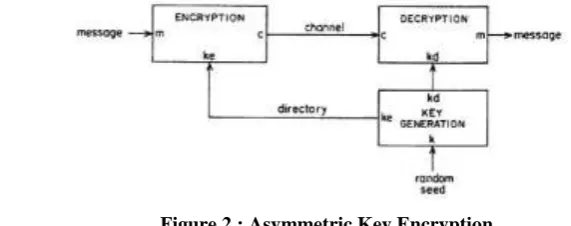
2.1.2 Asymmetric Key Encryption
For both encryption and decryption different keys are used. Hence the key management problem is overcome.
Both the keys are sufficient for encrypting and decrypting the message. A pair of key is used; one key for
encrypting and other is for decrypting the message. Private/Public key is used encrypting/decrypting message
and shown in Fig. 2.
Figure 2 : Asymmetric Key Encryption
III. ASYMMETRIC KEY ENCRYPTION
It is also known as public key encryption algorithm. The use of public key cryptography is public key
encryption. Based on the public key encryption there are many algorithms for transferring the message securely.
The security in public key encryption is confidentiality, the sender encrypts the message using receiver public
key and it is decrypted only by the receiver paired private key.
3.1 Identity Based Encryption Algorithm
Shamir [13] and Boneh et al. [11] introduces Identity-Based Encryption (IBE) with an efficient determinable
bilinear map. Halevi et al. [12] put forward IBE in a random oracle representation. The efficiency is increased
by the two schemes in outside random oracles that were proposed by Boyen et al. [10]. Sahai et al. [4]
descriptive attributes is viewed as an identity in Fuzzy IBE. It is used for application like Biometric identities in
IBE and attribute-based encryption. They proposed error tolerance between the identities of keys that are used
for encryption. In IBE there are few problems. If attributes come from multiple authorities, the
Fuzzy-IBE is possible or not.
Figure 3 Identity Based Encryption
Identity-based encryption was to simplify certificate management in e-mail systems. When Alice sends mail to
Bob at [email protected] she simply encrypts her message using the public key string “[email protected]”. There is no need for Alice to obtain Bob’s public key certificate. When Bob receives the encrypted mail he
contacts a third party, which we call the Private Key Generator (PKG). Bob authenticates himself to the PKG in
the same way he would authenticate himself to a CA and obtains his private key from the PKG. Bob can then
read his e-mail. Note that unlike the existing secure e-mail infrastructure, Alice can send encrypted mail to Bob
even if Bob has not yet setup his public key certificate. Also note that key escrow is inherent in identity-based
e-mail systems: the PKG knows Bob’s private key.
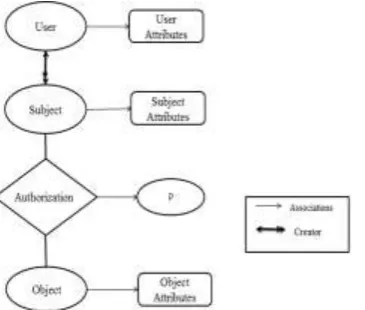
Figure 4 Overview of ABE based access control model
3.2 Attribute-Based Encryption
Attribute-based encryption (ABE) is a relatively recent approach that reconsiders the concept of public-key
cryptography. In traditional public-key cryptography, a message is encrypted for a specific receiver using the
receiver’s public-key. Identity-based cryptography and in particular identity-based encryption (IBE) changed the
traditional understanding of public-key cryptography by allowing the public-key to be an arbitrary string, e.g.,
the email address of the receiver. ABE goes one step further and defines the identity not atomic but as a set of
attributes, e.g., roles, and messages can be encrypted with respect to subsets of attributes (key-policy ABE -
KP-ABE) or policies defined over a set of attributes (ciphertext-policy ABE - CP-KP-ABE). The key issue is that
someone should only be able to decrypt a ciphertext if the person holds a key for "matching attributes" (more
Sahai et al. [4] proposed Attribute-Based Encryption (ABE) in Fuzzy IBE. The secret key is based on a set of
attributes. While decryption the set of attributes must match cipher text attributes.ABE has two types:
Key-Policy ABE (KP-ABE), Cipher text-Key-Policy ABE (CP-ABE). In Key-Key-Policy ABE [5], the cipher text is encrypted
with the attribute set. For decrypting, the policy is chosen by the key authorities. Fig -3: represents the
schematic representation of Attribute-Based Encryption [14]. Based on the attributes the signature of
information takes place. 3.2.1 Mediated Cipher Text-Policy Attribute-Based Encryption
Ibraimi et al. [2] proposed mediated Cipher text-Policy Attribute-Based Encryption (mCP-ABE) based on
mediated cryptography. It is an extension of CP-ABE with rapid attribute revocation. The cipher text is
decrypted by the user only if the access policy is satisfied by the attribute set of schemes in outside random
oracles that were proposed by Boyen et al. [10]. Sahai et al. [4] introduces different type of Identity-Based
Encryption (IBE) called Fuzzy Identity-Based Encryption. A set of descriptive attributes is viewed as an identity
in Fuzzy IBE. It is used for application like Biometric identities in IBE and attribute-based encryption. They
proposed error tolerance between the identities of keys that are used for encryption. In Fuzzy-IBE there are few
problems. If attributes come from multiple authorities, the Fuzzy-IBE is possible or not.
3.2.2 Multi Authority Attribute-Based Encryption
Chase [9] proposed Multi authority Attribute-Based Encryption in a fine grained access control ABE. They
proposed schemes that permit polynomial number of individual authorities and accepts the random number of
dishonest authorities. Later Lewko et al. [3] present this algorithm in new version. The authority can be anyone
and it doesn’t require any coordination between authorities. It doesn’t need a central authority. The algorithm is
scalable by preventing the occurrence incurred by depending on central authority. In addition to scalable,
efficiency and security is also enhanced.
3.2.3 Attribute-Based Encryption with Non-Monotonic Access Structures
Attribute-Based Encryption with Non-Monotonic Access Structures was introduced by Waters et al. [7]. In an
attribute the private key of users can be articulated by any access rule. Earlier ABE algorithms uses only
monotonic access structure, this limitation is overcome by this algorithm. While conserving collusion resistance
structure they encounter challenges because of the negation method.
3.2.4 Bounded Cipher Text-Policy Attribute Based Encryption
Goyal et al. [8] proposed Bounded Cipher text-Policy Attribute Based Encryption, having a security proof based
on a number theoretic assumption. It encourages the access policy signified by bounded size access construction
along with the nodes having threshold gates. With certain variations it supports non-monotone access structure.
3.2.5 Cipher Text-Policy Attribute Based Encryption
Cipher text-Policy Attribute Based Encryption (CP-ABE) was introduced by Bethencourt et al. [6] .CP-ABE is
encrypted data for complex access control in a system. The set of attributes provide the private key for users.
The policies are specified by the party who is encrypting data over the attributes that specifies which user can
able to decrypt. This algorithm keeps the encrypted data as confidential and secure opposed to collusion
resistance. This algorithm allows any monotone access structure, single authority and periodic attribute
revocation. Key escrow is not addressed. To overcome the limitations of previous CP-ABE are overcome and it
different authorities are solved using this algorithm. The inherent key escrow problem is resolved such that the
confidentiality of the stored data is guaranteed where key authorities may be compromised. For each attribute
group the fine-grained key revocation should be done. The components of a partial personalized and attribute
key to a user issued by the local authority, by performing secure 2PC protocol with the central authority. The
user attribute key can be updated individually and immediately. Thus, the scalability and security can be
enhanced.
3.2.6 Trust based Cipher Text-Policy Attribute Based Encryption
Secure data retrieval scheme is needed for using CP-ABE for decentralized DTNs where multiple key
authorities manage their attributes independently. But the main drawback is that the updating of attributes is not
so efficient and high complexity. In order to overcome the above cited problems here proposing a new technique
Trust based CP-ABE [15], for reducing complexity and also to improve the security in DTN. Here data
encryption and decryption implemented by elliptical curve digital signature algorithm and for key generation we
used Diffie–Hellman key generation method. In addition to that the geographical routing is also used for
finding the location of the nodes. In this method, each node analyzes other neighbour nodes, which are located
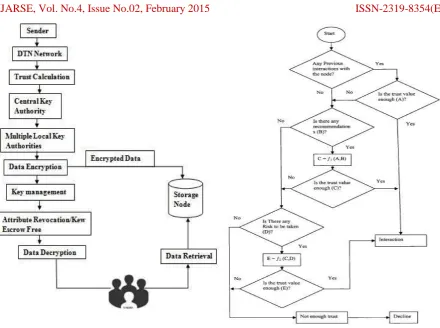
in the same subtask group. The trust based CP-ABE is shown in Fig. 5.
Trust Calculation: Trust value calculated to make more secure and to improve performance. The flow control
of trust value calculation is shown in Fig. 6.
Node location tracking: This location of node also traced to reduce overhead and increase performance. The
position of the node can be tracked by using geographical routing protocols .according to previous activity and
Figure 5 Trust based CP-ABE Figure 6 Algorithm for Trust calculation
IV. CONCLUSION
In this paper we survey about data encryption in network security and various encryption algorithms used in
cryptography to improve the data secrecy. In attribute based encryption gives more challenging solution to
cryptography .CP-ABE provides a scalable way of encrypting data such that the encryptor defines the attribute
set that the decryptor needs to possess in order to decrypt the cipher text. Thus, different users are allowed to
decrypt different pieces of data per the security policy in public key encryption there is no necessary for sharing
the keys. Diffie–Hellman key exchange method is used in many of these encryption algorithms. This key
exchange makes it desirable to securely transfer the data more protectable over an unsafe network.
Diffie-Hellman key exchange method is a way in which people may generate combined confidential information that
cannot be estimated by snooper. Finally in the trust based CP-ABE the trust value calculated to make more
secure and reduce communication cost apart from this location of node also traced to reduce overhead and
increase performance.
REFERENCES
[1] J. Hur and K. Kang,”Secure data retrieval for decentralized disruption-tolerant military networks”, in Proc.
IEEE/ACM Transactions on Networking, 2014.
[2]. L. Ibraimi, M. Petkovic, S. Nikova, P. Hartel, and W. Jonker, “Mediated ciphertext-policy attribute-based
encryption and its application,” in Proc. WISA, 2009, LNCS 5932, pp. 309–323.
[3]. A. Lewko and B. Waters, “Decentralizing attribute-based encryption, “Cryptology ePrint Archive: Rep.
[4]. A. Sahai and B. Waters, “Fuzzy identity-based encryption,” in Proc.Eurocrypt, 2005, pp. 457–473.
[5]. V. Goyal, O. Pandey, A. Sahai, and B. Waters, “Attribute-based encryption for fine-grained access control
of encrypted data,” in Proc.ACM Conf. Comput. Commun. Security, 2006, pp. 89–98.
[6]. J. Bethencourt, A. Sahai, and B. Waters, “Ciphertext-policy attribute based encryption,” in Proc. IEEE
Symp. Security Privacy, 2007, pp.321–334.
[7]. R. Ostrovsky, A. Sahai, and B. Waters, “Attribute-based encryption with non-monotonic access
structures,” in Proc. ACM Conf. Comput. Commun. Security, 2007, pp. 195–203.
[8]. V.Goyal, A. Jain, O. Pandey, and A. Sahai, “Bounded ciphertext policy attribute-based encryption,” in
Proc. ICALP, 2008, pp. 579–591.
[9]. M. Chase, “Multi-authority attribute based encryption,” in Proc. TCC, 2007, LNCS 4329, pp. 515–534.
[10]. Dan Boneh and Xavier Boyen. Efficient selective-id secure identity based encryption without random
oracles. In Proceedings of the International Conference on Advances in Cryptology (EUROCRYPT ’04),
Lecture Notes in Computer Science. Springer Verlag, 2004.
[11]. Dan Boneh and Matthew K. Franklin. Identity-based encryption from the Weil pairing. In Proceedings of
the 21st Annual International Cryptology Conference on Advances in Cryptology, pages 213–229.
Springer-Verlag, 2001.
[12]. Ran Canetti, Shai Halevi, and Jonathan Katz. A forward-secure public-key encryption scheme. In
Proceedings of Eurocrypt 2003. Springer-Verlag, 2003.
[13]. Adi Shamir. Identity-based cryptosystems and signature schemes. In Proceedings of CRYPTO84 on
Advances in cryptology, pages 47–53. Springer-Verlag New York, Inc., 1985.
[14]. B. Balamurugan and P. Venkata Krishna, “Extensive Survey on Usage of Attribute Based Encryption in
Cloud”, in Proceedings of Journal Of Emerging Technologies In Web Intelligence, VOL. 6, NO. 3, 2014,
pp.263-272
[15]. S.Revathi and A.P.V.Raghavendra, “Advanced Data Access Scheme in Disruption Tolerant Network”, in
International Journal of Innovative Research in Computer and Communication Engineering. Vol. 2, Issue
10, October 2014, pp.6207-6212.
BIOGRAPHY
1Dhiren Kumar Dalai received his B.E (CSE) degree from Anna University, India in 2010. He is pursuing M.E.
in the Computer Science, College of Engineering, Guindy, Anna University, Chennai. His research interest are
in the area of Network Security.
2
Elumalaivasan received his M.Tech (CSE) degree from Anna University, India in 2010. He is presently
working as teaching fellow in the Computer Science and Engineering Dept, College of Engineering, Guindy,
Anna University, Chennai. His research interest is in the area of Network Security.
3
Sreejith V P received the B.Tech (CSE) degree from University of Calicut, India, in 2006. He is pursuing M.E.
in the Computer Science, College of Engineering, Guindy, Anna University, Chennai. His research interests are