Available Online at www.ijcsmc.com
International Journal of Computer Science and Mobile Computing
A Monthly Journal of Computer Science and Information Technology
ISSN 2320–088X
IMPACT FACTOR: 6.017
IJCSMC, Vol. 6, Issue. 11, November 2017, pg.31 – 37
Performance Analysis and Validation
of Fuzzy based Secure LAR Routing
Protocol in MANETs using NN Tool
Y.V.S.Sai Pragathi
1, S.P.Setty
2¹Associate Professor, Stanley College of Eng. & Tech. for Women, Osmania University, Hyderabad, Telangana, India
²Professor, Andhra University, Vishakhapatnam, Andhra Pradesh, India
¹ [email protected]; 2 [email protected]
Abstract--- Artificial neural network can be used for predicting because of having the capability of examining and determining the historical data used for prediction. ANN has better accuracy than statistical and mathematical models. ANN works on the principle of biological neurons which is a type of data driven technique. The training simulation results indicate the feed forward back propagation model two input neurons and one output unit produce best predictive results for neural network. By varying the simulation, train the neural network in the performance function namely LAR, Secure LAR and FZ-S-LAR, the transfer functions TRANsig to validate the results. The results obtained after training the data under different scenarios mse gives better validation results. The errors obtained the training errors for mse is 0.99571, testing error is 0.98694 and validation is 0.98496.
Keywords— MANET, LAR, FZ-S-LAR, LAR, NN Tool, Artificial neural networks
I. INTRODUCTION
A mobile ad hoc network (MANET) is a collection of mobile devices that can communicate with each other without the use of a predefined infrastructure. Location aided routing is one of the routing protocol where a source node estimates the current location range of the destination node based on last reported location information [3][7].During the route discovery process, the route request messages are flooded in limited region known as expected zone which is expected to have the current location of the destination node. In this paper, we have fine-tuned the transmission range in order to minimize the energy consumption in security enhanced LAR protocol using Adaptive neuro-fuzzy inference system.
A. Fuzzy based secure LAR
II. LITERATURE REVIEW OF RELATED WORK
Zahra Moradi, Mohammad Teshnehlab in their paper” Intrusion Detection Model in MANETs using ANNs
and ANFIS” focused on the designing a mechanism of intrusion detection for this Network to provide a security framework to detect an especial security attack.
Akram A.Moustafa, in his paper “Performance Evaluation of Artificial Neural Networks for Spatial Data Analysis”, focused on the network parameters in order to get the optimal architecture of the network and to optimize the solution by reaching minimum training time and minimum number of training iterations.
Insung Jung and Gi-Nam Wang, in their paper “Pattern Classification of Back Propagation Algorithm Using Exclusive Connecting Network”, focused on design of pattern classification model based on the back-propagation algorithm for decision support system.
III.ROUTING PROTOCOL
A. LAR
Location aided routing is one of the reactive routing protocol where a source node estimates the current location range of the destination node based on last reported location information. During the route discovery process, the route request messages are flooded in limited region known as expected zone which is expected to have the current location of the destination node.
B. Secure LAR
Secure Location aided routing protocol (S-LAR) has implemented ECC cryptography. It is observed that the energy consumption has been increased due to the increase in the control overhead.
C. Fuzzy based secure LAR
Secure Location aided routing protocol (S-LAR) has implemented ECC cryptography. It is observed that the energy consumption has been increased due to the increase in the control overhead. In order to reduce the energy consumption transmission range is optimized using fuzzy inference system. Hence energy consumption has been reduced in secure LAR with fuzzy inference system.
IV.PROPOSEDWORK
In this paper, LAR is selected because it provides location based information and this is visible to all the nodes in the network. So, a secured LAR with RSA and ECC techniques are proposed. But by using secured LAR, routing overhead is increased. As the routing overhead increases energy consumption also increases. So, to minimize energy consumption Fuzzy based secure LAR is proposed. The proposed design is validated using Neural Network Tool.
Artificial Neural Networks
An Artificial Neural Network (ANN) is an information processing paradigm that is inspired by the way biological nervous systems, such as the brain, process information. The key element of this paradigm is the novel structure of the information processing system. It is composed of a large number of highly interconnected processing elements (neurons) working in unison to solve specific problems. ANNs, like people, learn by example. An ANN is configured for a specific application, such as pattern recognition or data classification, through a learning process.
An Artificial Neural Networks is a model composed with several highly interconnected units called nodes or neurons. Each neuron performs the simple operation on an input produce an output that output is forwarded to the next node or neuron in the sequence. Artificial Neural Networks are used various engineering applications, science and the properties of the Artificial Neural Networks is approximately complex and non-linear equations makes it a useful tool in electronic analysis. Artificial Neural Networks are suitable for pattern recognition and classification takes due to their non-linear, non-parametric adaptive learning properties.
Steps for the neural network design process A). Collect data B). Create the network C). Configure the network D). Initialize the weights and biases E). Train the network F). Validate the network G). Use the network.
A. Collect data
B. Create the network
To create the Neural Network, the easiest way is to create network functions and then how it is done is investigate by using to create a simple two-layer feed forward network. To create two-layer feed forward network by using the command feed forwardnet.
Fig. 1
C. Configure the network
After Neural Network has been created, it can be configured. The configuration of the Neural Network consists of input and target data examining, setting the network's input and output sizes to match the data, and choosing settings for processing inputs and outputs that will enable best network performance. When the training function is called the network configuration is automatically done. However, it can be done manually by using the configuration function to configure the network, issue the following commands.
p = -2:.1:2; t = sin (pi*p/2);
net1 = configure (net, p, t);
With this information, the configure function can set the network input and output sizes to match the data. The resulting network can then be configured with the configure command.
D. Initialize the weights and biases
After the Neural Network has been configured initialize the weights and biases of network parameters are turned then the network performance is optimized. When reinitialize the configuration of the network by using the command init. This function takes the network object as input and returns the object with all weights and biases are initialized. To initialize or reinitialize the network issue the following command.
net = init (net);
E. Train the network
After the network parameters are initialized then it is used for training. The multilayer feed forward network can be trained for non-linear regression or pattern recognition. It requires a set of examples of proper network behaviour network inputs p and target outputs t. to optimize the network performance by define the network performance function is net, perform Fcn. The default performance function for feed forward networks is mean square error mse –average mean square error between the network outputs and the target outputs. Neural networks have two different training concepts.
F. Validate the Network
Fig. 2
G. Use the Network
After the network is trained and validated, the network object is used to calculate the network response to any input. If the output is different, depending on the state of random number generator when the network was initialized, each time Neural Network is trained, the result can be different due to different network parametric values and different divisions of data into training, validation and test sets. For the Same problem different networks gives different outputs for the same input. To ensure that a Neural Network of good accuracy has been found, retain several times.
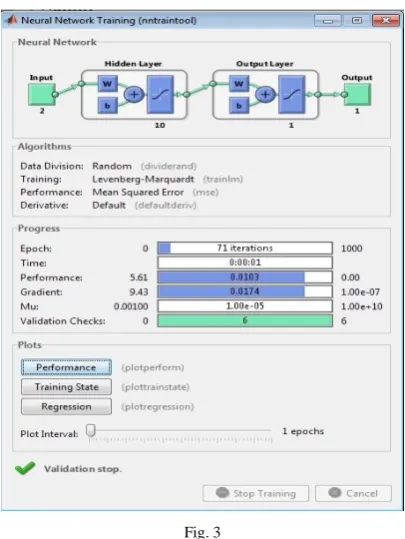
Fig. 3
ANNs are one of the artificial intelligence methods [6]. ANNs is designed to optimize the transmission range. ANN is designed with Network size and Simulation Area as inputs; Transmission range as output. The type of network selected is Feed Forward Back Propagation (FFBP) with training function TARINLM and LEARNGDM is used for adaptive learning function. Figure 4 depicts the ANFIS structure model
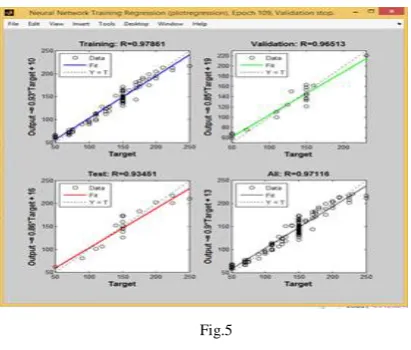
Figure 5 shows the regression plot.
Fig.5
V. RESEARCH METHODOLOGY
To evaluate the designs proposed in this paper, an effort is made to choose the most suitable evaluation methodology. Three evaluation methodologies are identified as simulation, experimental and mathematical. Of these three methods, Simulation method is chosen for the present study, as experimental method is not practicable, while mathematical method is highly restrictive.
Simulation Results and Analysis
NS-2 is an open simulation environment for computer networking research that is preferred in the research community. It is aligned with the simulation needs of modern networking research. It encourages community contribution, peer review, and validation of the software.
Our simulation settings for NS2 are summarized in table below.
TABLE I
NS-2 SIMULATION PARAMETERS
Simulation Parameters
Values
No. of Nodes 27,65,87,100
Area Size 200x200,500x500,750x750
Routing Protocol FZ-S-LAR, ANFZ-S-LAR
Simulation Time 1000Sec
Propagation Model Two Ray
Packet Size 256,512,1024
Mobility Model Random Way Point
Speed 5m/s
Range 586,775,803,816,981,985,9
VI.PERFORMANCE METRICS
We evaluate mainly the performance according to the following metrics.
Average Packet Delivery Ratio: It is the ratio of the number. of packets received successfully to the total number of Secure packets transmitted at each node.
Average Energy Consumed: Total energy consumed by all the nodes to the number of nodes.
Throughput: Total bytes received to the total bytes transmitted.
Overhead: Total protocol control bytes to the total data bytes transmitted.
Average End to end Delay: Average time take for the secure packets from send time to received time at the target node.
Figure 6 compares the average energy consumed for FZ-S-LAR, AN-FZ-LAR and AN-NN-LAR. Average 20% of energy saving is observed with AN-FZ-LAR when compared to FZ-S-LAR. Average 25% of energy saving is observed with AN-NN-LAR when compared to FZ-S-LAR.
Fig.6
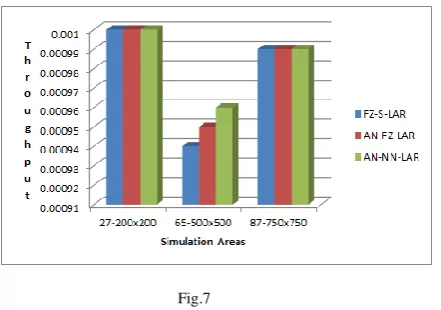
Figure 7 compares the throughput for FZ-S-LAR, AN-FZ-LAR and AN-NN-LAR. Average 0.7% throughput improvement is observed with AN-NN-LAR when compared to FZ-S-LAR.
Fig.7
Fig.8
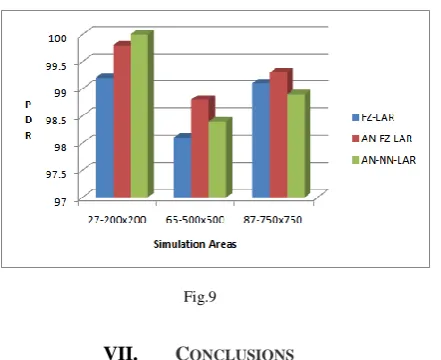
Figure 9 shows the comparison of Packet Delivery Ratio for FZ-S-LAR, AN-FZ-LAR and AN-NN-LAR. Average 0.3%of PDR improvement is observed in AN-NN-LAR.
Fig.9
VII. CONCLUSIONS
From the Simulation results it is concluded that AN-FZ-LAR and AN-NN-LAR total energy consumption
decreases by 20% compared to FZ-S-LAR. Average end to end delay of AN-NN-LAR increases by 10%
compared to FZ-S-LAR. Further work can be done on optimizing the PDR of AN-FZ-LAR and AN-NN-LAR.
References
[1] Y.V.S Sai Pragathi and Dr. S.P. Setty, “Design and implementation of Fuzzy Secure Location Aided Routing
(FZ-S-LAR) in MANETs” IJETT-Volume 38 Number 5-August 2016.
[2] Jyh-Shing Roger Jang,”ANFIS: Adaptive-Network-Based Fuzzy Inference System“IEEE Transactions on Systems Man and Cybernetics · June 1993.
[3] Y.Ko and N.H.Vaidya, “Location-aided routing (LAR) in mobile ad hoc networks,” in Proceedings of the ACM/ IEEE International Conference on Mobile Computing and Networking (Mobicom), 1998, pp. 66–75.
[4] Dr.S.P.Setty,” Implementation of Fuzzy Logic Based Node Traversal Time Performance Enhanced AODV in Mobile Ad hoc Networks”, International Journal of Advances in Computer Science and Technology, Volume 3,
No.3, ISSN 2320-2602, March 2014.
[5] Ahmed Al-Hmouz ,Jun Shen, R. Al-Hmouz, Jun Yan, “Modeling and Simulation of an Adaptive Neuro-Fuzzy
Inference System (ANFIS) for Mobile Learning” IEEE Computer Society,Issue No.03 - Third Quarter (2012
vol.5),pp: 226-237.
[6] Zahra Moradi and Mohammad Teshnehlab, “Intrusion Detection Model in MANETs using ANNs and ANFIS”, Proc. of CSIT vol.5 (2011), IACSIT Press, Singapore.
[7] V.R.Budyal, “ANFIS and agent based bandwidth and delay aware anycast routing in mobile adhoc networks”, Journal of Network and computer applications 39(2014)140-151,2013 Elsevier.
[8] Akram A.Moustafa, “Performance Evaluation of Artificial Neural Networks for Spatial Data Analysis”, Contemporary Engineering Sciences, Vol. 4, 2011, no. 4, 149 – 163.
[9] Insung Jung and Gi-Nam Wang,in their paper “Pattern Classification of Back Propagation Algorithm Using