IJEDR1303027 INTERNATIONAL JOURNAL OF ENGINEERING DEVELOPMENT AND RESEARCH | IJEDR Website: www.ijedr.org | Email ID: [email protected] 137
A Survey of the Optimization of clustering techniques
in Wireless sensor network
1
Amar shah,
2Kirti Patel,
3Prof. Pinal Patel
1,2M.E Research scholar, 3Assistant Professor 1GEC Sector-28,Gandhinagar, GTU, Gujarat, India2
SSESGI, Rajpur, Kadi, GTU, Gujarat, India
3C.S.E. Department, Government Engineering College, GTU, Gujarat, India
1[email protected], 2[email protected]
Abstract—Advances in wireless sensor network (WSN) technology has provided the availability of tiny and low-cost sensor nodes with capability of sensing various types of physical and environmental conditions, data processing, and wireless communication. However, the characteristic of wireless sensor networks requires more effective methods for data forwarding and processing. In wireless sensor network, the sensor nodes have a limited transmission range, with processing and storage capabilities as well as their energy resources are also limited. Routing protocols for wireless sensor networks are responsible for maintaining the routes in the network, to ensure reliable communication, save energy resources and increase network lifetime. So here we study a survey of routing protocols for Wireless Sensor Network, compare their strengths and limitations and which are more energy efficient LEACH and LEACH-C are clustering protocol and they provide energy efficient routing. Optimizing LEACH-C protocol to getting better network lifetime and Energy consumption.
Index Terms—WSN, Routing Protocol, Leach, Wireless Network
I.INTRODUCTION
Wireless Sensor networks consist of hundreds of thousands of low power multi-functional sensor nodes, operating in an unattended environment, with limited computation & Sensing capabilities. Sensor nodes are equipped with small, often irreplaceable batteries with limited power capacities [1].
As sensor nodes are basically battery-powered devices, the critical aspects to face concern how to reduce the energy consumption of nodes, so that the network lifetime can be extended to reasonable times. I concentrated on optimization of Hierarchical Energy Efficient Routing Protocols. Since unstable and unevenly distributed cluster heads can increase power of the network system in some existing protocol. I have
Proposed new technique for cluster head selection and cluster formation so it selects the consistent cluster heads in each round, also form the balance clusters in the existing hierarchical routing protocol (LEACH-C) to reduce the energy consumption of sensor nodes in sensing, processing and communication activities, overall it increases the lifetime of network.
II.CLASSIFICATION OF ROUTING TECHNIQUES
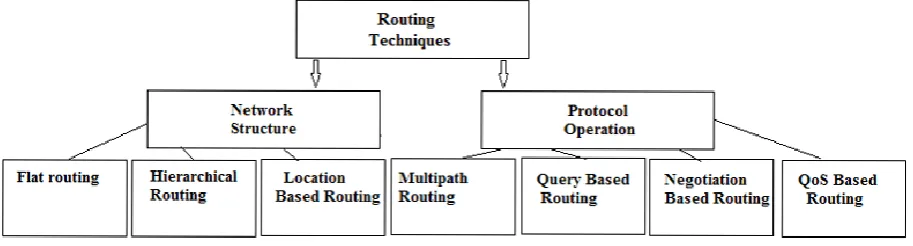
In general, routing in WSNs can be divided into flat-based routing, hierarchical-based routing, and location-based routing depending on the network structure as per the fig 1.
Fig 1 Classification of routing Techniques
In flat-based routing, all nodes are typically assigned equal roles .In hierarchical-based routing; however, nodes will play different roles in the network. In location-based routing, sensor nodes' positions are exploited to route data in the network.
A routing protocol is considered adaptive if certain system parameters can be con-trolled in order to adapt to the current network conditions and available energy levels. Furthermore, these protocols can be classified into multipath-based, query-based, negotiation-based, QoS-based or coherent-based routing techniques depending on the protocol operation. In addition to the above, routing protocols can be classified into three categories, namely, proactive, reactive, and hybrid protocols depending on how the source_nds a route to the destination.[4].
IJEDR1303027 INTERNATIONAL JOURNAL OF ENGINEERING DEVELOPMENT AND RESEARCH | IJEDR Website: www.ijedr.org | Email ID: [email protected] 138 efficient way to lower energy consumption within a cluster and by performing data aggregation and fusion in order to decrease the number of transmitted messages to the BS. Hierarchical routing is mainly two-layer routing where one layer is used to select cluster heads and the other layer is used for routing. However, most techniques in this category are not about routing, rather on "who and when to send or process/aggregate" the information, channel allocation etc., which can be orthogonal to the multihop routing function.[5]
III.WSNAPPLICATIONS AND CLUSTERINGADVANTAGES
Environmental applications
Forest fire detection
Seismic Monitoring
Flood detection
Automated agriculture
Ecological habitat monitoring
Military applications
Monitoring equipment
Battle field surveillance
Nuclear, biological and chemical attack detection
Target tracking
Monitoring enemy forces.
Health applications
Remote monitoring of physiological data
Disease prevention
Home applications
Home automation
Home security
Fire detection
Commercial applications
Vehicle tracking
Industrial and Commercial networked sensing
Traffic flow surveillance
Advantages of Clustering
1. Transmit aggregated data to the data sink.
2. Reducing number of nodes taking part in transmission. 3. Useful energy consumption.
4. Scalability for large number of nodes.
5. Reduces communication overhead for both single and multihop [3]
IV.CLUSTERING ALGORITHMS FOR WSN
LEACH: Low-Energy Adaptive Clustering Hierarchy
LEACH is a self-organizing, adaptive clustering protocol that uses randomization to distribute the energy load evenly among the sensors in the network. In LEACH, the nodes organize themselves into local clusters, with one node acting as the local base station or cluster-head. If the cluster heads were chosen a priori and axed throughout the system lifetime, as in conventional clustering algorithms, it is easy to see that the unlucky sensors chosen to be cluster-heads would die quickly, ending the useful lifetime of all nodes belonging to those clusters. Thus LEACH includes randomized rotation of the high-energy cluster-head position such that it rotates among the various sensors in order to not drain the battery of a single sensor. In addition, LEACH performs local data fusion to compress the amount of data being sent from the clusters to the base station, further reducing energy dissipation and enhancing system lifetime. [8]
Advertisement Phase
IJEDR1303027 INTERNATIONAL JOURNAL OF ENGINEERING DEVELOPMENT AND RESEARCH | IJEDR Website: www.ijedr.org | Email ID: [email protected] 139 Define abbreviations and acronyms the first time they are used in the text, even after they have been defined in the abstract. Abbreviations such as IEEE and SI do not have to be defined. Do not use abbreviations in the title or heads unless they are unavoidable.
[5]
Where P = the desired percentage of cluster heads (e.g., P = 0:05), r = the current round, and G is the set of nodes that have not been cluster-heads in the last 1 P rounds. Using this threshold, each node will be a cluster-head at some point within 1 P rounds. During round 0 (r = 0), each node has a probability P of becoming a cluster-head. The nodes that are cluster-heads in round 0 cannot be cluster-heads for the next 1P rounds. Thus the probability that the remaining nodes are cluster-heads must be increased, since there are fewer nodes that are eligible to become cluster-heads. After 1p 1 rounds, T = 1 for any nodes that have not yet been cluster-heads, and after 1P rounds, all nodes are once again eligible to become Cluster-heads. Future versions of this work will include an energy-based threshold to account for non-uniform energy nodes. In this case, we are assuming that all nodes begin with the same amount of energy and being a cluster-head removes approximately the same amount of energy for each node.
Each node that has elected itself becomes cluster-head for the current round broadcasts an advertisement message to the rest of the nodes. in this cluster-head advertisement phase, the cluster-heads use a CSMAMAC protocol, and all cluster-heads transmit their advertisements using the same transmit energy .
Schedule Creation
The cluster-head node receives all the messages for nodes that would like to be included in the cluster.cluster-head node creates a TDMA schedule telling each node when it can transmit. At this time schedule is broadcast back to the nodes in the cluster.
Data Transmission
Once the clusters are created and the TDMA schedule is fixed, data transmission can begin. Assuming nodes always have data to send, they send it during their allocated transmission time to the cluster head. This transmission uses a minimal amount of energy (chosen based on the received strength of the cluster-head advertisement). The radio of each non-cluster-head node can be turned off until the nodes allocated transmission time, thus minimizing energy dissipation in these nodes. The cluster-head node must keep its receiver on to receive all the data from the nodes in the cluster. When all the data has been received, the cluster head node performs signal processing functions to compress the data into a single signal.For example, if the data are audio or seismic signals, the cluster-head node can beam form the individual signals to generate a composite signal. This composite signal is sent to the base station. Since the base station is far away, this is a
high-energy transmission.[10]
PEGASIS: Power-Efficient Gathering in Sensor Information Systems
The main idea in PEGASIS is for each node to receive from and transmit to close neighbors and take turns being the leader for transmission to the BS. This approach will distribute the energy load evenly among the sensor nodes in the network. We initially place the nodes randomly in the play field, and therefore, the i th node is at a random location. The nodes will be organized to form a chain, which can either be accomplished by the sensor nodes themselves using a greedy algorithm starting from some node. Al tentatively, the BS can compute this chain and broadcast it to all the sensor nodes.[11]
For constructing the chain, we assume that all nodes have global knowledge of the network and employ the greedy algorithm. We could have constructed a loop, however ,to ensure that all nodes have close neighbors is difficult as this problem is similar to the traveling salesman problem.
The greedy approach to constructing the chain works well and this is done before the first round of communication. To construct the chain, we start with the furthest node from the BS. We begin with this node in order to make sure that nodes farther from the BS have close neighbors, as in the greedy algorithm the neighbor distances will increase gradually since nodes already on the chain cannot be revisited.
For gathering data in each round, each node receives data from one neighbor, fuses with its own data, and transmits to the other neighbor on the chain. Note that node I will be in some random position j on the chain. Nodes take turns transmitting to the BS, and we will use node number i mod N (N represents the number of nodes) to transmit to the BS in round i.
Thus, the leader in each round of communication will be at a random position on the chain, which is important for nodes to die at random locations. The idea in nodes dieing at random places is to make the sensor network robust to failures. In a given round, we can use a simple control token passing approach initiated by the leader to start the data transmission from the ends of the chain.[11]
PEGASIS performs data fusion at every node except the end nodes in the chain. Each node will fuse its neighbors data with its own to generate a single packet of the same length and then transmit that to its other neighbor (if it has two neighbors).
TEEN (Threshold sensitive Energy Efficient network protocol)
IJEDR1303027 INTERNATIONAL JOURNAL OF ENGINEERING DEVELOPMENT AND RESEARCH | IJEDR Website: www.ijedr.org | Email ID: [email protected] 140 Functioning
In this scheme, at every cluster change time, in addition to the attributes, the cluster-head broadcasts to its members,.[7]
Hard Threshold (HT ): This is a threshold value for the sensed attribute. It is the absolute value of the attribute beyond which, the node sensing this value must switch on its transmitter and report to its cluster head.[7].
Soft Threshold (ST ):This is a small change in the value of the sensed attribute which triggers the node to switch on its transmitter and transmit.[7]
The nodes sense their environment continuously. The one time a parameter from the attribute set reaches its hard threshold value, the node switches on its transmitter and sends the sensed data. The sensed value is save in an internal variable in the node, called the sensed value (SV). The nodes will next transmit data in the current cluster period, whenever both the following conditions are true:
1) The current value of the sensing attribute is greater than the hard threshold.
2) The current value of the sensing attribute differs from SV by an amount equal to or greater than the soft threshold.
Thus, the hard threshold tries to reduce the number of transmissions by allowing the nodes to transmit only when the sensed attribute is in the range of interest. The soft threshold further reduces the number of transmissions by eliminating all the transmissions which might have otherwise occurred when there is little or no change in the sensed attribute once the hard threshold.[7]
HEED (Hybrid Energy Efficient Distributed Protocol)
HEED (Hybrid Energy-Efficient Distributed clustering), that periodically selects cluster heads according to a hybrid of the node residual energy and a secondary parameter, such as node proximity to its neighbors or node degree.
Clustering Parameters
For this reason, cluster head selection is primarily based on the residual energy of each node. Measuring this residual energy is not necessary, since the energy consumed per bit for sensing, processing, and communication is typically known, and hence residual energy can be estimated. To increase energy efficiency and further prolong network lifetime, we also consider intra-cluster communication cost as a secondary intra-clustering parameter. For example, cost can be a function of neighbor proximity or cluster density .[6]
We use the primary clustering parameter to probabilistically select an initial set of cluster heads, and the secondary parameter to break ties among them. A tie in this context means that a node falls within the range of more than one cluster head. The secondary clustering parameter, intra-cluster communication cost, is a function of (i) cluster properties, such as cluster size, and (ii) whether or not variable power levels are permissible for intra cluster communication.[12]
Working
The clustering process is divided into a number of iterations, and in each iterations, nodes which are not covered by any cluster head double their probability of becoming a cluster head. Since these energy-efficient clustering protocols enable every node to independently and probabilistically decide on its role in the clustered network, they cannot guarantee optimal elected set of cluster heads.[6]
REFERENCES
[1] Mr.Soumen Chatterjee 2.Mr.Mohan Singh, A Centralized Energy-Ecient Routing Protocol for Wireless Sensor Networks, Electric and Electronics Department,Terii,Kurukshetra-13611.
[2] Kemal Akkaya, Mohamed Younis, "A Survey on Routing Protocols for WirelessSensor Networks."
[3] Suat Ozdemir,Yang Xiao b, "Secure data aggregation in wireless sensor networks: A comprehensive overview", Elsevier B.V, computer netwrks,2009.
[4] Nalin VimalKumar Subramanian, Survey on Energy-Aware Routing and Routing Protocols for Sensor, Department of Computer Science University of North CarolinaCharlotte, North Carolina, USA.
[5] Dr. Kemal Akkaya, Routing Protocols for Sensor Networks Hierarchical and Location-based and QoS Protocols, Department of Computer Science Southern Illinois University Carbondale.
[6] Harneet Kour and Ajay K. Sharma. Hybrid Energy E_cient Distributed Protocol for Heterogeneous Wireless Sensor Network. International Journal of Computer Applications (0975 8887) Volume 4 No.6, July 2010
[7] Arati Manjeshwar and Dharma P. Agrawal.TEEN: A Routing Protocol for Enhanced Efficiency in Wireless Sensor Networks In Proc, IEEE 2001
IJEDR1303027 INTERNATIONAL JOURNAL OF ENGINEERING DEVELOPMENT AND RESEARCH | IJEDR Website: www.ijedr.org | Email ID: [email protected] 141 [9] Wendi Rabiner Heinzelman, Anantha Chandrakasan, and Hari Balakrishnan, Energy-Efficient Communication Protocol
forWireless Microsensor Networks, 33rd Hawaii International Conference on System Sciences - 2000
[10]Wendi Rabiner Heinzelman, Anantha Chandrakasan, and Hari Balakrishnan, Energy-Efficient Communication Protocol forWireless Microsensor Networks, 33rd Hawaii International Conference on System Sciences - 2000
[11]Stephanie Lindsey and Cauligi S. Raghavendra. PEGASIS: Power-Efficient Gathering in Sensor Information Systems,Computer Systems Research Department The Aerospace Corporation,April 2003.
[12]http://www.computer.org/csdl/trans/tm/2004/04/h0366-abs.html