Submitted14 April 2017
Accepted 25 July 2017
Published22 August 2017
Corresponding author
Jozo Grgic, [email protected]
Academic editor
Scotty Butcher
Additional Information and Declarations can be found on page 15
DOI10.7717/peerj.3695 Copyright
2017 Grgic et al.
Distributed under
Creative Commons CC-BY 4.0 OPEN ACCESS
Effects of linear and daily undulating
periodized resistance training programs
on measures of muscle hypertrophy: a
systematic review and meta-analysis
Jozo Grgic1, Pavle Mikulic2, Hrvoje Podnar2and Zeljko Pedisic1
1Institute of Sport, Exercise and Active Living (ISEAL), Victoria University, Melbourne, Australia 2University of Zagreb, Faculty of Kinesiology, Zagreb, Croatia
ABSTRACT
Background. Periodization is an important component of resistance training pro-grams. It is meant to improve adherence to the training regimen, allow for constant progression, help in avoiding plateaus, and reduce occurrence and severity of injuries. Previous findings regarding the effects of different periodization models on measures of muscle hypertrophy are equivocal. To provide a more in-depth look at the topic, we undertook a systematic review of the literature and a meta-analysis of intervention trials comparing the effects of linear periodization (LP) and daily undulating periodization (DUP) resistance training programs on muscle hypertrophy.
Materials and Methods. A comprehensive literature search was conducted through PubMed/MEDLINE, Scopus, Web of Science, SPORTDiscus, Networked Digital Li-brary of Theses and Dissertations (NDLTD) and Open Access Theses and Dissertations (OATD).
Results. The pooled standardized mean difference (Cohen’s d) from 13 eligible studies
for the difference between the periodization models on muscle hypertrophy was−0.02
(95% confidence interval [−0.25, 0.21],p=0.848).
Conclusions. The meta-analysis comparing LP and DUP indicated that the effects of the two periodization models on muscle hypertrophy are likely to be similar. However, more research is needed in this area, particularly among trained individuals and clinical populations. Future studies may benefit from using instruments that are more sensitive for detecting changes in muscle mass, such as ultrasound or magnetic resonance imaging.
SubjectsKinesiology, Public Health
Keywords Skeletal muscle, Cross-sectional area, Lean body mass
INTRODUCTION
Regular participation in resistance training has been recommended to adults seeking general
health and fitness by theWorld Health Organization (2010),US Department of Health and
Human Services (2008),American College of Sports Medicine (2009)and many other global public health authorities. Resistance training is recommended as it may improve muscle mass, strength, and bone mass (Petersen, Hastings & Gottschall, 2017). It may also be
associated with greater mobility (Yamamoto et al., 2016), increased health-related quality
of life (Goldfield et al., 2017), increased resting metabolic rate (Campbell et al., 1994), and
reduced risk of type 2 diabetes (Grøntved et al., 2012). Population-based studies from
Australia and the US have found that 18.6% and 31.7% of adults, respectively, participate in muscle-strengthening physical activities at least two times a week (Bennie et al., 2016;
Loustalot et al., 2013). Muscle mass is also thought to be an important factor influencing performance in many sports disciplines, particularly in physique sports (e.g., bodybuilding, men’s physique, etc.). Resistance training designed to promote muscle hypertrophy is, therefore, for many athletes an important part of their training regimen.
According to Haff & Triplett (2016), periodization enables systematic, sequential,
and integrative scheduling and programming of training sessions to maximize specific physiological adaptations underpinning performance outcomes. Commonly used forms of periodization are the linear or classic periodization model (LP) and the nonlinear or
undulating periodization model. According to Rhea and colleagues (Rhea et al., 2002),
LP gradually increases training intensity and decreases volume, with these changes being made approximately every four weeks. A nonlinear form of periodization was previously
described byPoliquin (1988)and is characterized by more frequent alterations in intensity
and volume. The undulating periodization models can be performed on a weekly or daily basis. Daily fluctuations in intensity and load are often referred to as ‘‘the daily undulating periodization’’ (DUP), while the periodization with weekly fluctuations is termed ‘‘the weekly undulating periodization’’ (WUP).
The current empirical evidence provides insights regarding training frequency (Schoenfeld, Ogborn & Krieger, 2016), volume (Schoenfeld, Ogborn & Krieger, 2017), rest intervals (Schoenfeld et al., 2016b), and repetition ranges (Schoenfeld et al., 2016a). Despite these evidence-based general suggestions for designing a training protocol for muscle hypertrophy, there is a paucity of evidence regarding different periodization strategies.
It seems that most resistance training programs utilize some form of periodization, but it is still unclear whether the effectiveness of periodization is mainly related to the principle
of specificity when analyzing strength (Mattocks et al., 2016), or more determined by the
varying structure of the training programs and the differences in the volume of training (Kok, Hamer & Bishop, 2009). A recent systematic review and meta-analysis byHarries, Lubans & Callister (2015)found no significant differences between LP and undulating periodization models in increasing upper- and lower-body strength. However, the study did not analyze whether the two types of periodization differ in their effects on muscle hypertrophy. Findings about the effects of these two forms of periodization in volume equated comparisons on muscle hypertrophy seem to be equivocal, with some studies indicating greater benefits from the DUP model (Simão et al., 2012;Spineti et al., 2014) and others demonstrating no significant differences (De Lima et al., 2012;Prestes et al., 2015).
To provide a better understanding of the current evidence regarding the LP and DUP models and their effects on measures of muscle hypertrophy, we conducted a systematic review of the literature coupled with a meta-analysis. A more informed understanding of the topic may be of benefit to personal trainers and strength and conditioning coaches, professional athletes competing in many sports, and millions of those participating in muscle-strengthening activities for recreational and/or health purposes (Bennie et al., 2016;
Centers for Disease Control and Prevention, 2013;Harada et al., 2008;Loustalot et al., 2013;
Schoenborn, Adams & Peregoy, 2013). The focus of this paper was on LP and undulating periodization, specifically, DUP, as these models are most commonly used in intervention
studies examining the impact of periodization on muscular adaptations (Harries, Lubans
& Callister, 2015).
MATERIALS AND METHODS
The methods were specified in advance in the PROSPERO International prospective register of systematic reviews (ref: CRD42016047795).
Search strategy
A systematic literature search was conducted according to the guidelines for Preferred
Reporting Items for Systematic Reviews and Meta-Analyses (PRISMA) (Moher et al., 2009).
A comprehensive search of the PubMed/MEDLINE, SCOPUS, Web of Science (including Science Citation Index Expanded, Social Sciences Citation Index, and Arts & Humanities Citation Index), SPORTDiscus, Networked Digital Library of Theses and Dissertations (NDLTD) and Open Access Theses and Dissertations (OATD) databases was conducted. In all databases, a search through titles, abstracts, and keywords of indexed documents was performed from the inception of indexing to September 14th, 2016, by combining the search terms for periodization (periodis* and periodiz*) with the following search terms: resistance training; muscle hypertrophy; strength training; muscle mass; skeletal muscle; cross-sectional area; body composition; strength exercise; strengthening exercise; resistance exercise; weight training; weight lifting; muscle strengthening; muscular strengthening; muscle training; muscle exercise; muscle toning; muscle gain; muscle volume; weight bearing exercise; weight bearing training; bodybuilding; body building. The full syntax
with Boolean operators used for the literature search may be found inAppendix S1. As
part of the secondary search, we also screened the reference lists of all selected documents and the studies that have cited the included studies.
Inclusion criteria
Studies were assessed for eligibility based on the following inclusion criteria: (a) an experimental trial published in an English-language peer-reviewed journal or a doctoral thesis; (b) it compared the use of a LP resistance training program to a DUP resistance training program or to a mixture of WUP and DUP resistance training program in a traditional dynamic resistance exercise using coupled concentric and eccentric muscle actions; (c) the study used at least one method of estimating changes in muscle mass (studies using only measures of circumference without controlling for body fat changes were excluded as they do not provide an accurate assessment of changes in lean body mass); (d) the volume was equated between the different periodization models; (e) the study lasted for a minimum of six weeks and involved participants with no musculoskeletal injury or any other health condition that could directly or through medications associated with the management of a given condition be expected to impact the hypertrophic response
to resistance exercise (i.e., coronary artery disease and angiotensin receptor blockers), as
done in previous research examining muscle hypertrophy (reviewsSchoenfeld, Ogborn &
Krieger, 2017).
Study selection
The study selection was conducted independently by two authors (JG and HP) in order to minimize potential selection bias. Disagreements between the investigators were resolved through discussion and mutual consensus, and any remaining disagreements were settled by the third investigator (PM). Studies were excluded based on their title or, where necessary, by reading the abstract or full text. Attempts were made to contact authors to provide any additional data needed for a given study to meet the inclusion criteria.
Study coding and data extraction
The studies meeting the inclusion criteria were read and independently coded by two investigators (JG and HP) using a predefined spreadsheet. The following data was extracted: (a) descriptive information of participants by gender, age (ages 10–18 years were classified as adolescents, aged 19–39 classified as young adults, aged 40–64 classified as middle-aged adults, aged≥65 classified as elderly), and experience in resistance training (classified as
untrained if they had <1 year of experience and as trained if they had≥1 year of experience);
(b) the number of participants in each group; (c) the type of study design; (d) the duration of the intervention trial; (e) the characteristics of both resistance training models; (f) the type of morphologic measurements (skinfolds, circumferences, ultrasound, magnetic resonance imaging—MRI, dual energy X-ray absorptiometry—DXA, air displacement plethysmography— BOD-POD, and/or bio-impedance analysis—BIA); (g) the region of the body measured for the studies that used skinfolds, circumferences, ultrasound or MRI; and (h) main findings related to muscle hypertrophy. Coding was crosschecked between the coders, and all discrepancies were resolved through discussion. The assessment of potential coder drift was performed by randomly selecting 30% of the studies for recoding, as described byCooper, Hedges & Valentine (2009).
Quality assessment
To assess the methodological quality of the studies, we used the PEDro Scale (Maher et al.,
2003). The PEDro scale is a 11-criteria checklist for assessing the methodological quality of
randomized controlled trials. Studies are awarded 0–10 points, depending on the number of criteria they meet (the first item is not used to calculate the summary score). Due to the nature of exercise interventions, no included studies could theoretically do blinding of subjects and investigators, and hence none could earn points on the PEDro Scale items 5 and 6. In addition to presenting the overall PEDro Scale score, we therefore also presented the percentage of the maximal possible score, which is 8 points. Details about the scale items
can be found elsewhere (Maher et al., 2003). The same authors that performed the search
and coding of the studies independently completed the PEDro Scale. Any disagreement was resolved by mutual consensus or by consensus with a third investigator (PM).
Statistical analysis
Differences in the pre-post data for each individual study and measured muscle group were calculated as a percent change as follows:
(Post-training measure−Pre-training measure)/Pre-training measure×100.
A meta-analysis was performed using the ‘‘Comprehensive Meta-analysis’’ software (Biostat Inc., Englewood, NJ, USA). The data entry format that was used for the calculation of standardized mean differences (Cohen’s d [SMD]) and its 95% confidence interval (CI)
was ‘‘means, standard deviation (SD) pre and post, sample size (n) in each group, pre/post
correlation’’. As none of the studies reported correlation and it could not be estimated with
high precision (Borenstein et al., 2009) the data was standardized by post score SD values.
When the data is standardized by post score SD, the correlation values are not needed for the calculation of SMDs. Unlike the standardization by pre-intervention SD values, this
method provides more insights regarding the variability of the training effect (Dankel et
al., 2017c). In LP vs. DUP comparisons, where the data showed a greater increase from pre to post values for the LP group, this was expressed as the positive effect direction, and where the data showed a greater increase from pre to post values for the DUP group,
this was expressed as the negative effect size direction. The study bySpineti et al. (2014)
had two LP and DUP groups, so we analyzed their results separately. Four meta-analyses were performed: (i) including all 13 studies; (ii) a subgroup analysis including the studies that used direct measures of muscle hypertrophy; (iii) a subgroup analysis including the studies that used indirect measures of muscle hypertrophy; and (iv) a subgroup analysis including the studies with training periods longer than 11 weeks. Both measures were considered as muscle hypertrophy, assuming that changes in lean body mass with resistance training are mainly attributed to gains in muscle tissue. The random effect model was used for performing the meta-analysis. Sensitivity analysis was performed by (a) using the same software by removing one study at a time and then examining the outcomes and (b) removing both of the studies (Foschini et al., 2010;Inoue et al., 2015) that combined resistance training with aerobic training. The statistical significance threshold was set at
p<0.05.
RESULTS
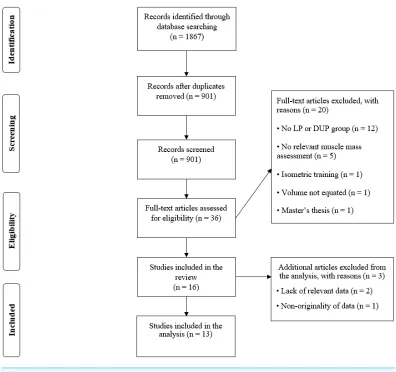
A total of 1,867 records were found in the primary search (Fig. 1, Supplemental
Information). A total of 36 papers were read in full to assess their eligibility for inclusion. A total of 16 studies were found to have potential to meet all the inclusion criteria. The authors of 4 studies (Ahmadizad et al., 2014;Prestes et al., 2009b;Rhea et al., 2002;Spineti et al., 2013) were asked to provide additional data required for their study to meet the inclusion criteria. For two studies (Prestes et al., 2009b;Rhea et al., 2002) the additional data was not provided upon our request, and they were, therefore, not included in the
review. A study (Spineti et al., 2013) was removed due to non-originality of the presented
data. The final number of studies included in this review was thirteen, with five studies using direct measures of muscle hypertrophy and eight studies using indirect measures of
Figure 1 Flow diagram of the search and study selection process.
muscle hypertrophy. All studies included in the systematic review received ethics approval from the local Institutional Review Board.
The pooled sample size from all the included studies wasn=417, with 303 participants
involved in either LP or DUP resistance training program. The average (±SD) duration
of the studies was 12±5 weeks. Most studies were conducted on untrained populations
with little or no resistance training experience (Ahmadizad et al., 2014;De Lima et al., 2012;Foschini et al., 2010;Harries, Lubans & Callister, 2016;Inoue et al., 2015;Kok, Hamer & Bishop, 2009;Kok, 2006;Prestes et al., 2015;Simão et al., 2012;Souza et al., 2014;Spineti et al., 2014) with only one study (Monteiro et al., 2009) comparing the effects of different periodization models on trained individuals.
The changes in measures of muscle hypertrophy from pre- to post-training intervention
are presented inTable 1. The unweighted mean percent change across studies was 3.9%±
3.0% (95% CI [2.5, 5.3], (0.32% per week of training)) for the LP and 5.1%±4.2% (95%
CI [3.1, 7.1], (0.43% per week of training)) for the DUP resistance training group. The mean percent changes for the subgroup of studies that used indirect measures of muscle
hypertrophy were 3.5%±2.9% (95% CI [1.2, 5.0]) for LP and 1.9%±1.3% (95% CI
Table 1 Studies on the difference between the effects of LP and DUP periodization models on muscular hypertrophy: summary of findings and assessment of methodological quality.
Study Publication type Participants Design Study
duration Hypertrophy/ lean body mass measurement Findings Methodological qualitya Percentage of the theoretical maximum score for exercise intervention trials Ahmadizad et al. (2014) Published, peer reviewed
32 young un-trained over-weight men
Random assignment either to a control group (n=8), or non-periodized (n=8), a LP (n=8) or a DUP (n=8) resis-tance training program perform-ing 6 different resistance trainperform-ing exercises. A mixture of both free weight and machine based multi-joint and single multi-joint isolation ex-ercises was used. The training was carried out 3 times per week.
8 weeks BIA No significant differences be-tween groups in changes in lean body mass (1.9 % increase for the LP group, 2.0 % increase for the DUP group).
6 75%
Buford et al. (2007)
Published, peer reviewed
18 young un-trained men and 10 young untrained women
Random assignment either to a LP (n=9), a DUP (n=10) or a WUP (n=9) resistance training program performing 14 different resistance train-ing exercises. A mixture of both free weight and machine based multi-joint and single-joint isolation exercises was used. The training was carried out 3 times per week.
9 weeks Chest and thigh cir-cumference (with 7 site skinfolds to control for body fat changes)
No significant differences be-tween groups in changes in muscle girth (2.0% increase for the LP group, 0.2% increase for the DUP group in the chest circumference, 6.6% increase for the LP group, 3.7% increase for the DUP group in the thigh circumference). The LP group decreased body fat by 1.3% (5.0%), while the DUP group decreased body fat by 1.4% (6.6%).
6 75%
De Lima et al. (2012) Published, peer reviewed 28 young untrained women
Random assignment either to a control group (n=8), or a LP (n=10) or a DUP (n=10) re-sistance training program per-forming 16 different resistance training exercises. A mixture of both free weight and machine based multi-joint and single-joint isolation exercises was used. The training was carried out 4 times per week.
12 weeks Triceps, suprailiac and thigh skinfolds
No significant differences be-tween groups in changes in lean body mass (4.7% increase for the LP group, 3.5% increase for the DUP group).
6 75%
Foschini et al. (2010) Published, peer reviewed 32 untrained obese adoles-cents (boys:
n=15, girls:
n=17)
Random assignment either to a LP (n=16) or a DUP (n=16) resistance training pro-gram performing 10 different resistance training exercises. A mixture of both free weight and machine based multi-joint and single-joint isolation exercises was used. Participants addition-ally performed 30 min of aerobic exercise. The training was carried out 3 times per week.
14 weeks BOD-POD No significant differences be-tween groups in changes in lean body mass (3.4% increase for the LP group, 2.4% increase for the DUP group).
6 75%
(continued on next page)
Table 1(continued)
Study Publication type Participants Design Study
duration Hypertrophy/ lean body mass measurement Findings Methodological qualitya Percentage of the theoretical maximum score for exercise intervention trials Harries, Lubans & Callister (2016) Published, peer reviewed 26 untrained adolescent boys
Assignment either to a con-trol group (n=10), or a LP (n=8) or a DUP (n=8) re-sistance training program per-forming 11 different resistance training exercises. A mixture of both free weight and machine based multi-joint and single-joint isolation exercises was used. The training was carried out 2 times per week.
12 weeks BIA No significant differences be-tween groups in changes in lean body mass (2.1% decrease for the LP group, 1.0% increase for the DUP group).
7 87%
Inoue et al. (2015) Published, peer reviewed 45 untrained obese adoles-cents (boys:
n=17, girls:
n=28)
Random assignment either to aerobic training, (n=20), or a LP (n=13) or a DUP (n=12) resistance training pro-gram performing 10 different resistance training exercises. A mixture of both free weight and machine based multi-joint and single-joint isolation exercises was used. Participants in the LP and DUP groups additionally performed 30 min of aerobic ex-ercise. The training was carried out 3 times per week.
26 weeks BOD-POD No significant differences be-tween groups in changes in lean body mass (7.9% increase for the LP group, 2.6% increase for the DUP group).
5 62%
Kok (2006) Doctoral dissertation
16 young untrained women
Random assignment based on the participants squat index (1RM-SQ/mass) either to a LP (n=
8) or a DUP (n=8) resistance training program performing 10 different resistance training ex-ercises. A mixture of both free weight and machine based multi-joint and single-multi-joint isolation exercises was used. The training was carried out 3 times per week.
12 weeks Ultrasound per-formed on the right rectus femoris
No significant differences be-tween groups in changes in muscle thickness (3.2% increase for the LP group, 12.9% in-crease for the DUP group in the cross sectional area).
5 62%
Kok, Hamer & Bishop (2009) Published, peer reviewed 20 young untrained women
Random assignment based on the participants squat index (1RM-SQ/mass) either to a LP (n=10) or a DUP (n=10) resistance training program performing 10 different resistance training ex-ercises. A mixture of both free weight and machine based multi-joint and single-multi-joint isolation exercises was used. The training was carried out 3 times per week.
12 weeks Ultrasound per-formed on the right rectus femoris
No significant differences be-tween groups in changes in muscle thickness (8.7% increase for the LP group, 14.8% in-crease for the DUP group in the cross sectional area)
6 75%
(continued on next page)
Table 1(continued)
Study Publication type Participants Design Study
duration Hypertrophy/ lean body mass measurement Findings Methodological qualitya Percentage of the theoretical maximum score for exercise intervention trials
Monteiro et al. (2009)
Published, peer reviewed
27 young trained men
Random assignment either to a non-periodized (n=9), a LP (n=9) or a DUP (n=9) resis-tance training program perform-ing 15 different resistance train-ing exercises. A mixture of both free weight and machine based multi-joint and single-joint iso-lation exercises was used. The training was carried out 4 times per week.
12 weeks Biceps, triceps, subscapular, and suprailiac skinfolds
No significant differences be-tween groups in changes in lean body mass (1.2% increase for the LP group, 0.3% increase for the DUP group).
5 62%
Prestes et al. (2015) Published, peer reviewed 49 untrained elderly women
Random assignment either to a control group (n=10), or a LP (n=20) or a DUP (n=19) resistance training program performing 10 dif-ferent resistance training ex-ercises. A mixture of both free weight and machine based multi-joint and single joint isolation exercises was used. The training was carried out 2 times per week.
16 weeks DXA No significant differences be-tween groups in changes in lean body mass (1.6% decrease for the LP group, 1.7% increase for the DUP group).
5 62%
Simão et al. (2012)
Published, peer reviewed
30 young un-trained men
Random assignment either to a control group (n=9), a LP (n=
10) or a to a mixed WUP and DUP (n=11) resistance train-ing program performtrain-ing 4 dif-ferent resistance training exer-cises: barbell bench press, chine front lat-pull down, ma-chine triceps extension, and the straight-bar standing biceps curl. The training was carried out 2 times per week.
12 weeks Ultrasound per-formed on the right biceps and triceps
No significant differences be-tween groups in changes in muscle thickness (5.7% increase for the LP group, 9.1% increase for the DUP group in the bi-ceps, 0.8% increase for the LP group, 4.3% increase for the DUP group in the triceps).
6 75%
Souza et al. (2014)
Published, peer reviewed
31 young un-trained men
Participants from each quartile according to their quadriceps cross-sectional were randomly assigned to a control group (n=
5), or a non-periodized (n=9), a LP (n=9) or a DUP (n=8) resistance training program per-forming 2 different resistance training exercises for the lower body: squat and knee extensions. The training was carried out 2 times per week.
6 weeks MRI performed on the dominant leg quadriceps
No significant differences be-tween groups in changes in cross-sectional area (4.6% in-crease for the LP group, 5.2% increase for the DUP group).
6 75%
(continued on next page)
Table 1(continued)
Study Publication type Participants Design Study
duration
Hypertrophy/ lean body mass measurement
Findings Methodological
qualitya
Percentage of the theoretical maximum score for exercise intervention trials
Spineti et al. (2014)
Published, peer reviewed
53 young un-trained men
Random assignment either to a control group (n=9), or a LP progressing from large to small (LG) muscle groups (n=10), a LP progressing from small to large (SG) muscle groups (n=
13), a DUP progressing from large to small (LG) muscle groups (n=11), a DUP progressing from small to large (SG) muscle groups (n=10) resistance train-ing program performtrain-ing 4 differ-ent resistance training exercises: biceps curl, triceps extension, lat pull down and bench press. The training was carried out 2 times per week.
12 weeks Ultrasound per-formed on the right biceps and triceps
No significant differences between groups in changes in muscle thickness (5.8% and 3.5% increase for the LP groups, 9.3% and 8.2% in-crease for the DUP groups in the biceps, 0.6% and 9.0% in-crease for the LP groups, 4.5% and 6.8% increase for the DUP groups in the triceps)
6 75%
Notes.
aDenotes the total score on the PEDro scale.
LP, linear periodization; DUP, daily undulating periodization; WUP, weekly undulating periodization; BIA, bio-impedance analysis; BOD-POD, air displacement plethysmography; DXA, dual en-ergy X-ray absorptiometry; MRI, magnetic resonance imaging.
Grgic
e
t
al.
(2017),
P
eerJ
,
DOI
10.7717/peerj.3695
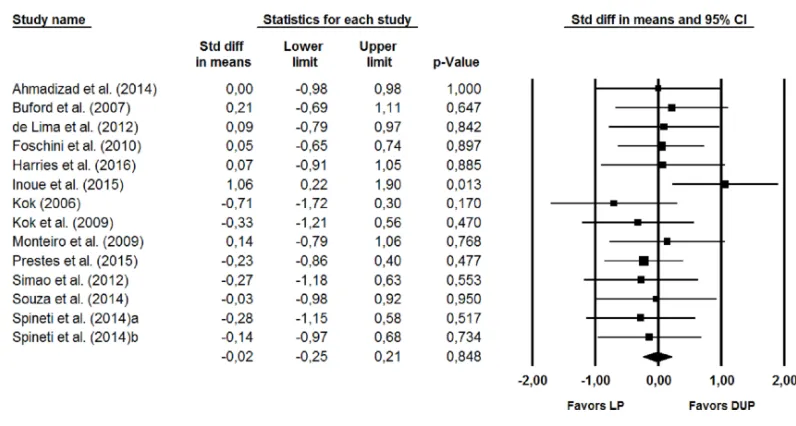
Figure 2 Forest plot showing differences between the effects plot of LP and DUP periodization models on measures of muscle hypertrophy.The size of the plotted squares reflects the relative statistical weight of each study. The numbers on theX-axis denote the standardized mean differences expressed as Cohen’s d. The horizontal lines denote 95% confidence intervals (CI) for the standardized mean differences. DUP, daily undulating periodization; LP, linear periodization; Std diff, standardized difference.
[1.1, 2.8]) for DUP. The mean percent changes for the subgroup of studies that used direct
measures of muscle hypertrophy were 4.7%±3.0% (95% CI [2.7, 6.6]) for LP and 8.3%
±3.7% (95% CI [6.0, 10.7]) for DUP.
The meta-analysis using random-effects model showed no significant differences
(p=0.848) between the effects of the two periodization models and their effects on muscle
hypertrophy. The pooled Cohen’s d (SMD) for the difference between the periodization
models was−0.02 (95% CI [−0.25, 0.21],p=0.848) (Fig. 2). None of the sensitivity
analyses removing one study at a time showed a significant difference between the two
periodization models. No significant difference (p=0.314) was also observed when the
sensitivity analysis was performed by removing two studies (Foschini et al., 2010;Inoue et
al., 2015) that included aerobic exercise together with the resistance training.
No significant differences between the two periodization models were observed in the subgroup analysis (Fig. 3) for studies that used direct measures of muscle hypertrophy
(SMD = −0.28 (95% CI [−0.65, 0.09]),p=0.135) for the studies that used indirect
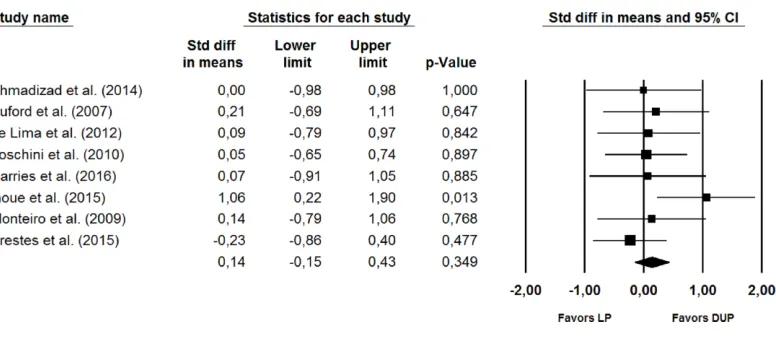
measures of muscle hypertrophy (SMD=0.14 (95% CI [−0.15, 0.43]),p=0.349) (Fig. 4),
or for the studies that lasted >11 weeks (SMD= −0.41 (95% CI [−0.29, 0.21]),p=0.747).
The PEDro scale quality assessment scores ranged from 5 to 7 points (Table 1) indicating moderate to high methodological quality across the included studies. The percentage of the theoretical maximum score for exercise intervention trials ranged from 62% to 87%.
DISCUSSION
This is the first systematic review to compare the effects of the LP and DUP resistance training programs on muscle hypertrophy. The meta-analysis comparing the two models
Figure 3 Forest plot showing differences between the effects plot of LP and DUP periodization mod-els on measures of muscle hypertrophy (direct measures).The size of the plotted squares reflects the rel-ative statistical weight of each study. The numbers on theX-axis denote the standardized mean differences expressed as Cohen’s d. The horizontal lines denote 95% confidence intervals (CI) for the standardized mean differences. DUP, daily undulating periodization; LP, linear periodization; Std diff, standardized dif-ference.
Figure 4 Forest plot showing differences between the effects plot of LP and DUP periodization models on measures of muscle hypertrophy (indirect measures).The size of the plotted squares reflects the rela-tive statistical weight of each study. The numbers on theX-axis denote the standardized mean differences expressed as Cohen’s d. The horizontal lines denote 95% confidence intervals (CI) for the standardized mean differences. DUP, daily undulating periodization. LP, linear periodization. Std diff, standardized dif-ference.
on muscle hypertrophy did not indicate a significant difference between their effects. Therefore, the main finding of our review is that, when LP and DUP are volume-equated, there is no evidence to conclude that one type of periodization outperforms the other in the above-mentioned variables.
In the reviewed studies, the volume of training was equated between the LP and DUP experimental groups. It has been purported that appropriate training variable manipulation (i.e., periodization) is more important for producing gains than the total training volume (O’Bryant, Byrd & Stone, 1988). However, our meta-analysis does not corroborate this hypothesis. It might be that, for muscle gain, training volume is more important than the
use of LP or DUP models (Kok, Hamer & Bishop, 2009), but it remains unclear whether these findings are generalizable to other forms of periodization (i.e., block periodization,
reverse linear periodization etc.). The study byKok, Hamer & Bishop (2009)showed that
changes in strength and hypertrophy mirrored the training volume load, both in the LP and DUP groups. However, this may not always be the case, as it seems that even simply
practicing the the strength assessment procedure may result in strength increases (Mattocks
et al., 2017). Nevertheless, the effects of training volume on gains in muscle mass were
confirmed in meta-analyses byKrieger (2010), and later by Schoenfeld and colleagues
(2017). There seems to be a dose–response relationship between resistance training volume
and increases in muscle mass, at least up to a certain level (Schoenfeld, Ogborn & Krieger,
2017). Although we observed no significant differences between LP and DUP in their
effects on muscle hypertrophy, the study byMonteiro et al. (2009)found that the group
that underwent a non-periodized resistance training lost 2.1 kg of lean body mass, while the
LP and DUP groups increased lean body mass by 0.8 kg and 0.2 kg, respectively.Monteiro
et al. (2009) suggest that both LP and DUP models might provide better results than a
non-periodized approach. However, in the study byMonteiro et al. (2009), the absolute
load was not adjusted throughout the duration of the study. It seems that not adjusting for increases in strength during the implementation of a resistance training program
might hinder muscular adaptations. By contrast, the studies bySouza et al. (2014)and
Ahmadizad et al. (2014)showed similar gains across the DUP, LP and the non-periodized groups. Furthermore, it seems that there is a general lack of evidence about effects of periodization in resistance training (Mattocks et al., 2016).
The DUP model involves increases and decreases in both volume and intensity
throughout the training cycles (Rhea et al., 2003). In contrast, the traditional LP approach
progresses from lower load/higher volume to heavier load/lower volume through the mesocycles. The latter pattern may not be ideal from a hypertrophy standpoint, as it has been suggested that muscle mass is not easily maintained through the low volume phases (Poliquin, 1988); however, as more recently highlighted byBickel, Cross & Bamman (2011), this might depend on the age of the participants. It may be assumed that a reverse LP approach would be preferable for hypertrophic effects. In the reverse LP model, the high
volume (i.e., hypertrophy) mesocycle is at the end of the macrocycle.Prestes et al. (2009a)
compared traditional LP and reversed LP models in a group of resistance-trained men. Their study found greater increases in lean body mass in the traditional LP group. However, a limitation of the study is the use of skinfold thickness measures to assess changes in muscle mass. No previous studies using direct measures of muscle hypertrophy have compared the effects of DUP and the reverse LP resistance training models on muscle mass. This may be an interesting area to explore in future studies.
Our findings mainly relate to young individuals, with only one study (Prestes et al.,
2015) that examined the effects of LP and DUP in a cohort of elderly woman. However,
as most other studies,Prestes et al. (2015)observed no significant differences in the effects of LP and DUP on lean body mass. An important and commonly neglected factor when choosing a periodization model pertains to motivational factors. LP resistance training programs might provide a greater benefit to the individuals who favor tracking progression
on a week-to-week or a month-to-month basis. By contrast, the DUP model might be more beneficial to the individuals who need more variety in order to adhere to the training programs. From the public health perspective, i.e., in relation to population-wide participation in resistance training, it might be worthwhile exploring these assumptions in future studies.
All but one reviewed study included untrained participants, which restricts generalization of the findings to the population of trained individuals. This is important to emphasize because it has been shown that training experience attenuates muscle protein synthesis (Kim, Staron & Phillips, 2005;Phillips et al., 1999;Tang et al., 2008) as well as intracellular anabolic signaling (Coffey et al., 2006;Gonzalez et al., 2015;Nader et al., 2014), resulting in slower hypertrophy adaptations in trained individuals when compared to untrained individuals. This may be a possible explanation of the overall non-significant difference between the effects of LP and DUP on muscle hypertrophy. However, as the recent study byMorton et al. (2016)has shown, even trained individuals may achieve robust gains in strength and muscle mass employing a non-periodized approach, if adequate progressive overload is used. Such findings may potentially put into question the need for implementing periodization in resistance training programs.
All included studies did report equating the training volume between the LP and DUP groups. However, a clearer standardization (i.e., training to volitional fatigue) has been
suggested for studies examining muscle hypertrophy (Dankel et al., 2017a). Furthermore,
some studies focused more on achieving muscular endurance (De Lima et al., 2012), while
others focused more on strength and hypertrophy (Simão et al., 2012). Some studies
examined the upper-body musculature (Simão et al., 2012; Spineti et al., 2014), while
others examined the lower-body musculature (Souza et al., 2014). Additionally, some
studies combined resistance training with aerobic exercise (Foschini et al., 2010;Inoue et al., 2015) and others (Simão et al., 2012;Spineti et al., 2014), combined DUP and WUP resistance training programs. Studies also used a range of different variants of LP and DUP periodization models. Also, changes in muscular hypertrophy were assessed using a range of methods and different muscle groups, with methods more sensitive to muscle
changes, such as ultrasound and MRI (Bemben, 2002) used only in four out of thirteen
reviewed studies. However, the variability of differences between the effects of LP and
DUP was very low across the studies, with all but one effect size (Inoue et al., 2015) being
classified as ‘‘trivial’’ and ‘‘small’’. This indicates that the effects sizes are unlikely to have been significantly affected by the diverse methodological approaches used in the studies. Furthermore, based on the PEDro score, the methodological quality of most reviewed studies would be classified as moderate, regardless of whether the overall PEDro score or the maximum possible score for exercise intervention trials was used as the reference.
The average duration of the reviewed studies was 12 weeks, with only three studies lasting more than 12 weeks. It is, therefore, unclear whether the effects of periodization protocols would show larger differences over a longer term. It has been suggested that, to observe significant differences between periodization models, a full 1-year macrocycle
might be needed (Buford et al., 2007). However, it might also be that both periodization
models would result in similar changes in muscle mass even if applied throughout the
whole macrocycle due to the ceiling effect with adaptation to resistance training (Dankel et al., 2017b). Considering the impediments for conducting long-term exercise interventions, it is not surprising that such studies are still lacking.
Further research in this field should aim to answer:
1. ‘‘Are there any differences between LP and DUP models in their effects on muscle hypertrophy among individuals with previous resistance training experience?’’ 2. ‘‘What are the effects of reverse LP models in comparison to DUP or traditional LP
periodization schemes when assessing muscle hypertrophy with direct (i.e., ultrasound, MRI, CT) methods?’’
On the point ofDankel et al. (2017c), it would be desirable for future studies to plot
the individual responses to the intervention to increase the practical interpretability of the findings.
CONCLUSIONS
The meta-analysis comparing LP and DUP approaches to resistance training indicated that the effects of the two periodization models on measures of muscle hypertrophy are likely to be similar. However, more research is needed in this area, particularly among trained individuals and clinical populations. Future studies may benefit from using instruments that are more sensitive for detecting changes in muscle mass, such as ultrasound or magnetic resonance imaging. Those interested in achieving maximal muscle hypertrophy should focus on training volume and progressive overload, while the use or the choice of a periodization model may be a matter of individual preference.
ADDITIONAL INFORMATION AND DECLARATIONS
Funding
The authors received no funding for this work.
Competing Interests
The authors declare there are no competing interests.
Author Contributions
• Jozo Grgic conceived and designed the experiments, performed the experiments,
analyzed the data, contributed reagents/materials/analysis tools, wrote the paper, prepared figures and/or tables.
• Pavle Mikulic conceived and designed the experiments, wrote the paper, reviewed drafts
of the paper.
• Hrvoje Podnar performed the experiments, contributed reagents/materials/analysis
tools, wrote the paper, reviewed drafts of the paper.
• Zeljko Pedisic conceived and designed the experiments, wrote the paper, reviewed drafts
of the paper.
Supplemental Information
Supplemental information for this article can be found online athttp://dx.doi.org/10.7717/
peerj.3695#supplemental-information.
REFERENCES
Ahmadizad S, Ghorbani S, Ghasemikaram M, Bahmanzadeh M. 2014.Effects of short-term nonperiodized, linear periodized and daily undulating periodized resistance
training on plasma adiponectin, leptin and insulin resistance.Clinical Biochemistry
47(6):417–422DOI 10.1016/j.clinbiochem.2013.12.019.
American College of Sports Medicine. 2009.American College of Sports Medicine
position stand. Progression models in resistance training for healthy adults.Medicine
& Science in Sports & Exercise41(3):687–708DOI 10.1249/MSS.0b013e3181915670. Bemben MG. 2002.Use of diagnostic ultrasound for assessing muscle size.Journal of
Strength and Conditioning Research16(1):103–108.
Bennie JA, Pedisic Z, Van Uffelen JGZ, Gale J, Banting LK, Vergeer I, Stamatakis E, Bauman AE, Biddle SJH. 2016.The descriptive epidemiology of total physical activity, muscle-strengthening exercises and sedentary behaviour among Australian
adults—results from the National Nutrition and Physical Activity Survey.BMC
Public Health16:73DOI 10.1186/s12889-016-2736-3.
Bickel CS, Cross JM, Bamman MM. 2011.Exercise dosing to retain resistance training adaptations in young and older adults.Medicine & Science in Sports & Exercise 43(7):1177–1187DOI 10.1249/MSS.0b013e318207c15d.
Borenstein M, Hedges LV, Higgins JPT, Rothstein HR. 2009.Introduction to meta-analysis. United Kingdom: John Wiley and Sons, Ltd. Publication.
Buford TW, Rossi SJ, Smith DB, Warren AJ. 2007.A comparison of periodization
models during nine weeks with equated volume and intensity for strength.Journal
of Strength and Conditioning Research21(4):1245–1250.
Centers for Disease Control and Prevention. 2013.Adult participation in aerobic
and muscle-strengthening physical activities—United States, 2011.Morbidity and
Mortality Weekly Report 62(17):326–330.
Campbell WW, Crim MC, Young VR, Evans WJ. 1994.Increased energy requirements
and changes in body composition with resistance training in older adults.The
American Journal of Clinical Nutrition60(2):167–175.
Coffey VG, Zhong Z, Shield A, Canny BJ, Chibalin AV, Zierath JR, Hawley JA. 2006. Early signaling responses to divergent exercise stimuli in skeletal muscle from
well-trained humans.The FASEB Journal20(1):190–192 DOI 10.1096/fj.05-4809fje.
Cooper H, Hedges L, Valentine J. 2009.The handbook of research synthesis and meta-analysis. 2nd edition. New York: Russell Sage Foundation.
Dankel SJ, Jessee MB, Mattocks KT, Mouser JG, Counts BR, Buckner SL, Loenneke JP. 2017a.Training to fatigue: the answer for standardization when assessing muscle
hypertrophy?Sports Medicine47(6):1021–1027DOI 10.1007/s40279-016-0633-7.
Dankel SJ, Mattocks KT, Jessee MB, Buckner SL, Mouser JG, Counts BR, Lau-rentino GC, Loenneke JP. 2017b.Frequency: the overlooked resistance
train-ing variable for inductrain-ing muscle hypertrophy?Sports Medicine47(5):799–805
DOI 10.1007/s40279-016-0640-8.
Dankel SJ, Mouser JG, Mattocks KT, Counts BR, Jessee MB, Buckner SL, Loprinzi PD, Loenneke JP. 2017c.The widespread misuse of effect sizes.Journal of Science and Medicine in Sport20(5):446–450DOI 10.1016/j.jsams.2016.10.003.
De Lima C, Boullosa DA, Frollini AB, Donatto FF, Leite RD, Gonelli PR, Montebello MI, Prestes J, Cesar MC. 2012.Linear and daily undulating resistance training
periodizations have differential beneficial effects in young sedentary women.
Inter-national Journal of Sports Medicine33(9):723–727 DOI 10.1055/s-0032-1306324. Foschini D, Araújo RC, Bacurau RF, De Piano A, De Almeida SS, Carnier J, Rosa
TD, De Mello MT, Tufik S, Dâmaso AR. 2010.Treatment of obese adolescents:
the influence of periodization models and ACE genotype.Obesity18(4):766–772
DOI 10.1038/oby.2009.247.
Goldfield GS, Kenny GP, Alberga AS, Tulloch HE, Doucette S, Cameron JD, Sigal RJ. 2017.Effects of aerobic or resistance training or both on health-related quality of life
in youth with obesity: the hearty trial.Applied Physiology, Nutrition, and Metabolism
42(4):361–370DOI 10.1139/apnm-2016-0386.
Gonzalez AM, Hoffman JR, Townsend JR, Jajtner AR, Wells AJ, Beyer KS, Willoughby DS, Oliveira LP, Fukuda DH, Fragala MS, Stout JR. 2015.Association between myosin heavy chain protein isoforms and intramuscular anabolic signaling
following resistance exercise in trained men.Physiological Reports3(1):e12268
DOI 10.14814/phy2.12268.
Grøntved A, Rimm EB, Willett WC, Andersen LB, Hu FB. 2012.A prospective study
of weight training and risk of type 2 diabetes mellitus in men.Archives of Internal
Medicine172(17):1306–1312DOI 10.1001/archinternmed.2012.3138.
Haff G, Triplett T. 2016.Essentials of strength training and conditioning. 4th edition. NSCA: Human kinetics.
Harada K, Oka K, Ota A, Shibata A, Nakamura Y. 2008.Prevalence and correlates of strength training among Japanese adults: analysis of the SSF National
Sports-Life Survey 2006.International Journal of Sport and Health Science6:66–71
DOI 10.5432/ijshs.6.66.
Harries SK, Lubans DR, Callister R. 2015.Systematic review and meta-analysis of linear and undulating periodized resistance training programs on
muscu-lar strength.Journal of Strength and Conditioning Research29(4):1113–1125
DOI 10.1519/JSC.0000000000000712.
Harries SK, Lubans DR, Callister R. 2016.Comparison of resistance training progression
models on maximal strength in sub-elite adolescent rugby union players.Journal of
Science and Medicine in Sport 19(2):163–169DOI 10.1016/j.jsams.2015.01.007. Inoue DS, De Mello MT, Foschini D, Lira FS, De Piano Ganen A, Da Silveira
Campos RM, De Lima Sanches P, Silva PL, Corgosinho FC, Rossi FE, Tufik S, Dâmaso AR. 2015.Linear and undulating periodized strength plus aerobic
training promote similar benefits and lead to improvement of insulin resistance
on obese adolescents.Journal of Diabetes and its Complications29(2):258–264
DOI 10.1016/j.jdiacomp.2014.11.002.
Kim PL, Staron RS, Phillips SM. 2005.Fasted-state skeletal muscle protein synthesis after
resistance exercise is altered with training.The Journal of Physiology568(1):283–290
DOI 10.1113/jphysiol.2005.093708.
Kok LY. 2006.Comparing linear and undulating periodisation for improving and main-taining muscular strength qualities in women. Unpublished doctoral dissertation, The University of Western Australia.
Kok LY, Hamer PW, Bishop DJ. 2009.Enhancing muscular qualities in untrained women: linear versus undulating periodization.Medicine & Science in Sports & Exercise41(9):1797–1807DOI 10.1249/MSS.0b013e3181a154f3.
Krieger JW. 2010.Single vs. multiple sets of resistance exercise for muscle hypertrophy:
a meta-analysis.Journal of Strength and Conditioning Research24(4):1150–1159
DOI 10.1519/JSC.0b013e3181d4d436.
Loustalot F, Carlson SA, Kruger J, Fulton JE. 2013.Muscle-strengthening activities and
participation among adults in the United States.Research Quarterly for Exercise and
Sport 84(1):30–38DOI 10.1080/02701367.2013.762289.
Maher CG, Sherrington C, Herbert RD, Moseley AM, Elkins M. 2003.Reliability of
the PEDro scale for rating quality of randomized controlled trials.Physical Therapy
83(8):713–721DOI 10.1093/ptj/83.8.713.
Mattocks KT, Buckner SL, Jessee MB, Dankel SJ, Mouser JG, Loenneke JP. 2017. Prac-ticing the test produces strength equivalent to higher volume training.Medicine & Science in Sports & ExerciseEpub ahead of printDOI 10.1249/MSS.0000000000001300. Mattocks KT, Dankel SJ, Buckner SL, Jessee MB, Counts BR, Mouser JG, Laurentino
GC, Loenneke JP. 2016.Periodization: what is it good for?Journal of Trainology
5:6–12DOI 10.17338/trainology.5.1_6.
Moher D, Liberati A, Tetzlaff J, Altman DG, PRISMA Group. 2009.Preferred reporting
items for systematic reviews and meta-analyses: the PRISMA statement.Annals of
Internal Medicine151(4):264–269DOI 10.7326/0003-4819-151-4-200908180-00135. Monteiro AG, Aoki MS, Evangelista AL, Alveno DA, Monteiro GA, Pi¸carro Ida C,
Ugrinowitsch C. 2009.Nonlinear periodization maximizes strength gains in
split resistance training routines.Journal of Strength and Conditioning Research
23(4):1321–1326DOI 10.1519/JSC.0b013e3181a00f96.
Morton RW, Oikawa SY, Wavell CG, Mazara N, McGlory C, Quadrilatero J, Baechler BL, Baker SK, Phillips SM. 2016.Neither load nor systemic hor-mones determine resistance training-mediated hypertrophy or strength gains
in resistance-trained young men.Journal of Applied Physiology 121(1):129–138
DOI 10.1152/japplphysiol.00154.2016.
Nader GA, Von Walden F, Liu C, Lindvall J, Gutmann L, Pistilli EE, Gordon PM. 2014.Resistance exercise training modulates acute gene expression during human
skeletal mmuscle hypertrophy.Journal of Applied Physiology116(6):693–702
DOI 10.1152/japplphysiol.01366.2013.
O’Bryant HS, Byrd R, Stone MH. 1988.Cycle ergometer performance and maximum leg
and hip strength adaptations to two different methods of weight-training.The
Jour-nal of Applied Sport Science Research2(2):27–30
DOI 10.1519/1533-4287(1988)002<0027:CEPAML>2.3.CO;2.
Petersen BA, Hastings B, Gottschall JS. 2017.Low load, high repetition resistance
train-ing program increases bone mineral density in untrained adults.The Journal of Sports
Medicine and Physical Fitness57(1–2):70–76DOI 10.23736/S0022-4707.16.05697-8. Phillips SM, Tipton KD, Ferrando AA, Wolfe RR. 1999.Resistance training reduces
the acute exercise-induced increase in muscle protein turnover.American Journal
of Physiology, Endocrinology and Metabolism276(1):E118–E124.
Poliquin C. 1988.Five ways to increase the effectiveness of your strength training
program.National Strength and Conditioning Association10(3):34–39.
Prestes J, Da Cunha Nascimento D, Tibana RA, Teixeira TG, Vieira DC, Tajra V, De Farias DL, Silva AO, Funghetto SS, De Souza VC, Navalta JW. 2015.Understanding
the individual responsiveness to resistance training periodization.Age37(3):9793
DOI 10.1007/s11357-015-9793-x.
Prestes J, De Lima C, Frollini AB, Donatto FF, Conte M. 2009a.Comparison of linear and reverse linear periodization effects on maximal strength and body
composition.Journal of Strength and Conditioning Research23(1):266–274
DOI 10.1519/JSC.0b013e3181874bf3.
Prestes J, Frollini AB, De Lima C, Donatto FF, Foschin D, De Cássia Marqueti R, Figueira Jr A, Fleck SJ. 2009b.Comparison between linear and daily undulating
pe-riodized resistance training to increase strength.Journal of Strength and Conditioning
Research23(9):2437–2442DOI 10.1519/JSC.0b013e3181c03548.
Rhea MR, Ball SD, Phillips WT, Burkett LN. 2002.A comparison of linear and daily undulating periodized programs with equal volume and intensity for strength.
Journal of Strength and Conditioning Research16(2):250–255.
Rhea MR, Phillips WT, Burkett LN, Stone WJ, Ball SD, Alvar BA, Thomas AB. 2003.A comparison of linear and daily undulating periodized programs with equated
vol-ume and intensity for local muscular endurance.Journal of Strength and Conditioning
Research16(1):82–87.
Schoenborn CA, Adams PF, Peregoy JA. 2013.Health behaviors of adults: United States,
2008–2010.Vital and Health Statistics257:1–184.
Schoenfeld BJ, Contreras B, Ogborn D, Galpin A, Krieger J, Sonmez GT. 2016a.Effects
of varied versus constant loading zones on muscular adaptations in trained men.
In-ternational Journal of Sports Medicine37(6):442–447 DOI 10.1055/s-0035-1569369. Schoenfeld BJ, Ogborn D, Krieger JW. 2016.Effects of resistance training frequency
on measures of muscle hypertrophy: a systematic review and meta-analysis.Sports
Medicine46(11):1689–1697DOI 10.1007/s40279-016-0543-8.
Schoenfeld BJ, Ogborn D, Krieger JW. 2017.Dose—response relationship be-tween weekly resistance training volume and increases in muscle mass: a
sys-tematic review and meta-analysis.Journal of Sports Sciences35(11):1073–1082
DOI 10.1080/02640414.2016.1210197.
Schoenfeld BJ, Pope ZK, Benik FM, Hester GM, Sellers J, Nooner JL, Schnaiter JA, Bond-Williams KE, Carter AS, Ross CL, Just BL, Henselmans M, Krieger JW. 2016b.Longer interset rest periods enhance muscle strength and
hyper-trophy in resistance-trained men.Journal of Strength and Conditioning Research
30(7):1805–1812DOI 10.1519/JSC.0000000000001272.
Simão R, Spineti J, De Salles BF, Matta T, Fernandes L, Fleck SJ, Rhea MR, Strom-Olsen HE. 2012.Comparison between nonlinear and linear periodized resistance training:
hypertrophic and strength effects.Journal of Strength and Conditioning Research
26(5):1389–1395DOI 10.1519/JSC.0b013e318231a659.
Souza EO, Ugrinowitsch C, Tricoli V, Roschel H, Lowery RP, Aihara AY, Leão AR, Wilson JM. 2014.Early adaptations to six weeks of non-periodized and periodized
strength training regimens in recreational males.Journal of Sports Science and
Medicine13(3):604–609.
Spineti J, Figueiredo T, Miranda H, De Salles BF, Fernandes L, Simão R. 2014. The effects of exercise order and periodized resistance training on maximum
strength and muscle thickness.International SportMed Journal15(4):374–390
DOI 10.1007/BF00572189.
Spineti J, Figueiredo T, Freitas de Salles B, Assis M, Fernandes L, Novaes J, Simão R. 2013.Comparison between different periodization models on muscular strength and
thickness in a muscle group increasing sequence.Sociedade Brasileira de Medicina Do
Exercício e do Esporte19(4):280–286DOI 10.1590/S1517-86922013000400011. Tang JE, Perco JG, Moore DR, Wilkinson SB, Phillips SM. 2008.Resistance training
alters the response of fed state mixed muscle protein synthesis in young men.
American Journal of Physiology–Regulatory, Integrative and Comparative Physiology 294(1):R172–R178DOI 10.1152/ajpregu.00636.2007.
US Department of Health and Human Services. 2008.Physical activity guidelines for
Americans. President’s Council on Physical Fitness and Sports.Research Digest
9:1–8.
World Health Organization. 2010.Global recommendations on physical activity for health. Geneva: WHO Press.
Yamamoto S, Hotta K, Ota E, Mori R, Matsunaga A. 2016.Effects of resistance training on muscle strength, exercise capacity, and mobility in middle-aged and
elderly patients with coronary artery disease: a meta-analysis.Journal of Cardiology
68(2):125–134DOI 10.1016/j.jjcc.2015.09.005.