364 |
P a g e
Flexural Behavior of High Strength Pre-Stressed Concrete
Beams under Static Loading at Elevated Temperature
M. Sekar
1, G. Kesavan
2 1Ph.D. Research Scholar, Dept.of Civil & Structural Engg,
SCSVMV University, Kanchipuram, (India)
2Assistant Professor, Dept. of Civil & Structural Engg,
SCSVMV University, Kanchipuram,( India)
ABSTRACT
.
The objective of this work was to experimentally determine the flexural behavior of pre-tensioned partial replacement concrete beams under elevated temperatures. In this research, an effort will be made to study the property of mineral admixtures by partial-replacement to cement in terms of improved performance in flexural strength and durability of various grades of pre-stressed concrete under elevated temperatures. The aim of the investigation work presents the result of experimental and systematic studies of the flexural behavior of pre-stressed concrete beams. Mix design was obtained for M60 grade concrete such as 1) Mix design with OPC, OPC + Silica Fume + Fly Ash + GGBS. For these mix designs of concrete, pre-tensioned beams (designed section) and cubes are cast in moulds and which will be further tested, analyzed for the said purpose. The fluid to fly ash ratio was fixed at 0.40. The preliminary tests were carried out for the fly ash concrete and optimizing the mix design. The cubes with 150 mm x 150 mm size and beams with dimensions of 1500 mm x 150 mm x 150 mm size with Indian standard stainless steel wires were cast. The combination pre-tensioned partial replacement concrete beams were tested, subjected to flexure test under two-point static loading test to determine the strength and the stiffness. The peak load, strength and Young's modulus of each specimen under each temperature was recorded. The elevated temperature effects were applied using an environmental chamber. Then property of elevated temperature of high-strength concrete is noted and their performance compared to normal strength concrete. The objective of this limited study was to give a summary of the effects of elevated temperature on the behavior of concrete materials and structures. After that compare the results between the beams with OPC + Fly Ash + Silica Fume, OPC + Fly Ash + GGBS and beams with OPC and prepare the graph for the same. The comparison was made and the results are presented. Relevant studies in which pre-stressed fly ash concrete structural essentials were subjected to elevated temperature and static loading are described.
Keywords: Pre-stressed concrete, High tension wires, Silica fume concrete, Flexural behavior,
365 |
P a g e
I. INTRODUCTION
a. General
Pre-stressed concrete is basically a concrete in which internal stress of a suitable magnitude and distribution are
introduced so that the stresses resulting from external forces are counteracted to a desired degree. Pre-stressed
concrete, on the other hand, combine high strength concrete with high strength steel in an “active manner”. This
is achieved by the tensioning the steel and holding it against the concrete, thus putting the concrete into
compression. In Pre-tensioned member, these sources include elastic shortening, creep of concrete, shrinkage of
concrete and relaxation of the pre-stressing steel. Under ordinary conditions, most concrete structures are
subjected to a range of temperature no more severe than that imposed by ambient environmental conditions.
The experiment was conducted on fly ash based geopolymer concrete by changing the types of curing
specifically ambient curing and hot curing. The compressive strength of warm cured concrete is much higher
than that of ambiently cured concrete. During ambient curing, the compressive strength increase as the period of
concrete increases from 7 days to 28 days. The compressive strength of warm cured fly ash based geopolymer
concrete does not increase significantly after 7 days [1]. It is exposed that the bond condition between the
concrete and reinforcing steel rod has a significant influence on the firefighting of reinforced concrete
structures, mainly when the temperature of the reinforcing steel bar is high (more than 600 °C). Hence, the
current assumption of a perfect bond condition for analysis of reinforced concrete structures under fire condition
is unconservative [2]. The results show prominent reductions in residual compressive, splitting and
steel-concrete bond under high temperatures with striking changes in bond stress–free-end slip trend behavior. Utilize
of fibres minimised the damage in steel-concrete bond under eminent temperatures and consequently the
reduction in bond strength [3]. Spalling of high-strength concrete was established to be significantly affected by
wetness transfer in the shell region of concrete and wetness transfer was found to be directly correlated to the
temperature profiles resulting from the description of pore structures, which are the main passages for moisture.
It was to establish that, in the high-strength (80 Mpa) concrete used in this study, the possibility of spalling and
level of damage could be concentrated according to dryness in the surface region (0–30 mm depth) [4].Tests
have provided a relationship between temperature and strength which should prove useful to the concrete reactor
vessel designer. These confirm that for short exposure to temperatures up to 600°F concrete retains 80 to 95% of
its compressive strength when tested warm further deterioration took place during cooling, so those cold
specimens exhibited residual strengths as low as 55% of the normal (unheated) strength[5].For producing
high-performance concrete (HPC), it is fine recognized that the use of complementary cementitious materials
(CCMs), such as silica fume (SF), ground granulated glass blast-furnace slag (GGBS) and fly ash (FA) are
essential. The concept of HPC has absolutely evolved with time. Originally it was equated to high strength
concrete (HSC), which certainly has some advantage, but it does not show a complete and true picture. There is
a need to consider previous properties of the concrete as well which sometimes, May constant take priority over
366 |
P a g e
b. Flexural Test Procedure
Figure 1: Flexural test of two point loading
The beams were tested in two-point loading, being simply supported on a pivot bearing on one side and a roller
bearing on the other, over a span of 1,500 mm. The identical bearing pad was placed at the loading points on top
of the beams. A beam resting on top of these provided a system for load distribution. The load was applied, by
means of a hydraulic jack, in increments of 5 KN throughout the tests. At every load increment, observations of
crack progress on the concrete beams were noted. Fabrication, surface treatments, and testing of specimens were
carried out under ambient laboratory conditions unless otherwise stated.
c. Principle of Pre-stressing
The purpose of pre-stressing is to place the concrete structure under compression in those regions where load
causes tensile stress. The tensions caused by the load will primarily have to cancel the compression induced by
the pre-stressing before it can crack the concrete. Pre-stressing can be applied to concrete members in two
behaviors, by pre-tensioning or post-tensioning. In pre-tensioned members, the pre-stressing strands are
tensioned against restraining bulkheads before the concrete is cast. After the concrete has been located, allowed
to harden and achieve adequate strength, the strands are released and their force is transferred to the concrete
member. Pre-stressing by post-tensioning involves installing and stressing pre-stressing wire or bar tendons only
after the concrete has been placed, hardened and attained a minimum compressive strength for that transfer.
d. Material Properties of Pre-stressing Steel
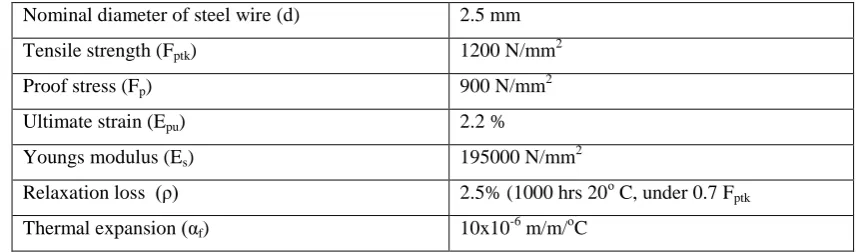
Nominal diameter of steel wire (d) 2.5 mm
Tensile strength (Fptk) 1200 N/mm
2
Proof stress (Fp) 900 N/mm2
Ultimate strain (Epu) 2.2 %
Youngs modulus (Es) 195000 N/mm
2
Relaxation loss (ρ) 2.5% (1000 hrs 20о C, under 0.7 Fptk
Thermal expansion (αf) 10x10-6 m/m/оC
II. SCOPE AND OBJECTIVES OF THE RESEARCH
The primary aim of this investigation was to evaluate the influence of high volumes of SCMs on the properties
of HSC. More specifically, the research had the following objectives:
1. To evaluate the percentage of cement replacement by Fly Ash and Micro Silica for the maximum residual
367 |
P a g e
2. To investigate the mechanical property of concrete viz., a residual compressive strength of concrete, preparedby replacing the Ordinary Portland Cement (OPC) with fly ash and micro silica at different temperatures
from 20oC to 80oC in addition to room temperatures and to arrive at the optimum proportions of various
constituents which give higher compressive strength.
3. To study the hydration properties and its significance on the properties of HSC.
4. To investigate the effects of various replacement intensities of FA, GGBS, and SF on compressive strength
and durability properties of concrete.
5. To evaluate the comparative response of various SCMs on the properties of HSC, and
6. To obtain the flexural behavior of pre-tensioned partial replacement concrete beams and conventional
concrete beams
III.MATERIALS
Concrete can be defined as a stone like material that has a cementitious medium within which aggregates are
embedded. In hydraulic cement concrete, the binder is composed of a mixture of hydraulic cement and water.
Concrete has an oven-dry density greater than 2400 kg/m3 but not exceeding 2600 kg/m3.
a. Binder
The function of the binder in concrete is to chemically bind all the constituent materials to form a stone-like
material. The commonly used binders in concrete are cement, fly ash (FA), silica fume (SF) and ground
granulated blast-furnace slag (GGBS).
b. Ordinary Portland cement
There are two different requirements that any cement must meet. It must develop the appropriate strength and
secondly, it must exhibit the suitable rheological behavior. The cement which meets this standard can vary quite
widely in their fineness and chemical composition. As a result, types of cement of nominally the same type will
have quite different rheological and strength properties, especially when used in combination with chemical
admixtures and supplementary cementing materials. Therefore, when choosing Portland types of cement for use
in high-strength concrete, it is compulsory to look carefully at the cement fineness and chemistry.
c. Fly ash (FA)
Fly ash (FA) class F, known also as pulverized- fuel ash, is the by-product obtained by electrostatic and
mechanical means from flue gases of power station furnaces fired with pulverized coal. The similarity of FA to
natural pozzolans of volcanic origin has encouraged the use of FA, in conjunction with Portland cement in
making the concrete.
d. Ground granulated blast-furnace slag (GGBS)
Ground granulated blast furnace slag (GGBS) is a byproduct achieved in the manufacturing of pig iron when
iron ore is reduced to pig iron. The granules shaped slag is then ground to fineness similar to Portland cement
e. Silica fume (SF)
Silica fume (SF) is an extremely reactive pozzolanic material. It is a by-product obtained from the manufacture
of silicon or ferrosilicon. It is extracted from the flue gases from electric arc furnaces. SF particles are very fine
368 |
P a g e
powder or is in the form of water slurry. It is commonly used as a replacement level of 5% to 12% by mass oftotal cementitious materials. It can be used successfully for the structures where high strength is needed or
significantly reduced permeability to water is a major concern. Extraordinary procedures are required to be
adopted for handling, placing and curing concrete with these very fine SF particles.
IV. COMPRESSIVE STRENGTH
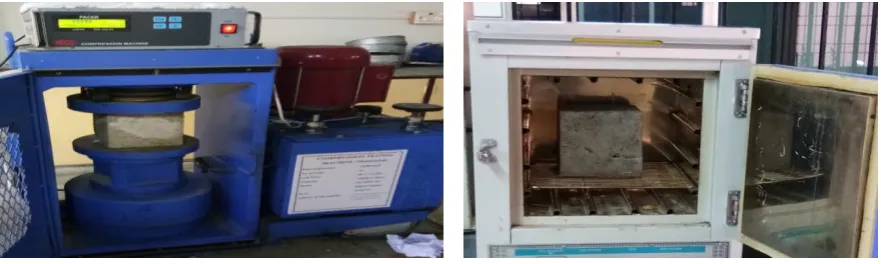
The compressive strength test was conducted on three 150 mm cubes using a compression testing
machine with a rate of loading of 50kN/min. One day prior to the test the cubes were removed from
the polythene sheet and immersed in a water tank for 24 hours. Immediately before testing, the cubes
were removed from the water bath and the surface dried by using a wet cloth in the lab. This was to
ensure that the cubes were hardened at a saturated-surface dry (SSD) condition.
Fig.2: Compression setup Fig.3: Hot curing of Cube
Table 1 Compressive Strength Development for Various Mixes
MIX ID
Compressive Strength (N/mm
2)
Without heat
With heating 80° c
(Oven dry 10hrs)
7 days
28 days
7 days
28 days
Ordinary Portland Cement
50.55
62.52
40.45
52.45
OPC 80% + FA 12.5% + SF 7.5%
51.50
64.75
41.75
55.75
OPC 80% + FA 12.5% + GGBS 7.5%
50.75
63.25
39.85
54.25
OPC 70% + FA 15% + SF 7.5% + GGBS 7.5%
52.50
62.60
40.25
51.75
V. EXPERIMENTAL PROGRAM
A. Pre-Tensioning
In pre-tensioning, the tendons are stretched temporarily against some external device before placing the
concrete. The concrete is then placed around the elongated tendons and allowed to develop sufficient strength
before the tendons are released from the external device thereby transferring the stress to concrete. The
pre-stressing techniques may be subdivided further into three types on the basis of the external device used for
369 |
P a g e
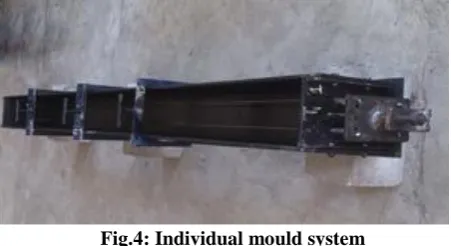
1. Long line method 2. Individual mould method 3. Strut method
\
Fig.4: Individual mould system
In this method, the pre-stressing tendons are stretched temporarily against the mould until the concrete placed in
the moulds becomes strong enough for the transfer of pre-stressing by the bond. In this system, the moulds for
the concrete members are used as external supports for holding the tensioned pre-stressing the steel. In the
process of tensioning the steel, the jacks bear against the moulds. Before the steel is released to transfer the force
to concrete, the moulds have to carry the force exerted by the jacks. The moulds are, therefore made from
structural steel strong enough to carry the jacking force.
VI. METHODOLOGY
a. Experimental
1. Mix design of concrete for desired strength
2. Casting of beams with same proportion as concrete cube
3. Test of concrete cube in 7 days and 28 days
4. Testing of beams
b. Preparation of Test Specimens and Experimental Setup
The pre-stressing force was applied by a conventional pre-stressing wrench suitable for pre-stress
4mm dia steel wires. Each tendon was pre-tensioned to a 9 KN load, that means 900N/mm
2initial
pre-stress in the steel wires. Test beams were steam cured for 10 hours at a maximum temperature of
80
oC. After steam curing pre-stressing force was released by flame cutting of steel wires. The beams
were tested under two-point loading which was monotonically increased. The beams are placed in the
50-ton frame. The schematic view of the test setup and the experimental setup are shown in Fig.
370 |
P a g e
VII. RESULTS AND CONCLUSION
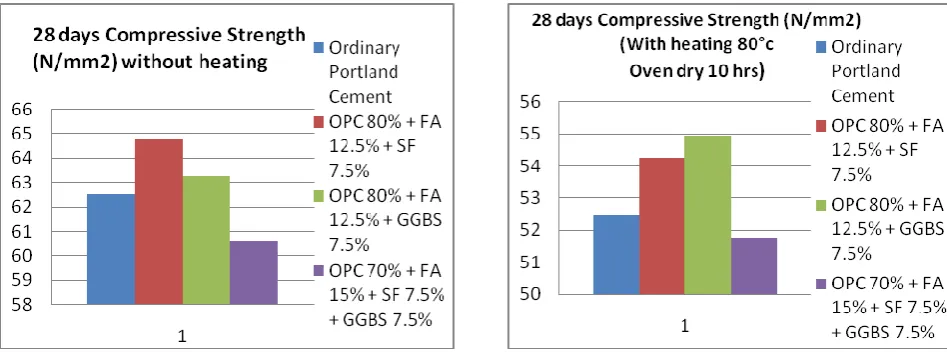
The following figures show the compressive strength of partial replacement concrete and control
concrete with 0.40 w/b ratio after exposure to 10 hour duration for 80
oC. The decrease in the
compressive strength is seen in, for temperature exposures in control concrete and the
OPC+SF+FA+GGBS concretes. The slight increase in compressive strength was observed between
the temperatures 80
oC due to the replacement of fly ash (12.5%) and micro silica (7.5%) materials
with OPC which evaporates the water content and accelerate the hydration.
Fig. 6: 7 days Compressive Strength or without heating Fig. 7: 7 days Compressive strength with heating
Fig. 8: 28 days Compressive Strength without heating Fig. 9: 28 days Compressive strength with heating
Load Carrying Capacity
a. The load vs. deflection details of pre-stressed conventional concrete and partial replacement
371 |
P a g e
Fig 10: Load vs deflection curve for OPC Fig 11: Load vs deflection curve for OPC + FA + GBS
Fig 12: Load vs deflection curve for OPC+FA+SF Fig. 13 Combined curves for load vs Deflection
b. The stress vs. strain details of pre-stressed conventional concrete and partial replacement concrete
beam are shown in fig.
372 |
P a g e
Fig 16: Stress vs Strain curve for OPC+FA+SF
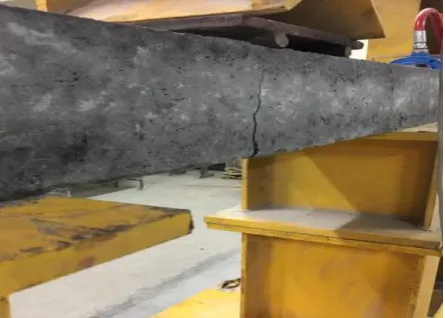
c. The deflection and failure mode of pre-stressed conventional concrete and partial replacement
concrete beam are shown in fig.
Fig.17: Deflectometer and LVDT placed in the Specimen Fig.18: Deflected shape of the beam
373 |
P a g e
VIII. CONCLUSION
Based on the experimental results, the following conclusions were drawn:
a) The cube (OPC 100%) specimens show better fire endurance compared to replacement mixes in
cube (80% of OPC, 12.5% of FA, 7.5% of GGBS), cube (80% of OPC, 12.5% of FA, 7.5% of SF) and
cube (80% of OPC, 12.5% of FA, 7.5% of SF, 7.5% of GGBS). An increase of 20% residual
compressive strength of (OPC+FA+GGBS) was found in when compared to OPC at 80
oC.
b) The residual compressive strength decreases with increase in temperature except for elevated
temperature at 80
oC.
c) The ground granulated blast furnace slag with an increase the percentage of Fly Ash has shown
improved resistance to the higher temperature at 0.40 water/binder ratio.
d) The replacement of the OPC with Fly Ash and GGBS reduces the emission CO
2and protects the
environment and also minimize the natural resources that are used in the manufacturing of cement.
e) The initial cracks were obtained by visual examination only. The initial cracks were obtained at 25
KN for conventional concrete, whereas the partial replacement concrete (OPC+FA+GGBS) initiates
the first crack at 30 KN. Then other partial replacement concrete initial cracks of obtained at 15 KN.
f) The flexural behavior of pre-tensioned conventional concrete beam and partial replacement
concrete (OPC+FA+GGBS) beams are similar. The maximum ultimate load of experimental work for
both concrete was 90KN.
g) The partial replacement concrete (OPC+FA+GGBS) concrete beam deflects more than the ordinary
concrete, nearly 15% more deflection at given load level.
h) From the experimental work, it is concluded that the partial replacement concrete behaves as
similar to conventional concrete. From the report was identified several economic benefits of using
OPC+FA+ GGBS concrete. OPC+FA+ GGBS concrete is 20% economically.
REFERENCES
[1] RanganVijaya B, studied the effect of types of curing on the strength of geopolymer concrete., Malaysian
Construction Research Journal, Vol-3, No- 2,2008.
[2] Hu KX. Researches on the bond-slip behavior between concrete and steel bar at elevated temperatures and
the fire resistance of reinforced concrete portal frames. Tongji University, China; 1989.
[3] Haddad RH, Al-Saleh RJ, Al-Akhras NM. Effect of elevated temperature on the bond between reinforcing
steel and fiber reinforced concrete. Fire Saf J 2008; 43 (6): 334-43.
[4] Ko J, Noguchi T, Ryu D. The spalling mechanism of high-strength concrete under fire. Mag Concr Res
2011; 63(5): 357-70.
[5] H. L. Malhotra, "The Effect of Temperature on the Compressive Strength of Concrete," Mag. Concrete
374 |
P a g e
[6] M. F. Day, "Effect of Elevated Temperatures on High-Tensile Steel Wires for Pre-stressed Concrete,"Paper No. 6349, Proc. rnst. Civ. Engrs., vol. 16 (May 1960), P 55-70.
[7] Forster, S. W., "High-Performance Concrete – Stretching the Paradigm" Concrete International, Oct 1994,