International Journal of Research (IJR)
e-ISSN: 2348-6848, p- ISSN: 2348-795X Volume 2, Issue 07, July 2015Available at http://internationaljournalofresearch.org
Using DWT, DCT and DFT creating Water marking &
Image Transforms
B.Bhavana
1; P.Praveen
2& D. Vijay Kumar
31M.Tech, Dept ECE,Vijaya Engineering College, Telangana, India.
Email:[email protected]
2 Assistant Professor,Dept ECE,Vijaya Engineering college, Telangana, India.
Email: [email protected]
3Associate Professor, HOD,Dept ECE,Vijaya Engineering college, Telangana,India,
Email: [email protected]
Abstract
Digital watermarking is the act of obnubilating a message cognate to digital signals in different forms like an image, musical composition, video within the signal itself. In this paper, we present review on Image Watermarking for Good Robustness .In this paper, we discuss the sundry factors utilized in watermarking, properties and application area where dihydrogen monoxide making technique need to be utilized. Additionally a survey on the some incipient work is done in image watermarking field.
Keywords: Watermarking; Spatial Domain; Image Transforms; DWT; DCT; DFT
1.
Introduction
Barcode becomes prominent because of their precision, and superior functionality characteristics. QR Code is a kind of 2D (two dimensional) Barcode symbol which is categorized in matrix code. It contains information in both the vertical and horizontal directions, whereas a 1D (unidimensional) Barcode symbol contains data in one direction only. QR Code holds a considerably more preponderant volume of information than a 1D Barcode. QR Code developed by Denso Wave [1]. Bar codes are linear unidimensional codes and can only hold up to 20 numerical digits, whereas QR codes are two-dimensional (2D) matrix barcodes that can hold 7,089 numeric characters and 4,296 alphanumeric characters, and 1,817 kanji characters of information [4].
In this paper, we describe a novel method to embed the QR code into still digital images. Most of the recent work in watermarking can be grouped into two categories: spatial domain methods, and frequency domain methods. Because frequency domain methods have better robustness than spatial domain, virtually a11 techniques embed watermarks in the frequency domain, such as DCT and DWT [2],[3]. To
(1) Finder Pattern: The three identical structures that are increase robustness against JPEG degradation of the watermarked image, we embed the watermark in low frequency domains of DWT. II.QR CODE.
2. Related Work
International Journal of Research (IJR)
e-ISSN: 2348-6848, p- ISSN: 2348-795X Volume 2, Issue 07, July 2015Available at http://internationaljournalofresearch.org
QR (Expeditious Replication) Codes, are 2-dimensional bar codes that encode text strings and were introduced by the Japanese corporation Denso Wave Incorporated [6]. QR codes are considered as the evolution of the unidimensional barcodes. They are able to encode information in both vertical and horizontal direction, thus able to encode an abundance of times more information than the unidimensional barcodes. QR codes consist of ebony and white modules which represent the encoded data.
B.QR Code structure
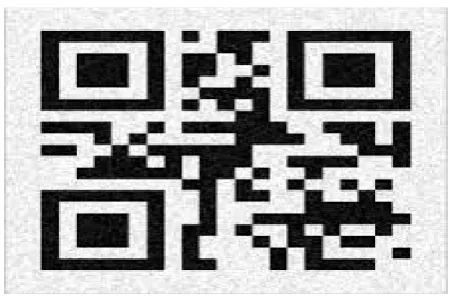
Here we utilize as an example version 2, optically discern Figure 1, which is the size that is most widely utilized, and predicated on [7], [8], [9], [10] analyze the structure of the QR Code.
Fig 1: Structure of QR Code Version 2.
Located in the upper corners and in the bottom left corner enable the decoder software to recognize. the QR code and determine the correct orientation. These patterns also allow
360 degree (omni-directional) high-speed reading of the code. These structures consist of a 3 X 3 black square surrounded by white modules that are again surrounded by black modules.
(2) Separators: The white separators that surround the Finder Patterns have width of one pixel and make it easier to distinguish the patterns.
(3) Timing pattern: A sequence of black and white modules that help the decoder software to determine the width of a single module.
(4) Alignment Pattern: This pattern allows the QR reader to correct for distortion when the code is bent or curved. The alignment pattern appears on version 2 and higher and the number of alignment patterns used depends on the version selected fro the encoding.
(5) Format Information: This section consists of 15 bits and contains the error correction rate and the selected mask pattern of the QR code. The error correction level can be identified from the first two modules of the timing pattern (see figure 2.2). The format information is read first when the QR code is decoded.
International Journal of Research (IJR)
e-ISSN: 2348-6848, p- ISSN: 2348-795X Volume 2, Issue 07, July 2015Available at http://internationaljournalofresearch.org
(7) Error Correction: The data code words are used in order to generate the error correction (EC) codeword’s, which are stored in the error correction section.
(8) Remainder Bits: This section contains empty bits if the data or the error correction bits cannot be divided into 8 bit code words without a remainder.
3. Implementation
In this paper we have culled a watermark as binary image of Burapha University logo. In the frequency domain we perform the embedding process on QR code image utilizing watermark. As shown in the figure we have to decompose the QR code image by two levels utilizing two-dimensional wavelet transformation. To instaurate the embedded watermark we do not require the pristine QR code image subsequently In our algorithm have two steps: watermark embedding and watermark extraction.
Fig 2: Water Marking Diagrams representation.
3.1 Watermark Embedding:
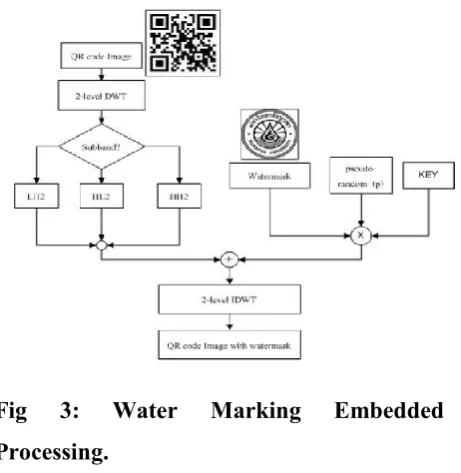
The following outlined procedure is for the embedding process (Fig.3)
Step of watermark image with secret key
i. The watermark image was produced as a bit sequence of watermark S. The data and background values were set to 1 and –1, respectively.
Where N is the total number of pixels in the watermark image.
ii. The pseudo-random sequence (P) whose each number can take a
value either 1 or –1 was randomly
generated with a secret key for embedding and extracting of the watermark.
Step of QR code image
I. The two-level DWT of MxMimage ( ) tiwascomputed for QR code image.
International Journal of Research (IJR)
e-ISSN: 2348-6848, p- ISSN: 2348-795X Volume 2, Issue 07, July 2015Available at http://internationaljournalofresearch.org
Where tiis input image. ′tiis output image with
watermark. ∝is a magnitude factor which is a constant determining thewatermark strength.
III. After that, the inverse DWT (IDWT) was thenapplied to obtain the watermarked image.
IV. Compute PSNR
Fig 3: Water Marking Embedded Processing.
3.2 Watermark Extraction:
The watermark extraction algorithm did not used theoriginal QR code image. A prognostication of the pristine value of the pixels is however needed. Thus, a presage of the pristine value of the pixels was performed utilizing noise elimination technique. In this paper, we utilize an averaging3×3 mask whose elements were fine-tuned to 1/9. The extraction process are outlined as follows (Fig.4):
I. The predicted imageticould be
obtained by smoothing the input image ti*with a spatial
Convolution mask. The prediction of the originalvalue can be defined as:
Where c is the size of the convolution mask. The watermarked image and the predicted image were DWT transformed independently.
International Journal of Research (IJR)
e-ISSN: 2348-6848, p- ISSN: 2348-795X Volume 2, Issue 07, July 2015Available at http://internationaljournalofresearch.org
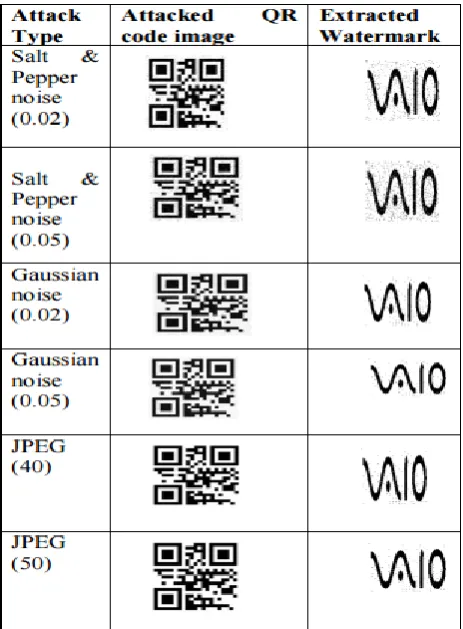
4. Experimental results
Table 1: Illustrate Watermark
values.
Fig 5: Water mark Extraction.
Table 2: PSNR and NC of QR Code
Image.
5. Conclusion
International Journal of Research (IJR)
e-ISSN: 2348-6848, p- ISSN: 2348-795X Volume 2, Issue 07, July 2015Available at http://internationaljournalofresearch.org
obtaining two authentication and secure detail information. The logo image is hided very safely in the QR code image. This method is very simple, convenient, and feasible and virtually utilized for providing copyright aegis against the data hackers. The described method is highly robust to compression and additive noise. In this, we additionally describe technique by utilizing DWT and SVD and gives result for the methods by exhibiting their practical result, which increase more robustness and authentication. By utilizing this we are able to transfer data more securely.7. From the Experimental results determinately it is concluded that by utilizing this system can achieve acceptable certain robustness to video processing which is scarcely possible with the other method.
6. References
[1] F. Hartung, and M. Kutter, “Multimedia watermarking techniques”, Proc. IEEE, vol. 87, no. 3, 1999, pp.1079–1107.
[2] V. Aslantas, “Optimal SVD based Robust Watermarking using Differential Evolution Algorithm”. [3] Chih-Chin Lai,“An improved SVD-based watermarking scheme using human visual characteristics”, Department of Electrical Engineering, National University of Kaohsiung, Kaohsiung 81148, Taiwan
[4] G.Prabakaran, R.Bhavani, M.Ramesh “A Robust QR- Code Video Watermarking
Scheme Based on SVD and DWT Composite Domain “Department of computer science Engineering, AnnamalaiUniversity, Tamilnadu, India.
[5] ThitapaPoomvichid, PantidaPatirupanusara and MahasakKetcham, “The QR Code for Audio Watermarking using Genetic Algorithm” International Conference on Machine Learning and Computer Science (IMLCS'2012) August 11-12, 2012 Phuket (Thailand).
[6] Shanjun Zhang1 * and Kazuyoshi Yoshino2, “DWT-Based Watermarking Using QR Code” By a grand of Research Institute for Integral Science, Kanagawa University.
[7] Lakshmi ChetanaVemuri, Gogineni Krishna Chaitanya, Narasimham “Geometric Invariant Digital Image Watermarking Techniques for QR code”, International Journal of Computer Science and Information Technologies, Vol. 3 (1) , 2012, 3037 – 3041.
[8] “Denso wave incorporated,”
http://www.denso-wave.com/qrcode/index.html
[9] R. Liu, and T. Tan, “An SVD-based watermarking scheme for protecting rightful ownership”, IEEE Trans. Multimedia, vol. 4, 2002, pp.121-128
International Journal of Research (IJR)
e-ISSN: 2348-6848, p- ISSN: 2348-795X Volume 2, Issue 07, July 2015Available at http://internationaljournalofresearch.org
Protection, IEEE Trans. Signal Process, vo.l2, pp. 1- 8, 2006
[11] Nikita Kashyap, “Image Watermarking Using 3-Level Discrete Wavelet Transform (DWT)”Department of Electronics & Telecommunication Engineering, Shankaracharya Technical Campus, Bhilai, India.
[12] GhoutiL, BouridaneA and Ibrahim MK, “Digital image watermarking using balanced multiwavelets” , IEEE Transactions on Signal Processing, 54(4), pp. 1519-1536,2006.
[13] Reddy AA, Chatterji BN, “A new wavelet based logowatermarking scheme”, Conf. Pattern Recognition letters, 26(7), pp. 1019-1027, 2005.
[14] Mei Jiansheng, Li Sukang1 and Tan Xiaomei, “A Digital Watermarking Algorithm Based On DCT and DWT” Nanchang Power Supply Company, Nanchang, China.
[15] Blossom Kaur, Amandeep Kaur, Jasdeep Singh, Steganographic Approach for hiding Image in DCT Domain, International Journal of Advances in Engineering & Technology, July 2011.
[16] Nagaraj V. Dharwadkar, B. B. Amberker&AvijeetGorai” Non-blind Watermarking scheme for color images in RGB space using DWT-SVD”, Department of Computer Science and Engineering
[17] National Institute of Technology, Warangal, India. M. Kutter, F. Jordan, and F. Bossen, "Digital signature of color images using amplitude modulationvol. 3022, pp. 518-526, 199.
Author Profiles
B.Bhavana pursuing her M.Tech, from Vijaya Engineering College, Telangana, India.
Email:[email protected]
P.Praveen completed his M.Techand working as a Assistant Professor, from Vijaya Engineering college,
Telangana,India, Email: [email protected]
9966687097
D. Vijay Kumar completed his M.Techand working as a Associate Professor, HOD , HOD,14-years ExperiencefromVijaya
Engineering college,
Telangana,India,
Email: [email protected]