Design and Implementation of Automatic Vending
Machine using VHDL
1
B.Varalakshmi & 2 SK.Sahir
1M.Tech Research Scholar, Priyadarshini Institute of Technology & Science, Chintalapudi 2HOD, Priyadarshini Institute of Technology & Science, Chintalapudi
Abstract
Nowadays, Vending Machines are well known among Japan, Malaysia and Singapore. The quantity of machines in these countries is on the top worldwide. This is due to the modern lifestyles which require fast food processing with high quality. This paper describes the designing of multi select machine using Finite State Machine Model with Auto-Billing Features. Finite State Machine (FSM) modeling is the most crucial part in developing proposed model as this reduces the hardware. In this paper the process of four state (user Selection, Waiting for money insertion, product delivery and servicing) has been modeled using MEALY Machine Model. The proposed model is tested using Spartan 3 development board and its performance is compared with CMOS based machine.
KEYWORDS
:
FSM; VHDL; VendingMachine; FPGA Spartan 3 development board
1. INTRODUCTION
Vending Machines are used to dispense various products like Coffee, Snacks, and Cold Drink etc. when money is inserted into
of products delivered with total price. This machine can be used at various places like Hotels, Restaurants and food streets. This reduces the time and cost.
1.1 Operation of Vending Machine
I. When the user puts in money, money counter tells the control unit, the amount of money inserted in the Vending Machine. II. When the user presses the button to purchase the item that he wants, the control unit turns
On the motor and dispenses the product if correct amount is inserted.
III. If there is any change; machine will return it to the user.
IV. The machine will demand for servicing when the products are not available inside the machine.
1.2 FSM (Finite State Machine) [2] [3]
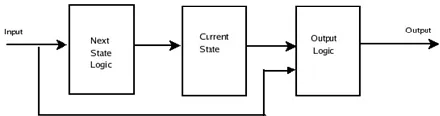
In a Finite State Machine the circuit’s output is defined in a different set of states i.e. each output is a state. A State Register to hold the state of the machine and a next state logic to decode the next state. An output register defines the output of the machine. In FSM based machines the hardware gets reduced as in this the whole algorithm can be explained in one process. MEALY Machine: In this machine model, the output depends on the present state as well as on the input. The MEALY machine model is shown in figure 1.
Figure 1: MEALY Machine Model
MOORE Machine: In Moore machine model the output only depends on the present state. The
MOORE machine model is shown in figure 2.
Figure 2: MOORE Machine Model
The paper is organized as: section 2 describes the related work. Section 3 relates the implementation of Vending Machine and section 4 gives the design methodology with description of states. Section 5 and section 6 shows simulation results and conclusion respectively.
2. RELATED WORK
logic to construct the model for steamed buns vending machine application. Conceptual modelling is described in [6]. In [4] the concept of automatic mobile payment is discussed. This concept is based on the short message payment with the main control module M68HC11 and GPRS module MC35. Thee various methods of designing VHDL based
Machines are discussed in [2], [3] and [9]. Also in *5+ the passenger’s requirements for ticketing system are given. In [7] a coffee vending machine is designed using single electron encoded logic (SEEL). The designed circuit is tested and its power and switching time is compared with the CMOS technology.
3. CONVENTIONAL DESIGN
IMPLEMENTATION
In this paper a state diagram is constructed for the proposed machine which can vend four products that is coffee, cold drink, candies and snacks. Four select (select1, select2, select3, select4) inputs are taken for selection of products. Select1 is used for the selection of snacks. Similarly select2, select3, select4 are used for coffee, cold drink and candies respectively. Rs_10 and rs_20 inputs represents rupees 10/- and 20/- notes respectively. A cancel input is also used when the user wants to withdraw his request and also the money will be returned through the return output. Return, product and change are the outputs. Return and change vectors are seven bits wide. Money is an in/out signal which can be
updated with the total money of all products delivered at a time. Money signal is seven bits wide. Money_count is an internal signal which can be updated at every transition. This signal is also seven bits wide. If the inserted money is more than the total money of products then the change will be returned through the change output signal. The products with their prices are shown by table 1. There are also two input signal clk and reset. The machine will work on the positive edge of clock and will return to its initial state when reset button is pressed. The proposed vending machine is designed using FSM modellingand is coded in VHDL language. The detail of the entire signal with their direction and description is shown in table 2.Table1:Productswiththeirprices
S.No. Products Price
1. Snacks 30/- 2. Coffee 40/- 3. Colddrink 40/- 4. Candies 30/-
Table2:Inputs/OutputswithRemarks
Name Width Directio n
Descriptio n
cl k
1 input Clock Reset 1 Input Synreset
Sel1 1 input Snacks Sel2 1 input Coffee Sel3 1 input Colddrink Sel4 1 input Candies Cancel 1 input Cancel Money 7 inout Totalmoney
Rs_10 1 input Rupees10/- Rs_20 1 input Rupees20/- Produc
t
1 output Productout Change 7 output Extrachang
e
4. DESIGN METHODOLOGY
4.1 CONVENTIONAL DESIGN
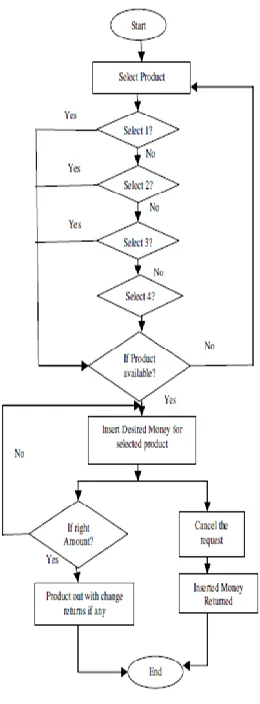
The state diagram mainly consists of four states (User Selection, Waiting for the money insertion, product delivery and servicing (when product_not_available=’1’)). Initially when the reset button is pressed, the machine will be ready for the users to select the product. This state is the initial state of the design. After this the user will select the product to be dispensed. This state can be one of the select1, select2, select3 and select 4. The machine can accept only two types of notes i.e. rupees 10/- and 20/-. Let us suppose that the user selects sel1 input. The machine will firstly check that whether the products are available in the machine or not. After this the control unit will move to the waiting state, where it will wait for the money to be inserted. Then if rupees 10/- note is inserted then the machine will go to state_1 and wait until the desired money is inserted. And if rupees 20/- note is inserted the machine will move to state_2 and then wait until 30/- rupees are inserted to the machine. When the desired amount is inserted the machine will go to the snacks state and snacks will be delivered at the product output. If products are not available in the machine then the control unit will demand for servicing and after service the machine will get reset. This methodology is explained using a flow diagram shown in figure 3.
Figure 3: Flow Chart for Proposed Vending Machine
Description of states
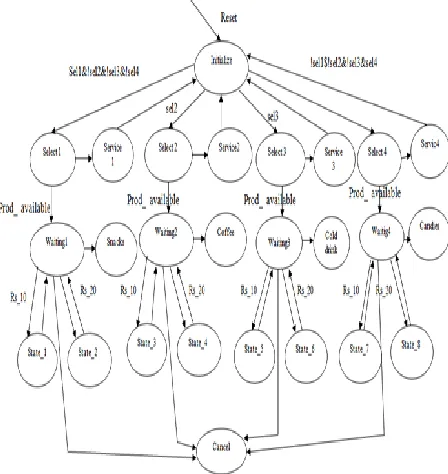
The selection of products and all the states are shown below in figure 4.
• When initialize=> money_count=0; Change=0; Product=0; • When select1=> Sel1&!sel2&!sel3&!sel4
When product_available=1 => nx_st1<= waiting1;
When product_available=0 => nx_st1<= service1;
• When waiting1=>
When rs_10&!rs_20 => nx_st1<=state_1; When !rs_10&rs_20=> nx_st1<= state_2; Change=0; product=0;
When money_count>=30 nx_st1<= snacks;
• When state_1=> Rs_10=1 & rs_20=0; Change=0; Product=0; Money_count=money_count+10;
Figure 4: Finite State Machine Diagram of Vending Machine
When state_2=> Rs_10=0 & rs_20=1; Change=0; Product=1; Money_count=money_count+20; • When snacks=>
Money_count>=30; Product=1;
Change=money_count-30; Snack_count=snack_count-1; • When service=>
snack_count= 4 product<=0;
• When cancel1=> cancel=1
return<=money_count;
Similarly we can select other products (coffee, Cold drink and candies).
4.2. PROPOSED DESIGN:
The design of the vending Machine deals with same logic as the conventional design but there will be few modifications. Here this design mainly implements using FSM for the best operating of the vending machine. So this structure has about 36 states which have been implemented using VHDL language and for Verilog HDL we have about 26 states. In this design we are initializing with logic with money inserted concept i.e. if only if least money (money=5) has been inserted then only the items will be displayed directly for the selection process. This design provides us a unique way of dealing with the states and also the internal complexities. The design only waits if the money is not entered, as soon as the least amount is entered the process starts and the available items are displayed on the screen itself rather than continuously checking for each product
items. This will reduce the time delay for each person to operate the vending machine. The rest of the design is more or like similar to the conventional design.
5. SIMULATION RESULTS
5.1 CONVENTIONAL DESIGN
The state diagram shown in figure 4 is simulated using Xilinx ISE Simulator. Simulation Waveforms for the selection of four products like snacks is shown in figure 5 and 6 respectively with servicing feature when products are not available in the machine and change return features when the money inserted is more than the money of the product.
Let us take an example that the user wants to take Snacks. When one selects sel1 button, the machine will check that whether the products are available or not, if available then it will go to the waiting state and wait for total money insertion. If rs_10 note is inserted it will go to state_1 and if rs_20 note is inserted it will so to state_2 and check whether money_count>=30 or not. If the money_count>- 30 then machine will go to state snacks and vend the product.
Figure6:Simulationwaveformwhensnack_count=0
Iftheuserwantstocanceltherequest,candosobypressingthecancelbuttonandthewhole moneyenteredwillbereturnedtotheuser.Thisisshowninfigure7.
Figure7: SimulationwaveformshowingCancelOperation TheRTLviewofthemachineisshowninfigure8.
Figure8: RTLviewofVendingMachine.
Figure : Representing the Vending Machine using Verilog HDL for the coffee order
Figure : Representing the Balance amount for the order which has been done (ONLY VHDL)
Thedesignsummaryoftheconventionalmachineisshownbelowintable3. Table3:DeviceUtilizationSummary
Logicutilization Used Available Utilization
NumberofSlices 228 3584 6% NumberofSliceflipflops 98 7168 1% Numberof4inputLUT’s 432 7168 6% NumberofbondedIOB’s 31 173 17%
NumberofGCLK’s 1 8 12%
Parameter usingFPGA UsingSingleElectron EncodedLogic(SEEL)
UsingCMOS technolo gy SwitchingSpeed 9.3ns 12.53n
s 300ns
The present FPGA based vending machine controller is implemented using FSMs with the help of Xilinx ISE Design Suite 12.4. The design is verified on the FPGA Spartan 3 development Board. State machines based vending Systems enhance productivity, reduce system development cost, and accelerate time to market. Also FPGA based vending machine give fast response and easy to use by an ordinary person. The enhancement of the design is mentioned in the section 4.2 as proposed design. This design is compared based on the languages i.e. VHDL and Verilog since these play key role in simulation as well as synthesis (pre and post) which have mention in simulation results. The next stage of this study is to convert this model into hardware and to calculate the total power consumption of the machine.
CONCLUSSION:
. This paper describes the designing of multi select machine using Finite State Machine Model with Auto-Billing Features. Finite State Machine (FSM) modeling is the most crucial part in developing proposed model as this reduces the hardware. In this paper the process of four state (user Selection, Waiting for money insertion, product delivery and servicing) has been modeled using MEALY Machine Model. The
proposed model is tested using Spartan 3 development board and its performance is compared with CMOS based machine.
REFERENCES
[1]FauziahZainuddin, NorlinMohd Ali, RoslinaMohdSidek, AwanisRomli, NooryatiTalib&Mohd.Izham Ibrahim (2009) “Conceptual Modeling for Simulation: Steaming frozen Food Processing in Vending Machine” International Conference on Computer Science and Information Technology, University Malaysia Pahang, pp.145-149. [2] Xilinx Inc., Spartan 3 Data sheet: http://ww w.xilinx.com. [3] Bhaskar “VHDL primer” Second Edition,
*4+ Peter Minns& Ian Elliott, “FSM-based Digital Design using Verilog HDL”, John Wiley & Sons Ltd 2008.
[5] Zhang Wen & Zhang Xin Long (2010) “Design and Implementation of automatic vending machine Based on the short massage payment” International Conference on Information and Communication technology in Electrical Sciences, Neijiang, Sichuan, China.pp.978-981.
Transport Ticketing System” Proceedings of the 8th International IEEE Conference on Intelligent Transportation Systems Vienna, Austria, pp-32-37.
[7] M. Zhou, Q. Zhang & Z. Chen (2006), “What Can Be Done to Automate Conceptual Simulation Modelling?” Proceedings of the 2006 Winter Simulation Conference, pp. 809 – 814.
[8] Biplab Roy &Biswarup Mukherjee (2010) “Design of Coffee Vending Machine using Single Electron Devices” Proceedings of 2010 International Symposium on Electronic System Design. Pp 38-43.
[9] C. J Clement Singh, K Senthil Kumar, JayantoGope, SumanBasu&Subir Kumar Sarkar (2007) “ Single Electron Device based Automatic Tea Vending Machine” proceedings of International Conference on Information and Communication Technology in Electrical Sciences (ICTES 2007) , pp 891-896.