
RMAC – A Lightweight Authentication Protocol for Highly Constrained IoT
Devices
Ahmad Khoureich Ka
Department of Computer Science, University of Alioune Diop de Bambey,Senegal
Abstract. Nowadays, highly constrained IoT devices have earned an important place in our everyday lives. These devices mainly comprise RFID (Radio-Frequency IDentification) or WSN (Wireless Sensor Networks) components. Their adoption is growing in areas where data security or privacy or both must be guaranteed. Therefore, it is neces-sary to develop appropriate security solutions for these systems. Many papers have proposed solutions for encryption or authentication. But it turns out that sometimes the proposal has security flaw or is ill-suited for the constrained IoT devices (which has very limited processing and storage capacities). In this paper we introduce a new authentication protocol inspired by Mirror-Mac (MM) which is a generic construction of authentication protocol proposed by Mol
et al. Our proposal namedRMACis well suited for highly constrained IoT devices since its implementation uses simple and lightweight algorithms. We also prove thatRMACis at least as secure as theMMprotocol and thus secure against man-in-the-middle attacks.
Key words: IoT, MAC, authentication, lightweight protocol, Xor-Cascade Encryption.
1 Introduction
The Internet of Things (IoT), refers to a wide variety of devices that can collect, share data and more to connect to the internet. These devices mainly comprise RFID or WSN components [1]. Data security and privacy constitute one of the biggest issues with the IoT since extremely sensitive data can be collected and shared anonymously [1]. Therefore, in order to maintain the growing interest (and trust) in connected objects in healthcare, in the retail supply chain and in the automotive industry to name a few, security in their implementation must be taken into account. Unfortunately, classical cryptographic primitives require important processing and storage capacities that constrained IoT devices do not have [2]. Therefore, it is necessary to invent secure and lightweight solutions. But designing such lightweight protocols is not easy, since they must take into account security, hardware efficiency and energy consumption. Nevertheless, several solutions for lightweight authentication protocol have been proposed. We can mention HB-like protocols [3, 4, 5], Message Authentication Codes [6, 7, 8] exploiting the difficulty of the LPN problem and others [9, 10, 11, 12, 13, 14, 2].
In this paper, we propose a new 3-round MAC authentication protocol namedRMAC(stands for Random MAC). One might ask why a new lightweight authentication protocol since there is a bunch of proposals. The answer is simply because many of the aforementioned proposals have been broken [15, 16, 17, 18, 19, 20] or have an storage and transmission cost unacceptably high [4, 6] for highly constrained IoT devices. This new protocol is inspired by theMM proposal [21], i.e. a 2-round authentication protocol based on weak MACs and provably secure against man-in-the-middle attacks. It also exploits the well-studiedr-round Xor-Cascade Encryption, i.e. a framework for designing block ciphers.
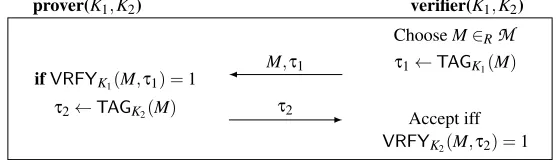
The main idea behind theMMproposal is that the prover responds to the verifier only if the pair(M,τ1)received is correct (see figure 1). Since theMACis unforgeable under random-message attack (uf-rma), any modification of the pair(M,τ1)stops the execution of the protocol. Therefore, the attacker has very little chance to have any information about the keys used in the authentication protocol. But the weakness of this method is that the attacker can use an isolated prover as a verification oracle because he can send a pair(M,τ1)to the prover and if the latter responds he will know that the pair is good and at the same time he will have for freeTAGK2(M)for anMof his choice. TheRMAC
protocol that we propose here eliminates this shortcoming.
information about the key with less than 2κ+n/2queries to both the 2-round Xor-Cascade Encryption itself and to its inner permutations. But this threshold can be easily reached when the attacker has at his disposal a genuine prover. Therefore, in order to overcome this weakness, we execute a key establishment protocol before the core authentication protocol to renew the key at each authentication session.
This paper is structured as follows. A brief introduction is done in section 1 followed by some definitions in section 2. Section 3 presents existing work. OurRMACprotocol is described in section 4 followed by the security arguments that weighs in its favor in section 5. Finally, a conclusion is given in section 6.
2 DEFINITIONS
2.1 r-round Xor-Cascade Encryption
The r-round Xor-Cascade Encryption (which can also be seen as a Generalized Even-Mansour Cipher1) can be considered as a framework for building block ciphers from a set of random permutations. Consider an ensemble
P
={Pi}i∈{0,1}κ of random permutations of {0,1}n, the r-round Xor-Cascade Encryption XCrP with r≤2κ de-fines a block cipher with message space {0,1}n and key space{0,1}(r+1)n+κr as follow: given a key (k,w)wherek= (k0,k1,· · ·kr)∈({0,1}n)r+1,w= (i1,i2,· · ·ir)∈({0,1}κ)rand a messagex∈ {0,1}n,
XCrP(k,w,x) =kr⊕Pir(kr−1⊕Pir−1(· · ·Pi2(k1⊕Pi1(k0⊕x))· · ·)) (1)
A considerable number of papers [22, 23, 24, 25] have shown that, in the model where the adversary is given oracle access to inner permutationsPi∈
P
of her choice and their inverses and to the outer permutation XCrP, the security of ther-round Xor-Cascade Encryption approaches 2κ+nwhenris increasing. Also other papers explored attacks on these constructions [27, 28, 29, 30].2.2 Message Authentication Codes
A message authentication code (MAC) is a triple of probabilistic polynomial-time algorithms (KGEN,TAG,VRFY) such that:
1. KGENis the key generation algorithm. It takes as input a security parameter 1nand outputs a keyKfrom a specified keyspace
K
.2. TAGis the MAC tag generation algorithm (may be randomized). It takes as input a keyKand a messageMfrom a specified message space
M
and outputs a MAC tagτ←TAGK(M).3. VRFYis the verification algorithm (assumed to be deterministic). It takes as input a keyK, a messageM and a MAC tagτand outputs a bitb=VRFYK(M,τ). If theTAGalgorithm is a cipher as in ourRMACprotocol,VRFY outputs 1 ifτ=TAGK(M)or 0 otherwise.
The security of a MAC is related to its resistance against forgery. The strongest notion of MAC security is suf-cma, that is strongly unforgeable under chosen-message attack. It refers to MACs for which any adversary has negligible chance to generate a valid MAC tag for a new message (a message whose MAC tag is not previously seen by the adversary) even if she has seen MAC tags for messages of its choosing. OurRMACprotocol is based on a weaker MAC (uf-rma MAC) that is a MAC which is unforgeable only under random-message attack. That is, the MAC is unforgeable if the adversary does not have the ability to perform chosen-message attack. The adversary can only see MAC tags for random messages (messages for which she has no control).
2.3 MITM secure authentication protocol
Man-in-the-middle (MITM) attacks are the most powerful attacks against authentication protocols [6]. The MITM adversary is allowed to interact several times (at will and even concurrently) with the prover and the verifier. An authentication protocol achieves MITM security if any MITM adversary cannot bring the verifier to accept.
3 EXISTING WORK
A number of works has been done on lightweight authentication protocols. There is HB-like protocols [3, 4, 5] which take advantage of the difficulty of solving the learning parity with noise (LPN) problem. The probabilistic nature of the verifier’s final response (accepting or rejecting the prover) in HB-like protocols is generally exploited to develop attacks against them [17, 18, 19]. In addition, despite their attractive design, which implies low computing resource requirements, their communication cost is often very high. Thus, it is hard to see an efficient HB-like protocol secure against man-in-the-middle attacks. However, there are other lightweight authentication protocols based on MACs. For example SQUASH [2] based on the Rabin encryption scheme, and others based on the LPN problem [6, 7, 31]. The proposals of Kiltz et al.[6] are MAC-based authentication protocols exploiting the difficulty of the LPN problem. These protocols have the advantage of having a tight reduction to the LPN problem and therefore secure against man-in-the-middle attacks. But they suffer from the large size of their keys and their large communication complexity. All these drawbacks make these protocols poorly suited for highly constrained IoT devices. More recent proposals have been made [9, 10, 11, 12] but it turns out that [9, 10] fail to achieve the claimed security level [15, 16]. The proposal of Molet al.named Mirror-Mac (MM) [21] has caught our attention.MMis a generic construction of a 2-round MITM secure protocol (see figure 1). Molet al.have proven that when instantiated with an uf-rma (unforgeable under random-message attack) MAC,MMis secure even if the adversary interacts at will with an arbitrary number of both prover and verifier instances. That is the adversary has negligible chance to make the verifier to accept. Our proposalRMACis inspired byMM.
prover(K1,K2) verifier(K1,K2) ChooseM∈RM
τ1←TAGK1(M) M,τ1
ifVRFYK1(M,τ1) =1
τ2←TAGK2(M) τ2 Accept iff VRFYK2(M,τ2) =1
Fig. 1. The generic MM construction of a 2-round MITM secure protocol proposed by Mol et al. [21]. using MAC = (KGen,TAG,VRFY) where the keysK1 andK2 are generated byKGen,TAGtakes as input a keyK and a messageM in a mes-sage spaceM and outputsTAGK(M)andVRFYtakes as input a keyK, a messageM and a MAC tagτin the tag spaceT then outputs a decisionVRFYK(M,τ)∈ {0,1}.
4 THE NEW PROTOCOL
Traditionally, a MAC authentication is a 2 steps protocol. The verifier and the prover share a common secretK. The verifier sends a challenge M to the prover that calculates and returns the corresponding tag τ←TAGK1(M)to the
verifier. The latter checks if the received tag is correctVRFYK1(M,τ) =1 to accept the prover. For such a scheme to be secure it is necessary that the MAC be suf-cma since the adversary has a direct access to it and can make chosen-message attacks. Such MACs are generally constructed from pseudorandom functions unusable in a highly constrained environment. A solution for highly constrained IoT devices is to use a MAC consisting of lightweight algorithms (certainly less sure than conventional MACs) and embed it in a protocol from which the adversary will not have a direct access to make chosen-message attacks. Therefore, the adversary is forced to be passive. It’s that solution that we implement with this new protocol (RMAC).
RMAC). The RMAC protocol also uses a new implementation of a Xor-Cascade Encryption consisting of only two rounds as an uf-rma message authentication code. Using this small number of rounds guaranties latency and low-cost hardware implementation [32]. In the rest of this paper, we call Small-Cipher orSCthat implementation of the 2-round Xor-Cascade Encryption.
We know from [22] that the 2-round Xor-Cascade Encryption is secure up to 2κ+n/2query complexity. When such construction is implemented in highly constrained devices (this must be a lightweight implementation) with a fixed key, the security threshold of 2κ+n/2queries can be easily reached. Thus, in order to make such an attack difficult and burdensome, we renew the key with a lightweight key establishment protocol.
4.1 The Lightweight Key Establishment Protocol
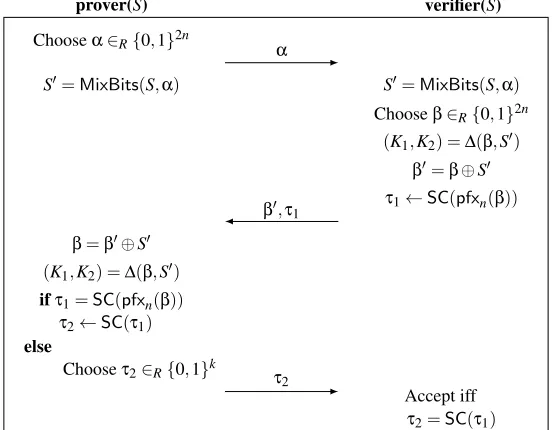
The lightweight key establishment protocol we describe here is run before the core authentication protocol. Figure 2 shows how the key establishment protocol works. The two parties share a secret keySof size 2n. The prover begins by drawing uniformly at randomαfrom{0,1}2nand then sends it to the verifier. They both computeS0=MixBits(S,α)
whereMixBits is a mixing function. After that, the verifier draws uniformly at randomβfrom {0,1}2n, computes β0=β⊕S0 and sends the result to the prover. Finally the two parties derive twon-bit long secret keysK1andK2by using∆(β,S0). The function∆acts as a comb onβwithnteeth randomly spaced, the space between the teeth is define byS0 (see algorithm 1). Any secure lightweight mixing function can be used but here we propose to use the mixing function introduced in the Gossamer protocol because it has an extremely lightweight nature [14] (see below).
The MixBits function Z = MixBits(X,Y) Z = X;
for(i=0; i<32; i++) { Z = (Z>>1) + Z + Z + Y ; }
Algorithm 1:∆(X,S). Deriving two bit stringsK1andK2fromXusingSas a comb. Input: Two 2n-bit stringsX=x1. . .x2nandS=s1. . .s2n
Output: Twon-bit stringsK1andK2 Processing:
1 InitializeK1←null
2 InitializeK2←null
3 Initializeb←0
/* wt denotes Hamming weight */
4 ifwt(S)>nthen b←1
5
6 fori=1. . .2ndo
7 ifsi=band|K1|<nthen
8 K1←K1||xi
9 else K2←K2||xi
10
4.2 Design Details of The Core Authentication Protocol
(β0,τ1)to the prover. Upon receiving(β0,τ1), the prover checks whetherτ1is equal toSC(pfxn(β)), and if so, sends τ2=SC(τ1)to the verifier, if not, sends a randomn-bit string to the verifier. The latter accepts the prover if and only if
τ2=SC(τ1).
prover(S) verifier(S)
Chooseα∈R{0,1}2n
α
S0=MixBits(S,α) S0=MixBits(S,α)
Chooseβ∈R{0,1}2n
(K1,K2) =∆(β,S0)
β0=β⊕S0 τ1←SC(pfxn(β))
β0,τ1
β=β0⊕S0
(K1,K2) =∆(β,S0)
ifτ1=SC(pfxn(β))
τ2←SC(τ1) else
Chooseτ2∈R{0,1}k
τ2
Accept iff
τ2=SC(τ1)
Fig. 2.TheRMACAuthentication Protocol usingSCwith keysK1,K2,S1andS2.pfxn(β)is the prefix of lengthnofβ.
Now we present our Small-Cipher2(SC) which is an extremely lightweight implementation of the 2-round Xor-Cascade Encryption. It is used as a message authentication code (MAC) by RMAC. Its inner permutation is an SP-network denotedRBOX(stands for Random Box). Basically, an SP-network applies to its input (a plaintext and a key) many rounds of transformation each consisting of a random substitution of value of bits along the input text (using an S-box), a permutation of bit positions (using a P-box) and a key mixing. The P-boxes of SP-networks are usually a fixed permutation of the bit positions of state but here we introduce keyed one.
In the rest of this section, we successively present the S-box, the P-box,RBOX(the Small-Cipher inner permutation) and Small-Cipher itself.
The S-box. It consists of the 4-bit to 4-bit S-box borrowed from the ultra-lightweight block cipher PRESENT [33]. This S-box is designed with hardware efficiency in mind for resource-limited devices. The following table recalls its action in hexadecimal notation.
x 0 1 2 3 4 5 6 7 8 9 A B C D E F
S-box[x] C 5 6 B 9 0 A D 3 E F 8 4 7 1 2
The P-box. LetL:{0,1}n× {0,1}n→ {0,1}nbe the bit positions permutation we introduce here. That is for every
K∈ {0,1}n,L(K,·)orL
K(·)is a permutation on{0,1}nthat preserves the hamming weight of its input. The way that
LK(·)computes the image of an inputX∈ {0,1}nis given by algorithm 2.
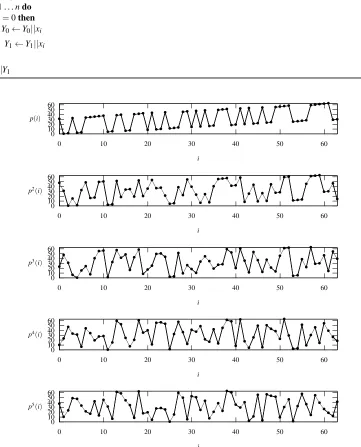
For a randomly chosenK∈ {0,1}n, the first plot from the top of figure 3 shows howL
Kmaps the original position of a bit of state to its new position. Note that the diffusion power ofLKis weak because some streak of consecutive bits of state are not perturbed. We can also see from the plotting two groups of points forming two superimposed slopes. Bits of K, which are equal to 1, give the group at the top and bits of K, which are equal to 0, give the group at the bottom. In order, to achieve a better diffusion, we can iterateLK a number of time. Figure 3 shows the improvement obtained by iteratingLK.
Algorithm 2:LK(X). Bit positions permutation.
Input: Twon-bit stringsK=k1. . .knandX=x1. . .xn Output: Ann-bit stringsY
Processing:
1 InitializeY0←null
2 InitializeY1←null 3 fori=1. . . ndo
4 ifki=0then
5 Y0←Y0||xi
6 else Y1←Y1||xi
7
8 Y←Y0||Y1
0 10 20 30 40 50 60
0 10 20 30 40 50 60
p(i)
i • • • • • • • • • • • • • • • • • • • • • • • • • • • • • • • • • • • • • • • • • • • • • • • • • • • • • • • • • • • • • • • • 0 10 20 30 40 50 60
0 10 20 30 40 50 60
p2(i)
i • • • • • • • • • • • • • • • • • • • • • • • • • • • • • • • • • • • • • • • • • • • • • • • • • • • • • • • • • • • • • • • • 0 10 20 30 40 50 60
0 10 20 30 40 50 60
p3(i)
i • • • • •• • • • • • • • • •• • • • •• • • • • • • • • • • • ••• •• • •• • • • • • • • • •• • • • • • • • • • • • • • • 0 10 20 30 40 50 60
0 10 20 30 40 50 60
p4(i)
i •• • • • • • • •• • • • •• • •• • • • • • • • • • • • • • •• • • • • •• • • • • • • • • • • • • • • • • • • • • • • • •• 0 10 20 30 40 50 60
0 10 20 30 40 50 60
p5(i)
i • •• • • • • • • • • • • • • • • • • • • • • • • • • • • • • • • • •• • • • • • •• •• • • • • • • • • • • • • • • • • • • •
Fig. 3.Improvement of the diffusion power by iteratingLKwhereKis the 64-bit string93E6748D4E52787C16. From top to bottom
we have the 1stto the 5thiteration ofLK.
TheRBOX. It is composed of the S-box presented earlier surrounded by two iterated P-Box layers. Since our P-boxes are keyed, letK1andK2be twon-bit keys, thereforeRBOXK1K2 consists of five iterations ofLK1followed by the S-box
and five iterations ofLK2 (see figure 4 for a depiction ofRBOXK1K2).
LK1 S-box LK2
×5 ×5
Fig. 4.RBOXK1K2. The P-boxesLK1andLK2are iterated five times.
The Small-Cipher (SC). In an initial phase, both the prover and the verifier hold the same 2n-bit secret keyS. Let S1=pfxn(S)andS2=sfxn(S)be respectively the prefix of lengthn ofS and the suffix of lengthn ofS. From the execution of the lightweight key establishment protocol the two parties obtained twon-bit session keys K1andK2. Since it is only required in the iterated Even-Mansour cipher to have the 3-round keys to be 2-wise independent [34]. Then, by using the two independentn-bit permutationsRBOXK1S1 andRBOXS2K2 and the round keys(K1,K1⊕K2,K2)
we have our implementation of the 2-round Xor-Cascade Encryption depicted in Figure 5.
RBOXK1S1 RBOXS2K2
K1 K1⊕K2 K2
Fig. 5.Small-Cipher using keysK1,K2,S1andS2
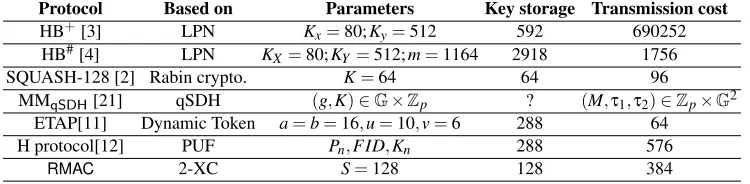
A comparison ofRMACwith other authentication protocols is given in table 1.
Table 1.Storage and transmission cost of some authentication protocols.Rabin crypto.stands for Rabin cryptosystem,qSDHfor q-Strong Diffie-Hellman,PUFfor Physical Unclonable Function and2-XCfor 2-round Xor Cascade Encryption. Values are given in bits.
Protocol Based on Parameters Key storage Transmission cost
HB+[3] LPN Kx=80;Ky=512 592 690252
HB#[4] LPN K
X=80;KY=512;m=1164 2918 1756
SQUASH-128 [2] Rabin crypto. K=64 64 96
MMqSDH[21] qSDH (g,K)∈G×Zp ? (M,τ1,τ2)∈Zp×G2 ETAP[11] Dynamic Token a=b=16,u=10,v=6 288 64
H protocol[12] PUF Pn,FID,Kn 288 576
RMAC 2-XC S=128 128 384
5 SECURITY ARGUMENTS
In this section, we present the security analysis ofSCand provide security proofs forRMAC.
5.1 Security ofSC
The Structure ofSC. SCis an implementation of the 2-round Xor-Cascade Encryption usingRBOX as its inner permutation. The 2-round Xor-Cascade Encryption is secure up to 2κ+n/2query complexity [22]. ForSC,
SCis theoretically secure up to 25n/2queries to the underlyingRBOXes and toSCitself. This bound is theoretical since theRBOXes cannot be considered as random permutations. This is why it is advantageous to change theRBOXes keys at each execution ofRMAC. Also, note that throughRMACit is difficult for an adversary to make a chosen plaintext attack (and even more difficult a chosen ciphertext attack) againstSC.
Resistance to Linear and Differential Cryptanalysis. Linear and differential cryptanalysis [35, 36] are among the most famous tools used to analyze the security of a block cipher. But those cryptanalysis tools are heavily dependent on the S-boxes involved in the linear approximation or in the differential characteristic as we traverse the SP-network (the so-called active S-boxes). Theorem 1 implies that, using the iterated linear layerLK with a secret keyK makes complex to follow a bit of state through the SP-network. Therefore, it is very unlikely to determine the active S-boxes which are crucial to linear and differential cryptanalysis.
Lemma 1.Let t≥0be an integer, i be the position of a bit of state and pt(i)its position after t iterations of L K.
pt(i) =i
t−1
∏
r=0(1−kpr(i)) + t−1
∑
r=0"
kpr(i)(n−w+2wpr(i))−wpr(i) t−1
∏
u=r+1(1−kpu(i))
#
(2)
Where kpr(i)is the bit at position pr(i)of K, w the Hamming weight of K and wpr(i) the Hamming weight of the prefix of length pr(i)of K.
Proof. We prove lemma 1 using the induction principle. Fort=0 we havep0(i) =i. Thus equation 2 is true fort=0.
Now we assumet>0 and show that equation 2 holds fort+1 iterations ofLK. From algorithm 1 we have:
p(i) =
i−wi ifki=0
n−w+wi otherwise which leads to:
p(i) =i(1−ki) +ki(n−w+2wi)−wi So
pt+1(i) =pt(i)(1−kpt(i)) +kpt(i)(n−w+2wpt(i))−wpt(i) By supposing that equation 2 is true, we have:
pt+1(i) =
"
i
t−1
∏
r=0(1−kpr(i)) + t−1
∑
r=0"
kpr(i)(n−w+2wpr(i))−wpr(i) t−1
∏
u=r+1(1−kpu(i))
##
(1−kpt(i)) +kpt(i)(n−w+2wpt(i))−wpt(i)
=i(1−kpt(i)) t−1
∏
r=0(1−kpr(i)) + (1−kpt(i)) t−1
∑
r=0"
kpr(i)(n−w+2wpr(i))−wpr(i) t−1
∏
u=r+1(1−kpu(i))
#
+kpt(i)(n−w+2wpt(i))−wpt(i)
=i
t
∏
r=0(1−kpr(i)) + t−1
∑
r=0"
kpr(i)(n−w+2wpr(i))−wpr(i) t
∏
u=r+1(1−kpu(i))
#
+kpt(i)(n−w+2wpt(i))−wpt(i)
=i
t
∏
r=0(1−kpr(i)) + t
∑
r=0"
kpr(i)(n−w+2wpr(i))−wpr(i) t
∏
u=r+1(1−kpu(i))
This final equation completes the proof.
Theorem 1.If K is secret, then after three iterations of LK the position of a bit of state is no longer related to its
original position but depends only on fixed unknown data (as they are determined by K).
Proof (Sketch of the proof).We show that the termi∏tr−=10(1−kpr(i))on the right-hand side of the equation given by lemma 1 vanishes after 3 iterations ofLK.
The positionspr(i)for 0≤r≤t−1 of bits ofKare not independent but the corresponding bits are independent since all bits ofKare drawn uniformly at random from{0,1}. Hence 1−kpr(i)for 0≤r≤t−1 can be considered as a random variable with equal probability of taking value 0 or 1. We know from [37] that when we draw uniformly at randomtbits, the longest streak of consecutive 1 we expect to have isΘ(log2t). Therefore, fort≥3 there is necessarily someuin the set of integer{0,· · ·,t−1}for which 1−kpu(i)=0.
Resistance to Algebraic Attacks. Algebraic attacks are known plaintext attacks. The adversary expresses the whole cipher as a system of multivariate algebraic equations and then tries to solve it using known plaintext-ciphertext pairs in order to recover the secret key.SCis a 2-round cipher that uses a 4-bit to 4-bit S-box and operates on 64-bit block. Each S-box can be described by 21 equations in 8 variables (4 inputs and 4 outputs). Therefore,SCcan be expressed as a system of 672 multivariate equations in 256 variables. The number of equations is not impressive. However, the difficulty of using an algebraic attack againstSCrelies on the fact that it will not be easy (as theorem 1 implies) to bind the input variables of the S-boxes of the first round to the bits of the plaintext, to bind the output variables of the S-boxes of the first round to the input variables of the S-boxes of the second round and to bind the output variables of the S-boxes of the second round to the bits of the ciphertext. Consequently, it is very unlikely that algebraic attack be effective againstSC.
5.2 Security ofRMAC
Security of The Lightweight Key Establishment Protocol Any modification onαwill only change the way thatK1 andK2are extracted fromβ. A modification ofαwill also change the value ofβ0(which is a one-time pad encryption
ofβ) transmitted to the prover by the verifier. Sinceβis drawn uniformly at random from{0,1}2n, the attacker derives
no benefit from its actions onα.
Security of The Core Authentication Protocol The following theorem states thatRMAChas the same resistance to MITM attacks asMM.
Theorem 2.IfMMinstantiated with an uf-rma MAC is a man-in-the-middle secure authentication protocol, thenRMAC
instantiated with the same type of MAC is a man-in-the-middle secure authentication protocol.
Proof. For this proof, we use the reduction technique. That is from an instance of theMM protocol we simulate an instance of theRMACprotocol. And show that if there is a MITM adversary that has a non-negligible advantage on RMAC, it can be used to mount a MITM attack againstMMwith a non-negligible success probability.
Now, let
A
be a MITM probabilistic polynomial-time adversary attacking RMACwith a non-negligible success probability. We construct a MITM probabilistic polynomial-time adversaryA
0that attempts to attackMM. So, from aninstance of theMMprotocol,
A
0simulates forA
an instance ofRMACas follows:1.
A
0begins by drawing uniformly at randomαfrom{0,1}2nand sends it to
A
.2. Upon receiving(r,τ1)from theMMverifier,
A
0draws uniformly at random r0 from{0,1}nand sends(r||r0,τ1) toA
. Since in theRMACprotocolpfxn(β0)is unrelated tosfxn(β0)andβ0is obtained from a one-time pad of two unknown bit strings, the view ofA
in this step is identically distributed to the view it has from the second step of RMAC.3.
A
0finishes the simulation by forwardingτ2received from theMMprover to
A
, or if it doesn’t receive nothing, sends a uniformly and randomly selectedn-bit string toA
. Since the MAC is uf-rma, the adversary is not allowed to see MAC tags for chosen messages. Therefore, it will not be able to distinguishτ1=TAGK1(r)fromτ2=TAGK1(τ1).We claim that this simulation is correct since the view of
A
when used as a sub-routine byA
0is identically distributed to the view it has when it interacts directly withRMAC. In conclusion,A
has the same advantage overRMACasA
0hasoverMM(which is negligible [21]).
Encapsulating the challenge in β0 using the one-time pad encryption reduces the security requirements on SC. Therefore, even if the attacker succeeded in finding a valid message-tag pair(m,τ), it has very little chance to reach
the next step of the protocol since it will not know how to encapsulate minβ0. Another aspect that reinforces the security of our protocol is that the prover returns a response to the verifier regardless the outcome of the verification (pfxn(β),τ1). This prevents the attacker from using theRMACprover as a verification oracle since it has no way of detecting a change in the behavior of theRMACprover following the outcome of the verification of the pair(β0,τ1). This is a one more security element that our protocolRMAChas over theMMprotocol. All this, allows us to say that our protocol can be seen as a generic construction (SCcan be replaced by a uf-rma MAC) at least as secure asMM which is a man-in-the-middle secure authentication protocol.
6 CONCLUSION
In this paper, we have presentedRMACa new lightweight MAC authentication protocol for highly constrained IoT devices. RMAC consists of ultra-lightweight algorithms and takes advantage — but also adds some extra steps — of the design ofMM, a two-round generic construction secure against man-in-the-middle attacks introduced by Mol et al. It also uses a new implementation of the extensively studied 2-round Xor-Cascade Encryption as a message authentication code. AlthoughSCis not intended to be a block cipher for resource constrained devices, we have shown that it is resistant to linear or differential cryptanalysis and to algebraic attacks. When viewed as a generic construction (SCreplaced by an unforgeable under random-message attack MAC),RMACis proven to be a secure MITM three rounds authentication protocol.
References
[1] L. David, R. Ammar, and M. Monique. “The Internet of Things”. In:The Internet Protocol Journal15 (2012), pp. 10–19. ISSN: 1944-1134. URL: https : / / www . cisco . com / c / dam / en _ us / about / ac123 / ac147 / archived_issues/ipj_15-3/ipj_15-3.pdf.
[2] A. Shamir. “SQUASH – A New MAC with Provable Security Properties for Highly Constrained Devices Such as RFID Tags”. In:Fast Software Encryption. Ed. by K. Nyberg. Berlin, Heidelberg: Springer Berlin Heidelberg, 2008, pp. 144–157.ISBN: 978-3-540-71039-4.
[3] A. Juels and S. A. Weis. “Authenticating Pervasive Devices with Human Protocols”. In:Advances in Cryptology – CRYPTO 2005. Ed. by V. Shoup. Berlin, Heidelberg: Springer Berlin Heidelberg, 2005, pp. 293–308.ISBN: 978-3-540-31870-5.
[4] H. Gilbert, M. J. B. Robshaw, and Y. Seurin. “Increasing the Security and Efficiency of HB+”. In:Advances in Cryptology – EUROCRYPT 2008. Ed. by N. Smart. Berlin, Heidelberg: Springer Berlin Heidelberg, 2008, pp. 361–378.ISBN: 978-3-540-78967-3.
[5] P. Rizomiliotis and S. Gritzalis. “GHB#: A Provably Secure HB-Like Lightweight Authentication Protocol”. In:Applied Cryptography and Network Security. Ed. by F. Bao, P. Samarati, and J. Zhou. Berlin, Heidelberg: Springer Berlin Heidelberg, 2012, pp. 489–506.ISBN: 978-3-642-31284-7.
[6] E. Kiltz et al. “Efficient Authentication from Hard Learning Problems”. In:Journal of Cryptology30.4 (Oct. 1, 2017), pp. 1238–1275.ISSN: 1432-1378.DOI:10.1007/s00145-016-9247-3.URL:https://doi.org/10. 1007/s00145-016-9247-3.
[7] S. Heyse et al. “Lapin: An Efficient Authentication Protocol Based on Ring-LPN”. In:Fast Software Encryp-tion. Ed. by A. Canteaut. Berlin, Heidelberg: Springer Berlin Heidelberg, 2012, pp. 346–365.ISBN: 978-3-642-34047-5.
[9] K. Fan et al. “Lightweight RFID Protocol for Medical Privacy Protection in IoT”. In:IEEE Transactions on Industrial Informatics14.4 (Apr. 2018), pp. 1656–1665.ISSN: 1551-3203.DOI:10.1109/TII.2018.2794996. [10] D. Liu et al.Compact-LWE: Enabling Practically Lightweight Public Key Encryption for Leveled IoT Device Authentication. Cryptology ePrint Archive, Report 2017/685. 2017.URL:https://eprint.iacr.org/2017/ 685.
[11] M. Chen, S. Chen, and Y. Fang. “Lightweight Anonymous Authentication Protocols for RFID Systems”. In: IEEE/ACM Transactions on Networking25.3 (June 2017), pp. 1475–1488.ISSN: 1063-6692. DOI:10.1109/ TNET.2016.2631517.
[12] H. Xu et al. “A Lightweight RFID Mutual Authentication Protocol Based on Physical Unclonable Function”. In:Sensors18.3 (2018).ISSN: 1424-8220.DOI:10.3390/s18030760.URL: http://www.mdpi.com/1424-8220/18/3/760.
[13] J. Y. Lee, W. C. Lin, and Y. H. Huang. “A lightweight authentication protocol for Internet of Things”. In:2014 International Symposium on Next-Generation Electronics (ISNE). May 2014, pp. 1–2.DOI:10 . 1109 / ISNE . 2014.6839375.
[14] P. Peris-Lopez et al. “Advances in Ultralightweight Cryptography for Low-Cost RFID Tags: Gossamer Proto-col”. In:Information Security Applications. Ed. by K.-I. Chung, K. Sohn, and M. Yung. Berlin, Heidelberg: Springer Berlin Heidelberg, 2009, pp. 56–68.ISBN: 978-3-642-00306-6.
[15] S. F. Aghili and H. Mala.Security Analysis of Fan et al. Lightweight RFID Authentication Protocol for Privacy Protection in IoT. Cryptology ePrint Archive, Report 2018/388. 2018.URL:https : / / eprint . iacr . org / 2018/388.
[16] D. Xiao and Y. Yu. “Cryptanalysis of Compact-LWE and Related Lightweight Public Key Encryption”. In: Sec. and Commun. Netw.2018 (Mar. 2018).ISSN: 1939-0114.DOI:10.1155/2018/4957045.URL:https: //doi.org/10.1155/2018/4957045.
[17] H. Gilbert, M. J. B. Robshaw, and Y. Seurin. “Good Variants of HB + Are Hard to Find”. In:Financial Cryptog-raphy and Data Security. Ed. by G. Tsudik. Berlin, Heidelberg: Springer Berlin Heidelberg, 2008, pp. 156–170. ISBN: 978-3-540-85230-8.
[18] D. Frumkin and A. Shamir.Un-Trusted-HB: Security Vulnerabilities of Trusted-HB. Cryptology ePrint Archive, Report 2009/044. 2009.URL:https://eprint.iacr.org/2009/044.
[19] K. Ouafi, R. Overbeck, and S. Vaudenay. “On the Security of HB# against a Man-in-the-Middle Attack”. In: Advances in Cryptology - ASIACRYPT 2008. Ed. by J. Pieprzyk. Berlin, Heidelberg: Springer Berlin Heidelberg, 2008, pp. 108–124.ISBN: 978-3-540-89255-7.
[20] K. Ouafi and S. Vaudenay. “Smashing SQUASH-0”. In:Advances in Cryptology - EUROCRYPT 2009. Ed. by A. Joux. Berlin, Heidelberg: Springer Berlin Heidelberg, 2009, pp. 300–312.ISBN: 978-3-642-01001-9. [21] P. Mol and S. Tessaro. “Secret-Key Authentication Beyond the Challenge-Response Paradigm: Definitional
Issues and New Protocols”. In: 2012.URL:http://www.cs.ucsb.edu/˜tessaro/papers/auth.pdf. [22] P. Gaˇzi and S. Tessaro. “Efficient and Optimally Secure Key-Length Extension for Block Ciphers via
Random-ized Cascading”. In:Advances in Cryptology – EUROCRYPT 2012. Ed. by D. Pointcheval and T. Johansson. Berlin, Heidelberg: Springer Berlin Heidelberg, 2012, pp. 63–80.ISBN: 978-3-642-29011-4.
[23] J. Lee. “Towards Key-Length Extension with Optimal Security: Cascade Encryption and Xor-cascade Encryp-tion”. In:Advances in Cryptology – EUROCRYPT 2013. Ed. by T. Johansson and P. Q. Nguyen. Berlin, Heidel-berg: Springer Berlin Heidelberg, 2013, pp. 405–425.ISBN: 978-3-642-38348-9.
[24] P. Gaˇzi. “Plain versus Randomized Cascading-Based Key-Length Extension for Block Ciphers”. In:Advances in Cryptology – CRYPTO 2013. Ed. by R. Canetti and J. A. Garay. Berlin, Heidelberg: Springer Berlin Heidelberg, 2013, pp. 551–570.ISBN: 978-3-642-40041-4.
[25] S. Chen et al. “Minimizing the Two-Round Even-Mansour Cipher”. In: Advances in Cryptology – CRYPTO 2014. Ed. by J. A. Garay and R. Gennaro. Berlin, Heidelberg: Springer Berlin Heidelberg, 2014, pp. 39–56. ISBN: 978-3-662-44371-2.
[27] J. Daemen. “Limitations of the Even-Mansour construction”. In:Advances in Cryptology — ASIACRYPT ’91. Ed. by H. Imai, R. L. Rivest, and T. Matsumoto. Berlin, Heidelberg: Springer Berlin Heidelberg, 1993, pp. 495– 498.ISBN: 978-3-540-48066-2.
[28] A. Biryukov and D. Wagner. “Advanced Slide Attacks”. In:Advances in Cryptology — EUROCRYPT 2000. Ed. by B. Preneel. Berlin, Heidelberg: Springer Berlin Heidelberg, 2000, pp. 589–606.ISBN: 978-3-540-45539-4. [29] O. Dunkelman, N. Keller, and A. Shamir. “Minimalism in Cryptography: The Even-Mansour Scheme
Revis-ited”. In:Advances in Cryptology – EUROCRYPT 2012. Ed. by D. Pointcheval and T. Johansson. Berlin, Hei-delberg: Springer Berlin Heidelberg, 2012, pp. 336–354.ISBN: 978-3-642-29011-4.
[30] I. Dinur et al. “Cryptanalysis of Iterated Even-Mansour Schemes with Two Keys”. In:Advances in Cryptology – ASIACRYPT 2014. Ed. by P. Sarkar and T. Iwata. Berlin, Heidelberg: Springer Berlin Heidelberg, 2014, pp. 439– 457.ISBN: 978-3-662-45611-8.
[31] Y. Dodis et al. “Message Authentication, Revisited”. In:Advances in Cryptology – EUROCRYPT 2012. Ed. by D. Pointcheval and T. Johansson. Berlin, Heidelberg: Springer Berlin Heidelberg, 2012, pp. 355–374. ISBN: 978-3-642-29011-4.
[32] J. Borghoff et al. “PRINCE – A Low-Latency Block Cipher for Pervasive Computing Applications”. In: Ad-vances in Cryptology – ASIACRYPT 2012. Ed. by X. Wang and K. Sako. Berlin, Heidelberg: Springer Berlin Heidelberg, 2012, pp. 208–225.ISBN: 978-3-642-34961-4.
[33] A. Bogdanov et al. “PRESENT: An Ultra-Lightweight Block Cipher”. In:Cryptographic Hardware and Embed-ded Systems - CHES 2007. Ed. by P. Paillier and I. Verbauwhede. Berlin, Heidelberg: Springer Berlin Heidelberg, 2007, pp. 450–466.ISBN: 978-3-540-74735-2.
[34] S. Chen and J. Steinberger. “Tight Security Bounds for Key-Alternating Ciphers”. In:Advances in Cryptology – EUROCRYPT 2014. Ed. by P. Q. Nguyen and E. Oswald. Berlin, Heidelberg: Springer Berlin Heidelberg, 2014, pp. 327–350.ISBN: 978-3-642-55220-5.
[35] E. Biham and A. Shamir. Differential Cryptanalysis of the Data Encryption Standard. Berlin, Heidelberg: Springer-Verlag, 1993.ISBN: 0-387-97930-1.
[36] M. Matsui. “Linear Cryptanalysis Method for DES Cipher”. In:Advances in Cryptology — EUROCRYPT ’93. Ed. by T. Helleseth. Berlin, Heidelberg: Springer Berlin Heidelberg, 1994, pp. 386–397. ISBN: 978-3-540-48285-7.
![Crystal structure of N [(methylsulfanyl)carbonyl]urea](data:image/gif;base64,R0lGODlhAQABAIAAAP///wAAACH5BAEAAAAALAAAAAABAAEAAAICRAEAOw==)