XLS is not a Strong Pseudorandom Permutation
Mridul Nandi
Indian Statistical Institute, Kolkata [email protected],
Abstract. In FSE 2007, Ristenpart and Rogaway had described a generic methodXLSto construct a length-preserving strong pseudorandom per-mutation (SPRP) over bit-strings of size at leastn. It requires a length-preserving permutationE over all bits of size multiple ofnand a block-cipherE with block sizen. The SPRP security ofXLSwas proved from the SPRP assumptions of bothE and E. In this paper we disprove the claim by demonstrating a SPRP distinguisher ofXLSwhich makes only three queries and has distinguishing advantage about 1/2. XLS uses a multi-permutation linear function, called mix2. In this paper, we also show that if we replacemix2by any invertible linear functions, the con-structionXLSstill remains insecure. Thus the mode has inherit weakness.
Keywords: XLS, SPRP, Distinguishing Advantage, length-preserving encryption.
1
Introduction
The notion of domain extension arises in many areas of cryptography such as hash function, pseudorandom function or PRF, strong pseudorandom permuta-tion or SPRP [12] etc. Usually, we design a building block defined for a small and fixed bit size domain. Then, by applying the building block iteratively, we obtain a similar kind of function defined over arbitrary domain. For example, a blockcipher defined on n bits can be used to define an encryption algorithm which can encrypt any message of size multiple ofn. To define a ciphertext for a message whose size is not a multiple of n, one can first apply some padding rule to make the (padded) message of size multiple of n. This method can not preserve length as it expands ciphertext length. A length-preserving encryption is called an enciphering scheme. The length-preserving property makes our task more difficult and restricted than length expanding encryptions. On the other hand, designing enciphering schemes over all bit strings of size multiple of block-size (i.e.,n) seems to be easier than defining over arbitrary bit strings. Many such enciphering schemes have been defined [10, 9].
paradigm. A standard trick like ciphertext stealing can also be applied to specific constructions (e.g.,AEZ[1]). However, all these approaches are not generic.
We call a methoddomain completion (or generic domain completion) if it converts any enciphering scheme over bit strings of size multiple ofninto an enciphering scheme over any bit strings (possibly of size at leastn).
To our best knowledge, so far only two domain completions have been proposed.
1. A popular, efficient and neatly defined domain completion method is XLS (eXtended by Latin Square) designed by Ristenpart and Rogaway [15]. The design rational ofXLSis similar to that of elastic blockcipher as both follow encrypt-then-mix paradigm.
2. Following hash-counter-hash paradigm, Nandi proposed a domain comple-tion method in [14].
In addition to these, a heuristically described method, calledElastic block-cipher [4], was proposed by Cook, Yung and Keromytis. Later elastic blockci-pher, defined over all bits of sizes in betweennand 2n, has been more formally defined in [5].
Applications of Domain Completion Method.While primarily interested in the theoretical question of how to obtain domain extension for ciphers, arbitrary-input-length enciphering is a problem with many applications. A well-known application is disk-sector encryption in which size of ciphertext and plaintext re-main same as the sector size of the disk. In general, enciphering scheme is easy to define for input sizes of multiple ofn(block size of the underlying blockcipher). Domain completion methods can be used to define the enciphering schemes for arbitrary bit strings. It is also used in other symmetric key algorithms such as authenticated encryption. For example,XLSis widely adapted in many authenti-cated encryptions, e.g. AES-COPA [2], Deoxys, Joltik, KIASU, Marble, SHELL etc. [1].
1.1 Our Contribution
In this paper we demonstrate a chosen plaintext-ciphertext adversary (CPCA) distinguisher against XLS(see Algorithm A0 in section 3.2). The attack makes
only three encryption and decryption oracle queries in an interleaved manner and has distinguishing advantage about 1/2. Thus, the security claim of XLSis wrong.
which applies any arbitrary linear permutations instead of mix2. Moreover, we consider keys of two invocations of the underlying blockcipherE to be indepen-dently chosen. We demonstrate similar CPCA-distinguishers (in section 4) for GXLS having advantage at least 1/4. So we conclude thatXLShas design flaws in its modes not in the choice of linear mixing functions.
2
XLS
and Its General Form
GXLS
Basics and Notation.
1. Ans-bit string X is denoted asX =X[1]X[2]· · ·X[s] whereX[i]∈ {0,1}. We denoteX[i..j] =X[i]· · ·X[j] and|X|=s.
2. A length-preserving function f satisfies|f(X)|=|X|for allX. 3. Any linear function from{0,1}sto
{0,1}tcan be represented by at
×sbinary matrix. Letrol(X) represent left circular rotation, that is, for any bit-stringX :=X[1]X[2]· · ·X[s] of lengths, letrol(X) =X[2]X[3]· · ·X[s]X[1]. Note thatrolis a linear invertible function and is represented by the following
s×sinvertible matrix:
R=
0 1 0· · · 0 0 0 0 1· · · 0 0
.. . 0 0 0· · · 0 1 1 0 0· · · 0 0
=
0 Is−1
1 0
.
Here,Is−1represents the identity matrix of size s−1.
4. Throughout the paper, letnbe a fixed integer representing the block-size of the underlying blockcipherE.
2.1 XLS and GXLSon {0,1}2n−1
In this section we describe howXLShas been defined for bit strings of size 2n−1. Later we show distinguishing attack ofXLSby making queries of size 2n−1 only. We refer readers to the original paper [15] for the definition ofXLSover arbitrary bit strings. We first define a linear function mix2: {0,1}2n−2
→ {0,1}2n−2 as
below
mix2(AB) = (A⊕rol(A⊕B), B⊕rol(A⊕B)) = ((R+I)·A+R·B, R·A+(R+I)·B)
=
R+I R
R R+I
·
A
B
E E E P Q A U V W B D C mix2 mix2 a
u=a⊕1
v
b=v⊕1
Π1 Π2 P Q A U V W B mix1 mix2 C Π3 D′ Π1 Π2 Π3 P Q A U D A D C a v B (3) (1) (2)
Fig. 2.1. Illustration of (1)XLS, (2)GXLSand (3) 3-round Elastic Blockcipher. The XLSand 3-round Elastic blockcipher are special cases of GXLS.
Algorithmic Definitions of XLSandGXLS Now we describe the algorithms XLSand GXLSwhich are defined on 2n−1 bits.
Algorithm XLSE,E Input:(P, Q)∈Fn
2×F
n−1 2 Output:(C, D)∈Fn2 ×F
n−1
2 .
01E(P) =akA, a∈F2.
02u=a!, (U, W) =mix2(A, Q). 03E(ukU) =vkV.
04b=v!, (B, D) =mix2(V, W). 05E(bkB) =C.
06 return (C, D).
Algorithm GXLS[Π1,mix1, Π2,mix2, Π3] Input:(P, Q)∈Fn2 ×F
n−1 2 Output:(C, D)∈Fn
2 ×F
n−1
2 .
01Π1(P) =A.
02 (U, W) =mix1(A, Q).
03Π2(U) =V.
04 (B, D) =mix2(V, W).
05Π3(B) =C.
06 return (C, D).
Here ! denotes bit complement. Here mix1 and mix2 are two invertible linear
functions on 2n−1 bits andmix2is a linear invertible function over{0,1}2n−2
bits as described before. TheΠi’s are independent uniform random (or pseudo-random) permutations whereas inXLS E andE are independent uniform ran-dom (or pseudoranran-dom) permutations. We also denote the generalized-XLS as GXLS[Π1,mix1, Π2,mix2, Π3](P, Q) = (C, D) as above (in the right hand side of
Fig. 2.1). Note that theXLSalgorithm is nothing butGXLS[E,!kmix2,E,!kmix2, E] where (!kf)(b, X) =b!kf(X). In order forGXLS to be invertible,mix1 andmix2
2.2 Elastic Blockcipher
The three round Elastic blockcipher can also be viewed as aGXLS[Π1,mix3, Π2,
mix3, Π3] where mix3(A, B) = ((A[i1]· · ·A[is])⊕B, A[i1]· · ·A[is]), |A| = n, |B| =s and 1 ≤i1 <· · · < is ≤n are some fixed integers (specific choices of these values depend on the underlying blockcipher). We illustrate this method in Fig 2.1 wheni1=n−s+ 1, . . . , is=n. Basic mix function of it can be defined as (XkY)7→X⊕YkX where|X|=|Y|=s. Similarly, four or higher number of rounds can be defined. So all of these follow the encrypt-mix paradigm iterated several rounds. We capture this paradigm for three iterations in GXLS. In the following sections, we prove that three rounds are not sufficient for havingSPRP.
3
Insecurity of XLS
In this section we show that XLS is not SPRP (strong pseudorandom permu-tation). In fact we establish a distinguisher making only three oracle queries having distinguishing advantage about 1/2. Moreover, if we repeat this attack independently, we can amplify the distinguishing advantage close to one. We first briefly define basics of security notions related to distinguishing advantages.
3.1 Security Definitions
LetRi denote the uniform random function from{0,1}i to{0,1}i, i.e., the uni-form distribution on the set Func({0,1}i,
{0,1}i) of all functions from
{0,1}i to itself. Given a set L ⊆ N :={1,2,· · · }, we denote RL for the tuple hRiii∈L of random functions whereRi’s are jointly independently distributed. We call the set L length set. We call RL a length-preserving uniform random function on {0,1}L:=
∪i∈L{0,1}i. Similarly, letPidenote the uniform random permutation on {0,1}i, i.e., the uniform distribution on the set Perm(
{0,1}i,
{0,1}i) of all permutations on{0,1}i. Note that the inverse random permutation,P−1
i , is also an uniform random permutation. We similarly define length-preserving uniform random permutation PL on{0,1}L which is independent composition of Pi for alli∈L.
Now letAbe an oracle algorithm which has access of two length-preserving oraclesO1andO2. SupposeAmakes queries from the set{0,1}Lfor both oracles.
We defineSPRP-advantageofAfor a length-preserving random permutation FL (not necessarily uniform) by
AdvFsprpL (A) =Pr[AFL,FL−1= 1]−Pr[APL,P−L1 = 1].
In general, we can define advantage for two pairs of tuples of length-preserving random functions (FL,F0L) and (GL,G0L) as
AdvA((FL,F0L),(GL,G0L)) =Pr[AFL ,F0
L = 1]−Pr[AGL,G0L = 1].
IfA interacts with a length-preserving random permutationO1 and its inverse
1. Ais not making any repetition query.
2. IfxiisO1-query andyiis its response then there is noO2-queryxj=yi for somej > iand vice-versa.
We can assume these since the responses are determined for these types of queries. An adversary satisfying the above conditions is called an allowed ad-versary.
Theorem 1. [11] Let RL and R0L be independently chosen length-preserving
uniform random functions and letPL be length-preserving uniform random
per-mutation. Then for any allowed adversary A which makes at most Q queries, we have,
AdvA((PL,PL−1),(RL,R0L))≤
Q(Q−1) 2m+1
wherem= min{`:`∈L}.
The above result says that an uniform length-preserving random permutation is very close to an uniform length-preserving random function. Thus if we want to prove that an enciphering scheme is not SPRP-secure by small number of queries then it would be enough to compute the distinguishing advantage from uniform random functions for an allowed adversary. For example, when Q= 3, if for length-preserving construction FL, AdvA((PL,PL−1),(FL,F−L1)) := c is significant for an allowed adversary thenAdvsprpFL (A) is at leastc−2−n+2which
is also significant.
Remark 1. The above is one side of the implication of the Theorem 1. The other application is to show a construction FL SPRP by showing AdvA((FL,FL−1), (RL,R0L)) is negligible.
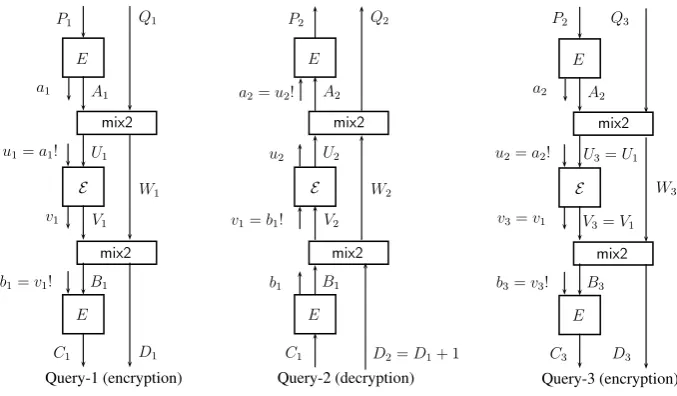
3.2 SPRP Distinguishing Algorithm
Distinguishing AlgorithmA0 for XLS.
1. Make encryption query (P1, Q1) and obtains response (C1, D1).
2. Make decryption query (C2 := C1, D2 := D1+ 1) and obtains
re-sponse (P2, Q2).
3. Make encryption query (P3=P2, Q3) and obtains response (C3, D3)
where
Q3=Q1+ (I+R−2)·(Q1+Q2+ 1).
4. return1 ifD3=Q1+Q3+D1, 0 otherwise.
3.3 Analysis of Attack
E
E
E
P1 Q1
A1 U1 V1 W1 B1 D1 C1 mix2 mix2 a1
u1=a1!
v1
b1=v1!
Query-1 (encryption)
E
E
E
P2 Q3
A2
U3=U1
V3=V1
W3 B3 D3 C3 mix2 mix2 a2
u2=a2!
v3=v1
b3=v3!
Query-3 (encryption) E
E
E
P2 Q2
A2
U2
V2
W2
B1
D2=D1+ 1
C1 mix2
mix2
a2=u2!
u2
v1=b1!
b1
Query-2 (decryption)
Fig. 3.1. A0 makes three queries and obtains collisions on U1 and U3 values with
probability 1/2 (due to the event thata1=a2).
Lemma 1. With the notations as described in the algorithmXLS, we haveA+
B= (R−1+I)
·(Q+D).
Proof.Sincemix2is inverse of itself we have (V, W) =mix2(B, D). By equating
W with line 02 of XLSalgorithm, we have
R·B+ (R+I)·D=R·A+ (R+I)·Q.
Thus,R·(A+B) = (R+I)·(Q+D) and so the result follows. ut
Lemma 2. With the notations as described in the algorithmXLS, we haveU+
V =R−1
·(Q+D).
Proof. Due to line 02 and 04, we have R·U + (I+R)·W =Qand R·V + (I+R)·W =D. Thus,R·(U+V) = (D+Q) and so the result follows. ut
The basic idea of our attack is to obtain an internal collision. Suppose we have two queries (Pi, Qi) with responses (Ci, Di),i= 1,2 such that theUivalues remain the same. So the outputsViare also same. Due to above lemma, we have
Q1⊕D1=Q2⊕D2. For a uniform random permutations this event can occur
with a probability of about 2−n+1. Now we show that in query-1 and query-3,U
values collide with probability 1/2 and so we can distinguishXLSfrom uniform random permutation with advantage about 1/2 (for largen, 2−n+1is negligible).
Theorem 2. The Algorithm ofA0has distinguishing advantage about1/2against
Proof. Note that A0 makes three encryption and decryption queries in an
in-terleaved manner. Let us denote the intermediate variables of computations of
ith query by using suffixi, 1≤i≤3. Let us denoteG=R−1+I. By Lemma 1, we haveA1+B1=G·(Q1+D1) andA2+B1=A2+B2=G·(Q2+D2) and
soA1+A3=A1+A2=G·(Q1+D1+Q2+D2) =G·(Q1+Q2+ 1). Now we
make our main claim:
Claim:U1=U3.
U1+U3= (R+I)·(A1+A3) +R·(Q1+Q3)
= (R+I)·G(Q1+Q2+ 1) +R·(Q1+Q3)
= (R+R−1)·(Q1+Q2+ 1) +R·(Q1+Q3)
SinceQ3=Q1+ (I+R−2)·(Q1+Q2+ 1), we haveU1=U3. ut
The rest of the proof is straightforward. As we have collision onU values, we have collision on V values, i.e., V1 = V3. But this can happen if the first
bit of inputs of E in query 1 and 3 match which can happen with probability 1/2. Assuming this, we can exploit the collision to make distinguishing attack as discussed before the theorem. We haveD3=Q1+Q3+D1. This can hold for
a uniform random permutation E with probability about 2−n+1. So the result
follows. ut
Remark 2. The same attack works for any length of the formkn−1 with same advantage. We only need the size of the partial block to be n−1. Note that we need the first bit of output of E in query 1 and 3 should match which can happen with probability 1/2. For other length inputs, the distinguishing advantage reduces as we need more bits collision. In general, if we want to distinguish XLS only on kn+s bits inputs then we need collision on the first
n−sbits of outputs ofE in query 1 and 3 which can happen with probability about 2s−n. So the distinguishing advantage would be about 2s−n
−21−n. So if the partial block size s is small the distinguishing advantage of our attack reduces. This is very natural as most of the intermediate bits are processed throughE.
4
Distinguishing attack on
GXLS
on
{
0
,
1
}
2n−1Now we demonstrate how we can modify the distinguishing attack for GXLS. This would suggest that any simple modification onXLS(such as changing mix functions with others) do not work. In other words, we show that the mode, not the mixing function, has inherent weakness. Behavior of this distinguishing attack depends on different cases of invertible mixing matrices mix1 and mix2.
As we need to assume these as linear permutations, we can represent these by the following (2n−1)×(2n−1) invertible matrices.
mix1=
M[1]n×n N[1]n×(n−1) M[2](n−1)×n N[2](n−1)×(n−1)
mix−21=
M0[1]
n×n N0[1]n×(n−1) M0[2](n−1)×nN0[2](n−1)×(n−1)
.
Before we demonstrate our attacks we state some notations and results which would be used.
Notations. Given ar×smatrixAwe denoteC(A) the column space of the matrix.
Lemma 3. Let Mr×s andNr×tbe two matrices andcr×1 is a vector such that
C(N)6⊆ C(M). For any two uniform random vectorsa← {$ 0,1}sandq $
← {0,1}t
(not necessarily independent)Pr[M ·a=N·q+c]≤1/2.
Proof.This is straightforward whenM is of the form Ir ∗ 0 0
whereris the rank of M and ∗ means that the sub matrix could be anything. In this case there must existi > r such thatith row ofN is non-zero. As qi is uniform on {0,1}, by equating the event on ith bit we get probability at most 1/2 to achieve the event.
For a general matrixM, we can find two non-singular square matricesS and
T such thatS·M·T = Ir ∗ 0 0
. So the given probabilitypshould be same as
Pr[SM T·(T−1a) =SN·q+S·c].
Let us denote M0 = SM T, a0 = T−1a, c0 = Sc and N0 = SN. With this notation, we havep=Pr[M0·a0 =N0·q+c0]. Now note thatM0 has the form as considered before. Due to invertible property ofS andT, we have the property thatC(N0)6⊆ C(M0) and,a0 andq0 follow individually uniform distributions. ut
Now we describe our attacks for different cases of the sub matrices of the mix functions. Conventionally, we use suffix 1, 2 and 3 to denote intermediate values for the first, second and third queries respectively.
4.1 rank(M[2])≤n−2
In this case we first claim that the column space of N[2] must contain a vector which does not belong to the column space of M[2]. Otherwise, the rank of (n−1)×(2n−1) matrix (M[2]N[2]) is less thann−2 which contradicts that the matrixmix1 is invertible.
Now we run the algorithmA0 only for the first two queries. As before, we
have M[2](A1+A2) =N[2](Q1+Q2) +N0[2]·1. Using the lemma 3, we know
that when the algorithm is interacting with uniform random permutation, the probability thatN[2](Q1+Q2) +N0[2]·1 belongs to the column space ofM[2] is
Distinguishing AlgorithmA1.
1. Make encryption query (P1, Q1) and obtain response (C1, D1).
2. Make decryption query (C2:=C1, D2:=D1+1) and obtain response
(P2, Q2).
3. return1 ifN[2](Q1+Q2) +N0[2]·1∈ C(M[2]), 0 otherwise.
Note that given a vectorvand a matrixM[2], there is an efficient algorithm to check whether a vector v belongs to the column space ofM[2]. For this we essentially need to solve the system of equationsM[2]·x=v and whenever we arrive contradiction a solution does not exist equivalentlyv is not a member of the column space. Alternatively we can first find some invertible matricesS and
T (by some standard elementary operations) such that
S·M[2]·T = I
r ∗
0 0
whererdenotes the rank of M[2]. SoM[2]·x=v if and only if
I r ∗
0 0
(T−1x) =S·v
which holds if and only if for alli > r, theith entry ofS
·v is zero.
Remark 3. Similar attack works when rank(M0[2])≤n−2. In this case we only need to interchange the role of encryption and decryption queries.
4.2 Case: rank(M[2]) = rank(M0[2]) =n−1, rank(N[1])≤ n−2
As N[1] does not have full rank, we can find Q1 6= Q2 such that N[1]Q1 = N[1]Q2. SoU values collide for two encryption queries (P, Q1) and (P, Q2). Now
we write the relationship among intermediate variables. SoA1=A2 and due to
choice ofQ1andQ2we also haveU1=U2and henceV1=V2. Now, let us write
mix2 function as
mix2=
M00[1]n×n N00[1]n×(n−1) M00[2](n−1)×n N00[2](n−1)×(n−1)
.
By the applications ofmix1and mix2 functions for two queries, we have
1. W1=M[2]·A1+N[2]·Q1,W2=M[2]·A2+N[2]·Q2and
2. D1=M00[2]·V1+N00[2]·W1,D2=M00[2]·V2+N00[2]·W2.
So W1+W2 = N[2]·(Q1+Q2) and D1+D2 = N00[2]·(W1+W2) = N00[2]·N[2]·(Q1+Q2). Note that for a random function, we observe this with
Distinguishing AlgorithmA2.
1. LetN[1]Q1=N[1]Q2.
2. Make encryption query (P1, Q1) and obtains response (C1, D1).
3. Make encryption query (P1, Q2) and obtains response (C2, D2).
4. return1 ifD2=D1+N00[2]·N[2]·(Q1+Q2), 0 otherwise.
4.3 Case: rank(M[2]) = rank(M0[2]) =n−1, rank(N[1]) =n−1
We make three queries same as A0 except the choice of Q3 whose value is
de-termined below. We have
1. U1+U3=M[1](A1+A2) +N[1]Q1+N[1]Q3.
2. M[2](A1+A2) =N[2](Q1+Q2) +N0[2](D1+D2) (from the computations
ofW1andW2).
As the rank of M[2] is n−1 and the right hand side of item 2 above is known, we can guess (A1+A2) correctly with probability 1/2 (since there are
only two choices). So we can guess M[1](A1+A2) from M[2](A1+A2) with
probability at least 1/2. LetX be the guessed value ofM[1](A1+A2). We now
choose Q3 such that U1+U3 = 0 (i.e., U1 = U3). From the item 1 of above,
we define Q3=N[1]−1·X+Q1. Note that N[1] is assumed to be invertible in
this case. SoPr[U1=U3]≥1/2. This essentially leads to a similar distinguisher
as inXLS. However, we need to compute the distinguishing event similar to the computation of the previous case. By the applications ofmix1, mix−21 and mix2
functions for three queries, we have
1. W1+W2=N0[2]·(D1+D2),
2. W2+W3=N[2]·(Q2+Q3), and
3. N00[2]·(W1+W3) =D1+D3.
So we haveD3=D1+N00[2]·(N0[2]·(D1+D2) +N[2]·(Q1+Q3)) which can
be observed with probability 2−n+1for a random function. We formally describe
the attack algorithm byA2 below.
Distinguishing Algorithm A3.
1. Make encryption query (P1, Q1) and obtains response (C1, D1).
2. Make decryption query (C2 := C1, D2 := D1+ 1) and obtains response
(P2, Q2).
3. GuessM[1](A1+A2), denotedX, fromN[2](Q1+Q2) +N0[2](D1+D2)
4. ChooseQ3such thatN[1](Q1+Q3) =X.
5. Make encryption query (P3=P2, Q3) and obtains response (C3, D3).
6. return1 ifD3=D1+N00[2]·(N0[2]·(D1+D2) +N[2]·(Q1+Q3)),
5
Conclusion
In this paper we provide chosen plaintext and ciphertext distinguishing attack (i.e., SPRP distinguisher) ofXLS. It makes three encryption and decryption calls and has distinguishing advantage about 1/2. This attack can be further extended to a general form of XLSfollowing mix-then-encrypt paradigm. We believe that it can not be repaired without introducing any non-linear functionality, e.g. an additional blockcipher call. So we need four blockcipher calls to make this types of design secure. Both Elastic blokcipher and Nandi’s construction make four calls of non-linear functions. However, Nandi’s construction could be potentially faster, as it requires two universal hash invocations (which can be achieved by applying four rounds of AES [6]) and one call of weak-PRF (optimistically, one can apply eight rounds of AES) in addition with a full blokcipher call (which is e.g., ten rounds of AES). So in total it requires 26 rounds ofAESwhich is much faster than four full invocations of AES.
Acknowledgement. This work is supported by Centre of Excellence in Cryp-tology at Indian Statistical Institute, Kolkata.
References
1. CAESAR submissions, 2014. http://competitions.cr.yp.to/caesar-submissions.html.
2. Elena Andreeva, Andrey Bogdanov, Atul Luykx, Bart Mennink, Elmar Tis-chhauser, and Kan Yasuda. Parallelizable and authenticated online ciphers. In
ASIACRYPT (1), pages 424–443, 2013.
3. Debrup Chakraborty and Palash Sarkar. HCH: A new tweakable enciphering scheme using the hash-encrypt-hash approach. In Rana Barua and Tanja Lange, editors,INDOCRYPT, volume 4329 ofLecture Notes in Computer Science, pages 287–302. Springer, 2006.
4. Debra L. Cook, Moti Yung, and Angelos D. Keromytis. Elastic aes. IACR Cryp-tology ePrint Archive, 2004:141, 2004.
5. Debra L. Cook, Moti Yung, and Angelos D. Keromytis. Elastic block ciphers: method, security and instantiations. Int. J. Inf. Sec., 8(3):211–231, 2009. 6. Joan Daemen, Mario Lamberger, Norbert Pramstaller, Vincent Rijmen, and
Fred-erik Vercauteren. Computational aspects of the expected differential probability of 4-round aes and aes-like ciphers. Computing, 85(1-2):85–104, 2009.
7. Shai Halevi. EME*: Extending EME to handle arbitrary-length messages with associated data. In Anne Canteaut and Kapalee Viswanathan, editors, IN-DOCRYPT, volume 3348 ofLecture Notes in Computer Science, pages 315–327. Springer, 2004.
8. Shai Halevi. TET: A wide-block tweakable mode based on Naor-Reingold. Cryp-tology ePrint Archive, Report 2007/014, 2007. http://eprint.iacr.org/.
10. Shai Halevi and Phillip Rogaway. A parallelizable enciphering mode. In Tatsuaki Okamoto, editor, CT-RSA, volume 2964 of Lecture Notes in Computer Science, pages 292–304. Springer, 2004.
11. Moses Liskov, Ronald L. Rivest, and David Wagner. Tweakable block ciphers. In Moti Yung, editor,CRYPTO, volume 2442 ofLecture Notes in Computer Science, pages 31–46. Springer, 2002.
12. M. Luby and C. Rackoff. How to construct pseudo-random permutations from pseudo-random functions. InAdvances in Cryptology – Crypto 1985, number 218 in Lecture Notes in Computer Science, page 447, New York, 1984. Springer-Verlag. 13. David A. McGrew and Scott R. Fluhrer. The extended codebook (XCB) mode of operation. Cryptology ePrint Archive, Report 2004/278, 2004. http://eprint.iacr.org/.
14. Mridul Nandi. A generic method to extend message space of a strong pseudoran-dom permutation. Computaci´on y Sistemas, 12(3), 2009.
15. Thomas Ristenpart and Phillip Rogaway. How to enrich the message space of a cipher. In Alex Biryukov, editor,FSE, volume 4593 ofLecture Notes in Computer Science, pages 101–118. Springer, 2007.
16. Palash Sarkar. Improving upon the tet mode of operation. In Kil-Hyun Nam and Gwangsoo Rhee, editors, ICISC, volume 4817 of Lecture Notes in Computer Science, pages 180–192. Springer, 2007.
![Fig. 2.1). Note that the XLSwhere (! algorithm is nothing but GXLS[E, !∥mix2, E, !∥mix2, E]∥f)(b, X) = b!∥f(X)](https://thumb-us.123doks.com/thumbv2/123dok_us/7936287.1317617/4.595.151.488.119.341/fig-note-xlswhere-algorithm-gxls-mix-e-mix.webp)