Creating Adaptive Feedback Designed for
Improving Data Entry Accuracy
K. Nagendra Rao
1, K.Venkata Ramana
2Associate Professor, Dept. of CSE,
CR
Engineering College, Guntur, Andhra Pradesh, IndiaResearch Scholar, Dept. of CSE, Dr.RR &Dr.SR Technological University, Chennai, Tamil Nadu, India
ABSTRACT: Data quality is a critical problem in modern databases. Data-entry forms present the first and arguably
best opportunity for detecting and mitigating errors, but there has been little research into automatic methods for im-proving data quality at entry time. In this paper, we propose USHER, an end-to-end system for form design, entry, and data quality assurance. Using previous form submissions, USHER learns a probabilistic model over the questions of the form. USHER then applies this model at every step of the data-entry process to improve data quality. Before entry, it induces a form layout that captures the most important data values of a form instance as quickly as possible and reduces the complexity of error-prone questions. During entry, it dynamically adapts the form to the values being entered by providing real-time interface feedback, reasking questions with dubious responses, and simplifying questions by refor-mulating them. After entry, it revisits question responses that it deems likely to have been entered incorrectly by reask-ing the question or a reformulation thereof. We evaluate these components of USHER usreask-ing two real-world data sets. Our results demonstrate that USHER can improve data quality considerably at a reduced cost when compared to current practice.
KEYWORDS: Data quality, data entry, form design, adaptive form.
1. INTRODUCTION
Organizations and individuals routinely make important decisions based on inaccurate data stored in supposedly au-thoritative databases. Data errors in some domains, such as medicine, may have particularly severe consequences. These errors can arise at a variety of points in the life cycle of data, from data entry, through storage, integration, and cleaning, all the way to analysis and decision making [1].While each step presents an opportunity to address data quali-ty, entry time offers the earliest opportunity to catch and correct errors. The database community has focused on data cleaning once data have been collected into a database, and has paid relatively little attention to data quality at collec-tion time [1], [2]. Current best practices for quality during data entry come from the field of survey methodology, which offers principles that include manual question orderings and input constraints, and double entry of paper forms [3].Although this has long been the de facto quality assurance standard in data collection and transformation, we be-lieve this area merits reconsideration. For both paper forms and direct electronic entry, we posit that a data-driven and more computationally sophisticated approach can significantly. Outperform these decades-old static methods in both accuracy and efficiency of data entry.
parties, it results in delays and other unintended negative consequences. We observed this scenario in an HIV/AIDS program in Tanzania, where time-consuming double entry was imposed upon a busy local clinic. The effort required to do the double entry meant that the transcription was postponed for months and handled in batch. Although the data eventually percolated up to national and international agencies, in the interim the local clinic was operating as usual via paper forms, unable to benefit from an electronic view of the data latent in their organization. Finally, many organiza-tions in developing regions are beginning to use mobile devices like smartphones for data collection; for instance, community health workers are doing direct digital data entry in remote locations. Electronic data-entry devices offer different affordances than those of paper, displacing the role of traditional form design and double entry [5]. We often found that there were no data quality checks at all in aı¨vely implemented mobile interfaces, compounding the fact that mobile data-entry quality is 10 times worse than dictation to a human operator [7].
In addition, we may extend USHER’s appropriate entry friction approach to provide a framework for reasoning about feedback mechanisms for the data-entry user interface.During data entry, using the likelihood of unanswered fields given entered answers, and following the intuition that multivariate outliers are values warranting reexamination by the data-entry worker, USHER can guide the user with much more specific and context-aware feedback. In Section 9, we offer initial thoughts on design patterns for USHER-inspired dynamic data-entry interfaces.The contributions of this paper are fourfold:
1. We describe the design of USHER’s core: probabilistic models for arbitrary data-entry forms.
2. We describe USHER’s application of these models to provide guidance along each step of the data-entry lifecycle: reordering questions for greedy information gain, reformulating answers for appropriate entry friction, and reasking questions according to contextualized error likelihood.
3. We present experiments showing that USHER has the potential to improve data quality at reduced cost. We study two representative data sets: direct electronic entry of survey results about political opinion and transcription of paper-based patient intake forms from an HIV/AIDS clinic in Tanzania.
4. Extending our ideas on form dynamics, we propose new user-interface principles for providing contextualized, intuitive feedback based on the likelihood of data as they are entered. This provides a foundation for incorporating data cleaning mechanisms directly in the entry process.
II. RELATED WORK
2.1. Data Cleaning
In the database literature, data quality has typically been addressed under the rubric of data cleaning [1], [2]. Our work connects most directly to data cleaning via multivariate outlier detection; it is based in part on interface ideas first pro-posed by Hellerstein [8]. By the time such retrospective data cleaning is done, the physical source of the data is typical-ly unavailable—thus, errors often become too difficult or time-consuming to be rectified. USHER addresses this issue by applying statistical data quality insights at the time of data entry. Thus, it can catch errors when they are made and when ground-truth values may still be available for verification.
2.2. User Interfaces
reask-ing, and widget customizations that provide feedback to the user based on the likelihood of their entries. Some of the enhancements we make for data quality could also be applied to improve the speed of entry.
2.3. Clinical Trials
Data quality assurance is a prominent topic in the science of clinical trials, where the practice of double entry has been questioned and dissected, but nonetheless remains the gold standard [16], [17]. In particular, Kleinman takes a proba-bilistic approach toward choosing which forms to reenter based on the individual performance of data-entry staff [18]. This cross-form validation has the same goal as our approach of reducing the need for complete double entry, but does so at a much coarser level of granularity. It requires historical performance records for each data-entry worker, and does not offer dynamic reconfirmation of individual questions. In contrast, USHER’s cross-question validation adapts to the actual data being entered in light of previous form submissions, and allows for a principled assessment of the trade-off between cost (of reconfirming more questions) versus quality (as predicted by the probabilistic model).
2.4. Survey Design
The survey design literature includes extensive work on form design techniques that can improve data quality [3], [19]. This literature advocates the use of manually specified constraints on response values. These constraints may be univa-riate (e.g., a maximum value for an age question) or multivauniva-riate (e.g., disallowing gender to be male and pregnant to be yes). Some constraints may also be ―soft‖ and only serve as warnings regarding unlikely combinations (e.g., age being 60 and pregnant being yes).
The manual specification of such constraints requires a domain expert, which can be prohibitive in many scenarios. By relying on prior data, USHER learns many of these same constraints without requiring their explicit specification.When these constraints are violated during entry,USHER can then flag the relevant questions, or target them for reasking. However, USHER does not preclude the manual specification of constraints. This is critical, because previous research into the psychological phenomena of survey filling has yielded common constraints not inherently learnable from prior data [3]. This work provides heuristics such as ―groups of topically related questions should often be placed together‖ and ―questions about race should appear at the end of a survey.‖ USHER complements these humanspecified con-straints, accommodating them while leveraging any remaining flexibility to optimize question ordering in a data-driven manner.
III. SYSTEM
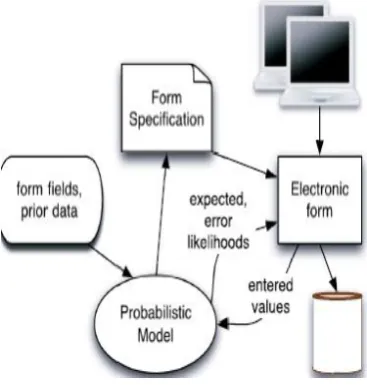
USHER builds a probabilistic model for an arbitrary dataentry form in two steps: first, by learning the relationships between form questions via structure learning, resulting in a Bayesian network; and second, by estimating the parame-ters of that Bayesian network, which then allows us to generate predictions and error probabilities for the form. After the model is built, USHER uses it to automatically order a form’s questions for greedy information gain. Section 5 describes both static and dynamic algorithms that employ criteria based on the magnitude of statistical information gain that is expected in answering a question, given the answers that have been provided so far. This is a key idea in our approach. By front-loading predictive potential, we increase the models’ capacity in several ways. First, from an infor-mation-theoretic perspective, we improve our ability to do multivariate prediction and outlier detection for subsequent questions. As we discuss in more detail in Sections 7 and 9, this predictive ability can be applied by reformulating er-ror-prone form questions, parameterizing data-entry widgets (type-ahead suggestions and default values), assessing answers (outlier flags), and performing in-flight reasking (also known as cross validation in survey design parlance). Second, from a psychological perspective, frontloading information gain also addresses the human issues of user fati-gue and limited attention span, which can result in increasing error rates over time and unanswered questions at the end of the form.
ques-tions can often enable an experienced agent to intuitively predict the remaining answers. USHER’s question ordering algorithms formalize this intuition via the principle of greedy information gain, and use them (scrupulously) to improve data entry.
USHER’s learning algorithm relies on training data. In practice, a data-entry backlog can serve as this training set. In the absence of sufficient training data, USHER can bootstrap itself on a ―uniform prior,‖ generating a form based on the assumption that all inputs are equally likely; this is no worse than standard practice. Subsequently, a training set can gradually be constructed by iteratively capturing data from designers and potential users in ―learning runs.‖ It is a common approach to first fit to the available data, and then evolve a model as new data become available. This process of semiautomated form design can help institutionalize new forms before they are deployed in production.
USHER adapts to a form and data set by crafting a custom model. Of course, as in many learning systems, the model learned may not translate across contexts. We do not claim that each learned model would or should fully generalize to different environments. Instead, each contextspecific model is used to ensure data quality for a particular situation, where we expect relatively consistent patterns in input data characteristics. In the remainder of this section, we illustrate USHER’s functionality with examples. Further details, particularly regarding the probabilistic model, follow in the ensuing sections.
3.1. Examples
We present two running examples. First, the patient comes from paper patient-registration forms transcribed by data-entry workers at an HIV/AIDS program in Tanzania.1 Second, the survey data set comes from a phone survey of
Fig.1. Bayesian network for the patient data set,showing Automatically inferred probabilistic relationships Between form questions.
political opinion in the San Francisco Bay Area, entered by survey professionals directly into an electronic form. In each example, a form designer begins by creating a simple specification of form questions and their prompts,response data types, and constraints. The training data set is made up of prior form responses. Using the learn-ing algorithms we present in Section 4, USHER builds a Bayesian network of probabilistic relationships from the data, as shown in Figs. 1 and 2. In this graph, an edge captures a close stochastic dependency between two random variables (i.e.,form questions). Two questions with no path between them in the graph are probabilistically independent. Fig. 2 illustrates a denser graph, demonstrating that political survey responses tend to be highly correlated. Note that a stan-dard joint distribution would show correlations among all pairs of questions; the sparsity of these examples reflects conditional independence patterns learned from the data.Encoding independence in a Bayesian network is a standard method in machine learning that clarifies the underlying structure, mitigates data overfitting, and improves the efficien-cy of probabilistic inference.
Fig.2. Bayesian network for the survey data set.
static ordering shown in Fig. 3. We can see in Fig. 3 that the structure learner predicted RegionCode to be correlated with DistrictCode. Our data set is collected mostly from clinics in a single region of Tanzania, so RegionCode provides little information. It is not surprising then, thatUSHER’s suggested ordering has DistrictCode early and RegionCode last—once we observe DistrictCode, RegionCode has very little additional expected conditional information gain. When it is time to input the RegionCode, if the user selects an incorrect value, the model can be more certain that it is unlikely. If the user stops early and does not fill in RegionCode, the model can infer the likely value with higher confi-dence. In general, static question orderings are appropriate as an offline process for paper forms where there is latitude for (re)ordering questions, within designer-specified constraints.
Fig. 3. Example question layout generated by our ordering algorithm. The arrows reflect the probabilistic dependencies from Fig. 1.
question based on the answer to DistrictCode, since DistrictCode is such a strong predictor of RegionCode. As we dis-cuss in Section 7, the reduced selection space for responses in turn reduces the chances of a data-entry worker selecting an incorrect response. For the latter, possibilities include using a ―split‖ drop-down menu for RegionCode that features the most likely answers ―above the line,‖ and after entry, coloring the chosen answer red if it is a conditional outlier. We discuss in Section 9 the design space and potential impact of data-entry feedback that is more specific and context-aware.
3.2.Implementation
We have implemented USHER as a web application (Fig. 4). The UI loads a simple form specification file contain-ing form question details and the location of the traincontain-ing data set. Form question details include question name, prompt, data type,widget type, and constraints. The server instantiates a model for each form. The system passes information about question responses to the model as they are filled in; in exchange, the model returns redictions and error probabil-ities.Models are created from the form specification, the training data set, and a graph of learned structural relation-ships.We perform structure learning offline with BANJO [20], an open source Java package for structure learning of Bayesian networks. Our graphical model is implemented in two variants: the first model used for ordering is based on a modified version of JavaBayes [21], an open source Java software for ayesian inference. Because JavaBayes only sup-ports discrete probability variables, we implemented the error prediction version of our model using Infer.NET [22], a Microsoft .NET Framework toolkit for Bayesian inference.
VI. LEARNING A MODEL FOR DATA ENTRY
The core of the USHER system is its probabilistic model of the data, represented as a Bayesian network over form questions. This network captures relationships between a form’s question elements in a stochastic manner. In particular, given input values for some subset of the questions of a particular form instance, the model can infer probability distri-butions over values of that instance’s remaining unanswered questions. In this section, we show how standard machine learning techniques can be used to induce this model from previous form entries.
We will use F={F1, . . . ; Fn} to denote a set of random variables representing the values of n questions comprising a data-entry form. We assume that each question response takes on a finite set of discrete values; continuous values are discretized by dividing the data range into intervals and assigning each interval one value.2 To learn the probabilistic model, we assume access to prior entries for the same form.
USHER first builds a Bayesian network over the form questions, which will allow it to compute probability distribu-tions over arbitrary subsets G _ F of form question random variables, given already entered question responses G` = g` for that instance, i.e., P(G|G`=g`).Constructing this network requires two steps: first, the induction of the graph struc-ture of the network, which encodes the conditional independencies between the question random variables F; and second, the estimation of the resulting network’s parameters.
The naive approach to structure selection would be to assume complete dependence of each question on every other question. However, this would blow up the number of free parameters in our model, leading to both poor generalization performance of our predictions and prohibitively slow model queries. Instead, we learn the structure using the prior form submissions in the database. USHER searches through the space of possible structures using simulated annealing, and chooses the best structure according to the Bayesian Dirichlet Equivalence criterion [23]. This criterion optimizes for a trade-off between model expressiveness (using a richer dependency structure) and model parsimony (using a smaller number of parameters), thus identifying only the prominent, recurring probabilistic dependencies.Fig. 1 and 2 show automatically learned structures
For two data domains.
V. DISCUSSION AND FUTURE WORK
Our simulated empirical evaluations demonstrate the data quality benefits of each of these components: question order-ing, reformulation and reasking.The USHER system we have presented is a cohesive synthesis of several disparate ap-proaches to improving data quality for data entry. The three major components of the system—ordering, reasking, and reformulation—can all be applied under various guises before, during, and after data entry. This suggests a principled road map for future research in data entry. For example, one combination we have not explored here is reasking before entry. At first glance this may appear strange, but in fact that is essentially the role that cross-validation questions in paper forms serve, as preemptive reformulated reasked questions. Translating such static cross-validation questions to dynamic forms is a potential direction of future work. Another major piece of future work alluded to in Section 9 is to study how our probabilistic model can inform effective adaptations of the user interface during data entry. We intend to answer this problem in greater depth through user studies and field deployments of our system. We can also extend this work by enriching the underlying probabilistic formalism. Our current probabilistic approach assumes that every ques-tion is discrete and takes on a series of unrelated values. Relaxing these assumpques-tions would make for a potentially more accurate predictive model for many domains. Additionally, we would want to consider models that reflect temporal changes in the underlying data. Our present error model makes strong assumptions both about how errors are distri-buted and what errors look like. On that front, an interesting line of future work would be to learn a model of data-entry errors and adapt our system to catch them. Finally, we are in the process of measuring the practical impact of our sys-tem, by piloting USHER with our field partners, the United Nations Development Program’s Millennium Villages Project [34] in Uganda, and a community health care program in Tanzania. These organizations’ data quality concerns were the original motivation for this work and thus serve as an important litmus test for our system.
VI. ACKNOWLEDGMENTS
The authors thank Maneesh Agrawala, Yaw Anokwa, Michael Bernstein, S.R.K. Branavan, Tyson Condie, Heather Dolan, Jeff Heer, Max van Kleek, Neal Lesh, Alice Lin, Jamie Lockwood, Bob McCarthy, Tom Piazza, Christine Rob-son, and the anonymous reviewers for their helpful comments and suggestions. We acknowledge the Yahoo Labs Technology for Good Fellowship, the Natural Sciences and Engineering Research Council of Canada, the US National Science Foundation (NSF) Graduate Fellowship, and NSF Grant 0713661.
REFERENCES
1. T. Dasu and T. Johnson, Exploratory Data Mining and Data Cleaning. Wiley, 2003.
2. C. Batini and M. Scannapieco, Data Quality: Concepts, Methodologies and Techniques. Springer, 2006.
3. R.M. Groves, F.J. Fowler, M.P. Couper, J.M. Lepkowski, E. Singer, and R. Tourangeau, Survey Methodology. Wiley-Interscience, 2004. 4. J. Lee, ―Address to WHO Staff,‖ http://www.who.int/dg/lee/speeches/2003/21_07/en, 2003.
5. J.V.D. Broeck, M. Mackay, N. Mpontshane, A.K.K. Luabeya, M.Chhagan, and M.L. Bennish, ―Maintaining Data Integrity in a Rural Clinical Trial,‖ Clinical Trials, vol. 4, pp. 572-582, 2007.
6. R. McCarthy and T. Piazza, ―Personal Interview,‖ Univ. of California at Berkeley Survey Research Center, [7] S. Patnaik, E. Brunskill, and W. Thies, ―Evaluating the Accuracy of Data Collection on Mobile Phones: A Study of Forms, SMS, and Voice,‖ Proc. IEEE/ACM Int’l Conf. In-formation and Comm.Technologies and Development (ICTD), 2009.
7. J.M. Hellerstein, ―Quantitative Data Cleaning for Large Databases,‖ United Nations Economic Commission for Europe (UNECE), 2008. 8. A. Ali and C. Meek, ―Predictive Models of Form Filling,‖Technical Report MSR-TR-2009-1, Microsoft Research, Jan. 2009.
9. L.A. Hermens and J.C. Schlimmer, ―A Machine-Learning Apprentice for the Completion of Repetitive Forms,‖ IEEE Expert: