ISSN(Online): 2320-9801
ISSN (Print): 2320-9798
International Journal of Innovative Research in Computer
and Communication Engineering
(An ISO 3297: 2007 Certified Organization)
Vol. 3, Issue 3, March 2015
Detection of Hacking nodes using Dynamic
Sensor with Ant Colony Optimization
R.Balaji
1,
V.Abhishek
2, D.Kerana Hanirex
3.
Student, Dept of C.S.E, Bharath University, Chennai, Tamil Nadu, India1.
Student, Dept of C.S.E Bharath University, Chennai, Tamil Nadu, India2.
Assistant Professor, Dept. of C.S.E., Bharath University, Chennai, Tamil Nadu, India3
ABSTRACT: Detection of hacking nodes can be defined as tracking system to show the negative effects that malicious nodes cause in MANET (Mobile ad hoc network. This paper proposes an survey about Detection of hacking nodes based on data transmission. The main problem in existing system is that the variable brink length of the polygon and the impact of the targets dynamic movements, brink detection and real time polygon. After the survey on various literature papers, we are concluding a new way, that increases confidentiality of the data and efficiency, , we have enclosed the proposed method with the ACO algorithm which allow itself to detect the terrorist nodes that are to be labeled and performs the active classification,. A mobile ad hoc network (MANET) is a group of mobile hosts and able to communicate one another in the absence of fixed infrastructure.. If the entity at a particular range cannot be determined then several static nodes are located for better coverage and to reduce the total travelled distance by the nodes. The approximation and the foreseeing of the nodes are done by space Theory and the location of the nodes by using ant colony optimization..
KEYWORDS: Detection of hacking nodes, AODV protocol, spammers, Dynamic sensor, Ant colony optimization algorithm (ACO) , Static sensor
I. INTRODUCTION
Detection of hacking nodes are based on the data transmission and tracking the malicious nodes, they are most widely used in highly confidential authenticated data stores and military government organization. And they are the efficient one that deal with the detection of terrorist nodes and are most widely used to analyze, find the methods for recommendation context. The terrorist node will cause the information overload problem, to avoid this it is important to create a personalization technique that recommend appropriate contents to the users. The problem of performance of variable brink length of the polygon and the impact of the brink detection of the real time polygon forwarding in target tracking. Recommended system may guide the people to make their own decision like what to buy, what to watch, especially useful in the large amount of data.Recommended system helps to find out the choices or to decide the solution without any previous experiences, although they are famous in various concepts and familiar with many related works, some of their problems are still continuing in the market, the problem may be estimated as the rating of items, and one of the important and main issue is the low-performance that too in real time applications, other related issues may be the limited content analysis, data insecurity etc.
II. RELATEDWORK
ISSN(Online): 2320-9801
ISSN (Print): 2320-9798
International Journal of Innovative Research in Computer
and Communication Engineering
(An ISO 3297: 2007 Certified Organization)
Vol. 3, Issue 3, March 2015
the notification message is distributed efficiently by the dynamic broadcast protocol. [5] involves a concept of Distributed processing of the RSSI signals allows minimizing the power consumption of the nodes and the latency at the central base station.. a drift compensation time synchronization protocol to implement a reliable TDMA protocol,[6] proposes a robust tracking mobile targets framework using unreliable node sequences. Beside the basic design, multi‐dimensional smoothing is proposed for further enhancing system accuracy. In this [7] One with timeout applied on nodes receiving message from non-RNG (non-LMST) neighbour and retransmitting immediately otherwise (unless list of RNG or LMST neighbours in need of the message is empty), and one with timeout applied on all the nodes. We proved that LMST is a subset of RNG, which explains why LMST always performs better among the two,[8] propose an improved noise model which incorporates both additive noises and multiplicative noises in distance sensing. We then use a maximum likelihood estimator for prelocalization to remove the sensing nonlinearity before applying a standard Kalman filter. [9] propose an optimal solution which achieves 100% coverage and minimizes the energy consumption under certain ideal situations. the prediction-based scheme outperforms the conservative scheme, and it can achieve a relatively high coverage and low energy consumption close to the optimal solution.[10] propose a software-based wake-up strategy, which has a short average delay and a predictable worse-case delay. a set of tradeoffs that are useful for the future development of real-time sensor systems
III.EXISTING SYSTEM
The existing System wireless sensor network (WSN) consists of spatially distributed autonomous sensors to monitor physical or environmental conditions and to pass all the collected data through the network to a main base station. Here the wide-area surveillance and reconnaissance using mobile sensor networks (MWSN).having more problem. The problem is the sensors are static, and the sensors are mobile, how to plan the trajectory of the mobile sensors so these two we can’t able to monitoring the all node positions. Getting coverage problem in wireless sensor networks. Coverage in a wireless sensor network can be thought of as how well the wireless sensor network is able to monitor a particular field of interest. Once the entity is supervised, mobile sensor nodes concentrate in that entity. If the entity at a particular range cannot be determined then several static nodes are located for better coverage and to reduce the total travelled distance by the nodes. Two interesting problems, which we are currently investigating, are as follows: 1) the performance of variable brink lengths of the polygon versus adjustable transmission power levels in a WSN for target detection and its energy cost in the WSNs; 2) the impact of the target’s dynamic movements, brink detection, and real-time polygon forwarding in target tracking.
IV.PROPOSED SYSTEM
We propose a new tracking framework, called Face Track, which employs the nodes of a spatial region surrounding a target, called a face. Instead of predicting the target location separately in a face, we estimate the target’s moving toward another face. We introduce an edge detection algorithm to generate each face further in such a way that the nodes can prepare ahead of the target’s moving. We introduce an edge detection algorithm, which is used to reconstruct another conceptual polygon, called a critical region, by generating an edge, called a brink, to the active polygon. We determine the followings,
• Position • Energy • Velocity
Real time application of this project is tracking of terrorist nodes.At any time, we will be able to measure the speed with which it is moving the energy leftover in the node.By determining the above parameters, the military intelligence team could develop measures to counter such nodes.We also determine the neighbor nodes for the terrorist node in the network, so we can take any malicious-attack measures through them.
ISSN(Online): 2320-9801
ISSN (Print): 2320-9798
International Journal of Innovative Research in Computer
and Communication Engineering
(An ISO 3297: 2007 Certified Organization)
Vol. 3, Issue 3, March 2015
FIG:OVERALL ARCHITECTURE
V. CLASSIFICATION OF THE TOTAL FRAMEWORK
There modules that are deployed with this project are
1. Ad Hoc On-Demand Distance Vector Routing (AODV). 2. Space Based Optimization.
3. Message Passing Algorithm. 4. Ant Colony Optimization.
Ad Hoc on-Demand Distance Vector Routing (AODV):
An ad-hoc routing protocol is a convention, or standard, that controls how nodes decide which way to route packets between computing devices in a mobile ad hoc network. In ad-hoc networks, nodes are not familiar with the topology of their networks. Instead, they have to discover it. The basic idea is that a new node may announce its presence and should listen for announcements broadcast by its neighbors. Each node learns about nodes nearby and how to reach them, and may announce that it, too, can reach them. Note that in a wider sense, ad hoc protocol can also be used literally, that is, to mean an improvised and often impromptu protocol established for a specific purpose.
Table-driven (Pro-active) routing On Demand (Reactive) routing
Hybrid (both pro-active and reactive) routing
ISSN(Online): 2320-9801
ISSN (Print): 2320-9798
International Journal of Innovative Research in Computer
and Communication Engineering
(An ISO 3297: 2007 Certified Organization)
Vol. 3, Issue 3, March 2015
routes back to the needy node. When a node receives such a message and already has a route to the desired node, it sends a message backwards through a temporary route to the requesting node.
AODV METHODS:
The proposed protocol will be structured into the following four main phases, which will be explained in the subsequent subsections:
Route Lookup Phase Data Transfer Phase Reputation Phase Timeout Phase
The proposed design, Reputed-ARAN, proves to be more efficient and more secure than normal ARAN secure routing protocol in defending against both malicious and authenticated malicious nodes
ROUTE LOOKUP PHASE
This phase mainly incorporates the authenticated route discovery and route setup phases of the normal AODV secure routing protocol. In this phase, if a source node S has packets for the destination node D, the source node broadcasts a route discovery packet (RDP) for a route from node S to node D. Each intermediate node interested in cooperating to route this control packet broadcasts it throughout the mobile ad hoc network.
DATA TRANSFER PHASE
At this time, the source node S and the other intermediate nodes have many RREPs for the same RDP packet sent earlier. So, the source node S chooses the highly-reputed next-hop node for its data transfer. If two next-hop nodes have the same reputation, S will choose one of them randomly, stores its information in the sent-table as the path for its data transfer.
REPUTATION PHASE
In this phase, when an Intermediate node receives a data acknowledgement packet (DACK), it retrieves the record, inserted in the data transfer phase, corresponding to this data packet then it increments the reputation of the next hop node. In addition, it deletes this data packet entry from its sent-table. Once the DACK packet reaches node S, it deletes this entry from its sent-table and gives a recommendation of (+1) to the node that delivered the Acknowledgement. TIMEOUT PHASE
In this phase, once the timer for a given data packet expires at a node; the node retrieves the entry corresponding to this data transfer operation returned by the timer from its sent table. Then, the node gives a negative recommendation (-2) to the next-hop node and deletes the entry from the sent- table. Later on, when the intermediate nodes’ timers up the node that dropped the packet expire, they give a negative recommendation to their next hop node and delete the entry from their sent-table.
Space Based Optimization:
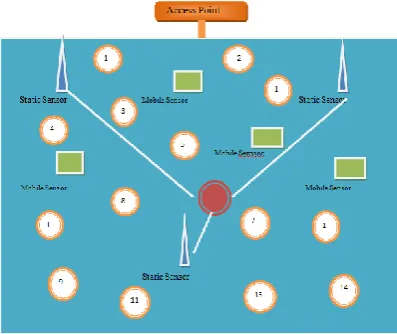
Static Sensor detecting the terrorist node:
ISSN(Online): 2320-9801
ISSN (Print): 2320-9798
International Journal of Innovative Research in Computer
and Communication Engineering
(An ISO 3297: 2007 Certified Organization)
Vol. 3, Issue 3, March 2015
independently of the movement of the mobile ones. Space Based approximation is used to detects and calculate the Approximating the position of the entity, Foresee the next-step position of the entity using existing and preceding position approximation. Static sensors are watched the whole network, its having all the information of the node in the networkis a closed subset IR of given as follows
[x]=[x,y]={x ∑ IR¦x<=x<=y}
Where x and y are the lower an endpoints of the space, respectively.
[x] could also be defined by its centre and its width given by C([x])=(x+y)/2 and W([x])= (y-x) respectively .A multidimensional space of Iran, also called box, is given by the Cartesian product of n real spaces[x]=[x1] X …… X [x]An space has a dual nature as sets and real numbers. The space theory takes advantage of this quality to extend all arithmetic and set operations to spaces. For Localization and Prediction of node space based Approximation is used.
Fig Static Sensor detecting the terrorist node:
After detecting terrorist node, Static sensor informs approximation position of terrorist node (by using Space based approximation algorithm) to mobile sensors nodes.
ISSN(Online): 2320-9801
ISSN (Print): 2320-9798
International Journal of Innovative Research in Computer
and Communication Engineering
(An ISO 3297: 2007 Certified Organization)
Vol. 3, Issue 3, March 2015
Message Passing Algorithm:
Message passing algorithm is used by the sensor node for pass the information about the anonymous to the nearest mobile nodes. Sensor which covers the anonymous search for the mobile node to track it location, for that sensor node could send the information about the anonymous to mobile nodes. Sensor first search for the mobile within in that coverage area by using the routing information and its range level of sensing the mobile nodes. Once the sensor sensed the location of the mobile node it passes information about the anonymous. This process is done by the message passing algorithm. f X=(Xv) is a set of discrete random variables with a joint mass function p, the marginal distribution of a single Xi is simply the summation of p over all other variables The sum-product algorithm is related to the calculation of free energy in thermodynamics. Let Z be the partition function. A probability distribution(as per the factor graph representation) can be viewed as a measure of the internal energy present in a system, computed as The free energy of the system is then It can then be shown that the points of convergence of the sum-product algorithm represent the points where the free energy in such a system is minimized. Similarly, it can be shown that a fixed point of the iterative belief propagation algorithm in graphs with cycles is a stationary point of a free energy approximation.
Ant Colony Optimization
Detecting terrorist node, Static sensor informs approximation position of terrorist node to mobile sensors nodes. All mobile nodes are get information about the target by static nodes. Mobile nodes are calculated the distance D from their position P to the target, target distance D subtracted by the entire mobile node and their position. Then minimum distance from the position to the target of the mobile node selected to send for track the target. Ant Colony Optimization, it is used to find the coverage of the target node from the position of the mobile sensor s. To detect the detachment of the target each mobile sensor is using this technique to find which mobile need to follow and track target node. The following properties are used for this technique, position, speed, energy.Real time application of this project is tracking of terrorist nodes. At any time, we will be able to measure the speed with which it is moving the energy leftover in the node. By determining the above parameters; the military intelligence team could develop measures to counter such nodes. We also determine the neighbour nodes for the terrorist node in the network, so we can take any malicious-attack measures through them. Ant colony optimization algorithm (ACO) is a probabilistic technique for solving computational problems which can be reduced to finding good paths through graphs. And we can detect the exact information about node.
VI.RESULTANALYSIS
ISSN(Online): 2320-9801
ISSN (Print): 2320-9798
International Journal of Innovative Research in Computer
and Communication Engineering
(An ISO 3297: 2007 Certified Organization)
Vol. 3, Issue 3, March 2015
VII.CONCLUSION AND FUTURE WORK
In this project, we will propose to all wide area node exact position using AODV protocol implementing and using Ant Colony Optimization for detect and implementing extra module the following properties exact information about node. Real time application of this project is tracking of terrorist nodes. At any time, we will be able to measure the speed with which it is moving the energy leftover in the node By determining the above parameters, the military intelligence team could develop measures to counter such nodes. We also determine the neighbour nodes for the terrorist node in the network, so we can take any malicious-attack measures through them.To enable target tracking by a mobile sensor with a prior knowledge on target motion, presented a proportional navigation strategy and several variants. In, a continuous nonlinear periodically time-varying algorithm was proposed for adaptively estimating target positions and for navigating the mobile sensor in a trajectory that encircles the target. Belkhouchet et al.modeled the robot and the target kinematics equations in polar coordinates, and proposed a navigation strategy that attempts to position the robot in between a reference point and the target so as to successfully follow the target. Using the similar set of nonlinear kinematics equations, Vargas et al. proposed a cubic navigation function, which is both further by implementing new algorithm for authentication check through which the performance of the blacklisting system can be improved.
REFERENCES
1. Guojun Wang, Member, IEEE, Md Zakirul Alam Bhuiyan, Member, IEEE,Jiannong Cao, Senior Member, IEEE , and Jie Wu, Fellow, Member IEEE Detecting Movements of a Target Using Face Tracking in Wireless Sensor Networks IEEE Trans on Parallel and Distributed System, vol. 25, no. 4, Apr 2014.
2. J. Cartigny, F. Ingelrest, D. Simplot, and I. Stojmenovic, “Localized LMST and RNG Based Minimum-Energy Broadcast Protocolsin Ad Hoc Networks,” Ad Hoc Networks (Elsevier), vol. 3, no. 2, pp. 1-16, 2005.
3. M.Z.A. Bhuiyan, G. Wang, and J. Wu, “Polygon-Based Tracking Framework in Surveillance Wireless Sensor Networks,” Proc. IEEE Int’l Conf. Parallel and Distributed Systems (ICPADS), pp. 174- 181, 2009.
4. O. Kaltiokallio, M. Bocca, and L.M. Eriksson, “Distributed RSSI Processing for Intrusion Detection in Indoor Environments,” Proc. Ninth ACM/IEEE Int’l Conf. Information Processing in Sensor Networks (IPSN), pp. 404-405, 2010.
ISSN(Online): 2320-9801
ISSN (Print): 2320-9798
International Journal of Innovative Research in Computer
and Communication Engineering
(An ISO 3297: 2007 Certified Organization)
Vol. 3, Issue 3, March 2015
6. W. Zhang and G. Cao, “Dynamic Convoy Tree-Based Collaboration for Target Tracking in Sensor Networks,” IEEE Trans. Wireless Comm., vol. 3, no. 5, Sept. 2004.
7. Z. Wang, W. Lou, Z. Wang, J. Ma, and H. Chen, “A Novel Mobility Management Scheme for Target Tracking in Cluster-Based Sensor Networks,” Proc. Sixth IEEE Int’l Conf. Distributed Computing in Sensor Systems (DCOSS), pp. 172-186, 2010.
8. T. He, P. Vicaire, T. Yan, L. Luo, L. Gu, G. Zhou, R. Stoleru, Q. Cao, J. Stankovic, and T. Abdelzaher, “Achieving Real-Time Target Tracking Using Wireless Sensor Networks,” Proc. 12th IEEE Real-Time and Embedded Technology and Applications Symp. (RTAS), pp. 37-48, 2006. 9. M. Waelchli, M. Scheidegger, and T. Braun, “Intensity-Based Event Localization in Wireless Sensor Networks,” Proc. Conf. Int’l Federation for Information Processing Wireless On-Demand Network Systems and Services (IFIP WONS), pp. 41-49, 2006.