KNN Based Classification Energy Efficient
Routing Algorithm for Maximizing Network
Lifetime of MANETs
Nayan Kumar Joshi, S. Valarmathy, Dr. T. Muthumanickam, T. Sheela,
ME Student[Applied Electronics] , VMKV Engineering College, Salem, Tamilnadu, India
Associate Professor, Dept. of ECE, VMKV Engineering College, Salem, Tamilnadu, India
Professor & Head, Dept. of ECE, VMKV Engineering College, Salem, Tamilnadu, India
Associate Professor, Dept. of ECE, VMKV Engineering College, Salem, Tamilnadu, India
ABSTRACT: In this paper of a robust metric learning Approach on facial expressions using texture feature and KNN
Based classifications, we basically emphasised on two factors in this field. The 1st and important thing is inherent subtlety, the appearance features and geometric features of spontaneous expressions basically the overlap with each other, so as to make it difficult for classifiers to find the effective separated boundaries. And the 2nd thing on which we are emphasising is, in all the training set it basically comes with a dubious class labels which can create an obstacle in recognization performance if no measure should be taken. In this paper we are implementing a new method called spontaneous expression recognization process, which is based on roboust metric learning so as to sought out with the two important issues in this paper. The most important requirement here is to increase the discrimination level in the different facial expressions. We got to know a new metric space in which a more number of chances are thereof same class is possessed by the spatially close data points. If we emphasis more in this , So to characterize all annotation reliability, we can define by specificity and sensitivity one annotator, instead of using the noisy level directly for metric learning techniques. The various comparative experiments can show us that our experiments have success percentage as compare to others in spontaneous facial expression recognization field and can be changed to recognize various other expressions.
KEYWORDS: Human Computer Interface (HCI), K-Nearest Neighbor Method (KNN), Constrained Local Model
(CLM), Gabor Filters
I. INTRODUCTION
Copyright to IJIRCCE 10.15680/ijircce.2015.0304175 3824 multiple labels from different annotators are collected. The sensitivity and specificity of each annotator, which indicates the annotation reliability.
And the distance metric is jointly estimated under the Expectation Maximization (EM) framework via an efficient online learning algorithm. Third, we extensively compare our method with other methods. Experiments show that our method not only performs significantly better in recognizing spontaneous expressions, but also generalizes well to pose expressions. The main problems rises here is registering of a parameterized shaped model so that it can exactly landmarked locations. This problem are mostly occurs due to the image noise, intrinsic and resolution sources of variability. Many methodologies have been applied for this with various degrees.
In [2] authors used average residual battery level of the entire network and it was calculated by adding two fields to the RREQ packet header of a on-demand routing algorithm i) average residual battery energy of the nodes on the path ii) number of hops that the RREQ packet has passed through. According to their equation retransmission time is proportional to residual battery energy. Those nodes having more battery energy than the average energy will be selected because its retransmission time will be less. Small hop count is selected at the stage when most of the nodes have same retransmission time. Individual battery power of a node is considered as a metric to prolong the network lifetime in [3]. Authors used an optimization function which considers nature of the packet, size of the packet and distance between the nodes, number of hops and transmission time are also considered for optimization. In [ 4] initial population for Genetic Algorithm has been computed from the multicast group which has a set of paths from source to destination and the calculated lifetime of each path. Lifetime of the path is used as a fitness function. Fitness function will select the highest chromosomes which is having highest lifetime. Cross over and mutation operators are used to enhance the selection. In [5] authors improved AODV protocol by implementing a balanced energy consumption idea into route discovery process. RREQ message will be forwarded when the nodes have sufficient amount of energy to transmit the message otherwise message will be dropped. This condition will be checked with threshold value which is dynamically changing. It allows a node with over used battery to refuse to route the traffic in order to prolong the network life. In [6] Authors had modified the route table of AODV adding power factor field. Only active nodes can take part in rout selection and remaining nodes can be idle. The lifetime of a node is calculated and transmitted along with Hello packets. In [7] authors considered the individual battery power of the node and number of hops, as the large number of hops will help in reducing the range of the transmission power. Route discovery has been done in the same way as being done in on-demand routing algorithms. After packet has been reached to the destination, destination will wait for time δt and collects all the packets. After time δt it calls the optimization function to select the path and send RREP. Optimization function uses the individual node’s battery energy; if node is having low energy level then optimization function will not use that node.
II. EXISTING METHOD
A. Design Considerations:
In the existing method of facial recognization only 2D images are basically processed, and though they are not fully succeed in various fields.
In the old method the output remittance chances are very less as compare to newer versions.
A lot of existing and old methods were tried within a consistent work procedure in which a different type of parametric approximity are undone to the true liking locations or landmarks.
In the existing method all the works are maximized and processed under, point distribution model, which is not a fully correct and eligible process.
So as in maximum cases if no measure is taken, all the training set usually contains double class levels which can damage the performance.
B. Description of the Proposed Algorithm:
In this method 3D and all type of images can be processed and though they are fully succeed in all the fields.
Here basically a mixture of face texture and shape is used to present a facial expression. When the system basically inherits the shape constraint at the global level, this hybrid presentation is able to incorporate all local pixel patterns of variation.
III.IIISHAPEFEATURE
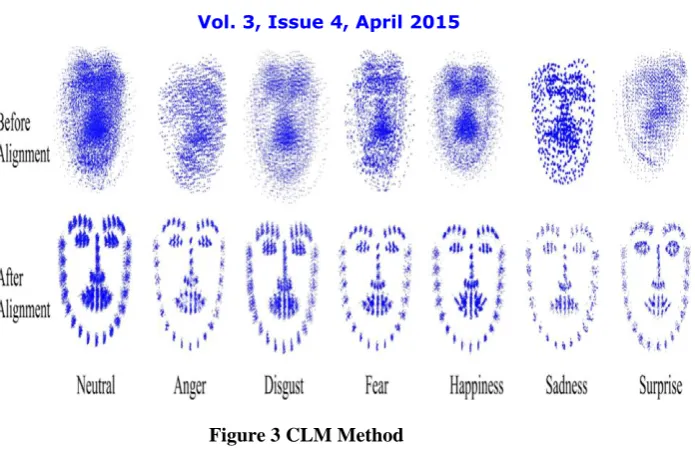
The geometric face shape information is captured by a set of 68 points known as landmarks. To remove variations in scale, orientation, and reference point, Procreates Analysis is employed to align these shapes to the mean shape. It illustrates the superimposition of 7 basic expressions from the validated MFP before and after Procreates alignment.
IV.SIMULATION RESULTS
The Gabor filters, with kernels similar to the 2 Deceptive field profiles of the mammalian cortical simple cells, have been reported to give improved facial expression recognition performance. Therefore, we use as facial texture features the Gabor features. To have face images with normalized shape and intensity, we first linearly warp the image so that the face shape in the resulting image is aligned with the mean shape. Then, the self-quotient image is calculated to attenuate illumination variation, which is obtained via a per-pixel division operation between the original image and its Gaussian smooth edversion. Our Gabor filter bank consists of filters at 5 scales and 8 orientations. Studies in psychologys how that facial feature of expressions are located around mouth, nose, and eyes, and their locations are essential for explaining and categorizing facial expressions. Therefore 7 local patches located around corre- sponding landmark points are chosen as the expressions alency regions, Gabor features are then calculated from these 7 patches respectively, resulting in a feature vector of dimension 560.
Copyright to IJIRCCE 10.15680/ijircce.2015.0304175 3826
Figure 3 CLM Method
V. CONCLUSION AND FUTURE WORK
All the investigation to be done for the strategies for the model fittings has been done. All the various type of existing methods were possessed within a consistent type of frame works where they were. A new type of technique has been used as an approximation when all that uses a various non parametric approximation. Two next innovations are proposed in order to reduce computational complexity and avoid local optimization. The proposed method was shown to outperform three other optimization strategies on the task of generic face allocation. All the in future works will involve all the various local detectors their types and shapes and their effects as a required point of time.
APPLICATIONS
It can be used in photographic fields, such as animation and editing.
It plays a vital role in day to day medical accepts, especially in neurology sector.
It also got used in various other official uses such as lie detector testing and other fields.
In today's generation its most sections are assembling in medical fields, such as brain scanning, and full body scanning, though it shows the correct effect of the problems occurred.
It can also be used to identify the accurate facial expression, which the face is in which expression.
REFERENCES
[1]I.KOTSIA,S.ZAFEIRIOU,I.PITAS,TEXTURE AND SHAPE IN FORMATION FUSION FOR FACIAL EXPRESSION AND FACIAL ACTION UNIT RECOGNITION,
PATTERN RECOGNITATION.41(2008)833–851.
[2] M. Kyperountas, A. Tefas, I. Pitas, Silent feature and reliable classifier selection for facial expression classification, PatternRecognit.43(2010)972–986.
[3] H.-Y. Chen, C.-L. Huang, C-M. Fu, Hybrid-boost learning for multi- pose face detection and facial expression recognition, Pattern Recognitation. 41(2008) 1173–1185.
[4] M.F. Valstar, M. Pantic, Z. Ambadar, J.F. Cohn, Spontaneous vs. Posed facial behavior: automatic analysis of brow actions, in: Proceedings of the 8th International Conference on Multimodal Interfaces, ICMI ’06, ACM, New York, NY,USA,2006, pp.162–170.
[5] J. Cohn, K. Schmidt, The timing of facial motion in posed and spontaneous smiles, Int.J. Wavel., Multi resolut. Inf. Process. 2(2004)1–12. [6] S. Wan, J.K. Aggarwal, A scalable metric learning-based voting method for expression recognition, in:10th IEEE International Conference on
Automatic Face and Gesture Recognition(FG),2013,pp.1–8.
[7] P.J.N.J.A. Russell, Judgments of emotion from spontaneous facial expressions of new Guineans, Emotions7 (2007)736–744.
[9] X.Sun, L.Rothkrantz, D.Datcu, P.Wiggers, A Bayesian approach to recognise facial expressions using vector flows, in: Proceedings of the International Conference on Computer Systems and Technologies and Workshop for PhD Students in Computing, Comp Sys Tech'09, ACM, New York, NY, USA, 2009, pp. 28:1–28:6.
[10] Y.Wang, H.Ai, B.Wu, C.Huang, Real time facial expression recognition with ad a boost, in: Proceedings of the 17th International Conference on Pattern Recognition, vol.3, pp.926–929.
[11] S. Das,K.Yamada, Article: an HMM based model for prediction of emotional composition of a facial expression using both significant and in significant action units and associated gender differences, Int.J. Comput. Appl.45 (2012) 11–18.