International Journal of Innovative Research in Science, Engineering and Technology An ISO 3297: 2007 Certified Organization Volume 6, Special Issue 4, March 2017
National Conference on Technological Advancements in Civil and Mechanical Engineering – (NCTACME'17)
17th -18th March 2017
Organized by
C. H. Mohammed Koya
KMEA Engineering College, Kerala- 683561, India
Optimization of Duplex Stainless Steel in End
Milling Process
Nithin Rajan1
Assistant Professor, Department of Mechanical Engineering, Nirmala Engineering College, Chalakudy, Kerala, India1
ABSTRACT: The main objective of this project is to find out the optimum cutting parameters during end milling
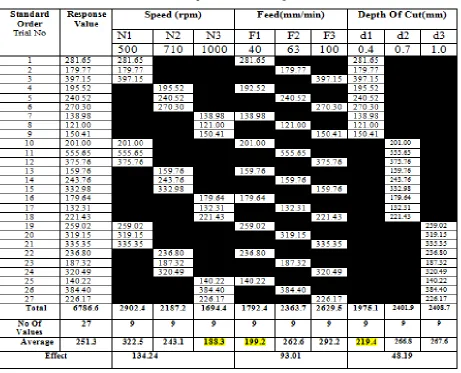
operation of ASTM grade 4A Duplex stainless steel using TiNi coated carbide tools. The influence of cutting speed, feed rate and depth of cut on surface roughness, cutting force are to be observed and noted. In this study, the Taguchi method is used to find out the optimal cutting parameters for surface roughness, cutting force, tool temperature and tool wear in milling. The L27 orthogonal array is employed to study the performance and characteristics in milling operations. Three factors namely, cutting speed, feed rate and depth of cut are used as the input parameter. Three levels of spindle speeds(500,710,1000rpm),three levels of feed rate(40,63,100mm/min)and three levels of depth of cut(0.4,0.7,1.0mm) are employed. Experimental results are provided to illustrate the effectiveness of this approach.
KEYWORDS: Self curing concrete, Internal curing, Poly Ethylene Glycol
I. INTRODUCTION
During the last 30 years, the usage of stainless steel material increased dramatically. The attractive combination of excellent corrosion resistance, a wide range of strength levels including Strength retention at cryogenic and elevated temperature, good formability and an aesthetically pleasing appearance have made stainless steel materials of choice for a diverse range of application ,from critical piping components in boiling water nuclear reactors to the ubiquitous kitchen sink.
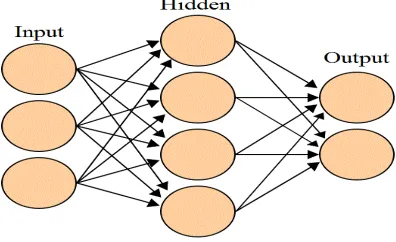
This work is carried out to find out the optimum cutting conditions. This work is carried out also to find out the influence of the cutting parameters such as cutting speed, feed rate and depth of cut on the surface finish, cutting force, tool wear and tool temperature using design of experiment method .Use of design of experiment method is economical and efficient in optimization of process parameters. The work is also carried out to predict the surface roughness using ANN. The usage of ANN gives almost accurate prediction values.
It is difficult to develop a precise mathematical model for a dry milling process as it is very complex. A non linear relationship between performance parameters and operating parameters exists in this process. Mathematical model like linear and non-linear regression models may not be able to capture those non linear correlations.ANN has the ability to correlate the input and output parameters are used for modeling in this process.ANN is characterized by topology, learning rule and activation function used. Domain knowledge from examples can be captured by neural networking and do not archive knowledge in an explicit from such as rules or database. Yet they can readily handle both continuous and discrete data and have a good generalization capability. Neural network can be used as mapping devices and pattern classifiers. In the manufacturing field they are used as optimization, modeling, prediction, control, classification and pattern recognition in the data association, clustering and signal processing
II.RELATEDWORK
The equipments used for the output parameters measurement are surface roughness meter and kistler dynamometer respectively.
Fig 1 Stainless steel work piece Fig 2
surface roughness measurement
Fig 3 Milling operation
Table 1 Material specification
Software used
Matlab program to predict the Cutting force
p = [500 40 0.4; 500 63 0.4;500 100 0.4; 710 40 0.4;710 63 0.4;710 100 0.4; 1000 40 0.4;1000 63 0.4;1000 100 0.4; 500 40 0.7;500 63 0.7;500 100 0.7; 710 40 0.7;710 63 0.7;710 100 0.7; 1000 40 0.7;1000 63 0.7;1000 100 0.7; 500 40 1.0;500 63 1.0;500 100 1.0; 710 40 1.0;710 63 1.0;710 100 1.0; 1000 40 1.0;1000 63 1.0;1000 100 1.0]’;
t=[281.65;179.77;397.15;195.52;240.52;270.30;38.98;121.0;150.41; 201.0;555.65;375.76;159.48;243.76;332.98;179.64;132.31;221.43; 259.02;319.15;335.35;236.88;187.32;320.49;142.22;384.46;226.17]’; plot(p,t,'o')
net = newff(p,t,10); y1 = sim(net,p) plot(p,t,'o',p,y1,'x')
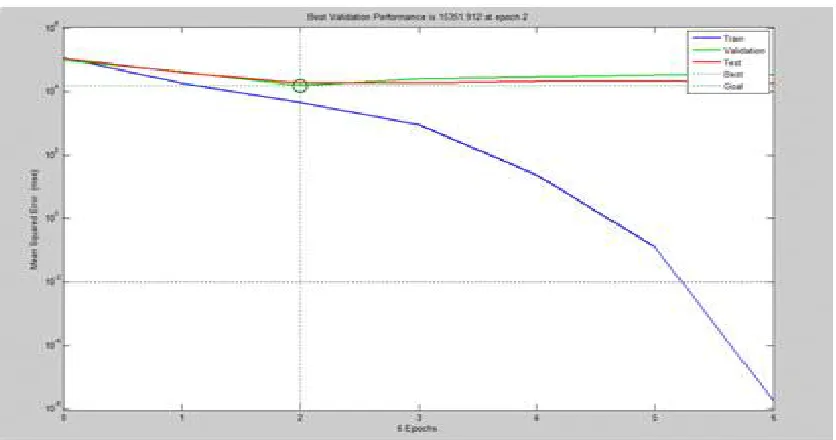
net.trainParam.epochs = 1000; net.trainParam.goal = 0.001; net = train(net,p,t);
r=[0.16 283 .5]’; y2 = sim(net,r)
III.EXPERIMENTAL RESULTS
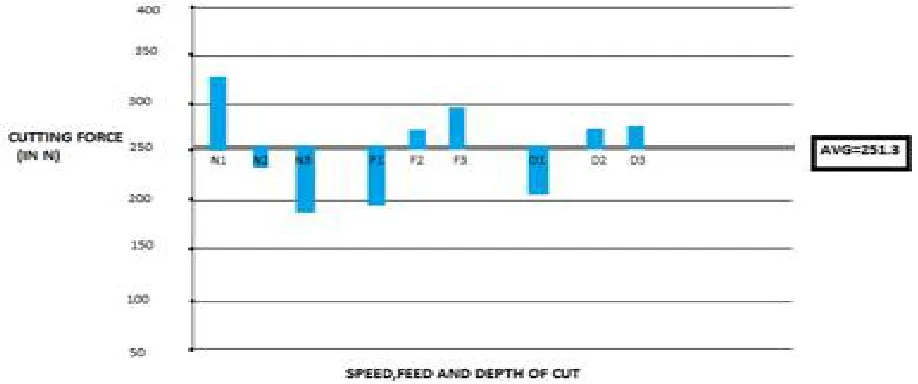
Fig4. Response graph for cutting force
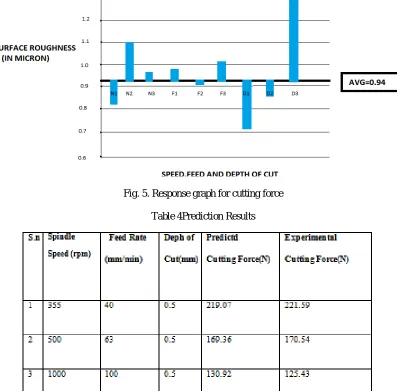
Fig. 5. Response graph for cutting force
Table 4Prediction Results
The experimental data of measured Cutting force are utilised to train the neural network model .Trained neural network models are used in predicting cutting force for various different cutting conditions .The developed prediction system is found to be capable of accurate cutting force prediction for the range it has been trained .The predicted values of the ANN were found to be very close to the experiment values
.
Fig 6 Regression result from ANN model: Output Vs Target
2. Low feed rate (40mm per min) , low depth of cut (0.4 mm) and cutting speed of (1000 rpm) lead to smaller value of resultant cutting force for the specific test range.
3. In end milling, use of high cutting speed (1000 rpm), low feed rate (40mm per min) and low depth of cut (0.4 mm) are recommended to obtain better surface finish for the specific test range.
4. Artificial Neural Network (ANN) was used to predict the cutting force. The predicted values of the ANN were found to be very close to the experimental values.
REFERENCES
[1] J.A. Ghani, I.A. Choudhury, H.H. Hassan “.Application of Taguchi method in the optimization of end milling parameters.” Faculty of
Engineering, UniversitiMalaya, 50603 Kuala Lumpur, Malaysia.
[2] Azlan Mohd Zain , Habibollah Haron a, Safian Sharif .“ Prediction of surface roughness in the end milling machining using Artificial
Neural Network” Expert Systems with Applications
[3] J. Stirnimann, A. Kirchheim .”New Cutting Force Dynamometers for High-Precision Machining “Reprint from “Industrial TOOLING ‘97”,
9/10 September 1997.
[4] P. Marimuthu and K. Chandrasekaran .“Experimental study on stainless steel for optimal Setting of machining parameters using Taguchi and
Neural Network” .
[5] Guey-Jiuh Tzou , Ding-Yeng Chen, Chun-Yao Hsu.”Application of Taguchi method in the optimization of cutting parameters for turning
operations.”