ISSN(Online): 2319-8753 ISSN (Print): 2347-6710
I
nternational
J
ournal of
I
nnovative
R
esearch in
S
cience,
E
ngineering and
T
echnology
(A High Impact Factor, Monthly, Peer Reviewed Journal)
Visit: www.ijirset.com
Vol. 7, Issue 5, May 2018
Landmark Recognition Using Image
Processing With MQTT Protocol
Thorat Prajakta S1, Patil Snehal R1., Singh Aarti Y1, D.J.Pereira2
B.E Students, Department of Computer Engineering, Govt College of Engineering and Research, Awasari (Kd.),
Pune, India1
Professor, Department of Computer Engineering, Govt College of Engineering and Research, Awasari (Kd.),
Pune, India2
ABSTRACT: The most important necessity for any user visiting an unknown or known establishment is true information. Even using Google and other searches wastes a lot of time. Asking around to people often confuses and misleads visitors. Hence, to bridge this user – information gap, a system providing complete true information to any naïve user needs to be formed. Our system takes an image as input from user and provides detailed real-time information. The image from the user will be processed and compared with the images in the database using Homograph. If match found, the information related to that image will be fetched and transferred using MQTT protocol. A client side will also be provided for small entrepreneurs to update information independently. There are various reasons why MQTT can be preferred over HTPP. MQTT is much faster and more flexible. Also, it works on various levels to provide security depending on user preferences. The image can be tested against various conditions according to camera quality and environmental conditions. Further, we will be explaining the system in detail along with its future scope in the world of computer vision.
KEYWORDS: MQTT protocol, SIFT algorithm, SQLite, Template matching, Java.
I. INTRODUCTION
ISSN(Online): 2319-8753 ISSN (Print): 2347-6710
I
nternational
J
ournal of
I
nnovative
R
esearch in
S
cience,
E
ngineering and
T
echnology
(A High Impact Factor, Monthly, Peer Reviewed Journal)
Visit: www.ijirset.com
Vol. 7, Issue 5, May 2018
developed to try overcoming these issues. MQTT was developed by IBM developers. It provides high speed transmission for large scale data and is highly preferred for real-time transmission. Also, wide range of ports is available for connections so any specific port can be set.To summarize, all above concepts explained i.e. image processing, content matching, MQTT etc. play a vital role in Deep learning and data transfer to output remarkable efficiency. The references mentioned here will give a quick overview of some of these concepts and a basic idea of how exactly things are expected to work. The concept of Image Recognition has been around for decades and technologies have improved alongside with its help. It acts as the core for graphic and motion related applications mainly due to its performance boosting tools. It basically deals with graphical data and complex processing algorithms. Extracting useful data from images gained popularity in early 90s and invented concepts like face detection and biometric scans.
An important factor supporting this process is Storage technologies. Databases are being trained and developed to store and manage large data chunks. SQL, Mongo, oracle etc. are some to mention. Images consume a lot of data space and hence it becomes necessary to dedicate resources to support database management. Various image processing techniques require swift data interaction and faster processing algorithms with can be achieved by sophisticated database monitoring resources. Internet Protocols, which are the backbone of data transmission over the network also help in increasing overall efficiency. Traditional HTTP has now been substituted with different protocols which are more favourable. TCP/IP was created with the advancement of internet. One such protocol is MQTT (Message Queue telemetry transfer) protocol. Developed by IBM, it is much faster and flexible
II. LITERATURE SURVEY
This paper of [1] Content and Context information Fusion (2011), Author[1]: Tao Chen, illustrates the use of mobile application for recognizing different landmarks using SVM algorithm . It recognizes the picture using content matching . Information is extracted from the picture using Bow(bag of words ) this content is matched with the image and GPS location and a result is generated . According to the survey made SIFT(scale invariant feature transform) is the most promising content analysis approach . However the large patches of SIFT in a single image makes computational cost of the image very high. To reduce this computational cost Bow has been used . However Bow has two major disadvantage (i)it ignores the spatial layout information of the landmark image (ii)It does not discriminate the different foreground in the image. In order to eliminate the first problem a spatial pyramid matching scheme is used. It partitions the images into fine cells and then calculates the histogram inside cell of the image. However this pyramid does not discriminate between different foreground. First the spatial pyramid decomposition is adopted to partition the image into a set of multi-resolution pyramid cells. The histogram of each cell is calculated using previously constructed codebook.
Finally, SVM issued to train these descriptors into a classifier This paper of [2] Survey on Mobile Landmark Recognition for Information Retrieval, Author[1]: Tao Chen, shows the use of mobile application for recognizing different landmark and to retrieve information from the picture. For classification purpose the is classified into different feature having global classification, local classification. The commonly used feature in mobile landmark recognition is global feature. Global feature differentiate picture according to its colour and texture. It uses multi-dimensional statistical responses of specific image filter to represent high dimensionality composed histogram feature. It also uses SIFT for retrieving information from the picture. This feature is used in almost all the landmark recognition app Augmented technology is also used to display information from the picture. SIFT improves the accuracy and improves the computational time. Colour-edge histogram patch (CEHP) are used to select an optimal number of candidates in the first stage.
ISSN(Online): 2319-8753 ISSN (Print): 2347-6710
I
nternational
J
ournal of
I
nnovative
R
esearch in
S
cience,
E
ngineering and
T
echnology
(A High Impact Factor, Monthly, Peer Reviewed Journal)
Visit: www.ijirset.com
Vol. 7, Issue 5, May 2018
Recognition Using Machine Learning, Author[1]: Andrew Crudge, input data of 193 images are given from google database. this data act as a training data set for the SVM. The training data set given to the SVM must contain vector that contain all the information of the images. To make each example the same feature dimension, the image must be cropped to an aspect of 5:2 ratio. To extract the feature from the image a HOG descriptor is used. HOG analyses the gradient orientation of the image. The images is divided into small cells. HOGdescriptor also possesses several other useful properties for object detection. Drawback of HOG tool is that it does notadjust to the invariant in orientation of the images. SVM is used as machine learning classifier for this application.
SVM was chosen as it works efficiently for high dimensional images. Drawback of SVM is it does not work on large number of datasets. Four classifier were compared by running a dataset of 100 images. But SVM attained a accuracy of 80%-90%. To detect a target building hidden within a larger image, the image is cropped into multiple overlapping cells with identical aspect ratios. Overall, the results are very encouraging, and they demonstrate that landmarks can be accurately identified from an image using a basic classification algorithm. An accuracy as high as 90% is attainable using a relatively small sample size.
This paper is [4] Evaluation of Image-Based Landmark Recognition Techniques, Author[1]: Yutaka Takeuchi. Recognizing landmarks in sequences of images is a challenging problem for a number of reasons. First of all, the appearance of any given landmark varies substantially from one observation to the next. In addition to variations due to different aspects, illumination changes, external clutter, and changing geometry of the imaging devices are other factors affecting the variability of the observed landmarks. Finally, it is typically difficult to make use of accurate 3D information in landmark recognition applications. For those reasons, it is not possible to use many of the object recognition techniques based on strong geometric models. The color values are resampled using a standard equalization. Specifically, the histogram of color values is divided into eight classes of roughly equal numbers of pixels. The color image is then coded on eight levels using those classes Edges are computed using Deriche’s edge detector, and edge elements are linked and expanded into line segments. The input image is a 160x120 normalized red image. Five histogram features are computed from the edge image. This registration problem can be made tractable through a few domain assumptions. First of all, the interest is in landmarks that are far from the observer. Second, let’s assume that the images come from video sequences taken from a moving vehicle looking forward or from a transverse observer.
III. WORKING MECHANISM
The entire system is divided in three basic modules namely,
i. User module ii. Client module
iii. Image processing system
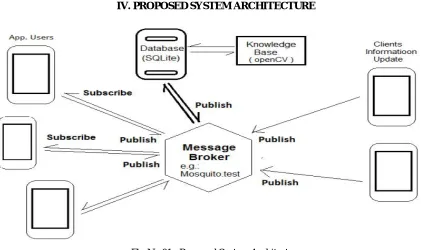
First, the users are requested to login so as to categorize clients and App users. The user is asked to click an image which is temporarily stored in the phone memory before being transferred. The image is then transferred to the database for processing. The file transfer occurs under MQTT protocol standards. The database consists of knowledge base which helps in comparison process. Feature extraction concept comes in handy when efficient matching is needed. Image is compared with all the images in the database to assure close to accurate results. Homograph is applied on the server side and it terminates when comparison process completes. After getting a match, the reference ID of the matched image is followed to the database to prepare the information for transfer. The data is then passed on to the phone on the same connection along with the image.
ISSN(Online): 2319-8753 ISSN (Print): 2347-6710
I
nternational
J
ournal of
I
nnovative
R
esearch in
S
cience,
E
ngineering and
T
echnology
(A High Impact Factor, Monthly, Peer Reviewed Journal)
Visit: www.ijirset.com
Vol. 7, Issue 5, May 2018
IV. PROPOSED SYSTEM ARCHITECTURE
Fig No 01. Proposed System Architecture
The entire system runs on MQTT protocol for communication. The image from the user and the data updated by the client is concurrently transferred to the SQL Database through the message broker.
V. MQTT PROTOCOL
ISSN(Online): 2319-8753 ISSN (Print): 2347-6710
I
nternational
J
ournal of
I
nnovative
R
esearch in
S
cience,
E
ngineering and
T
echnology
(A High Impact Factor, Monthly, Peer Reviewed Journal)
Visit: www.ijirset.com
Vol. 7, Issue 5, May 2018
It was developed by IBM and is open source for developers. It works on publish-subscribe methodology. The user subscribes to a topic and the server publishes such topics continuously. Entire process is handled by the Message Broker. Publish–subscribe is a messaging pattern where senders of messages, called publishers, do not program the messages to be sent directly to specific receivers, called subscribers, but instead characterize published messages into classes without knowledge of subscribers. Similarly, subscribers express interest in one or more classes and only receive messages that are of interest, without knowledge of which publishers. Deep learning algorithms were considered as traditional methods before the development of similar and more efficient algorithms. Homography is one such example which is much faster. It works on monochrome images and performs pixel to pixel matching. It is open source and developed in OpenCV
ISSN(Online): 2319-8753 ISSN (Print): 2347-6710
I
nternational
J
ournal of
I
nnovative
R
esearch in
S
cience,
E
ngineering and
T
echnology
(A High Impact Factor, Monthly, Peer Reviewed Journal)
Visit: www.ijirset.com
Vol. 7, Issue 5, May 2018
Login page:
ISSN(Online): 2319-8753 ISSN (Print): 2347-6710
I
nternational
J
ournal of
I
nnovative
R
esearch in
S
cience,
E
ngineering and
T
echnology
(A High Impact Factor, Monthly, Peer Reviewed Journal)
Visit: www.ijirset.com
Vol. 7, Issue 5, May 2018
VII. CONCLUSIONS
In the future, other feature extraction methods can be looked at that may give better accuracy but require fewer dimensions. An algorithm will also need to be developed that can automatically search and obtain data from a database. The project can ultimately become part of the back-end code for a feature-recognition smartphone app.Also, a major affecting factor for the same is the transmission of data across the network. MQTT over TCP/IP is found much more effective at present for quick transfer of messages even on a giant scale but further researches can be made for attaining maximum flexibility and boost the transactions for better real time O-T-G experience. By using uniqueness in the picture, the time required by the app to recognize any picture will be less. This will also help app to attain high accuracy in terms of result. This app can be used in future in term of augmented reality to know the shape and structure of a particular building or monument. Even it can be used to recognize object which are used in our daily life.
REFERENCES
[1] Tao Chen, Kim-Hui Yap, Lap-Pui Chau “Content and Context information Fusion for Mobile Landmark Recognition” IEEE pp. 978-1-4577- 0031-6/11, 2011.
[2] Tao Chen, Kui Wu, Kim-Hui Yap, Zhen Li, and Flora S. Tsai “A Survey on Mobile Landmark Recognition for Information Retrieval” IEEE pp. 978-0-7695-3650-7/09, 2009.
[3] Yutaka Takeuchi, Martial Hebert “Evaluation of Image-Based Landmark Recognition Techniques” Carnegie Mellon University, 2009.
[4] Tom Duckett, UlrichNehmzow “Performance Comparison of Landmark Recognition Systems for Navigating Mobile Robots” America Association for Artificial Intelligence, 2000.
[5] David M. Chen “Memory-Efficient Image Databases for Mobile Visual Search” March 2014.
[6] Aditya Srinivas Timmaraju and Anirban Chatterjee “Monulens: Real-time mobile-based Landmark Recognition” Stanford University Stanford,CA – 94305.
[7] Filippo Galli “Landmark Recognition with Deep Learning” NEUROSCIENTIFIC SYSTEM THEORY” TechnischeUniversit at Munchen,2016. [8] Yan-Tao Zheng, Ming Zhao, Yang Song, Hartwig Adam, Ulrich Buddemeier, Alessandro Bissacco, Fernando Brucher, Tat-Seng Chua, and Hartmut Neven “Tour the World: building a web-scale landmark recognition engine”
ISSN(Online): 2319-8753 ISSN (Print): 2347-6710
I
nternational
J
ournal of
I
nnovative
R
esearch in
S
cience,
E
ngineering and
T
echnology
(A High Impact Factor, Monthly, Peer Reviewed Journal)
Visit: www.ijirset.com
Vol. 7, Issue 5, May 2018
[10] A. M. Kaneko and K. Yamamoto, "Landmark recognition based on image characterization by segmentation points for autonomous driving," 2016 SICE International Symposium on Control Systems (ISCS), Nagoya, 2016, pp. 1-8.
[11] J. Cao, T. Chen and J. Fan, "Fast online learning algorithm for landmark recognition based on BoW framework," 2014 9th IEEE Conference on Industrial Electronics and Applications, Hangzhou, 2014, pp. 1163-1168.
[12] J. Cao et al., "Landmark recognition via sparse representation," 2015 IEEE International Conference on Digital Signal Processing (DSP), Singapore, 2015, pp. 1030-1034.