ISSN(Online): 2320-9801
ISSN (Print): 2320-9798
International Journal of Innovative Research in Computer
and Communication Engineering
(A High Impact Factor, Monthly, Peer Reviewed Journal)
Vol. 4, Issue 1, January 2016
An Analysis and Review of Spam Detection
Techniques in Various Forms
Ms. R.Priya1, Dr. P. Sumathi2,
Research Scholar, PG & Research, Department of Computer Science, Government Arts College (Autonomous),
Coimbatore, India1
Assistant Professor, PG & Research, Department of Computer Science, Government Arts College (Autonomous),
Coimbatore, India2
ABSTRACT: Spam are the most occurred threat in the online usage system which would be send periodically to the
multiple users continuously which are invalid message for the corresponding users. These spam messages might cause the performance of users in various forms like system corruption, performance degradation and so on. This spam messages needs to be prevented for the system performance improvement. There is various research works has been conducted previously for better prevention of the spam messages from the hackers. This analysis work attempts to review of various research works that has been conducted with the goal of prevention of spam messages. This research works also provides the discussion of merits and demerits of the different research methodologies to predict the better approach that can provide the way of better detection of spam messages.
KEYWORDS: Spam detection, hackers, filtering, bot nets
I. INTRODUCTION
Spam is defined as unwanted or unnecessary electronic junks which come frequently to emails. Some unwanted ads or posts that are displaying in the web pages also referred as spam which should be analysed efficiently for the better performance improvement. Spam is considered as the most concerned threat in the online usage system which might cause the performance of system by consuming larger storage consumption and leading to overload of the system. The overload of the system would degrade the system performance which might lead to corruption and loss of the system files. This is the biggest research concern in the biggest industries and the organization in the real world who is about to maintain various files and information.
Some automated mechanisms that are implemented for spam detection would prevent the unsolicited messages from displaying. This automated mechanism might prevent the email from known persons too due to usage of new email ids. This would be greater trouble in the online usage systems, thus differentiation of unsolicited messages from the known mail ids should be done. The automated mechanism must be programmed to find the differentiation between the unwanted ads and the wanted emails.
These spam mails needs to be prevented for the better utilization of storage spaces and preventing system from failures. Various methodologies has been introduced earlier which attempts to prevent the spam storage emails. However, those methods are mostly similar to each other which can be easily detected by the various anti spam techniques. Thus, there is a chance of race course between the spam detection techniques and the anti spam techniques. This analysis work attempts to discuss the various features, merits and demerits of spam detection and anti spam techniques with the concern of the different terminologies and factors. The following section would provide the detail of the different features that can be used for detection of spam messages.
ISSN(Online): 2320-9801
ISSN (Print): 2320-9798
International Journal of Innovative Research in Computer
and Communication Engineering
(A High Impact Factor, Monthly, Peer Reviewed Journal)
Vol. 4, Issue 1, January 2016
the contents that are present over the web pages and the real world applications. Cloaking is a technique to modify the contents that are present in the web pages and preventing the real world pages to display the original contents. Among these most popular spam detection technique is the take usage of web page application features to modify or create the contents that are present in the system.
The main contribution of the analysis work is to research the various previous research methodologies that have been conducted previously and discussing the merits and demerits of those methods to predict the better approach from which research can be focussed. The overall organization of the research methodology is given as like as follows: This section provides the detailed introduction about the spam detection techniques. In section 2, different research methodologies that has been conducted previously for detection the spam messages has been discussed. In section 3, merits and demerits of the previous research methodologies that have been conducted in the section 2 has been given. In section 4, overall analysis of the research methodology is concluded.
II. RELATED WORK
This section provides the detailed discussion of the different previous research methodologies that has been conducted by various researchers has been given. The methodology used and the working procedure of the different research methodologies has been discussed in depth and the merits and demerits of those methodologies has been given in the following section.
Brian Whitworth et al (1) discussed and analysed about the spam details and the introduction about the detection methodologies. The author provides the role of spam detection in the real worlds and the effects of spam in the application in terms of their causes. The author has given detailed introduction about the impacts of the spam detection techniques with their effects of reduction of gap in the real world application. To do so, author has developed a software system that concern on finding the spam occurrence. This software system is capable of finding the spam occurrence in the automated manner with improved performance.
Linda Dailey Paulson (2) analysed the resolution for the spam prevention in the automated manner permanently. The author has analysed the many ways that can be used for complete prevention of the spam mails from the different sources. This work provides the various issues that might be arise due to arrival of more junk messages. These causes and effects of these issues are given in the detailed manner with the concern of the different terminologies. The side effects of spam in the long running application are also discussed in the detailed manner. The author has concluded that there is no way for prevention of the spam mails in the complete manner due to their various threat occurrence and their side effects.
VedatCoskun et al (3) proposed a quarantine region scheme for effective detection of the spam attacks in the wireless sensor networks. The main goal of this proposed scheme is to detect the issues like delay tolerance and the energy problems that might arise in the wireless sensor network due to the occurrence and arrival of spam messages in to the environment. This detection mechanism is applied in the quarantine region for detection of the spam mails to improve the performance of the system. The author has proved that the QRS can achieve the trade off between the resilience against spam attacks and the number of authentications. The experimental results of this work concludes that the propose scheme can achieves the better prevention of the spam message into the wireless sensor network system.
Adam J.O’donnell (4) designed a framework called the microcosm which is called as stock spam. The stock spam is nothing but the group of the spam emails and the stock messages that are incorporate with each other in terms of analysis of various merits. The stock spam allows users to define the users to group the various emails along with their advertisement in the secured manner. This framework allows users to define the different terms and concepts that are reasonable for the provisioning of the emails such as junk mails. This framework attracts various industry people to implement in their organization to provision and handling of spam messages in the considerable manner.
ISSN(Online): 2320-9801
ISSN (Print): 2320-9798
International Journal of Innovative Research in Computer
and Communication Engineering
(A High Impact Factor, Monthly, Peer Reviewed Journal)
Vol. 4, Issue 1, January 2016
concern of the various contents and collusion items present in the environment. Improving the privacy of the users by securely transmitting messages between ports by using the privacy preserved protocols. This process is done in the collaborative manner to improve the spam detection process by filtering out the contents that are present in the real world applications. The overall research of this work proves that the proposed research can contribute towards better detection of the spam mails with improved privacy and less false detection rate.
Lourdes Araujo et al (6) proposed a link based features with language model to predict the spam arrival in the effective manner. This method assures the detection of the spam mails and junk mails can be done in the effective manner by learning the feature that are main reasonable for those implementation. This is done by introducing the classification mechanism into the system that can assure the learning of knowledge. This proposed methodology would be applied on the contents that are retrieved from the various web pages in order to allow them to learn the different methodologies. This mechanism leads to a complete knowledge learning about the proposed mechanism, thus the experimental results of this work provides better result by detecting the spam mails in the effective manner.
Chi-Yao Tseng et al (7) proposed a novel Email abstraction scheme for better prediction of the spam junks that are entering into the system. This mechanism is based on near duplicate detection scheme which attempts to preserve the Email junk detection capability in the effective manner by implementing the methodology that can identify the near duplicate items. This methodology is based on Email layout system which can identify the knowledge of the system in the effective manner by updating the changes occurred in the dynamic manner. The overall research of this work concludes that the propose mechanism can provide the accurate result. The layout of the Emails would be updated periodically by learning the knowledge of information system using the learning mechanism. This methodology is evaluated on the real live data set to evaluate the performance improvement.
ZhenhaiDuan et al (8) proposed a SPOT framework which is a spam detection mechanism. The SPOT works based on monitoring the messages that flowing in the environment. The divergence behaviour of different messages that are transferred between the different mediums would be calculated for identifying the pattern of the spam messages. This is done by collecting the two-month e-mail trace from various sources. This mechanism can automatically detect the spam messages that are arriving into the system in terms of evaluating the performance and divergence of the different spam messages. The performance improvement of the proposed mechanism is evaluated by comparing it with the other zombie Spam detection mechanism in terms of performance measures called the accuracy and precision rate.
HaiyingShen et al (9) proposed SOAP methodologies which make utilize the social networking environment for the better prediction of the spam messages that are entering into the system in terms of improved utilization of the system. This methodology is based on the distributed approach which would collect the spam node details from the nodes which would be shared with other nodes present in the environment to improve the security. The proposed methodology of this work provides the performance improvement over the real time environment by adapting the social network environment knowledge information. SOAP integrates four components into the basic Bayesian filter: social closeness-based spam filtering, social interest-based spam filtering, adaptive trust management, and friend notification.
ISSN(Online): 2320-9801
ISSN (Print): 2320-9798
International Journal of Innovative Research in Computer
and Communication Engineering
(A High Impact Factor, Monthly, Peer Reviewed Journal)
Vol. 4, Issue 1, January 2016
III.COMPARISON ANALYSIS
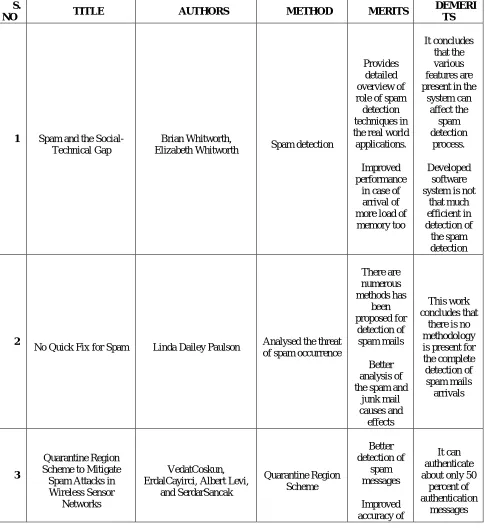
This section provides the merits and demerits of different research methodologies which have been conducted previously with the concern of the effective detection of spam messages and mails.
Table 1. Comparison Analysis of different research methodologies
S.
NO TITLE AUTHORS METHOD MERITS
DEMERI TS
1 Spam and the Social-Technical Gap
Brian Whitworth,
Elizabeth Whitworth Spam detection
Provides detailed overview of role of spam detection techniques in the real world applications.
Improved performance
in case of arrival of more load of
memory too
It concludes that the various features are present in the
system can affect the
spam detection
process.
Developed software system is not
that much efficient in detection of
the spam detection
2
No Quick Fix for Spam Linda Dailey Paulson Analysed the threat of spam occurrence
There are numerous methods has
been proposed for
detection of spam mails
Better analysis of the spam and
junk mail causes and
effects
This work concludes that
there is no methodology is present for the complete detection of
spam mails arrivals
3
Quarantine Region Scheme to Mitigate Spam Attacks in Wireless Sensor
Networks
VedatCoskun, ErdalCayirci, Albert Levi,
and SerdarSancak
Quarantine Region Scheme
Better detection of
spam messages
Improved
It can authenticate about only 50
percent of authentication
ISSN(Online): 2320-9801
ISSN (Print): 2320-9798
International Journal of Innovative Research in Computer
and Communication Engineering
(A High Impact Factor, Monthly, Peer Reviewed Journal)
Vol. 4, Issue 1, January 2016
detection of spam emails
Achieves better trade off between detection of spam emails
Can lead to more computation
overhead
4 The
EvolutionaryMicrocosm of Stock Spam
Adam J.O’donnell Microcosm
Providing user flexible environment to allow them
to publish their ad contents in
the environment
Can lead to better handling of
the spam message with
the concern of system performance improvement
More computation
overhead
Increased detection capability of researchers to
provide a flexible environment.
5 Privacy-Aware
Collaborative Spam Filtering
Kang Li, ZhenyuZhong, andLakshmishRamaswamy
ALPACAS—a privacy-aware framework for collaborative spam
filtering
More privacy which provides the
secured environment for the users to prevent
from the performance
degradation which occurs
due to spam mails
Improved false positive
rate by detecting the
spam in the effective and
accurate manner
More computation time required to resolve the
system configuration
details
Classification result might get affected in
ISSN(Online): 2320-9801
ISSN (Print): 2320-9798
International Journal of Innovative Research in Computer
and Communication Engineering
(A High Impact Factor, Monthly, Peer Reviewed Journal)
Vol. 4, Issue 1, January 2016
6
Web Spam Detection: New
ClassificationFeatures Based on Qualified
Link Analysisand Language Models
Lourdes Araujo and Juan Martinez-Romo link-based features with language-model (LM) Improved detection of spam mails that are arriving into the system by
learning the features of the different web pages More secured environment can be assured by detecting the spam in dynamic manner Accuracy might get reduced in case of presence of more computation overhead 7
Cosdes: A Collaborative Spam DetectionSystem
with a Novel E-Mail AbstractionScheme
Chi-Yao Tseng, Pin-Chieh Sung, and Ming-Syan
Chen novel e-mail abstraction scheme Better prediction of the knowledge of the system by learning the system spam detail Periodical update of Email structure leads to the
better prediction of spam junk mail arrivals Upto date information maintenance might violate the performance
of the near duplication checking mechanism
8 Detecting Spam
Zombies byMonitoring Outgoing Messages
ZhenhaiDuan, Peng Chen, Fernando Sanchez,Yingfei Dong, Mary Stephenson, and James Michael Barker
spam zombiedetection system More accuracy in prediction of spam zombie messages Improved performance of real world system in better Less system performance due to handling of large volume of data’s that are entering
ISSN(Online): 2320-9801
ISSN (Print): 2320-9798
International Journal of Innovative Research in Computer
and Communication Engineering
(A High Impact Factor, Monthly, Peer Reviewed Journal)
Vol. 4, Issue 1, January 2016
the spam messages
More precision and accuracy rate
9 Leveraging Social
Networks forEffective Spam Filtering
HaiyingShen, and Ze Li
SOcial network Aided Personalized
and effective spam filter (SOAP)
Better detection of
the spam messages
Less computation
overhead
More privacy in terms of analysing the
various parameters
that are considered
Less accuracy in detection of
spam messages
1 0
Analysis on the Content Features and Their Correlationof Web Pages for Spam
Detection
JiHua, Zhang Huaxiang
calculating probabilityformulae
of the entropy and
independentn-grams
Mo re accuracy in prediction of
spam messages
Improved system performance
More content features might
degrade the system performance.
IV.NUMERICAL ANALYSIS
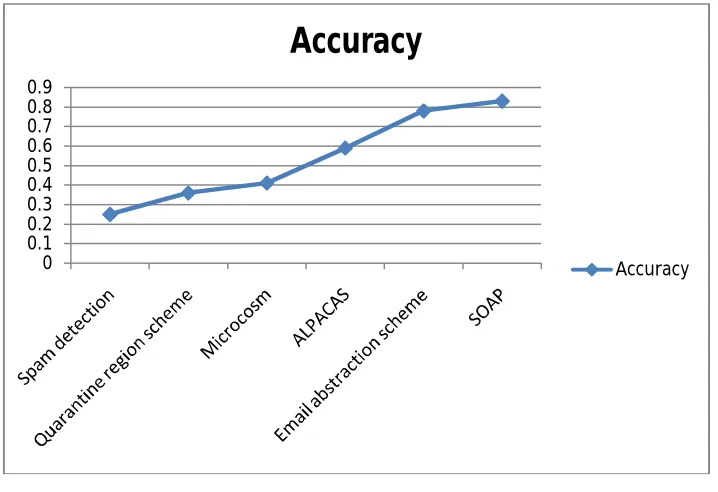
This section provides the numerical analysis of the various methodologies that has been introduce with the concern of detection of spam contents that are present in the system. This performance analysis is done based on the performance measure called the accuracy.
ISSN(Online): 2320-9801
ISSN (Print): 2320-9798
International Journal of Innovative Research in Computer
and Communication Engineering
(A High Impact Factor, Monthly, Peer Reviewed Journal)
Vol. 4, Issue 1, January 2016
Figure 1. Accuracy Comparison
The above graph depicts the accuracy comparison for the various methodologies. This graph proves that the SOAP approach provides better result than the other methodologies with improved accuracy rate.
V. CONCLUSION AND FUTURE WORK
Spam is a most concerned threat in the online usage application where the adversaries attempt to violate the system performance by continuously sending junk mails or spam mails. This unwanted and repeated receiving message behaviour would violate the system performance by corrupting operating system. This analysis paper discusses the various methodologies in terms of different spam detection techniques to find the properties. The numerical evaluation of this work proves the SOAP methods can provide better result than the other mechanism in terms of improved accuracy rate.
REFERENCES
1. Brian Whitworth, Elizabeth Whitworth, “Spam and the Social-Technical Gap”, Published by the IEEE Computer Society, 2004 2. Linda Dailey Paulson, “No Quick Fix for Spam”, IT programmer, June 2005
3. VedatCoskun, ErdalCayirci, Albert Levi, and SerdarSancak, “Quarantine Region Scheme to Mitigate Spam Attacks in Wireless Sensor Networks”, IEEE transactions on mobile computing, vol. 5, no. 8, august 2006
4. Adam J.O’donnell, “The Evolutionary Microcosm of Stock Spam”, published by the IEEE computer society, 2007
5. Kang Li, ZhenyuZhong, and LakshmishRamaswamy, “Privacy-Aware Collaborative Spam Filtering”, IEEE transactions on parallel and distributed systems, vol. 20, no. 5, may 2009
6. Lourdes Araujo and Juan Martinez-Romo, “Web Spam Detection: New Classification Features Based on Qualified Link Analysis and Language Models”, IEEE transactions on information forensics and security, vol. 5, no. 3, september 2010
7. Chi-Yao Tseng, Pin-Chieh Sung, and Ming-Syan Chen, “Cosdes: A Collaborative Spam Detection System with a Novel E-Mail Abstraction Scheme”, IEEE transactions on knowledge and data engineering, vol. 23, no. 5, may 2011
8. ZhenhaiDuan, Peng Chen, Fernando Sanchez, Yingfei Dong, Mary Stephenson, and James Michael Barker, “Detecting Spam Zombies by Monitoring Outgoing Messages”, IEEE transactions on dependable and secure computing, vol. 9, no. 2, march/april 2012
9. HaiyingShen, and Ze Li, “Leveraging Social Networks for Effective Spam Filtering”, IEEE transactions on computers, vol. 63, no. 11, november 2014
10. JiHua, Zhang Huaxiang, “Analysis on the Content Features and Their Correlation of Web Pages for Spam Detection”, Communications System Design, March 2015
0 0.1 0.2 0.3 0.4 0.5 0.6 0.7 0.8 0.9
Accuracy
ISSN(Online): 2320-9801
ISSN (Print): 2320-9798
International Journal of Innovative Research in Computer
and Communication Engineering
(A High Impact Factor, Monthly, Peer Reviewed Journal)
Vol. 4, Issue 1, January 2016
BIOGRAPHY
Dr.P.Sumathiis working as an Assistant Professor in the Department of Computer Science, Government Arts College,
Coimbatore. She completed PhD in the area of Grid Computing at Bharathiar University. She completed M.Phil in the area of Software Engineering at Mother Teresa Women’s University. She completed MCA at Kongu Engineering College at Perundurai. She has published many national and International journals. She has about seventeen years of teaching and research experience. Her research interests include Data Mining, Distributed Computing and Software Engineering.