Analytical Study on the Behavior of Cold
Formed Beam Column Connections
Ranjitha S1*, Sattainathan Sharma A2 , Vinoth kumar N3
Post Graduate Student, Civil Engineering, Valliammai Engineering College, Chennai, India1* Assistant Professor, Civil Engineering, Valliammai Engineering College, Chennai, India. 2 3
ABSTRACT: Cold formed steel members are built up sections from the products of steel plate, sheet or strip material at an ambient temperature in order to achieve the desired shapes, so that it can be used to convince the structural and functional requirements. Cold formed steel sections has been extensively used in recent trends due to its varied applications and advantages. Also, these sections are found to be an alternate to hard rolled steel section since it is more effective in high strength to weight ratio. Literature studies reveal that properties of Hot rolled steel sections were more frequently analysed, unlike cold forms. Also the results shows that the bolted joints of Hot rolled steel sections are efficient. Therefore, the study of properties and behaviour of the cold formed steel sections as a primary structural member will provide futuristic technology applications. This paper presents the non-linear finite element analysis of steel beam column connections (cold formed section). Hereby it provides the analytical results of behaviour of the beam-column connections with the bolted and welded joints.
KEYWORDS: cold-formed steel, bolted joints, welded joints, non-linear analysis.
I. INTRODUCTION
Cold formed steel sections are light weight material, formed during the process of cold roll, where the sheet stock plate or strip material is fed longitudinally through a series of rolls, each of which works the steel progressively until it reaches the desired shape. Thickness of material that can be formed generally ranges from 0.16mm to 19mm thick and sections with yield strength from 250 to 450 N/mm2 which are commonly available. Cold formed steel structures has its benefits like build ability, strong and light weight, design flexibility, safety, speed, quality and recyclable etc.,
Thin sheet steel products are extensively used in building industry, and range from purlins to roof sheeting and floor decking. Generally these are available for use as basic building elements for assembly at site or as prefabricated frames or panels. These thin steel sections are cold-formed, i.e. their manufacturing process involves forming steel sections in cold state (i.e. without application of heat) from steel sheets of uniform thickness. These are given the generic title
Cold Formed Steel Sections. Sometimes they are also called Light Gauge Steel Sections or Cold Rolled Steel Sections. The thickness of steel sheet used in cold formed construction is usually 1 to 3 mm. Much thicker material up to 8mm can be formed if pre-galvanised material is not required for the particular application. The method of manufacturing is important as it differentiates these products from hot rolled steel sections. Normally, the yield strength of steel sheets used in cold formed sections is at least 280N/mm2, although there is a trend to use steels of higher strengths, and sometimes as low as 230N/mm2 .
Although the cold rolled products were developed during the First World War, their extensive use worldwide has grown only during the last 20 years because of their
that can be manufactured, cold formed steel construction has been used for highly pleasing designs in practically every sector of building construction.
In general, cold formed structural members are used as secondary members in building constructions and they are connected to primary structural members through mechanical fasteners depending on the connection configuration. Connections are the physical components which mechanically fasten the structural elements and these fasteners are important in transferring force and moment from structural top member to the supporting element. Structural joints can be classified into several categories by referring to its strength and stiffness. Cold formed steel fasteners has a variety of joint elements used either by screws or bolted connection or welded connections or storage rack connection etc., The contribution of each component from the developed joints should be identified to achieve more reliable structural behaviour.
Design guidelines for cold formed steel connections are limited to their fundamental behaviour. Detailed design procedures for cold formed section joint are uncommon due to their wide variance and specific purpose and most design are made based on testing results. As many research have been carried out and significance of cold formed section is concerned. This paper aims to collect data on the behaviour of Cold Formed Beam Column Connections
with different Types of Joints compared with experimental and analytical datas by finite element modeling technique.
OBJECTIVE
To study the structural performance of Cold Formed Steel beam column connection with the bolted and welded joints configuration using inelastic analysis –moment resistance and deflection using Finite Element Software (ABAQUS).
SCOPE
In steel structures, moment resisting steel frames are highly regarded for their seismic performance. This regard is based on their ductility and inelastic performance, since inelastic deformation is used to dissipate energy during major earthquakes. This dissipation of energy is predominantly required in the connections like beam column joints. The internal forces and moments produced in these connections influence the behaviour of the overall structures. Cold formed steel structures are tend to be very slender on compared with the hot rolled steel, it is expected that deformation and stiffness will often be significant in this type of steel sections.
II.BEAM TO COLUMN CONNECTIONS
Simple Connections
(i)Simple connections are assumed to transfer only shear at some nominal eccentricity and typically used in frames up to about five stories in height, where strength rather than stiffness govern the design.
(ii)In such frames separate lateral resisting system is to be provided in the form of bracings or shear walls.
Rigid Connections
(i)Rigid connections in high-rise and slender structures, stiffness requirements may warrant the use of rigid connections. Rigid connections transfer significant moments to the columns and are assumed to undergo negligible deformations at the joint.
III.SECTIONAL AND MATERIAL SPECIFICATIONS
The section are selected from is 811-1987 specification for cold formed light gauge steel sections. Beam and Column are in symmetrical I section. Width of top and bottom flange is 150mm, depth of web is 150mm , length of beam is 800mm and length of column is 1000mm and thickness is 2.5mm.
Similarly, both the beam and columns are of symmetrical channel sections with width of top and bottom flange is 75mm, depth of web is 150mm, length of beam and column are 800mm & 1000mm respectively.
The thickness is of 2.5mm.
Four models was created using two types of joints as bolts and welded connections. Yield strength of steel sections is fy = 230N/mm2
Poisson ratio is 0.3
IV.NUMERICAL ANALYSIS I Section
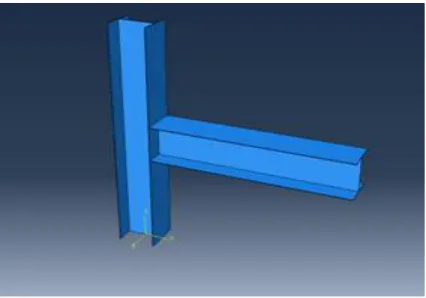
The steel I section beam is connected to the flange portion of the column .The 3-D view of beam-column connection is shown in Figure 1.
Figure 1 3-D view of beam-column connection
a. WELD JOINTS
Fillet weld used is of 6mm.
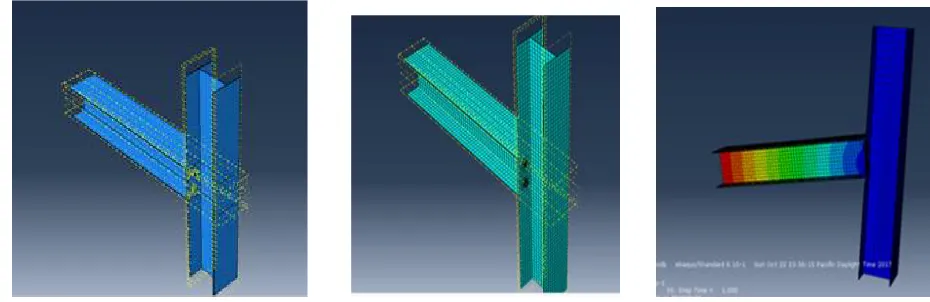
Figure 2 Interaction Figure 3 Meshing of Welded joint Figure 4 Deformed Weld Connection
The meshing is the next important process done to discritize the model into a finite numbers for the purpose of analysing that makes the solver to solve easily. The meshing of welded joints is shown in figure 3.
The next step after meshing is the load type and the boundary conditions to be given for the solver to run the analysis. After the load is been given, the beam column connections deformation is shown in figure 4
b. BOLT JOINTS
Total numbers of bolt used in this section is 8 nos.
Interaction is one of the initial process in Abaqus Software and the beam column interaction and the meshing of the model section is shown in figure 5&6 respectively, similarly other process is also carried out.
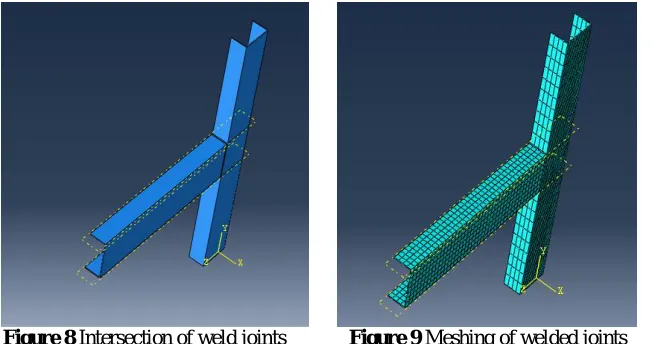
Figure 8 Intersection of weld joints Figure 9 Meshing of welded joints Figure 10 Deformed welded joints The deformed displacement and deformed shape is shown in figure 10.
b. BOLT JOINT
For bolted joints , 4 nos bolts are being used on either side of the beam connected to the flange portion of the channel section steel column. The intersection ,meshing and deformed pattern of bolted joints by the finite element non-linear analysis is shown in figure 11,12&13 respectively.
Figure 11 Bolted joint interaction Figure 12 Meshing of bolt joint Figure 13 Deformed bolt joint.
V. RESULT AND DISCUSSION
From the analysis determined the ultimate load value of bolted joint as 16KN and welded joint as 12KN for I-section. For the case of Channel section, the ultimate load value for bolted joint as 11kN and welded joint as 8kN.
Specimens- Beam Column connection
Ultimate load (kN)
I -section Weld joint 12 Bolt joint 16
CHANNEL section
Weld joint 8
Bolt joint 11
VI. CONCLUSION
An analytical study was conducted to investigate the structural performance of cold formed steel beam column connections with the bolt and weld joints for the two types sections i.e., I section and Channel section. From the analysis it is evident that I-section is behaving dominantly in withstanding axial load over CHANNEL section. further, this implies the advantage of having bolted joint in light weight steel structures.
Also detailed study has been carried out for effect of load on bolted and welded joints. The experiment confirming the above analysis is to be carried out in future.
REFERENCES
1. Anna green Antony,Journal of “Cold formed steel sigma section joints” International journal of innovative research in technology,volume 3-2016.
2. Bayan Anwar ali, sariffudin said,Mondhanim Osman,Journal of “Cold formed steel frame with bolted moment connections” International journal of civil and structural engineering, volume 1 - 2010.
3. K.F. Chung, L. Lau,Journal of “Experimental investigation on bolted moment connections among cold formed steel members” Engineering structures – 1999.
4. M. Dundu,Journal of “Base connections of single cold-formed steel portal frames” Journal of construction steel research - 2012.
5. DenizAyhan, Benjamin W. Schafer,Journal of “Cold-formed steel member bending stiffness prediction” Journal of constructional steel research
– 2015.
6. Ibrahim Elkersh,Journal of “ Experimental investigation of bolted cold formed steel frame apex connections under pure moment” Ain shams engineering journal – 2010.
7. M.F.Wong, K.F.Chung,“structural behaviour of bolted moment connections in cold-formed steel beam-column sub-frames”
8. Xianzhong Zhao, Tuo Wang, Yiyi Chen, K.S. Sivakumaran,Journal of “Flexural behaviour of steel storage rack beam-to-upright connections”
the scientific world journal- 2014.
9. W.K. Yu, K.F.Chung, M.F.Wong,Journal of “Analysis of bolted moment connections in cold formed steel beam-column sub-frames”Journal of constructional steel research - 2005.
10. YeongHuei Lee, Cher Siang Tan, ShahrinMohammad, MahmoodMdTahir, and Poi NgianShek,Journal of “Review on Cold-Formed Steel Connections” The scientific world journal – 2014.
11. F. Zadanfarrokh, E. R. Bryan,Journal of “Testing and Design of Bolted Connections in Cold Formed Steel Sections” International speciality conference on cold-formed steel structures – 1992.