An Experimental Study on CLSM Bricks
using Flyash and Construction Debris waste
Akshatha B A 1, Saleena A S 2, Mohammed Sareeh 3, Muhammad Aslam M K 4, Muhammed Muhad 5
Assistant Professor, Department of Civil Engineering, BIT Engineering College, Mangalore, Karnataka, India1
U.G. Students, Department of Civil Engineering, BIT Engineering College, Mangalore, Karnataka, India 2,3,4,5
ABSTRACT: Controlled Low-Strength Material (CLSM) is a flowable state cementitious fill at the time of placement and has restricted compressive strength to facilitate successive excavation. It is also known as Flow-Crete and controlled density fill as well as by various names. In this present study CLSM ingredients proportions are varied to makes bricks by achieving good strength. Materials used are cement, Flyash, M- sand, Construction Debris and Laterite soil with 0.8 water cement ratio. Strength and other parameters of bricks such as flow table test, compressive strength test, water absorption, soundness test, impact test, and brick pillar test were tested. Brick having 15% and 20% cement shows high strength and all the other bricks of different mixes satisfied I S standards and are recommendable.
KEYWORDS:Controlled Low-Strength Material (CLSM), Flyash, Construction Debris and Compression Strength.
I. INTRODUCTION
Controlled Low-Strength Material (CLSM) is a cementitious fill that is in a flowable state at the time of placement and has limited compressive strength to facilitate successive excavation. CLSM is also known as Flow-Crete and controlled density fill as well as by various proprietary names. CLSM can be designed with varying strength and density, considering the cost and future needs, low strength CLSM shall be necessary to allow future excavation, whereas if the there is no scope for future excavation the strength can be at higher side, further the density of CLSM can be modified as per the cost and material needs. Properties of CLSM can be enhanced as per the requirement to compensate particular need like corrosion resistance, Exacavatability, strength flow ability etc. Material properties such as shrinkage, subsidence and settlement are not considered as specification performance or requirement properties. Construction debris consists of unwanted material produced directly or incidentally by the construction or industries. This includes building materials such as insulation, nails, electrical wiring, shingle, and roofing as well as waste originating from site preparation such as dredging materials, tree stumps, and rubble. Construction waste may contain lead, asbestos, or other hazardous substances.
II. NEED OF THE STUDY
III. OBJECTIVE OF THE STUDY
The main objectives of CLSM bricks are as follows:
1. To determine the properties of lateritic soil, M-sand, Cement and Flyash.
2. Selection of best CLSM mixes for the production of bricks by varying the material percentage based on Compressive strength.
3. To determine the strength characteristics of CLSM bricks.
IV. REVIEW OF LITERATURE
Darshan et al., (2017) used low strength material in order to make bricks the ingredient materials percentage is varied to achieve more strength. Materials used are cement, GGBS, M- sand and Laterite soil with 0.8 water to cement ratio. Strength and other parameters of bricks were tested such as flow table test, compressive strength test, water absorption, soundness test , impact test, durability test and brick pillar test. Carried out water absorption test for different proportions for 24hrs and observed results which are less than 20%. Hence it satisfies the I.S standards and it is good to use for construction. Durability test is done by carrying compressive strength test after 7 and 14 days
Nataraj and Vadiraj(2016) investigated on effective replacement for the compacted backfill using fly ash, cinder aggregate, water with the fine aggregate to achieve controlled low strength materials .in this experiment cinder aggregate acts as coarse aggregate. This CLSM mix absorbs more water initially at 30 minutes after mixing and for the 15% of cinder aggregates in the mix gives optimum unconfined compressive strength at 28 days. Density of all different mix trials more than 800kg/m3. So, from this study concluded that coarse aggregate in this study is satisfied. Also this CLSM mix can be excavated.
Gaurav and Karna (2015) carried out experimental investigation on Laterite Soil Bricks using Cement and Fly ash along with the Laterite soil. The bricks were prepared with fly ash (20%), cement (5-10%) and soil (70-75%). The experiment is conducted to different percentage of fly ash and laterite with 5 to 10% of cement to obtain the best percentage of fly ash that can be added with cement and soil to manufacture low cost bricks. Size of brick is 20x10x10cm and that casted bricks are tested using ctm to carry out compression strength test on fly ash mixed cement laterite bricks 9.5N/mm2. The CLSM bricks with fly ash 20% and cement 10% show a compressive strength of 9.5 N/mm2 higher than Laterite bricks. When compared laterite stone it is having 4.5-time greater compression strength result and this type of bricks can be used as a load bearing wall bricks.
Naik et. al., (2004) prepared CLSM mix using wood ash, cement, sand, fly ash and water. Mix contained with 80% of wood ash, 15% of sand and 5% of cement showed strength of 0.8 N/mm2 in 28 days and attained 1.4N/mm2 after a year. Compressive strength test result is optimum for s-1 mix that is 0.8mpafor 28 days but for one year age s-2 mix gives 14.4mpa optimum strength because combination of wood fly ash and coal fly ash increases the compressive strength with the increase in age. Water permeability of s-2 and s-3 decreases with the increase in age when compare to s-1 mix because of the improvement. The researchers observed the reduction in permeability of CLSM with the age.
V. MATERIALS USED
1. CEMENT
Table 1: Properties of cement
Properties Result IS code Requirement
Specific gravity 3.05
Standard consistency 31%
Setting time Initial(Minutes) 33 min 30 minimum
Final(Minutes) 380 min 600 maximum
Compressive strength (MPa) 7 days 32 33
28 days 46 43
2. M SAND
The Manufactured sand obtained from a quarry at Mudipu, Mangalore confirming to IS: 383-1970 and having specific gravity of about 2.59 was used to cast cubes. The physical properties are tabulated in Table 2
Table 2: Properties of M- sand
Properties Value
Specific gravity 2.65 Water absorption (%) 2.8% Fineness modulus 3.46
3. LATERITE SOIL
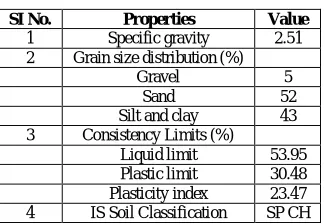
Laterite soil used in this study was collected at the depth of 1m from Bearys Institute of Technology, Innoli region located in Dakshina Kannada district.
Table 3: Properties of Laterite Soil
SI No. Properties Value
1 Specific gravity 2.51
2 Grain size distribution (%)
Gravel 5
Sand 52
Silt and clay 43
3 Consistency Limits (%)
Liquid limit 53.95
Plastic limit 30.48
Plasticity index 23.47
4 IS Soil Classification SP CH
4. FLY ASH
Flyash used in this study was collected from RMC Mangalore located in Dakshina Kannada district.
Table 4: Properties of Flyash
Sl. No Physical Properties Value
1 Color Whitish grey
2 Bulk Density (g/cm3) 1
3 Specific Gravity 2.29
4 Moisture (%) 3.14
5. CONSTRUCTION DEBRIS
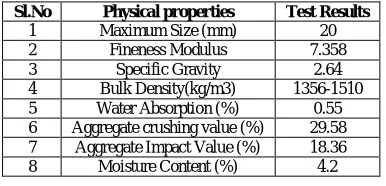
Construction Debris used in this study was collected from Mangalore located in Dakshina Kannada district
Table 5: Properties of Construction Debris
Sl.No Physical properties Test Results
1 Maximum Size (mm) 20
2 Fineness Modulus 7.358
3 Specific Gravity 2.64
4 Bulk Density(kg/m3) 1356-1510
5 Water Absorption (%) 0.55
6 Aggregate crushing value (%) 29.58
7 Aggregate Impact Value (%) 18.36
8 Moisture Content (%) 4.2
VI. RESULT AND DISCUSSIONS
1. MIX PROPORTIONS
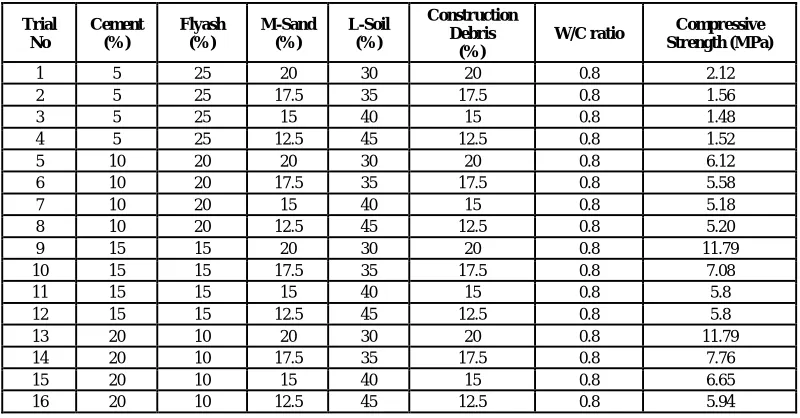
Depending upon the trial and error method different proportions are selected. Water Cement ratio is decided depending upon the Literature survey and different mixes are decided based on the trial and error methods.
Table 6: Mix Proportion
Trial No
Cement (%)
Flyash (%)
M-Sand (%)
L-Soil (%)
Construction Debris (%)
W/C ratio
1 5 25 20 30 20 0.8
2 5 25 17.5 35 17.5 0.8
3 5 25 15 40 15 0.8
4 5 25 12.5 45 12.5 0.8
5 10 20 20 30 20 0.8
6 10 20 17.5 35 17.5 0.8
7 10 20 15 40 15 0.8
8 10 20 12.5 45 12.5 0.8
9 15 15 20 30 20 0.8
10 15 15 17.5 35 17.5 0.8
11 15 15 15 40 15 0.8
12 15 15 12.5 45 12.5 0.8
13 20 10 20 30 20 0.8
14 20 10 17.5 35 17.5 0.8
15 20 10 15 40 15 0.8
2. COMPRESSIVE STRENGTH RESULTS
Test results are carried to 70.7mm*70.7mm*70.7mm mould having a 50cm2 area. The different mixes are casted and tested for 3 and 7days. The Table 7 shows the compressive strength results.
Table 7: Compression Test on Cubes
Trial No Cement (%) Flyash (%) M-Sand (%) L-Soil (%) Construction Debris (%)
W/C ratio Strength (MPa)Compressive
1 5 25 20 30 20 0.8 2.12
2 5 25 17.5 35 17.5 0.8 1.56
3 5 25 15 40 15 0.8 1.48
4 5 25 12.5 45 12.5 0.8 1.52
5 10 20 20 30 20 0.8 6.12
6 10 20 17.5 35 17.5 0.8 5.58
7 10 20 15 40 15 0.8 5.18
8 10 20 12.5 45 12.5 0.8 5.20
9 15 15 20 30 20 0.8 11.79
10 15 15 17.5 35 17.5 0.8 7.08
11 15 15 15 40 15 0.8 5.8
12 15 15 12.5 45 12.5 0.8 5.8
13 20 10 20 30 20 0.8 11.79
14 20 10 17.5 35 17.5 0.8 7.76
15 20 10 15 40 15 0.8 6.65
16 20 10 12.5 45 12.5 0.8 5.94
Based on the Compressive Strength results four Mix Proportions were selected to manufacture the CLSM Bricks. Table 8 gives the selected mix proportions details
Table 8: Selected Mix Proportions for CLSM Bricks
Brick Mix Proportion (%) Ce m e n t (% ) F ly a sh ( % ) M -S a n d (% ) L -S o il (% ) Co n st ru c ti o n D e b ri s (% ) w /c ra ti o Co m p re ss iv e S tre n g th (M P a )
Brick A 10:20:20:30:20 10 20 20 30 20 0.8 6.12
Brick B 15:15:20:30:20 15 15 20 30 20 0.8 11.79
Brick C 15:15:17.5:35:17.5 15 15 17.5 35 17.5 0.8 7.08
Brick D 20:10:20:30:20 15 15 20 30 20 0.8 11.79
3. BRICK TESTS
Standard tests are conducted on CLSM bricks as per IS standards. such as Compressive strength test, Water absorption, Soundness test, Impact test, Hardness test, Structure of brick, Efflorescence test and brick column test.
1. Water Absorption Test
Name Mix-proportion C:G:M-S:CD:LS
Weight of brick before soaking(kg)
Weight of brick after soaking for 24
hrs (kg)
Water absorption (%)
Brick A 10:20:20:30:20 2.20 2.26 2.65
Brick B 15:15:20:30:20 2.18 2.23 2.24
Brick C 15:15:17.5:35:17.5 2.29 2.38 3.78
Brick D 20:10:20:30:20 2.18 2.22 1.80
Water absorption test results of CLSM Brick A, B, C and D are 2.65%, 2.24%, 3.78% and 1.80% respectively, which is less than 20%. This satisfies the IS: 3495 (Part 2):1992 code standards, hence it is advisable to use for construction of wall.
2. Soundness Test
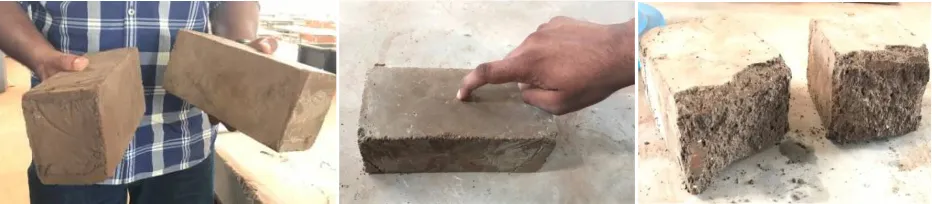
After 28 days of curing two CLSM bricks are struck each other to know the resistance of CLSM bricks on unexpected impact. CLSM bricks gave clear ringing bell sound when struck each other. This shows that there is no void or air pocket inside the. Fig.1 shows the Soundness test for CLSM bricks.
3. Impact Test
In This Test Bricks Are Allowed To Fall from Height of 1m. CLSM Bricks Didn’t Break After Fall. If Bricks Break Then It Has Low Impact Value and is Not Suitable for Construction.
4. Hardness Test
In This Test Brick Is Scratched Using Sharp Tool Or Finger Nail. If There Is No Scratch Impression On Brick Then It Is Said To Be Hard Brick. The Fig.2 Shows Hardness Test of Brick.
Fig 1: Soundness test for CLSM bricks. Fig 2: Hardness Test of Brick. Fig.3: Inner Structure of Brick
5. Structure of Bricks
To know the structure of brick, select any one CLSM brick and break it. Observe the inner portion of broken brick. It is free from lumps and voids. The Fig.3 shows the inner structure of brick
6. Compressive Strength of Brick
Graph1: Compression Strength on Brick.
In compressive strength test for 28 days all bricks types satisfies IS standards that is > 6.5 N/mm2. Hence it advisable to use for load and non load bearing walls.
7. Brick Pillar Test
Brick pillar consist of 3 bricks of dimension L*B*W::19*9*9cm are used for masonry with 1:3 mortar proportion. All bricks types satisfy I S standards. Hence it is advisable to use for load bearing walls. Fig.4 shows brick column test result respectively. From the graph 2, it is shown that all bricks types satisfy I S standards that are > 6.5 N/mm2 for 14 days. Hence it advisable to use for load bearing walls.
Fig.4: Brick Column Test Graph 2 Compressive Strength test Result
VII. CONCLUSIONS
1. Water absorption test is conducted for different proportions for 24 hrs and observed results such as 2.65%, 2.24%, 3.78% and 1.80% which is less than 20%. Hence it satisfies the I.S standards and it is good to use for construction. 2. The bricks which are tested for impact, soundness, hardness and structure tests are having good results and satisfy
the Codal provision.
3. In compressive strength test for 28 days all bricks types satisfies IS standards that is > 6.5 N/mm2. Hence it 10
16 15 18
0 5 10 15 20
Brick A Brick B Brick C Brick D
Compression Strength on Brick
28 Days
8 10 9
12
0 5 10 15
Brick A
Brick B
Brick C
Brick D
C
o
m
p
r
e
ss
io
n
S
tr
e
n
gth
in
N
/m
m
2
Brick Column Test
4. Brick pillar consist of 3 bricks of dimension l*b*w::19*9*9cm are used for masonry with 1:3 mortar proportion. All bricks types satisfy I S standards that is > 6.5 N/mm2 for 14 days. Hence it advisable to use for load bearing walls.
REFERENCES
[1] Gaurav.,and Karuna (2015) “Study on Fly ash mixed Laterite-Cement Bricks”., International Journal of Engineering Research and Technology.,Vol.4., Issue 07, ,pp 124-130.
[2] Lissy, P.N., and Sreeja. M. S (2014) “Utilization of Sludge in Manufacturing of Energy Efficient Bricks”, IOSR Journal of Mechanical and Civil Engineering., Vol. 11,. Issue. 4,.Ver.3., pp 70-73.
[3] Lee,.Seong and Kuran(2014) “Flowable Backfill Materials from Bottom Ash for Underground Pipeline”, Issue. 7, ISSN. 1996-1944, pp 3337-3352. www.mdpi.com/Journal/Materials.
[4] MarjiveV. R., Badwaik V. N., and Ram. B (2016) “Experimental Studies on Controlled Low Strength Material Using Stone Dust and EPS Beads” IACSIT International Journal of Engineering and Technology, Vol. 8,. No. 4,. pp 265-268.
[5] Nataraja M. C,.Vadiraj N. R (2016) “CLSM with Fly ash and Cinder Aggregates, An Effective Replacement for the Compacted Backfill”, Indian Journal of Advances in Chemical Science IS-2016, pp 289-293.
[6] Tarun Naik. R,. Rudolph N,.Rafat and Yoon (2004) “Properties of Controlled Low Strength Materials Made with Wood Fly ash” Journal of ASTM International, Vol. 1., No 6., pp 1-10.
[7] Puttaraj,.Shanmuka,.Navaneeth, P. J.,and Prathima, T, B., (2014)“Utilization of Waste Plastic in Manufacture Plastic Soil Bricks” International Journal of Technology Enhancements and Emerging Engineering Research, Vol. 2,.Issue. 4,. ISSN 2347-4289,. pp 102-107. [8] IS 8112-1989: Specification for 43 grade Ordinary Portland Cement. “Buro of Indian standards”.
[9] IS 383-1970: Specification for Coarse aggregate and Fine aggregate from natural sources for concrete. [10] IS 2386-1 (1963): Methods of test for aggregate for concrete, Part 1: Particle size and shape.