http://www.sciencepublishinggroup.com/j/cm doi: 10.11648/j.cm.20180201.14
High Performance Bricks from Straw and Asphalt
Sitpalan Ahilan
*, Dharani Sandunika Abeysinghe, Kolitha Fernando, Thilini Priyadarshi Herath
Department of Physics, Faculty of Science, Eastern University Sri Lanka, Vantharumoolai, Sri Lanka
Email address:
*
Corresponding author
To cite this article:
Sitpalan Ahilan, Dharani Sandunika Abeysinghe, Kolitha Fernando, Thilini Priyadarshi Herath. High Performance Bricks from Straw and Asphalt. Composite Materials. Vol. 2, No. 1, 2018, pp. 26-31. doi: 10.11648/j.cm.20180201.14
Received: November 28, 2018; Accepted: December 21, 2018; Published: January 22, 2019
Abstract:
This study investigated a partial replacement of clay by additives for bricks. The purified clay mixed with different volume percentage of additives (Asphalt and Straw from agricultural waste) as separate and both to cast as bricks with the standard dimensions of 18.5 × 8.5 × 6.5 cm3. Cylindrical pellets casted with the dimensions of average diameter of 40 mm and thicknesses about 2.5 ± 0.2mm. The casted bricks and pellets are air dried in open atmosphere for 8-10 days. These bricks and pellets are fired for three days, at the end of three days kiln is allowed to cool to reach room temperature. The sample bricks are tested for compressive strength and water absorption; pellets are tested for thermal conductivity and electrical conductivity. From the obtained results, it has concluded that the compressive strength slightly increased against density of the bricks. A moderate decrement observed in the water absorption against density of the samples and compressive strength weakens with the increment of water absorption of the samples. Improved electrical conductivities of the samples with additives appears change in electrical properties from insulating to semiconducting. Thermal conductivity values of the samples with additives are climb against the 100% clay sample. The result shows that the greatest thermal conductivity of 0.905 Wm-1K was obtained for 85% Clay / 5% Straw / 10% Asphalt sample. The additives enhance porosity and heat contact through the samples. The values obtained and with reference to the graphs plotted, can be concluded that the 90% Clay / 5% Straw / 5% Asphalt sample is superior among the samples.Keywords:
Clay, Asphalt, Straw, Compressive Strength, Water Absorption, Electrical Conductivity, Thermal Conductivity1. Introduction
Clay brick is the oldest artificial building material and still in usage, because availability of clay in most countries and economical. Its durability and aesthetic appeal enhance its extensive application in the building structures. The properties of ancient bricks vary considerably in terms of raw materials, production methodology, and period [1]. The recycling wastes as alternative raw materials are not new and successfully used in most countries. A large number of researches are evidence to fully utilize waste produce from rice husk. Gorhan et al. conceded the mineralogical analysis on powdered samples of porous bricks made up with rice husk by X-ray diffraction (XRD), thermo gravimetric and differential thermal analysis (TG-DTA). Concluded that clay and 10 wt% rice husk are the optimum composition for production of clay [2]. Sutas et al. studied effect between rice husk and rice husk ash to properties of bricks. Comparative adding between rice husk and rice husk ash were varied by 0
– 10 wt%. The result is evidence for higher level of addition of rice husk showed less compressive strength and density of specimens [3]. The observations recorded during the tests shows that bricks with the 2 wt% addition of rice husk to clay, exhibit a compressive strength of 6.59 MPa which is smaller than the reference clay bricks, satisfying the requirements of IS 1077 [4]. The different volume percentage of rice husk 4%, 8%, 12%, and 16% in the clay declared the compressive strength of bricks decreased [5]. This research work carried out with the different weight percentages of straw and asphalt as additives. The proportions were taken according to volume ratios as straw is a very light material and if considered the weights the amount of straw for a specific weight will be more than the others.
2. Materials and Methodology
2.1. Materials
Veppavettuvan in Batticaloa district, Sri Lanka. Our previous publication [6] concluded that the Veppavettuvan clay has some optimistic outcome on the additives compared to collected clay additives from some other regions in the Sri Lanka.
Straw: straw collected for this study from Veppavettuvan in the Batticaloa district, Sri Lanka. Such acquired straw was chopped into small pieces manually before using them in the mixture.
Asphalt: Liquid asphalt is the second additive used in the study. It is basically content of bitumen, two types of bitumen emulsions or asphalt liquids as CSS and CRS (cationic slow setting and cationic rapid setting) were used. Both CSS and CRS were in equal volume ratios to get mixing to control the setting out time to reach necessary asphalt volume.
Water: Tap water was used in the sample preparation.
2.2. Purifying, Mixing, and Sample Preparation
2.2.1. Cleaning Process of the Clay Samples
Collected clay was purified in separate by following methodology. Initially larger aggregates (stones, roots, etc.) were removed manually by hands and used different sizes of mesh. Then the clay were well mixed in the pure water and purified by the mesh. The purified clay was packed in a cotton cloth and hanged for 24 hours to remove water under the gravity; filter out clay was placed in an open dry place for 24 hours to dry. The dried clay was crushed as powder by using mortar and pestle.
2.2.2. Clay Brick Preparation
The purified clay was separately mixed with pure water and shuddered to soften the clay for casted as 100% clay bricks. The shuddered clay was kept in the cool dry place to accumulate water into the clay for 24 hours and casted as bricks. According to the literature [7], a wooden mould selected to cast the bricks was 18.5 × 8.5 × 6.5 cm3. The clay brick samples were used to evaluate the water absorption and compressive strength test.
2.2.3. Clay Cylindrical Pellets Preparation
According to the literature [8] and available equipment in our laboratory to test the thermal conductivity and electrical conductivity of the clay; shuddered clay was separately casted as cylindrical pellets with the dimensions of average diameter of 40mm and about 2.5 ± 0.2 mm thicknesses [8, 9].
2.2.4. Brick and Cylindrical Pellets Curing
The casted clay bricks and cylindrical pellets as explained in the section 2.2.2 and 2.2.3 were dried in the open dry place for seven days and then burnt in the furnace [10]. After firing, all specimens were grounded and polished to get the suitable geometry with decided dimensions.
2.2.5. Sample Matrix
Pure clay was mixed with additives and casted as bricks and pellets. The volume (V) percentages were used in above casting process as shown in the sample matrix table 1.
Table 1. Sample matrix.
Sample Name Clay(C) (V%) Straw(S) (V%) Asphalt(A) (V%)
100 % C 100 0 0
50% C / 50 %S 50 50 0
50% C / 50% A 50 0 50
85% C / 5% S / 10%A 85 5 10
85% C / 10% S / 5% A 85 10 5
90% C / 5%S / 5%A 90 5 5
2.3. Experimental Methodology
2.3.1. Compressive Strength Test
The standard ASTM C109 test method was conducted to measure the compressive strength of the mortars and bricks with 5000 kN hydraulic testing machine with the loading rate of the test was 0.10 mm/s. Six specimens on each samples were tested and the average was the strength [7].
2.3.2. Water Absorption
Water absorption test is required to check whether the bricks are suitable for water logged areas or not. As per standards the bricks should not absorb water more than 20% of its original weight [10]. The specimens were dried in a drying oven at a temperature of 110°C to 115°C for 24 hours and were removed the bricks from the oven for allow to cool them to room temperature then obtain it’s weight W1(kg). Specimens were immersed completely in water at room temperature (28 ± 3°C) for 24 hours and removed the specimens, wiped out any traces of water by using a damp
cloth and weight the specimen W2(kg). Water absorption capacity was calculated by the equation is:
− × 100
2.3.3. Electrical Conductivity
Two point uniaxial method was used to calculate the electrical conductivity of cylindrical pellet specimens [9]. In this method, the specimens were dried in a drying oven at the temperature of 110°C to 115°C for 24 hours to eliminate the contribution of evaporable water to electrical conductivity, then were removed from the oven and allow cooling them to room temperature. The specimen was placed between two parallel copper plates and ensures proper electrical connection.
Ih AV
2.3.4. Thermal Conductivity
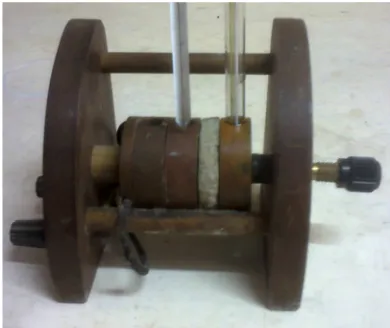
On the basis of literature, the steady state technique was performed to measure the thermal conductivity of cylindrical pellet specimen by using Lee’s disc apparatus [10]. The cylindrical specimen was placed between two plates of the Lees disc apparatus as shown in Figure 1. One plate was heated, and other was heated to lesser. Temperature of the plates was monitored until reach the steady state. The steady state temperatures of plates (t1
and t2), thickness (h), and cross sectional area (A) of the
specimen was measured. Thermal conductivity (λ) of the sample was calculated by using following equation. Quantity of heat passing through the cross-sectional area of the specimen (Q) was measured by using current and potential through the heating coils of the Lee’s disc apparatus.
λ −
Figure 1. Lees disc apparatus.
3. Results and Discussion
3.1. Compressive Strength
The compressive strength of the bricks is mentioned in the following Table 2, the coefficient of variation is notified in between brackets.
Table 2. Compressive strength of bricks.
Sample Name Compressive strength of brick (Coefficient of variation%) (MPa)
Density of brick (Coefficient of variation%) (kgm-3)
100 % C 11.5 (56) 1675 (3)
50% C / 50 % S 6.4 (9) 1299 (3)
50% C / 50% A 10.7 (8) 1327 (4)
85% C / 5% S / 10% A 2.0 (41) 1475 (3)
85% C / 10% S / 5% A 5.1 (29) 1408 (5)
90% C / 5% S / 5% A 6.1 (42) 1439 (2)
Table 2 shows a comparison of the development of compressive strength between pure clay, straw, and asphalt as different volume percentages of additives.
According to the table 2, it can be explained that the brick containing pure clay (100% clay) experiences compressive strength higher than that of brick with additives. The compressive strength of the samples with additives shows reduction in their strength compared to the 100% clay sample. The 50% Clay with additive of 50% asphalt shows slight decrease in compressive strength, but others have marginal difference compare to 100% pure clay sample.
Density of the brick samples is in between the range of 1675 and 1299 kgm-3. It’s indicating that the weight of the samples is not in an enormous deviation. The actual compressive strength depends upon the specific raw material, additives, size selected, and mechanical bonding between the brick and additives. This is concluded from the nature of microstructure of the aggregate mode from straw ash. Bricks experienced more shrinkage due to the additives which caused break in the micro-structural bonds and partially produced crystallization process of the
asphalt might be decreased compressive strength [11].
Figure 2. Compressive strength against density of bricks.
3.2. Water Absorption
Table 3. Density, Water absorption, and Water absorption per density of the sample bricks.
Sample name Density(kgm-3) Waterabsorption (%) Water absorption per density (%/kgm-3)
100 % C 1675 13.4 0.008
50% C / 50 % S 1299 24.6 0.019
50% C / 50% A 1327 28.1 0.021
85% C / 5% S / 10% A 1475 22.0 0.015
85% C / 10% S / 5% A 1408 24.0 0.017
90% C / 5% S / 5% A 1439 19.7 0.014
The average density of the samples, water absorption, and water absorption per kilogram of unit volume were calculated and the results are illustrated in the Table 3. The water absorption values obtained have significant increment for the samples with additives with respect to the value of pure clay brick sample, showing significant difference between 13.4% and 28.1% of the average values.
Figure 3. Water absorption against density of bricks.
Figure 4. Compressive strength against water absorption of bricks.
Density and compressive strength of specimens shows polynomial trend line against water absorption with regression coefficient of 0.927 and 0.871 respectively as shown in above figures 3 and 4. According to Figure 4, the compressive strength of the samples slightly decreased when their water absorption increased. It could be attributed to the fact that specimens with higher porosity would allow more
water, and low level of compressive strength.
The dimension and distribution of the pores determined by the raw materials, additives, and percentage of additives of the brick [12]. Carbonates and firing temperature are contributing the formation of small pores, such pores negatively influence the quality of the bricks, as their compressive strength decreased and water absorption increased [13].
3.3. Electrical and Thermal Conductivity
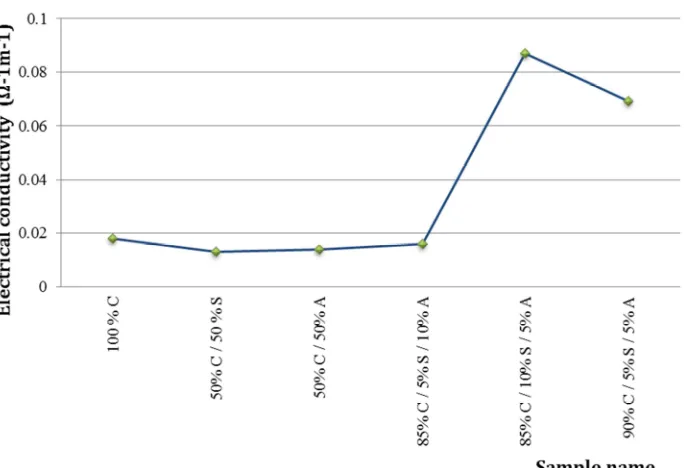
Table 4 shows the effect of electrical conductivity of pellet samples. Samples with 85%C / 10% S / 5% A and 90% C / 5% S / 5% A permitted about 4 and 3 times than 100% Clay pellets. Samples allow higher current to pass through due to its highest electrical conductivity, might be higher the salt content. The increase in conductivity of clay with additives appears change in electrical properties from insulating to semiconducting. The asphalt is formed by hard bonding might changes its electrical properties. Trend of the current through the samples shown in Figure 5 and illustrating higher additive percentage are not showing much different in the electrical conductiviey, but 85% C / 10% S / 5% A and 90% C / 5% S / 5% A samples showed higher electrical conductivity among the samples.
According to the Table 4, thermal conductivity values of the samples with additives are increased with respect to the 100% clay pellet sample. The result shows that the greatest thermal conductivity of 0.905 Wm-1K was obtained for 85% C / 5% S / 10% A sample and lowest value of that on 100% pure clay sample as 0.676Wm-1K. Therefore indicates that pure clay samples are better insulating materials among the samples because of their lowest thermal conductivities. The clay conduct heat at the lowest rate and absorbent power acquire prolonger time to reach the steady state.
Table 4. Electrical and thermal conductivity of the pure clay and clay with additive pellets.
Sample number Sample name Electrical conductivity at 28 ± 2°C (Ω-1m-1) Thermal conductivity 28 ± 2°C (Wm-1K)
1 100 % C 0.018 0.676
2 50% C / 50 % S 0.013 0.892
3 50% C / 50% A 0.014 0.891
4 85% C / 5% S / 10% A 0.016 0.905
5 85% C / 10% S / 5% A 0.087 0.903
6 90% C / 5% S / 5% A 0.069 0.890
Figure 5. Thermal conductivity against sample name of pellets.
4. Conclusions
The results are indicating of the satisfactory performance of additives in clay bricks. The compressive strength of the samples with additives shows reduction in their strength compared to the pure clay sample. Density of the brick samples with additives are slightly decreased with respect to the pure clay sample. Compressive strength shows slight increase against density of the bricks, might be due to the cause of reduction in micro pores and enhances bonding between clay particles. The values of water absorption slightly increased with additives in the samples. The additives causing more char and promoting pores in the samples and enhancing water absorpt decrement observed in the water absorption against density of the samples and compressive strength decreased with the increment of water absorption of the samples. Thermal conductivity of the samples increased with the additives, might be due to the char formation produced more heat transfer than clay. Electrical conductivity of the samples with smaller amount of additives shows marginal increment than others. From the values obtained and with reference to the graphs plotted, can be concluded that the 90% C / 5% S / 5% A sample is superior among the samples.
Author Contributions
Ahilan Sitpalan directed and supervised the work, including designing the experimental methodology, which was undertaken by appended authors.
References
[1] Ateater HA, Ellickson T. Remanent Magnetization of Ancient Bricks. Nature. 1958, 181: 404.
[2] GokhanG, Osman S. Porous Clay Bricks Manufactured With Rice Husks. Construction and Building Materials. 2013, 40: 390–396.
[3] Sutas J, Mana A, Pitak L. Effect of Rice Husk and Rice Husk Ash to Properties of Bricks. Procedia
Engineering.2012, 32: 1061 – 1067.
[4] WatileRK, Deshmukh SK, DurgePV, Yawale AD. Utilization of Rice Husk For Production of Clay Brick.
International Journal of Research in Advent Technology. 2015: 199-203.
[5] Ashish KumarP, Rinku P. Comparative Study of Compressive Strength of Bricks Made With Various Materials to Clay Bricks. International Journal of Scientific and Research Publications. 2012, 2(7): 1-4.
[6] Sitpalan A, Ananda EMS, Aashik AR, Preththiha V, Rajitha VKM and Suventhiran S. Feasibility of Natural Clay Additives in Cement Mortar. RRJPAP, 2018, 6(1): 01-07.
[7] ASTM C109 Standard Test Method for Compressive Strength of Hydraulic Cement Mortars. https://www.astm.org/Standards/C109. 15th October 2018.
[8] Kim KH, Jeon SE, Kim JK, Yang S. An experimental study on thermal conductivity of concrete. Cement and concrete research, 2003;33 (3):363-371.
[9] Adekunle A, et al. Analysis of Thermal and Electrical Properties of Laterite, Clay and Sand Samples and Their Effects on Inhabited Buildings in Ota, Ogun State, Nigeria.
Journal of Sustainable Development Studies. 2014;6:391-412.
[10] Leonel RF, et al. Characterization of soil-cement bricks with incorporation of used foundry sand. Cerâmica. 2017;63:329-335.
[11] Badr El-Din EH, Hanan AF, Ahmed MH. Incorporation of water sludge, silica fume, and rice husk ash in brick making.
Advances in Environmental Research. 2012; 1(1): 83-96.
[12] Cultrone G, De La Torre MJ, Sebastian EM, Cazalla O, Rodriguez-Navarro C. Behavior of brick samples in aggressive environments. Water Air and Soil Pollution. 2000; 119:191–207.
[13] Cultrone, G, Sebastián E, Elert K, De La Torre MJ, Cazalla O, Rodriguez-Navarro C. Influence of mineralogy and firing temperature on the porosity of bricks. Journal of the European Ceramic Society. 2004; 24:547–564.