Scholarship at UWindsor
Scholarship at UWindsor
Electronic Theses and Dissertations Theses, Dissertations, and Major Papers
2008
Effectiveness of techniques for the learning of face-name
Effectiveness of techniques for the learning of face-name
associations
associations
Olivia Chu
University of Windsor
Follow this and additional works at: https://scholar.uwindsor.ca/etd
Recommended Citation Recommended Citation
Chu, Olivia, "Effectiveness of techniques for the learning of face-name associations" (2008). Electronic Theses and Dissertations. 7941.
https://scholar.uwindsor.ca/etd/7941
This online database contains the full-text of PhD dissertations and Masters’ theses of University of Windsor students from 1954 forward. These documents are made available for personal study and research purposes only, in accordance with the Canadian Copyright Act and the Creative Commons license—CC BY-NC-ND (Attribution, Non-Commercial, No Derivative Works). Under this license, works must always be attributed to the copyright holder (original author), cannot be used for any commercial purposes, and may not be altered. Any other use would require the permission of the copyright holder. Students may inquire about withdrawing their dissertation and/or thesis from this database. For additional inquiries, please contact the repository administrator via email
EFFECTIVENESS OF TECHNIQUES FOR THE LEARNING OF FACE-NAME
ASSOCIATIONS
by
Olivia Chu
A Thesis
Submitted to the Faculty of Graduate Studies
Through the Department of Psychology
In Partial Fulfillment of the Requirements for the
Degree of Master of Arts at the
University of Windsor
Windsor, Ontario, Canada
2008
Published Heritage Branch
395 Wellington Street Ottawa ON K1A0N4 Canada
Direction du
Patrimoine de I'edition
395, rue Wellington Ottawa ON K1A0N4 Canada
Your file Votre reference ISBN: 978-0-494-47066-4 Our file Notre reference ISBN: 978-0-494-47066-4
NOTICE:
The author has granted a non-exclusive license allowing Library and Archives Canada to reproduce, publish, archive, preserve, conserve, communicate to the public by
telecommunication or on the Internet, loan, distribute and sell theses
worldwide, for commercial or non-commercial purposes, in microform, paper, electronic and/or any other formats.
AVIS:
L'auteur a accorde une licence non exclusive permettant a la Bibliotheque et Archives Canada de reproduire, publier, archiver,
sauvegarder, conserver, transmettre au public par telecommunication ou par Plntemet, prefer, distribuer et vendre des theses partout dans le monde, a des fins commerciales ou autres, sur support microforme, papier, electronique et/ou autres formats.
The author retains copyright ownership and moral rights in this thesis. Neither the thesis nor substantial extracts from it may be printed or otherwise reproduced without the author's permission.
L'auteur conserve la propriete du droit d'auteur et des droits moraux qui protege cette these. Ni la these ni des extraits substantiels de celle-ci ne doivent etre imprimes ou autrement reproduits sans son autorisation.
In compliance with the Canadian Privacy Act some supporting forms may have been removed from this thesis.
Conformement a la loi canadienne sur la protection de la vie privee, quelques formulaires secondaires ont ete enleves de cette these.
While these forms may be included in the document page count,
their removal does not represent any loss of content from the thesis.
Canada
Bien que ces formulaires
Author's Declaration of Originality
I hereby certify that I am the sole author of this thesis and that no part of this thesis has been published or submitted for publication.
I certify that, to the best of my knowledge, my thesis does not infringe upon anyone's copyright nor violate any proprietary rights and that any ideas, techniques, quotations, or any other material from the work of other people included in my thesis, published or otherwise, are fully acknowledged in accordance with the standard referencing practices. Furthermore, to the extent that I have included copyrighted material that surpasses the bounds of fair dealing within the meaning of the Canada Copyright Act, I certify that I have obtained a written permission from the copyright owner(s) to include such material(s) in my thesis and have included copies of such copyright clearances to my appendix.
iv
Abstract
Research has shown that people have a particular difficulty recalling the
names of faces, (McWenney, Young, Hay, & Ellis, 1987). This study compares
four mnemonic techniques created for learning and remembering face name
associations in healthy young adults: basic repetition, repetition with presentation
of the face at different angles, spaced retrieval, and pre-exposure technique. The
results of the study indicated that learning names under spaced retrieval, in which
information is learned and retained through increasing or stable intervals of time
dependent on individual performance, produced the greatest recall of names.
Combining the pre-exposure technique with spaced retrieval did not improve
recall of names. This study also found correlations between face name recall
performance and performance on various neuropsychological measures. Face
name learning and recall was positively associated with measures of facial
recognition, attention, verbal and figural fluency, word memory, and executive
This is thus far the largest self-constructed project that I have completed and I could not
have done it without the help of the following individuals. I would like to thank my
primary supervisor, Dr. Christopher Abeare, for all his insight and support, and the
multitude of long distance phone calls and emails made in order to complete this thesis. I
would also like to thank my committee members: Dr. Anne Baird, Dr. Geri Salinitri, and
Dr. Robin Hanks for all the invaluable suggestions and recommendations they provided. I
would like to express my appreciation to Matt Bondy and Kayla Chauvin for helping me
with data collection and Josh Chauvin for his Direct RT knowledge. Last but not least, I
would like to thank my family, my housemates, and my boyfriend Richard. It was their
support and encouragement that gave me the strength and confidence to complete this
vi
Table of Contents
AUTHOR'S DECLARATION OF ORIGINALITY iii
ABSTRACT iv
ACKNOWLEDGMENTS v
LIST OF TABLES vii
LIST OF FIGURES viii
CHAPTER
I. INTRODUCTION
Context of the Problem 1 Memory for Face Name Associations 2
Techniques for Improving Learning Face Name Associations 4 Face Name Associations and Neuropsychological Tests 16
Purpose of Proposed Research 16
II. METHOD
Participants 21 Design 22 Materials 22 Neuropsychological Measures 24
Procedure 26
III. RESULTS
Demographics 32 Face Name Learning and Memory 33
Correlations with Neuropsychological Tests 37
IV DISCUSSION
Overview 44 Memory Techniques and Face Name Learning 45
Face Name Learning and Neuropsychological Measures 49
Limitations 54 Practical Implications 55
REFERENCES 58
APPENDICES
Appendix A Names of Faces Stimuli 74
List of Tables
Table Page
1 Median, Standard Deviation and Range of Face Name Association Scores
for Each Condition 34
2 Means, Standard Deviations and Percentile for Neuropsychological Tests
Performance 38
3 Correlations Between Neuropsychology Tests Scores and Face Name
Association Scores 40
List of Figures
viii
Figure Page
1 Procedure for the Learning Condition 23
2 Face Stimuli for the Mass Retrieval with Encoding Features Condition 23
3 Mean Rank Recall Difference Between Mass Retrieval Conditions and
Introduction
Context of the Problem
People are often faced with the task of remembering the names and faces of
family members, friends, co-workers, and clients during social interactions. But there are
times when we see a familiar face yet we are unable to put a name to it. Given the social
expectations of recalling names on cue, forgetting the names of people we have met can
be embarrassing and may result in a loss of confidence in daily interactions. The inability
to recall names of familiar people may have negative social consequences such as
avoidance of the person whose name we forgot or becoming stressed in thinking of
creative substitutes for the person's name (e.g. hey you) so that the person is unaware we
cannot remember his/her name. This difficulty with recalling names seems to increase as
we age regardless of cognitive functioning level (Larson, Nyberg, Backman, & Nilsson,
2003). In fact, the most common memory complaint with normal aging is forgetting
proper names (Reese & Cherry, 2004).
The question is why do we have difficulty with retrieving face name associations?
It has been proposed that the successful production of a person's name as belonging to
that person's face consists of 4 components (Groninger, 2006). The first component is to
recognize that a person's face is familiar. The second component is to identify a familiar
name. The next component is to determine that a particular name belongs to a particular
person. The final component consists of successfully generating the name when a face is
used as a cue. When these components are examined separately, we have relatively few
of unfamiliar faces viewed only once from a set of faces; we are able to immediately
recognize over 90% of faces studied once and 80% to 95% of the faces studied once two
days later with less than 5% false identifications (Courtois & Mueller, 1981). Likewise
studies have shown that we have superior memory for name recognition, even greater
than our memory for faces (Faw, 1990; Warrington & Taylor, 1973). Furthermore
recognition memory for names and faces separately are durable even after a 12-14 day
delay (Faw, 1990).
Memory for Face Name Associations
However, learning face and name associations is particularly difficult, especially
recalling a person's name when we see the person's face. When young and old adults are
taught to remember new names and faces, they do poorer at matching the face to a name
or vice versa than simply recognizing if they had seen a face or name before
(Naveh-Benjamin, Guez, Kilb, & Reedy, 2004). Research demonstrates that retrieving proper
names of faces is more difficult than recalling other personal information associated with
faces (Cohen, 1990; Stanhope & Cohen, 1993; McWenney et al., 1987). When normal
healthy people have to learn a proper name, the occupation, or a possession of new faces,
they recalled fewer names than occupations or possessions (Cohen, 1990; Stanhope &
Cohen, 1993). The same pattern is true for patients with memory impairments (Milders,
1998; Moran, Seidenberg, Sabsevitz, Swanson, & Hermann, 2005). In addition, it takes
longer to give the proper name of a face than to categorize the occupation or nationality
Word frequency or concreteness does not explain the advantage for other types of
semantic information over names because it occurs even if proper names and occupations
are described by the same words such as baker as an occupation and Baker as name in
young and older adults (Cohen & Faulkner, 1986; McCluney & Krauter, 1997; McWeeny
et al., 1987; Rendell, Castel, & Craik, 2005). In addition, producing a name takes longer
than producing an occupation even if the response requirements are equated such as
having to decide if two people have the same occupation or if they have the same
common first name (Young, Ellis, & Flude, 1988). Similarly, Johnston and Bruce (1990)
found that name retrieval takes longer than retrieving property semantic information such
as nationality of a person and whether the person is alive or dead.
The reason for our difficulty may be that proper names are considered less
meaningful and less likely to be represented in semantic memory (Cohen, 1990;
McCluney & Krauter, 1997). When people were asked to recall names and personal
possessions, the rate of names recalled was less than meaningful possessions (e.g. dog)
and similar to the recall rate of meaningless, non-word possessions (e.g. wesp). However
this pattern may be dependent on the frequency of exposure to or the familiarity of
semantic information to be remembered. Adults and children are faster at recalling proper
names than information belonging to familiar semantic dimensions (occupations and
nationality) that are uncommon, for example remembering the occupations "Hafner" (a
stovefitter) and "Sphragist" (a sigillograph) (Rahman, Sommer, & Olada, 2004).
Moreover, the time taken to produce names is faster than the time taken to give
descriptive information such as nationality or educational qualifications for very familiar
been shown that students can recognize and match at a 90% accuracy rate the names and
faces of their classmates in yearbooks 15 years later (Bahrick, Bahrick, & Wittlinger,
1975).
Techniques for Improving Learning Face Name Associations
Our unique difficulty in remembering face name associations has resulted in the
development of different techniques to improve our memory for face name associations.
Various techniques will be described including encoding facial features, verbalizing
faces, the pre-exposure technique, and spaced retrieval.
Encoding Facial Features
Studies have demonstrated that the greater number of features processed for a
face, the better the memory for that face (Groninger, 2006). Similarly, visually distinct
faces are recognized more accurately and quickly than typical faces (Cohen & Carr,
1975; Valentine & Bruce, 1986). Visual distinctiveness is dependent on both single
features and global features, such as face shape or eyebrow thickness, and the
relationship or configuration of features with respect to each other (Leder & Bruce,
1998). Clarity of faces impacts the long term recall of names associated with faces; faces
that are rated higher on clarity had greater name recall than faces rated less clear
(Groninger, 2000; 2006).
A simple way of increasing the number of features processed for the face is to
view the face at different angles to allow various features to be seen. As previously
mentioned, the ability to successfully recall a name from a face requires the recognition
associations (1986), there is a facial recognition unit (FRU) that contains the structural
visual descriptions of a face, which allows a face to be recognized regardless of changes
in head angle, lighting, or emotional expressions. When a face is viewed, it is encoded
structurally and compared to a set of facial descriptions stored in the FRU. If the encoded
facial representation matches a stored set of face descriptions in the FRU, the viewed face
is recognized as familiar; otherwise it is deemed to be unfamiliar. If a face is viewed at
many angles, it should strengthen the FRU for the face and thereby facilitating face
recognition and face name recall.
Verbalizing Faces
Encoding facial features is a strategy that focuses on the first step of recalling face
name associations: improving our memory for faces. Another strategy with a similar aim
is verbalizing faces. Research showed that learning takes place best when a pictorial
stimulus is paired with a verbal response (Brainerd, Desrochers, & Howe, 1981). Studies
have indicated the facilitative effects of verbalizing faces (Bloom & Mudd, 1991; Bower
& Karlin, 1974; Mueller, Courtois, & Bailis, 1981). Describing faces is thought to
enhance the quantity (Courtois & Mueller, 1979) and/or quality of the information
processed (Berman & Cutler, 1998) such that more features of the face are attended to
(resulting in a greater number of pathways for later recall) or the face is encoded as more
visually distinct or mentally clear (leading to better impression of the face in memory for
later recall). Others have suggested that describing faces increases the level of semantic
processing that leads to richer semantic associations of the described faces to facilitate
6
A method of verbalizing faces is making trait judgments of faces (such as if the
person looks honest or caring); making such judgments to unfamiliar faces at encoding
leads to better face recognition than making physical judgments such as sex of the person
or the person's thickness of lips (Berman & Cutler, 1998; Bower & Karlin, 1974; Mueller
et al., 1981). In fact, it has been found that faces judged for traits show the same
recognition performance as faces judged for visual distinctiveness (Daw & Parkin, 1981;
Parkin & Goodwin, 1983). Judgments made on personality traits require more time than
judgments about facial features (Daw & Parkin, 1981). Personality trait judgments also
resulted in more eye movements than making feature judgments and more eye movement
is related to greater effort (Bloom & Mudd, 1991). Making trait judgments has been
suggested to increase the level of processing performed on faces through semantic
associations leading to a deeper and holistic encoding of the faces for easier retrieval
(Bower & Karlin, 1974).
Pre-exposure Technique
A recent verbalizing faces method described by Downes, Kalla, Davies, & Flynn
(1997) is the pre-exposure technique. According to these authors, pre-exposure refers to
viewing a component of the to-be learned association alone first before learning the
association. In learning face name associations, the first component of the association is
the face. The pre-exposure technique involves presenting a face and making evaluative
trait judgments of the face before presenting the name associated with the face. This
technique has been proposed to aid in face name recall by allowing the face to be
encoded adequately through evaluative judgments to create a more stable and meaningful
face but a combination of showing the face and making evaluative judgments of the face
prior to name presentation that makes this technique effective (Kalla, Downes, & Van der
Broek, 2001). Once the face has been encoded deeply and internally represented, it can
be paired with a name solely or through the use of a mnemonic process for name retrieval
so that the name can be superimposed onto that face's perceptual representation.
Downes et al. (1997) compared the pre-exposure technique, visual mediation
technique, pre-exposure technique with the visual mediation, and two control conditions.
Patients with memory impairments were asked to learn names associated with ten easily
imaginable faces in three different experimental conditions. In the pre-exposure
condition, a face was shown for 6 seconds and participants were asked to make 2-3
evaluative judgments about the face such as whether the person looked pleasant, honest,
or intelligent before being shown the name of the face for 4 seconds and asked to
memorize the face name association. In the visual mediation condition, the face was
shown with the name and the experimenter provided the participants a link between the
name and a specific feature of the face. In the pre-exposure with imagery condition, the
two conditions were combined such that the face was judged alone first without the name
and then the face and name were linked together in a visual imagery. The control
conditions involved the face and name shown simultaneously for either 4 or 10 seconds
and participants were asked to memorize the face name associations. Experimental
conditions were terminated when participants met the learning criterion of accurately
recalling 80% of the faces shown.
Face name associations were then tested with a face displayed without the name
8
performance of the pre- exposure technique was not significantly different than the two
control conditions, the pre- exposure with imagery condition produced the highest level
of name recall, the fewest trials to reach criterion and the slowest forgetting at a 24 hour
delay test compared to the pre-exposure and visual imagery conditions. In fact combining
pre exposure with visual mediation resulted in a name recall increase by almost 100%
and reduced the number of trials to reach learning criterion by 50% compared to the
visual mediation technique alone. However, the results obtained may have been affected
by practice effects given that the combined pre-exposure and visual mediation condition
was always the last condition for participants.
In a follow up study, Kalla et al. (2001) asked memory impaired participants to
remember 20 face name pairs using 4 different conditions: pre-exposure technique,
errorless learning, errorful learning, and errorless learning combined with pre- exposure.
The order of conditions was counterbalanced. The pre-exposure condition was similar to
the one used by Downes et al. (1997). The errorful learning condition involved
participants being shown a face for 6 seconds and then given the surname but asked to
guess what the first name would be; if the participant guessed the name on the first try,
the name of the face was replaced with another name. This method was used to ensure
that errors were made for each face name association. In contrast, the errorless learning
condition involved participants being shown a face for 6 seconds and then presented with
the first and last name. This method of showing the name of the face was considered
errorless because it did not allow errors to occur since there was no guessing by the
participants. In the combined condition, the face was presented for 6 seconds in which
name. During the test phase, participants were shown the face without the name and
asked to provide the full name associated with the face. Results of the study indicated that
the combined condition enhanced recall of names (first names, surnames, and full names)
and required fewer trials to attain the learning criterion than the errorful and errorless
conditions. Using pre exposure with errorless learning doubled the number of names
recalled in the standard errorless learning.
Spaced Retrieval
The techniques mentioned thus far focus on improving memory for faces, spaced
retrieval is a technique that often targets name recall. Spaced retrieval is a mnemonic
technique in which information is learned and retained through testing at increasingly
longer periods of time. A piece of information (e.g. a name) is taught and tested
repeatedly at intervals that systematically lengthen if recall is successful. On the other
hand, if recall is unsuccessful, the information is restated or repeated and the next recall
interval is reduced to the previous successful interval (Camp, Foss, Stevens, & O'Hanlon,
1996). Spaced retrieval incorporates the shaping procedure, errorless learning principle,
spacing effect, testing effect, and expanding rehearsal.
Spaced retrieval can be viewed as a shaping procedure applied to acquiring and
retaining information in memory (Abrahams & Camp, 1993). Originated from the
behavior modification literature, shaping refers to reinforcing consecutive events to
achieve a specific, target behavior. In the case of spaced retrieval, the target behavior is to
retain information in long term memory and the testing intervals are adjusted based on
the participant's memory performance to produce successive approximations to long term
10
Spaced retrieval is likely effective, in part, because it involves errorless learning.
Errorless learning refers to a principle in which errors are reduced or eliminated when an
individual is initially learning information (Terrace, 1963). The principle assumes that
errors produced during learning interfere with the correct responses. If errors are not
eliminated, reinforcement of errors can occur and be strengthened over time according to
the Hebbian learning rule (Hebb, 1961). The Hebbian rule states that if two neurons fire
together from temporal input (such as erroneous response to a question), the strength of
connection between them increases and thereby also makes the likelihood of making the
same response (an erroneous response) again higher. In spaced retrieval, a person who
produces an erroneous response during testing is immediately corrected, thereby reducing
errors. Reducing or eliminating errors has been found to be beneficial in remembering
names compared to traditional trial and error methods (Evans et al., 2000; Haslam,
Gilroy, Black, & Beesley, 2006; Metzler-Baddeley & Snowden, 2005).
As the name suggests, spaced retrieval includes the spacing effect. The spacing
effect refers to a memory advantage for the same action performed at widely separated
times rather than the same action performed consecutively repeatedly (mass repetitions).
Information has been found to be retained better if it is repeated in a separated and
distributed fashion than in a continuous, massed fashion (Hintzman & Block, 1973;
Kausler, Wiley, & Phillips, 1990; Melton, 1970). There are many theories as to how the
spacing effect occurs including increased consolidation, deficient processing, encoding
specificity, and increased semantic processing (for a review see Bjork & Allen, 1970;
In spaced retrieval, information is repeated in a distributed fashion through
testing. The testing effect is the advantage of retention for information that is tested
compared to information that is merely presented for additional study. The testing effect
has been found to be robust (Allen, Mahler, & Estes, 1969; Hogan & Kintsch, 1971; Kuo
& Hirshman, 1996; Landauer & Bjork, 1978). Testing can promote learning even when
feedback is not provided (Langer, Keenan, & Medosch-Schonbeck, 1986; Postman, 1982;
Roediger & Karpicke, 2006) and can improve the person's understanding of that
information (Carrier & Pashler, 1992). The act of retrieval in testing has been
hypothesized to create a retrieval context similar to later retrieval attempts (Landauer &
Bjork, 1978) or strengthen existing memory routes (Birnbaum & Eichner, 1971).
Research revealed that tested information showed an advantage in delayed recall but not
immediate recall (Landauer & Eldridge, 1967; Whitten & Bjork, 1977). Testing and
spacing improve memory independently (Carpenter & DeLosh, 2005; Landauer & Bjork,
1978); testing was found to double the rate that names are recalled over just studying
names and names repeated at spaced intervals were retained three times more than at
mass intervals (Carpenter & DeLosh, 2005). But the highest retention rate is for items
tested at spaced intervals (Carpenter & DeLosh, 2005; Cull, 2000; Cull, Shaughnessy, &
Zechmeister, 1996; Landauer & Eldrigde, 1967).
The testing of learned material in spaced retrieval is conducted at increasing or
expanding intervals in time. For example, when learning new information, the first test is
given after a short time interval, the second test is given after a longer time interval, and
then the third test is given after an even longer time interval. Expanding retrieval
in memory by preventing information from being forgotten but also making retrieval
difficult enough to allow elaborate processing (Carpenter & DeLosh, 2005). Thus, the
most optimal expanded interval would be one in which an individual is tested just at the
point when information would have been forgotten (Bjork, 1988). It has been shown that
learning information under expanding retrieval conditions produces greater recall than
uniformed or mass retrieval (Landauer & Bjork, 1978; Rea & Modigliani, 1985). The
expanding retrieval may also aid recall by using the transfer appropriate effect because
the best practice for a long delay retention is to retrieve information after increasingly
long delays.
However, there is some evidence that expanding retrieval is not always superior
to other retrieval schedules. Research found that expanding testing intervals show an
advantage over uniform testing intervals when feedback is not given but this advantage
disappears when feedback is given (Cull et al., 1996). In addition, Cull (2000) found that
there was no difference between uniform or expanded spaced intervals in learning a list
of words. The lack of significant findings in the studies may be related to the difficulty
level such that the expanding spaced intervals were not spaced far enough to appear more
difficult than uniformly spaced intervals. The proposed advantage for expanded over
uniform intervals is when there is preventative maintenance but this advantage may be
eliminated when preventative maintenance is suppressed and instead corrective
maintenance is used. Furthermore, Morrow and Fridriksson (2006) compared teaching
aphasic patients to name items using fixed spaced retrieval (in which retrieval intervals
were expanding if person responds correctly) and randomized spaced retrieval (in which
significant differences between fixed and randomized spaced retrieval in terms of the
number of sessions required to master naming items and the retention rate at which items
were recalled. Further research is needed to examine the difference between fixed and
random spaced retrieval.
Although research on spaced retrieval in healthy people have been scarce, it has
been shown to be successful in teaching people to remember word lists (Glenberg, 1977;
Rea & Modigliani, 1985), word pairs (Bellezza & Young, 1989; Whitten & Bjork, 1977),
brief actions with objects (Kausler, et al., 1990), and names of objects (Toppino,
Kasserman, & Mracek, 1991). On the other hand, spaced retrieval has been often studied
in clinical populations. Older adults with dementia were successfully trained to remember
different types of information using spaced retrieval intervention including: recalling
personal information (Davis, Massman, & Doody, 2001), remembering to give a colored
coupon to the experimenter after a one week delay (McKitrick, Camp, & Black, 1992),
using a calendar as an external memory aid (Camp et al., 1996), remembering to drink
some liquid while swallowing food (Brush & Camp, 1998), recalling where objects were
placed (Camp & Stevens, 1990), and recalling names of common objects (Abrahams &
Camp, 1993; McKitrick & Camp, 1993). This technique has also been found to be
successful in teaching people with aphasia to name objects (Brush & Camp, 1998;
Fridriksson, Holland, Beeson, & Morrow, 2005; Morrow & Fridriksson, 2006).
The spaced retrieval technique has also been found to improve memory for face
name associations. Learning names to faces appear to be compatible with spaced retrieval
because real life encounters in which face name associations must be remembered are
14
Landauer and Bjork (1978) showed students pictures of unfamiliar faces with first and
last names. They either studied the full name or were shown the first name and asked to
recall the last name. Face and name associations were presented either in uniform
(3-3-3-3) or expanding spaced retrieval (0-1-3-8) formats. After a 30 minute delay, students
were then shown faces with either the first or last name and asked to recall the other
name not shown. Retention for names was found to be better when they were tested than
studied. In addition, tested names were better retained under an expanded repetition
schedule than a uniform repetition schedule. But it is uncertain whether names recalled
were due to name face associations or first and last name associations because of the
testing methodology used in this study.
Carpenter and DeLosh (2005) conducted a series of studies to determine the
separate and combined effects of testing and spacing in learning face name associations
when only faces served as cues for names. University students learned surnames along
with unfamiliar faces in photographs either in a study or a test condition with and without
feedback. A greater number of names were retained under the test conditions of a single
test and multiple tests without feedback than in the study conditions. Furthermore, they
compared different repetition schedules and found retention was better using spaced
repetition than mass repetition; in fact mass repetition was statistically similar to a single
presentation of name. Although a spacing advantage was found, they did not find any
difference between uniform and expanding schedules for both study and test conditions.
However the intervals used for expanding schedule (3-5-7) compared to uniform
schedules (3-3-3) may not have been difficult enough to demonstrate the preventative
Spaced retrieval has been applied to remembering names of faces for older adults.
Camp and Schaller (1989) successfully taught a man with memory impairments the name
of a daycare staff member. After 2 sessions, the man was able to retain the name at a 6
month follow-up testing. Carruth (1997) integrated the spaced retrieval technique with
music therapy to improve the naming abilities of healthy older adults at a nursing home.
More than half of the participants in the study were able to retain the learned names of
nursing home staff members in photographs. In addition, these gains extended to the real
world as one of the participants began calling one of the staff members by her name after
learning it in the spaced retrieval music condition. Likewise patients with probable
Alzheimer-type dementia (AD) were able to relearn the names of familiar faces using
spaced retrieval (Clare, Wilson, Carter, & Hodges, 2003; Clare, Wilson, Carter, Roth, &
Hodges, 2002). Most of these patients demonstrated improvement in recalling names and
remembered more names compared to baseline after 6 and 12 months. Hawley and
Cherry (2004) taught older adults with probable AD to recognize and recall new face
name associations. Participants in this study were trained to select the target photograph
from distracters and recall the name of the person in the photograph at the sound of the
beeper. After 2 weeks of training, the number of failed trials decreased, the number of
correct trials increased, and correct face name associations were recalled at increasingly
longer retention intervals. Moreover, by the end of the training, all AD participants were
able to recognize the actual live person in the photograph they were being trained on that
week. Some AD patients were able to recall the name of the target live person by the end
16
Face name associations and neuropsychological tests
Since learning faces name associations is a memory task, it is not surprising that
research has found that recall rates for newly learned faces and names is related to recall
scores on other memory tests (Hux, Manasse, Wright, & Snell, 2000). But learning and
remembering face name associations was found to be correlated with other cognitive
measures in addition to memory. It was shown that performance in learning new face
name associations was positively correlated with learning pairs of common words,
remembering visual complex designs, and word fluency performance in older adults
(Neils-Strunjas, Krikorian, Shidler, & Likoy, 2001). In errorless learning studies, learning
the names of objects was significantly correlated with performance in executive
functioning and recognition memory tests in patients with memory and word finding
difficulties (Fillingham, Sage, & Lambon-Ralph, 2006). In addition, dementia patients
who do better on attention tests such as Digit Span showed greater benefit in using
errorless learning for remembering novel face name and occupation associations than
dementia patients who scored lower on attention tasks (Haslam et al., 2006).
Purposes of proposed research Rationale and Background
Although many mnemonic techniques have been found to be effective, there are
few studies that compare various techniques for learning face name associations in
non-clinical populations. The majority of the current studies has focused on non-clinical
populations with memory difficulties (Komatsu, Mimura, Kato, Wakamatsu, & Kashima,
healthy people without clinical memory problems have difficulties recalling a name to a
face and would benefit from mnemonic techniques. This study attempts to fill this gap by
comparing and contrasting the effectiveness of several mnemonic techniques in learning
and remembering novel face name associations for young healthy adults.
The research on using spaced retrieval for helping healthy adults recall names of
faces has been scarce. Spaced retrieval has been shown to improve recall of words and
names of objects for healthy people and several studies conducted thus far have shown
that it can also be beneficial in learning name and face associations. Given the limited
number of studies that has examined spaced retrieval in learning face name associations,
additional research in this area is warranted. The present study aims to evaluate spaced
retrieval as mnemonic technique for learning face name associations in a non-clinical,
undergraduate student population. The two studies previously mentioned (Carpenter &
DeLosh, 2005; Landauer & Bjork, 1978) that used face name associations as learning
stimuli separated the intervals by intervening pictures of faces, and the accuracy of
responses did not affect the spacing of the intervals. This study used the spaced retrieval
method often employed in clinical populations described by Camp et al. (1996) and
applied it to a healthy adult population. In this method, the retrieval intervals are
dependent on individual performance in which successful recall of information is tested
at longer intervals whereas unsuccessful recall of information is corrected and tested at
the last successful interval. Therefore the exact spacing of the intervals for each stimulus
varied across participants because it was dependent on the accuracy of the participant's
responses. Even though the spacing intervals for the stimulus differed for each person,
18
each stimulus was presented and tested an equal number of times. In addition, the past
studies evaluating spaced retrieval in normal adults often used only three or four
intervals. The present study used five retrieval intervals for each stimulus to increase the
opportunity of observing the maximum potential of this technique. The study attempts to
replicate previous findings that spaced retrieval facilitates greater face name associations
than mass retrieval.
Studies have demonstrated spaced retrieval as a useful mnemonic technique, but it
has rarely been combined with other techniques. Research shows that combining
mnemonic techniques can have additive facilitation effects beyond using either technique
alone (Downes et al., 1997; Kalla et al., 2001). Integrating spaced retrieval with other
mnemonic strategies may enhance the strength of this method. Another aim of the present
study is to determine whether the facilitation of spaced retrieval in face name associations
would be enhanced with the pre-exposure technique. The pre-exposure technique has
been found to enhance other mnemonic techniques including visual mediation and
errorless learning. But as far as we know, the combination of the pre-exposure technique
and spaced retrieval has never been conducted. This is the first study to examine the
effects of the combination of these two mnemonic techniques on memory for face name
associations. The pre-exposure technique is used to improve the acquisition of faces in
memory whereas the spaced retrieval method is used to facilitate successful retrieval of
the name associated with the face. Therefore theoretically it may be useful to combine
these two methods since one technique focuses on one component of the association (the
face) and the second technique focuses on the other component of the association (the
face name associations in healthy adults, it could have implications for helping clinical
populations with memory difficulties.
Four experimental conditions were compared: (1) continuous repetition of the
same face orientation presented each time with the name (mass retrieval condition), (2)
continuous repetition with a different orientation of the face presented with the name
(mass retrieval with encoding features condition), (3) spaced retrieval with the same face
presented each time before name retrieval (spaced retrieval condition), and (4) pre
exposure and spaced retrieval (combined condition) with the same face presented and
judged each time before free recall of name (half of the faces were judged for the same
trait at each presentation whereas the other half of the faces were judged for different
traits at each presentation). Given that the aim of mnemonic techniques is to improve
long term retention of name face associations, a delay period of thirty minutes between
immediate testing session and delayed testing session was chosen because normal
retention of information thirty minutes after learning has been considered to be
consolidated information and a part of long term episodic memory (Bell, Fine, Dow,
Seidenberg & Hermann, 2005). During the thirty minutes delay, participants completed
several neuropsychological tests. Past studies have found that learning and remembering
face name associations was significantly correlated with cognitive domains such as
memory for words, executive functioning, attention, and verbal fluency in older healthy
adults and patients with memory difficulties. The last aim of this study is to determine
whether performance in recalling faces and names would be correlated with performance
in various neuropsychological measures that involved memory, attention, fluency, and
20
Hypotheses
Hypothesis 1.
Since the current literature shows that memory for faces involves a structural visual
description of a face that allows a face to be recognized regardless of changes in head
angle and that memory for faces has been shown to improve with greater number of
features processed for a face, we would expect that viewing the face at various angles
during the learning session in the Mass retrieval with encoding features condition will
result in greater number of names learned and recalled than viewing the face at only one
angle in the Mass retrieval condition.
Hypothesis 2.
Given that spaced retrieval using intervening stimuli has been found in past studies to
facilitate name face recall over mass retrieval for students, we would expect the number
of names recalled under the spaced retrieval conditions which alters the testing intervals
according to individual performance will be greater at the immediate and delayed testing
sessions than the number of names recalled under mass retrieval conditions.
Hypothesis 3.
The techniques of pre-exposure and spaced retrieval have been found be effective in
teaching face name associations. These two techniques target separate components in
learning face name associations so combining them should be beneficial in the retention
of name retrieval in response to faces. We would predict that names learned using the
combined pre-exposure with spaced retrieval will result in greater number of names
learned and recalled during the immediate and delayed testing sessions than names
Hypothesis 4.
Past studies have found that memory for words, executive functioning, attention, and
word fluency were significantly correlated with recalling face name associations in older
adults and patients with memory difficulties. We would predict that cognitive
neuropsychological measures that assess attention, facial recognition, executive
functioning, and memory for words would be significantly positively correlated with
learning and recalling unfamiliar face name associations.
Method
Participants
The participants were psychology students at the University of Windsor. The
sample size was 126 participants (23 males and 103 females) recruited through a
participant pool for psychology students to attain course credits for their participation.
Participants were between 18 to 51 years old with the mean age of 22. A majority of the
students (60%) were psychology majors or minors. Students completed a short screening
questionnaire to determine if they met any exclusion criteria. Participants were excluded
if they did not have normal or corrected to normal vision, were ever diagnosed with a
learning disability, were diagnosed with depression or an anxiety disorder and currently
feeling depressed or anxious, or had a history of neurological conditions. Participation
was completely voluntary and informed consent was obtained from all participants prior
22
their choice for their participation. This study obtained ethics approval from the
University of Windsor Research Ethics and participants were treated according to
standard ethical principles.
Design
A between subjects design was used in which participants were randomly assigned to one
of the four conditions: the mass retrieval condition, the mass retrieval with encoding
features condition, the spaced retrieval condition, or the combined condition.
Materials
Seventeen black and white photographs of faces (8 male and 8 female experimental faces
and one androgynous practice face) were sampled from the face database of Max Planck
Institute for Biological Cybernetics. Each photograph had a black background and was
approximately 9.03 cm by 9.03 cm in size. Faces were laser-scanned heads without hair.
All the faces selected were adult Caucasians with no emotional expressions or distinctive
facial features. For the learning trials of Mass retrieval, Spaced retrieval and Combined
conditions the faces were presented in a 3A view; an intermediate view between profile
and full frontal views in which in both eyes and one of ear is visible (see Figure 1). This
view was chosen because it was found to be the optimal view for processing faces (Laeng
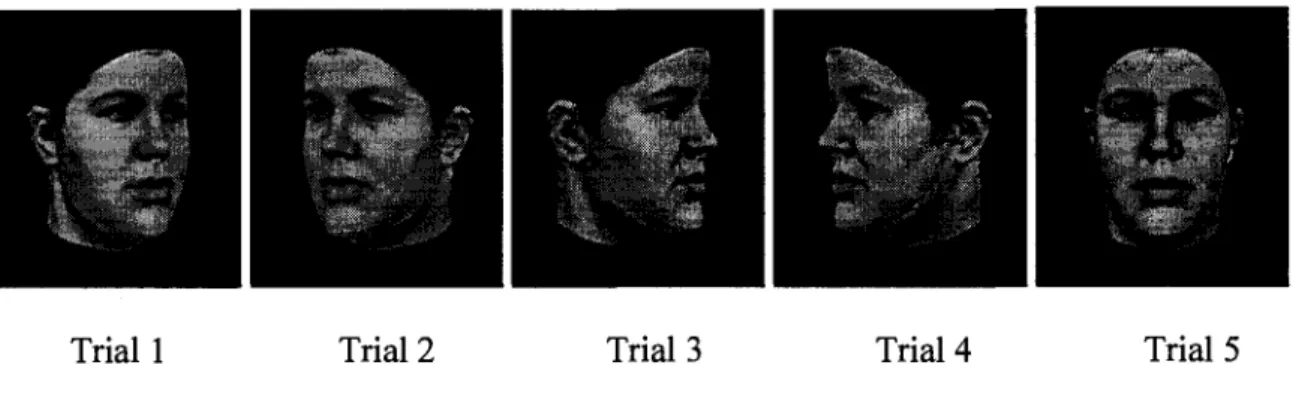
& Rouw, 2001). For the learning trials of Mass retrieval with encoding features
condition, the faces were presented in multiple views including the intermediate view
facing right and left, the profile view facing right and left, and the full frontal view (see
My name is Morgan
Figure 1. Procedure for the Learning Conditions
Trial 1 Trial 2 Trial 3 Trial 4 Trial 5
Figure 2. Face stimuli for the Mass Retrieval with Encoding Features Condition
Seventeen surnames were sampled from normative data published by
Zechmeister, King, Gude, and Opera-Nadi (1975). Selected surnames had similar ratings
for frequency, familiarity, orthographic distinctiveness, and pronounceability. Seventeen
first names were sampled from popular first names listed by the Social Security
Administration of United States. Selected first names had similar frequency according to
the data pool from Social Security card applications for births that occurred in the United
24
States from the year 2000 to 2007. All names chosen were between five and eight letters
in length.
Each of the seventeen first names was randomly assigned to one of the seventeen
surnames to make a full name (see Appendix A). Each face was randomly assigned to
one of the full names so that each face is associated with a full name. One of the face
name pairs was randomly chosen to be the practice face and the other sixteen faces were
randomly placed in an ordered sequence.
Neuropsychological Measures
Verbal Fluency Test (Benton, Hamsher, & Sivan, 1994).
The Verbal Fluency Test is a measure of a person's fluency in verbal language or
the ease in which a person can think of different words. This test consists of two subtests:
letter fluency, and category fluency. In letter fluency, the participant was asked to name
as many words as possible that start with a certain letter in 60 seconds to measure
phonemic fluency. In category fluency, the participant was asked to name as many words
as possible that belong to a certain category such as animals in 60 seconds to measure
semantic fluency.
Five Point Test (Regard, Strauss, & Knapp, 1982).
The Five Point Test is a measure of a person's spatial fluency or the ease in which
a person can think of different designs. This test requires the participant to produce as
many new original abstract designs in three minutes. The participant was given a piece of
paper in which there were boxes with five dots inside and asked to make as many
must start at a dot and end at a dot; but participants did not need to use all the dots to
make a design but at minimum need to use two dots.
Trail Making Test (TMT) (Reitan, 1955).
The Trail Making Test measures visual scanning, visual spatial ability,
visuomotor speed, set switching ability, and cognitive flexibility. There are two parts to
this test: Trails A and B. In Trails A, the participant was asked to connect numbers in
order on a page of randomly placed numbers as quickly as possible. In Trails B, the
participant was asked to connect numbers and letters by switching between a letter and a
number (e.g. A-l-B-2) in alphabetical and numerical order on a page of randomly placed
numbers and letters as quickly as possible.
Digit Span Test (The Psychological Corporation, 1997).
The Digit Span Test from the Wechsler Adult Intelligence Scale -III (WAIS-III)
measures attention, concentration, and working memory. This test consists of two
subtests: forward and backwards conditions. In the forward condition, the participant
repeated a number sequence in the same order as presented by the examiner. In the
backward condition, the participant repeated a number sequence in the reverse order as
presented by the examiner. In both conditions, the length of the number sequence
increased until the participant can no longer repeat the sequence.
California Verbal Learning Test 2 edition (CVLT—II) (Delis, Kramer, Kaplan, & Ober, 2000).
The CVLT-II measures verbal list learning and memory by assessing recall and
recognition of two words lists over immediate and delayed trials. In the learning trial, the
26
words as possible immediately after the presentation of the list. List A is composed of
four words from four different categories (furniture, vegetables, ways of travelling, and
animals). There were five learning trials before another 16 word interference list (List B)
was presented for one trial and the participant was asked to recall as many words as
possible from the interference list. Immediately after List B, the participant was given a
short delay free recall trial (recall as many words as possible) and a short delay cued
recall trial (recall as many words that belong to each category e.g. furniture) for List A.
Then, twenty minutes later, the participant was given a long delay free recall, long delay
cued recall and yes/no recognition (presented with List A, List B and distracter words and
asked whether each word was on List A) trials for List A.
Recognition Memory Test (RMT) (Warrington, 1984).
The RMT measures a person's ability to recognize photographs of faces. The
participant was shown 50 photographs of faces one at time and asked to engage in an
alternative forced choice recognition task in which each of the 50 faces are paired with a
distracter face and the participant was asked to select the target face that was shown
before.
Procedure
For each condition, participants read the instructions presented on the computer
and completed a practice trial with guidance from the examiner. After the practice trial,
the learning session was given (see Figure 1). The learning session involved presenting
the information to be learned (a face presented in the middle of the computer screen with
name?" appeared on the screen and participants were asked to type in the full name
associated with the face and then press the enter key). Participants were instructed to
press enter if they did not know the name. If participants typed in the wrong name or just
pressed the enter key, the computer screen displayed the face and the correct name for
two seconds: "My name is ". This procedure was repeated for the same face five
times sequentially before the next face name pair was presented. The specific instructions
for the learning session differed according to the condition and are provided later in this
paper.
After participants saw and attempted to recall all sixteen face name associations,
they engaged in a short mathematic distracter task for five minutes: adding together as
many two randomly chosen double digit numbers (e.g. 45 and 32) as possible within five
minutes. The two numbers were shown for one second before a text box was displayed
asking participants to type in the sum of the two numbers. Following the distracter task
was the immediate testing session in which participants were shown all the sixteen faces
previously learned one at a time in random order. Each face was presented in the middle
of the screen for six seconds, followed by the words "What is my name?" presented on
the screen and the participants were instructed to type in the name associated with the
face or press enter if they could not recall the name.
Following the immediate testing session, the participants completed a
demographic questionnaire and various cognitive neuropsychological tasks (Verbal
Fluency Test, Five Point Test, Trail Making Test, Digit Span Test) for thirty minutes.
immediate testing session. Participants were again shown all sixteen faces one at a time
in random order. Each face was presented for six seconds and participants had to type in
names associated with the face or press enter if they could not recall the name. When
participants finished the delayed testing session, they completed the California Verbal
Learning Test and the Recognition Memory Test. Lastly, participants were debriefed on
the purpose of the study.
Mass Retrieval Condition
A face was presented in the middle of the computer screen with the name printed
underneath the face for six seconds before a blank screen was shown for two seconds.
The same face again was presented for six seconds without the name. Then the face
disappeared and the words "What is my name?" appeared on the screen and the
participant was asked to type in the full name associated with the face. This procedure
was repeated for the same face five times sequentially before the next face name pair was
presented.
Mass Retrieval with Encoding Features Condition
This condition is similar to the mass retrieval condition. A face was presented in
the middle of the computer screen with the name printed underneath the face for six
seconds before a blank screen was shown for two seconds. The same face was presented
again for six seconds without the name. Then the face disappeared and the words "What
is my name?" appeared on the screen and the participant was asked to type in the full
name associated with the face. Then the participant was shown the same face oriented at
a different angle for six seconds. This is the only difference between the mass retrieval
whereas in the mass retrieval with encoding features condition, the same face was shown
at five different angles for each face name pair to promote greater encoding of facial
features. Thus, every time the participant was tested for the face name pair in this
condition, a different view of the face was presented. The rest of the learning session
procedure was exactly the same as for mass retrieval condition.
Spaced Retrieval Condition
A face was presented in the middle of the computer screen with the name printed
underneath the face for six seconds before a blank screen was shown for two seconds.
The participant was asked to do a distracter activity of adding two double digit numbers
together. The numbers appeared on the screen for one second and the participant was
instructed to type in the sum of the two numbers. Participants engaged in the distracter
task for five seconds before the same face was presented again for six seconds, followed
by a blank screen for two seconds and the words "What is my name?" appeared on the
screen. The participant was asked to type in the full name associated with the face. Next,
the participant engaged in the same distracter task described earlier until it was time for
the next testing interval. The intervals were determined by the accuracy of the
participant's name recall responses. If the participant responded correctly, the next testing
interval was expanded: 10 seconds, 30 seconds, 60 seconds and 120 seconds. If the
participant responded incorrectly, the next testing interval remained the same as the last
previous successful recall interval. Previous studies using dementia patients participants
have used expanding intervals of 0, 20, 40, 60, 90 and 120 seconds (Camp et al., 1996) or
30
intervals because the participants are healthy adults who do not have memory
impairments. After each face was tested five times, a blank screen appeared for 2 seconds
and participants performed the distracter activity of adding numbers for 10 seconds
before the next face name association was presented and tested in the same procedure.
Pre Exposure and Spaced Retrieval: The Combined Condition
A face was presented in the middle of the computer screen for four seconds. A
blank screen appeared for two seconds before the words "Does this person look ?"
was presented on the screen. The participant was instructed to make evaluative judgments
of the face by answering one of five possible questions: does this person look
honest/pleasant/intelligent/ responsible/friendly? The participant typed Y for yes and N
for no. The same face was then presented in the middle of the screen for six seconds with
the name typed underneath the face. After a blank screen was shown for two seconds, the
participant was asked to do a distracter activity of adding two double digit numbers
together. The numbers appeared on the screen for one second and the participant was
instructed to type in the sum of the two numbers. The participant did the distracter task
for five seconds before the same face was presented again for six seconds, followed by a
blank screen for two seconds and the words "What is my name?" appeared on the screen.
The participant was asked to type in the full name associated with the face. Next, the
participant engaged in the same distracter task described earlier until it was time for the
next testing interval. Like the spaced retrieval condition, these intervals were determined
by the accuracy of the participant's name recall response: if the participant responded
120 seconds and if the participant responded incorrectly, the next testing interval
remained the same as the previous successful recall interval.
The participant did the distracter task until the next testing interval time was up
before the same face was presented again for six seconds, and a blank screen appeared for
two seconds. The participant was instructed to make evaluative judgments of the face by
typing in Y for yes or N for no to the question "Does this person look ?" presented
on the screen. For half of the faces, the participant judged the face on the same trait every
time, e.g. "does this person look honest?" appeared at each interval. For the other half of
the faces, the participant judged the faces on different traits every time, e.g. "does this
person look honest?" appeared on one interval and "does this person look intelligent?"
appeared on the next interval. After the participant made the judgment, a blank screen
appeared for two seconds and the words "What is my name?" appeared on the screen and
the participant was asked to type in the full name associated with the face. Then the
participant engaged in the same distracter task described earlier until it was time for the
next testing interval. After each face was judged and tested five times, a blank screen
appeared for 2 seconds and participants performed the distracter activity of adding
numbers for 10 seconds. Then the next face was presented, judged, and tested in the same
32
Results
Demographics
A chi square analysis revealed that males and females were distributed fairly
evenly across the four conditions (X (3) = 3.13, p = .37). There were no significant
difference in the ages of participants across the four conditions (F(3, 122) = 0.18,/? =
.91). Although our study used psychology students, there was a mixture of students from
different majors such as business, communications, sociology, and neuroscience. A chi
square analysis found no difference in the distribution of psychology and non psychology
major students between the four conditions (X2(3) = 3.69,p = .30).
Self-reported ethnicity of the participants was grouped according to Caucasian
and Non Caucasian. A participant was considered Caucasian if he or she indicated as
being Caucasian or reported to be a person from a European descent (Oxford Pocket
Dictionary of Current English, 2008). More than half of the participants were considered
Caucasian (74%). Research has demonstrated the existence of an own race bias in which,
people tend to have better memory for faces that share their ethnicity, such that
Caucasians are more likely than non -Caucasians to remember Caucasian faces (Anthony,
Copper, & Mullen, 1992). Since this study used exclusively Caucasian faces, it is
important to determine if there is a difference in ethnicity membership across the four
groups that may be contributing to the performance in learning and remembering face
name associations. Chi square results showed no significant differences between ethnicity
Face Name Learning and Memory
Performance was judged according to the accuracy of each participant's response
for the first name, last name, and full name of the faces. The name of the face had to be
spelled correctly with no errors to obtain a score of 1. For example if a participant got the
first name correct and the last name incorrect, he/she would get a score of 1 for the first
name, and 0 for last name and full name. On the other hand, if a participant got the full
name correct, he/she would get a score of 1 for first name, last name, and full name. The
data were analyzed using the Mann-Whitney and Kruskal-Wallis tests due to the
skewness of the distributions. Post hoc tests were run using the Mann-Whitney test with a
Bonferroni correction. The median, range, and standard deviations for each condition are
34
Table 1
Median, Standard Deviation and Range of Face Name Associations Scores for Each Condition
Correct Score by Condition Trial Type
LT First Name
LT Last Name
LT Full Name
IT First Name
IT Last Name
IT Full Name
DT First Name
DT Last Name
DT Full Name
Median (SD) Range Median (SD) Range Median (SD) Range Median (SD) Range Median (SD) Range Median (SD) Range Median (SD) Range Median (SD) Range Median (SD) Range Mass Retrieval 78 (2.219) 72-80 79 (2.362) 72-80 77 (3.695) 68-80 2 (2.080) 0-8 1 (1.670) 0-7 0(1.528) 0-7 2 (2.336) 0-8 1 (1.841) 0-8 0(1.720) 0-8 Mass Retrieval with Encoding Features 77 (2.219) 71-80 79 (3.475) 67-80 76 (4.594) 63-80 1 (1.637) 0-6 1 (1.067) 0-4 0 (0.942) 0-3 1 (1.659) 0-7 1 (0.774) 0-3 0 (0.568) 0-2 Spaced Retrieval 78(2.107) 70-80 78 (2.874) 65-80 76 (3.734) 61-80 2 (2.332) 0-12 2(1.912) 0-10 1 (1.936) 0-10 3 (2.474) 0-13 1 (2.363) 0-12 1 (2.238) 0-12 Combined 78(4.718) 56-80 77.5 (5.025) 55-80 74(6.718) 46-80 2(2.125) 0-9 1 (1.736) 0-8 1 (1.722) 0-7 2(1.807) 0-9 1 (1.796) 0-9 1 (1.768) 0-9
LT = Learning Trial
IT = Immediate Testing Trial
DT = Delayed Testing Trial
Learning Trial
In general, there was no significant difference between conditions in learning first
names (H(3) = 2.34, p = .51), last names (H(3) = 2.64,/? = .46), or full names (H(3) =
= 3.07 for first names and Mdn = 76.00, sd = 4.76 for full names) were slightly better
than males (Mdn = 77.00, sd = 3.14 for first names and Mdn = 74.00, sd = 5.00 for full
names) at learning the first names (U = 751.00, r = .02) and full names (U = 855.50, r =
-.02) of faces independent of the condition to which they are assigned. In addition,
Caucasians (Mdn = 79.00, sd = 2.38) were slightly more accurate at learning the last
names (U = 1030.50, r = .02) of faces than non Caucasians (Mdn = 77.00, sd = 5.43).
Immediate Recall Testing Trial
There was a significance difference between conditions in recall of the last names
(H(3) = 9.88, p < .05) and full names (H(3) = 12.33, p < .05) of faces at the immediate
delay trial. Post hoc tests revealed a significant difference between Mass retrieval with
encoding features condition and Spaced retrieval condition for last names (U = 312.00, r
= -.37) and full names (U = 283.00, r = -.36). As predicted, participants in Mass retrieval
with encoding features condition (Mdn = 1.00, sd = 1.07 for last names and Mdn = 0.00,
sd = 0.94 for full names) had lower scores than participants in Spaced retrieval condition
(Mdn = 2.00, sd = 1.91 for last names and Mdn = 1.00, sd = 1.94 for full names) when
recalling names of faces. Participants performed significantly better in the Combined
condition (Mdn = 1.00, sd = 1.74 for last names and Mdn = 1.00, sd = 1.72 for full
names) than participants in the Mass retrieval with encoding features condition in
recalling last names (U = 287.50, r = -.31) and full names (U = 299.00, r = -.37).
A Mann-Whitney test was conducted to compare the scores of participants that
learned faces using mass retrieval (Mass retrieval condition and Mass retrieval with
encoding features condition) and participants that learned faces using spaced retrieval
36
between these two groups in recalling last names (U = 1426.50, r - -.25) and full names
(U = 1326.50, r = -.30) in the immediate trial. Participants who used spaced retrieval to
learn faces remembered more names than participants who used mass retrieval (see
Figure 3).
D Mass Retrieval Conditions • Spaced Retrieval Conditions
"1
MeanR
i
80 -, 70 60 50 40 30 20 10
-ImmedMtei medidto mediate Delayed Delayed Delayed Testing first Testing last Testing full Testing first Testing last Testing full
name name name name name name Trial type Name type
Figure 3. Mean Rank Recall Difference Between Mass Retrieval Conditions and Spaced
Retrieval Conditions'
Delayed Recall Testing Trial
A significant difference was found between conditions for recall of first names (H(3) =