IDENTIFICATION OF MATERIAL DAMAGE
IN TWO DIMENSIONAL DOMAINS
USING SQUID BASED NDE SYSTEM
H.T. BANKS 1 and F. KOJIMA 2Abstract
Problems on the identification of two-dimensional spatial domains arising in the detection and characterization of material damage are considered. For electromag-netic nondestructive evaluation systems, observations of the magelectromag-netic flux from the front surface are used in a output least-square approach. Parameter estimation tech-niques based on the method of mappings are discussed and approximation schemes are developed applying a finite-element Galerkin approach. Theoretical convergence results for computational techniques are given and results are applied to numerical experiments to demonstrate the efficacy of the proposed schemes.
1
Introduction
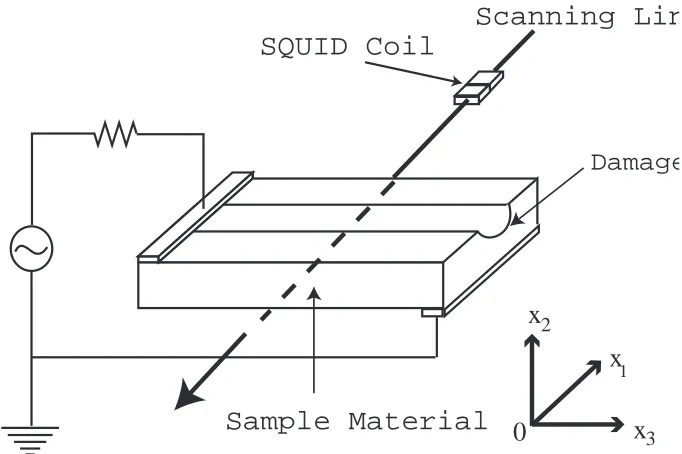
Detection and characterization of small cracks and corrosion embedded in the structures of aircraft are critical issues in the maintenance of aging aircraft. For instance, carbon fiber reinforced plastics (CFRP) have been widely used in the advanced aircraft and, as a result, demand has grown for assessing the structural integrity of structures made from those materials. An important effort on such problems entails quantitative nondestructive evaluation methods in SQUID-based NDE system [1]. It is well known that SQUIDs (su-perconducting quantum interference devices ) have very high sensitivity for magnetic flux measurements. Due to the highly sensitive magnetic flux measurements, inverse analyses on electromagnetic problems are effectively used for detecting and characterizing cracks and delamination. Initial efforts on such inverse problems include nondestructive testing under SQUID measurements using the direct current method [2]. However, the detections of non-through crack and corrosion-like damage by direct current flows are insufficient be-cause of the lack of information for deep-lying effects from vertical component of magnetic flux measurements. Since a skin depth of metal varies according to frequency of flowing current, it is possible to detect the deep-lying flows by controlling the frequency. To this end, SQUID based nondestructive evaluation (NDE) systems using injection current methods have been recently developed [3, 4]. In this paper, we propose a computational method for recovering corrosion-like damage with magnetic flux density data from the SQUID based NDE system with alternating current force. The idea of the method of mapping techniques ([5, 6]) are effectively used in our inversion procedures. Figure 1 illustrates the overall configuration of SQUID based NDE system proposed here. In this 1Center for Research in Scientific Computation, North Carolina State University, Raleigh, NC 27695-8205, USA. E-mail: [email protected]
Sample Material
SQUID Coil
Scanning Lin
Damage
x
x
x
1
2
3
0
Figure 1: Overall Configuration of SQUID based NDE System
inspection procedure, alternating current forces with multiple angular frequencies are ap-plied to the sample material inspected. A damage corrupts the current flows inside the conductor and we can detect this disturbance from the magnetic flux measurements by the SQUID. The task we consider here is to identify the geometrical shape of the damage from input and output data. Throughout the paper, we assume that the damage is lo-cated sufficiently far from both sides of the sample and that the direction of current flow is uniform with respect to the length direction. In Section 2, we consider a two-dimensional mathematical model for inspections based on a SQUID-based NDE system. In Section 3, a direct problem is formulated in variational form in an appropriate Hilbert space. In Section 4, the inverse problem is discussed in the context of a nonlinear output least square problem. The class of admissible parameters are given and the existence of solu-tions is demonstrated using the idea of the method of mappings. Section 5 is devoted to theoretical convergence for the proposed computational method. Numerical experiments are summarized in Section 6 to demonstrate the efficacy of the proposed method. Related efforts on similar problems are given in [7, 8, 9] where eddy current based techniques are used and the focus is model reduction techniques are opposed to the use of the method of maps employed here.
2
Mathematical Model of Inspection Procedures
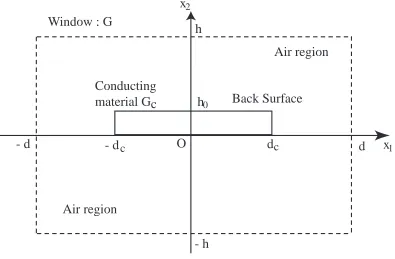
Our forward analysis is considered on a cross section of the conducting material sample, i.e.,
Gc ={ x= (x1, x2)| |x1|< dc, 0< x2 < h0 }
Air region
- d
d
h
- h
O
h
0Conducting
material Gc
Air region
x
x
1 2
Back Surface
Window : G
- d
cd
cFigure 2: Inspection Area
our problem is defined on an appropriate computational “window” given by G={ x| |x1|< d, |x2|< h(h0 < h < ∞)}.
A set of alternating current sourcesJiwith frequenciesωiis applied to the sample material Ji(t,x) = (0,0, Js(x))T cos(ωit).
The set of applied frequencies ω={ωi}Mi=1o can be determined in accordance with the skin depth condition,
δ = s
2
σµω (1)
whereµdenotes the magnetic permeability and whereσdenotes the electrical conductivity of the sample. Given that skin depth of a metal changes according to frequency of flowing current, it is possible to detect a configuration of deep-lying defects by varying the frequency. For the output, measurements can detect the gain margin and phase change of the voltage using a LCZ meter. This means that the SQUID measurements can be represented as
B(t,x) =B(x) cos(ωt+θ(x)).
Thus it is natural and convenient that the state variables be described by complex phasor representations. The phasor form of Maxwell’s equations is given by
∇ ·E = 0, (3)
∇ ×E = −jωB, (4)
∇ ×H = J. (5)
Following a standard approach, we introduce the magnetic vector potential A=
(Ax1, Ax2, Ax3) defined by B =∇ ×A and the cross product of Eq. ( 4 ) can be replaced by representing E+jωA as the gradient of a scalar electrical potential φ, i. e.,
E=−jωA− ∇φ.
In conjunction with Ohm’s law J = σE and the constitutive law B = µH, the system state A is governed by
∇ × 1
µ∇ ×A = −jωσA−σ∇φ (6)
∇ ·(jωA+∇φ) = 0. (7)
We assume here that the sample is of nonmagnetic material, so that the magnetic per-meability µis equal to that of air, i.e., µ=µ0. In our formulation, the magnetic vector potential becomes A= (0,0, A3). Therefore, the equation for the component of magnetic vector potential A3 =A is simply rewritten as
− 1
µ0∇
2A+jχ
cσωA=−χcσ ∂φ ∂x3
where χc denotes the characteristic function of the conducting region Gc. Taking into account that the right side of the above equation is composed of the source current density, it follows that
Js=−σ ∂φ
∂x3 inGc.
Consequently we can formulate the two dimensional forward problem in terms of the equation:
− 1
µ0
∂2A(x1, x2) ∂x21
+ ∂
2A(x 1, x2)
∂x22
!
+jχcσωA(x1, x2) =χcJs(x1, x2). (8)
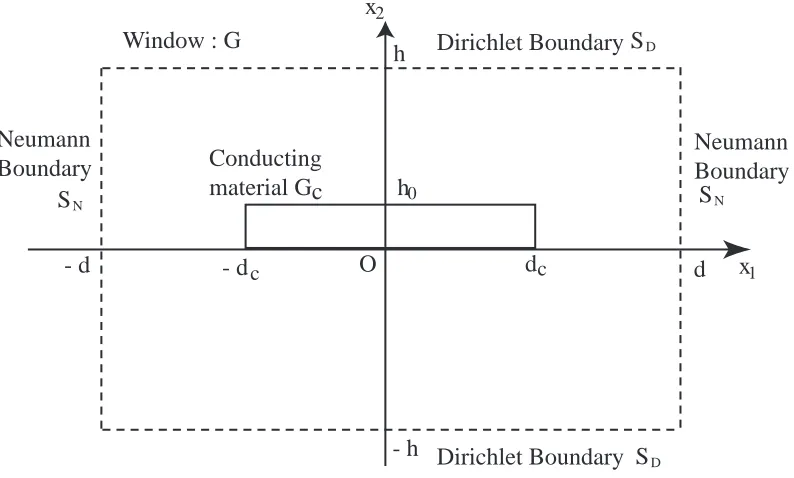
Since the boundaries in the x2 directions are assumed to be sufficiently far from the sample, we assign a Dirichlet boundary condition on this part of the boundary, i. e.,
A= 0 on SD (9)
where
SD ={ x | |x1|< d, |x2|=h }.
We also consider the boundaries in thex1 directions to be sufficiently far from the damage so that Neumann boundary conditions in the x1 direction can be set as:
∂A
- d d h
- h O
h0
Conducting material Gc
x x
1 2
Window : G SD
SD
SN SN
Dirichlet Boundary
Dirichlet Boundary Neumann
Boundary
Neumann Boundary
- dc dc
Figure 3: Setting of the boundary condition on the window
where
SN ={x | |x1|=d, |x2|< h}.
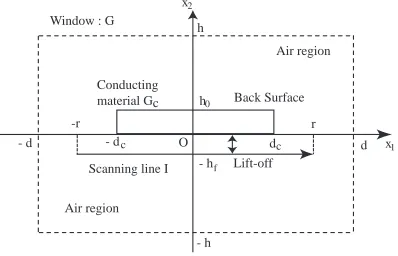
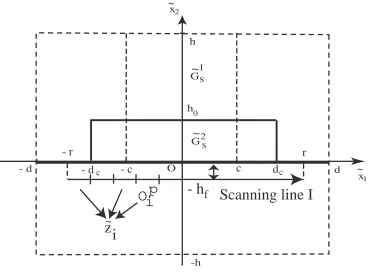
Figure 3 denotes the boundary conditions on the computational window. In contrast to other magnetic sensors, SQUID measurements can directly detect the magnetic flux densities that are independent of the applied frequencies. Suppose that the scanning strategy is given on the line
I ={ x∈G| |x1| ≤r (dc < r), x2 =−hf }, as shown in Fig. 4. Thus the observation mechanism involves data
B2(xp) =−∂A
∂x1(x
p) for xp ∈I, p= 1,2,· · ·, m. (11)
and the observations are given by
z =HA ∈ Cm (12)
where H denotes the bounded operator given by
{H}p = −
1
|Op| Z
Op
∂(·) ∂x1dx1
x2=−hf
(13)
and Op denotes the sub-interval ofI defined by
Op ⊂ (p= 1,2,· · ·, m). (14)
Air region
- d
d
h
- h
- h
O
h
0Scanning line I
Conducting
material Gc
Lift-off
Air region
x
x
1 2
f
Back Surface
Window : G
- d
cd
c-r
r
Figure 4: Scanning procedures
3
Weak Formulation
Let q be a constant vector which characterizes an unknown damage shape where we assume
[H-0] The admissible setQ of damage parameters is a compact subset of RM .
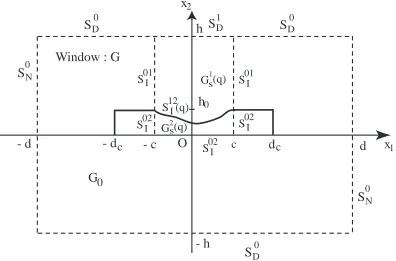
We introduce the “suspect region” Gs ⊂ G which covers the suspected but unknown damage. More precisely, as depicted in Fig 5, the domain Gs is described by
Gs={ x= (x1, x2) | |x1|< c, 0< x2 < h }.
For convenience of discussions, the suspect region Gs is decomposed into two subre-gions which correspond to the air region G1s and the conducting region G2s and these are parametrized by q. Thus the “window” G is decomposed into three sub-regions G0, G1s and G2s as follows:
Gs =G1s(q)∪Gs2(q), G0 =G−Gs.
We assume the boundary of G is decomposed into SN0 = {x | |x1|=d, |x2| ≤h }
- d
d
h
- h
O
h
0x
x
1 2
Window : G
G1
G2
S
D1S
DS
NS12I(q)
(q)
(q)
0
S
0N0
S
D0S
D0S01I S01I
S02I S02I
S02I
G
0- d
c- c
cd
cs
s
Figure 5: Domain decomposition
and that the interface among sub-regions are defined by SI01 = {x| |x1|=c, h0 ≤x2 < h}
SI02 = {x| |x1|=c, 0< x2 < h0 } ∪ {x| |x1| ≤c, x2 = 0 }
and SI12 is defined by the interface between G1s(q) and G2s(q). The form of SI12 will be described in the later discussions. The system state is then denoted by
A:=A0 in G0 A:=Ai in Gis (i= 1,2) where
Ai :=ARi +jAiI (i= 0,1,2).
In the sequel, we suppose that the electric conductivity of the conducting material sample has constant valueσc, i.e.
σ=χcσc. Thus the subsystem on G0 is described by
− 1
µ0∇ 2AR
0 −χcσcωAI0 = χcJs (15)
− 1
µ0∇ 2AI
with the boundary condition
AR0 =AI0 = 0 on SD0 (17)
∂AR
0
∂n = ∂AI
0
∂n = 0 on S
0
N. (18)
The subsystems defined on G1s(q) and G2s(q) are described respectively by
∇2AR
1 = 0 (19)
∇2AI
1 = 0 in G1s(q) (20)
with the boundary condition
AR1 =AI1 = 0 on SD1, (21)
and
− 1
µ0∇ 2AR
2 −σcωAI2 = Js (22)
− 1
µ0∇ 2AI
2 +σcωAR2 = 0 in G2s(q). (23)
We also need the interface conditions between G0,G1s(q), andG2s(q),
AR0 −AR1 =AI0−AI1 = 0 (24)
∂AR 0 ∂n − ∂AR 1 ∂n = ∂AI 0 ∂n − ∂AI 1
∂n = 0 on S
01
I (25)
AR0 −AR2 =AI0−AI2 = 0 (26)
∂AR 0 ∂n − ∂AR 2 ∂n = ∂AI 0 ∂n − ∂AI 2
∂n = 0 on S
02
I (27)
AR1 −AR2 =AI1−AI2 = 0 (28)
∂AR 1 ∂n − ∂AR 2 ∂n = ∂AI 1 ∂n − ∂AI 2
∂n = 0 on S
12
I (q). (29)
Let ϕ be in the set
Vq ={ ϕ ∈H1(G0∪G1s(q)∪G2s(q))| ϕ = 0 onSD0 ∪SD1 }
endowed with the norm
kϕk2 := ZZ
G0∪G1s(q)∪G2s(q)
|∇ϕ|2dx1dx2.
Let us set
~
ϕ:= (ϕR, ϕI)∈Vq×Vq.
Then, for any ϕ, ~~ ψ ∈Vq×Vq, we define the bilinear form on Vq×Vq a(q)(ϕ, ~~ ψ) := 1
µ0
ZZ
G0∪G1s(q)∪G2s(q)
∇ϕR· ∇ψR+∇ϕI · ∇ψIdx1dx2
−ω ZZ
G0∪G2s(q)
χcσcϕIψRdx1dx2
+ω ZZ
G0∪G2s(q)
and the linear form on Vq
L(q)(ϕ~) := ZZ
G0∪G2s(q)χcJsϕ
Rdx
1dx2. (31)
Lemma 1: Suppose that
[H-1]: The applied angular frequency ω is properly chosen such that ω≤ω0 <∞
and that
χcJs∈L2(G).
Then, for every q∈Q, there exists a unique solution A~(q) = (AR, AI)∈V
q×Vq which is
the solution of
a(q)(A, ~~ ϕ) =L(q)(ϕ~) for ϕ~ ∈Vq×Vq. (32) Moreover, we have
kA~(q)kVq×Vq ≤K1kχcJskL2(G) (33)
where K1 is a constant independent ofq.
Proof: For arbitrary ϕ~ ∈Vq×Vq, a(q) is Vq×Vq-elliptic with constant δ= 1/µ0 since
a(q)(ϕ, ~~ ϕ) = 1 µ0
ZZ
G0∪G1s(q)∪G2s(q)
∇ϕR2+∇ϕI2
dx1dx2 =δkϕ~k2Vq×Vq (34)
from which follows the coercivity. For the boundedness, it can be easily checked that
a(q)(ϕ, ~~ ψ)≤γkϕ~kVq×Vqψ~
Vq×Vq. (35)
The linear functional L(q) is bounded onVq×Vq, i.e.,
|L(q)(ϕ~)| = ZZ
G0χcJsϕ
Rdx
1dx2+
ZZ
G2s(q)
JsϕRdx1dx2
≤ ZZ
G0
χcJsϕRdx1dx2+ ZZ
G2s(q)
JsϕRdx1dx2
≤
ZZ
G0|χcJs|
2
dx1dx2
1 2
+ ZZ
G2s(q)
|Js|2dx1dx2 !1
2
×kϕ~kL2(G0∪G1s(q)∪G2s(q))
≤ Mkϕ~kVq×Vq for ϕ~ ∈Vq×Vq.
Applying the Lax-Milgram lemma, for eachq∈Q, we find there exists a unique solution ~
A(q)∈Vq×Vq satisfying (32). Similarly, we have
- d
d
h
- h
O
h
0x
x
1 2
Window : G
G1
G2(q)
(q)
G
0- d
c- c
cd
cr(x ; q)
1s
s
Figure 6: The unknown damage function
from which follows
kA~(q)kVq×Vq ≤K1 where K1 = M δ . This completes the proof.
Remark: In [H-1], the upper bound of angular frequency ω0 can be reasonably set for the inspection. More precisely, the angular frequency ω of the applied current force must be properly chosen by the skin depth condition (1).
4
Admissible Class and Method of Mapping
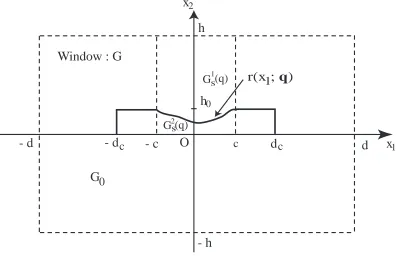
In this section, we restrict the corrosion-like damage so that it can be represented by a simple parametrized function. The unknown defect shape is characterized by a function
x2 =r(x1;q) for |x1| ≤c (36)
with
0< r(x1;q)≤h0 ( < h <∞ ) and r(−c;q) =r(c;q) =h0
as depicted in Fig. 6. We describe by Q ⊂ RM an admissible set of possible parameter
- d
d
h
- h
O
h
0x
x
1 2
Window : G
G1
G
0- d
c- c
cd
cs
~
G
~
2sFigure 7: Refence domains
[H-3] There exists a constantβ such that, for each q∈Q, 0< β ≤r(·,q).
[H-4]There exists a functiondist:Q×Q→R1 with dist(q,q)˜ →0 as |q−q˜| →0 such that
kr(·,q)−r(·,q)˜ k1,∞≤dist(q,q)˜ for q,q˜ ∈Q.
The subregions G1(q) and G2(q) given in the previous section can now be explicitly rewritten as
G1s(q) ={ x| |x1|< c, r(x1,q)< x2 < h} and
G2s(q) = { x| |x1|< c, 0< x2 < r(x1,q) },
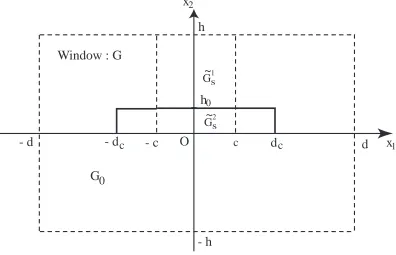
respectively. Associated with these sub-domains, we define the reference sub-domains as shown in Fig. 7:
˜
G1s ={ x| |x1|< c, h0 < x2 < h } ˜
G2s ={ x| |x1|< c, 0< x2 < h0 }.
We introduce the affine mapping:
x=T(q)˜x= (
T1(q)˜x for ˜x∈G˜1s T2(q)˜x for ˜x∈G˜2s
h
O
x
x
1 2
- c
c
r(x ; q)
1h
0G
1(q)
G
2(q)
h
O
x
x
1 2
- c
c
h
0G
1G
2~
~
T(q)
~
~
s
s
s
s
Figure 8: Transformation mapping from the reference domain into the domain with dam-age
where
T1(q) =
(
x1 = ˜x1
x2 = (h−r(˜x1;q))(˜x2−h)/(h−h0) +h
T2(q) =
(
x1 = ˜x1
x2 = r(˜x1;q)˜x2/h0 .
These mappings result in the following identities :
Gis(q) =Ti(q)◦G˜is (i= 1,2). (38)
Figure 8 illustrates the transformation from the reference domain ˜G1s∪G˜2s into the domain with damageG1s(q)∪G2s(q). Let ˜ϕ be in the set
˜
V ={ ϕ˜∈H1(G0∪G˜1s∪G˜2s) |ϕ˜= 0 on SD0 ∪SD1 } endowed with the norm
kϕ˜k2 := ZZ
G0∪G˜1s∪G˜2s
|∇ϕ˜|2dx˜1dx˜2.
Let us set
~˜
ϕ:= ( ˜ϕR,ϕ˜I)∈V˜ ×V .˜
Then, for any ϕ, ~~˜ ψ˜∈V˜ ×V˜, the bilinear form a(q) can be represented on ˜V ×V˜ as
˜
a(q)(~ϕ, ~˜ ψ˜) := 1 µ0
2
X
i=1 ZZ
˜
Gis
˜
∇ϕ˜R
·∇˜T
i(q) −t
˜
∇Ti(q) −1
˜
+∇˜ϕ˜I·∇˜Ti(q)−t∇˜Ti(q)−1∇˜ψ˜Idet∇˜Ti(q)dx˜1dx˜2 + 1 µ0 ZZ G0 n ˜
∇ϕ˜R·∇˜ψ˜R+∇˜ϕ˜I·∇˜ψ˜Iodx˜1dx˜2
−ω ZZ
˜
G2s
σcϕ˜Iψ˜Rdet∇˜T2(q)dx˜1dx˜2
+ω ZZ
˜
G2s
σcϕ˜Rψ˜Idet∇˜T2(q)dx˜1dx˜2
−ω ZZ
G0χcσc
˜
ϕIψ˜Rdx˜1dx˜2 +ω ZZ
G0χcσc
˜
ϕRψ˜Idx˜1dx˜2. (39)
The linear form on ˜V is also represented by ˜
L(q)(~ϕ˜) := ZZ
˜
G2s
Jsϕ˜Rdet∇˜T2(q)dx˜1dx˜2+ ZZ
G0χcJs
˜
ϕRdx˜1dx˜2. (40)
Noting that
˜
∇Ti(q) =
∂x1
∂˜x1
∂x1
∂x˜2
∂x2
∂˜x1
∂x2
∂x˜2
,
we obtain
˜
∇T1(q) =
1 0
−r0(˜x1;q)(˜x2−h) h−h0
h−r(˜x1;q)
h−h0
∇˜T2(q) =
1 0
−r0(˜x1;q)˜x2
h0
r(˜x1;q)
h0
.
Similarly, we have
det∇˜T1(q)= h−r
(˜x1;q) h−h0 det
∇˜T1(q)= r
(˜x1;q) h0 .
Hence the explicit form of Eq. (39) can be represented as
˜
a(q)(~ϕ, ~˜ ψ˜) :=
2
X
i=1 ZZ
˜
Gis
(
ai1(q) ∂ϕ˜
R ∂x˜1
∂ψ˜R ∂x˜1 +
∂ϕ˜I ∂x˜1
∂ψ˜I ∂x˜1
!
+ai2(q) ∂ϕ˜
R ∂x˜1
∂ψ˜R ∂x˜2 +
∂ϕ˜R ∂x˜2
∂ψ˜R ∂x˜1 +
∂ϕ˜I ∂x˜1
∂ψ˜I ∂x˜2 +
∂ϕ˜I ∂x˜2
∂ψ˜I ∂x˜1
!
+ai3(q) ∂ϕ˜
R ∂x˜2
∂ψ˜R ∂x˜2 +
∂ϕ˜I ∂x˜2
∂ψ˜I ∂x˜2
!)
dx˜1dx˜2
+1 µ0
ZZ
G0
∂ϕ˜R ∂x˜1
∂ψ˜R ∂x˜1 +
∂ϕ˜I ∂x˜1
∂ψ˜I ∂x˜1 +
∂ϕ˜R ∂x˜2
∂ψ˜R ∂x˜2 +
∂ϕ˜I ∂x˜2
∂ψ˜I ∂x˜2
!
dx˜1dx˜2 +
ZZ
˜
G2sa0
(q)−ϕ˜Iψ˜R+ ˜ϕRψ˜Idx˜1dx˜2 +ω
ZZ
G0χcσc
−ϕ˜Iψ˜R+ ˜ϕRψ˜I
where
a11(q) = r
0(˜x
1;q)2(˜x2 −h)2+ (h−r(˜x1;q))2
µ0(h−h0)(h−r(˜x1;q))
a12(q) = r
0(˜x
1;q)(˜x2 −h)
µ0(h−r(˜x1;q))
a13(q) = h−h0 µ0(h−r(˜x1;q))
a21(q) = r
0(˜x
1;q)2x˜22+r(˜x1;q)2
µ0h0r(˜x1;q)
a22(q) = −r
0(˜x
1;q)˜x2
µ0r(˜x1;q)
a23(q) = h0 µ0r(˜x1;q),
and where
a0(q) = ωσcr(˜x1;q)
h0 .
From (40), the transformed linear form can be explicitly rewritten by
˜
L(q)(~ϕ˜) := ZZ
˜
G2s
Jsr(˜x1;q) h0 ϕ˜
Rdx˜
1dx˜2+
ZZ
G0χcJs
˜
ϕRdx˜1dx˜2. (42)
Lemma 2: With the hypotheses [H-0] to [H-4], there exist positive constants α, λ, K2 and K3 such that, for q1,q2 ∈ Q, the bilinear form ˜a(q)(·,·) satisfies the following in-equalities for all ~ϕ, ~˜ ψ˜∈V˜ ×V˜:
˜
a(q)(~ϕ, ~˜ ϕ˜) ≥ α~ϕ˜2˜
V×V˜ (43)
a˜(q)(~ϕ, ~˜ ψ˜) ≤ K2~ϕ˜˜ V×V˜
ψ~˜
˜
V×V˜
(44)
˜a(q)(~ϕ, ~˜ ψ˜)−a˜(˜q)(~ϕ, ~˜ ψ˜) ≤ K3dist(q,q)˜ ~ϕ˜˜ V×V˜
~ψ˜
˜
V×V˜
(45)
where
dist(q,q)˜ →0 as |q−q˜| →0.
Moreover, α, K2, and K3 can be chosen as constants which are independent of the pa-rameter vector q.
Proof: It can be easily shown that, with c1, c3 >0, any quadratic form satisfies
c1(ξ1)2−2c2ξ1ξ2+c3(ξ22)≥ c1c3−
(c2)2
2 min
n
From (41), the associated quadratic form for each suspect region Gi
s(i= 1,2) becomes n
a1i(q)(ξ1R)2+ 2ai2(q)(ξ1Rξ2R) +ai3(q)(ξR2)2
o
+ nai1(q)(ξ1I)2+ 2ai2(q)(ξ1Iξ2I) +ai3(q)(ξ2I)2o
≥ ai1(q)ai3(q)−(ai2(q))2
2 min
n
(ai1(q))−1,(ai3(q))−1o
×(|ξ1R|2 +|ξ2R|2+|ξI1|2+|ξ2I|2). (46) We easily find that
ai1(q)ai3(q)−(ai2(q))2 = 1 for i= 1,2. Under the hypotheses [H-2]and [H-3], we admit that
(a11(q))−1 = µ0(h−h0)(h−r(˜x1;q))
r0(˜x1;q)2(˜x2−h)2+ (h−r(˜x1;q))2 ≥ µ0
M1+M2
(a13(q))−1 = µ0(h−r(˜x1;q)) h−h0 ≥µ0
where
M1 = sup q∈Q
sup
x1∈[−c,c]
|r0(˜x1;q)|2 M2 = h−β h−h0
!2
≥1.
This implies that, forG1s,
minn(a11(q))−1,(a13(q))−1o≥ µ0
M1+M2. (47)
Similarly, noting that
(a21(q))−1 = µ0h0r(˜x1;q)
r0(˜x1;q)2x˜22+r(˜x1;q)2 ≥
µ0β
h0(M1+ 1)
(a23(q))−1 = µ0r(˜x1;q)
h0 ≥
µ0β
h0 ,
we obtain
minn(a21(q))−1,(a23(q))−1o≥ µ0β h0(M1+ 1)
for G2s. (48) Choosing the constant as
α= min (
µ0
M1+M2,
µ0β
h0(M1+ 1),
1 µ0
)
which is independent of q, we obtain the coercivity (43) of the transformed sesquilinear form. To prove the boundedness, we note that, under the hypotheses [H-1] to [H-4], it follows that
aij(q) ≤ sup
q∈q
sup
˜
Gis
aij(q)2
1 2
(=M2) for i= 1,2;j = 1,2
ai3(q) ≤ max
(
h−h0
µ0(h−β),
h0
µ0β
)
(=M3) for i= 1,2
Thus, by setting as
K2 = max
M2, M3, M4, µ−01
,
we obtain the boundedness (44). To establish the continuity property, we note that, for any q,q˜∈Q,
˜a(q)(~ϕ, ~˜ ψ˜)−˜a(˜q)(~ϕ, ~˜ ψ˜)
≤ X2
i=1 ZZ ˜
Gis
"n
ai1(q)−ai1(˜q)
o ∂ϕ˜R ∂x˜1
∂ψ˜R ∂x˜1 +
∂ϕ˜I ∂x˜1
∂ψ˜I ∂x˜1
!
+nai2(q)−ai2(˜q)o ∂ϕ˜
R ∂x˜1
∂ψ˜R ∂x˜2 +
∂ϕ˜R ∂x˜2
∂ψ˜R ∂x˜1 +
∂ϕ˜I ∂x˜1
∂ψ˜I ∂x˜2 +
∂ϕ˜I ∂x˜2
∂ψ˜I ∂x˜1
!
+nai3(q)−ai3(˜q)o ∂ϕ˜
R ∂x˜2
∂ψ˜R ∂x˜2 +
∂ϕ˜I ∂x˜2
∂ψ˜I ∂x˜2
!#
dx˜1dx˜2
+ ZZ
˜
G2s
{a0(q)−a0(˜q)}
−ϕ˜Iψ˜R+ ˜ϕRψ˜Idx˜1dx˜2.
With the hypotheses [H-1] to[H-4], it can be argued that aij(q)(i= 1,2;j = 1,2,3) are continuous in L∞( ˜Gi
s). We can thus infer the continuity of the bilinear form (41) with
respect to q∈Q. The proof has been completed. Lemma 3: Let
~˜
A(q) =A~◦T(q)
be the transformed system state. Then, with the hypotheses [H-0] to [H-4], for every q∈Q, there exists a unique solution
~˜
A(q)∈V˜ ×V˜ (49)
in the sense that
˜
a(q)(A~˜(q), ~ϕ˜) = ˜L(q)(ϕ~˜) for ~ϕ˜∈V˜ ×V .˜ (50) Moreover the solution A~˜(q) in the system on G = G0 ∪G˜1s ∪G˜2s is bounded in ˜V ×V˜ uniformly inq∈Q.
Proof: FromLemma-2and from (30), (31), (41), and (42), we have that, forϕ~ ∈Vq×Vq and ~ϕ˜∈V˜ ×V˜,
α~ϕ˜2˜
V×V˜ ≤ |a(q)(ϕ, ~~ ϕ)| ≤K2 ~ϕ˜2˜
V×V˜
and
a(q)(ϕ, ~~ ϕ) = ˜a(q)(~ϕ, ~˜ ϕ˜).
Taking into account that the constantsαandK4 are independent of the unknown param-eter q, this implies that the Vq×Vq-norm is equivalent to the norm of ˜V ×V˜ uniformly in q∈Q. Since, under the hypothesis (H-1),
L˜(q)(~ϕ˜)≤K4~ϕ˜
there exists the solution ~A˜in ˜V ×V˜ in the sense of (50). The proof has been completed. Lemma 4: With the hypotheses [H-0] to [H-4], q → A~˜(q) is continuous from Q to
˜ V ×V˜.
Proof: Let qk → q in Q and let A~˜(qk), ~A˜(q) be the corresponding solutions of (50).
Then, from (50), we have
˜
a(qk)(A~˜(qk), ~ϕ)−˜a(q)(A~˜(q), ~ϕ) = [ ˜L(qk)−L˜(q)](ϕ~) for ∀ϕ~ ∈V˜ ×V .˜ Then we may rewrite
˜
a(qk)(A~˜(qk)−A~˜(q), ~ϕ) + [˜a(qk)−˜a(q)](A~˜(q), ~ϕ) = [ ˜L(qk)−L˜(q)](ϕ~) for ∀ϕ~ ∈V˜ ×V .˜
Choosing as ϕ~ =A~˜(qk)−~A˜(q) in ˜V ×V˜ and using (43) and (45) in Lemma-2, we find that
α|A~˜(qk)−A~˜(q)|2V˜×V˜ ≤dist(qk,q)
|χJs|L2(G)+|A~˜(q)|2V˜×V˜
|A~˜(qk)−A~˜(q)|˜
V×V˜.
This yields the desired continuity, that is,
α|A~˜(qk)−A~˜(q)|V˜×V˜ ≤ dist(qk,q)
|χJs|L2(G)+|A~˜(q)|2V˜×V˜
−→ 0 asqk →q.
The proof has been completed.
The observation for the transformed state A~˜can be rewritten by ˜
z(q;ω) = ˜HA~˜(q;ω) (51) where ˜H: ˜V ×V˜ →Rm×Rm is given by
h ˜
H~ϕ˜i
i = −
1
|Op| Z
Op
∂ϕ˜R ∂x˜1 ,
∂ϕ˜I ∂x˜1
! dx˜1
˜
x2=−hf
(p= 1,2,· · ·, m).
Figure 9 depicts the procedures for gathering the measurement data from SQUIDs. Lemma 5: With the hypotheses [H-0] to [H-4], the mapping q → z˜(q) is continuous fromQ to Rm×Rm.
Proof: Taking into account that the operator ˜H belongs to L( ˜V ×V˜;Rm×Rm) for each q∈Q, we see that the above statement follows directly from Lemma-4.
- d d h
O
x x
1 2
h
0
-h G 2 G
1
~
~ ~
~
Scanning line I
- h
fOi
p
z
~i
s
s
c - c
- dc dc
- r r
Figure 9: Data acquisition by SQUIDs
Shape Identification Problem SIDP:
Given the observed data{zd(ωi)}Mi=1o from applying the set of alternating injection currents
{Jscos(ωit)}iM=1o, then find the optimal q=q∗ which minimizes the fit-to-data functional
F(q) = 1 2
Mo
X
i=1
z˜(q;ωi)−zd(ωi)2 (52)
with respect to q∈Q where Qis a compact set of RM.
Theorem 1: With the hypotheses [H-0] - [H-4], the problem SIDP has at least one solution q∗ ∈Q.
This follows immediately from the continuity properties given in Lemma 5 and the compactness of Q.
5
Computational Method and Convergence Analysis
The computational scheme is based on the use of a finite Galerkin approach to construct a sequence of finite dimensional approximating identification problems. To approximate SIDP, we choose a sequence of finite dimensional subspace HN×HN ⊂V˜×V˜ such that
ΠNϕ~−ϕ~˜
V×V˜ −→0 as N → ∞ for ϕ~ ∈
˜
where ΠN is the orthogonal projection of
˜
L2(G0∪G˜1s∪G˜2s)×L˜2(G0∪G˜1s∪G˜2s) onto HN ×HN (54)
The approximating system is defined forA~˜N ∈HN ×HN by
˜
a(q)(A~˜N, ~ϕ˜N) = ˜L(q)(ϕ~˜N) for ~ϕ˜N ∈HN ×HN. (55) The observation output for the approximating system can be represented as
˜
zN(q;ω) = ˜HA~˜N(q;ω). (56) Thus the computational method is formulated as follows:
Approximate Shape Identification Problem (ASIDP)N:
Find ˆqN ∈Q which minimizes
FN(q) = 1 2
Mo
X
i=1
z˜N(q;ωi)−zd(ωi)2 (57)
Lemma 6: LetqN →q∈Q. Then ~˜
AN(qN)−→A~˜(q)∈V˜ ×V .˜ (58)
Proof: We have
A~˜
N
(qN)−A~˜(q) ˜
V×V˜
≤A~˜N(qN)−ΠNA~˜(q) ˜
V×V˜
+ΠNA~˜(q)−A~˜(q)
˜
V×V˜ .
From (53), it suffices to prove
A~˜
N
(qN)−ΠNA~˜(q) ˜
V×V˜
→0 for qN →q∈ Q as N → ∞.
We obtain
˜
a(qN)(A~˜N(qN), ~ψN)−˜a(q)(A~˜(q), ~ψN) = [ ˜L(qN)−L˜(q)](ψ~N) forψ~N ∈HN ×HN. Furthermore we have
˜
a(qN)(A~˜N(qN)−ΠNA~˜(q), ~ψN) + ˜a(qN)(ΠNA~˜(q)−A~˜(q), ~ψN)
Choosing ψ~N = ∆N =A~˜N(qN)−ΠN~A˜(q), we find that
α∆N2˜
V×V˜ ≤ K2
ΠNA~˜(q)−A~˜(q)
˜
V×V˜ k
∆NkV˜×V˜
+dist(qN,q)~A˜(q)
˜
V×V˜ k
∆NkV˜×V˜ +Mdist(qN,q)k∆NkV˜×V˜.
Consequently, we obtain
α∆N˜
V×V˜ ≤K2
ΠNA~˜(q)−A~˜(q)
˜
V×V˜
+dist(qN,q) A~˜(q)
˜
V×V˜
+M !
.
Thus, given any qN →q∈Q, it follows that ∆N →0 as N → ∞.
Since it can be shown that the approximate solution A~˜N depends continuously on q, solutions exist to the problem (ASIDP)N for each N. Having established the results of Lemma 6, we can now use standard arguments [10, 11] to prove the following theorem.
Theorem 2: Suppose that the hypotheses [H-0]to [H-4]hold and let ˆqN be a solution
of the problem (ASIDP)N. Then the sequence nqˆNo admits a convergent subsequence
ˆ
qNk with ˆqNk →q∗ asN
k→ ∞. Moreover, q∗ is a solution of the problem (SIDP).
We now turn to a particular implementation of the method presented above. Let{BiM(x1)}Mi=1 be the series of B-spline functions ([12]). To characterize the crack depth, the shape func-tion r(x1) is represented as
x2 =r(x1;q) =
MX+1
i=0
qiMBiM(x1) for|x1| ≤c < di (59)
withq0M =qMM+1 =h0. In order to ensure the compactness of the parameter setQ([H-0]), we impose constraints,
Q=n q∈RM |β ≤qi ≤h0 i= 1,2,· · ·, M o. (60)
Remark: The defect shape function satisfies the hypotheses [H-1] to[H-4]. For the state approximation, let us choose ∪∞N=1{ψN
i }Ni=1 as a set of basis functions in
˜
V. (In the calculations reported on below, we used piecewise linear finite elements.) That is, for each N, {ψN
i }Ni=1 are linearly independent and ∪Nspan{ψNi }Ni=1 is dense in L2(G0∪G˜1s ∪G˜2s). Then the approximate subspaces can be chosen as ˆHN = HN ×HN
where HN =span{ψˆN
i }2i=1N. Thus we can reconstruct the basis function by
ˆ ψiN =
(ψN
i ,0) for i= 1,2,· · ·, N
An approximate solution can be then defined by ~˜
AN :=
2N X
i=1
wiNψˆiN
where the coefficient vector wN ={wN
i }2i=1N is chosen such that, for j = 1,2,· · ·2N,
˜ a(q)(
2N X
i=1
wiNψˆNi ,ψˆjN) = ˜L(q)( ˆψNj ).
Hence the system can be approximated by solving the linear system
KN(q)wN =fN(q) (61)
where
[KN(q)]i,j := ˜a(q)( ˆψiN,ψˆjN) for i, j = 1,2,· · ·,2N and where
[fN(q)]j := ˜L(q)( ˆψNj ) for j = 1,2,· · ·,2N. The corresponding output can be computed as
˜
zN(q;ωi) = ˜HNwN(q;ωi) (i= 1,2,· · ·, Mo) (62) where
[ ˜HN]i,j := [ ˜HN]iψˆNj for i= 1,2,· · ·, m;j = 1,2,· · ·,2N. Our computational algorithm is to seek the parameter ˆqN ∈Qwhich minimizes
FN(q) = 1 2
Mo
X
i=1
H˜NwN(q;ω
i)−zd(ωi)
2
. (63)
6
Computational Experiments
In the numerical experiments, the window, the suspect region, and the size of conducting material sample in Fig. 9 were preassigned as
Window (domain) : d= 0.350[m] h= 0.240[m] Suspect region : c= 0.025[m]
Conducting Material : dc = 0.025[m] h0 = 0.020[m]
Assuming that the sample material was a carbon fiber reinforced plastic (CFRP), the conductivity σc and the permeability µ0 were taken as σc = 1 ×10⁶ [S/m] and µ0 = 4π×10−7 [H/m], respectively. In the numerical experiments, we assume that a single frequency was used, i. e.,, M0 = 1 in (57). The alternating current Js and the applied frequency f = ω/2π were respectively given by Js = 40 [mA] and f = 100[Hz]. The number of observation points was set as m = 30 and the set of scanning positions of SQUID coil probe given by (14) were chosen as
¯
0
0.025
-0.025
x
1x
20.020
Figure 10: The decomposition of sample material
where
oi = 0.0125 + 0.025i, i= 1,2,· · ·,30,
and where denotes a sufficiently small positive value to restrict the effective area of the SQUID pick-up coil. The scanning line in Fig. 9 were set as r = 0.0375[m] and hf = 0.003[m], respectively.
To discretize the system model by a finite-element method, the reference domain G0∪G˜1s∪G˜2s was divided into a finite number of elements{ek}Kk=1e and a numberNe(> Ke)
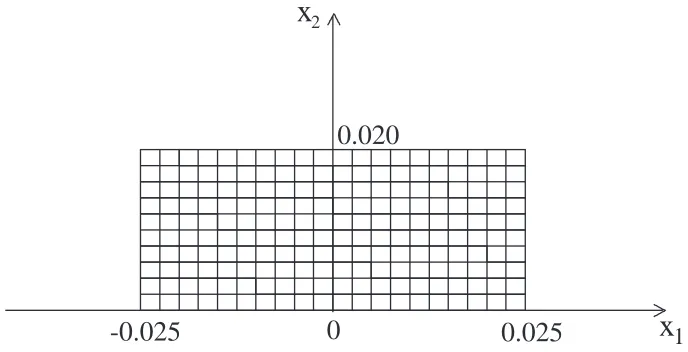
of nodes defined by{x˜i = (˜xi1, x˜i2)}Ni=1e were selected in the reference domain. Each element is preassigned as an axiprallel rectangle with nodes at the vertices (see e. g., [13]). The number of finite elements and nodes in the numerical experiments reported in the sequel were set asKe= 3000(= 50×60) andNe = 3061(= 51×61) respectively. Figure 10 depicts the decomposition of the conducting material treated here. The number of elements and nodes in the material were taken as 200(= 10×20) and 231(= 11×21), respectively. Integration in the element matricesKN(q) and the element vector fN(q) were computed numerically by a Gauss-Legendre formula.
For these test example computations, simulated data {zd} were generated by first solving the finite-Galerkin model (61) and (62). A series of random Gaussian noise were added to the numerical solutions, thereby producing simulated noisy data for the algo-rithm. The essential difficulties in (ASIDP)N come from the fact that real data are
heavily corrupted by observation noise and it often occurs that the corresponding model output data are far from those practical data. Tikhonov regularization is one possible technique for avoiding these serious difficulties in computational efforts. To this end, we adopt Tikhonov’s regularization techniques to our inverse algorithm. More precisely, a regularization term is added to the cost functional (63) (see [14] for more details):
FηN(q) =FN(q) + η 2
where
[Lc]i,j =
1 −1 0 · · · · 0 0 1 −1 0 · · · 0
..
. 0 . . . ... ... ..
. ... . .. ... 0 0 0 · · · 0 1 −1
∈ R(M−1)×M
In order to select the “optimal” parameter η, we used L-curve analysis (see [15, 16]). The outline of this approach in these experiments is summarized as follows:
[L-curve analysis] : Given η∈[0,∞), solve FηN(ˆq(η)) = min
q F N
η (q), (65)
for each fixed η∈[0,∞), collect the points z˜N(ˆq
η;ω)−zd(ω)
2
,Lcˆqη2 (66)
and plot the above points. Then the ”optimal” parameter η0 can be chosen as a point that lies in the ”corner” of the resulting curve.
Evaluation of the vector gradient of the cost function (65) is the computationally expensive part of our algorithm. This can be accomplished by using a co-state approach. For the numerical results reported in this paper, we used the gradient projection method ([17]) which is a particularly useful technique for optimization problems with linear inequality constraints such as those in (60). The iterative algorithm for finding ˆqN in this experiment
is the same as that in [5].
In our test examples, we considered corrosion shape identification for conducting mate-rial samples with corrosion-like damage (of varying corrosion shape) as depicted in Fig. 6. The parameter function (59) to be identified is a piecewise linear spline function. We denote the knot sequence for r by
−0.025 =τ0M < τ1M <· · · < τMM+1 = 0.025 and the unknown parameter vector qM ={qM
i }Mi=1 is then given by qiM =r(τiM) for i= 1,2,· · ·, M.
For the computational experiments, the dimensions of unknown parameter vector qwas taken as M = 19. The lower bound in (60) was chosen as β = 0.001. The initial guesses for the parameters were given by
qiM =h0(= 0.02) (i= 1,2,· · ·, M)
0 0.005
0.01 0.015 0.02 0.025
-0.02 -0.01 0 0.01 0.02
x [m]
x [m] Initial Guess
True function
1
2
Figure 11: True function and estimated function in Example 1 (noise free)
Example 1: In this test example, we deal with the shape recovery for the CFRP sam-ple with a symmetric type of corrosion as shown in Figure 11. The values of the true parameters were given by
q119=q1919 = 0.0195 q219 =q1819= 0.0190 q319=q1719= 0.0185 q419=q1916 = 0.0180 q519=q1915 = 0.0175 q619 =q1419= 0.0170 q719=q1319= 0.0165 q819=q1912 = 0.0160
q199 =q1119= 0.0155 q1019= 0.0150.
The estimated parameters are listed in Table 1 using data that is with noise free, and with data containing 5%, 10%,and 20% relative noise. Fig. 12 depicts the L-curve for 5% noise case and ηo = 5.0×10⁻¹² was chosen as the optimal regularization parameter in (64). The successful results is demonstrated in Fig. 13 that depicts the estimated shape using Tikhonov regularization with the optimal selection ηo and without the regularization.
Example 2: In this example, we deal with a somewhat more difficult case as compared to that of Example-1. The type of damage was given by a non-symmetric function as illustrated in Figure 14. We set the same dimension for the unknown parameter vector as in Example 1 and we also used the same knot sequence. The values of the true parameters were preassigned in
q119= 0.0195 q219= 0.0190 q319= 0.0185 q194 = 0.0180 q519 = 0.0175