A CHANGING PEDAGOGY IN LEARNING AT ASML
Ad van Tilburg
Master’s thesis of the Educational Science and
Technology program at the Faculty of Behavioural
Sciences at the University of Twente
2007
Supervisors:
Dr. G.J. Gervedink Nijhuis Dr. A. Strijker
A.Morris, ASML
TABLE OF CONTENTS
LIST OF FIGURES ... III LIST OF TABLES...IV PREFACE AND ACKNOWLEDGEMENTS... V
1 INTRODUCTION AND RESEARCH QUESTIONS ... 1
1.1 REASONS FOR THIS PROJECT...1
1.2 PROBLEM STATEMENT AND RESEARCH QUESTIONS...2
1.3 GOALS AND OBJECTIVES OF THE PROJECT...3
1.3.1 The company ASML ...3
1.3.2 The Training Department of ASML...3
1.3.3 Way of working at the Training Department ...5
1.3.4 The Research questions discussed ...5
1.4 PRODUCT...9
1.5 METHODS...9
1.6 STRUCTURE OF THE THESIS...10
2 BLENDED LEARNING ...11
2.1 RELATION TRAINING WITHIN EDUCATION...11
2.2 TRADITIONAL DESIGN MODELS...12
2.3 INTRODUCTION TO INSTRUCTIONAL DESIGN REGULAR TRAINING...16
Four Design paradigms ...16
2.3.1 The instrumental paradigm...16
2.3.2 The communicative paradigm...16
2.3.3 The pragmatic paradigm...17
2.3.4 Artistic paradigm...18
2.4 DESIGN MODEL FOR EDUCATIONAL MEDIA...18
Curriculum design...19
2.5 TWO PEDAGOGICAL MODELS:ACQUISITION AND PARTICIPATION MODEL...20
2.5.1 Participatory Design (PD)...21
2.6 INVENTORY OF LEARNING SCENARIOS...23
2.6.1 The four scenarios and ASML ...24
2.7 COURSE MANAGEMENT SYSTEM WITHIN BLENDED LEARNING...26
2.7.1 The course management system and stretching the mold ...26
2.7.2 The course management system used within ASML training: Moodle...28
2.8 CONCLUDING REMARKS ON THE LITERATURE REVIEW OF BLENDED LEARNING...30
3 CONTEXT REVIEW OF COURSE DESIGN AT ASML TRAINING... 31
3.1 INTRODUCTION TO COURSE DESIGN WITHIN ASML ...31
3.2 THE TRAINING DEPARTMENT...32
3.2.1 The function of the course developers...32
3.2.2 The function of the trainer...33
3.2.3 Way of working course developers...34
3.3 E-LEARNING AT THE TRAINING DEPARTMENT...38
3.3.1 E-Learning and the training department ...38
3.4 MULTIMEDIA DEVELOPMENT PROCESS WITHIN THE TRAINING DEPARTMENT OF ASML .40 3.5 CONTEXT ANALYSIS...44
3.5.1 The group interview ...44
3.5.2 The steps of the group interview...44
3.6 CONCLUDING CONTEXT REVIEW OF COURSE DESIGN AT ASML TRAINING...47
4 DESIGN OF A STRUCTURED WAY OF WORKING “TEMPLATE”... 48
4.1 GROUP-BASED LEARNING...48
4.3 DESIGN CONSIDERATIONS FOR THE TEMPLATES...49
4.4 THE PHASES WITHIN THE TEMPLATE...50
4.5 TEMPLATE IMPLEMENTED IN THE COURSE MANAGEMENT SYSTEM MOODLE...55
4.6 CONCLUSION...59
5 TEMPLATE EVALUATION AND CONCLUSIONS ... 60
5.1 METHOD AND PROCEDURE...61
5.1.1 Method...61
5.1.2 Procedure...61
5.2 THE INSTRUMENTS FOR THE EVALUATION...62
5.3 THE DATA OF THE EVALUATION...63
5.3.1 The data of the questionnaire...63
5.3.2 Open questions and Verbal feedback from trainers and course developers ...65
5.4 SUMMARY OF THE MAIN FINDINGS...66
5.5 CONCLUSION OF THE EVALUATION...67
6 CONCLUSIONS RECOMMENDATIONS AND REFLECTION ... 68
6.1 CONCLUSIONS AND RELATION WITH THE RESEARCH QUESTIONS...68
6.1.1 The Changing role of the developer ...71
6.1.2 The Changing role of the trainer ...72
6.1.3 Conclusions overall research question...73
6.2 RECOMMENDATIONS FOR THE TRAINING DEPARTMENT...74
6.3 PERSONAL REFLECTION...75
REFERENCES ... 76
SUMMARY ... 81
SAMENVATTING ... 83
Appendices Appendix 1 Decision aspects table to help to choose your CMS ... 85
Appendix 2 Raised issues... 88
Appendix 3 Empty review list... 90
Appendix 4 Filled Issue list sorted in order of importance... 92
Appendix 5 Course development process... 94
Appendix 6 Multimedia development process ... 95
Appendix 7 All the phases... 96
List of Figures
Figure 1. From all-classroom to a learning architecture (Rosenberg, 2001)... 4
Figure 2. Scenarios in corporate learning (Collis, 2003)... 7
Figure 3. Relationships among terms associated with instruction. ... 11
Figure 4. The Dick and Carey Model (1985)... 13
Figure 5. The Addie model... 14
Figure 6. the OKT-model (Plomp, 1982)... 14
Figure 7. The ISD process (Clark, 1995) ... 15
Figure 8. Prototypingmodel for design (Tripp & Bichelmeyer, 1990, p. 136)... 19
Figure 9. Participation Process (Sfard, 1998). ... 23
Figure 10. Evolution toward the new economy in higher education (Roosendaal, cited in Collis & Gommer, 2001)... 25
Figure 11. Training department communication... 31
Figure 12. Training department ... 32
Figure 13. Course development process ... 36
Figure 14. The strategic foundation for E-Learning depicts all the critical components for successful e-learning initiatives (Rosenberg, 2001)... 39
Figure 15. Short course development process. ... 40
Figure 16. Multimedia development model partly based on the OKT model (Verhagen, Kuiper, & Plomp, 1999)... 41
Figure 17. Overview diagram all issues ... 45
Figure 18. The course development team... 47
Figure 19. AP model... 49
Figure 20. The course development phases for the training department implemented within the AP model... 50
Figure 21. Phase 0 Course design ASML... 51
Figure 22. Phase 1 course design ASML... 51
Figure 23. Phase 2 course design ASML... 52
Figure 24. Phase 3 course design ASML... 52
Figure 25. Phase 4 course design ASML... 53
Figure 26. Phase 5 course design ASML... 53
Figure 27. Phase 6 course design ASML... 53
Figure 28. Phase 7 course design ASML... 54
Figure 29. Implement materials into CMS... 54
Figure 30. Phase 9 course design ASML... 54
Figure 31. Start screen template for course design ... 55
Figure 32. Trainers and/or course developers view ... 56
Figure 33. Example of one of the phases (Phases 1) within the CMS Moodle... 56
Figure 34. Course developer view phase 4-9... 57
Figure 35. Logged in as a trainer... 57
Figure 36. Trainers editing view of the course design template ... 58
Figure 37. Research approach (Reeves, 2000, p. 25)... 60
Figure 38. Five categories within the CMS Moodle... 62
List of Tables
Table 1. Four scenario’s for flexible learning (Collis & Gommer, 2000)... 7
Table 2.Variables, actors and assumptions... 8
Table 3. Core design activities in instructional design models (Andrews & Goodson, 1980) ... 13
Table 4. Two metaphors for learning (adapted from Sfard, 1998, pp. 6-7) ... 20
Table 5.Scenarios for flexible learning (Collis & Gommer, 2001)... 24
Table 6. Characteristics of course-management systems. (De Boer, 2002)... 27
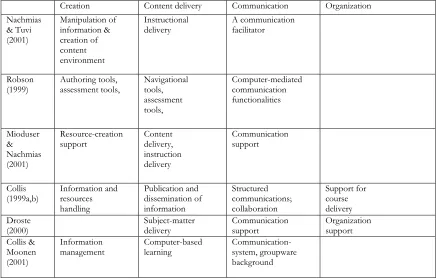
Table 7. WWW-based applications: Extending flexibility within pedagogical categories (Collis, 1999)... 29
Table 8. Essential Functions of the course developer at ASML training: ... 32
Table 9. Table Essential Functions of the trainer at ASML training... 33
Table 10. Functions overview ASML training department... 34
Table 11. Authorities and responsibilities course development ... 37
Table 12. Authorities and responsibilities within multimedia development ... 43
Table 13. Top six issues... 45
Table 14. Category general questions ... 63
Table 15. Category Course development within ASML questions... 63
Table 16. Category Blended learning and learning scenarios ... 64
Table 17. Category support of the template... 64
Table 18. Category concept and terminology of the templates within the 9 phases ... 65
Preface and acknowledgements
After my study at the PTH in Eindhoven I thought that I had finished my long path of learning. (LTS, MTS, PTH). But in the year of the millennium I got the change to start with this study at the University of Twente “Toegepaste Onderwijskunde” supported by the company I work for ASML. Now seven school years and many kilometres of driving later I am writing my final thesis. The people who know me will understand the choice I made for the chosen ADDIE design model!
Every year I had my moments of thoughts but due to the major support at home and some special moments in June 2002 and October 2003 I continued with pleasure. The study took a little bit longer then planned but was definitely word it. Within the training department we talk about learning every day and this study helped me to think about it more. I hope that I can contribute to the “Changing pedagogy in learning within the training department”.
First of all I want to thank Alex who gave me the opportunity to do this study and my colleagues at the training department who supported me and showed interest. Within the University there were some teachers I want to mention who inspired and helped, thanks Allard, Petra, Koos, Wim, Irene and special thanks to Gerard who help me a lot with this thesis. I would like to say thank to my fellow students and Erik who helped me to enjoy my study time. Further thanks to all the others who supported me during my study.
Last but not least I would especially thank Gaby who always was there for me, supported me and gave me all the confidence I needed.
Ad van Tilburg
Eindhoven, Augustus 2007.
1.1
1
Introduction and research questions
“The illiterate of the 21st century will not be those who cannot read and write, but those who cannot learn, unlearn, and relearn”. Alvin Toffler
The title of this thesis “A changing pedagogy in learning” is related to the change which is ongoing at the training department of ASML. There are no two days the same and we learn different things every day so it should be with education. Training should adapt the changes in education to the time we live in. The training department of ASML is planning to implement a Course Management System (CMS). In the timeframe of this thesis is it not yet decided which CMS will be chosen. Due to the fact that Moodle, an open source learning environment is already in use by the training department of ASML for a project of assessment, this CMS is used as an example in this thesis. Section 1.1 explains in general the reason for this project; Section 1.2 describes the overall problem description and other related questions. The goals and objectives are discussed in Section 1.3. The product (the outcome) is explained in Section 1.4. How to get to this product, which methods to be used are discussed in Section 1.5, and Section 1.6 gives an overview of the chapters of this thesis.
Reasons for this project
A training department has two main functions: the first main function is to spread knowledge about the product the company is making to internal and external customers. ASML is making a machine used for the semiconductor industry. The knowledge about the machines, how they work and how to maintain them, needs to be trained to the engineers who directly work with the machine. These engineers are called trainees; see Section 1.3 for more details about the trainees.
The second main function is to create course materials that will be used during the training of the trainees. These course materials can be a combination of various materials, such as electronic (e-learning) files and of paper binders. The training department is one of the first direct contacts with the customer and is therefore a sort of business card for ASML to the customers. The training department should be a knowledge database for the company. The training department can be divided into two teams, one team to deliver the knowledge, the training delivery team, and a team which develops the course materials, the course development team. When the course developers have created new or updated course materials then the trainers have to learn these materials to be able to train the trainees this new information.
1.2 Problem statement and research questions
Given the reason for a project described in Section 1.1 the overall research question is:
“How can a training delivery team be involved from the start in the design process of new and updated course materials? What combination of different educational methods used by the course development team can support and stimulate the learning process? How can the latest information related to new or upgraded course materials be incorporated in new and existing products? How can trainers be utilized to better support the trainees (customers)? “
The problem was brought to attention during a department meeting. After that department meeting a meeting was held with the training manager for Europe to discuss the problems which were brought up during the meeting.
After discussions with the coach (University of Twente) and the training manager Europe of ASML the following design task was agreed. The project will focus on an overview of educational scenarios which will support development of course material. Templates will be designed which can be used in a course management system according to a learning scenario. Furthermore there will be a plan made on how to implement these renewed scenarios within the training department.
The preliminary investigation focuses on the context of the problem and what the internal and external needs for the training department are.
In order to help the course development team templates, will be designed to help them to structure the way of creating course materials. Within this structure, the involvement of the training delivery team should be taken into account. These templates should be designed according to a pedagogic approach. Therefore investigations need to take place about the different pedagogic approaches and strategies in relation with a CMS and blended learning. To be able to design these templates and implementation of the new way of working some answers need to be given to the following questions:
1. What is Blended Learning?
2. What are design paradigms in a corporate context?
3. What different pedagogical models and instructional approaches are used in relation to a CMS? 4. Which learning scenarios are used within a corporate training department such as ASML?
Implementing this new way of working within the training department will also be a change of learning within the department. Therefore, there is a need to investigate which of the four scenarios for educational delivery (Collis and Moonen, 2001, p. 199) will be applicable for the training department; back to the Basics, the Global Campus, Stretching the Mold, or the New Economy?
In principle every learning organisation is able to be divided into one of the four scenarios from (Collis and Moonen, 2001), looking at the organization at the moment and how they would like to be in the future. A learning organization needs to be busy with modernization to motivate the learners and to prepare them for their daily work.
Therefore, in every organisation there will be a movement taking place in the way of learning. To be able to find out which scenario will be suitable for the training department after implementation of the templates the following questions also need to be discussed and answered.
5. What are task based learning templates?
6. Which templates can be used for an LCMS to support a certain scenario?
7. What will be the role of the trainer with the new learning scenario supported by use of templates?
8. What will be the role of the course developer with the new learning scenario supported by use of templates?
And last but not least it is very important that the learning scenario and the templates, which will be used to support the course developers and trainers, will be implemented according to a plan.
1.3 Goals and objectives of the project
Out of the overall research question from Section 1.2 there are some questions derived. These questions will be discussed in this Section. Each question will be explained and what is meant by the question. First a general more in detailed explanation of ASML and the training department will be given.
1.3.1 The company ASML
ASML is a world leader in the manufacture of advanced technology systems for the semiconductor industry. The organization offers an integrated portfolio for manufacturing complex integrated circuits (also called ICs or chips). ASML designs, develops, integrates, markets and services advanced systems used by customers – the major global semiconductor manufacturers – to create chips that power a wide array of electronic, communications and information technology products.
With every generation of new Personal Computers, the complexity of producing integrated circuits with more functionality increases. Semiconductor manufacturers need partners that provide technology and complete process solutions. ASML is committed to provide customers with leading edge technology that is production-ready at the earliest possible date. ASML technology is supported by process solutions, enabling customers to gain and sustain a competitive edge in the marketplace.
ASML’s corporate headquarter is in Veldhoven, the Netherlands. Manufacturing sites and research and development facilities are located in Connecticut, California and the Netherlands. Technology development centers and training facilities are located in Japan, Korea, the Netherlands, Taiwan and the United States. Additionally, ASML provides optimal service to its customers via over 50 sales and service organizations in 16 countries. Founded in the Netherlands in 1984, the company is publicly traded on Euro Next Amsterdam and NASDAQ under the symbol ASML.
The vision of the Worldwide Training organization is to be the number 1 provider of learning solutions in the semi-conductor industry, in support of the ASML mission and Customer Supportstrategic intent. The IC industry requires increasingly sophisticated technology and an infrastructure required to support this technology. To support advancing technology, ASML offers a variety of training courses either on-site or delivered in state-of-the-art facilities. Training programs focus on providing customers with the knowledge and skills required to optimize ASML system performance and utilization.
The training programs provide a clear route to increased productivity. Organized courses focus primarily on hands-on experience. Students gain the skills and knowledge needed to operate and maintain ASML systems. Class sizes are limited to ensure that students receive significant amounts of equipment exposure. ASML has made a significant investment in new training facilities worldwide. ASML has some of its newest production systems currently dedicated for training.
New courses are developed and given in main headquarters Europe. A major drive within the company is to improve the knowledge in the field, to cut costs and to improve customer satisfaction. Training is the major way to improve the knowledge in the field. This is focused two-ways. One focus is on first line Field Service and the other focus is on 2nd line Competence Development. The 1st line Field Service Engineer requires extensive travel to local training centers. This is specifically the case for new-hires. The 2nd line engineers need to travel to Main headquarters Europe for Competence Development.
1.3.2 The Training Department of ASML
courses are delivered onsite (at customer sites) but most of them are delivered at the training centers in Veldhoven and in Tempe. To be able to support the training organization better in the future a CMS will be implemented.
The training department of ASML is divided into two teams, a course development team and a training delivery team. The course development team is responsible for creating the materials which will be used by the delivery team to deliver the training to internal and external trainees (customers). The new courses are developed in Main headquarters Europe by the course development team. The courses are 80% focused on practice based on performing of procedures on the training machines.
The trainings are divided into four levels. Level 1 (Introduction), Level2 (periodic maintenance), Level 3 (maintenance and adjustment) and Level 4 (diagnostics). The mean part of all theory lessons will still be delivered according to the original all-classroom schedule (Figure 1). More and more, the training department will move to the Final architecture schedule.
In the all-classroom model a trainer is delivering training in front of a group of trainees in a classroom or at the machine. The basic principle is that knowledge will be delivered by a trainer in front of a group of trainees. The final architecture is a combination of different transfers of knowledge (Figure 1). Firstly there will always be a knowledge transfer by a trainer in front of a class. Then there are different options, such as more classroom training, on the job learning or a mentoring program. The main difference between the all classroom schedule and the final architecture is the possible contribution of the trainee, because the trainee can choose the way of learning which suits him/her best.
Figure 1. From all-classroom to a learning architecture (Rosenberg, 2001).
At the moment the training department is missing a pedagogy strategy in learning or a learning path for training updates. There is limited time for the development team to cross train the delivery team and the delivery team needs to be up to date at all times about all new subjects or upcoming new updates to the course materials. A clear process is missing how to maintain and update all course materials including cross training the delivery team.
1.3.3 Way of working at the Training Department
A training department should be working according to a curriculum. In this curriculum there should be time planned to update trainers with all the new information that is developed or about the upcoming new materials. So a training department needs a process to modernize and develop new course materials and update the trainers during the whole process of development. To be able to set up such a curriculum it’s important to know what the way of working of the training department currently. Habermas (1984) distinguishes three ways of working. Instrumental, when they are directed at efficient interventions in a state of affairs in the world (e.g. through labor),
Strategic, when they guide attempts to successfully influence the decisions of other actors (e.g. in relations of domination).
Communicative rationality underlies action that is aimed at mutual understanding, conceived as a process of reaching agreement between speaking subjects to harmonize their interpretations of the world. There is some distinction between the way of working that is oriented on success and a way of working that is focused on getting consistent. Instrumental and strategic are both directed to success. A communicative way of working focuses on consistency?
Within ASML an Instrumental approach of working is used within the training department.
1.3.4 The Research questions discussed
In Section 1.2 the research questions are mentioned, in this Section the research questions will be explained more in detail and it will be explained how the questions will be investigated and where these answers from the investigation will be given in this thesis.
1. What is Blended Learning?
2. What are design paradigms in a corporate context?
3. What different pedagogical models and instructional approach are available in relation to a CMS? 4. Which learning scenarios are used within a Training Department such as ASML?
5. What are task based learning templates?
6. Which templates can be used for a CMS to support a certain scenario?
7. What will be the role of the trainer with the new learning scenario supported by use of templates?
8. What will be the role of the course developer with the new learning scenario supported by use of templates? 9. How can the learning scenario be implemented within the training department?
1. What is Blended Learning?
models that is used most is (ID) (Smith and Ragan, 1999) “Instructional Designis the systematic process of translating general principles of learning and instruction into plans for instructional materials and learning”. (p. 2)
Many definitions exist for instructional design - all of them are an expression of underlying philosophies and view points of what is involved in the learning process. Distinguishing the underlying philosophy of learning (in terms of: How does learning occur? What factors influence learning? What is the role of memory? How does transfer occur? What types of learning are best explained by the theory? Can help trainers and course developers select the design model most congruent with their education philosophies. Different ID models are: Addie, OKT, Dick and Carey model, Robert Gagne’s ID model, Minimalism, Rapid Prototyping. But what is blended learning? Blended learning is a combination of different educational methods, which will support and stimulate a learning process. Combinations of different educational methods are combinations of remote training, classroom training and or E-learning. A different way of saying is that blended learning this is combining the advantages of distance learning with classroom and E-learning.
2. What are design paradigms in a corporate context?
This question will be answered during the literature investigation in Chapter 2. We will investigate which of the four design paradigms (Visscher-Voerman, 1999) the course developers within the training department use.
• Instrumental paradigm: planning-by-objectives.
• Communicative paradigm: communication to reach consensus.
• Pragmatic paradigm: interactive and repeated tryout and revision.
• Artistic paradigm: creation of products based on connoisseurship
What will be the difference in use in combination with a CMS? Different Educational approaches will be investigated and compared such as: Problem based Learning, project based learning, task oriented learning, experimental based learning, collaborative based learning and skills based learning. Which approach is used by the training department and is this approach useful in combination with a CMS? The support for the trainers and course developers with using a CMS and new educational approaches related to more flexibility in education with use of different learning methods. To underline this 4-E model of Collis and Moonen (2001) will be used.
3. What different pedagogical models and instructional approach are there in relation with a CMS? 4. Which learning scenarios are used within a Training Department such as ASML?
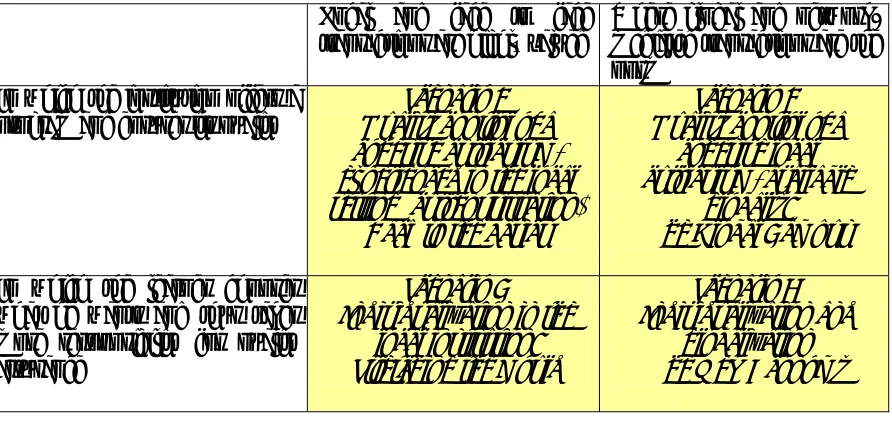
Table 1. Four scenario’s for flexible learning (Collis & Gommer, 2000) Local and face to face
transactions are highly valued
Where global and network-mediated transactions are the
norm In which the institution
offers a program and
ensures its quality A Back to the basics B The global Campus In which the learner
chooses what he wants and thus takes more responsibility for quality assurance
C Stretching the mold D The new economy
For a corporate learning organization these scenarios differ (Figure 2).
In the corporate learning setting, different dimensions have emerged to represent change tendencies. One dimension still relates to local versus distance, but in a different way than universities. Local is seen as leaving the workplace and coming to a classroom course in a corporate learning center for some number of days. Global is replaced by "workplace": staying on the job while learning. The second dimension relates to the mode of learning in terms of individual versus group or community. Individual learning is often associated with the "any time, any where" slogan while a group or community orientation is less about speed of learning than it is about learning with and from others. These two dimensions were seen in an analysis of courses offered by the Shell EP Learning Centre in The Netherlands (Hendriks, 2003). Figure 2 shows these four scenarios.
Figure 2. Scenarios in corporate learning (Collis, 2003)
During the preliminary investigation we will discuss which scenario is valid at this moment at the training department of ASML and which scenario will possibly be used in the future. The different possibilities need to be examined for the four scenarios and which scenario will be most suitable for the training department, taking into account the implementation of templates within a LMS (Learning Management System) and the pedagogic approach. To be able to answer this question a literature study will be held.
5. What are task-based learning templates?
literature investigation into task oriented templates according to the minimalism approach (Carroll ,1998)? During this literature investigation no other actors are involved such that the question to which this should be asked is not imported.
6. Which templates can be used for a CMS to support a certain scenario?
To be able to answer this question the results of questions 3 & 4 have to be taken into account. Further we need to investigate which template is the most suitable within the chosen scenario of the training department. Possible options for the chosen template will be investigated and discussed with all the people concerned. Points of issues will be the result, which will be taken into account with the design model which will be used, for example, ADDIE model (Rosset, 1987; Wedman & Tessmer, 1993). The introduction of the templates will give a new way of working within the training department.
7. What will be the role of the trainer with the new learning scenario supported by use of templates? 8. What will be the role of the course developer with the new learning scenario supported by use of
templates?
Within every change the emphasis on actors will be different (Table 2.Variables, actors and assumptions give a good overview of these changes, the changes per actor and which assumptions are playing an important role. The table is a junction of actors from Fisser (2001) and the changes from Boonstra (DU project team 2007) and the assumptions for managers defined by (Caluwe & Vermaak, 2002). These categories of actors are important for the success of the changes. Every way of changes has its own important key figures. If all actors are included in a positive way in the process the chance of success will be bigger.
Table 2. Variables, actors and assumptions.
Things / people will change if …..
Blue change - Board - Monitors the taken steps and monitor these,
and if needed correct these on time.
- everything is stabilized and kept under
control
- point out the short comes and make them
aware of these,
- Be able to motivate them to show new
things
- To be able to create a collective learning
situation White
change -- Board Middle management - Higher management - Faculty
- Students - Support - external
- Take care of the will and wish of the natural
way of the human self, add meaning to it
- The energy will come from the people them
self
- Dynamic / complexity will see, - To remove blockades,
1.4
1.5
9. How can the learning scenario be implemented within the Training Department?
The implementation of the change is to see in the white change Table 2 it’s a fundamental change throughthe whole organization which ask a lot of the people involved and the end destination is not clear. The people have to invest in how it should be and what need to be reached. Blockades need to be removed and the use of symbols and rituals will be playing an important role.There will be a new way of looking and new competencies need to be learned. This will be investigated in detail through the whole process of preliminary investigation, design, implementation and evaluation according through Plomp, Feteris, Pieters and Tomic (1992).
Product
The project will focus on an inventory of learning scenarios that can support blended learning, templates that can be used in the course management system that support a certain learning scenario, and an implementation plan how the new learning scenario can be implemented.
Methods
The goal of this thesis is to emphasise the change in education for the training department and design templates to support the training department and the new learning scenario. Additional we will check how these templates can be implemented into the way of working of the course development team and training delivery team.
A changing pedagogy in learning at ASML will mean that the training department also has to change to a different scenario. This change from scenario is theoretically very easy but in practice there are many aspects involved. The different learning scenarios need to be identified and there needs to be an investigation which scenario is most applicable for the training department. Interviews and or questionnaires will be done with, the trainers, developers, training delivery and course delivery team managers and the world wide training manager. Next to these learning scenarios need to be identified with different pedagogical approaches in relation to a CMS. A pedagogical model relates to the abstract concepts about the learning- and teaching process that underlie an instructional approach. Sfard (1998) identifies two basic types of pedagogical models, the Acquisition Model and the Participation Model. The general purposes of this research is to identify types of flexibility involving Web-supported learning in higher education and how Web-based course management systems can support course developer and trainer choices with respect to flexibility. It is important to support the need that trainers have for the use of course management systems and new pedagogies that relate to more-flexible learning and teaching models. The 4-E model from Collis and Moonen (2001) will be used to express this integration.
To support the course developers and the trainer’s, templates will be created. A template is: a document or file having a preset format, used as a starting point for a particular application so that the format does not have to be recreated each time it is used. How these templates will be designed and which conceptual model will be used will be investigated during the literature study of this thesis. The templates will be designed at the start with use of the general model Plomp et al. (1992). Further the minimalism Carroll (1998) approach will be used because the templates will be used as a sort of procedure. To bring the course developers and the trainers closer to work with each other the Participatory design (Slocum, 2003) will be used.
1.6
Out of the interviews, issues will come up which will then be implemented. After the templates are implemented an evaluation needs to take place according to Plomp et al. (1992) about the use of the templates.
Structure of the thesis
2.1
2
Blended Learning
Blended learning is a combination of different educational methods, which will support and stimulate a learning process. Combinations of different educational methods are combinations of remote training, classroom training and or E-learning. In other words, blended learning is combining the advantages of distance learning with classroom and E-learning. According to e-learning consultant Brandon Hall, “The online experience provides tools that add value to all the traditional modes, from classroom experiences to learning from books. It’s about combining media and technologies for maximum impact.”(http://www.brandon-hall.com/) Blending, such as the mix of face-to-face and online learning have become particularly prominent (Delahoussaye & Zemke, 2001). Through these combinations blended learning has all the ingredients for the knowledge routes in 2006 like individual learning plans and social contacts with the help of the digital learning environment. Before explaining what blended learning is, we should know the relationship between educations, instruction, teaching and training. This will be discussed in Section 2.1. In Section 2.2 gives an explanation of different instructional design methods and how these “classic” methods fit into a new way of learning “E-learning”. The four design paradigms on how the educational design and development processes might be conducted are discussed in Section 2.3 from which the choice for the discussed instructional design methods is made. Section 2.4 explains design models for educational media, Section 2.5 two pedagogical models the Acquisition and the Participation models are discussed.
The training department wants to focus more and more on E-learning. This means a move of scenario which will be discussed in Section 2.6.
Blended learning’s claims to sustained behavioral change rest solidly on an instructional design model that acknowledges the learning stages, provides appropriate instructional strategies for those stages, and reinforces skills development through practice, feedback, and testing.
Blended learning represents an effective and proven learning model. It capitalizes on the strengths and benefits of technology-based training as well as classic self-study, classroom, and on-the-job instruction in a “mix & match” format that is tailored to the specific training needs of each organization.
Relation training within education
According to Rosenberg (2001) training is the “default” approach to facilitate and improve performance and instruction is the specific process that makes training work.
According to Smith and Ragan (1999), education is a broad concept that describes all experiences in which people learn. Many of these experiences are unplanned, incidental, and informal...in other words, unintentional, which is what distinguishes education from instruction. Instruction is a part of education because all instruction consists of experiences leading to learning (Figure 3). By contrast, not all education is instruction since many experiences that lead to learning are not specifically developed and implemented to ensure attainment of particular learning goals.
Figure 3. Relationships among terms associated with instruction. Education
Instruction
Training
2.2
In Figure 3 the concepts can be described as following:
Education: All experiences in which people learn (Smith & Ragan, 1999).
“Instruction is the intentional facilitation of learning toward identified learning goals” Smith and Ragan (1999) states instruction is the deliberate arrangement of learning conditions to promote the attainment of some intended goal (learning outcome). Instruction can be used distinctly from related terms such as education, training, and teaching. Instruction includes all learning experiences in which the instructional support is carried out by teaching or other forms of mediation.
Training is the term to refer to those instructional experiences that are focused on individuals acquiring very specific knowledge, skills, or abilities that they will normally apply almost immediately. The immediacy of application is what distinguishes training. Training often refers to the learning experiences directed toward preparing learners with specific on-the-job skills, most commonly in settings such as business, military, and government. Not all instruction can be considered training (Smith & Ragan, 1999).
Teaching and instruction are the most interchangeable terms. Smith and Ragan (1999) define teaching to refer to those learning experiences that are facilitated by a human being (not video, TV, textbook, or computer based program), a real live teacher. Instruction however, includes all learning experiences in which the instructional support is carried out by teaching or other forms of mediation. In some cases, teaching is considered instruction, and in others it will be more like a general education experience, but without the focus that typifies instruction.
Approximately 90 % of the regular training within ASML is still delivered as classroom training. Computer based training (CBT) was introduced a few years ago for the introduction course. Then remote training was introduced to deliver small portions of theory lessons. At the moment classroom training is given with some support of simulation programs during the training. Blended learning is what is going on at this moment.
Traditional design models
The most widely used design model / methodology for developing new training programs is called Instructional Systems Design (ISD) or just Instructional Design (ID). This model provides a step-by-step system for the evaluation of trainee’s needs, the design and development of training materials, and the evaluation of the effectiveness of the training intervention. Smith & Ragan (1999) “Instructional Design is the systematic process of translating general principles of learning and instruction into plans for instructional materials and learning”.
Figure 4. The Dick and Carey Model (1985)
Several authors have reviewed a number of instructional design models in order to increase understanding of design activities. The review provided by Andrews and Goodson (1980) clearly shows that instructional design models focus upon technical-professional activities. They reviewed 40 instructional design models, and found that these models share a core of 14 design activities, which are summarized in Table 3.
Table 3. Core design activities in instructional design models (Andrews & Goodson, 1980)
1 Formulating of broad goals and detailed sub goals stated in observable terms 2 Development of pre-test and post-test matching goals and sub goals
3 Analysis of goals and sub goals for types of skills / learning required 4 Sequencing of goals and sub goals to facilitate learning
5 Characterization of learner population
6 Formulation of instructional strategy to match subject matter and learner requirements 7 Selection of media to implement strategies
8 Development of courseware based on strategies
9 Empirical try-out of courseware with learner population, diagnosis of learning and courseware failures, and revision of courseware based on diagnosis
10 Development of materials and procedures for installing, maintaining, periodically repairing the instructional program
11 Assessment of need, problem identification, occupational analysis, competence, or training
12 Consideration of alternative solutions to instruction
13 Formulation of system and environment descriptions and identification of constrains 14 Costing instructional programs
phases do not end once the training program is implemented. The five phases work like a loop. They are continually repeated on a regular basis to see if further improvements can be made (Figure 5).
Figure 5. The Addie model
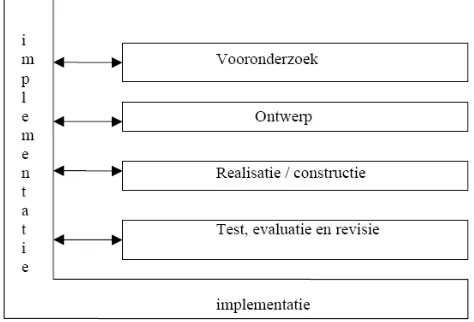
During analysis, the designer develops a clear understanding of the "gaps" between the desired outcomes or behaviours, and the audience's existing knowledge and skills. The design phase documents specific learning objectives, assessment instruments, exercises, and content. The actual creation of learning materials is completed in the development phase. During implementation, these materials are delivered or distributed to the student group. After delivery, the effectiveness of the training materials is evaluated. Most of the instructional design models start from the assumption that instruction or training will be the appropriate solution to the problem. The OKT-model (Plomp, 1982) has not been designed specifically for the field of instructional design but it is also a model with ADDIE phases. The difference with the instructional ADDIE-models is that the OKT-model shows the evaluation phase before the implementation phase, and that the implementation phase starts at the analysis phase, which implies that designers should think about and anticipate the implementation from the beginning and during the whole process (Figure 6). Plomps OKT model (1982) shows an emphasis on implementation activities, the designers need to start thinking about the implementation conditions at the beginning of the design process.
Figure 6. the OKT-model (Plomp, 1982)
modules, which can be tested with the student audience, and then revised based on their feedback. The systematic approach to development has many advantages when it comes to the creation of technology-based training. To create engaging metaphors or themes, sub matter experts and course developers work together in a process that validates the creative approach with trainees early in the development cycle. Despite these advantages, there are practical challenges with a purely systematic design approach in the management of resources. In most cases, training programs must be developed under a fixed and often limited budget and schedule.
When closely examined, good ISD is more engineering than art. Its important benefits come from well documented procedures, a differentiated staff team development approach, separation of instructional content and strategy, and the continuing evolution of a prescriptive, analytical, research-based model. In order for teams of developers to work efficiently and effectively together, procedures must be well documented at all levels of the ISD process (Figure 7).
One prominent Web source is Big Dog’s ISD Page (Clark, 1995). Clark’s treatment is similar to many other Web sources: he provides a visual model incorporating the ADDIE terms, but refers to it as “the ISD process” Figure 7.
Documented procedures allow for peer review, process control, and the possibility for improving practice over time. Perhaps the greatest strength of the ISD process is the evolutionary nature of the prescriptive, research-based model itself. While the practice of ISD still retains the strengths of the empirical evaluation and revision cycles, to the extent research and experience permit, it is prescriptive. That is, rather than depending extensively on the test-revision cycle to generate effective instruction in an iterative manner, every attempt is made to incorporate research findings and past experience into the detailed procedures and supporting ISD documentation to ensure that the instruction developed comes as close to the mark as possible the first time.
Figure 7. The ISD process (Clark, 1995)
2.3 Introduction to Instructional Design regular training
This Section describes the four design paradigms related to the different design models described in Section 2.1. To be able to choose a design model to work with, it is important to know what design model and paradigm they use at the moment.
Four Design paradigms
Visscher-Voerman and her colleagues have identified four different perspectives on educational design and development which they have labeled instrumental, communicative, pragmatic and artistic (Visscher-Voerman, 1999). In this Section, these four design paradigms are distinguished.
• Instrumental paradigm: planning-by-objectives;
• Communicative paradigm: communication to reach consensus; • Pragmatic paradigm: interactive and repeated tryout and revision; • Artistic paradigm: creation of products based on connoisseurship.
2.3.1 The instrumental paradigm
The instrumental model has as its central activity “planning by objectives. This means that in the beginning of the process, (often extensive) time is devoted to exploring and formulating the intended outcomes of the project, resulting in concrete goals and objectives. Thus, problem and needs analysis is done at an early stage of the design process. Next, the means are determined that are necessary to reach these concrete goals and objectives. Because of its focus on ends and means, the rationality underlying this model can be called instrumental. Within ASML most development activities are based on this way of working, first creating an objective then plan the design activities / goals.
Although designers with an instrumental rationality place great emphasis on the analysis of goals and means, the specific activities they employ can differ in scope and time. Depending on the specific project, these activities can vary, for example, from extensive interviews and observations with potential learners and subject matter experts, to a short interview with the trainers. Having specified the goals, designers specify the means that will be used to reach the goals. This design phase results in a blueprint of the product to be made. The objectives that have been formulated at the beginning of the project serve as a reference throughout the entire design process. In the instrumental paradigm, logical reasoning and working systematically (from one phase to another) are considered essential elements to guarantee that the best solution is reached.
The emphasis in this paradigm is on instrumental or technical reasoning, which is proclaimed by both proponents and opponents of planning-by-objectives models. A large number of the design models rely on an instrumental rationality, such as instructional design models for example Dick and Carey (1985), Gagne, Briggs, and Wagner (1992), Gerlach and Ely (1980), Kemp, Morrison, and Ross (1994). The most known model is the one from Dick and Carey (1985) Figure 4. There are a lot of similarities within the different design models but the general structure underlying these models is a generic problem solving approach. Section 2.2 has explained some common instructional design models according to this approach.
2.3.2 The communicative paradigm
designers may analyze existing materials, observe real learning situations, or visualize their ideas into the new materials. Solution alternatives are considered carefully and communicated and articulated between stakeholders. Because of its focus on a shared consensus and on communication as a vehicle to get there, the rationality underlying this paradigm can be called communicative. Course designers should not only strive for internal, but also for external consistency Kessels (1993) argues that in order to reach external consistency, course designers should adopt a relational approach and conduct activities in the domain of interpersonal dynamics of decision-making on educational planning. In the relational approach, course designers should aim at gaining commitment.
The concept of communicative rationality was introduced by Habermas (1984), the most prominent current representative of critical theory. Habermas argues that whereas instrumental rationality might be useful to solve a technical problem, communicative rationality should be used when people are involved. For this communication to be just, everyone concerned should be able to participate in the process, with equal chances and rights. Communication therefore, has a strong legitimizing function, and speaks of 'critical rationality', rather than of 'communicative rationality' to highlight the relation to critical theory involvement, and support for implementation from the beginning of the process. This elaborates the concept of 'implementation starts at the preliminary analysis' (Plomp, 1982). Course designers should obtain the perceptions of all persons involved and integrate them in the product to be made. Frequent communication among team members and other stakeholders is essential to reach consensus as to what the problem is and how it should be solved. A consensus approach is not only seen as a mere strategic 'trick' to increase the chance on a successful implementation but as necessary for reaching intrinsic quality of the product. In the communicative paradigm, considerable attention is being paid to socio-professional activities in the design process. Establishing a shared frame of reference and reaching consensus among all those involved are important elements.
2.3.3 The pragmatic paradigm
In the pragmatic paradigm, both the practical environment in which the product will be implemented and its users are central to the design process. This is a typical paradigm for Prototyping approaches. The basic rationale is that validity, and especially practicality and effectiveness (Nieveen, 1997) can best be determined in a practical test with the users. According to these approaches, course designers can only be satisfied with what they make if it works and if it is useful. The multiple views of the users provide the primary judgment for assessing an educational product as valid, and especially practical and effective. Therefore, early in the design process, several prototypes or interim versions of the product are evaluated with users. Thus, designers quickly start to make a preliminary version of the eventual product. This preliminary version -a prototype- is evaluated formatively with the users either by discussing it (usually in the beginning of the project) or by trying it out (often later in the project). During these evaluations, the potential of the product becomes more concrete, helping the course designers to make better decisions about the specifications of the product. Since these highly iterative approaches plead to make a prototype early in the process, some authors refer to these processes as rapid prototyping (Rieber, 1994; Tripp & Bichelmeyer, 1990) (Figure 8).
Within this paradigm, the use of concrete prototypes is seen as an essential means for identifying the specifications of the product in interaction with course designer, sub matter expert and end users. Depending on user satisfaction and available time and finances, the process of design, evaluation, and revision is repeated several times.
2.4
2.3.4 Artistic paradigm
The basic idea underlying the artistic paradigm is that individuals construct their own reality. Course designers could be considered as artists choosing among an almost unlimited variety of ways of representing their view of reality (Marsh & Willis, 1995). Therefore, the rationality underlying this paradigm is called artistic, which has a basis in post-modernism.
Designers with an artistic rationality construct design problems and solutions in their own way. They conceptualize the situation into one they understand from their own professional background. Just like artists, designers make certain moves and immediately judge these moves. According to Schön (1983) course designers evaluate their moves in a threefold way. First, they judge how desirable the consequences of their moves are, based upon categories drawn from normative design domains. Second, they judge the extent to which their current moves conform to earlier moves, or violate the implications set up by earlier moves. Third, they estimate how much they appreciate the new problems or potentials the current move has created. Means and ends are framed interdependently in the problem situation. After a lead-time in which the idea for a product matures, course designers conceptualize this idea into a product. The course designers may test their own ideas by talking about them with others or by showing them and observing their reactions. The norms and values of the course designer play a decisive role in decision making about the product. Artistry is the basis for bringing a design into being.
Looking at the four paradigms we can say that the course developers at ASML are working closest to the instrumental paradigm. Before they start to develop course materials course objectives are created and a planning is made when materials need to be finished. The problem statement stated that the course developers do not or too with involve the trainers during the design of course materials. Therefore, it could be an option that the instrumental and the communicative paradigm together will be a solution to get a better way of working! But when you look at the explanation of the pragmatic way of working then this way of working will suit ASML training department best. Why? Due to the fact that the industry ASML is working in is changing so rapidly it’s almost impossible to finalize objectives and plan dead lines for course materials. The pragmatic way of working explained that course materials will be designed in combination with the users (you could say that the trainers are the users during the prototype creation).
rapid prototyping (Rieber, 1994; Tripp & Bichelmeyer, 1990) (Figure 8) is a design model that fits into this paradigm but to get more structure in the design process in combination with more interaction I would prefer to choose for the ADDIE model in combination with the pragmatic design to be used to design the templates and the new way of working within the department.
Design model for educational media
Bichelmeyer (1990) depicted standard instructional design activities in a model for prototyping, visualized in Figure 8 according to them, a prototyping approach starts with a restricted analysis; then a small part of the solution is constructed (design) and tested (research). Test results are analyzed, which generates input for new design activities. This cycle is repeated several times. In such prototyping models, as well, the traditional ADDIE-phases could be recognized. But, the phases are iterative and may overlap highly.
Time
Figure 8. Prototypingmodel for design (Tripp & Bichelmeyer, 1990, p. 136)
The last decade has also shown an increased use of ICT in performance support systems. Both designers and researchers have focused on how technology could support designer’s tasks, for example in the format of on-the-job training, job-aids, or communication and interaction tools. A tool which ASML is going to introduce next to the LCMS is a LMS (Learning Management System) which will be used as a skill tracking database.
Curriculum design
In the previous Sections some traditional and educational design models were discussed but a learning organization should also work according to a specific curriculum. One of the first systematic and rational approaches to curriculum design and development is Tyler’s ‘planning by objectives approach’ (1949). His work is often referred to as the Tyler-rationale, offering a logical ground for curriculum design. The Tyler-rationale addresses four basic questions:
• What educational purposes should the organization seek to attain?
• What educational experiences can be provided that is likely to attain these purposes? • How can these educational experiences be effectively organized?
• How can we determine whether these purposes are being attained?
2.5 Two Pedagogical models: Acquisition and Participation model
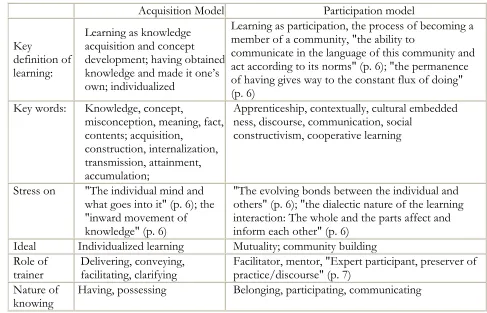
A pedagogical model relates to the abstract concepts about the learning- and teaching process that underly an instructional approach. Sfard (1998) identifies two basic types of pedagogical models, the Acquisition Model and the Participation Model. Table 4 summarizes Sfard`s interpretation of these two fundamental pedagogical models.
Table 4. Two metaphors for learning (adapted from Sfard, 1998, pp. 6-7)
Acquisition Model Participation model
Learning as participation, the process of becoming a member of a community, "the ability to
communicate in the language of this community and act according to its norms" (p. 6); "the permanence of having gives way to the constant flux of doing" (p. 6)
Stress on "The individual mind and what goes into it" (p. 6); the "inward movement of knowledge" (p. 6)
"The evolving bonds between the individual and others" (p. 6); "the dialectic nature of the learning interaction: The whole and the parts affect and inform each other" (p. 6)
Ideal Individualized learning Mutuality; community building Role of
trainer Delivering, conveying, facilitating, clarifying Facilitator, mentor, "Expert participant, preserver of practice/discourse" (p. 7) Nature of
knowing Having, possessing Belonging, participating, communicating
With the Acquisition Model, the focus of learning activities is on the acquisition of pre-specified knowledge and the development of pre-determined concepts. In contrast, with the Participation Model, the focus of learning activities is on becoming a member of a community of practice, learning from the community but also contributing to it. With the Acquisition Model, what is to be learned is generally pre-determined. The quality control of the content selection and presentation rests with the trainer. In contrast, with the Participation Model, the interactions to which the trainee contributes may serve to change the knowledge base of the community even as he or she participates in it. Learning is not so much a matter of understanding and applying, but rather degrees of insight, belonging and participating.
2.5.1 Participatory Design (PD)
Participatory Design (PD) is an approach to the assessment, design, and development of technological and organizational systems that places a premium on the active involvement of workplace practitioners (usually potential or current users of the system) in design and decision-making processes.
There are a number of positive aspects to PD. Participatory methods are often used in the natural environment of the user (e.g. a workplace) and thus offer high ecological validity and are heavily user centered. Co-designing with real users in realistic situations and environments helps improve the quality of feedback users provide. Frequent iteration between users and designers reduces misconceptions designers make (in part due to insufficient domain experience). Additionally, the social intent of PD to avoid deskilling of workers and create humane products is admirable. PD can help to improve the communication within the course developers and the trainers. Trainers need to be involved from the beginning during the development of new course materials whichs the communication between the two groups. The design of the templates will build on this PD design method.
However, some other PD research has revealed a number of potential issues in the application of participatory design methods. There are a range of studies and methods which many researchers agree are PD, however, what is or is not PD is still the subject of debate. Consequently, the issues discussed below do not apply to all PD studies and methods, but would certainly apply to some studies which claim to be PD.
Some issues and potential solutions are briefly discussed below. The issues will be discussed related to the problem description.
• Asking trainers to design objects themselves
This is different than trainers providing feedback or proposed variations on existing designs. Trainers are usually not trained designers. Consequently, they can produce bad designs or feel uncomfortable doing unfamiliar designs activities. A potential solution is to provide trainers with simple designs in primitive forms that invite variation and re-appropriation. A related problem is that if users have too much power to control designs, they may advocate poor designs, or designs that avoid automation.
• Expecting domain experts to be technology experts
New technologies can be extremely complex and their advantages and disadvantages often reveal themselves only after long usage in real situations. In most cases trainers won’t be able to accurately tell us what technology offerings they want. However, they can show what they need through other methods. It is possible to have people show us their needs through normal activities; and then present them with fictional devices that address those needs. Trainers have to make practical examples of how they want to tell or explain things, best is to invite the course designer to a practical training session.
• Asking trainers to predict theoretical usage
No one can accurately predict their future behavior, particularly in semi conductor industries and environments with unfamiliar technologies. Watching actual use of prototypes during trainings and getting feedback on them provides more realistic input from users.
• Asking trainers to start from scratch
• Expecting trainers to want to contribute
Participatory design came from trade union roots where organizations ensured workers understood the impact of technologies and were motivated to help construct new designs. In more contemporary design situations users may not be willing to devote time to help build technologies which other people profit from. A key challenge is determining how to interest or motivate trainers to help build a product they may use in the near future.
• Letting small numbers of users greatly impact design
Representative user feedback is useful, and being aware of non-representative issues affecting design is useful. However, thinking that extreme issues are commonplace when they are not can ruin a design. Using a small sample of trainers runs the risk of one user being an outlier with unrepresentative concerns. These trainers can provide useful challenges to the design, but they should not drive it. PD approaches that repeatedly use the same group of future users stand a greater chance of this occurring. It is possible to take the approach of using different (small) groups of users in an iterative fashion, to sample a more diverse set of opinions about proposed designs and avoid over-emphasizing outliers. This often requires PD methods to adjust to avoid long-term interactions with the same user group.
• Focusing on what trainers design instead of what they need
Potential users can easily draw an interface on a piece of foam or paper – that does not necessarily make it a workable design or help solve their real problems. Trainers can usefully review product ideas if they are presented in realistic situations, and in language the trainers can relate to. They can also use technologies in basic forms, which allow for generation of new design ideas based on observed usage. While user-generated solutions should not be ignored, focusing on work practices and observed problems provide a great deal of participatory design input in the form of high-quality requirements.
• Confusing design education with creating good designs
Iterative processes have a good dialogue between designers and users. This necessarily requires the user to learn a bit about design, and for the designer to learn a bit about the domain being designed for. Sometimes PD attempts to have users do the design work, and design ideas originating from users are presumed to be of high quality – because they originate from users. Some PD projects have even had explicit goals of educating users about design during the design process. While this could be appropriate in some education settings, in many professional software development projects there isn’t a goal of training users in neither design, nor money to waste on implementing poor design ideas. Professional designers are hired because they have expertise to create good designs, and with the input of users they can efficiently and accurately do so.
• Attempting to prescribe humane workplaces via designs
Since the beginning of PD, there has been a social goal of creating democratic workplaces where workers are able to design their own future tools and avoid dehumanizing technologies. Modern software development would do well to adopt this awareness of the social impact of the tools they create. However, it should be remembered that the technologies in use are only a small part of the picture of a humane workplace. Any technology can be harnessed into a system designed to subjugate workers. It is the larger system of workplaces policies and law which ultimately decide if workers are respected.
• Judging what is not participatory design
2.6
accepted fashion. Participation will happen in a variety of new ways, and much of it won’t fit the idealized conceptualizations of traditional PD. PD needs to embrace adaptation of how it is used if it is to be effective and increase in popularity.
The above Sections have identified potential weaknesses in PD. Many PD methods are already very good, but as they are applied in new environments they will need adaptation. So will the PD method be adapted into the templates in combination with the ADDIE phases?
A participatory approach advocates actively involving ‘the trainers’ in decision-making processes. In general, the processes can be seen as a three-step cycle of planning, implementation and evaluation, whereby a participatory approach may be used in some or all of these steps (Figure 9).
Participation in analyze
Participation in evaluation Participation in design
Participation in implementation
Figure 9. Participation Process (Sfard, 1998).
Inventory of learning scenarios
Difference between high school and training: With education you spent a day in the seminar or four years in college. Training, on the other hand, is measured by what you can do when you've completed it. Focus will be on your daily job activities. The Scenario’s for flexible learning (Collis & Gommer, 2001). The scenarios developed higher educations are visible in Table 5. But what is the definition on higher education? Does training also belong to higher education?
Table 5. Scenarios for flexible learning (Collis & Gommer, 2001)
Local and face to face
transactions are highly valued Where global and network-mediated transactions are the norm
In which the institution offers a
program and ensures its quality Quality control of a Scenario A cohesive curriculum, what he wants and thus takes more responsibility for quality
2.6.1 The four scenarios and ASML
A short description of the four scenarios and how they are related to the training department of ASML will be discussed.
Scenario A: Back to basics
Trainees are visiting the training centre. Training will be given in the classical way, this means face to face contact between trainer and trainee and between themselves. The study program is defined by the training department and prepared by the trainer. For the internal customers (ASML employees) the internal network (intranet) is used to support the training. Communication, like invitations etc, will be done with E-mail. So this is an organized educational program with classroom training
Scenario B: The global Campus
Trainees want to follow a structured educational program but want to follow this program from local office. The internet will be used to follow some theoretical programs. In this case, trainees do not have to physically move to a training department. Very important for this way of education is the technical part of the whole setup etc. Trainees have to logon to an environment to get access to the courses, the course materials and to be able to apply for a course and later also to follow the course. Communication will be done through the site and or portal of the training department (LMS).
Scenario C: Stretching the Mold
The trainee does not need to be personally involved with the study program but decides how and where to follow the course. Face to face or remote. The trainee wants to make his/her own study planning with or without consultation of the trainer. The internet will be the most valuable communication resource. The technology is then also very important.
Scenario D: The new economy
The trainee can decide everything for them self. The trainee wants to make all the decisions them self related to the education program they want to follow or attend. The trainee is well informed about the different trainings and which are important to attend for his/here future development.