Collection, Annotation and Analysis of Gold Standard Corpora for
Knowledge-Rich Context Extraction in Russian and German
Anne-Kathrin Schumann
Saarland University/University of Vienna
[email protected]
Abstract
This paper describes the collection, annotation and linguistic analysis of a gold standard for knowledge-rich context extraction on the basis of Russian and German web corpora as part of ongoing PhD thesis work. In the following sections, the concept of knowledge-rich contexts is refined and gold standard creation is described. Linguistic analyses of the gold standard data and their results are explained.
1
Introduction
Defining statements have long been recognised as a fundamental means of knowledge transfer. Corpus-based research on the description and automated extraction of such statements has produced results for a variety of languages, e.g. English (Pearson, 1998; Meyer, 2001; Muresan and Klavans 2002; Marshman; 2008), French (Malaisé et al., 2005), Spanish (Sierra et al., 2008), German (Storrer and Wellinghoff, 2006; Walter, 2010; Cramer, 2011), Slovenian (Fišer et al., 2010), “Slavic” (Przepiórkowski et al., 2007), Portuguese (Del Gaudio and Branco, 2007) and Dutch (Fahmi and Bouma, 2006; Westerhout, 2009). These studies describe linguistic properties of defining statements, lexico-syntactic patterns or extraction grammars. Not all of them report results of extraction experiments, but many of the papers that do so combine linguistically informed extraction methods with machine learning or heuristic filtering methods.
Only few studies, however, provide a syste-matic description of the gold standard annotation process (with Walter, 2010, and Cramer, 2011, being notable exceptions), although the identification of defining statements is a non-trivial issue and reliable data is needed for the comparison of experimental results. Moreover, descriptions of the linguistic properties of
defining statements, including statistical studies, seem to be largely missing, while results of small-scale studies suggest that the amount of variation in empirical data is not appropriately depicted by the literature (Walter, 2010).
In this paper, we focus on the description of the gold standard annotation process for two languages, namely Russian and German. For Russian, research in the field is still restricted to isolated efforts, whereas for German different kinds of definitions (Walter, 2010, studies legal definitions whereas Cramer, 2011, focuses on lay definitions from web corpora) have been studied. We also provide information concerning the linguistic annotation of the gold standard data and linguistic analyses aimed at revealing typical linguistic properties of knowledge-rich contexts.
2
Knowledge-Rich
Contexts
and
Definitions
Knowledge-rich contexts (KRCs) can be described as pieces of text that may be helpful in a conceptual analysis task. Such tasks are usually performed in the context of terminology work and translation which constitute the main application area of the present work. Examples 1 and 2 present KRCs found in our data.
For a more formal definition of KRCs, it is important to consider that KRC extraction is related to the development of terminological knowledge bases (Meyer et al., 1992) and concept systems. These systems stress the relevance of semantic relations holding between concepts. Consequently, KRC extraction aims at identifying contexts for specialised terms that provide semantic information about the underlying concepts, including information about semantic relations between concepts (see ISO 1087-1: 2000). Moreover, KRCs are related to a set of minimal validity criteria that, however, are less strict than the criteria applied to definitions.
In practice, the boundary between definitions and KRCs is not always clear. Several of the
1) Альтернативный источник энергии — способ, устройство или сооружение, позволяющее получать электрическую энергию (или другой требуемый вид энергии) и заменяющий собой традиционные источники энергии, функционирующие на нефти, добываемом природном газе и угле.
[An alternative source of energy is a method, a machine or a construction that enables the production of electrical (or of another, necessary kind of) energy, thus substituting traditional sources of energy based on oil, natural gas or coal.]
2) Das Verhältnis Energieertrag („Output“) zu Input wird Leistungszahl genannt. [The relation between energy output and input is called coefficient of performance.]
above-mentioned studies employ the term “definition”, whereas the types of “definitions” subsumed under this term vary considerably. For our own work, we assume that definitions are subtypes of KRCs which echo the categories of “proper definition”, “redundant definition”, “complete definition” and “partial definition” as introduced by Bierwisch and Kiefer (1969) while covering a larger set of semantic relations, e.g. those relations that are relevant to terminological tasks, and satisfying less strict formal criteria.
3
Gold Standard Creation
The gold standard was created in three steps:
In a first step, corpora were collected and KRC candidates were manually selected for annotation. Subcorpora were created to contain annotated KRCs.
In a second step, more KRC candidates were selected from the subcorpora and annotated.
In a third step, the gold standard was consolidated by applying qualitative criteria to the output of the previous two annotation steps.
3.1 Corpus Collection
Russian and German web corpora were crawled using the Babouk corpus crawling engine (de Groc, 2011). The web was chosen as our source of data since for many languages and specialised topics it offers a yet fairly unassessed wealth of data that can hardly be provided by traditional offline resources. Moreover, language workers use online resources extensively while the internet itself, given its known properties such as redundancy and noisiness (Fletcher 2004), has not yet been evaluated with respect to its usefulness for conceptual analysis tasks. Table 1 gives an overview over the Babouk corpora. The
german_dev corpus was created within the TTC project1.
Corpus Domains Tokens
russian_dev cars ~350,000
russian_test nuclear energy, cars, physics, …
~1,010,000
german_dev wind energy ~990,000
german_test IT, alternative energy sources, energy supply
~7,270,000
Table 1: Web corpora crawled with Babouk
From these corpora, KRC candidates (full sentences) were selected by the author, a trained translator, by manually inspecting a part of the texts in each corpus. The selection criteria were:
the candidate must contain potentially relevant information for a conceptual analysis task,
it must embody at least one of the
following semantic relations:
hyperonymy/hyponymy, meronymy,
process, position, causality, origin, function, reference,
at least one target term (a definiendum) can be identified as argument of one of the above-mentioned semantic relations,
the information provided by the candidate must be currently valid (use of present tense) or temporal restrictions must be clearly marked,
the candidate must at least be roughly attributable to one domain of interest,
the information provided by the candidate must be generalisable or shed light on one interesting aspect of the definiendum.
1
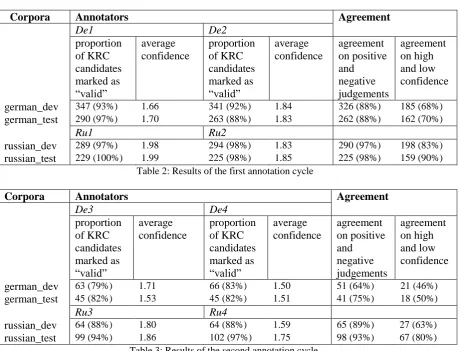
Each candidate KRC together with at least one previously annotated definiendum candidate was then presented to two independent annotators, namely Master students of translation. Each annotator was a native speaker of the respective language and had been acquainted with the established validity criteria during an introductory seminar. Annotators were asked to give a simple binary assessment of the KRC status of each KRC candidate given the above validity criteria. For positive judgements, annotators were also asked to give a simple binary assessment of their annotation confidence (1 = “not very confident”, 2 = “confident”, hence the interval of average confidence for each annotator ranges between 1 and 2). Table 2 summarizes the results of this step by giving acceptance rates and average confidence for each annotator and corpus. Under “agreement”, the table also summarises absolute and relative values for agreement on KRC validity judgements and confidence agreement (agreement on “high” and “low” confidence for a given candidate) for those KRCs in the gold standard that were marked “valid” by both annotators. Based on the results of this step, small sub-corpora were extracted from the web corpora to contain the KRC candidates agreed upon by all annotators.
3.2 Annotation Refinement
To achieve maximum coverage of the KRC annotation in the sub-corpora, we manually went through all four sub-corpora again to identify KRC candidates that may have been missed in the first candidate selection step. These new candidates were passed to four new annotators – two native speakers and experienced translators for each language – along with the same annotation criteria. This step resulted in the data summarised in table 3.
3.3 Discussion and Final Gold Standard Creation
Bierwisch and Kiefer (1969) are among the first to point out that linguistic criteria do not fully explain whether a statement can be considered defining or not. Cramer (2011) conducts extensive definition annotation experiments, concluding that the annotators’ individual stance towards a candidate statement and the corresponding text, knowledge of the domain and other criteria influence whether a statement is considered defining. For a terminological setting, this is problematic, since these
characteristics can be controlled only if the target users are known (e.g. in a small company setting, but not in the case of an online termbase).
The results of our own (small) annotation experiment seem to support Cramer’s (2011) claim that individual criteria of the annotators influence the annotation process, resulting in different rates of acceptance/rejection and varying levels of confidence as summarised in tables 2 and 3: Although all annotators marked the vast majority of the KRC candidates presented to them as “valid”, average confidence varies considerably between annotators, but also between corpora and annotation cycles. The different confidence levels and acceptance rates of the individual annotators indeed suggest that annotators develop individual annotation strategies while sudden confidence jumps (or drops) with, however, stable acceptance rates may be the result of changes in these strategies that, however, cannot be linked directly to linguistic criteria. Agreement seems to be generally higher in the first annotation cycle for both Russian and German which may be an effect of a more admissive pre-selection of candidates for the second cycle resulting in a potentially lower quality of candidates. The slightly, but consistently higher values achieved for russian_test in comparison to russian_dev may be an effect of the less ‘technical’ material in this corpus, since russian_dev contains a considerable amount of instructional texts which may not suit the annotators’ expectations.
Category Prop. KRCs
Prop. RIC
p CI
perfective aspect
0.2168 0.6298 408.0662 < 0.0001 [-0.4498, -0.3762]
imperfective aspect
0.7814 0.3679 408.6745 < 0.0001 [0.3767, 0.4503]
imperative 0.0091 0.0195 3.7124 0.0540 [-0.0206, -0.0001]
passive 0.2168 0.0990 62.3199 < 0.0001 [0.0876, 0.1480]
infinitive 0.0747 0.1902 65.8157 < 0.0001 [-0.1429, -0.0881]
participle 0.0719 0.1504 35.2414 < 0.0001 [-0.1041, -0.0528]
first person 0.0009 0.0694 74.3668 < 0.0001 [-0.0833, -0.0536] second
person
0.0109 0.0366 15.1299 0.0001 [-0.0385, -0.0129]
third person 0.5383 0.3157 119.5548 < 0.0001 [0.1828, 0.2624] present tense 0.7058 0.4170 198.2847 < 0.0001 [0.2499, 0.3278]
past tense 0.1949 0.3110 41.1045 < 0.0001 [-0.1514, -0.0807]
future tense 0.0118 0.0624 38.8885 < 0.0001 [-0.0661, -0.0350]
singular 0.5501 0.5090 3.8523 0.0497 [0.0001, 0.0821]
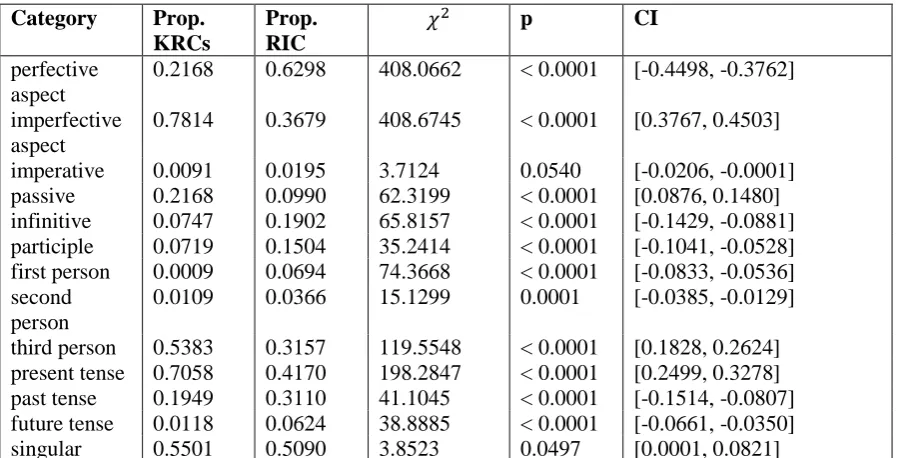
Table 6: Distributional differences of morphological markers between verbs in Russian KRCs and RIC.
Russian also shows fewer occurrences of modals (e.g.должен, “he must” and мочь, “may, can”).
In another step, we studied morphological properties of verbs in the KRC samples in comparison, again, to similarly-sized samples from the reference web corpora (NCL for German, RIC for Russian) and samples of non-KRCs from the gold corpora. To this end, we analysed the morphological tags outputted by TreeTagger (for Russian) and mate (for German). The categories for which both comparisons gave significant results on Russian are summarised in table 6. The analysis shows that verbs in Russian KRCs are more often in imperfective aspect, passive voice and third person present tense. Less frequently in the gold standard we find imperative forms, verbal infinitives (maybe due to a lack of modals that need to be followed by an infinitive, see above) and participles. As previously, the German data echoes these results. A manual analysis of the
syntactic realisation of the predicates in the KRCs gave evidence that Russian “unpersonal-definite” constructions (subjectless sentences with a verb in third person plural serving as predicate) and German presentatives may be light indicators for KRCs.
5.3 Discussion
Our results on the lexical level amount to a tendency towards an unpersonal style exhibited by KRCs in both languages. On the other hand, typical elements of defining statements (e.g. generalising adverbs or mentions of specific disciplines) that are described in the literature
could not be found in high quantity. Obviously, larger datasets are necessary for an in-depth study of the lexical properties of KRCs. The
morphological properties of verbs in the KRCs seem to support our hypothesis of an unpersonal, fact-oriented style, while imperfective aspect, present tense, presentatives and subjectless sentences can be understood as generalisation signals.
6
Conclusions and Future Work
Acknowledgement
The work described in this paper was partly funded by the CLARA project (EU/FP7), grant agreement n° 238405. I am also grateful to my anonymous reviewers for their helpful remarks. Last but not least, I am indebted to my colleagues José Martinez Martinez and Ekaterina Lapshinova-Koltunski for many interesting discussions and suggestions.
References
Baroni, M. and Evert, S. 2008. “Statistical methods for corpus exploitation”. In Lüdeling, A. and Kytö, M. (eds), Corpus Linguistics. An International
Handbook (Handbücher zur Sprach- und
Kommunikationswissenschaft 29). Mouton de Gruyter, Berlin.
Bierwisch, M. and Kiefer, F. 1969. “Remarks on Definitions in Natural Language”. In Kiefer, F. (ed), Studies in Syntax and Semantics.
(Foundations of Language 10). Reidel, Dordrecht. Bohnet, B. 2010. “Top Accuracy and Fast
Dependency Parsing is not a Contradiction”. COLING 2010, August 23-27, Beijing, China: 89-97. Available online at http://www.aclweb.org/anthology/C/C10/C10-1011.pdf.
Cramer, I. M. 2011. Definitionen in Wörterbuch und Text: Zur manuellen Annotation, korpusgestützten
Analyse und automatischen Extraktion
definitorischer Textsegmente im Kontext der computergestützten Lexikographie. Published PhD thesis. Technical University Dortmund. Available online at https://eldorado.tu-dortmund.de/bitstream/2003/27628/1/Dissertation. pdf.
de Groc, C. 2011. “Babouk: Focused web crawling for corpus compilation and automatic terminology extraction”. IEEE/WIC/ACM: International Conference on Intelligent Agent Technology, August 22-27. Lyon, France: 497-498.
Del Gaudio, R. and Branco, A. 2007. “Automatic Extraction of Definitions in Portuguese: A Rule-Based Approach”. In Neves, J., Santos, M.F. and Machado, J.M. (eds.) Progress in Artificial
Intelligence. (Lecture Notes in Artificial
Intelligence 4874). Springer, Berlin.
Fahmi, I. and Bouma, G. 2006. “Learning to Identify Definitions using Syntactic Features”. Workshop on Learning Structured Information in Natural Language Applications at EACL 2006, April 3, Trento, Italy: 64-71. Available online at http://ai- nlp.info.uniroma2.it/eacl2006-ws10/WS10-eacl2006-proceedings.pdf.
Fišer, D., Pollak, S. and Vintar, Š. 2010. “Learning to Mine Definitions from Slovene Structured and Unstructured Knowledge-Rich Resources”. LREC 2010, May 19-21, Valletta, Malta: 2932-2936. Available online at http://www.lrec-conf.org/proceedings/lrec2010/pdf/141_Paper.pdf. Fletcher, W. H. 2004. “Making the Web More Useful
as a Source for Linguistic Corpora”. In Connor, U. and Upton, T. A. (eds), Applied Corpus
Linguistics. A Multidimensional Perspective.
Rodopi, Amsterdam/New York.
International Organization for Standardization. 2000. International Standard ISO 1087-1: 2000 – Terminology Work – Vocabulary – Part 1: Theory and application. ISO, Geneva.
Malaisé, V., Zweigenbaum, P. and Bachimont, B. 2005. “Mining defining contexts to help structuring differential ontologies”. Terminology 11 (1): 21-53. Marshman, E. 2008. “Expressions of uncertainty in candidate knowledge-rich contexts: A comparison in English and French specialized texts”.
Terminology 14 (1): 124-151.
Meyer, I. 2001. “Extracting knowledge-rich contexts for terminography: A conceptual and methodological framework”. In Bourigault, D., Jacquemin, C. and L’Homme, M.-C. (eds), Recent Advances in Computational Terminology. (Natural Language Processing 2). John Benjamins. Amsterdam/Philadelphia.
Meyer, I., Skuce, D., Bowker, L. and Eck, K. 1992. “Towards a New Generation of Terminological Resources: An Experiment in Building a Terminological Knowledge Base”. COLING 1992, August 23-28, Nantes, France: 956-960. Available online at http://acl.ldc.upenn.edu/C/C92/C92-3146.pdf.
Muresan, S. and Klavans, J. 2002. “A Method for Automatically Building and Evaluating Dictionary Resources”. LREC 2002, May 29-31, Las Palmas, Spain: 231-234. Available online at http://www.lrec-conf.org/proceedings/lrec2002/. Nivre, J., Hall, J., Nilsson, J., Chanev, A., Eryigit, G.,
Kübler, S., Marinov, S. and Marsi, E. 2007. “MaltParser: A language-independent system for data-driven dependency parsing”. Natural
Language Engineering 13(2): 95-135.
Pearson, J. 1998. Terms in Context. (Studies in Corpus Linguistics 1). John Benjamins, Amsterdam/Philadelphia.
http://langtech.jrc.it/BSNLP2007/m/BSNLP-2007-proceedings.pdf.
Quasthoff, U., Richter, M. and Biemann, C. 2006. “Corpus Portal for Search in Monolingual Corpora“. LREC 2006, May 24-26, Genoa, Italy: 1799–1802. Available online at: http://www.lrec-conf.org/proceedings/lrec2006/.
Sachs, L. and Hedderich, J. 2009. Angewandte
Statistik. Methodensammlung mit R. Springer,
Berlin/Heidelberg.
Schmid, H. 1994. “Probabilistic Part-of-Speech Tagging Using Decision Trees”. International Conference on New Methods in Language Processing, Manchester, England: 44–49. Available online at: ftp://ftp.ims.uni-stuttgart.de/pub/corpora/tree-tagger1.pdf.
Sharoff, S. 2006. “Creating general-purpose corpora using automated search engine queries”. In M. Baroni and S. Bernardini (eds) WaCky! Working papers on the Web as Corpus. Gedit. Bologna. Available online at: http://www.comp.leeds.ac.uk/ssharoff/publications/ wacky-paper.pdf.
Sharoff, S., Kopotev, M., Erjavec, T., Feldmann, A. and Divjak, D. 2008. “Designing and evaluating a Russian tagset”. LREC 2008, May 28-30, Marrakech, Morocco: 279-285. Available online at http://www.lrec-conf.org/proceedings/lrec2008/. Sharoff, S. and Nivre, J. 2011. “The proper place of
men and machines in language technology. Processing Russian without any linguistic knowledge.” Dialogue 2011, May 25-29, Bekasovo, Russia: 591-604. Available online at
http://www.dialog-21.ru/digests/dialog2011/materials/ru/pdf/58.pdf. Sierra, G., Alarcón, R., Aguilar, C. and C. Bach.
2008. “Definitional verbal patterns for semantic relation extraction”. Terminology 14 (1): 74-98.
Storrer, A. and Wellinghoff, S. 2006. “Automated detection and annotation of term definitions in German text corpora”. LREC 2006, May 24-26, Genoa, Italy: 2373-2376. Available online at http://www.lrec-conf.org/proceedings/lrec2006/. Walter, S. 2010. Definitionsextraktion aus
Urteilstexten. Published PhD thesis. Saarland University. Available online at:
http://www.coli.uni-saarland.de/~stwa/publications/DissertationStephan Walter.pdf.
Westerhout, E. 2009. “Definition Extraction Using Linguistic and Structural Features”. First Workshop on Definition Extraction, Borovets, Bulgaria: 61-67. Available online at