Pause and Stop Labeling for Chinese Sentence Boundary Detection
Hen-Hsen Huang
Department of Computer Science and
Information Engineering,
National Taiwan University,
Taipei, Taiwan
[email protected]
Hsin-Hsi Chen
Department of Computer Science and
Information Engineering,
National Taiwan University,
Taipei, Taiwan
[email protected]
Abstract
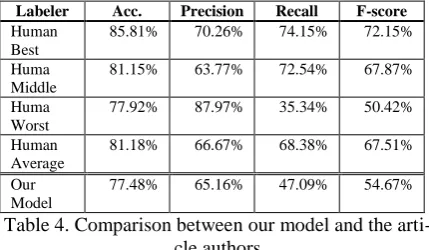
The fuzziness of Chinese sentence boundary makes discourse analysis more challenging. Moreover, many articles posted on the Internet are even lack of punctuation marks. In this pa-per, we collect documents written by masters as a reference corpus and propose a model to label the punctuation marks for the given text. Conditional random field (CRF) models trained with the corpus determine the correct delimiter (a comma or a full-stop) between each pair of successive clauses. Different tag-ging schemes and various features from differ-ent linguistic levels are explored. The results show that our segmenter achieves an accuracy of 77.48% for plain text, which is close to the human performance 81.18%. For the rich for-matted text, our segmenter achieves an even better accuracy of 82.93%.
1
Introduction
To resolve sentence boundary is a fundamental issue for human language understanding. In Eng-lish, sentence boundary detection (SBD) focuses on the disambiguation of the usages of punctua-tion marks such as period to determine if they mark the end of sentences.
In Chinese, the concept of “sentences” is fuzz-ier and less-defined. Native Chinese writers sel-dom follow the usage guidelines of punctuation marks. They often decide where to place a pause (i.e., a comma) and where to place a stop (i.e., a full-stop) in the writing according to their indi-vidual subjectivity. People tend to concatenate many clauses with commas. As a result, a Chi-nese sentence is often very long. That makes a text hard to be understood by both humans and machines. For example, a real world sample sen-tence
“這是有點霸道,但也有道理,因為他們是
上市公司,每一季要向美國證管會報告總公 司、附屬公司及子公司的營運及財務狀況, 帳都是照一套會計原則來做,所以很多時候 他們的要求,是出自一種單純的需要,而並
不是故意要來欺負我們。”
could be divided into three sentences such as
“這是有點霸道,但也有道理。” „This is a little overbearing, but is also reasonable.‟
“因為他們是上市公司,每一季要向美國證
管會報告總公司、附屬公司及子公司的營運
及財務狀況,帳都是照一套會計原則來做。”
„Because they are listed companies and should report a summary of operation and financial sta-tus of their corporation, subsidiaries, and affili-ates to the U.S. Securities quarterly, the ac-counts are prepared in accordance with the same set of accounting principles.‟
“所以很多時候他們的要求,是出自一種單
純的需要,而並不是故意要來欺負我們。”
„For this reason, their requests are usually from the simple need, not to intentionally bully us.‟
The meaning from the set of shorter sentences is more concentrated and more readable than from the single longer one.
An even serious issue of Chinese punctuation marking is raised from the massive informal writing on the Internet. The articles posted fre-quently lack of punctuation marks. Authors usu-ally separate clauses by whitespaces and new-line symbols, and the boundaries of sentences are partially or entirely missing. Splitting an entire
document into sentences is indispensable. For example, the following text from the Internet
“父親在一條小徑裡找到一株相思樹 正結
滿了一小粒一小粒的果實
我終於知道所謂「相思果」是什麼
剪下一兩條樹枝上面都是纍纍的紅豆
慢慢的從山上走下來
天色也跟著漸漸的黑了”
could be divided into a number of sentences with proper punctuation marks:
“父親在一條小徑裡找到一株相思樹,正結
滿了一小粒一小粒的果實。” „My father found an acacia in a narrow path, which is covered with fruits.‟
“我終於知道所謂「相思果」是什麼。” „I eventually knew the so called “Acacia fruit” is.‟
“剪下一兩條樹枝,上面都是纍纍的紅豆。”
„Cut a couple of branches, on which there are full of red beans.‟
“慢慢的從山上走下來,天色也跟著漸漸的
黑了” „Slowly walked down from the hill, and the sky was getting dark.‟
As well, the punctuation marked text becomes more structured and more readable. At present, numerous Chinese documents on the Internet are written without the punctuation marks. To deal with those informal written data, splitting the entire document into sentences is a fundamental task as important as the Chinese word segmenta-tion does.
In this paper, we classify the delimiter type be-tween each pair of successive clauses into “pause” (a comma) to indicate a short stop in a sentence, and “stop” (a full-stop, an exclamation mark, or a question mark) to indicate the end of a sentence. Conditional random fields (CRFs) (Lafferty et al., 2001) are used for such a sequential labeling task. Given a text which lacks of punctuation marks or is improperly marked, the proposed model will insert or modify the punctuation marks in the text, and determine the boundaries of sentences.
The rest of this paper is organized as follows. First, we review the related work in Section 2. In Section 3, two datasets and their characteristics are presented. The labeling scheme and a variety of features are introduced in Section 4. In
Sec-tion 5, the experimental results are shown and discussed. Finally, Section 6 concludes the re-marks.
2
Related Work
A typical SBD task in English is to distinguish the usages of a period, including full-stop, ab-breviation, number point, and a part of ellipsis (…). Various approaches are applied in this task and achieve very high performance. A rule-based model manually encoded by experts achieves an error rate of 0.9% (Aberdeen et al., 1995). The best unsupervised method achieves an error rate of 1.41% without the need of the dictionary and the abbreviation list (Mikheev, 2002). By the supervised learning approach, a modern SVM-based model achieves an even lower error rate of 0.25% (Gillick, 2009).
In Classical Chinese, there are no space and punctuation marks in the writing. As a result, all the Chinese characters in a paragraph are succes-sive (one by one) without word, clause, and sen-tence boundaries. Huang et al. (2010) propose a CRF model with various features including n-gram, jump, word class, and phonetic infor-mation to segment a Classical Chinese text into clauses and achieve an F-score of 83.34%.
In Modern Chinese, Jin et al (2004) propose a method to classify the roles of commas in Chi-nese long sentences to improve the performance of dependency parsing. Xu et al (2005) propose a method to split a long sentence into shorter piec-es to improve the performance of Chinpiec-ese- Chinese-English translation task. Zong and Ren (2003), and Liu and Zong (2003) segment a spoken ut-terance into a set of pieces. The above works fo-cus on segmenting long sentences into shorter units for certain applications. Different from their works, recovery of the missing punctuations, and resolutions of the usages of both commas and full-stops are the major contributions of this paper.
3
Datasets
Dataset #articles #fragments #fragments ending with a pause
#fragments ending with a stop
Average length in a fragment
#pause/#stop
Sinica dataset 36 4,498 3,175 1,323 11.76 2.40
Master dataset 1,381 296,055 204,848 91,207 10.45 2.25
Table 1. Statistics of Sinica and Master Datasets
Figure 1. Markov Chain of the k-tag set tagging scheme
Each article is shown to three labelers without the punctuation marks, and the labelers have to label an appropriate punctuation mark at the end of each fragment. Among the 36 articles, there are 4,498 fragments in total to be labeled. The agreement between labelers is 0.554 in Fleiss‟ kappa, i.e., the category of moderate agreement. The mellow human agreement shows the ambi-guity and the subjectivity inherent in the pause and stop labeling task.
The Sinica dataset is still not enough to be a moderate training dataset. Thus, we construct a larger Master dataset which is a collection of 1,381 articles written by Chinese masters. The masters include the modern Chinese pioneers such as Lu Xun (魯迅) and Zhu Ziqing (朱自清), the famous contemporary writers, and the profes-sional columnists. These masters are not only the experts in Chinese writing, their writing styles are also the paradigm for Chinese learners. For this reason, the uses of punctuation marks by them can be considered as the expert-level anno-tation. In this way, the collection of their articles is a dataset naturally authoritative. Since the Master dataset is crawled from the Internet, the layout information like HTML tags and symbols are available in addition to the plain text. Some HTML tags such as line breaker and paragraph maker can be used as clues to sentence segmen-tation.
The statistics of the two datasets are shown in Table 1. The number of documents in Master dataset is 38.36 times larger than that in Sinica dataset. Besides, the number of fragments in the former dataset is 65.82 times larger than that in
the latter one. The average length of a fragment in these two datasets is quite similar, i.e., 11.76 and 10.45 characters. Besides, the ratio of the number of pauses to stops is also similar, i.e., 2.40 and 2.25.
4
Labeling Method
To label the type of each delimiter between suc-cessive fragments, the sequential labeling model, CRFs, is applied. We experiment different tag-ging schemes and feature functions with CRF.
4.1 Tagging Scheme
The typical tagging scheme for text segmentation is 2-tag set in which two types of labels, “start” and “non-start”, are used. As shown in Table 1, the ratios of the pauses to the stops are 2.40 in Sinica dataset and 2.25 in Master dataset. In oth-er words, the classification between the class “start” and the class “non-start” is unbalanced. On average, a stop-ending clause appears after two to three pause-ending clauses.
Rather than the 2-tag set scheme, a longer tag-ging schemes, k-tag sets, are reported better in Chinese word segmentation (Xue, 2003; Zhao et al., 2006) and Classical Chinese sentence seg-mentation (Huang et al, 2010). We experiment different k-tag set schemes in pause and stop la-beling. A fragment could be labeled with one of the following tags: L1, L2, …, Lk-3, R, M, and S.
L means Left boundary. The tag Li (1ik-3) labeled on fragment f denotes f is the i-th frag-ment of a sentence. The tag R, which means
Right boundary, marks the last fragment of a sentence. The fragments between Lk-3 and R are
labeled with the tag M (Middle). A single frag-ment forming a sentence is labeled with the tag S
(Single). The Markov Chain of the k-tag set tag-ging scheme is shown in Figure 1. For example, the fragments in the first sample in Section 1 can be labeled in the 4-tag set scheme as follows:
“這是有點霸道,” (L1) “但也有道理。” (R)
“因為他們是上市公司,” (L1)
“每一季要向美國證管會報告總公司、附屬
“帳都是照一套會計原則來做。” (R) “所以很多時候他們的要求,” (L1) “是出自一種單純的需要,” (M) “而並不是故意要來欺負我們。” (R)
In this paper, 2-tag set, 4-tag set, and 5-tag set are explored.
4.2 Linguistic Features
Several types of features are proposed as follows.
Phonetics Level (P): The features include the initials, finals, and tones of the first character and the last character in a fragment. The syllabic fea-ture useful in the speech recognition is unavaila-ble in the written text. In this study, we use the pronunciation of each Chinese character to cap-ture the phonetics information. In our assumption, the pronunciation combination between the last character of a fragment and the first character of the next fragment is a clue to the type (a pause or a full-stop) of successive fragments. The phonet-ic system is based on Mandarin Phonetphonet-ic Sym-bols (MPS), also known as Bopomofo, in which there are 21 types of initials, 36 types of finals, and 5 types of tones.
Character Level (C): The features include the leftmost and the rightmost Chinese character (Hanzi) unigrams, bigrams, and trigrams of a fragment, and the number of Chinese characters in a fragment. From the empirical statistics of the distribution of Chinese words by length, 79.52% of Chinese words are covered in unigrams, bi-grams, and trigrams (Chen et at., 1997).
Word Level (W): The features include the leftmost and the rightmost word unigrams, bi-grams, and trigrams of a fragment, and the num-ber of words in a fragment. We perform Chinese word segmentation with the Stanford Chinese word segmenter (Chang et al., 2008). As shown in Table 1, the average lengths (in Characters) of a fragment are 11.76 and 10.45 in Sinica dataset and in Master dataset, respectively. The average length of Chinese words in these two datasets is 2.49 characters. For this reason, all the characters in most fragments are able to be captured within the leftmost and the rightmost trigrams.
Part-of-Speech Level (POS): The features in-clude the leftmost and the rightmost POS uni-grams, biuni-grams, and trigrams in a fragment. Be-sides, the presences or absences of certain POS tags in a fragment are also checked. These tags include noun, pronoun, verb, conjunction, parti-cle, adverb, adjective, and their combinations.
Figure 2. Extracting the top-level structure from the syntax tree
We perform POS tagging with the Stanford parser (Levy and Manning, 2003).
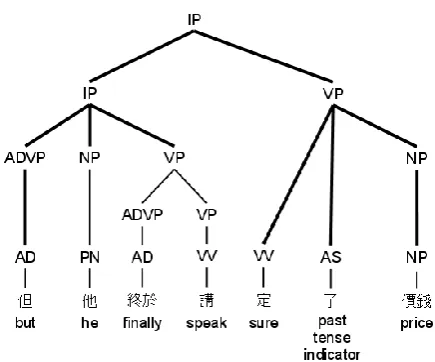
Syntactic Level (S): We get the syntactic tree of a fragment by the Stanford parser, and extract the structure of the upper three levels, which forms the fundamental composition of the frag-ment. In addition, the leftmost path and the rightmost path of the tree are also extracted. Fig-ure 2 shows the upper three levels of the parsing tree, the leftmost path, and the rightmost path of the sample fragment in the bold edges. For in-stance, the structure of the upper three levels in Figure 2 formed in preorder format is IP(IP(ADVP NP VP) VP(VV AS NP)), the leftmost path is IP(IP(ADVP(AD))), and the rightmost path is IP(VP(NP(NP))).
Topic-Comment Structure (TC): A Chinese sentence is usually composed of a topic and sev-eral comments. The topic clause contains the top-ic of the sentence, and the comment clauses give more information on the topic, which is usually omitted in the comment clauses. Once a new top-ic appears in a clause to begin a new sentence, the sentence before the clause will be known to be complete in topic-comment structure. For ex-ample, the sentence
“我的心分外地寂寞。” „My heart is
especial-ly loneespecial-ly.‟
is a single clause and is complete in the topic-comment structure. In this example, the topic is the noun phrase “我的心” („My heart‟), and the comment is “分外地寂寞” („is especially lonely‟).
“我從山下走下來,一路瀏覽兩旁的夜景,
一路細數空中的星光。” „I walked from the
mountain, looked at both sides of scenarios, and gazed at the stars in the sky.‟
The topic is the pronoun „I‟, and the three verb phrases, „Walked …‟, „Looked at …‟, and „Gazed at …‟, are all the comments. For a given text, if one can accurately classify each fragment as a topic or a comment, the boundaries of sen-tences are also resolved.
To detect the topic clause is difficult. In this study, we capture the cue for topic-comment structure from the surface information. We pos-tulate that a topic-clause tends to be a noun phrase or a complete fragment consisting of both noun phrase and verb phrase, and the comment-clause tends to be a verb phrase. For this reason, a fragment is represented in one the four types, NP, VP, NP-VP, and OTHER. In addition, the core noun in the noun phrase and the core verb in the verb phrase are also extracted.
Discourse Connective (DC): Some word pairs are usually used between or within sentenc-es. We prepare a discourse connective list that contains 33 inter-sentence connectives such as “最初 ... 目前” (originally … at present) and 348 intra-sentence connectives like “不但 … 而且” (not only … but also). The two words in a pair of inter-sentence connective are collocated across sentences. For example, the pair “最初 … 目前” is almost shown in two successive sentences re-spectively rather than shown in the fragments which belong to a single sentence. Therefore, this is a clear cue that a stop should be inserted between inter-sentence connectives. In the other hand, the two words in a pair of intra-sentence connective are collocated within a single sen-tence. In this case, no stop should be inserted between them.
For each fragment, we use four features, inter-forward, inter-backward, intra-inter-forward, and in-tra-backward, to capture discourse connection between it and its preceding (successive) frag-ment. When fragments fi and fj (i<j) contain an inter-sentence connective, the inter-forward fea-ture of fi and the inter-backward feature of fj will be increased by 1. We deal with the intra-sentence connective in the similar way. That is, the corresponding forward and intra-backward features will be increased accordingly. In the current implementation, the window size is set to 2.
Collocated Word (CW): Rather than the con-nectives collected from dictionaries, numerous inter and intra sentence word pairs are automati-cally mined from the training data as supple-ments to Discourse Connective, which is rela-tively smaller. We collect the collocations that tend to appear between inter and intra sentences from the training data, and filter them with mu-tual information and classification confidence.
Layout Information (LI): The layout infor-mation such as whitespaces, tabs, and new-lines are usually available in the text. Moreover, the articles posted on the Internet are often embed-ded with a lot of HTML tags and special symbols that indicate the layout styles. Those tags in-cludes the line breaker (<br>), the paragraph marker (<p>), the span (<span>), the block (<div>), the non-breaking space ( ), and so on. The types and the occurrences of the sur-rounding symbols and tags form the features to represent the layout information of a fragment.
The layout information is unavailable from Sinica dataset because it is comprised of plain text.
5
Experiments
There are three parts of experiments. In the first part, we evaluate the performances of different tagging schemes with the basic features. As re-sults, the best tagging scheme will be utilized in the following experiments. In the second part, the performances of various features and their combinations are evaluated. The best combina-tion of the features will be adopted in the last part of experiments. In the last part, we compare the performance of our best model with those of the labelers. All the evaluation results are report-ed using 5-fold cross-validation.
5.1 Evaluation Metrics
tion. In Proceedings of CIPS-SIGHAN Joint Con-ference on Chinese Language Processing, pages 15-22, Beijing, China, August.
Mei xun Jin, Mi-Yong Kim, Dongil Kim, and JongHyeok Lee. 2004. Segmentation of Chinese Long Sentences Using Commas. In Proceedings of SIGHAN, pages 1-8, Barcelona, Spain.
John Lafferty, Andrew McCallum, and Fernando Pe-reira. 2001. Conditional Random Fields: Probabil-istic Models for Segmentation and Labeling Se-quence Data. In Proceedings of the 18th Interna-tional Conference on Machine Learning, pages 282-289.
Roger Levy and Christopher D. Manning. 2003. Is it harder to parse Chinese, or the Chinese Treebank? In Proceedings of the 41st Annual Meeting on As-sociation for Computational Linguistics, pages 439-446.
Ding Liu and Chengqing Zong. 2003. Utterance Seg-mentation Using Combined Approach Based on Bi-directional N-gram and Maximum Entropy. In
Proceedings of the Second SIGHAN Workshop on Chinese Language Processing, pages 16-23.
Andrei Mikheev. 2002. Periods, Capitalized Words, etc. Computational Linguistics, 28(3):289–318.
Jia Xu, Richard Zens, and Hermann Ney. 2005. Sen-tence Segmentation Using IBM Word Alignment Model 1. In Proceedings of the European Associa-tion for Machine TranslaAssocia-tion (EAMT 2005), pages 280-287.
Nianwen Xue. 2003. Chinese Word Segmentation as Character Tagging. Computational Linguistics and Chinese Language Processing, 8(1):29-48.
Hai Zhao, Chang-Ning Huang, Mu Li, and Bao-Liang Lu. 2006. Effective Tag Set Selection in Chinese Word Segmentation via Conditional Random Field Modeling. In Proceedings of the 20th Pacific Asia Conference on Language, Information and Compu-tation (PACLIC-20), pages 87-94, Wuhan, China, November 1-3.