E x p e r i m e n t s on S e n t e n c e B o u n d a r y D e t e c t i o n
M a r k S t e v e n s o n a n d R o b e r t G a i z a u s k a s D e p a r t m e n t o f C o m p u t e r S c i e n c e ,
U n i v e r s i t y o f S h e f f i e l d
R e g e n t C o u r t , 211 P o r t o b e l l o S t r e e t , S h e f f i e l d
S1 4 D P U n i t e d K i n g d o m
{marks, r o b e r t g } @ d c s , shef. a c . u k
A b s t r a c t
This paper explores the problem of identifying sen- tence boundaries in the transcriptions produced by automatic speech recognition systems. An experi- ment which determines the level of human perform- ance for this task is described as well as a memory- based computational approach to the problem.
1 T h e P r o b l e m
This paper addresses the problem of identifying sen- tence boundaries in the transcriptions produced by automatic speech recognition (ASR) systems. This is unusual in the field of text processing which has generally dealt with well-punctuated text: some of the most commonly used texts in NLP are machine readable versions of highly edited documents such as newspaper articles or novels. However, there are many types of text which are not so-edited and the example which we concentrate on in this paper is the o u t p u t from ASR systems. These differ from the sort of texts normally used in NLP in a number of ways; the text is generally in single case (usually upper), unpunctuated and may contain transcrip- tion errors. 1 Figure 1 compares a short text in the format which would be produced by an ASR system with a fully punctuated version which includes case information. For the remainder of this paper error- free texts such as newspaper articles or novels shall be referred to as "standard text" and the o u t p u t from a speech recognition system as "ASR text".
There are many possible situations in which an NLP system may be required to process ASR text. The most obvious examples are NLP systems which take speech input (eg. Moore et al. (1997)). Also, dictation software programs do not punctuate or capitalise their o u t p u t but, if this information could be added to ASR text, the results would be far more usable. One of the most important pieces of inform-
1 Speech recognition systems are often evaluated in terms of word error rate (WER), the percentage of tokens which are wrongly transcribed. For large vocabulary tasks and speaker- independent systems, WER varies between 7% and 50%, de- pending upon the quality of the recording being recognised. See, e.g., Cole (1996).
G00D EVENING GIANNI VERSACE ONE OF THE WORLDS LEADING FASHION DESIGNERS HAS BEEN MURDERED IN MIAMI POLICE SAY IT WAS A PLANNED KILLING CARRIED OUT LIKE AN EXECUTION SCHOOLS INSPECTIONS ARE GOING TO BE TOUGHER TO FORCE BAD TEACHERS OUT AND THE FOUR THOUSAND COUPLES WH0 SHARED THE QUEENS GOLDEN DAY
Good evening. Gi~nni Versace, one of
the world's leading fashion designers, has been murdered in Miami. Police say
it was a planned killing carried out
like an execution. Schools inspections are going to be tougher to force bad teachers out. And the four thousand couples who shared the Queen's golden
day.
Figure 1: Example text shown in standard and ASR format
ation which is not available in ASR o u t p u t is sen- tence b o u n d a r y information. However, knowledge of sentence boundaries is required by many NLP tech- nologies. P a r t of speech taggers typically require input in the format of a single sentence per line (for example Brill's tagger (Brill, 1992)) and parsers gen- erally aim to produce a tree spanning each sentence. Only the most trivial linguistic analysis can be car- ried out on text which is not split into sentences.
[image:1.612.339.557.210.412.2]program. The spoken portion of the British National Corpus (Burnard, 1995) contains 10 million words and was manually marked with sentence boundar- ies. A technology which identifies sentence boundar- ies could be used to speed up the process of creating any future corpus of this type.
It is important to distinguish the problem just mentioned and another problem sometimes called "sentence splitting". This problem aims to identify sentence boundaries in standard text but since this includes punctuation the problem is effectively re- duced to deciding which of the symbols which poten- tially denote sentence boundaries ( . , ! , ?) actually do. This problem is not trivial since these punc- tuation symbols do not always occur at the end of sentences. For example in the sentence "Dr. J o n e s l e c t u r e s a t U . C . L . A . " only the final full stop de- notes the end of a sentence. For the sake of clarity we shall refer to the process of discovering sentence boundaries in standard p u n c t u a t e d text as "punc- tuation disambiguation" and t h a t of finding them in unpunctuated ASR text as "sentence boundary detection".
2
R e l a t e d Work
Despite the potential application of technology which can carry out the sentence boundary detec- tion task, there has been little research into the area. However, there has been work in the re- lated field of punctuation disambiguation. Palmer and Hearst (1994) applied a neural network to the problem. T h e y used the Brown Corpus for training and evaluation, noting that 90% of the full stops in this text indicate sentence boundaries. T h e y used the part of speech information for the words sur- rounding a punctuation symbol as the input to a feed-forward neural network. But, as we mentioned, most part of speech taggers require sentence bound- aries to be pre-determined and this potential cir- cularity is avoided by using the prior probabilities for each token, determined from the Brown corpus markup. The network was trained on 573 potential sentence ending marks from the Wall Street Journal and tested on 27,294 items from the same corpus. 98.5% of punctuation marks were correctly disam- biguated.
Reynar and Ratnaparkhi (1997) applied a max- imum entropy approach to the problem. Their system considered only the first word to the left and right of any potential sentence boundary and claimed that examining wider context did not help. For both these words the prefix, suffix, presence of particular characters in the prefix or suffix, whether the candidate is honorific (Mr., Dr. etc.) and whether the candidate is a corporate designator (eg. Corp.) are features t h a t are considered. This sys- tem was tested on the same corpus as Palmer and
Hearst's system and correctly identified 98.8% of sentence boundaries. Mikheev (1998) optimised this approach and evaluated it on the same test corpus. An accuracy of 99.2477% was reported, to our know- ledge this is the highest quoted result for this test set.
These three systems achieve very high results for the punctuation disambiguation task. It would seem, then, t h a t this problem has largely been solved. However, it is not clear that these techniques will be as successful for ASR text. We now go on to describe a system which attempts a task similar to sentence boundary detection of ASR text.
Beeferman et al. (1998) produced a system, "CY- B E R P U N C " , which added intra-sentence punctu- ation (i.e. commas) to the o u t p u t of an ASR system. T h e y mention that the comma is the most frequently used punctuation symbol and its correct insertion can make a text far more legible. C Y B E R P U N C operated by augmenting a standard trigram speech recognition model with information about commas; it accesses only lexical information. C Y B E R P U N C was tested by separating the trigram model from the ASR system and applying it to 2,317 sentences from the Wall Street Journal. T h e system achieved a precision of 75.6% and recall of 65.6% compared against the original punctuation in the text. 2 A fur- ther qualitative evaluation was carried out using 100 randomly-drawn o u t p u t sentences from the system and 100 from the Wall Street Journal. Six human judges blindly marked each sentence as either ac- ceptable or unacceptable. It was found that the Penn TreeBank sentences were 86% correct and the system o u t p u t 66% correct. It is interesting that the human judges do not agree completely on the ac- ceptability of many sentences from the Wall Street Journal.
In the next section we go on to describe exper- iments which quantify the level of agreement that can be expected when humans carry out sentence b o u n d a r y detection. Section 4 goes on to describe a computational approach to the problem.
3
D e t e r m i n i n g H u m a n A b i l i t y
Beeferman et. al.'s experiments demonstrated that humans do not always agree on the acceptability of comma insertion and therefore it may be useful to determine how often they agree on the placing of sentence boundaries. To do this we carried out ex- periments using transcriptions of news programmes, specifically the transcriptions of two editions of the
~Precision and recall are c o m p l e m e n t a r y e v a l u a t i o n m e t - rics c o m m o n l y u s e d in I n f o r m a t i o n Retrieval (van R i j s b e r g e n , 1979). In t h i s case precision is the p e r c e n t a g e of c o m m a s pro- p o s e d by the system w h i c h are correct while recall is the per- c e n t a g e of the commas occurring in the test corpus which the system identified.
BBC television program "The Nine O'Clock News" .3 The transcriptions consisted of punctuated mixed case text with sentences boundaries marked using a reserved character ("; "). These texts were produced by trained transcribers listening to the original pro- gram broadcast.
Six experimental subjects were recruited. All sub- jects were educated to at least Bachelor's degree level and are either native English speakers or flu- ent second language speakers. Each subject was presented with the same text from which the sen- tence boundaries had been removed. T h e texts were transcriptions of two editions of the news program from 1997, containing 534 sentences and represented around 50 minutes of broadcast news. T h e subjects were randomly split into two groups. The subjects in the first group (subjects 1-3) were presented with the text stripped of punctuation and converted to upper case. This text simulated ASR text with no errors in the transcription. The remaining three sub- jects (4-6) were presented with the same text with punctuation removed but case information retained (i.e. mixed case text). This simulated unpunctuated standard text. All subjects were asked to add sen- tence boundaries to the text whenever they thought they occurred.
T h e process of determining human ability at some linguistic task is generally made difficult by the lack of an appropriate reference. Often all we have to compare one person's judgement with is t h a t of an- other. For example, there have been attempts to determine the level of performance which can be ex- pected when humans perform word sense disambig- uation (Fellbaum et al., 1998) but these have simply compared some human judgements against others with one being chosen as the "expert". We have already seen, in Section 2, t h a t there is a signific- ant degree of human disagreement over the accept- ability of intra-sentential punctuation. The human transcribers of the "Nine O'Clock News" have access to the original news story which contains more in- formation than just the transcription. Under these conditions it is reasonable to consider their opinion as expert.
Table 1 shows the performance of the human sub- jects compared to the reference transcripts. 4
An algorithm was implemented to provide a baseline tagging of the text. The average length of sentences in our text is 19 words and the baseline al- gorithm randomly assigns a sentence break at each word boundary with a probability of ~ . The two annotators labelled "random" show the results when this algorithm is applied. This m e t h o d produced a
3This is a 25 minute long television news program broad- cast in the United Kingdom on Monday to Friday evenings.
4F-measure (F) is a weighted harmonic combining preci- sion (P) and recall (R) via the formula 2PR
P T R "
very low result in comparison to the expert annota- tion.
1 Upper 84 68 76 2 Upper 93 78 85 3 Upper 90 76 82 4 Mixed 97 90 94 5 Mixed 96 89 92 6 Mixed 97 67 79 R a n d o m Upper 5 5 5 R a n d o m Mixed 5 5 5
Table 1: Results from H u m a n Annotation Experi- ment
T h e performance of the human annotators on the upper case text is quite significantly lower than the reported performance of the algorithms which performed punctuation disambiguation on standard text as described in Section 2. This suggests t h a t the performance which may be obtained for this task may be lower t h a n has been achieved for standard text.
~Sarther insight into the task can be gained from determining the degree to which the subjects agreed. Carletta (1996) argues t h a t the kappa statistic (a) should be adopted to judge a n n o t a t o r consistency for classification tasks in the area of discourse and dialogue analysis. It is worth noting t h a t the prob- lem of sentence b o u n d a r y detection presented so far in this paper has been formulated as a classification task in which each token b o u n d a r y has to be clas- sifted as either being a sentence b o u n d a r y or not. Carletta argues t h a t several incompatible measures of a n n o t a t o r agreement have been used in discourse analysis, making comparison impossible. Her solu- tion is to look to the field of content analysis, which has already experienced these problems, and adopt their solution of using the kappa statistic. This de- termines the difference between the observed agree- ment for a linguistic task and t h a t which would be expected by chance. It is calculated according to for- mula 1, where Pr(A) is the proportion of times the annotators agree and P r ( E ) the proportion which would be expected by chance. Detailed instructions on calculating these probabilities are described by Siegel and Castellan (1988).
Pr(A) - P r ( E )
= (1)
1 - P r ( E )
[image:3.612.376.546.104.212.2]lows tentative conclusions to be drawn (see Carletta (1996)).
We began to analyse the d a t a by computing the kappa statistic for both sets of annotators. Among the two annotators who marked the mixed case (sub- jects 4 and 5) there was an observed kappa value of 0.98, while there was a measure of 0.91 for the three subjects who annotated the single case text. These values are high and suggest a strong level of agree- ment between the annotators. However, manual analysis of the annotated texts suggested that the subjects did not agree on many cases. We then ad- ded the texts annotated by the "random" annotation algorithm and calculated the new ~ values. It was found that the mixed case test produced a kappa value of 0.92 and the upper case text 0.91. These values would still suggest a high level of agreement although the sentences produced by our random al- gorithm were nonsensical.
The problem seems to be that most word bound- aries in a text are not sentence boundaries. There- fore we could compare the subjects' annotations who had not agreed on any sentence boundaries but find that they agreed most word boundaries were not sentence boundaries. T h e same problem will effect other standard measures of inter-annotator agreement such as the Cramer, Phi and Kendall coefficients (see Siegel and Castellan (1988)). Car- letta mentions this problem, asking what the dif- ference would be if the kappa statistic were com- puted across "clause boundaries, transcribed word boundaries, and transcribed phoneme boundaries" (Carletta, 1996, p. 252) rather than the sentence boundaries she suggested. It seems likely t h a t more meaningful ~ values would be obtained if we restric- ted to the boundaries between clauses rather than all token boundaries. However, it is difficult to ima- gine how clauses could be identified without parsing and most parsers require part of speech tagged input text. But, as we already mentioned, part of speech taggers often require input text split into sentences. Consequently, there is a lack of available systems for splitting ASR text into grammatical clauses.
4 A C o m p u t a t i o n a l A p p r o a c h t o S e n t e n c e B o u n d a r y D e t e c t i o n
The remainder of this paper describes an implemen- ted program which attempts sentence boundary de- tection. The approach is based around the Timbl memory-based learning algorithm (Daelemans et al., 1999) which we previously found to be very success- ful when applied to the word sense disambiguation problem (Stevenson and Wilks, 1999).
Memory-based learning, also known as case-based and lazy learning, operates by memorising a set of training examples and categorising new cases by as- signing them the class of the most similar learned
example. We apply this methodology to the sen- tence boundary detection task by presenting Timbl with examples of word boundaries from a train- ing text, each of which is categorised as either s e n t e n c e _ b o u n d a r y or no_boundary. Unseen ex- amples are then compared and categorised with the class of the most similar example. We shall not discuss the m e t h o d by which Timbl determines the most similar training example which is described by Daelemans et al. (1999).
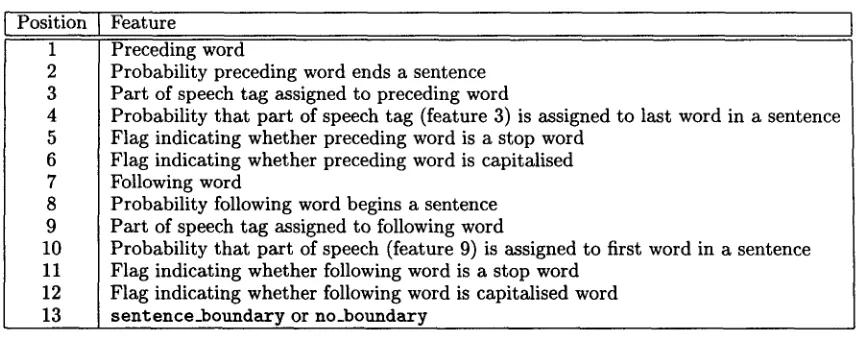
Following the work done on punctuation disambig- uation and that of Beeferman et. al. on comma in- sertion (Section 2), we used the Wall Street Journal text for this experiment. These texts are reliably part of speech tagged 5 and sentence boundaries can be easily derived from the corpus. This text was initially altered so as to remove all punctuation and map all characters into upper case. 90% of the cor- pus, containing 965 sentence breaks, was used as a training corpus with the remainder, which contained 107 sentence breaks, being held-back as unseen test data. T h e first stage was to extract some statistics from the training corpus. We examined the training corpus and computed, for each word in the text, the probability t h a t it started a sentence and the prob- ability that it ended a sentence. In addition, for each part of speech tag we also computed the probability that it is assigned to the first word in a sentence and the probability that it is assigned to the last word. 6 Each word boundary in the corpus was translated to a feature-vector representation consisting of 13 ele- ments, shown in Table 2. Vectors in the test corpus are in a similar format, the difference being that the classification (feature 13) is not included.
The results obtained are shown in the top row of Table 3. Both precision and recall are quite prom- ising under these conditions. However, this text is different from ASR text in one important way: the text is mixed case. The experimented was repeated with capitalisation information removed; that is, features 6 and 12 were removed from the feature- vectors. T h e results form this experiment are shown in the b o t t o m row of Table 3. It can be seen that the recorded performance is far lower when capital- isation information is not used, indicating that this is an important feature for the task.
These experiments have shown that it is much easier to add sentence boundary information to mixed case test, which is essentially standard text with punctuation removed, than ASR text, even as-
5Applying a priori tag probability distributions could have been used rather than the tagging in the corpus as such re- liable annotations may not be available for the output of an ASR system. Thus, the current experiments should be viewed as making an optimistic assumption.
eWe a t t e m p t e d to smooth these probabilities using Good- Turing frequency estimation (Gale and Sampson, 1996) but found that it had no effect on the final results.
Position Feature 1
2 3 4 5 6 7 8 9 10 11 12 13
Preceding word
Probability preceding word ends a sentence Part of speech tag assigned to preceding word
Probability that part of speech tag (feature 3) is assigned to last word in a sentence Flag indicating whether preceding word is a stop word
Flag indicating whether preceding word is capitalised Following word
Probability following word begins a sentence Part of speech tag assigned to following word
Probability that part of speech (feature 9) is assigned to first word in a sentence Flag indicating whether following word is a stop word
Flag indicating whether following word is capitalised word
sentence_boundary
orno_boundary
Table 2: Features used in Timbl representation
Case information [I P I R I F
Applied I 78 [ 75 [ 76 Not applied 36 35 35
Table 3: Results of the sentence boundary detection program
suming a zero word error rate. This result is in agreement with the results from the human annota- tion experiments described in Section 3. However, there is a far greater difference between the auto- matic system's performance on standard and ASR text than the human annotators.
Reynar and Ratnaparkhi (1997) (Section 2) ar- gued that a context of one word either side is suf- ficient for the punctuation disambiguation problem. However, the results of our system suggest that this may be insufficient for the sentence boundary detec- tion problem even assuming reliable part of speech tags (cf note 5).
These experiments do not make use of prosodic in- formation which may be included as part of the ASR output. Such information includes pause length, pre-pausal lengthening and pitch declination. If this information was made available in the form of extra features to a machine learning algorithm then it is possible that the results will improve.
5 C o n c l u s i o n
This paper has introduced the problem of sentence boundary detection on the text produced by an ASR system as an area of application for NLP technology. An attempt was made to determine the level of human performance which could be expected for the task. It was found that there was a noticeable dif- ference between the observed performance for mixed and upper case text. It was found that the kappa
statistic, a commonly used method for calculating inter-annotator agreement, could not be applied dir- ectly in this situation.
A memory-based system for identifying sentence boundaries in ASR text was implemented. There was a noticeable difference when the same system was applied to text which included case information demonstrating that this is an important feature for the problem.
This paper does not propose to offer a solution to the sentence boundary detection problem for ASR transcripts. However, our aim has been to high- light the problem as one worthy of further explor- ation within the field of NLP and to establish some baselines (human and algorithmic) against which further work may be compared.
A c k n o w l e d g e m e n t s
The authors would like to thank Steve Renals and Yoshihiko Gotoh for providing the data for human annotation experiments and for several useful con- versations. They are also grateful to the following people who took part in the annotation experiment: Paul Clough, George Demetriou, Lisa Ferry, Michael Oakes and Andrea Setzer.
R e f e r e n c e s
D. Beeferman, A. Berger, and J. Lafferty. 1998. CY- BERPUNC: A lightweight punctuation annota- tion system for speech. In Proceedings of the IEEE International Conference on Acoustics, Speech
and Signal Processing, pages 689-692, Seattle,
WA.
E. Brill. 1992. A simple rule-based part of speech tagger. In Proceeding of the Third Conference on Applied Natural Language Processing (ANLP-92),
[image:5.612.119.547.70.240.2]L. Burnard, 1995. Users Reference Guide for the
British National Corpus. Oxford University Com-
puting Services.
J. Carletta. 1996. Assessing agreement on classific- ation tasks: the kappa statistic. Computational
Linguistics, 22(2):249-254.
N. Chinchor, P. Robinson, and E. Brown. 1998. HUB-4 Named Entity Task Defini- tion (version 4.8). Technical report, SAIC. http ://www. nist. gov/speech/hub4-98.
R. Cole, editor. 1996. Survey of the State of the
Art in Human Language Technology. Available at:
http://cslu.cse.ogi.edu/HLTsurvey/HLTsurvey.html. Site visited 17/11/99.
W. Daelemans, J. Zavrel, K. van der Sloot, and A. van den Bosch. 1999. TiMBL: Tilburg memory based learner version 2.0, reference guide. Technical report, ILK Technical Report 98-03. ILK Reference Report 99-01, Available from http ://ilk. kub. nl/" ilk/papers/ilk9901, ps. gz. C. Fellbaum, J. Grabowski, S. Landes, and A. Ban-
mann. 1998. Matching words to senses in Word- Net: Naive vs. expert differentiation of senses. In C. Fellbaum, editor, WordNet: An electronic lex-
ieal database and some applications. MIT Press,
Cambridge, MA.
W. Gale and G. Sampson. 1996. Good-Turing frequency estimation without tears. Journal of
Quantitave Linguistics, 2(3):217-37.
Y. Gotoh and S. Renals. 2000. Information extrac- tion from broadcast news. Philosophical Trans- actions of the Royal Society of London, series A: Mathematical, Physical and Engineering Sciences.
(to appear).
A. Mikheev. 1998. Feature lattices for maximum en- tropy modelling. In Proceedings of the 36th Meet- ing of the Association for Computational Linguist-
ics (COLING-ACL-98), pages 848-854, Montreal,
Canada.
R. Moore, J. Dowding, H. Bratt, J. Gawron, Y. Gorfu, and A. Cheyer. 1997. CommandTalk: A Spokcaa-Language Interface to Battlefield Simu- lations. In Proceedings of the Fifth Conference on
Applied Natural Language Processing, pages 1-7,
Washington, DC.
D. Palmer and M. Hearst. 1994. Adaptive sen- tence boundary disambiguation. In Proceedings of the 1994 Conference on Applied Natural Language
Processing, pages 78-83, Stutgart, Germany.
J. Reynar and A. Ratnaparkhi. 1997. A max- imum entropy approach to identifying sentence boundries. In Proceedings of the Fifth Conference
on Applied Natural Language Processing, pages
16-19, Washington, D.C.
S. Siegel and N. Castellan. 1988. Nonparametrie
Statistics for the Behavioural Sciences. McGraw-
Hill, second edition.
M. Stevenson and Y. Wilks. 1999. Combining weak knowledge sources for sense disambiguation. In
Proceedings of the Sixteenth International Joint
Conference on Artificial Intelligence, pages 884-
889. Stockholm, Sweden.
C. van Rijsbergen. 1979. Information Retrieval.
Butterworths, London.