Nested Sliding Window Protocols
with Packet Fragmentation
Gerald
W.
Shapiro
and
Harry G.
Perras
Center for Communications and Signal Processing
Electrical and Computer Engineering Department
North
Carolina State University
CCSP TR-89/15
Nested Sliding Window Protocols With Packet Fragmentation'
Gerald W. Shapiro
Department of Management Science
VPI & SU
Blacksburg, VA 24061-0235
Harry G. Perros
Department of Computer Science North Carolina State University
Raleigh, NC 27695-8206
ABSTRACT
A single-hop OSI structured network with multiple layers of sliding window flow control and
packet fragmentation between layers is analyzed. An approximation algorithm is presented
to hierarchically reduce the network to a single queue whose performance characteristics
represent the original network. Network transmission characteristics are restricted to Erlang
distributions. Validation against exact and simulation results showed that the approximation
algorithm has a satisfactory error level.
I. INTRODUCTION
Most modern communication network protocols are designed using a layered structure along
the lines of the OSI model [1]. A common means of implementing the required sequencing,
pactng, congestion control, and data integrity functions of a protocol layer is a sliding window
protocol [1J. Under such a protocol each data packet at a given layer in the sender is given
a number in the range 0 to W-1. W is the window size of this layer. Upon successful receipt
of a data packet, the receiving protocol peer generates an acknowledgment packet for the
sender, indicating the number of the received data packet. Once the acknowledgment is
re-ceived by the sender, the packet number can be re-used to send another packet. If at any time
the sender has W unacknowledged packets outstanding, that sender is blocked and cannot
pass another packet to the layer below it until an acknowledgment for one of the outstanding
1 Supported in part by AIRMICS via the North Carolina State University Center for Communications
packets arrives. There are a number of variants on this basic scheme used in practice, (see
[2]).
Within a given hop, more than one protocol layer may have a sliding window scheme. In such
a situation each protocol layer will have its own window size and packet numbers, and the
sliding window schemes are such that one is imbedded within the other. We refer to this
structure as nested window protocols.
Each layer may have a maximum size data unit it can process, the maximum packet size of
that layer. When a layer at the sending station, say layer l, has a larger maximum packet size
than the layer below it, (layer i - 1), it may be necessary to split the packet from layeri into a
number of smaller packets. This process is referred to as fragmentation of the higher layer
data packet. The peer layer i - 1 at the receiving station must reassemble the fragments
be-fore passing the original data up to the layer i above it.
Of interest to network designers are the throughput and delay performance characteristics of
networks using sliding window protocols. Since the sending layers will periodically be
blocked, the effective transmission capability of the network is less than the raw transmission
rate.
Even simplified models of the sliding window protocol have resisted efforts to date to find
ex-act closed form solutions for the performance measures, (although numerical techniques
in-volvinq the analysis of the underlying Markov chain may be applied to fairly small examples.)
Current analysis depends upon approximation techniques.
Sliding window protocols were analyzed originally (see (3)-[6]) using a closed queueing
net-work with population W. This implies that packets do not enqueue at a blocked sender, but
rather that packets arriving to a blocked sender are "lost". Such models do not accurately
represent the total delay characteristics of packet delivery. Lam (7) presents a general
mod-elling framework which can model a sliding window protocol under this loss assumption.
The models described above deal with only a single layer of sliding window control, and do
not include packet fragmentation. Goto, Takahashi, and Hasegawa [9] and Akyildiz [10]
ana-lyze a model which limits the number of packets allowed at each intermediate station between
the sender and receiver by blocking the downstream neighbor of a full station, in addition to
limiting the number of packets in the end to end connection by the loss assumption. This
comes closer to modelling nested stiding window schemes, but no acknowledgment
mech-anism is modeled, nor is packet fragmentation.
An analysis useful for predicting the maximum throughput of a sliding window controlled link
is presented by Kleinrock and Kermani [11]. In this analysis there is always a packet waiting
for a returning acknowledgment. Fragmentation and nesting are not considered.
Reiser [12] and Thomasian and Bay [13], use a flow-equivalent server technique to model the
sliding window link as a single server queue with state dependent service rate. In this
ap-proach the acknowledgment packets do not explicitly appear in the approximating queue; the
effect of delays due to all sequence numbers in use is accounted for in the delivery service
time of the equivalent server. While these models do not consider fragmentation, they do
explicitly model the delay of packets enqueued at a blocked sender.
Modelling approaches similar to the above are used by Gihr and Kuehn (14l, Varghese, Chou
and Nilsson (15), and Schwartz (16]. In Gihr and Kuehn's analysis the characteristics of the
physical transmission process are obtained from analysis of a LAN, in a hierarchical model.
They also consider group arrivals to the sliding window controlled layer, modelling
fragmen-tation from a higher layer. Both (15] and [16] note that the method is not very accurate in the
face of group arrivals.
Three recent papers also address the need for ~ multi-layer analysis of communications
net-works. Mitchell and Lide [17] present a general framework which uses a closed queueing
network, (ala [6]), to model sliding window control. Murata and Takagi [18] consider a token
network model is used for the sliding window layer. Neither paper addresses packet
frag-mentation.
Fdida, Perras, and Wilk [19] present a methodology for analyzing arbitrary configurations of
sliding window controlled networks. Both nested and series configurations are allowed;
however, packets may not be fragmented, and are presumed to arrive singly. Each layer of
sliding window control is reduced to a state-dependent infinite server queue without explicit
acknowledgments, using a flow-equivalence methodology. Queueing delays for transmission
when all sequence numbers are in use is accounted for in the mean service time of the infinite
server. The method is hierarchical, reducing the lowest layers first.
In this paper a hierarchical method is presented for analyzing nested sliding window
con-trolled layers. Each layer with sliding window control is reduced to a single queue without
explicit acknowledgments. The simple nature of the equivalent queue facilitates analysis of
multiple layers. Unlike other papers, specific attention is given in this analysis to
fragmenta-tion and reassembly. The analysis here is restricted to a single-hop (no intermediate stafragmenta-tions)
connection.
In Section II, the model of nested layers of sliding window protocols is presented. Section III
gives the approximation methodology, and in Section IVthe approximations are compared to exact and simulation results. Finally, the conclusions are given in Section V.
II. A Model for Nested Layers of Sliding
Window Flow Control
Let us consider for a moment, a single-hop communication link with one sliding window flow
packets
holding
Queue
I I I II I
1-+
I"
II
"1-.
token
Queue
--+
I I I I I
110 --..
trensml ss1 on
queue
,-.
---01111111
ecknowledgment
Queue
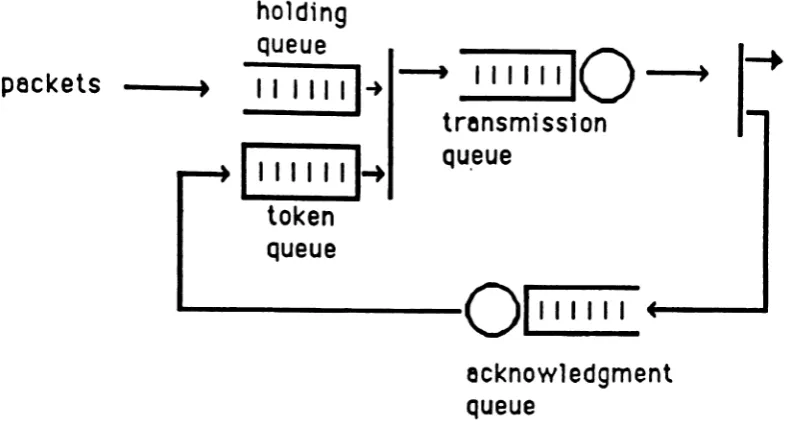
Figure 1 - Single Sliding Window Flow Control
Packets arrive at the holding queue. If there is a token available at the token queue, a packet
takes the token and proceeds to the transmission queue. Upon service completion the packet
leaves the system and the token joins the acknowledgment queue. After completion of its service. the token joins the token queue. Packets that arrive at the system when the token queue is empty are forced to wait in the holding queue. The number of tokens is set equal to the maximum window size.
In order to represent the window flow control in a simple manner, we make use of the
tol-lowing two symbols
1111111'-'
1111111111-+
(We note that these symbols are similar to those used in Fdida, Perras. and Wilk [19]). The
join symbol depicts the following operation: when both queues contain a customer each. the
two custo·m.ers instantaneously depart from their respective queues and merge into a single
customer. The split symbol depicts the operation where a customer arriving at this point is
split into two entities.
Now, let us consider the above single-hop communication link with two layers or nested sliding
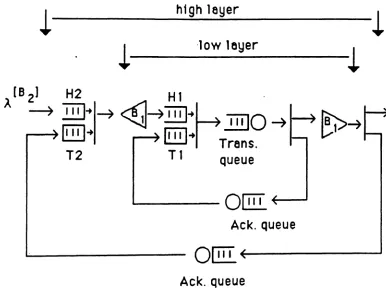
window flow control and packet fragmentation/reassembly, as shown in Figure 2.
h1 gh layer
'low leyer
~---i
[B 2]
H2
H1
.
)..
~
Tiil-+~
-, "'U-,
~ ,...(1~""i"i711
~-+
I
r
.1JI]O
--+
...-.... IT:!TI
-+IT:!TI
-+T
rens.
T2
T 1
Queue
~---O@I
Ack. Queue
O@I~---"'"
Ack. Queue
Figure 2 - The Model for th~ Nested Two-Layered
Sliding Window Flow Control
~
--+
fregmentot
ton
reassembtq
The fragmentation symbol indicates the operation where a packet upon arrival at that point is
split into 8 subpackets. This operation is assumed to take zero time. The reassembly symbol
indicates a buffer where subpackets watt. When the 8th subpacket arrives, all the B sub-packets are instantaneously assembled into a single packet which is released immediately
For presentation purposes, we shall refer to the outside window flow control in Figure 2 as the
high layer, and to the inside window now control as the low layer. Packets arrive at the high
layer according to a Poisson process with rate A. An arriving packet is immediately frag-mented into B2 high layer packets. Each of these packets requires a token from the token
queue T2 in order to enter the low layer. Those high layer packets for which there is no token
available are forced to wait in the holding queue H2. Upon entry to the low layer. a high layer
packet is immediately fragmented into 8, low layer packets. Each of these packets is 1hen
subjected to window now control using token queue T1. They are then transmitted to the
re-ceiver one at a time. An acknowledgment for a low layer packet is generated immediately
upon receipt of the packet. High layer packets are acknowledged upon receipt of Bt low layer
packets comprising the original high layer packet Let W2 and Wt be the window size for the
high and low layer respectively.
We assume that packets arrive in the order in which they were sent, as would be the case in
a virtual circuit protocol. The transmission time is modelled as a single server queue with
exponentially distributed server time. Retransmission of packets is ignored. assuming that the
mean transmission time measures average time to successfully deliver a packet. We also
assume an infinite buffer at layer 2, and sufficient buffer space at layer 1 to hold W28 ,packets.
in addition to the transmission time These service delays have been ignored as we wish to
focus on the interaction between the sliding window now control and packet
fragmenta1ion/reassembly. These delays can be easily incorporated approximately seeing
that the model is analyzed using a hierarchical decomposition method.
Although the above described model has only two layers of sliding window control, it is of
sufficient generality to demonstrate the method of analysis proposed here. The goal is to
re-duce an arbitrary number of nested layers of sliding window control to a single server queue
which represents the performance characteristics of the nested layers. This is done in a
hi-erarchical manner. We first analyze the low layer, as shown in Figure 1,in order to construct a flow-equivalent queue. (This equivalent queue is obtained assuming a Poisson arrival
pro-cess. Upon arrival, a packet is immediately fragmented into 81 subpackets.) Then, in Figure
2, we replace the low layer by its equivalent queue, thus obtaining a queueing model similar
to the one shown in Figure 3, where the transmission queue represents the equivalent queue.
holding
AX
JlX
n
R
(8]
Queue
-~~
I I I I I
IIO-~-+
1-+
~
I
1-+
)
II
n
Htrensrm
5S1
on
reessembly
II
I
n
TI1-+
Queue
buff
er
token
W
eck
Queue
Queue
011
I I I I I
Jl
A
n
A
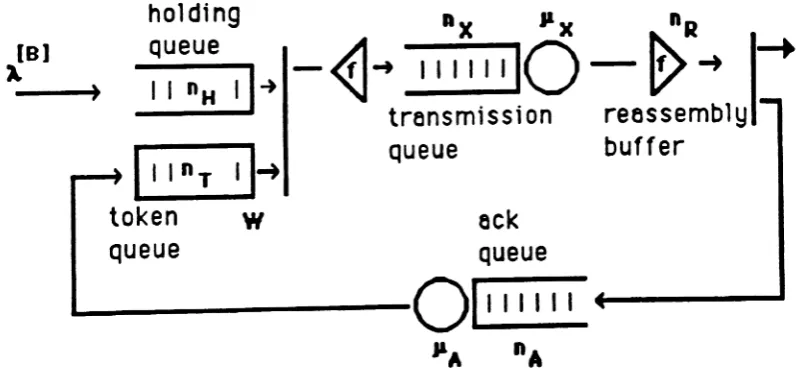
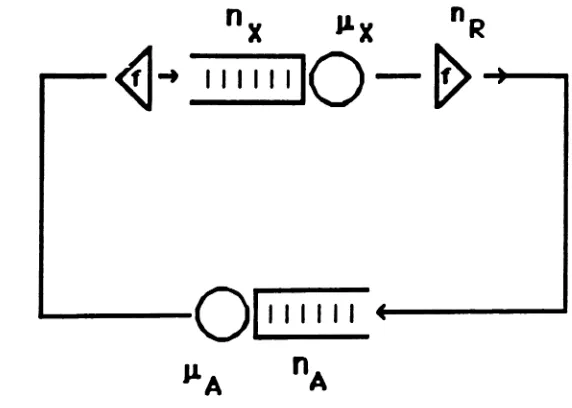
Figure 3 - The Model of a Sliding Window Flow Control
With Packet Fragmentation and Reassembly
Next. we reduce the network in Figure 3 to a single queue, which will represent the
charac-teristics of the oriqinal network. Ifthere is another protocol layer above the two depicted in
Note that unlike the methodology in [12] and related papers, this study does not use a
state-dependent service rate in the equivalent queue. Given exponential transmission times, each
equivalent queue will be of the Erlang type.
It is evident that in order to be able to tackle any number of nested layers of sliding window
now control we need to be able to construct a flow equivalent Queue of the Queuing system
shown in Figure 3. This is taken up in the following section.
III. Reduction to a Single Queue
Let us consider the model shown in Figure 3. Arrivals are in batches of B. The inter-arrival time between two batches is exponentially distributed with mean 1/J.. The window size is W.
When a packet goes through window flow control it is fragmented into f packets. We shall
refer to the packets in the holding queue as high layer packets, and the fragmented packets
inside the window flow control as low layer packets. The service times at the transmission
queue and the acknowledgment queue are exponentially distributed with parameter J..Lx and
J.LA respectively.
Let us define the following notation:
nH: number of high layer packets in holding queue
nr: number of tokens in token queue
nA: number of tokens in acknowledgment queue nx: number of lower layer packets in transmission queue
nR: number of lower layer packets in reassembly buffer ns: number of high layer packets undelivered.
(i.e .. the number of packets"in the system"). 1
ns= nH
+ ,
(nx+
nR)'Given the triple (ns• nAt nR) other quantities above can be calculated using the following
re-lations:
nx= fmin(ns. W - nA) - nR'
The triple (ns ,
n
A ,n
R) then suffices as the state of the system. We will denote a specific state by(ij,k).letPIJ,Irbe the probability of finding the system in state (iJ,k) in steady state. The steady state
probability balance equations which determinePIJ,Irare:
lpooo -
I I - J.L.nAt"O,1 ,Ons
=
0 (A.+
J.LA)POJ,O=
J.LA!JOj+1 ,O+J.LXP1J-1,f-1' j=
1,2, ...,W - 1(A.
+
J.LA)PO,W,o=
J.LXP1,W-1,f-10< ns <
B(A.
+
J.LX)Pi,O,O= IlAPi ,1,O(A.
+
J.lx)p/o k"=
IlAPi,1Ik+
J.lXPiO k-1 'I I k=
1,2, ..., f - 1(~
+
IlA+
Ilx)p/J,o=
J.lAP/J+1 ,O+
lliPi+1J-1,f-1' j=
1,2, ...,W - 1(A
+
IlA+
IlX)PiJ,k= J.lA!JiJ+1 ,k+
IlXPiJ, k-1 'j = 1,2, ..., W - 2 k = 1,2, ..., f - 1
(A
+
J.lA+
Jl.x)P',W-1,k=
JLXP /,W- 1,k- 1I k=
1,2, ...,f - 1 (A.+
J.lA)P"W,o= IlXPi+1,W-1,f-1(1)
(A
+
Jl.X)Pi,O,O= Jl.APi,1,O+
APi-B,o,a(A.
+
J1.X)Pi,O,k=
J.1APi,1,k+
IlXPi,O,1< -1+
A.Pi-B,O,k' k=
1.2, ..., ' - 1(A.
+
IlA+
11x)P'J,O= J-lAPij+1,O+
JLXPi+1J- 1,f- 1+
APi-BJ,O ' j = 1,2, ..., W - 1(A
+
IlA+
JlX)PiJ,k=
J.lAfJIJ+1 ,k+
JlxP/J, k- 1+
)..P;-BJ, k'j=1 ,2, ...,W-2 k=1.2 .... ,f-1
(A
+
IlA+
J1x)P"W-1,k= JlXPi,W-1,k-1+
lp/-B,W-1,k' k= 1,2, ...,f - 1(A.
+
1J.A)PI,W,O=
/IXP/+1,W-1,f-1+
APi-B,W,OIt is desired to reduce the sliding window controlled network of Figure 3 to a single server
queue, and to that end we look at the probabilities
Pit
P,is the probability of having i high layer packets in the entire system. We will work from the
rate equations governing Pi' in order to construct this equivalent queue.
The rate equations governing PI are obtained by summing all of the rate equations (1) with
i
as a subscript on the left hand side. These equations are, (with like terms on left and right
hand sides cancelled),
0<;<8 .
W-1
A.Po
=
JLxL P1J,f-1 J=OW-1 W-1
APi = JLxL PI+1J.f-1 - JLx
I
PIJ,f-l •j=O j=O
W-1 W-1
APi
=
A.Pi-B+
JLxLP,+1J,f-1 - JLxLPiJ,f-1 .i
~
BJ=O j=O
(3)
W-1
We see that the summation
L
Pi,j,f-1 plays an important role. This quantity is the probabilityj:O
of being in those states from which an immediate transition to a state with one less high layer
packet in the system is possible when there are ipackets in the system. (The numberofhigh layer packets in the system only decreases when the final fragment of an original high layer
packet completes transmission. This only occurs when the number in the reassembly buffer
isf - 1 ).
It is desirable to have a set of rate equations for Piwhich do not depend upon the "internal"
parameters of the lower layer,
n
A andn
R • Dependence of the rate equations (3) on thereas-sembly buffer population can be eliminated by making the assumption (for
i
>
0),(4)
for each pair1<,1<' E {O,1, ...,f - 1}. Assumption (4) states that it is equally likely to find any of
as nA
<
W, i.e., as long as there are packets in the transmission queue. Since the mean timespent with k in the reassembly buffer, (given that a packet is in transmission), is
1/11"
for each possible value ofk, assumption (4) seems reasonable.(In fact, while it is true that
00W-1 00W-1
I I
PiJ,k=
I
L PiJ,k'1=1)=0 ;=1j=O
(4) is not true: however, (4) proves to be an adequate assumption).
Using assumption (4) and (2) we have
'-1 W-1 W-1
Pi
=
P"w,o+
I
LP/J,k = Pi,W,O+ ,
IPiJ,f-1k=O j=O J=O
thus
W-1
I
PiJ,f-1 = (Pi - Pi,W,O)/fj=O
(5)
(5) shows another quantity that proves pivotal in the analysis of the sliding window protocol:
p;,W,O' is the probability that all tokens are in the acknowledgement queue, and i high layer
packets are in the system. Define B;as the conditional probability of having all the tokens in
the acknowledgment queue given
i
high layer packets in the system, Le.,Combining (5) and (6), we have
Bj =
Pi,W,O
P,
(6)W-1
I
PiJ,f-1=
P,{1 - 8/)/'.j=O
W-l
Substituting this expression for
L
PiJ,f-1 into (3), we note that under assumption (4). (3) is thej-a
set of rate equations for a bulk arrival queue with state dependent exponential service rate
J.Lx
-,- (1 - 8,).
The values a; can be calculated from the solution to the rate equations (3). There is no known
closed form solution to these equations, thus the solution must rely upon a numerical
tech-nique. Other authors who have used a flow equivalent server methodology to model sliding
window protocols use an approximation procedure to generate the
e, ,
for i = 1,2,.u, W, and assume that Bw+"=
Bw for any n>
0, (see [12J-[18]). The B, are not computed explicitly in these papers, but rather the system throughput is analyzed for the closed system consistingof the transmission and acknowledgement queues when there are i packets in the closed
network. Since this throughput is equal to Ilx(1 - a), the computation of
a,
is implicit. We haveobserved empirically that the results of this approximation are not good for a bulk arrival
system, while they are satisfactory for Poisson arrivals, (see Fdida, Perros, Wilk (19)).
This study takes another approach to simplifying this system. We shall replace the state
de-pendent service rates
1J.;
(1 -a
i) with a single. state independent service rate. which is. insome sense, an average of the state dependent rates. This results in a fairly simple
approx-imation of the original system.
0.01
e.ee
0.07
0.015
0
LOS
0.01 0.OS
12 15 18 it a
i
high loyer packets in system
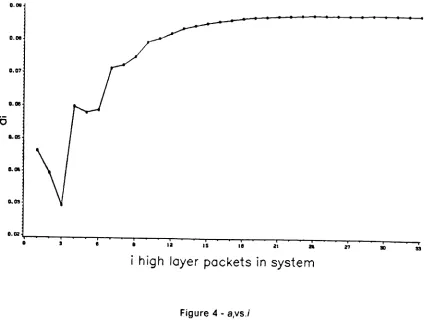
Figure 4 -B,vs.i
We observe that the values tend towards a constant as i gets large. This behavior was
ex-hibited for every choice of parameter values of the system.
Let us refer to the settling down of a,to a constant as ; increases as a state-asymptotic prop-erty. (This is to distinguish from time asymptotic behavior). That all systems examined show
this behavior is not surprising. The state transition structure of the model is aperiodic. When
there are a large number of packets in the system, the system will behave much like a closed
model with W tokens circulating. in that erich token returning to the sending station will find
a packet waiting. As the holding queue is being depleted. the tokens will be continuously
moving through the system and we would expect that the distribution of the tokens between
the acknowledgment and transmission queues will reach a statistical equilibrium. Let us
de-note the state-asymptotic value of
a,
by80" .this point. since the holding queue has been empty. the sending station will have had a chance
to "stockpile" some tokens. and thus the probability of having all tokens in the
acknowledg-ment queue will be relatively low. (The state i = B can also be reached by a transmission
completion with B
+
1 packets in the system, but for systems with utilization not close to one.this event is less likely than arrival to an empty system.)
To construct a single queue approximation to the model under study with state indepehdent
service rate, we would like to find a value 8 which is an average of the
e;
This average value should be less than 80t)' and greater that Be.Let us look at estimating Bf)t'l' the upper bound on
a.
An obvious approach is to use a closed network version of the original network with W packets circulating. This network is shown inFigure 5.
"x
...--01111111
J1
A
"A
Figure 5 - Closed Model Used in Approximation Procedure
The rate diagrClm for this closed network is shown in Figure 6. for the case where' = 3 and
~=O
~n
R
-:
1
n
R
-=2 )
Jl
X
J.lX
nA=O
0
)0
)Q/PX
n~~A
T
Jl
A
Jl
A
T
Jl
X
0
J1
X
)
.A
),
~
T
Jl
A
Jl
X
T
Jl
A
Jl
X
n
A
: 2 0
)0
\ , 1
Jl
A
J!x
t
Jl
A
J1
x
n
A = 3 0
~O
T
Jl
A
n
A
,= ~0
Figure 6 - Rate Diagram of Model Shown
in Figure 5 for W
=
4,f=3.Take for the state of the closed system the pair (nA ,nR ) . Denote the probability of state U.k)
by
YI.It-Sin~e there are Afinite number of states in this model, the state probabilities of this system
are rather easily solved for. It seems that the probabilityYw.o should be a good estimate of
80t'l' as the original system under saturation behaves much like a closed network; however. it
turns out thatYw.o over-estimates Bot"for every choice of parameters examined.
An explanation for this discrepancy comes from comparing the nature of the closed system
to the original. Note that in the original system each transmission completion when
sys-tern there is no explicit value of ns . Itis assumed that ns is "Iarge", and that the number in the acknowledgment queue is increased at the rate at which transmission completions occur
when nR= , - 1, and decreased at the rate at which acknowledgment completions occur. Thus
the closed model estimates for large
n
sthat the probability nux into state (n, j+
1,0) due to a transmission completion is IJ.XPn.i, t-1' wheren
is a "'large" value ofn
s' In the original system, the flux into state (nj+
1,0) due to transmission completions is J.LXP"""J,f-1' If PnJ,t-1 andp;"'J,t-1were equal, then the closed model would accurately predict the probability distribution
of the acknowledgment queue for large ns ;however, in general these probabilities are not equal.
If we look at the state asymptotic behavior of the probabilities Pi' we note that the value of
Pi~lIP; tends to a constant ratio as igets large. (see Figure 7).
'.1
1.2
1.1 1.0
0 0•8
:;J
~o.e
;0.7
.D0 • 8
o
-OD.5
o
~
a..
a.' O.S0.2
0.1
• • II 1$ , . II " 17
Number of high level packets in system
Figure 7 -
P;, tiP;
VS. iThis phenomenon is observed for all of the test cases run. We thus post that for; large
for some Yoo E (0.1). A formula for Yon comes from summing the aggregate rate equations (3)
for i
=
0,1,2,...,N+
B, which gives us (after simplification)N+B W-1
A L PI
=
IlxLPN+B+1J,f-1'I=N+1 j=O
From (7) and (assuming Nis large) assumption (8), (9) becomes, (after simplification),
(9)
B
= 1 - - , { - 1-yoo
(Jlx/fJ Y~(1 - Y(0) .
We see that assumption (8) implies the existence of Boo' since the right-hand side above is independent ofN. We thus have an equation relating Booand Yoo
B
1 - - , { - 1-yoo
Boo
=
(Ilx/f)y~(1
- Y(0) . (10)Another equation relating aoo and Yoo is obtained from an analysis of the closed network,
(Fig-ure 5). We have already seen that empirical evidence indicates that there is a constant ratio between state probabilities for large
n
s. Let us modify the rate at which tokens enter theac-knowledgment queue in the closed model in order to reflect more accurately the true
dy-namics of the system. Since the only service completions which result in a token entering the
acknowledgment queue are those which occur when
n
R = , -1 ,we will replace the rate Ilxat which transmission completions occur in these states by YooJlx, and leave the other service rates alone.
The probability balance equations for this modified system are:
Yoo JlXY W- 1,f- 1
=
PAYw,o nA=
W - 1
ILXYW- 1,f- 2 = (ILA+
YoolL x)YW- 1,f- 1n
A= W - 2....,1(-1
'YooIJ. XYj,f- 1
=
JlAl > J+1,kk=O
J..LXYj,f-2 = (J..LA
+
YooJ1X)Yj,f-1 - J.lAYj+1,f-1J1XYj,k = (J.l.A
+
J1X)Yj,k+1 - J.l.AYj+1,k+1' k= f - 3,...,0(-1
'YooIJ.XYO,f- 1
=
IJ.ALY1,kk=O
J.l.XYO,f-2
=
YooJlXYO,f-1 - JlAY1,f-1JI.XYO,k
=
JlXYO,k+1 - JlAY1,k+ 1 ' k=
f - 3,...,0(11)
Equations (11) can be solved by noting that the closed network on which the rate equations
are based can be cast as a Coxian server with a state dependent arrival rate. Marie, [20], has
developed an algorithm for solving for the state probabilities of such a queue.
Let us see how the closed network can be described as a Coxian server with state dependent
arrival rates. Let nc
=
W - nA . nc is the number of high layer packets in the transmissionqueue, (including the high layer packet in service). Arrivals to the transmission queue occur
at rate J..LA whenever the acknowledgment queue is not empty, thus the state dependent arrival
process to the transmission queue, denoted by A(nc)is given by
_ {JlA, nc = 0,1, ...,W-1
A.(nc) -
°
, nc->
W . (12)The transmission server can be thought of as a Coxian-f server of high layer packets. A high
layer packet beginning service at the transmission server requires f sequential exponential
service phases before completing service. In the model with modified rates, (i.e. (11)), the first
, - 1 service phases have rate IJ.x and the last phase has rate '100 IJ.xo Yw.o •the probability of
having arl tokens in the acknowledgment queue in the closed model, is equal to the probability
that nc
=
0 in the Coxian server with state dependent arrival rate (12). This probability canUsing the solution from (11) for Yw,o as an estimate of Boo together with (10) gives us two
re-lationships betweenBoo andYoo' Solving for the pairBoo' Yoowhich simultaneously satisfies both
relations resulted in a consistent under-estimate of Boo; however, this under-estimate proved empirically to be a fairly good choice for
a.
Furthermore, it was empirically found that it suffices to carry out a couple of iterations of the algorithm used to find the simultaneoussol-ution to (10) and (11). Thus, the following algorithm proves to give a good value for 8.
Approximation Algorithm
1. Let }'~= 1. Solve (11) for 8
00,
2. Use the value of800 from 1) to calculate a new Yoo ' using (10).
3. Using 'Yoo from 2), calculate a new Boo from the closed network equations (11). Use this
value ofa~ for
a.
The approximation algorithm gives a good estimate for the average service rate of high layer
packets,
~x
(1 - B). It remains to determine the type of server to be used for the approximate queue. The model of Figure 3 has a transmission mechanism which must complete fexpo-nentially distributed transmissions to deliver a high layer packet. The transmission time for
the high layer packet thus has an Erlang-f distribution. In the approximation procedure, we
used an Erlang-h server with mean service rate
Il;
(1 - B)to represent the transmissionnetwork as seen by the higher layer.
The number of stages, h, in the approximate Erlang server is determined as follows. If f is 2
or 3,h
=
2 is used. This choice is based on comparison of experiments with h=
1,2 , and 3in the approximation algorithm against exact solutions computed by Neuts' matrix-geometric
procedure, [21]. For anyf> 3, h= 3 is used. Since the sliding window mechanism introduces variability into the effective delivery time distribution beyond that of the transmission time
distribution, less than f stages are used in the approximate model, since the Erlang-k family
of distributions has increasing variance as k decreases. The exception to this rule Is when
f= 2. In this case the Erlang-2 distribution and the exponential. or Erlang-1. gave comparable
results. The number of stages In the approximate model is limited to three, since the Erlang-k
distributions become less distinct as k increases. It is hoped that using no more than three
Limiting the number of stages in the approximate Erlang server also helps to keep the
com-putational burden of the approximation scheme down when more than two nested layers of
sliding window protocol are analyzed. Consider the network of Figure 8(a). This network has
three layers of sliding window protocol. Analyzing the performance of this network
hierar-chically, we would first reduce the lowest layer to a single exponential server. We use the
approximation algorithm to compute the service rate of this server, analyzing the lowest layer
model with arrivals at rate
AB
1B2in batches of sizeB
3. After this step we have the approximatenetwork of Figure 8(b). Now we use the approximation algorithm to reduce the lowest layer
of sliding window protocol in this network, using an arrival process of rate
AB
1with batches of size 82, This results in the network of Figure 8(c), where the Erlang-h server has h=
2or 3, depending upon the magnitude of B3 .The network of Figure 8(c) appears to be a model which we have not yet considered. It differs
from the model of Figure 3 by having an Erlang rather than an exponential server. From a modelling point of view, however, these two networks have the same structure. In the model
of Figure 3 f exponential services must be completed to deliver a high layer packet. From the
point of view of the higher layer, the fragmentation and re-assembly of the lower layer are
invisible; the higher layer sees the delivery as an Erlang t, (fexponential times on per
frag-ment). In Figure 8(c), B2 Erlang services must be completed to deliver a high layer packet.
Since one Erlang-h service is composed of the sum of h exponential random variables,
deliv-ery of a high layer packet in the model of Figure 8(c) takes hB2exponential delays; thus the
model of Figure 8(c) is equivalent to the model of Figure 3 when f = hB2• Casting the problem
in this form, we can reduce the network of Figure 8(c) to a single queue using the
approxi-mation algorithm.
We now see why keeping the number of Erlang stages in the approximation server small is
~---
OE
~---_---JJl
A
1
(e) - Orlg1nel model
~----
OE ....
(
-Jl
A2
" " " - - - 0 E
~---JJl
A
1
(b) - lowest 1evel
reduced
...-.---- OE
~---_...
Jl
A
1
(c) - two lowest levels
reduced
Table 1 • Data Set Parameters for Validation of Queueing Model Shown In Figure 3
Data Set
Number % of maximumlBflJ.lxas Batchsize
Window size
Frag
1 22% 3
2
2
.432
26% 32
2 .833 20% 3 4
2
.434 20% 3 15
2
.435
17% 32
4 .236 17% 3 4 4 .23
7 24% 3
2
16 .068 35% 8
2
2
.459 32% 8 4
2
.4510 48% 8
2
6 .1511 79% 3 2
2
.8312 67% 3 4
2
.8313 62% 3 8
2
.8314 70% 3
2
4 .6315 62% 3 4 4 .63
16 60% 3 8 4 .63
17 69% 3
2
10 .6318 61% 3 4 10 .63
19 80% 6
2
2
.8320 67% 6 4
2
.8321 62% 6 8 2 .83
22 96% 6
2
5
1.2523 81% 6 4 5 1.25
24 93% 3 4 2 .94
25 85% 3 8 2 .94
26 98~o 3
2
8 .7527 84% 3 4 8 .75
28
80% 3 8 8 .7529
89% 5 42
.9330 82% 5 8
2
.9331 86% 5
2
5
.70IV. APPROXIMATION RESULTS
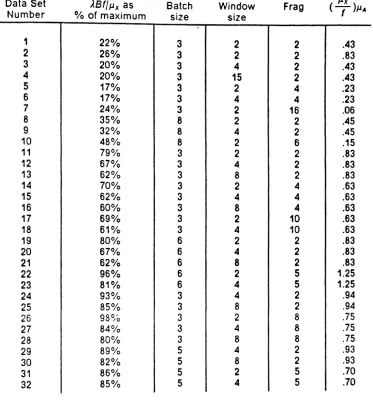
The approximation algorithm was evaluated for 32 data sets of networks with the structure of
Figure 3. The parameters for these data sets are shown in Table 1. In each case the
ap-proximate results were compared to exact solutions obtained numerically. The numerical
procedure for these models required working with matrices of the order of f BW, so there is
a practical limit on the range of parameters which could be tested. Within these limits, the
system utilization, (the second column of Table 1 shows the offered load as a percentage of
the maximum possible throughput), the window size, f, and the ratio of high layer packet
transmission time to acknowledgment transmission time. (
~.
)IIlA
were varied.The numerical procedure used was Neuts: matrix-geometric algorithm, [21]. Due to the highly
regular structure of the rate equations (1), considerable computational efficienciescan be
ef-fected. In a straight-forward appllcation of the matrix-geometric algorithm, a matrix of
di-mension fBW would need to be inverted. This matrix has a block structure. and its inverse
can be evaluated directly in terms of the inverse of anf\Nsized block. The smaller block also
has a regular structure, and its inverse can be written without recourse to a numerical
pro-cedure. The algorithm was written in PASCAL, and the abstract data typing features of that
language facilitated the block structure representation of the rate matrix.
Figure 9 shows the relative error in mean number of high layer packets in the system vs. the
predicted probability that the acknowledgment queue is full. The probability of having the
acknowledgment queue full is a measure of how far from a true Erlang distribution the
trans-mission time distribution will be. The percent errors are fairly low. In addition to the errors
introduced by not having an Erlang transmission distribution, there are also errors due to
approximating a system with f> 5 by an Erlang-3. Figure 10 shows the relative error in
pre-dicted mean vs. probability that the acknowledgment queue is full, for those data sets where
, =
2. (Due to the limitations of the numerical procedure this is the only value of 'for whichmany data points were calculated). In this case. we see that the errors are roughly correlated
0.4
0.3
0.2
0.18
6
2 .
o
~-,...a""""---.---r--..---..--.-_ _
0.0
4
10
c: CD OJ~
E
...
.., c
.,
....
~
Q) '
-L. 0
t:
Q)
probebillty eck Queue full
Fi gure 9 - Rel at1ve Error
01
the Mean Number
of
Hi gh
Leyer
Packets vs.
Probability
Ack.
Queue
is
Full
0.3
02
0.1 o~---..---...--....---.--....----.0.0
c
4
IJ Q) (f)E~
c~3
..- U L- ., o C. L-~ L- 02
OJ L. (1) OJ :>.0 ..-E
..,
CD ~
1
...-
c:
Q)
L.
probebility eck Queue full
Fi gure 10 - Re let
i
ve Error of the rteen Number of
While errors due to Erlang "fit" problems cloud the picture. it is generally true 'hat for a given
f.
high utilization, high ratio ('~
)/II
A and small window size will be the cases with the worstperformance, having relative errors from 5% to 10%. This observation matches that of
pre-vious studies, (15].
Table
2
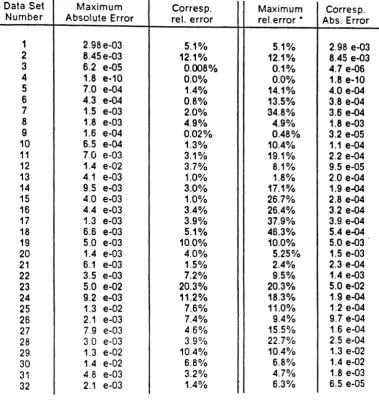
compares the actual values forPi
against the values from the approximating queue for the data sets of Table 1. For each data set the maximum absolute error over all i and themaximum relative error for states with probability greater than 0..001 are shown. The results
are fairly good. In Table 2 we also show the relative error at the value ofi for which the
maximum absolute error was observed. and the absolute error for the value of i where the
maximum relative error was observed.
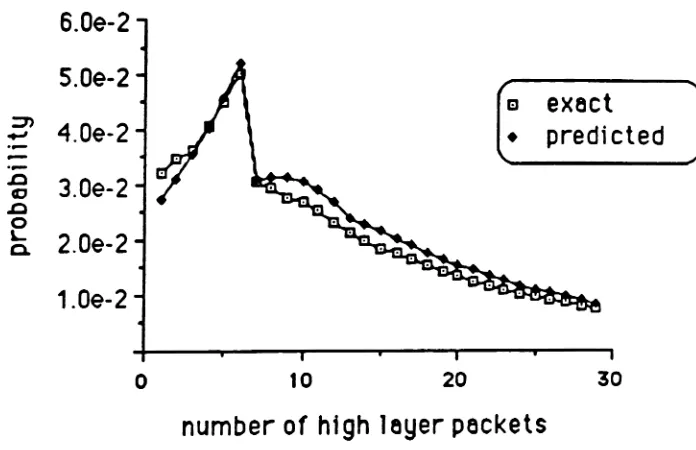
Figure 11 shows the predicted and actual PI probabilities for data set 23, which was one of the
poorest predictions, having a maximum deviation of 0.05.
6.0e-2
5.0e-2
exact
::n
4.0e-2
predi cted
+J
.0
3.0e-2
CD
.c 0
L.
2.0e-2
Q.
1.0e-2
o
10 20 30number of hi gh
layer packets
Figure 11 - Predicted vs. Actual Probability Distribution
Table 2 • Predicted vs. Actual
Pi
Data Set Maximum Corresp. Maximum Corresp.
Number Absolute Error reI. error rel.error * Abs. Error
1
2.98e-03 5.1 % 5.1 % 2.98 e-Q32 8.45e-03 12.1 % 12.1 % 8.45 e-03
3 6.2 e-OS 0.008% 0.1% 4.7 e-Q6
4 1.8 e-10 0.0% 0.0% 1.8 e-10
5 7.0 e-Q4 1.4% 14.1% 4.0 e-04
6 4.3 e-Q4 0.8% 13.5% 3.8 e-D4
7 1.5 e-03 2.0% 34.8% 3.6 e-D4
8 1.8 e-03 4.9% 4.9'% 1.8 e-03
9 1.6 e-04 0.020/0 0.48% 3.2 e-D5
10 6.5 e-04 1.3% 10.4% 1.1 e-04
11 7.0 e-03 3.1 % 19.10/0 2.2 e-04
12 1.4 e-02 3.7% 8.1 % 9.5 e-05
13 4.1 e-03 1.0% 1.8% 2.0 e-04
14 9.5 e-Q3 3.0% 17.1 % 1.9 e-Q4
15 4.0 e-03 1.0% 26.7% 2.8 e-Q4
16 4.4 e-03 3.4% 26.4% 3.2 e-Q4
17 1.3 e-03 3.90/0 37.9% 3.9 e-Q4
18 6.6 e-03 5.10/0 46.3% 5.4 e-Q4
19 5.0 e-03 10.0% 10.0% 5.0 e-D3 .
20 1.4 e-03 4.0% 5.25% 1.5 e-03
21 6.1 e-03 1.5% 2.4% 2.3 e-Q4
22 3.5 e-03 7.2% 9.5% 1.4 e-D3
23 5.0 e-02 20.3% 20.3% 5.0 e-02
24 9.2 e-03 11.2% 18.3% 1.9 e-Q4
25 1.3 e-02 7.6% 11.0% 1.2 e-04
26 2.1 e-03 7.4% 9.4% 9.7 e-04
27 7.9 e-03 4.6% 15.5% 1.6 e-04
28 3.0 e-03 3.9% 22.7% 2.5 e-04
29 1.3 e-02 10.4% 10.4°/0 1.3 e-02
30 1.4 e-02 6.8°10 6.8°10 1.4 e-02
31 4.8 e-03 3.2% 4.7% 1.8 e-03
32 2.1 e-03 1.4°/0 6.3°10 6.5 e-OS
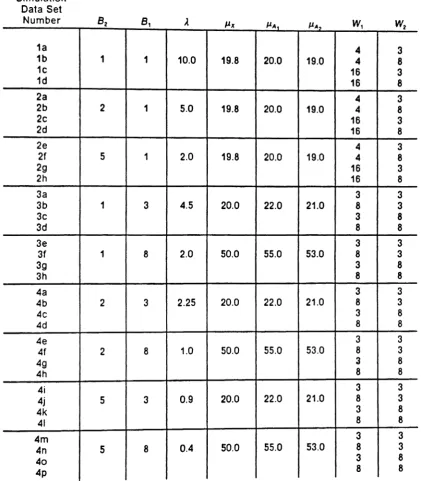
Table 3 • Simulation Data Set Parameters for Validation of the Queueing Model shown in Figure 2
B,
11I,
1a 4 3
1b 1 1 10.0 19.8 20.0 19.0 4 8
1c 16 3
1d 16 8
2a 4 3
2b 2 1 5.0 19.8 20.0 19.0 4 8
2c 16 3
2d 16 8
2e 4 3
2f 5 1 2.0 19.8 20.0 19.0 4 8
2g
16 32h 16 8
3a 3 3
3b 1 3 4.5 20.0 22.0 21.0 8 3
3c 3 8
3d 8 8
3e 3 3
3f 1 8 2.0 50.0 55.0 53.0 8 3
3g 3 8
3h 8 8
4a 3 3
4b
2
3 2.25 20.0 22.0 21.0 8 34c 3 8
4d 8 8
4e 3 3
4f 2 8 1.0 50.0 55.0 53.0 8 3
4g 3 8
4h 8 8
4i 3 3
4j 5 3 0.9 20.0 22.0 21.0 8 3
4k 3 8
41 8 8
4m
3 34n
5 80.4
50.0 55.0 53.0 8 340 3 8
4p
8 8Simulation Data Set
Multi-layer Simulation vs. Approximation Results
Above we compared the results of the approximation algorithm of Section III to exact results
for a model with the structure of Figure 2. The comparisons of the approximate results to
exact results assumes that the transmission queue is an exact representation of the lower
layer network, and thus allows us to evaluate the approximation algorithm apart from errors
in the lower layer approximation. We next evaluated the performance of the hierarchical
method.
We performed the hierarchical reduction for 36 examples with the structure of Figure 2. In
each case the approximation algorithm was used to reduce the lower layer sliding window
control shown in Figure 1 to a single queue, assuming arrivals at the rate AB2. In this case the
lower layer approximation is simplified since there is no fragmentation inside the lower layer
window flow control. The resulting approximation queue was then used as the transmission
queue in a network with the structure of Figure 3, and this latter network was analyzed by the
approximation algorithm.
The data set parameters used are shown in Table 3. We attempted to use enough data sets
to examine the various possible relationships between W1, W2, B1 •and 82 .
Due to the large state space associated with an exact probabilistic model of Figure 2, we are
not able to generate exact solutions against which to compare the approximation results. We
thus constructed a simulation model of the network in Figure 2, with the rates, window sizes,
and amount of fragmentation as parameters. We used the results from a simulation model
as a basis of comparison for the approximation results. For each data set in Table 3, a
num-ber of independent replications of the simulation were run. Each replication began with no
packets in the system, and all tokens at both layers in the token queue. Each replication was
terminated after 500 high layer packets were delivered. We calculated the mean number of
high layer packets in the system for each replication, and from these values calculated an
approximate 95% confidence interval for the mean number of high layer packets in the
The comparison of the simulation mean number of high layer packets in the system and the
predicted mean number from the hierarchical approximation is shown in Table 4 We see that
with the exception of cases 3a. 3c, 3f, 3h, 4a, and 4c, the approximate means lie within the 95%
confidence intervals.
We also used the simulation data to construct point estimates of the probability distribution
of the number of high layer packets in the system, along with the associated approximate 95%
confidence intervals for these estimates. Figure 12 shows a comparison of the probability
distribution of high layer packets in the system obtained using simulation against the
proba-bility distribution generated by the approximation algorithm. Figure 12 is for case 4m, and
was selected as being typical.
0.08
20
10
number of hi gh leyer
packets
0.00
o
0.06
-m-
~ppro)(irnition:n
...
sVnul~tion
~
....
~
....
.c
0.04
.,
D
0
s;
c..
0.02
Figure 12 - Comparison of Simulation and Approximation Probability
Distributions of the Number of High Layer Packets for Data Set 4m
We also experimented with a state-dependent now-equivalent server approach. developed by
Fdida. Perros. and Wilk. (19). The authors developed this procedure assuming single Poisson
arrivals at rate
J.:
we generalized the procedure to batch arrivals. (as in (14]). and tested the . t I data sets for the model of Figure 3 with f= 1. These results wereprocedure agalns samp e
Table 4 • Comparison of Approximate and Simulation Means for the Data Sets Given In Table 3
Data Approx. Simulation 95% conf.
Set mean mean interval
1a 1.64086 1.609 ±0.3516
1b 1.182 1.1778 ±0.1997
1c 1.4297 1.445 ±0.2807
1d 1.0355 1.001 ±0.1308
2a 2.7365 2.3068 ±0.5234
2b 1.8230 1.7338 ±0.3324
2c 2.4025 2.033 ±0.4543
2d 1.6075 1.4247 ±0.2428
2e 6.2412 6.108 ±1.610
2f 3.9034 4.1997 ±O.8466
29 5.5368 5.4561 ±1.4297
2h 3.5031 2.8488 ±0.6891
3a 4.0051 3.2045 ±0.4435
3b 1.9267 1.7681 ±0.2595
3c 3.9699 3.2013 ±0.4440
3d 1.9115 1.7655 ±0.2593
3e 0.5351 0.5244 ±0.O286
3f 0.4347 0.4127 ±O.O194
3g 0.5351 0.5245 ±0.0286
3h 0.4347 0.4127 ±0.O194
4a 6.5422 5.6219 ±O.8189
4b 3.1004 2.7855 ±0.4104
4c 6.4776 5.6043 ±O.8200
4d 3.0694 2.7749 ±0.4123
4e 0.8414 0.8300 ±0.0724
4f 0.6787 0.6452 ±0.0505
4g 0.8414 0.8300 ±0.0724
4h 0.6787 0.6452 ±0.OS05
4i 11.416 13.693 ±3.1462
4j 6.6247 7.4186 ±1.4554
4k 14.001 13.675 ±3.1474
41 6.5432 7.3887 ±1.4545
4m
1.7604 1.6871 ±O.22714n 1.4108 1.3066 ±0.1541
40
1.7604 1.6871 ±0.2271The method performed well with single arrivals, though errors were slightly higher for both
predicted mean and predicted distribution compared to the algorithm in this paper. For
batched arrivals, (8
>
1), the flow-equivalence method was markedly inferior. The predictedstate probabilities were monotonically decreasing, and did not reflect the true shape of the
distribution. The relative errors for the mean number in the system exceeded
250~
in somecases.
An explanation for the poor performance of the flow-equivalence methodology with batched
arrivals is the assumption inherent in the technique that the service rate with n packets in the
system is the service rate of a closed system in steady-state with min (n,W) packets present.
With batched arrivals this instantaneous steady-state assumption is not warranted.
v.
CONCLUSIONSIn this paper we have presented a new procedure for approximating the behavior of a single
hop network with multiple layers of sliding window flow control. The method differs from most
previous research presented in the published literature in that it explicitly takes into account
the fragmentation of packets which occurs in actual systems. The procedure was compared
to exact numerical solutions, and found to perform well.
We see particularly that for systems with batched arrivals that the state asymptotic approach
yields better results than procedures based on
a
equivalent server approach. Theflow-equivalent server technique assumes an "instantaneous steady state" behavior of the
net-work, that is, the network with a given population behaves like a closed network in steady
state with that population. This technique is successful in the models where the state does
not change dramatically in anyone instantaneous transition. This is clearly not the case in
systemswith batched arrivals.
The procedure is easy to implement, and easy to solve on a computer. Its speed makes it
feasible to think of including the procedure in an interactive network designer expert system,
The procedure reports its results as the service rate and number of exponential service stages
of a queue. This should make it a useful add-on to general purpose queueing network solution
software packages. These packages typically cannot handle the special features of a sliding
window protocol. By reducing the portions of the queueing network which have sliding
win-dow control to a single queue, the procedure approximates the sliding winwin-dow sub-net by a
REFERENCES
[1J ~.S. Tanenbaum, Computer Networks, Englewood Cliffs NJ: Prentice-Hall, Second
Edi-tion, 1988. '
(2] M. Gerla and L. Kleinrock, "Flow Control: A Comparative Survey," IEEE Trans. Com-mun., Vol. COM-28, April 1980
(3] M.C. Pennotti and M. Schwartz, "Congestion Control in Store and Forward Tandem Links," IEEE Trans. Commun., Vol. COM-23, December 1975.
[4] A: Chaterjee, N.D. Georganas, and P.K. Verma, ..Analysis of a Packet Switched Network with End to End Congestion Control and Random Routing," IEEE Trans. Commun., Vol. COM-25, December 1977.
[5] J. Labetoulle,. G. Pujolle, and N. Mikou, ..A Study of Flows in an X25 Environment," in Flow Control In Computer Networks, J.L. Grange and M. Gien, Eds, NY: North Holland, 1979.
[6] M.Reiser, itA Queueing Network Analysis of Computer Communication Networks with Window Flow Control," IEEE Trans. Commun. Vol. COM-27. August 1979.
[7] S. Lam, "Queueing Networks with Population Size Constraint," IBM Journal of Res. and Develop., Vol. 21, No.4, 1977.
[8] A. Thomasian and P. Bay, "Analysis of Queueing Network Models with Population Size Constraints and Delayed Blocked Customers," in Proc. 1984 ACM SIGMETRICS Confer-ence on Measurement and Modelling of Computer Systems,
a
special issue of Per-formance Evaluation Rev., Vo1.12, No.3, 1984.[9] K. Goto, Y. Takahashi, and J. Hasegawa, IIAn Approximate Analysis of Controlled Tan-dem Queues," in Proc. of the Int'l Seminar on Modelling and Performance Evaluation Methodology, Paris, 1983.
[10] I.F. Akyildiz, "Performance Analysis of Computer and Communications Networks with local and Global Window Flow Control," INFOCOM '88, pp. 400-410.
[11J L. Kleinrock and P. Kermani, "Static Flow Control in Store and Forward Computer Net-works," IEEE Trans. Commun., Vol. COM-2S, February 19S0.
[12J M. Reiser, "Adrnlsslon Delays on Virtual Routes with Window Flow Control," in Perf. of Data Commun. Systems and Their Applications, G. Pujolle, ed., NY: North Holland, 1981.
[13J A. Thomasian and P. Bay, "Performance Analysis of Window Flow Control for Multiple Virtual Routes," Proc. IEEE INFOCOM '84, San Francisco, April 9, 1984.
[14J O. Gihr and P.J. Kuehn, "Comparison of Communication Services with Connection-or-iented and Connectionless Data Transmission," in Proc. Int'I. Seminar on Computer Networking and Performance Evaluation. Tokyo, September 18-20. 1985.
[15] G.
Varghese, W. Chou, andA.A.
Nilsson, "Queueing Delays on Virtual Circuits using a Sliding Window Flow Control Scheme.n Proc. ACM SIGMETRICS Conference,Minneap-olis, 1983.
[16] M. Schwartz, IIPerformance Analysis of the SNA Virtual Route Pacing Control," IEEE Trans. Commun., Vol. COM-30, Jan. 1982.
[18) M. Murata and H. Takagi, "Two-Layer Modeling for Local Area Networks," IEEE Trans. Commun., Vol. COM-36, Sept. 1988.
(19) S. Fdida, H. Perras, and A.Wilk, "Semaphore Queues: Modelling Multi-Layered Window Flow Control Mechanisms," IEEE Trans. Commun., (to appear).
(20] R. Marie, "Calculating Equilibrium Probabilities for1(n)/CIc
/1/N
Queues," in Proceedingsof Performance '80, Toronto, 1980.