106
FINANCIAL TIME SERIES REPRESENTATION USING
MULTIRESOLUTION IMPORTANT POINT RETRIEVAL
METHOD
Chaliaw Phetkingl,Mohd Noor Md. Sap2,Ali Selamat2
I.2Faculty of Computer Science and Information System
Universiti Teknologi Malaysia,lohor, Malaysia
[email protected],2{mohdnoor,aseJamat }@utm.my
Abstract: Financial time series analysis usually conducts by determining the series important
points. These important points which are the peaks and the dips indicate the affecting of some
important factors or events which are available both internal factors and external factors. The
peak and the dip points of the series may appear frequently in multiresolution over time.
However, to manipulate financial time series, researchers usually decrease this complexity of
time series in their techniques. Cons~quently,transforming the time series into another easily
understanding representation is usually considered as an appropriate approach. Inthis paper, we propose a multiresolution important point retrieval method for financial time series
representation. The idea of the method is based on finding the most important points in
multiresolution. These retrieved important points are recorded in each resolution. The
collected important points are used to construct the TS-binary search tree. From the TS-binary
search tree, the application of time series segmentation is conducted. The experimental results
show that the TS-binary search tree representation for financial time series exhibits different
performance in different number of cutting points, however, in the empirical results, the
number of cutting points which are larger than 12 points show the better results.
Keywords: Financial time series, Multiresolution , TS-binary search tree, SB-binary search
tree, Segmentation
1. INTRODUCTION
Time series analysis is become one of the most popular data mining tasks and is widely
applied in many research areas; for example, economics, finance, medicine, chemistry,
bioinformatics, etc. For financial time series, the data are generated from the complex and
dynamic system with noisy, non-stationary and chaotic data series [I]. Financial data such as
stock prices or currency exchanges are discrete time series of prices data. A financial time
series demonstrates its movement in a fluctuant way due to some important factors or events
which are available both internal factors (e.g. company news) and external factors (e.g.
politics, economic growth). These important factors usually reflect to stock prices or
exchange rates directly.
Financial time series researches usually relate to following tasks; pattern matching[3],
segmentation[4], dimensionality reduction[5], c1ustering[6], and forecasting[7]. As with all
time series data mining problems, the key to effective and scalable algorithms is choosing a
suitable representation of the data [2]. Many researchers propose the representation
techniques of time series data as found in reference [2],[8],[9],[ 10]. Authors in [8] propose an
Extended Symbolic Aggregate ApproXimation(ESAX) which is a symbolic representation of
financial time series. ESAX was adapted from the original SAX[2]. In reference[9], the
author presents a generalized model in financial time series by the utilizing of turning points
in financial data. Turning points can be considered as the important points in a study done by
Fu et al. [10].
In the study of Fu et al. [10], they propose a financial time series representation based
on the Perceptually Important Points(PIPs)[lI] which are mapped to SB-Tree data
structure. These PIPs are collected by measuring the distance between the series
points and their trend. The point that has the largest distance is chosen. Alternatively,
the important points exist in the series usually occur in as both the peak points and the
dip points with the equivalent importance priority. Thus, it is better to collect both the
most peak point and the most dip point in the same time or in the same iteration.
In this paper, we introduce a TS-binary search tree for financial time series data based on
a Multiresolution ImportaNt pOits Retrieval (MINOR) method. MINOR is used for collecting
the most important points (MIPs) which comprises of the most peak (MP) point and the most
dip (MD) point. The MIPs are collected in multiresolution views and used for constructing the
TS-binary search tree. The financial time series segmentation is conducted as an
implementation.
This paper is organized as following. Section 11, we introduce the MINOR method.
Section JJl the TS-binary search tree for financial time series representation is proposed.
Section IV, an example of trend based financial time series segmentation is conducted. The
last section, the conclusion and recommendation for future works are described.
2. RETRIEVALS OF THE MOST IMPORTANT POINTS
In this section, the retrieval of the most important points of financial time series is
focused. Firstly, the multiresolution important point retrieval method is conducted, and the
second section, the method of finding the most important points is described.
2.1 MINOR method
Given time series S= {Sj, S2, S3, ... ,sm}, where m is the length of time series. First, finding
the global trend of the time series sequence is processed by drawing a trend line which
connects the first point and the last point of the time series. Next, the MIPs which comprises
of MP and MD points are recorded. To retrieve the MP and the MD points from the time
series, we apply the Finding the Most Important Points (FiMIP) method. Consequently, the
MP and MD points are used as cutting points, then, the time series is divided into three
subsequences. For each subsequence, starting from the first subsequence, finding the trend of
the subsequence is conducted and then finding MP and MD points of the subsequences are
determined and recorded.
The algorithm is performed recursively until the final condition is met. The final condition
is the length of final subsequences which is designed by user. However, the smallest length of
a subsequence that can be used as the final condition is 3. The pseudo code of the MINOR
method is depicted in figure I.
Function MINOR(S,cond) Input sequence S[ I..m] Integer cond
Output list MIPL,sl Begin
Repeat while length(S)>~cond MIP~FiMIP(S.cond) Add MIP to MIPList
Divide segment S into S I, S2 and S3 at MIP Recursively call to MINOR for all S I,S2,S3 End
End
Return MIPL,sl End
Figure I Pseudo code for MINOR method
2.2 FiMIP method
Given a time series segment S = { 51,52, ""Sm-I, sm}, the algorithm of FiMIP can be
illustrated as following.
MIP is a set of the most important points obtained from a sequence. Two kinds of points
are collected; MP and MD points. Each pair of MP and MD is retrieved from a sequence in
iteration. The MP point is the point that has the largest distance away up from the trend line of
the sequence and the MD point is the point that has the largest distance away down from the
trend line of the sequence. Measuring of the distance can be determined by various methods;
for example, Euclidean distance(ED), perpendicular distance (PD), and vertical distance
(VD).
Actually, the distance value is positive for MP point and negative for MD point. In
particular, in this paper vertical distance measurement is selected because of the better results
in capturing of the highly fluctuated points [10]. The illustration of the method is depicted in
figure 2.
f
s3(x3,y3)f""'"
p'"
1
d2
s2(x2,y2)
sm -l(xm -1,ym -1)
dm-1
b
,sm -l'(xm -l',ym -11
s... sm(xm,ym)
Figure 2 VD height measuring
As can be seen, figure 2 illustrates a vertical distance measurement. The method is started
from making a trend line connecting between the first and the last points, we can see as the
lineSISm in figure 2. From the trend line, we can see that peak points appear up higher than
the lineSISm, and conversely, the dip points appear lower down from the lineSISm' Different
points correspondingly give different distance far away from the lineSISm'Every point around
the line SISm must be measured its distance. In figure 2., for example, the point Sz appears
110
lower than the line SJSmand the pointSm-Jappear higher than the lineS.Sm' In case of the point
S2, the distance d2is measured. As can be seen above, d2is a straight line connecting between
S2 andsz', thus d2is a distance betweenS2 andS2'orYrYz' or we can say d2is a YO ofS2. For
the point Sm.j, we can find its YO in similar way. In general, the distance of the ith point is
Yi-Y/can be calculated as equation 1.
d,=Y, -Y,'
wherex, andy,are the coordinate of theithpoint and 1OS;iOS;m.Y" Yeare the value of the time series at the first pointX.Iand the end pointXerespectively.
In figure 2, supposedly, if YO ofs2is the smallest value and if YO ofsm _, is the largest
value, thus, we can recordS2and its YO as MO point and recordSm-J and its YO as MP point.
t
[
L
~-~(a) (b)
Figure 3 All points are lower than the trend line(a) and all points are lower than the trend line(b).
Nevertheless, there are other two special cases of FiMIP method. These two special cases
are depicted in figure 3 and figure 4.
Finding the MPO points in other two cases, their calculations h,we a little bit of
difference. In figure 3(a), all points appear as dip points; the MP point is not available. Thus,
in this case we can record MO point information but MP point cannot be recorded, so it is set
to be NULL. Similarly, in figure 3(b), all points appear as peak points, thus, the MP point is
recorded while MO point is set to be NULL.
111
3. TS-BINARY SEARCH TREE REPRESENTAnON
TS(Time Series)-binary search tree is designed as a variety of binary search tree with
additionally special nodes and their arcs information while the binary search tree properties
are kept. As can be seen, in binary search tree, ifxis a node with key value key[x] and it is
not the root of the tree, then the node can have a left child (denoted by left[x]), a right child
(right[x]) and a parent (p[x]). Every node of a tree is constructed under the following binary
search tree properties:
(I) for allnodesyin left subtree ofx,key[y] <key[x]
(2) 'for all nodesyin right subtree ofx,key[y]>key[x]
The additional nodes in TS-binary search tree are the two special nodes; one is the first
element of the time series, which is placed at the first node of the tree, and the other one is the
last element of the time series which is placed as the right child of the first node. These two
nodes, their iterations and their distances equal to zero.
To construct the next node of the TS-binary search tree, the founded MIPs are adopted.
The first used point is the peak point which is a member of the pair of the peak and the dip
points, however, if the peak is not available the second point-the dip point is determined.
The construction of the tree is performed recursively. From the root node, let root is the
pointer points to the root, and newNode is the node, which is formed by the current MIPs.
For more detail, following is an example of the representation demonstration with the
ten-point time series data. The data is transformed into the range of 0 and I. The graphical
illustration of the time series is shown in figure 4.
'1
i:\0.9 /: \ 0.8 i: \
I ' \
07 / : \
i
0.6
0.5
0.4
0.3 /
I
0.2j
I 0.1
112
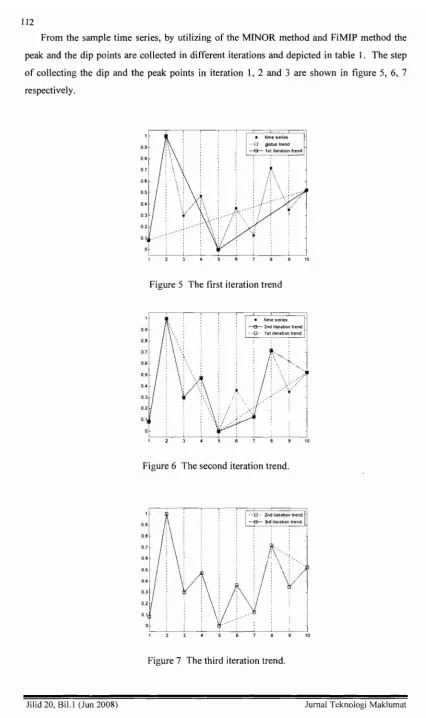
From the sample time series, by utilizing of the MINOR method and FiMIP method the
peak and the dip points are collected in different iterations and depicted in table I. The step
of collecting the dip and the peak points in iteration I, 2 and 3 are shown in figure 5, 6,7
respectively.
'~
:\0.9 : \
0.8 i \
071 . \
0.6
0.1
~
timeSeries- - 0 -global trend -a---1st iteration trend
10
Figure 5 The first iteration trend
0.9
o.a
0.1
• time series
-a----2nd iteration trend - - E} - 151 Iteration trend
~'" :
I~\ -.~_
\ : "'..,
\: ~;)
\....:-->/
.-
",
10
Figure 6 The second iteration trend.
0.9
o.a
0.7
0.1
§ d it...Ioon t<end -e---3rd iteration trend
;\-.
/
\\ .\
:yN::/:\V
..
./
. . .
. .
10
.Iilid 20. BiJ.l (.Tun 2008)
Figure 7 The third iteration trend .
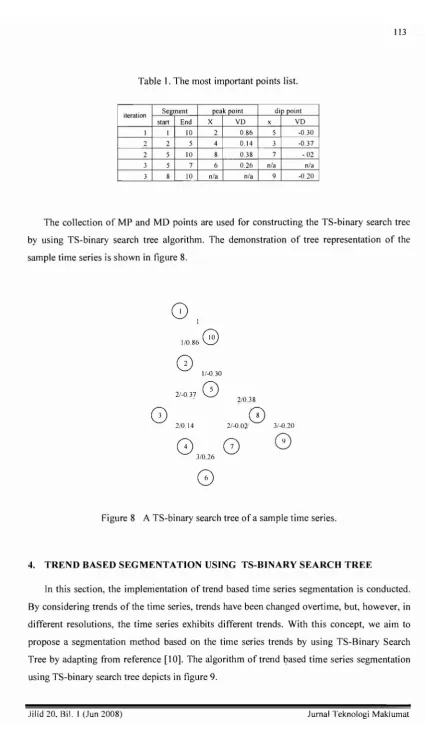
Table 1. The most important points list.
iteration Segment peak point dip point
star! End X vo x vo
1 I 10 2 0.86 5 -0.30 2 2 5 4 0.14 3 -0.37
2 5 10 8 0.38 7 -.02 3 5 7 6 0.26 n/a n/a
3 8 10 n/a n/a 9 -0.20
The collection of MP and MD points are used for constructing the TS-binary search tree
by using TS-binary search tree algorithm. The demonstration of tree representation of the
sample time series is shown in figure 8.
8
1G
1/0.86
Q
1/-0.30
2/-0.37
0
2/038
0
2/0.14 2/-0m'8
3/-0.208
3/0.26G
G
G
Figure 8 A TS-binary search tree of a sample time series.
4. TREND BASED SEGMENTATION USING TS-BINARY SEARCH TREE
In this section, the implementation of trend based time series segmentation is conducted.
By considering trends of the time series, trends have been changed overtime, but, however, in
different resolutions, the time series exhibits different trends. With this concept, we aim to
propose a segmentation method based on the time series trends by using TS-Binary Search
Tree by adapting from reference [10]. The algorithm of trend based time series segmentation
using TS-binary search tree depicts in figure 9.
The algorithm firstly considers the MIP in the lowest resolution by accessing the tree
from root. The first-two nodes are retrieved from the first and the last points of the time
series. Consequently, accessing the next node is determined by the node iteration and its YD.
From the time series in figure 4 and its tree in figure 8, the next node to access is the node
x=2 this shows the result of segmentation in figure 9(a). Next,the node x=5 is retrieved since
its iteration is 1 and it has a largest VD after previous node, this makes the time series is
segmented into three segments as shown in figure 9(b).
The next accessing node is considered with the node with iteration 2, but, in this iteration
there are 4 choices, the largest VD node should be retrieved first, thus, node x=8 is retrieved.
With the 3 accessed nodes, the time series is segmented into 3 segments as shown in figure
9(c). By considering in the similar way, the following nodes should be retrieved are node x
equals to 3, 4, 7, 9, and 6 respectively.
(a)
:Q'.("
.' I .OJJ
(b)
.:i
J.I
I
"l·,···/1 \ ! .. 'I \ I
::;)' " 1 /
1
::,/ '. J ,,/ j
'.LL .
'-!-l'--,-',~~J
Figure 9 A sample time series with 1 cutting point(a), 2 cutting points(b) and 3 cutting points(c).
S. EXPERIMENTAL RESULTS
In this section, we experiment the segmentation algorithm with 2725 data points of
closing prices of Hang Seng Index (HSI) since January 2, 1997 until December 31,2007. The
results of segmentation are reported in different number of segments and comparing between
the results done by our method and the results done by the method proposed in reference [10].
The segmentation results of our experiments are done by using our proposed method and
comparing to the SB-Tree based method [10]. The comparisons are conducted by the
segmentations in di fferent number of 3, 4, 6, 8, 10, 12, 14, 16, 18, and20cutting points.
The performance of segmentation is measured by the root mean square errors
(RMSE). The RMSE can becalculated from the distances between the original time
series and its segment trends. Table
2
shows the results of the experiments and figure10demonstrates the comparison of those two methods.
(a)
T
--T
,
j
_~_~J
'000 '500 2000 2500 3000
(b)
06
T
O.
j
J
.000 '500 2000 2500 3000
Figure 10 Segmentation of HSJ index using: SB-Tree based segmentation in 3 and 7
segments respectively (a),(b) , and TS-Binary Search Tree based segmentation in3and7
segments respectively(c),(d).
(c)
'r---3000
(d)
o.
06
1000 1500 2000 2500 3000
Figure 10 Segmentation of HSI index using: SB-Tree based segmentation in 3 and 7
segments respectively (a),(b) , and TS-Binary Search Tree based segmentation in 3 and 7
segments respectively(c),(d). (Cont'.)
Table 2. Numbers of cutting points and the errors
No. of cutting RMSE
points TS-BS tree SB- tree
3 0.1263 0.1263
4 0.1714 0.1325
6 0.1081 0.0678
8 0.0677 0.0647
10 0.0648 0.0770
12 0.0633 0.0881
14 0.0636 0.0849
16 0.0635 0.0688
18 0.0644 0.0675
20 0.0630 0.0650
1--
TS-Binary Search Tree ---- S8-TreeRMSE ,-'-'-\
0.12 \ ,
oO~Lj\~/""'"
+ ' - - '-... ' ... -- •• _------a~ ,
3 .. 6 5 10 12 1. 16 18 20
number of cutting points
Figure I I Performance comparison of segmentation based on TS-binary search tree method
and SB-binary search tree method
As can be seen in table 2 and figure II, the RMSE of the segmentation the errors show
sharp peaks at 4 cutting points on both two methods and dramatic falls until number of cutting
points are 8. At the 8-cutting points, the graph show almost the same error values. However,
from the 8 cutting points, SB-tree based methods gradually increases until number of cutting
points is 12, then, the graph slightly declines and remain stable. While the errors of SB-tree
based method between 8 to 12 cutting points, the graph show a remain constant and less
errors comparing to the SB-tree based method.
6. CONCLUSION
In this paper, we have proposed a method for financial time series representation based on
the most important points retrieval method. The idea of the method is based on finding the
most important points in multiresolution. These retrieved important points are recorded in
each resolution. The collected important points are used to construct the TS-binary search
tree. From the TS-binary search tree, the application of time series segmentation is conducted.
Our experiments have been tested on the real stock market time series.
The proposed method shows that the performance of the method is better when using the
segmentation with number of segments more than 6 cutting points and the results show very
poor performance when using the cutting points less than or equal to 6. Future works the
method should be applied in other dataset and with different size of the dataset.
REFERENCES
[I] Peters E.E., Chaos and order in the capital markets. John Willey&Sons 1996.
[2] Lin 1., Keogh E., Lonardi S., Chiu B. A Symbolie Representation of Time Series, with
Implications for Streaming Algorithms. In proceedings of the 8th ACM SIGMOD
Workshop on Research Issues in Data Mining and Knowledge Discovery. (2003).
[3] FuT-C., Chung F-L., Luk R., Ng C-M., Stock time series pattern matching:
Template-based vs. rule-Template-based approaches. Engineering Applications of Artificial Intelligence 20,
2007, pp.347-364.
[4] Chung F-L, FuT-C, Ng V., Luk R.W.P., An Evolutionary Approach to Pattern-Based
Time Series Segmentation. IEEE Transactions on Evolutionary Computation 8, 5.
October 2004, pp. 471-489.
[5] Wang Q., Megalooikonomou, V. A dimensionality reduction technique for efficient
time series similarity analysis. Information Systems 33, March 2008. pp.115-132.
[6] Pattarin F.. Paterlini, S., Minerva, T. Clustering financial time series: an application to
mutual funds style analysis. Computational Statistics & Data Analysis 47, 2, September
2004, pp.353-372.
[7] Hueng C.J., McDonald, J.B., Forecasting asymmetries in aggregate stock market
returns: Evidence from conditional skewness. Journal of Empirical Finance 12,5,
December 2005,pp.666-685.
[8] Battuguldur Lkhagva, Yu Suzuki, Kyoji Kawagoe: New Time Series Data
Representation ESAX for Financial Applications. ICDE Workshops 2006.
[9] Bao D. A generalized model for financial time series representation and prediction.
Applied Intelligence, DOl: 10.1 007/s I0489-007-01 04-9 .
[ltD] Fu T-C.." Chung F-L., Luk R..'and N(g·C-M., Representing financial time series based on data point iimpurtance., Enqgineerirlg Applications <of Artificial IntclligenceVolume 21,
2,March2!008, pp.277-300..
lll] Chung, F-L., Fu, T-C., Luk, iR..,1'Ng, V. Flexible time sories ¥Idem matching based on
perceptually important poi1U5. In: Internationall Jiliint Conference on Arti ficial
Intelligence Workshop on Learning from Tempordll and Spatial Data, pp.1-7.