DEVELOPMENT OF A REAL-TIME SPEAKER RECOGNITION SYSTEM USING TMS320C31
PRAKASH A/L SOWNDAPPAN
DEVELOPMENT OF A REAL-TIME SPEAKER RECOGNITION SYSTEM USING TMS320C31
PRAKASH A/L SOWNDAPPAN
A thesis submitted in fulfilment of the requirements for the award of the degree of
Master of Engineering (Electrical)
Faculty of Electrical Engineering Universiti Teknologi Malaysia
iii
iv
ACKNOWLEDGEMENTS
I wish to thank my supervisor, Ir. Prof. Dr. Sheikh Hussain Shaikh Salleh for his guidance and motivation. Without his continued support and interest, this thesis would not been the same as presented here.
I am grateful to the staff of Pusat Pengajian Siswazah and the Faculty of Electrical Engineering for their assistance during my study. A special thanks for the lab assistants for their support and help.
v
ABSTRACT
vi
ABSTRAK
vii
TABLE OF CONTEN TS
CHAPTER TITLE PAGE
1 INTRODUCTION
1.1 Overview of Speaker Recognition 1.2 Real-Time Speaker Recognition System 1.2.1 Related Work
1.2.2 Objective 1.2.3 Scope of Work
1.3 Organization of the Thesis
2 FUNDAMENTALS OF SPEAKER RECOGNITION 2.1 Basic Model of Speaker Recognition
2.2 Sampling and Preprocessing
2.2.1 Analogue-To-Digital (ADC) Conversion 2.2.2 Preemphasis
2.2.3 Speech Framing 2.2.4 Edge Detection 2.2.5 Windowing 2.3 Feature Extraction
2.3.1 The LPC Model
2.3.2 Autocorrelation Analysis 2.3.3 LPC analysis
2.3.4 Cepstral Analysis 2.4 Vector Quantization
2.4.1 VQ Codebook Design
2.5 Feature matching and speaker classification
viii
2.5.1 Dynamic Time Warping 2.5.2 Vector Quantization 2.5.3 Hidden Markov Model
2.5.3.1 Problem 1 – Probability Evaluation 2.5.3.2 Problem 2 – Optimal State Sequence 2.5.3.3 Problem 3 – Parameter Estimation 2.5.4 Artificial Neural Network
2.6 Summary of the Algorithms Chosen for the Speaker Recognition System
3 DEVELOPMENT OF ALGORITHM FOR REAL- TIME IMPLEMENTATION
3.1 Speech Sampling 3.2 Edge Detection
3.3 Autocorrelation Analysis
3.3.1 Offline Autocorrelation Computation
3.3.2 Offline Autocorrelation Computation at the End of Each Frame
3.3.3 Inline Autocorrelation Computation 3.3.4 Inline Autocorrelation Computation for
Overlapping Speech Frames
3.3.5 Autocorrelation computation comparison 3.3.6 Summary
3.4 Computation and Memory Requirement for Various Classifiers
3.4.1 Vector Quantization 3.4.2 Dynamic Time Warping 3.4.3 VQ-DTW
3.4.4 Hidden Markov Models 3.4.5 Artificial Neural Networks
3.4.6 Speaker Recognition Classifier Feasibility
ix
4 SYSTEM DESIGN 4.1 Hardware Design
4.1.1 Digital Signal Processor 4.1.2 Memory
4.1.3 Analog Interface 4.1.4 Real-Time Clock
4.1.5 Power and Heat Consideration 4.1.6 PCB Design
4.2 Software Design
4.2.1 Software Development Flow 4.2.2 Software Modules
4.3 Recognition Threshold
4.4 Combination Lock Numbers for Speaker Verification 4.4.1 Single N umber Authentication
4.4.2 Combination Number Authentication – Method 1
4.4.3 Combination Number Authentication – Method 2
4.4.4 Varied Threshold Values 4.4.5 Combination Lock Observation
5 RESULTS AND DISCUSSION 5.1 Test Methodology
5.2 Test Results
5.2.1 True Speaker Access Result 5.2.2 Impostor Access Result 5.2.3 Training and Access Timing 5.3 Application as a Door Access System
5.3.1 System O verview 5.3.2 System Performance
5.4 Comparison with Commercial Product
x
5.5 Summary
6 CONCLUSION
6.1 Summary
6.2 Limitation of the Design 6.3 Suggestion for Further Work
REFERENCES
78
80 80 81 81
83
xi
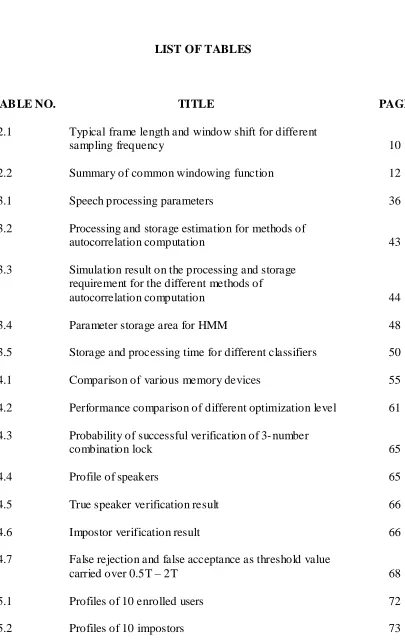
LIST OF TABLES
TABLE NO. TITLE PAGE
2.1 Typical frame length and window shift for different sampling frequency
2.2 Summary of common windowing function 3.1 Speech processing parameters
3.2 Processing and storage estimation for methods of autocorrelation computation
3.3 Simulation result on the processing and storage requirement for the different methods of autocorrelation computation
3.4 Parameter storage area for HMM
3.5 Storage and processing time for different classifiers 4.1 Comparison of various memory devices
4.2 Performance comparison of different optimization level
4.3 Probability of successful verification of 3- number combination lock
4.4 Profile of speakers
4.5 True speaker verification result
4.6 Impostor verification result
4.7 False rejection and false acceptance as threshold value carried over 0.5T – 2T
5.1 Profiles of 10 enrolled users 5.2 Profiles of 10 impostors
xii
5.3 True speaker identification and verification success count
5.4 True speaker entry attempts success count 5.5 Impostor recognition result
5.6 Entry attempts by impostor
74
74 75
xiii
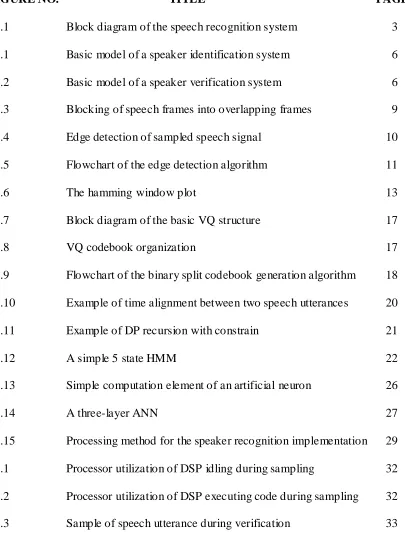
LIST OF FIGURES
FIGURE NO. TITLE PAGE
1.1 Block diagram of the speech recognition system
2.1 Basic model of a speaker identification system 2.2 Basic model of a speaker verification system 2.3 Blocking of speech frames into overlapping frames 2.4 Edge detection of sampled speech signal
2.5 Flowchart of the edge detection algorithm
2.6 The hamming window plot
2.7 Block diagram of the basic VQ structure 2.8 VQ codebook organization
2.9 Flowchart of the binary split codebook generation algorithm
2.10 Example of time alignment between two speech utterances
2.11 Example of DP recursion with constrain 2.12 A simple 5 state HMM
2.13 Simple computation element of an artificial neuron 2.14 A three-layer ANN
2.15 Processing method for the speaker recognition implementation
3.1 Processor utilization of DSP idling during sampling
3.2 Processor utilization of DSP executing code during sampling 3.3 Sample of speech utterance during verification
xiv
3.4 Flowchart of the edge detection algorithm
3.5 Autocorrelation computation for M=3 and N=15 3.6 Inline autocorrelation computation for M=3 and N=15 3.7 Inline autocorrelation computation for overlapping frames, with no windowing function
3.8 Inline autocorrelation computation for overlapping frames, with hamming windowing function applied
4.1 Block diagram of the hardware
4.2 Memory map of the speaker recognition board 4.3 The designed speaker recognition board
4.4 Software development flow for the speaker recognition system
4.5 Block diagram of software modules developed for the speaker recognition system
4.6 False rejection and acceptation for a one number authentication
4.7 False rejection and acceptation for 3- number authentication (method 1)
4.8 False rejection and acceptation for 3- number authentication (method 1)
5.1 The door entry interface panel
34
35 38
41
42
52 56 59 60
63
68
69
69
xv
LIST OF SYMBOLS AND ABBREVIATIONS
ADC - Analog-to-digital conversion AIC - Analog interface circuits ALU - Arithmetic logic unit ANN - Artificial neural networks
ASIC - Application Specific Integrated Circuit CCS - Code Composer Studio
COFF - Common object file format DAC - Digital-to-analog converter DMA - Direct memory access DNL - Differential nonlinearity
DP - Dynamic programming
DSK - DSP Starter K it
DSP - Digital signal processor
DTW - Dynamic Time Warping
EER - Equal error rate
EPROM - Electronically programmable read-only memory
EEPROM - Electronically erasable programmable read-only memory FPGA - Field Programmable Generic Array
GMM - Gaussian Mixture Model HMM - Hidden Markov Models IC - Integrated circuit
I/O - Input/output
IER - Identification error rate
K - Number of overlapping frames
xvi
L - Frame count
LCD - Liquid crystal display LPC - Linear Predictive Coding
M - Window shift
MFCC - Mel-Frequency Cepstrum Computation MFLOPS - Million floating-point operations per second MIPS - Million instructions per second
N - Frame length
NV - Non-volatile
PC - Personal computer
PCB - Printed circuit board
QFP - Quad flatpack
RAM - Random access memory
RCC - Real Cepstral Coefficients
ROM - Read-only memory
RTC - Real-time clock
SMT - Surface mount technology SNR - Signal to noise ration
SQRR - Signal to quantization noise ratio
VQ - Vector quantization
xvii
LIST OF APPENDICES
APPENDIX TITLE PAGE
A Schematic diagram
B Composite drawing of PCB Layout
C Sampling loop and interrupt service routine
D Autocorrelation analysis source code
E LPC cepstrum analysis source code
F DTW source code
86
92 93
94
CHAPTER 1
INTRODUCTION
In this chapter, an overview into the area of speaker recognition is given. Related work on real-time speaker recognition system, along with the objective and scope of work are given, and ended by a short description of the chapters of this thesis.
1.1 Overview of Speaker Recognition
Personal identity identification is an i mportant requirement to controlling access to protected resources. Personal identity is us ually claimed by using personal possessions like a key or badge, or knowledge of certain infor mation like a password or combi nation numbers (Naik, 1990). However, these can be lost, stolen or counterfeited, thereby posting a threat to security. Biometric identification by usi ng certain features of a person is a more secured solution for security identification. Fi ngerprint, hand geometry, retinal scanning, speech, and handwriting are examples of biometric features.
2
Speaker recognition has been show n to yield near perfect recognition results. Speaker identification using 630 speakers from the TIMIT database has given a result of less than 0.5% error rate (Reynolds, 1995). IER (identification error rate) of less than 0.75% have been reported during speaker identification and EER (equal error rate) of less than 0.13% during speaker verification experi ments (Wilder moth and Pawilal, 2003). These results were obtained using the TIMIT, YOHO and ANDOSL databases.
1.2 Real-Time Speaker Recognition System
For a speaker recognition system to be used in practice, the response ti me, or the ti me taken to train and to recognize the speakers must me mini mi zed to an acceptable level. The size of the speaker database grows when the number of speakers in a system is increased. This poses two problems in terms of memory requirement for speech database storage, and processing ti me required by the system.
1.2.1 Related Work
Wor k by Karpov (2003) on real-time speaker identification system has been concentrated i n the area of algorithm optimization, without looking into the hardware design aspect. Sara (1998) concentrated on opti mized speech processing in the DSP56001 hardware platform, especially in the application of noise reduction and speech enhancement. Kwek (2000) worked on a hardware based speech recognition system much similar to the hardware developed in this master’s work. Both work by Sara (1998) and Kwek (2000) are hardware based but are not concentrated in the area of speaker recognition.
1.2.2 Objective
3
1.2.3 Scope of Work
A significant amount of experiments and study have been outlined in this thesis in these two areas: processing and storage requirement for real-time speaker recognition system. Description of a TMS320C31 based speaker recognition system is given. This system is tested i n a real application as a speaker recognition door access system. An inline computation method of autocorrelation computation that reduces recognition ti me is benchmar ked in ter ms of processing and memor y requirement. The feasibility study of using various feature matchi ng techniques in a real-time system is also outlined in terms of processing and memor y requirement. The effect of combi nation lock number in speaker verification is investigated.
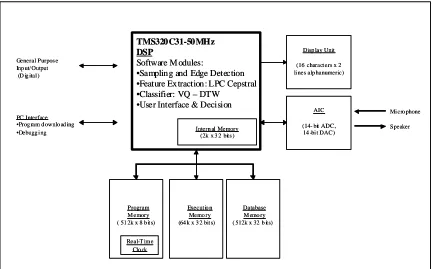
Figure 1.1 shows the block diagram of the final implementation of the speech recogni tion hardware implementation. A TMS320C31 digital signal processor runni ng at 50MHz is used to execute the speaker recognition al gorithm. The LPC Cepstral technique is used for feature extraction of speech signal. The classifier used is the combi nation of VQ- DTW feature compression and matching techniques.
Database M emo ry ( 512k x 32 b it s) Execut io n
Memo ry (64 k x 3 2 bit s) TMS320C31-50MHz DSP
Software M odules:
•Sampling and Edge Detection •Feature Extraction: LPC Cepstral •Classifier: VQ – DTW
•User Interface & Decision
Intern al Memory (2k x 3 2 bit s )
Real-T im e Clo ck
AIC
(14- bit ADC, 14 -bi t DAC)
Mi cro phone
Speaker Disp lay Unit
(16 charact ers x 2 li nes alp hanumeric) General Purpos e
Inp ut/ Output (D ig ital )
PC Interface •Prog ram d ownlo ad ing •Debugg i ng
Program M emory ( 51 2k x 8 b it s)
Database M emo ry ( 512k x 32 b it s) Execut io n
Memo ry (64 k x 3 2 bit s) TMS320C31-50MHz DSP
Software M odules:
•Sampling and Edge Detection •Feature Extraction: LPC Cepstral •Classifier: VQ – DTW
•User Interface & Decision
Intern al Memory (2k x 3 2 bit s )
Real-T im e Clo ck
AIC
(14- bit ADC, 14 -bi t DAC)
Mi cro phone
Speaker Disp lay Unit
(16 charact ers x 2 li nes alp hanumeric) General Purpos e
Inp ut/ Output (D ig ital )
PC Interface •Prog ram d ownlo ad ing •Debugg i ng
Program M emory ( 51 2k x 8 b it s)
4
1.3 Organization of t he Thesis
In Chapter 2, a brief explanation of various al gorithms and approaches used i n speaker recognition systems are given. Speaker recognition starts with speech acquisition, followed by speech feature extraction, and the modeled for speaker discrimi nation. Feature comparison and modeling techniques like Dynamic Ti me Warping, Vector Quantization, Hidden Markov Models, and Artificial Neural Networks are explained.
Chapter 3 exami nes the algorithms and various opti mizations used in the implementation of a real-time speaker recognition system. A feasibility study on speaker recogni tion modeling algorithms is outlined here.
The hardware and software implementation of the speaker recognition s ystem are outlined in Chapter 4.
The results of experiments and discussion of the developed speaker recognition system are given i n Chapter 5.
82
83
REFERENCES
Atal, B. S. (1974). Effectiveness of Linear Prediction Characteristics of the Speech Wave for Automatic Speaker Identification and Verification. J. Acoust. Am. 55(6): 1304 - 1312.
Batlle, E. Fonollosa, J. (1996). CPU and Memory Requirements for Real-Time Speech Recognition Systems Using the TMS320C3x/C4x. Proc. The First European DSP Education and Research Conference Paris (France).
Bennani, Y. and Fogelman, F. (1990). A connectionist approach for automatic speaker recognition. Proc. ICASSP 90. April. Albuquerque, Mexico. 265 - 268.
Campbell, J.P. (1997). Speaker recognition: a tutorial. Proc. IEEE. 85(9): 1437 - 1462. Champod, C. and Meuwly, D. (2000). The inference of identity in forensic speaker
recognition. Speech Communication. 31(2-3): 193 - 203.
Karpov, Evgeny. (2003). Real-time speaker identification. University of Joensuu: Master Thesis.
Kester, Walt. (2004). Analog-Digital Conversion, U.S.: Analog Devices.
Kinnunen, T. and Fränti, P. (2001). Speaker Discriminative Weighting Method for VQ-Based Speaker Identification. Proc. 3rd International Conference on audio-and video-based biometric person authentication (AVBPA). June 6-8, Halmstad,
Sweden, 150 - 156.
Kinnunen, T. and Kärkkäinen, I. (2002). Class-Discriminative Weighted Distortion Measure for VQ-Based Speaker Identification. Proc. Joint IAPR International Workshop on Statistical Pattern Recognition (S+SPR 2002. August 6-9,
Windsor, Canada, 681-688.
Kwek, Ser Wee. (2000). Real Time Implementation of Speech Recognition System Using TI Floating-Point Processor TMS320C31. Universiti Teknologi
Malaysia: Final Year Project Thesis.
84
Naik, J.M. (1990). Speaker Verification: A Tutorial. IEEE Communication Magazine. January, 42-47.
Oglesby, J. Mason, J. S. (1990). Radial basis function network for speaker recognition. Proc. ICASSP 90. April, Albuquerque, Mexico, 261-264.
Oglesby, J. Mason, J. S. (1991). Radial basis function network for speaker identification. Proc. ICASSP 91. May, Toronto, Canada. 393-396. Parsons, Thomas W. (1987). Voice and Speech Processing. McGraw-Hill.
Rabiner, Lawrence R. and Juang, B, H. (1986). An Introduction to Hidden Markov Models. IEEE ASSP Magazine, 3(1): 4-16.
Rabiner, Lawrence R. and Juang, B, H. (1993). Fundamentals of Speech Recognition. Englewood Cliffs, N.J.: Prentice-Hall.
Reynolds, D. (1995). Large population speaker identification using clean and telephone speech. IEEE Signal Processing Letters. 2: 46-48.
Saito, Shuzo and Nakata, Kazuo. (1985). Fundamentals of Speech Signal Processing. U.S.: Academic Press.
Sara, Grassi (1998). Optimized implementation of speech processing algorithms. University of Neuchatel: Ph.D. Thesis.
Sensory, Inc. (2002). RSC-4X Family Speech Recognition Microcontroller. U.S.: 80-0220-A 2/02 Datasheet.
Shao, Cheng Woo. (2000). Speaker Recognition Using ANN. Delft University of Technology: Master Thesis.
Soong F. K., Rosenberg, A. E. and Rabiner, L. R. (1985). A Vector Q uantization Approach to Speaker Recognition. Conference Record 1985 IEEE International Conference on Acoustics, Speech, and Signal Processing. March. 387-389.
Texas Instruments. (2004). SM320C6711-EP, SM320C6711B-EP, SM320C6711C-EP, SM320C6711D-EP Floating-Point Digital Signal Processors. U.S.: SGUS054
Datasheet.
85