Article
Synthesis of 1,5-Functionalized 1,2,3-Triazoles Using
Ionic Liquid/Iron(III) Chloride as Efficient and
Reusable Homogeneous Catalyst
Antonio De Nino1*, Pedro Merino2, Vincenzo Algieri1, Monica Nardi1,3, Maria Luisa Di Gioia4, Beatrice Russo1, Matteo Antonio Tallarida1, Loredana Maiuolo1*
1 Dipartimento di Chimica e Tecnologie Chimiche, Via P. Bucci, cubo 12C, Università della Calabria, 87036 Rende (CS), Italy.
2 Instituto de Biocomputacion y Fisica de Sistemas Complejos (BIFI). Universidad de Zaragoza Campus San Francisco 50009 Zaragoza, Aragon. SPAIN
3 Dipartimento di Agraria, Università Telematica San Raffaele, Via di Val Cannuta, 247, Roma, 00166, Italy 4 Dipartimento di Farmacia e Scienze della Salute e della Nutrizione, Edificio Polifunzionale, Università
della Calabria, 87036 Rende (CS), Italy
* Correspondence: [email protected]; Tel.: +39-0984 492043
Abstract: An efficient, eco-compatible and very cheap method for the construction of triazoles via eliminative azide–olefin cycloaddition (EAOC) reaction has been developed by a catalytic system IL/FeCl3, offering an highly regioselective approach to structurally diverse 1,5-disubstituted
1,2,3-triazoles in up to 95% yield. This strategy features the reuse of catalytic system through simple operations. Mechanistic studies indicated that an asynchronous concerted dipolar cycloaddition-elimination process might be involved.
Keywords: azides, [3+2] cycloaddition, EAOC reaction, electron-deficient olefins, 1,2,3-triazoles
1. Introduction
Triazoles are five member N-heterocyclic compounds bearing three nitrogen atoms in the ring. They exist in two isomeric forms namely 1,2,3-triazoles and 1,2,4-triazoles and are important nucleus for the development of drugs, mainly because they are resistant to oxidation, reduction and hydrolysis in both acidic ad basic conditions because of their aromatic nature [1]. Their active participation in hydrogen bond formation, dipole-dipole and π stacking interactions can mimic
peptide bonds enhancing their binding ability with different biological targets [2]. Therefore, triazoles
represent a significant class of nitrogen compounds with important biological properties, such as antibacterial, anticancer, antivirus, antimalarial, anti-inflammatory and antituberculosis [3-4]. In particular, 1,2,3-triazoles have found a broad spectrum of biological applications such as β-lactum antibiotic tazobactum, cefatrizine and anticancer compound carboxyamidotriazole (CAI) that are some drugs available in the market [5].
Many approaches for the synthesis of 1,2,3-triazoles have been developed so far. The conventional synthetic method of 1,2,3-triazoles is 1,3-dipolar cycloaddition of Huisgen between alkynes and organic azides [6], which generally provides a mixtures of 1,4- and 1,5-regioisomers. The most important developments were achieved in this area by the copper catalyzed azide-alkino cycloaddition (CuAAC) to obtain the 1,5-disubstituted isomer and the ruthenium azide-alkino cycloaddition (RuAAC) to achieve the 1,4-disubstituted isomer [7-11]. However, the (CuAAC)-catalyzed process only works with terminal alkynes whereas the (RuAAC)-(CuAAC)-catalyzed reaction requires the use of very expensive ruthenium salt as catalyst.
As an alternative approach to azide–alkyne cycloaddition, electron deficient olefins were proposed to replace alkynes because of their easy availability and low cost preparation [12-13]. The azide–olefin cycloaddition furnishes triazoline, an unstable compound that readily decompose but that may be transformed into the stable triazole by eliminative azide olefin cycloaddition (EAOC). In
this process, the olefin carrying a leaving group reacts with the azide to form the intermediate triazoline that gives the corresponding triazole by elimination reaction [14].
Nitroolefins, as versatile starting materials, are excellent dipolarophiles to synthesize triazoles by EAOC cycloaddition. In fact, the presence of electron withdrawing nitro group both improves the 1,3-dipolar cycloaddition process and favors the formation of required 1,2,3-triazoles due to the fast nitrous acid loss through elimination step (Scheme 1).
Scheme 1. EAOC cycloaddition to synthesize 1,5-disubstituted 1,2,3-triazoles
Over the past decade, many researchers have shown substantial interest in the EAOC process of nitroolefins. In particular, EAOC of nitroolefins to provide 1,2,3-triazoles was realized in presence of various catalysts such as TBAF [15], p-toluene sulfonic acid [16], cerium triflate [17] and Bi2WO6
nanoparticles [18]. An alternative route of EAOC was realized generating the nitroolefin in situ [19-20]. Earlier these years, EAOC reaction of nitroolefins in the absence of catalysis, required prolonged times for completion, low regioselectivity and poor efficiency [21].
Considering the importance of 1,2,3-triazoles and in continuation with our experience in catalysis [22-25] herein we report the application of FeCl3 in ionic liquid (ILs) as reusable
homogeneous catalyst system. To the best of our knowledge, there is been no report available on the synthesis of EAOC of nitroolefins using iron catalyst in ionic liquid in the open literature so far.
Ionic liquids (ILs) have received in last years a good deal of attention since classical organic reactions, including cycloadditions reactions, can be performed in these media with great advantages (yield and selectivity) as compared to conventional conditions [26-30]. Ionic liquids are distinguished by the advantages pertaining to these solvents such as no measurable vapor pressure, easy solvent recover/recycle and high solubility of the Lewis acids in these solvents [31-33].
Recently, among the plethora of Lewis acids reported in the literature, iron catalysts have been identified as important and effective catalysts in various organic reactions because of their low price, easy availability, sustainability, non-toxicity and environmentally friendly characteristics [34-40].
In this paper, we investigated a number of catalyzed-EAOC reactions of nitroolefins in different ionic liquids and Lewis acids. Finally, we selected the [mpy]OTf/FeCl3 system considering both the
strong coordination of NO2 group to the Fe-catalyst and the use of 1-methyl pyridinium trifluoromethanesulfonate ([mpy]OTf) as ideal reaction medium due the strong stabilization of reaction intermediates. Major advantages in the utilization of this ionic liquid are the low toxicity, the cost and the easy one-step preparation through halide-free direct synthesis, by adding directly methyl trifluoromethane sulfonate to dry pyridine.
2. Results
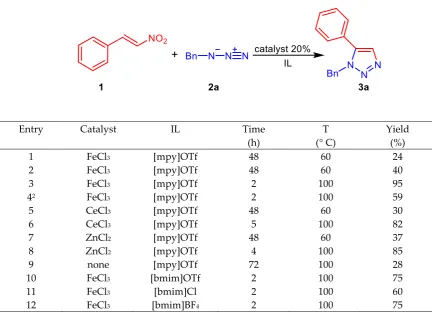
Table 1 Optimization of reaction conditions1
Entry Catalyst IL Time
(h)
T (° C)
Yield (%)
1 FeCl3 [mpy]OTf 48 60 24
2 FeCl3 [mpy]OTf 48 60 40
3 FeCl3 [mpy]OTf 2 100 95
42 FeCl3 [mpy]OTf 2 100 59
5 CeCl3 [mpy]OTf 48 60 30
6 CeCl3 [mpy]OTf 5 100 82
7 ZnCl2 [mpy]OTf 48 60 37
8 ZnCl2 [mpy]OTf 4 100 85
9 none [mpy]OTf 72 100 28
10 FeCl3 [bmim]OTf 2 100 75
11 FeCl3 [bmim]Cl 2 100 60
12 FeCl3 [bmim]BF4 2 100 75
1. Reaction conditions: 2.0 eq. of 2 were used unless the reaction in entry 1, in which 1.0 eq. of 2 was employed. 2. 10 mol % FeCl3
In an initial experiment, the reaction was performed in 1-methyl pyridinium
trifluoromethanesulfonate ([mpy]OTf)at 60 °C catalyzed by 20 mol % FeCl3 in a 1:1 ratio of reagents,
isolating 1,5-disubstituted triazole 3a in 24% yield after 48 h reaction due to degradation of benzylazide 2a (Table1, entry 1). The use of 1.2 eq. or 1.5 eq. of azide did not lead to satisfactory results. A doubling of azide concentration revealed an increase of yield to 40% (Table 1, entry 2). Subsequently, when the reaction temperature was raised to 100 °C, the yield of product improved significantly, also reducing the reaction time (Table 1, entry 3). Any attempt to reduce the amount of catalyst did not provide improvements of the product yield (Table 1, entry 4).
Further screening of Lewis acids (Table 1, entry 5-8) revealed that the optimal results were obtained in the presence of FeCl3 as catalyst (Table 1, entry 3). Moreover, without any catalyst, the
reagents 1a and 2a in same reaction conditions gave the 1,5-disubstituted triazole 3a in very low yield after a long reaction time (Table1, entry 9). This last result highlights that the catalyst accelerates the reaction by increasing the electrophilicity of the nitroolefin through coordination but it is not involved in the elimination step.
Changing from 1-methyl pyridinium trifluoromethane sulfonate [mpy]OTf to 1 -butyl-3-methylimidazolium triflate [bmim]OTf, 3--butyl-3-methylimidazolium chloride [bmim]Cl or 1-butyl-3-methylimidazolium tetrafluoroborate [bmim]BF4 as solvent (Table 1, entries 10-12) did not have a
Table 2 Synthesis of 1,5-disubstituted 1,2,3-triazoles 3a-n
Entry R R1 Product Yield (%)
1 H Bn 3a 95
2 2-Cl Bn 3b 85
3 3-Cl Bn 3c 84
4 4-Cl Bn 3d 86
5 4-Me Bn 3e 92
6 4-MeO Bn 3f 93
7 2-NO2 Bn 3g 81
8 H Ph 3h 91
9 2-Cl Ph 3i 87
10 3-Cl Ph 3j 93
11 4-Cl Ph 3k 92
12 4-Me Ph 3l 96
13 4-MeO Ph 3m 92
14 2-NO2 Ph 3n 95
Notably, several sensitive functionalities, such as chloro (3b-d; 3j-k), methyl (3e; 3l), methoxy (3f; 3m), and nitro (3g; 3n), were unaffected under the present reaction conditions, and the reaction also tolerated ortho-substitution in the aromatic ring.
3. Discussion
In order to confirm the eliminative azide-olefin cycloaddition (EAOC) mechanism we investigated the possible reaction pathway.
Scheme 2. Approaches for the cycloaddition between NS and PA
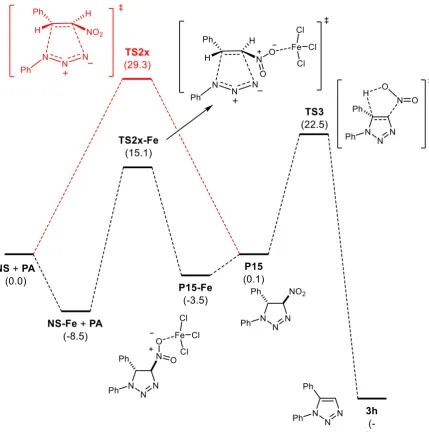
The analysis of the optimized transition structures and the corresponding IRCs revealed concerted processes in all cases. The preferred one, TS2x, was that corresponding to channel 2/exo (energy barrier of 29.3 kcal/mol), with differences of 0.2, 2.1 and 2.3 kcal/mol with respect to channel 2/endo (TS2n), channel 1/endo (TS1n) and channel 1/exo (TS1x), respectively (Scheme 2). Next, we evaluated the same reaction catalyzed by iron(III) chloride, which is coordinated at the nitro group. The same trend was observed for the catalyzed reaction; thus, the transition structure TS2x-Fe corresponding to channel 2/exo and leading to cycloadduct P15-Fe was also the preferred one. In the presence of iron(III) chloride the barrier was reduced to 23.6 kcal/mol (Figure 1). In agreement with an increasing of the polarity for the reaction, a more asynchronous reaction was found.
Figure 1. Reaction coordinate for the formation of 3h from (E)-nitrostyrene and phenyl azide. Both catalyzed (iron(III) chloride) and uncatalyzed (in red) cycloaddition reactions are included for the purpose of
comparison. (For detailed data see SI)
Figure 2. Optimized geometries (B3LYP-D3BJ/Def2SVP) of TS2x-Fe and TS3.
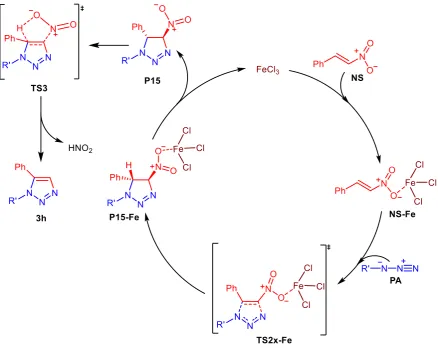
According to these findings, it is possible to propose the catalytic cycle illustrated in Scheme 3, to hypothesize for the first time, the best of our knowledge, that the nitrous acid elimination step in not supported by coordination of the metal.
Scheme 3. Proposed mechanism of eliminative azide–olefin cycloaddition (EAOC) reaction
The first step of the reaction is the coordination of iron(III) chloride to nitroolefin compound
NS to form an activated intermediate NS-Fe that reacts with the azide derivative PA to produce a triazoline intermediate P15-Fe through a transition state TS2n-Fe. The final step consists of the production of FeCl3 in its original quantity and elimination of HNO2 to afford 1,5-disubstituted
Moreover, considering that the used ionic liquid ([mpy]OTf) was a type of excellent reaction medium, we suppose that the IL may stabilize the coordinated intermediates by general electrostatic interactions[41-44], favoring both the cycloaddition reaction with azide compound and the transformation of triazoline derivative in triazole substrate. In fact, a weak interaction between IL cation and anion favors the possibility for the cation (or anion) to solvate the transition state (ionic coordinated intermediate)[45-46].
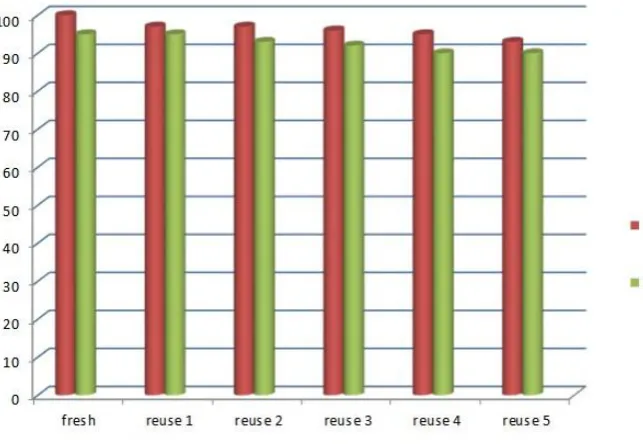
The catalytic system IL/FeCl3 has been analyzed also with respect to recovery and reuse in the
reaction between (E)-nitrostyrene 1a and benzylazide 2a and the results are shown in Figure 3.
Figure 3. Recovery and re-use of catalytic IL/FeCl3 system until six cycles
As shown in Figure 3 similar conversion were obtained, showing that the ionic liquid/FeCl3
4. Materials and Methods
All reagents were purchased from Sigma-Aldrich or Alfa Aesar and used without purification.
Reactions were monitored by TLC using silica plates 60-F264, commercially available from Merk. 1H
and 13C NMR spectra were recorded at 300 MHz and 75 MHz, respectively, in CDCl3 using
tetramethylsilane (TMS) as internal standard (Bruker ACP 300 MHz). Chemical shifts are given in parts per million and coupling constants in Hertz. LC-MS analysis were carried using an Agilent 6540 UHD Accurate - Mass Q-TOF LC-MS (Agilent, Santa Clara, CA) fitted with a electrospray ionization source (Dual AJS ESI) operating in positive ion mode. Chromatographic separation was achieved using a C18 RP analytical column (Poroshell 120, SB-C18, 50 x 2.1 mm, 2.7 mm) at 30 °C with a elution gradient from 5% to 95% of B over 13 min., a being H2O (0.1% FA) and B CH3CN (0.1% FA). Flow rate
was 0.4 mL min-1.
4.1 Synthesis of Ionic Liquids
1-methyl pyridinium trifluoromethanesulfonate ([mpy]OTf) was prepared by halide-free direct synthesis as reported in literature [47-48].
4.2 General procedure for synthesis of 1,5-disubstituted-1,2,3-triazoles 3a-n
In a two-necked round bottom flask, equipped with bubble condenser and magnetic stir bar, ionic liquid (5ml), FeCl3 (20 mol%), (E)-nitrostyrene 1a-n (1 eq) and azide 2a-b (2 eq) were placed. The
reaction was conducted at 100°C for the appropriate time. The crude was extracted with dichloromethane (3x5ml) and the combined organic layer was evaporated under vacuum. The crude product was purified on flash silica gel column by using hexane/ethyl acetate (9:1 v/v) to obtain the desired product (3a-n).
4.3 Procedure of recycling of the catalytic system IL/FeCl3
After the polar phase was extracted three times by dichloromethane, the ionic liquid/FeCl3 mixture
was washed with hexane and dried at 65 °C under vacuum condition. Successive runs were performed in the recycled ionic liquid/FeCl3 by reacting fresh reagents at the usual conditions.
5. Conclusions
In conclusion, we have reported an efficient approach to prepare 1,5-disubstitued-1,2,3-triazoles derivatives via a FeCl3 mediated eliminative azide–olefin cycloadditions (EAOC) in ionic liquid as
solvent. The principle features of this synthetic method are high atom economy, simple operation, high yields and the reuse of catalytic system IL/FeCl3 until six cycles. The nature of the Lewis acid
and ionic liquid appears to have a large impact to the regiocontrol of the reaction, where the ionic liquid anion might stabilize the cationic transition state allowing formation of the triazoline intermediate. Theoretical calculations indicate that an asynchronous concerted dipolar cycloaddition-elimination process might be involved in the formation of 1,5-functionalized triazoles and support the hypothesis that the subsequent elimination step to carry out triazoles proceeds without iron coordination.
Author Contributions: Conceptualization, A. De Nino and L. Maiuolo; Methodology, B. Russo, V. Algieri and M. Tallarida; Software, P. Merino; Validation, A. De Nino, L. Maiuolo and P. Merino; Formal Analysis, M. Nardi and M.L. Di Gioia ; Investigation, P. Merino; Data Curation, L. Maiuolo, V. Algieri; Writing-Original Draft Preparation, A. De Nino and L. Maiuolo; Supervision, P. Merino and A. De Nino.
Funding: This research received no external funding.
Acknowledgments: We thank the Italian Ministry of University and Scientific Research (MIUR) for a doctoral grant and the University of Calabria for financial support. This research was supported by the Spanish MINECO (FEDER-CTQ2016-76155-R to P.M.) The authors thankfully acknowledge the resources from the supercomputers "Memento" and “Cierzo”, technical expertise and assistance provided by BIFI-ZCAM (Universidad de Zaragoza, Spain).
Conflicts of Interest: The authors declare no conflict of interest
Appendix A
Data for the products
1-benzyl-5-phenyl-1,2,3-triazole (3a)
1H-NMR (CDCl3, 300 MHz): δ (ppm) 5.55 (s, 2H, CH2), 7.05-7.12 (m, 2H, Ar), 7.22-7.33 (m, 5H, Ar),
7.38-7.48 (m, 3H, Ar), 7.75 (s, 1H, CH). 13C-NMR (CDCl3, 75 MHz): δ (ppm) 51.83, 126.97, 127.17,
128.16, 128.82, 128.92, 128.95, 129.50, 133.30, 135.53, 138.15. ESI(+)-MS: m/z [M+H] calcd for C15H14N3
236.1182, found: 236.0952
1-benzyl-5-(2-chlorophenyl)-1,2,3-triazole (3b)
1H-NMR (CDCl3, 300 MHz): δ (ppm) 5.45 (s, 2H, CH2), 6.90-6.99 (m, 2H, Ar), 7.01 (d, 1H, J=7.60 Hz,
1.70 Hz, Ar), 7.15-7.30 (m, 4H, Ar), 7.40 (td, 1H, J=7.70Hz, 1.70Hz, Ar), 7.47-7.52 (m, 1H, Ar), 7.72 (s, 1H, CH). 13C-NMR (CDCl3, 75 MHz): δ (ppm) 52.50, 126.44, 126.90, 127.72, 128.21, 128.62, 129.97,
131.18, 132.01, 134.32, 134.43, 134.78, 134.83. ESI(+)-MS: m/z [M+H] calcd for C15H13ClN3 270.0793,
found: 270.1254
1-benzyl-5-(3-chlorophenyl)-1,2,3-triazole (3c)
1H-NMR (CDCl3, 300 MHz): δ (ppm) 5.55 (s, 2H, CH2), 7.05-7.16 (m, 3H, Ar), 7.23 (m, 1H, Ar),
7.26-7.34 (m, 3H, Ar), 7.36 (d, 1H, J=7.55Hz, Ar), 7.39-7.45 (m, 1H, Ar), 7.75 (s, 1H, CH); 13C-NMR (CDCl3,
75 MHz): δ (ppm) 52.11, 127.03, 127.21, 128.37, 128.64, 128.94, 129.01, 129.66, 130.22, 133.52, 134.92, 135.18, 136.80. ESI(+)-MS: m/z [M+H] calcd for C15H13ClN3 270.0793, found: 270.1256
1-benzyl-5-(4-chlorophenyl)-1,2,3-triazole (3d)
1H NMR (CDCl3, 300 MHz): δ (ppm) 5.54 (s, 2H, CH2), 7.03-7.10 (m, 2H, Ar), 7.14-7.21 (m, 2H, Ar),
7.25-7.33 (m, 3H, Ar), 7.36-7.43 (m, 2H, Ar), 7.74 (s, 1H, CH); 13C NMR (CDCl3, 75 MHz): δ (ppm)
51.95, 125.37, 127.07, 128.31, 128.94, 129.26, 130.19, 133.46, 135.30, 135.85, 137.04. ESI(+)-MS: m/z [M+H] calcd for C15H13ClN3 270.0793, found: 270.1252
1-benzyl-5-(4-methylphenyl)-1,2,3-triazole (3e)
1H NMR (CDCl3, 300 MHz): δ (ppm) 2.43 (s, 3H, CH3), 5.57 (s, 2H, CH2), 7.09-7.22 (m, 4H, Ar),
7.22-7.29 (m, 2H, Ar), 7.22-7.29-7.37 (m, 3H, Ar), 7.75 (s, 1H, CH); 13C NMR (CDCl3, 75 MHz): δ (ppm) 21.31,
1-benzyl-5-(4-methoxyphenyl)-1,2,3-triazole (3f)
1H NMR (CDCl3, 300 MHz): δ (ppm) 3.87 (s, 3H, CH3), 5.56 (s, 2H, CH2), 6.92-6.99 (m, 2H, Ar),
7.08-7.16 (m, 2H, Ar), 7.17-7.24 (m, 2H, Ar), 7.28-7.37 (m, 3H, Ar), 7.73 (s, 1H, CH); 13C NMR (CDCl3, 75
MHz): δ (ppm) 51.67, 55.39, 114.42, 119.01, 127.12, 128.12, 128.84, 130.25, 133.09, 135.69, 137.99, 160.52. ESI(+)-MS: m/z [M+H] calcd for C16H16N3O 266.1288, found: 266.1609
1-benzyl-5-(2-nitrophenyl)-1,2,3-triazole (3g)
1H NMR (CDCl3, 300 MHz): δ (ppm) 5.42 (s, 2H, CH2), 6.90-6.97 (m, 2H, Ar), 7.00 (dd, 1H, J=7.50Hz,
1.53Hz, Ar), 7.15-7.25 (m, 3H, Ar), 7.55 (td, 1H, J=7.54Hz, 1.56Hz, Ar), 7.62 (dd, 1H, J= 7.95 Hz, 1.56Hz, Ar), 7.66 (s, 1H, CH),8.12 (dd, 1H, J=8.21Hz, 1.43Hz, Ar);13C NMR (CDCl3, 75 MHz): δ (ppm)
52.85, 122.27, 124.92, 127.77, 128.42, 128.72, 131.01, 133.04, 133.11, 133.23, 133.94, 134.40. ESI(+)-MS: m/z [M+H] calcd for C15H13N4O2 281.1033, found: 281.1016
1,5-diphenyl-1,2,3-triazole (3h)
1H NMR (CDCl3, 300 MHz): δ (ppm) 7.22-7.31 (m, 2H, Ar), 7.36-7.44 (m, 5H, Ar), 7.44-7.50 (m, 3H,
Ar),7.90 (s, 1H, CH); 13C NMR (CDCl3, 75 MHz): δ (ppm) 125.23, 126.79, 128.61, 128.87, 129.24,
129.37, 133.41, 136.64, 137.75. ESI(+)-MS: m/z [M+H] calcd for C14H12N3 222.1026, found: 222.0591
5-(2-chlorophenyl)-1-phenyl-1,2,3-triazole (3i)
1H NMR (CDCl3, 300 MHz): δ (ppm) 7.22-7.32 (m, 2H, Ar), 7.32-7.43 (m, 6H, Ar), 7.43-7.50 (m, 1H,
Ar),7.90 (s, 1H, CH); 13C NMR (CDCl3, 75 MHz): δ (ppm) 124.16, 126.60, 127.02, 129.02, 129.26,
130.22, 131.07, 131.95, 134.13, 134.75, 134.90, 136.62. ESI(+)-MS: m/z [M+H] calcd for C14H11ClN3
256.0636, found: 256.0782
5-(3-chlorophenyl)-1-phenyl-1,2,3-triazole (3j)
1H NMR (CDCl3, 300 MHz): δ (ppm) 7.06-7.13 (m, 1H, Ar), 7.26-7.35 (m, 2H, Ar), 7.35-7.44 (m, 3H,
Ar), 7.45-7.55 (m, 3H, Ar), 7.92 (s, 1H, CH); 13C NMR (CDCl3, 75 MHz): δ (ppm) 125.21, 126.73,
128.57, 129.39, 129.53, 129.55, 130.14, 133.64, 134.89, 136.28, 136.42. ESI(+)-MS: m/z [M+H] calcd for C14H11ClN3 256.0636, found: 256.0781
5-(4-chlorophenyl)-1-phenyl-1,2,3-triazole (3k)
1H NMR (CDCl3, 300 MHz): δ (ppm) 7.13-7.20 (m, 2H, Ar), 7.30-7.39 (m, 4H, Ar), 7.43-7.50 (m, 3H,
Ar),7.87 (s, 1H, CH); 13C NMR (CDCl3, 75 MHz): δ (ppm) 125.23, 129.23, 129.47, 129.52, 129.83,
133.45, 135.51, 136.38, 136.68. ESI(+)-MS: m/z [M+H] calcd for C14H11ClN3 256.0636, found: 256.0781
5-(4-methylphenyl)-1-phenyl-1,2,3-triazole (3l)
1H NMR (CDCl3, 300 MHz): δ (ppm) 2.36 (s, 3H, CH3), 7.08-7.18 (m, 4H, Ar), 7.33-7.41 (m, 2H, Ar),
7.41-7.48 (m, 3H, Ar),7.84 (s, 1H, CH); 13C NMR (CDCl3, 75 MHz): δ (ppm) 21.30, 116.82, 123.74,
125.25, 128.47, 129.21, 129.58, 133.14, 137.89, 139.42. ESI(+)-MS: m/z [M+H] calcd for C15H14N3
236.1182, found: 236.0834
5-(4-methoxyphenyl)-1-phenyl-1,2,3-triazole (3m)
1H NMR (CDCl3, 300 MHz): δ (ppm) 3.81 (s, 3H, CH3), 6.83-6.90 (m, 2H, Ar), 7.10-7.18 (m, 2H, Ar),
7.34-7.41 (m, 2H, Ar),7.41-7.48 (m, 3H, Ar), 7.81 (s, 1H, CH); 13C NMR (CDCl3, 75 MHz): δ (ppm)
55.32, 114.35, 118.95, 125.24, 129.14, 129.35, 129.96, 132.96, 136.76, 137.60, 160.28. ESI(+)-MS: m/z [M+H] calcd for C15H14N3O 252.1131, found: 252.1197
5-(2-nitrophenyl)-1-phenyl-1,2,3-triazole (3n)
1H NMR (CDCl3, 300 MHz): δ (ppm) 7.28-7.31 (m, 1H, Ar), 7.33-7.42 (m, 3H, Ar), 7.46 (dd, 1H, J=7.42
Hz, 1.70 Hz, Ar), 7.60-7.75 (m, 3H, Ar), 7.84 (s, 1H, CH), 8.04 (dd, 1H, J=7.90 Hz, 1.60 Hz, Ar); 13C
NMR (CDCl3, 75 MHz): δ (ppm) 122.56, 124.53, 125.17, 129.38, 129.46, 130.92, 132.78, 133.45, 133.75,
References
1. Y. L. Angell, K. Burgess, Chem. Soc. Rev.2007, 36, 1674-1689.
2. N. Singhal, P. K. Sharma, R. Dudhe, N. Kumar, J. Chem. Pharm. Res.2011, 3, 126-133.
3. G. C. Tron, T. Pirali, R. A. Billington, P. L. Canonico, G. Sorba, A. A. Genazzani, Med. Res. Rev.2008, 28, 278-308.
4. P. Thirumurugan, D. Matosiuk, K. Jozwiak, Chem. Rev.2013, 113, 4905-4979.
5. A. Aziz Ali, D. Gogoi, A. K. Chaliha, A. K. Buragohain, P. Trivedi, P. J. Saikia, P. S. Gehlot, A. Kumar, V. Chaturvedi, D. Sarma Bioorg. Med. Chem. Lett.2017, 27, 3698–3703.
6. R. Huisgen, Angew. Chem., Int. Ed. Engl.1963, 2, 565-598.
7. C. W. Tornøe, C. Christensen, M. Meldal, J. Org. Chem. 2002, 67, 3057-3064.
8. V. V. Rostovtsev, L. G. Green, V. V. Fokin, K. B. Sharpless, Angew. Chem., Int. Ed. 2002, 41, 2596-2599. 9. L. Zhang, X. Chen,; P. Xue, H. H. Y. Sun, I. D. Williams, K. B. Sharpless, V. V. Fokin, G. Jia, J. Am. Chem.
Soc.2005, 127, 15998-15999.
10. L. K. Rasmussen, B. C. Boren, V. V. Fokin, Org. Lett.2007, 9, 5337-5339.
11. B. C. Boren, S. Narayan, L. K. Rasmussen, L. Zhang, H. Zhao, Z. Lin, G. Jia, V. V. Fokin, J. Am. Chem. Soc. 2008, 130, 8923-8930.
12. R. Huisgen, G. Szeimies, L. Möbius, Chem. Ber.1966, 99, 475-490.
13. W. Broeckx, N. Overbergh, C. Samyn, G. Smets, G. Labbe, Tetrahedron1971, 27, 3527-3534.
14. D. Gangaprasad, J. Paul Raj, T. Kiranmye, R. Sasikala, K. Karthikeyan, S. Kutti Rani, J. Elangovan Tetrahedron Letters2016, 57, 3105–3108.
15. D. Amantini, F. Fringuelli, O. Piermatti, F. Pizzo, E. Zunino, L. Vaccaro, J. Org. Chem.2005, 70, 6526-6529. 16. X.-J. Quan, Z.-H. Ren, Y.-Y. Wang, Z.-H. Guan, Org. Lett.2014, 16, 5728-5731.
17. Y.-C.Wang, Y.-Y. Xie, H.-E. Qu, H.-S. Wang, Y.-M. Pan, F.-P. Huang, J. Org.Chem.2014, 79, 4463-4464. 18. B.Paplal, S. Nagaraju, V. Palakollu, S. Kanvah,; B. V. Kumar, D. Kashinath, RSC Adv., 2015, 5, 57842-57846. 19. Sengupta, S.; Duan, H.; Lu, W.; Petersen, J. L.; Shi, X. Org. Lett., 2008, 10, 1493-1496.
20. Thomas, J.; John, J.; Parekh, N.; Dehaen, W. Angew. Chem., Int. Ed., 2014, 53, 10155-10159. 21. Zefirov, N. S.; Chapovskaya, N. K.; Kolesnikov, V. V. Chem. Commun. 1971, 1001-1002.
22. A. De Nino, O. Bortolini, L. Maiuolo, A. Garofalo, B. Russo, G. Sindona, Tetrahedron Letters2011, 52, 1415– 1417.
23. [M. Nardi, M. L. Di Gioia, P. Costanzo, A. De Nino, L. Maiuolo, M. Oliverio, F. Olivito, A. Procopio Catalysts 2017, 7, 269-281.
24. M. L. Di Gioia, P. Costanzo, A. De Nino, L. Maiuolo, M. Nardi, F. Olivito, A. Procopio RSC Adv., 2017,7, 36482-36491.
25. M. Nardi, N. H. Cano, A. De Nino, M. L. Di Gioia, L. Maiuolo, M. Oliverio, A. Santiago, D. Sorrentino, A. Procopio Tetrahedron Letters2017, 58,1721–1726.
26. P. Padar, A. Bokros, G. Paragi, P. Forgo, Z. Kele, N. M. Howarth, L. Kovacs, J. Org. Chem.2006, 71, 8669-8672.
27. M. Rodriquez, A. Sega, M. Taddei, Org. Lett.2003, 5, 4029-4031.
28. A. Aggaewal, N. L. Lancaster, A. R. Sethi, T. Welton, Green Chem.2002, 4, 517-520.
29. O. Bortolini, A. De Nino, A. Garofalo, L. Maiuolo, B. Russo, Synthetic Communications, 2010, 40, 2483–2487. 30. [30] D. Yin, C. Li, B. Li, L. Tao, D. Yin, Adv. Synth. Catal.2005, 347, 137-142.
31. T. Welton, Chem. Rev., 1999, 99, 2071-2084.
32. H. Weingrtner, Angew. Chem. Int. Ed., 2008, 47, 654-670.
33. B. Wu, W.W. Liu, Y.M. Zhang, H. Wang, Chem. Eur. J., 2009, 15, 1804-1810. 34. A. A. O. Sarhan, C. Bolm, Chem. Soc. Rev., 2009, 38, 2730-2744.
35. A. Correa, O. C. Mancheno, C. Bolm, Chem. Soc. Rev., 2008, 37, 1108-1117 36. C. Bolm, J. Legros, J. Le Paih, L. Zani, Chem. Rev., 2004, 104, 6217-6254. 37. Y. Yuan, F. Chen, D.B. Zhao, Appl. Organometal. Chem., 2009, 23, 485-545
38. B. Bitterlich, K. Schroder, M. K. Tse, M. Beller, Eur. J. Org. Chem., 2008, 29, 4867-4870 39. I. Iovel, K. Mertins, J. Kischel, A. Zapf, M. Beller, Angew. Chem. Int. Ed., 2005, 44, 3913-3917. 40. J. Kischel, I. Jovel, K. Mertins, A. Zapf, M. Beller, Org. Lett., 2006, 8, 19-22.
42. A.Vidis, C. A. Ohlin, G. Laurenczy, E. K. Esters, G. Sedelmeier, P. J. Dyson, Adv. Synth. Catal.2005, 347, 266–274.
43. R. Bini, C. Chiappe, V. Mestre, C. Pomelli, T. Welton, Theor.Chem. Acc.2009, 123, 347–352. 44. S.Tiwari, N. Khupse, A. Kumar, J. Org. Chem.2008, 73, 9075–9083.
45. A. M. Fernandes, M. A. A. Rocha, M. G. Freire, I. M. Marrucho, J. A. P. Coutinho, L. M. N. B. F. Santos, J. Phys. Chem. B2011, 115, 4033–4041.
46. C. Chiappe, M. Malvaldi, C. S. Pomelli Green Chem., 2010, 12, 1330–1339.
47. A. De Nino, L. Maiuolo, P. Merino, M. Nardi, A. Procopio, D. Roca-López, B. Russo, V. Algieri, ChemCatChem, 2015, 7, 830-835.