IJEDR1502179
International Journal of Engineering Development and Research (www.ijedr.org)1041
Analysis of Website for Improvement of Quality and
User Experience
1Kalpesh Prajapati, 2Viral Borisagar 1ME Scholar, 2Assistant Professor 1
Computer Engineering Department,
1Government Engineering College, Sector-28, Gandhinagar, India
________________________________________________________________________________________________________
Abstract - With the rapid growth of online website individuals generate and consume a large amount of online information. Because of large amount of item information on website, customer has face difficulty in selection of items. Recommendation Systems provide a solution to this. Recommendation System improves website quality by providing Intelligence recommender system and User Experience by providing web personalization retrieving recommended items of personal interests. In this paper we propose a model of Recommendation systems for websites like online music, booking website for movies, online watch movies, News websites, Online Book Store, Online Library ,Tours and Travelling Websites. Our work improves Neighborhood Restricted rule based Recommender System (NRRS++) by adding user personal interest retrieved from social networking sites. Users of the site require account in social networking site.
Index Terms - Recommender Systems, Social site profile, Web Personalization
________________________________________________________________________________________________________
I.INTRODUCTION
A major limitation of a rule-based recommender system is the problem of reduced coverage (Lin et al.2002, Gedikli & Jannach 2010). This phenomenon is generally caused due to the usage of a single global min sup threshold in the mining process, which leads to the effect that no rules involving rare items can be found. To confront the problem, researchers have introduced Neighborhood-Restricted rule-based Recommender System (NRRS) (Gedikli & Jannach 2010) using multiple min sups framework (Liu 1999). The NRRS uses an Apriori-like algorithm known as Improved Multiple Support Apriori IMS Apriori) (Kiran & Reddy 2009) to discover frequent item sets and a tree-structure known as Extended Frequent Item set graph (EFI-graph) to store the rules and recommend products to the users.
In the multiple min sups framework, each item in the database requires a min sup like constraint known as minimum item support (MIS). The methodology to specify items’ MIS values is an open research problem in this framework.
The frequent item sets discovered with the multiple min sups framework do not satisfy the anti monotonic property. This increases the search space, which in turn increases the computational cost of mining the frequent item sets. In addition, IMSApriori suffers from the performance problems involving the generation of huge number of candidate item sets and multiple scans on the database. Thus NRRS is a computationally expensive recommender system.
It has also been observed that NRRS can recommend uninteresting items to the users. Further details on this issue are discussed in later parts of this paper.
Kiran & Reddy makes an effort to improve the performance of NRRS. The key contributions are as follows:
An improved NRRS using the relative support measure (Yun et al. 2003) has been proposed to confront the coverage problem. We call it as NRRS++.
An improved EFI-graph structure, called EFI growth++, has been introduced to improve the recommendations. Experimental results on the real-world datasets demonstrate that NRRS++ can provide better recommend.[1]
II.LITERATURESURVEY
Masaru Kitsuregawaet al .proposed an effective and efficient rule-based recommender system known as NRRS++ to confront the coverage problem that persists in the conventional rule-based recommender systems. It also solves the problem of rare items. Due to this problem the items which have less number of transactions never recommended to the user same way the new item is also never recommended to the users. It find out the reason behind the problems in traditional recommendation systems is single minimum support. So it introduced multiple minimum supports in a new system. [1]
IJEDR1502179
International Journal of Engineering Development and Research (www.ijedr.org)1042
One of research introduced trust/reputation systems are one of the solutions to deal with this problem with the help of personalized services. These systems suggest items to the user by estimating the ratings that user would give to them. In this paper, a trust-based recommendation system where agents reach information and filter them using their trust relationships is proposed. The system uses the ideas presented in for recommending movies. This system uses reliability measure and estimated scores for giving better recommendations. [6]In [7] develop a novel product recommender system called METIS, a MErchanT Intelligence recommender System, which detects users’ purchase intents from their micro blogs in near real-time and makes product recommendation based on matching the users’ demographic information extracted from their public profiles with product demographics learned from reviews. Unlike traditional product recommender systems which are often designed for some specific e-commerce websites and can only make recommendations when users are performing e-commerce activities in those websites, our system is not constrained by any particular e-commerce website and can make instantaneous product recommendations to users who have expressed their purchase intents in micro blogs.
III.PROPOSEDMETHODOLOGY
Problem Identification
There are some factors that degrade performance of recommendation algorithms.
Recommend Uninteresting Items - NRRS++ use the multiple minimum support so it increase coverage area for recommending items that will improve more probability of recommending uninteresting items.
Ignore Personal Interests - NRRS++ ignore personal interest of user. It uses the database of users which have the similar interests of yours. So prediction is done on base of interests of other users. The persons have individual likes and dislikes for various items. So we can’t predict accurately using this method.
System work flow
Figure 1.Proposed Method work flow
IJEDR1502179
International Journal of Engineering Development and Research (www.ijedr.org)1043
IV.IMPLEMENTATIONANDRESULTS
Figure 2. Login using Facebook Account in website
IJEDR1502179
International Journal of Engineering Development and Research (www.ijedr.org)1044
Figure 4. List of Recommended Movies using Proposed MethodIJEDR1502179
International Journal of Engineering Development and Research (www.ijedr.org)1045
Figure 6. List of Recommended Books using Proposed MethodIJEDR1502179
International Journal of Engineering Development and Research (www.ijedr.org)1046
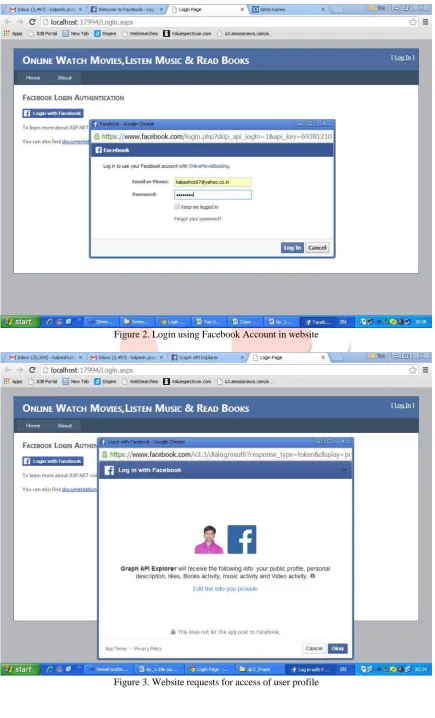
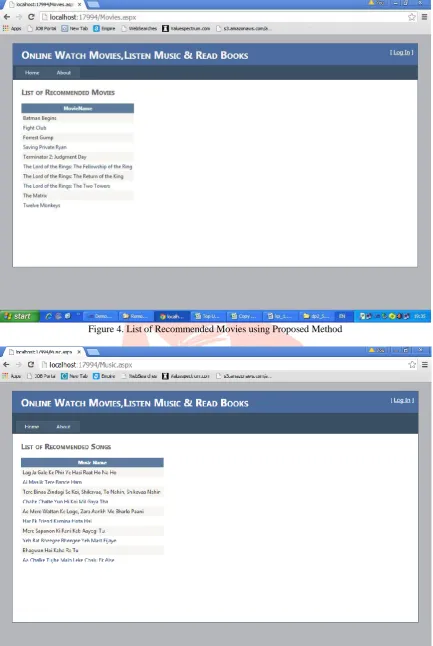
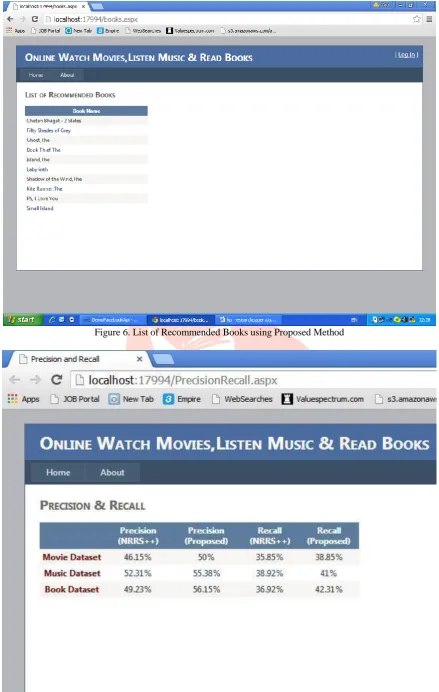
We have taken sample of “Online Watch Movies, Music and Books” as sample website and “Movie Lens dataset” as sample dataset for Movies. Music and Books create a Test Dataset as Database by downloading data. User has to use their facebook account to login in our website shown in Fig 2.After login into website using facebook account user will redirect to the next page in facebook website where it will ask for permission to access their basic profile data and Video activity, Music Activity and Book activity shown in Fig 3.After user gave permission website will retrieve basic profile and user likes. Now if we want to access Movies Web page then it will gives you movies recommendation using Proposed Method shown in Fig 4.If we want to access Music Web page then it will gives you songs recommendation using Proposed Method shown in Fig 5.If we want to access Books Web page then it will gives you Books recommendation using Proposed Method shown in Fig 6.In Fig 7,we compare results, Precision and Recall using both algorithms. We calculate Precision and Recall for Movies, Music and Books using NRRS++ algorithm. We also calculate Precision and Recall for Movies, Music and Books using proposed algorithm. It shows that Proposed Method is give better recommendation than NRRS++ algorithm.
V.CONCLUSIONANDFUTUREWORK
In recommendation system the major problem is recommendations of uninteresting items and ignoring personal interests. We review many algorithms of recommendation for efficient recommendation. Using social profile we got the personal interests and improve NRRS++ algorithm by removing uninteresting items and showing items of personal user interests. So we can provide the complete set of recommending items on base of user’s personal interests only.
We prove here that by adding knowledge of facebook user profile personal interests like movies, music and books in NRRS++ algorithm we can provide better Recommendation. We apply both algorithms on Movie lens dataset, Music Test Dataset and Books dataset and Calculate Precision and Recall. Final Result is shown in Fig 7.It shows that proposed method is better for recommendation than NRRS++
In future work, enhance this algorithm for other categories and use other social networking like twitter and cover more categories with this algorithm.
REFERENCES
[1] R. Uday Kiran and Masaru Kitsuregawa “An Improved Neighborhood-Restricted Association Rule-based Recommender System” Proceedings of the Twenty-Fourth Australasian Database Conference (ADC), Adelaide, Australia,Vol 137, pp. 43-50 , 2013.
[2] Jaydeep patel and Viral borisagar “UNDERSTAND CUSTOMER BEHAVIOR USING SOCIAL MEDIA IN RECOMMENDATION SYSTEM” International Journal For Technological Research In Engineering Volume 1, Issue 10, June-2014.
[3] R. Uday Kiran and Masaru Kitsuregawa “Towards Efficient Discovery of Frequent Patterns with Relative Support" COMAD, pp. 92 – 99, 2012.
[4] R Suguna and D Sharmila. “An Efficient Web Recommendation System using Collaborative Filtering and Pattern Discovery Algorithms” International Journal of Computer Applications,Vol 70, No. 3, pp. 37-44, May 2013.
[5] Purnima Tomar, Prateek Arora, Aakash Goel, Dharmender Saini “Social Profile Based Gift Recommendation System International Journal of Computer Science and Information Technologies (IJCSIT), Vol. 5 (3), 3670-3673, 2014.
[6] Makbule Gulcin Ozsoy and Faruk Polat “Trust Based Recommendation Systems”, ACM, pp. 199-208, 2013.
[7] Wayne Xin Zhao, Yanwei Guo, Yulan He, Han Jiang, Yuexin Wu and Xiaoming Li “We Know What You Want to Buy: A Demographic-based System for Product Recommendation On Microblogs” ACM, pp. 1935-1944 , 2014.
[8] Kailun Hu, Wynne Hsu, Mong Li Lee “Utilizing Users’ Tipping Points in E-commerce Recommender Systems” IEEE, pp. 494 – 504, 2013.