warwick.ac.uk/lib-publications
Manuscript version: Author’s Accepted ManuscriptThe version presented in WRAP is the author’s accepted manuscript and may differ from the published version or Version of Record.
Persistent WRAP URL:
http://wrap.warwick.ac.uk/88872 How to cite:
Please refer to published version for the most recent bibliographic citation information. If a published version is known of, the repository item page linked to above, will contain details on accessing it.
Copyright and reuse:
The Warwick Research Archive Portal (WRAP) makes this work by researchers of the University of Warwick available open access under the following conditions.
Copyright © and all moral rights to the version of the paper presented here belong to the individual author(s) and/or other copyright owners. To the extent reasonable and
practicable the material made available in WRAP has been checked for eligibility before being made available.
Copies of full items can be used for personal research or study, educational, or not-for-profit purposes without prior permission or charge. Provided that the authors, title and full
bibliographic details are credited, a hyperlink and/or URL is given for the original metadata page and the content is not changed in any way.
Publisher’s statement:
Please refer to the repository item page, publisher’s statement section, for further information.
1
COORDINATING SERVICE PROVISION IN DYNAMIC SERVICE SETTINGS:
A POSITION PRACTICE RELATIONS PERSPECTIVE
Accepted for publication at the Academy of Management Journal on May 22nd 2017.
Angela Aristidou
Warwick Business School, University of Warwick
Scarman Road, Coventry CV4 7AL, United Kingdom.
Michael Barrett
Judge Business School, Cambridge University
Trumpington Street, Cambridge CB2 1AG, United Kingdom.
Please cite as: Aristidou A. and Barrett, M. 2017. Coordinating Service Provision in
Dynamic Service Settings: A position practice relations perspective. Academy of
2
ABSTRACT
How is continuity of service provision supported in dynamic service settings (DSS) when
interactions span space and time, and are being increasingly infused by technology? We
explored this question through our eighteen-month qualitative study of the DSS of UK mental
health. We found that the pattern of interaction that emerges is constantly reconfigured
through processes of spanning time, stretching space and through distributed agency. Further,
we found that service provision does not only occur among work roles with clear
(cross)organizational links but also through diverse interaction among current customers and
their friends, as well as customer-to-customer interactions. We characterize such service
provision which is not anchored to any service organization as being extraorgnizational.
Further, we highlight the importance of the history of interactions and how trust built through
diverse interactions in the past may influence trust building in current interaction. To explain
our findings we introduce the concepts of “position-practices” and position-practice relations
(PPR) to theorize how diverse interaction among dispersed actors contributes to service
provision continuity in DSS. We develop a conceptual process model which identifies
processes of spanning time, and the stretching of space by which the PPR web of service
provision is dynamically reconfigured, and with what consequences for both our case as well
as other dynamic service settings.
Acknowledgements
We are indebted to the associate editor and three anonymous reviewers for their insightful comments and thoughtful guidance on our manuscript. We are grateful to participants in the Warwick Business School ‘Connections-in-Action’ workshop and the Oxford Said Business School
3
INTRODUCTION
Service provision is a demanding challenge to organizations operating in Dynamic Service
Settings, such as health, law, education, childcare and consulting (Nembhard & Tucker,
2011). Achieving and maintaining continuous service provision in DSS requires multiple
actors in different roles, both within and across organizations, working together (Gittell,
2006; Alter, 1990) and with customers (Okhusen & Bechky, 2009: 495; Gittell, 2011: 406),
such as doctors, nurses, and patients in a healthcare service setting. However, not all
individuals that contribute to continuous service provision in a DSS can be identified in roles.
And not all individuals interact within organizations; some might be found outside the
boundaries of any organization (e.g. friends of a customer) and even interact through online
platforms. This suggests that existing literatures drawing on role-based approaches to
coordination have not accounted for unexpected actors interacting across space and time in
novel ways, with unpredictable consequences for (future) service provision, for customers
and for the organizations involved. How this diverse interaction among dispersed actors
contributes to coordinating and, thus, supports continuous service provision in Dynamic
Service Settings needs to be understood.
Current scholarship puts forward a strong argument that work activities can be
coordinated through “the interactions that occur while individuals enact roles” (Bechky,
2006: 8). From role-theoretical perspectives, interaction among individuals-in-roles (such as
doctors, nurses, patients) enables coordination because roles enjoy clear boundaries,
well-defined responsibilities and pre-assigned activities (Bigley & Roberts, 2001, Griffin, Neal &
Parker, 2007). Specific roles are typically accountable for the delivery of a service; for
example, a doctor- nurse- assistant bounded “role set” may be accountable for health service
delivery in a hospital (Valentine & Edmondson, 2015: 406). Within a role set, the individuals
4
(Okhusen & Bechky, 2009; Valentine & Edmondson, 2015). Accordingly, role-theoretical
perspectives support that worker-customer interaction improves service dynamics (e.g.
Albertsen et al., 2014; Gutek, 1999; Gittell, 2002b; Gittell & Douglass, 2012; Bond & Gittell,
2010; Cramm et al., 2014; Cramm & Nieboer, 2012, 2014a, b), and that coordination effects
are improved through worker-worker interaction within an intra-organizational role set (e.g.
Gittell, 2002a; Gittell et al., 2008; 2015; Gittell, Seidner & Wimbush, 2010; Gittell, 2001),
and worker-worker interaction within an inter-organizational role set (e.g. Gittell & Weiss,
2004).
We add to current scholarship through our 18-month field study (2009-2011) in the
DSS of UK mental health. Failing to maintain continuity in service provision in this DSS may
not only result in a record of poor performance for an organization, but also in adverse
outcomes for specific patients, with a knock-on effect on their future well-being and the
broader community. As we demonstrate through our data, continuous service provision was
supported by interaction within intra- and inter-organizational role sets, which we observed.
However, we were surprised to additionally observe that multiple actors’ actions
unexpectedly interlock despite not having specified organizational or cross-organizational
links, e.g. former customers (e.g. past patients) and friends of customers. Importantly, this
interaction was also directly aimed at the intended outcome of maintaining the continuity of
service provision for specific, current customers. Existing scholarship, with its focus on
clearly defined, intra- and inter-organizational role sets, cannot adequately explain these
observations. Nor does existing research adequately account for our observation of variation
in the pattern of interaction that would otherwise be sufficient to achieve service continuity.
As our study is longitudinal, we also noted that some of the variations in the pattern of
interaction in the DSS of our study are ephemeral, while others are not. Either way, this
5
involved in this Dynamic Service Setting. Furthermore, because earlier influential empirical
works typically examine role-based interaction among physically collocated actors, as on film
sets (Bechky, 2006), hospital units (Valentine & Edmondson, 2015), and airports (Gittell,
2001) existing research does not help explain work in our empirical setting where actors do
not all interact in real time and may not share the same physical location, but rather do so
through social media and other technological platforms (Barrett, Davidson, Prabhu, and
Vargo 2015).
Our study therefore, poses a puzzle to understand how the continuity of service
provision is supported in DSS through interaction that spans (physical and virtual) space and
time, often through technology, and even though a pattern of interaction may vary over time.
In order to make sense of findings, to which existing research cannot offer sufficient
explanation, our article demonstrates the importance of integrating insights from
role-theoretical perspectives with those of practice-role-theoretical perspectives (Schatzki et al., 2001;
Nicolini, 2013; Whittington et al, 2006; Feldman & Orlikowski 2011). We adopt, advocate
and illustrate a practice approach – the Position-Practice Relations perspective [hereafter:
PPR; Giddens, 1984; Stones, 2005] – which provides the theoretical handholds that facilitate
a reconsideration of agency, temporality, spatiality and the role of technology. Its distinctive
features further enable us to articulate the processes by which variation emerges over time in
any pattern of interaction, which we labeled as processes of spanning time and stretching
space. We found that the implications of the constant reconfiguration of the pattern of
interaction on future coordinating efforts in DSS, was profound. The insights enabled by the
adoption of the PPR perspective are developed into a conceptual process framework, and
provide theoretical contributions as well as offering new research avenues for future work.
First, we add the notion of PPR to the toolkit of organizational theorists interested in
6
economic importance - Dynamic Service Settings. To explain how continuity of service
provision is supported in DSS when interaction spans space and time, and is being
increasingly infused by technology, researchers –we argue- must additionally account for the
ever-changing situation (because of the evolving customer needs), for individual agency, and
for agency distributed in time and (both physical and digital) space. Our article demonstrates
how the PPR notion allows researchers to understand, examine and address the puzzle
generated under the conditions encountered in our field study. Our PPR perspective
highlights the importance of the history of interaction and - in an interesting twist - also
highlights how trust built through diverse interaction in the past may influence trust building
in current interaction.
Second, our findings bring practice theory to bear on role-based perspectives, thereby
bringing together the two theoretical areas. In this way, our findings signify theoretical
linkages between practice theory and role theory and provide a set of clear implications of
adopting a position-practice perspective for conceptualizations of interaction to support
service provision. We therefore offer a complementary point of view for role-based theorists
interested in service settings and in coordinating in service settings, contributing to current
conversations in the literatures on relational coordination theory (Gittell, 2006; Gittel, 2011),
service relationships and service interactions (Gutek, 1999; Conlon et al., 2004). By doing so,
we extend the practice view on role-based coordination (e.g. Bechky, 2006), encompass and
go beyond theorizing only specific types of role-based interaction and their reciprocal
interrelationships (e.g. Gittell & Douglass, 2012; Ple, 2013; Gittell, 2002b) and demonstrate
that service provision does not only occur among work roles with clear (cross)organizational
links but also through diverse interaction among current customers and their friends, as well
as customer-to-customer interaction. This suggests that service provision does not have to be
7
Below, we first review the existing literature on role-theoretical perspectives on
interaction and then present our perspective of practice-position relations to address the
puzzle posed by our field study. We then describe the research setting and the details of the
research design. From our longitudinal data, we present how multiple actors coordinate their
efforts in our DSS towards service provision continuity. We then discuss how our findings
contribute to our understanding of role-based interaction, role-based coordination, and the
role of PPR in extending these literatures. We also provide boundary conditions for our study
and future research directions.
MAINTAINING SERVICE PROVISION IN DYNAMIC SERVICE SETTINGS
Coordinating activities among multiple service workers within and across organizational
boundaries, while simultaneously tailoring these activities to the emerging needs of the
customer (i.e. patient), with the purpose of maintaining service provision for the specific
customer, is a novel challenge facing service settings (Okhusen & Bechky; 2009: 496; Gittell,
2011).
Different aspects of this challenge have motivated various groups of contemporary
scholars. According to the theory of relational coordination, which examines relating for the
purpose of task integration under conditions of reciprocal interdependence, uncertainty and
time constraints (Gittell, 2006), repeated interaction between workers such as those
characterizing DSS, would over time generate stronger relationships among those interacting
and thus avoid adverse consequences to service provision (Gittell, 2002: 1410; Gittell,
Weinberg, Bennett, & Miller, 2008; Gittell, Weinberg, Pfefferle, & Bishop, 2008). For the
literature on “service interactions”, the repeated worker-customer interactions such as those
typical of DSS, would over time generate “service relationships” (Gutek and colleagues,
1999; 2000; e.g. visiting the same physician over a period of years). The history of these
8
as proposed by Gutek (1999: 219) and demonstrated in Conlon and colleagues (2004). Both
streams of literature draw the conceptual link from repeated interaction among actors (albeit
primarily focusing on different actors), to maintaining service provision in settings that share
DSS characteristics.
These literatures are role-based, because the interacting actors are perceived to be in
‘roles’, or “activity-based positions that can be assumed by anyone with the necessary
training” (Valentine & Edmondson, 2015: 405). For Gutek (1999), the “customer and
workers get to know each other as role occupants” (p. 219). For relational coordination
studies, the reciprocal interrelating between workers (Gittell & Weiss, 2004; Gittell &
Douglass, 2012), is examined through the relationships among service workers occupying
specific roles (e.g. doctors, nurses, assistants; Gittell et al. 2008, 2015). Role-based
interaction is thus perceived as crucial to support service provision in settings that share DSS
characteristics. We therefore focus on the contributions of this body of research to our
understanding of how efforts towards continuous service provision are coordinated in DSS,
while highlighting the ways in which it does not adequately account for our field study
observations.
Existing Research on Role-based Interaction in settings that share DSS characteristics
A key contribution of existing research based on role-based perspectives, is the
demonstration that interaction – either within an intra-organizational role set or within an
inter-organizational role set – enables coordinating and thus supports service provision.
In settings that share DSS characteristics and intended outcome, scholars have
frequently examined interacting actors who are in roles linked with a focal organization (i.e.
in worker roles; in the role of the current customer) and, thus, are perceived to interact within
an intra-organizational role set, typically because this specific set of roles (e.g. one doctor,
9
Valentine & Edmondson, 2015). Interaction among service workers within a focal service
organization was the initial focus of relational coordination theory in care groups and
hospitals (Gittell, 2002a; Gittell, Weinberg, Bennett & Miller, 2008; Gittell et al., 2015;
Gittell et al., 2010) and aviation (Gittell, 2001). Other scholars have focused on interaction
between service workers of a focal service organization and current customers, which is
perceived to lie at the heart of organizational life in a range of service settings (Albertsen et
al, 2014; Gutek, Bhappu, Liao-Troth, & Bennett, 1999; Gutek, Cherry, Bhappu, Schneider, &
Woolf, 2000; Gittell, 2002; Skaggs & Huffman, 2003). This worker-customer interaction is
even used as the defining characteristic of DSS by Nembhard and Tucker (2011), and the
focus of Gutek and her colleagues (1999, 2000) in a variety of settings including cruise ships
(Conlon, Van Dyne, Milner, & Kok Yee, 2004). Across studies, individuals-in-roles interact
within an intra-organizational role set, with the aim of achieving and maintaining service
provision (continuous medical care; on-time flight departures; etc).
As recent literature suggests, however, it makes a difference to service provision
dynamics when studies additionally account for interaction with roles outside the focal
service organization (e.g. Bond & Gittell, 2010; Derrington, 2012; Cramm et al., 2014).
Expanding the intra-organizational “role set” of previous empirical studies, Gittell and Weiss
(2004), for instance, examine interaction among workers within a hospital (pp.134-139) and,
also, interaction among hospital specialists and specialists working for ‘external partners’ of
the hospital (e.g. in the roles of family doctors). In other words, the authors examine
interaction between workers within a focal organization and workers in other service
organizations within an inter-organizational role set. Importantly, the authors find that this
interaction contributes to improved service delivery (p. 147).
A second key contribution of existing research is found in the few rare empirical
10
an organizational role-set. One such study, Ple’s (2013) examination of banking service
provision, has demonstrated the ‘influence’ (p.3) of worker-customer interaction on
worker-worker interaction. The reverse ‘influence’ is discovered in Gittell (2002a). Since DSS are
characterized by both, these studies expand our conceptual horizons by demonstrating the
need to account for the interrelations of different types of role-based interaction when
examining service provision in DSS. Building on this insight, relational coordination theory
has recently expanded to include a focus on worker-customer interaction (e.g. Parsons, 2012;
Cramm & Nieboer, 2014a, b), with Gittell and Douglass (2012) calling for the study of
interrelations among types of interaction (p.716).
Existing research has provided important evidence for the significance of different
types of role-based interaction (worker-customer, worker-worker within a single
organization, worker of one organization with worker of other organizations) in supporting
service provision in settings sharing DSS characteristics. However, we must add to existing
insights to adequately account for our field study observations, as we elaborate in detail
below.
Some difficulties with existing scholarship
Within a role set, role-based interaction helps role occupants coordinate their efforts because
roles have clear reporting relationships (Bigley & Roberts 2001: 1287) and because “people
[role occupants] know whom they are working with and how to find each other (…) and
everyone together has a collective responsibility for interdependent work” (Valentine &
Edmondson, 2015: 407). This powerful understanding underpins the tendency for empirically
examining interaction in intra/inter-organizational role sets where actors have readily visible
links (e.g. reporting relationships) to one another (workers, and/or customers).
In our field study, we observed that there were no clearly defined links between some
11
patients, neighborhood friends) often through their activity of social media platforms (e.g. a
chatroom) or through activity outside any organizational space (e.g. the neighborhood park).
Indeed, we would be challenged to position this interaction within any typical
inter/intra-organizational role set. Which may explain why we still know very little about how this
diverse interaction may contribute towards maintaining service provision in DSS and how it
might even interrelate with well-studied types of interaction, such as worker-worker. This, we
argue, poses a limitation to understanding how service provision is maintained in DSS for
three main reasons.
First, if scholars start their investigation from the assumption that all significant
decisions of whom to account within, or exclude from, the role set have been made in the past
or by some higher authority that decided the boundaries of who is relevant and who is not,
and the “links” between them, then we may perceive actors as being in a situation where they
are stuck with only a pre-specified selection to choose from, deploy or enact in their efforts to
coordinate towards continuous service provision in DSS. Although studies do not rule out the
possibility of variability or change in the pattern of role-based interaction because of the
“agentic dimension” (Emirbayers & Mische, 1998: 975), they do not adequately explain how
actors (in roles) might selectively recognize, locate, and implement change in their ongoing
and situated interaction. Indeed, this variability in the pattern of interaction over time is
precisely what we observed in our field study of 18 months. Recent calls to study the
personal in role-based relationships (Gittell, 2011, pp. 405-406) underline this limited
awareness of agency and situatedness in existing work.
Second, repeated worker-worker interaction, repeated worker-customer interaction
and repeated interaction among workers of one organization and another organization are
each separately suggested to support the maintainance of service provision, as discussed
12
as Gittell and Douglass (2012) theorize – and Ple (2013) and Gittell (2002b) support – then
these arguments may be extended to propose that reciprocally interrelating through all these
different interactions, would further support service provision continuity in DSS. And,
therefore, it follows from the same arguments that excluding interaction either comfortably
situated within an inter/intra-organizational role set (e.g. worker-current customer) or not
(e.g. the interaction we observe in our field study among past patients and current patients),
may have the unintended consequence of excluding important insights on how the continuity
of service provision is maintained in DSS.
Third, if interaction continues being examined primarily in geographically limited
role sets where role actants interact face-to-face and in real-time (e.g. on a cruise ship;
Conlon et al., 2004), this ignores a powerful trend in the delivery of services which are
increasingly moving out of organizational spaces (e.g. the hospital) and into
non-organizational spaces (e.g. the community in our field study), often supported through
technology and social media platforms. The well-established benefits of physical co-location
(copresence; Mead, 1934; Goffman, 1963) on enabling coordination (Okhusen & Bechky,
2009), have had the inadvertent outcome of maintaining the focus of the scholars in this
stream of research on face-to-face interaction taking place in organizational spaces.
Our field study therefore, poses a puzzle to understand how actors coordinate their
efforts in DSS towards maintaining service provision, despite the spread of interaction across
(virtual and physical) space and time through technology, and even though the typical pattern
of interaction may change over time. Since current scholarship does not go far enough to
examine distributed agency, temporality, spatiality and technology in interaction that supports
coordinating in DSS, we find it helpful to advance a practice perspective on interaction to
13
Bringing in the notion of Position-Practice Relations to account for agency, spatiality, temporality, and technology
We propose that the Position-Practice Relations lens (Giddens, 1984; Stones, 2005) helps us
tackle the puzzle of our field study, i.e. how distributed agency, temporality, spatiality and
technology in interaction contribute to the pattern of interaction that supports coordinating
within DSS.
First, the Position-Practice Relations [PPR] lens directs attention to the practice that
actors in position-practices collectively perform. The concept of “position-practices”
recognizes that all interaction ‘depends upon the “positioning” of individuals in the
time-space contexts of activity’ (Giddens 1984: 89). While “position-practices” are frequently
associated with roles (Coad & Glyptis, 2014: 146; Cohen, 1989), this concept stresses the
practice that might not inhere in roles. In so doing it helps us to understand how actors
coordinate their efforts in DSS, as it is shifts the emphasis away from pre-specified intra- or
inter- organizational role sets to the practice that links these agents across time and space in
position-practice relations (Stones, 2005; Coad, Jack & Kholeif, 2015). Such a focus is an
appealing approach to understand how actors coordinate their efforts in DSS when not all
actors share explicit (cross)organizational links.
Second, when individuals are in position-practices in relation to a specific task (e.g.
the continuity of service provision), it follows that they are also located in a web of
‘relations’ among position-practices, referred to as a PPR web (Coad & Glyptis, 2014;
Stones, 2005). Within any PPR web, “interactions… are produced through the agency of
social actors’’ (Cohen, 1989: 2) and are “necessary for actors to coordinate their actions with
others” (Coad & Herbert, 2009; found in Coad & Glyptis, 2014:147). As a result of such
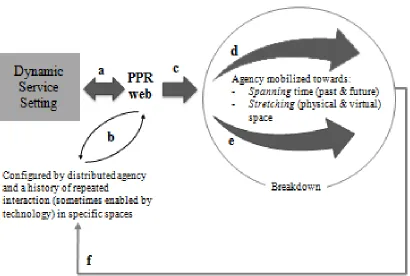
continuous interaction among agents in “position-practices” within this PPR web, the PPR
14
the importance of temporality in shaping the pattern of interaction over time. Further, recent
work (Coad & Herbert, 2009; Greenhalgh & Stones, 2010) has highlighted that technology,
which has been largely ignored in existing scholarship, is a critical element of
position-practice relations and technology mediated interaction may (re)shape PPR webs.
We contribute by combining role-based and practice-based views to better understand
how multiple actors coordinate their efforts in dynamic service settings which are
increasingly infused with and depend on technology for service provision. Earlier work
(Bechky, 2006) has adopted a practice-based conception of role-based interaction. However
the actors in Bechky’s (2006) temporary organization (film sets) are in very close physical
proximity to one another and do not interact with customers but rather only within an
intra-organizational role set (director, grip, actor, etc). Further, in Bechky’s (2006) research setting
and analysis there is less of a focus on longitudinal observations of variation in the pattern of
interaction. By examining the PPR web in the context of our empirical study, we can explain
the variation observed in the typical pattern of interaction which we observed over time and,
importantly, the empirical and theoretical implications of this variation on the continuity of
service provision. In other words, in this article we address the research question: How does
diverse interaction among dispersed actors contribute to coordinating and, thus, supporting
continuous service provision in Dynamic Service Settings?
METHODS
The Dynamic Service Setting of Mental Health Care
Being a chronic illness, mental health is a typical DSS, characterized by continuous
worker-customer interaction with the intended outcome of maintaining service delivery over a period
of time extending to years. In this setting, service workers are specialized and highly
interdependent with each other within a service organization and across other service
15
services). Maintaining the continuity of patient care in these conditions is further challenged
by the fact that patient needs vary over time, often significantly. As such, mental health is an
ideal setting to study how actors coordinate their efforts in a DSS as they share similar
characteristics to other DSS such as law, education, childcare and consulting.
The Empirical Context of Mental health care in the UK
Across the UK, young people under the age of 18 may access mental health treatments at the
publicly funded organizations called “Child and Adolescent Mental Health Services”, or
CAMHS. Our study took place in a specific geographical area of the UK where the local
CAMHS organization catered to a population of wide socioeconomic, ethnic and urban-rural
heterogeneity. This CAMHS is typical of under-age public mental health service
organizations in the UK, in terms of its organizational processes and treatments, as it offers
specialist care to young people such as counselling, psychological therapies, family therapy
and community support. We consider this CAMHS as the focal service organization, its
employees as CAMHS service workers of the focal service organization, and the patients as
current customers.
Research Approach
This paper draws on qualitative data collected between November 2009 and March 2011 (1.5
years) within the geographical “catchment” area of CAMHS. Consistent with other
practice-based studies (e.g.Mazmanian, 2013; Nicolini, 2011; Orlikowski & Scott, 2013), our study
draws on multiple qualitative methods: documentation, observations and interviews (we
present these in detail). Through these methods, our efforts aimed to identify those activities
that would be considered as relevant to the composition of the practice of mental health
service provision. Our focus on the routine or daily activities that are performed in the
16
Nicolini, 2011: 606; Mazmanian, 2013: 1230; Orlikowski, 2002: 255),1 and our emphasis on
human activities in a specific area is informed both by the purpose of our study and by the
need to make an analytical “cut” (Barrett, Oborn, Orlikowski, & Yates, 2012).
Data Sources
We followed an emergent strategy for data collection. Initially, research access was
facilitated by a research grant with the local mental health “Trust” (a public organization that
includes CAMHS) as the designated partner. We used a “snowball technique” (Lincoln &
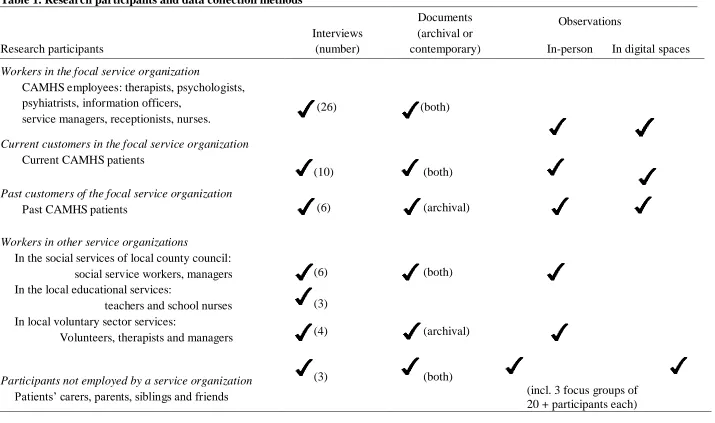
Guba, 1986) to identify research participants outside CAMHS (see Table 1). Informed
consent was acquired by individual research participants.
[Insert Table 1 about here]
Observations. Our observations were conducted "in the natural context of occurence" (Adler
& Adler, 1994), which in our study spread across multiple research sites (described below).
We catalogued all our field observations so that, over time, we believe that we relatively
covered the range of typical activities (Barley, 1990) in mental health provision.
Physical sites of the focal service organization. Initially, we were non-participant observers
in 13 out of the 15 physical sites of CAMHS, of which we observed a sub-set (n=3) for thirty
non-consecutive days to deepen our immersion in the field. We attended two ‘team
meetings’ in one of the CAMHS units, lasting about 90 minutes each and further attended
two ‘referral assessment sessions’ in another CAMHS unit, lasting 60 minutes each.
Additionally, we observed seven “service improvement initiatives” which typically lasted 1
to 3 hours and took place in an informal setting -- over pizza, coffee and usually in late
afternoon. They were organized by groups of patients and their carers or by CAMHS
workers. Participation was voluntary and ad-hoc. One was monthly and would last 3 hours,
17
bringing together 26 to 30 participants: 3 CAMHS service CAMHS workers, 7 current
CAMHS service users, 14 carers or family members of current CAMHS members, 2 past
CAMHS service users, and 2 carers or family members of past CAMHS patients. For our
study, these provide rich observations on the activities of multiple actors within CAMHS
(e.g. team meetings) and outside CAMHS (e.g. pizzeria). Notes from these observations were
copious (134 pages), often verbatim and anonymised, and followed up with interviews of
observed participants. We later extended our observations to other sites, physical and virtual.
Physical sites of other service organizations. We observed the physical sites of other
organizations that became relevant to our study, sometimes accompanying workers to their
work appointments and often speaking to them in the halls and common areas around offices.
Organizational virtual sites. We observed specific online sites that were brought to our
attention by research participants as “virtual places” where current and past CAMHS patients
interact: NHS Choices forums, Pinpoint, Public Opinion, and Moodzone.
Other virtual sites. Our attention was drawn by current CAMHS patients to a forum on the
popular social media website Facebook, which was created by and attracted a sub-set of past
and current CAMHS patients from the specific UK region of our study. This forum was
public (i.e. accessible to anyone with a Facebook account, which is free to acquire) from
October 2009 to September 2011. We did not observe patients using these social media
platforms per se, but we had access to the textual record of these activities through the
“history line” of each social media platform, which offered what we have called “a frozen
record” of activities that occured even months prior to our study. This provided us with a
wealth of data around the online and offline activities of current and past patients.
Interviews. In addition to numerous reflective conversations in the field, we draw on data
18 Formal interviews (n=38) were recorded and transcribed verbatim. In the interviews to
CAMHS workers, questions included: "Can you tell us what you do when you deliver mental
health care to your patients?" To actors other than CAMHS workers, we asked: "Can you tell
us what you do when you (your son, your daughter, etc) receive(s) mental health care?" We
also modified two key research questions first designed by Sandberg and Pinnington (2009):
"What other people are involved, and how are they involved when you are delivering (or
receiving) mental health care?" and "What tools and equipment, are involved, and how do
you use them when you are delivering (or receiving) mental health care?" (p.1151). The
Sandberg and Pinnington (2009) study is similar to ours because it is practice-based, and
hence we benefited from these two questions that the authors’ used to “explore in detail the
people and things involved in ways of practicing” (p. 1151). Following closely their approach
to interviewing, we also sought to elicit concrete examples from participants through
follow-up questions (such as, "Can you provide an example that illustrates more specifically
how....?", p. 1151) and through what the authors call ‘confirmatory questions’ (p.1151), such
as, "So if I understand you correctly you mean that...?". However, the focus of Sandberg and
Pinnington (2009) is ‘competence’ in the context of corporate law, while our research
investigates mental health service provision. Also, we used these questions with workers,
customers and other members of their communities (e.g. carers), while Sandberg and
Pinnington (2009) only address these questions to service workers (i.e. lawyers). Because of
these two differences, we modified research questions and interview protocols accordingly.
Ethnographic interviews (n=20) as participants left meetings in a range of spaces typically
focused on specific activities or issues at hand.
Documentation includes service/organization documents and patient documents. Memos and
other documents were accessed through the CAMHS intranet with help from CAMHS
19
collected extensive documentation generated by CAMHS, such as schedules, meeting
minutes, organizational information, best practice protocols, care guidelines, transition plans,
policies, meeting minutes, and evaluation criteria. For service organizations other than
CAMHS, we collected publicly available documentation and documentation that became
available to us through participants.
Analytical Approach
The initial focus of our empirical, practice-based study was to examine the practice of mental
health service provision in the geographical area of our setting. Therefore, Stage 1 of our
analysis examines activities relevant to mental health service provision in the context of our
study. Stages 2, 3 and 4 pertain specifically to the findings and discussion of this article.
Stage 1. We assembled on a timeline all the relevant activities that were collected through
interviews, documentation and observations. We coded all our data together, a grounded
theory strategy (Charmaz, 2006; Strauss & Corbin, 1998), and coded according to when they
emerged in the practice of mental health service provision. This analysis identified the
specific activities carried out in the practice of mental health service provision in the specific
context of our study, thus grounding our study in the everyday, routine activities that are
jointly performed by and collectively meaningful to multiple actors in a specific context.
First, this analysis revealed the significance of interaction in supporting the practice
of mental health service provision. The notion of “interaction” surfaced early in our analysis,
because it featured frequently in our participants’ accounts of how they provide (or receive)
mental health service and even more prominently in their explanations about how their efforts
interlink with others’ towards maintaining mental health service provision for current
CAMHS patients, as in the representative example below:
[Interview, CAMHS therapist]
20
with him at home to help him communicate with them and warn them about his bursts of anger. They did [this activity at home] and within three sessions there was a remarkable improvement in how our patient warned them about his anger. And we also need the parents in the room [at CAMHS] to do transference work, to take the information out with them to the home, because ASD children cannot do that very well, so the parents have to be in the room with the young person.
Interviewer: So what is transference work? I don’t know really
CAMHS therapist: It’s the work I do together with the parents, when they come here [in CAMHS]. It’s sort of work. We talk together about how they can best support what the patient and I do here [points to the room around her] when the patient is at home with them, when they are at home talking, joking, even arguing.
Interviewer: And this is something everyone does?
CAMHS therapist: I would be surprised if someone doesn’t [laughs]. It is important to keep those communication lines open and strong, otherwise we… you see we all are in this together and talking to the parents is key to our success as a [service] unit [at delivering mental health service].
Second, our first round of analysis highlighted that “breakdowns” in service provision
were recurrent. These would prompt a pattern of interaction that was not typical either before
or after those breakdowns. For example, during a breakdown, we would often code in our
data that “CAMHS workers and workers of other service organizations reviewing/revising
existing procedures and treatment activities”. We coded 34 “breakdowns” in our dataset,
using the following criteria: (i) the definition, by Lok and DeRond (2013), “when things
don’t go as planned or as expected” and (ii) whether a breakdown unsettles typical service
provision for specific patients. Of these, we had recorded and/or observed longitudinally
eleven (11).
Stage 2. At this point, we had noted the analytical promise of interaction and breakdown,
although it was unclear how interaction supports service provision despite – or through-
recurrent breakdowns. Holding on to our hunch that these constructs are significant (Locke,
Golden-Biddle & Feldman, 2008), we sought out literatures that might help better understand
how interaction supports service provision.
We turned to the existing literatures on role-based interaction as a “sensitizing
21
examining data and relevant literatures (Gioia, Corley, & Hamilton, 2013; Locke,
Golden-Biddle, & Feldman, 2008), in another round of coding, we identified types of role-based
interaction in our data. We focused on identifying and refining our description of each type of
interaction, ensuring that each type was consistent across its multiple occurrences. We then
categorized each type of interaction, by juxtaposition with those in the relevant literature
(Suddaby, 2006: 634), and so we chose labels that reflect these literatures: Worker of the
Focal organization with Worker of the Focal organization, Worker Focal with Worker of
Other organization, Worker Focal with Current Customer.
Stage 3. Even after the Stage 2 analysis, we had not accounted for interaction that was
obvious in our data and had an impact on service provision. For example, as described in the
excerpt above, the interaction between the CAMHS therapist and the parents of the young
ASD patient. This instance of interaction clearly contributes to coordinating service provision
for the specific ASD patient. In fact, the absence of such interaction may jeopardize service
provision continuity. Intrigued by similar observations, we further examined the distinctions
between our empirical data and the insights generated by existing scholarship and identified
the following areas in which existing literature was less helpful in making sense of our field
study observations.
First we noted - similar to the parents of the ADS patient - multiple actors interacting
without enjoying clear links with each other or with the focal service organization (CAMHS).
These actors might be, for example, friends of the patient. Indeed, interactions between the
patient and her friends were often cited in interviews as key for maintaining the patient’s
engagement with the service (coded in 34 instances). In total, we coded 132 such instances in
our dataset, with the following criteria: (i) the instance of interaction occurs among actors not
in direct link to CAMHS, or in a reporting relationship to one another (ii) this instance of
22
current CAMHS patients. We observed multiple such instances of interaction in Service
Improvement Initiatives (24 instances) and in informal settings (12 instances; e.g. pizzeria
meeting of ASD families).
Second, we noted the absence of consideration of technology in current empirical
accounts, as often existing studies on role-based interaction are concerned primarily with
face-to-face interaction in real time. By “technology” we broadly refer to technology-based
platforms: computer-, phone-, network- or internet-based. Yet, our data analysis quickly
highlighted the significance of technology to enable interactions dispersed across the physical
and virtual sites of our multi-sited empirical study. Examples range from the internet-based
social media platforms such as the Facebook site of past and current CAMHS patients, to the
workers emailing updates in real-time to a colleague who could not attend the ongoing
CAMHS team meeting. We coded 111 instances in our dataset, with the following criteria: (i)
technological platforms enable interaction aimed at the intended outcome of maintaining
service provision for specific CAMHS patients (ii) actors draw on the historical (“frozen”)
record of past activity found on technological platforms, with the intended outcome of
maintaining service provision.
Third, while analyzing data across breakdowns and over time, we were intrigued by the
“modifications” that we observed happening during breakdowns to the pre-existing pattern of
interaction. We sought to understand what effect this variation may have for maintaining
service provision for the specific patients involved. Since our longitudinal data allowed for
such an investigation, we re-coded our data to explore this direction further and noted two
processes: (1) actors would go back in time in the patient’s history, their own experiences,
and knowledge of past similar incidents, while also try to imagine future possibilities of
patient care for this specific patient in this evolving situation and (2) actors would seek
23
in order to maintain service provision. We labeled the first process as “spanning time” and
the second as process of “stretching space”. These often overlapped but not always. Both
often had the (unintended) consequence of including additional, unexpected actors, such as a
past patient in the process of “stretching space”, or the former councilor of the current
CAMHS patient who is brought back into the fold in the process of “spanning time”.
Stage 4. Our analysis in Stages 1-3 highlights that, the practice of mental health service
provision (composed of activities, saying and doings of the participants to the practice) comes
to be a practice through interaction. The pattern of interaction that supports coordinating
among the multiple participants in the practice of mental health service provision, unfolds
and changes over time, sometimes supported by technology, across physical and virtual,
organizational and non-organizational spaces.
In tune with much recent inductive research, we subsequently drew on the concept of
Position-Practice Relations (Cohen, 1989 and Stones, 2005; drawing on Giddens, 1984) to
account for the situatedness of unfolding action across time, for spatiality, and the enabling
role of technology and to help structure our interpretations. Through an iterative process
between recent literature on PPR (e.g. Coad & Glyptis, 2014; Coad, Jack & Kholeif, 2015;
Stones, 2015) and our analysis, we focused specifically on those aspects of the PPR notion
that provide strong theoretical “handholds” to address the puzzle of our study. As we
demonstrate, the notion of PPR webs in particular, offers a powerful lens to examine the
processes by which agency, temporality, spatiality and technology come together towards the
intended outcome of continuity of service provision. We provide more information about this
24 FINDINGS
In the next two sub-sections we present findings from our longitudinal analysis of how
diverse interaction support the coordinating of dispersed actors towards continuous service
provision in Dynamic Service Settings.
In the first section, we draw on our interview, observation and archival data to display
how actors in multiple position-practices interact within the PPR web of mental health
service provision. This section is followed by an analysis in which we discuss how our
theoretical perspective of Position-Practice Relations develops key aspects of agency,
temporality, spatiality and the role of technology to advance our understanding of how
interaction supports service provision in DSS.
In the second section we present our findings through two examples (Jonathan’s and
Anna’s) that display chronologically how multiple actors in multiple position-practices
interact to realize the intended outcome of maintaining the practice of service provision for
these patients over time, during and despite the observed breakdowns. Following recent work
(Nicolini, 2011; Deken, Carlile, Berends & Lauche, 2016; Jarzabowski & Le, 2017), we
adopt the strategy of providing “representative narratives” (Deken et al., 2016), through
which to “illustrate” (Jarzabowski & Le, 2017) our findings. Each of the two examples is
followed by an analysis in which we further develop our key theoretical insights and extend
these insights to account for distributed agency and the role of the technology enabled
processes which involve spanning time and stretching space.
Interaction produced in a ‘Position-Practice Relations’ Web: Where, Whom, When and How
The intended outcome of maintaining continuous service provision for a specific patient,
brings together multiple individuals in “position-practices” relevant to this task and, over
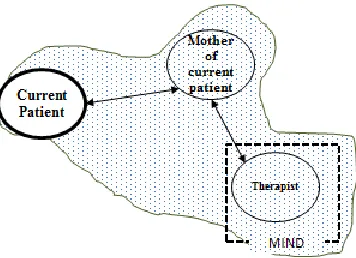
time, creates a “web” of relations among them. Figure 1 offers a visual of a “typical” PPR
25
studies that visualize PPR webs (e.g. Coad & Glyptis, 2014; Greenhalgh & Stones, 2010), our
visual foregrounds an “agent-in-focus” – in our study, the position-practice of the current
patient.
[Please Insert Figure 1 here:
Visual of typical PPR web in Mental Health service provision]
Within this PPR web of service provision, “practice-positions” (depicted as “ovals” in Figure
1) are always in relation to the task of maintaining service provision for our “current patient”.
Position-practices typical in our setting are those of the “therapist to the current patient”, the
“nurse to the current patient”, the “carers (mother, father) to the current patient”, but also the
“GP (family doctor) to the current patient” and the “school teacher to the current patient”.
Interaction among those occupying position-practices (depicted in Figure 1 with arrows), is
produced through the agency of actors, situated in space and time and often enabled by
technology (such as mobile phones, email, or social media platforms). We next offer multiple
examples from our rich dataset.
Where: Interaction spread across organizational and non-organizational spaces
For depression, anxiety and obsessive compulsive disorders, which are the majority of
“presentations” in CAMHS [citation withheld to maintain anonymity of the organization], the
“first line of defense is CBT [Cognitive-Behavioral Therapy]” (Interview, CAMHS
psychiatrist). Through weekly appointments at a CAMHS unit, CAMHS patients and
CAMHS workers engage in CBT activities that are “hands-on”, as the goal is to “explore,
together, different skills that the patient can use to change their daily actions, behaviors and
feelings that are holding them back”, then, patients “go home and practice, essentially, their
homework” (Interview, CAMHS therapist).
In Samantha’s case, her Obsessive Compulsive Behavior [OCD] meant that this
26
prepared herself or seen prepared in front of her eyes” (Interview, CAMHS therapist). CB T
activities started with “blueprinting”, which is “filling in a handout in which the patient and
therapist together note down what the patient has done in the past, what worked and what
not” (Interview, same). Then, Samantha took this handout home. It was Samantha’s choice –
at home- to “test, one-by-one” all the activities on the “what-worked-in-the-past-list”, record
what she did in a “journal” and return a week later (for her next CBT appointment) to review
this journal together with her CAMHS therapist and “discuss each item’s future potential”
(Interview, same).
For Ginni, a 15-year-old patient diagnosed with anxiety and obsessive compulsive
behavior, one of the CBT sessions involved the activity of recording Ginni’s voice…
…[d]escribing her absolute worst fears. Then [during the appointment] she [Ginni] listened to the recording on her earphones repeatedly, in order to heighten her anxiety levels, let them spike as high as they can be [Interview, CAMHS psychologist]
The same psychologist explained that this activity aimed to “let her [Ginni] see that she can
actually calm herself down even when in the after-stage of superbly high levels of anxiety.”
In-between appointments, it was Ginni’s idea to repeat this activity while taking a walk with
her mother.
Similarly, Roger, a 13-year old with dog-phobia first “took hold of various dog-related
items: a dog leash, a dog collar, a dog bowl, in here [the CAMHS appointment room] with my
encouragement” (Interview, CAMHS nurse) and with time, “took on the daily activity of
going to the park for 5 minutes every afternoon and gradually increase to 30 minutes”
(Interview, same). As the park is usually full of dogs in the afternoon, this activity aimed to
“desensitize him [to dogs’ presence] and increase his confidence over time. He started first by
going with his brothers [to the park]” (Interview, same).
Analysis of spatiality in interacting towards supporting continuous service provision
Samantha, Jo, Ginni and Roger, among other current patients on CBT therapy, interact
regularly with CAMHS workers in the position-practices of (e.g.) the “nurse to
27
experiments with various techniques to support the desired change, both within and outside
the CAMHS appointment room (i.e. at home, while taking a walk, at the local park).
Indeed, without patient involvement and engagement within and outside the time and
space of CAMHS appointments, mental health service provision cannot emerge. “To put it
simply, if they don’t want to engage, we cannot make them engage and we certainly cannot
make them want to change. They need to want it” (Interview, CAMHS psychologist).
Multiple site observations and interview data also highlights that patients’ family members
(carers, or foster parents) together explore ways to better support patient treatment, and they
meet both within and outside the location of a CAMHS unit. For example, Ginni in the
position practice of the “current patient” interacts with her mother (in the position-practice of
“the mother of Ginni”) towards maintaining Ginni’s mental health service provision by taking
walks together while Ginni listens to the recording of her worst fears. The agency of these
actors, and in particular the current patient, is critical towards maintaining service provision
in DSS, as we present next.
Whom with: Interaction produced through the agency of multiple actors in
“position-practices”
Samantha, Jo, Ginni and Roger present examples of how the patient’s active participation to
the practice of mental health service provision shapes their (future) care. Each of them
actively seeks treatment options, chooses to put time and effort into particular treatment
options over others, and might reject alternatives. Each of them might actively recruit other
participants (parents, siblings), passively allow them into or restrict from the activities aimed
at maintaining the current patient’s mental health service provision. In turn, those participants
(parents, siblings) choose -or not- how, when and with what intensity to participate in the
activities to maintain Sam, Jo, Ginni and Roger’s continuity of care. As the examples of
Samantha, Ginni, Jo and Roger illustrate, the agency of each and any of these multiple actors
28
current patient. Further examples from our fieldwork strongly support the insight that
interaction within a PPR web (the arrows in Figure 1) is produced through the agency of
actors in position-practices.
Parents, siblings and friends of patients engaged in Cognitive Behavioral Therapy, as
presented earlier, might choose to jointly enact the treatment activities with the patient, at
home (e.g. going for walks, going to the park, doing breathing exercises, filling in a
“blueprinting” handout, etc). Parents of patients engaged in psychoanalysis [a different type
of therapy] might, for example, “hold containment” in-between sessions – the importance of
this activity explained to us as follows:
When Mia [current patient] leaves [the appointment room], she is usually confused, all over the place. All of our psychoanalysis patients, not just Mia. Psychoanalysis is quite intense, very deep, not just about skills but digging deep. She [Mia] might go home and tell the parents that I [CAMHS psychologist to Mia] was mean or that it is “boring”. Of course, the young person has to be free to come to therapy or not. But if the parents cannot “hold containment” around Mia, to be consistent in their reactions and in their activities with her at home, psychoanalysis cannot work here [emphasis in voice, Interview CAMHS psychologist]
Similarly, the example below highlights how maintaining service provision is also supported
by interaction – without involvement of CAMHS workers. This is the case of Lena and
Fiona, two current CAMHS patients and friends, who:
[We] both go to the same CAMHS unit, and quite often our appointments are at the same time, so we wait together and chat. It’s funny how the techniques we learn in cognitive behavioural therapy sessions can be turned into something fun. We practice the techniques such as mindfulness, relaxation and color therapy together, though sometimes we find it hard to keep a straight face [Excerpt from online blog on a public website for NHS patients]
These two girls in position-practices of “current CAMHS patients” offer a colourful
description of how they “share” therapeutic activities and highlight the positive effect this has
on the care of each one of them. The interaction between these two “current patients”,
involving activities of “practicing mindfulness, relaxation and color therapy together”, is
likely to be in-between CAMHS appointments and at a non-CAMHS location, such as the
school, or the girls’ homes. Each individual in this interaction (Lena and Fiona) chose the
29
color therapy). So far, these choices seem to support both girls’ continuity of service
provision according to their own online account.
Lena and Fiona are current patients - but even past CAMHS patients would place
themselves within the PPR web of current patients by volunteering to participate in activities
targeting the current patients’ continuity of care - as the following example illustrates:
[Extract below from observations at a CAMHS-organized service improvement initiative which took place at the specialist CAMHS eating disorders unit]
Hayne (current patient): So what do we, should we expect over the Christmas period
Liam (current patient): People will be eating a lot over Christmas and then they will be going on diets after Christmas [Note: patient appears very concerned]
Rebecca (past patient - volunteer): What I did back then was I distance [sic] myself from people talking about diets, I just avoid talking to them. I tell them that this is not what I want to be talking about and that is it. And also I stick to a meal plan over Christmas, so that I would gain weight and start thinking straight again [Note: gaining weight is considered a positive outcome for patients diagnosed with anorexia]
Liam (current patient): Then what about the meal plan?
Rebecca (past patient - volunteer): That, yes, I stick to it. There is a closing in the [CAMHS] unit over Christmas, they are minimum staff or something, not real closing but sort of. The first Christmas I did not know, it was unexpected. [So] request a meal plan in advance and also ask your nurse to add a bit extra to it
[explanation: more calories]. It is better to have a bit extra so you don’t feel
like the poor kid at your family Christmas table. It goes against what you think you want, I know. [But] that’s what I would do if I did it over again. Ask your nurse.
Additionally, parents and siblings might interact as well. During our days of observations at
CAMHS units, we noticed that younger patients under the driving age would typically arrive
to the appointment together with a carer, in the carer’s car, and sometimes, with younger
family members (e.g. siblings). Typically, when the patient entered the appointment room,
carers and siblings would not leave the CAMHS unit, but instead would wait in Reception
until the young person emerged at the end of the appointment, at which point they would all
leave together. While waiting for 30 to 60 minutes every week at about the same time, the
patient’s carer(s) and even siblings were surrounded by other patients, carers and siblings
similarly awaiting for appointments, often chatting with one another while waiting,
30
Similarly, we observed multi-family group meetings of parents, grandparents, siblings of
current CAMHS patients, planned by family members themselves, with one person typically
taking the lead to organize the logistics of such a get-together and others actively participating
by showing up and even offering car rides to other participants.
More predictaby, CAMHS workers would constantly interact with the aim of
providing care for patients. For example, on a weekly or bi-weekly basis, each CAMHS unit
held a team meeting in which all CAMHS workers would discuss ongoing cases, such as in
the one below [excerpt from our observations at a CAMHS team meeting]:
Jen (CAMHS therapist): Next case, that’s me. I am wondering if we need to do some more parent-child work for this 12 year old. Child initially presented, the presenting issue was he was bullied in school and had lice in her hair and there was some abuse situation at home. The child has been in distress, not functioning well at school and has learning problems. Mother rather neglectful, blames the child a lot. But she [child] is thriving in our sessions, for six months now.
Diana (CAMHS psychologist, not directly involved in patient treatment): The father? Jen: Ehmmm, out of the picture.
Diana: Perhaps why mother is blaming her [child].
Jen: She’s not on ASD or ADHD [explanation: not diagnosed with Autistic Spectrum Disorder or Attention Deficit Disorder].
Diana: The problem lies in the relationships and I bet the mum cannot cope with this child for her own reasons.
Jen: I thought that too, so I recommended VIG for them[Video Interactive Guidance is a type of treatment activity where a camera is installed in the patient’s home by the Local Educational Authoriy, not CAMHS, for a short period of time to ‘capture’ daily home life. This is then used as input for school activities and for future treatment sessions and care plans with CAMHS workers]
Ellie (CAMHS psychiatrist, not directly involved in patient treatment): VIG is appropriate, it will bring in more evidence, it seems an appropriate intervention. Jen: The mother said it is too much for the whole family, but I will recommend it
again. The problem is, things keep bouncing back every time we make progress. Diana: Don’t give in yet, ask again, recommend it and explain what it is and how it
will be useful to them, for them all.
These interactions among CAMHS workers were planned in the sense of being
regular (ever two weeks) and having clear expectations of participation and format. There