Munich Personal RePEc Archive
Triple-acyclicity in majorities based on
difference in support
Llamazares, Bonifacio and Pérez-Asurmendi, Patrizia
University of Valladolid
2013
Online at
https://mpra.ub.uni-muenchen.de/52218/
Triple-acyclicity in majorities based on difference in support
Bonifacio Llamazaresa,∗, Patrizia P´erez-Asurmendib
a
PRESAD Research Group, IMUVA, Departamento de Econom´ıa Aplicada, Universidad de Valladolid, Avda. Valle de Esgueva 6, 47011 Valladolid, Spain.
bPRESAD Research Group, SEED Research Group, IMUVA, Universidad de Valladolid, Avda. Valle de Esgueva 6, 47011
Valladolid, Spain.
Abstract
In this paper we study to what extent majorities based on difference in support leads to triple-acyclic collective decisions. These majorities, which take into account voters’ intensities of preference between pairs of alternatives through reciprocal preference relations, require to the winner alternative to exceed the support for the other alternative in a difference fixed before the election. Depending on that difference, i.e., on the threshold of support, and on some requirements on the individual rationality of the voters, we provide necessary and sufficient conditions for avoiding cycles of three alternatives on the collective decision.
Keywords: Triple-acyclicity; Majorities based on difference in support; Reciprocal preference relations; Voting systems
1. Introduction
The aggregation of individual preferences under the simple majority rule could lead to a cyclical collective preference. This fact was firstly pointed out by Condorcet [5] and known since then as the Condorcet’s paradox. Recalling the classical example of this paradox, assume the following three voters’ preferences over three alternativesx1,x2andx3:
x1≻1x2≻1x3 x2≻2x3≻2x1 x3≻3x1≻3x2, (1)
where xi ≻p xj i, j, p∈ {1,2,3} means that individualp strictly prefers alternative xi to alternativexj
when both alternatives are in comparison. Guided by the preferences given in (1), individuals cast a vote for their preferred alternative in pairwise contests. Aggregating these votes we obtain that alternativesx1, x2
andx3 defeat x2,x3and x1, respectively, by two votes to one. Therefore, the collective preference relation
≻is cyclical (and hence intransitive) given thatx1≻x2≻x3≻x1.
In the above example, individual preferences are misrepresented. Every voter declares if he/she prefers an alternative to another one but nothing about the quantification of this preference. A wide variety of
∗Corresponding author
authors (see, for instance, Morales [27], Sen [30] or Nurmi [28]) have pointed out the importance for a voting system (for getting a representative aggregation of individual preferences) of taking into account the individuals’ intensities of preference among the alternatives in comparison. Reciprocal preference relations formalize such idea. Through them, and by using values in the unit interval, every voter declares his/her intensity of preference between the alternatives compared by pairs. Following this approach, we assume that individuals’ preferences are given by reciprocal preference relations and that they fulfill some kind of transitivity condition to avoid misleading preferences.
The introduction of the intensities of preference promotes the extension of several aggregation rules to the context of reciprocal preference relations. In the field of majority rules stand out the efforts done by Garc´ıa-Lapresta and Llamazares to extend some of them through different operators that aggregate individual reciprocal preferences (see Garc´ıa-Lapresta and Llamazares [12], Llamazares and Garc´ıa-Lapresta [24, 25], and Llamazares [21, 23]). They have also introduced majorities based on difference in support or Mfk majorities (see Garc´ıa-Lapresta and Llamazares [14]). Under them, an alternativexi defeats another onexj
if the sum of the voters’ intensities of preference forxi exceeds the sum of the intensities of preferences for
xj in a given quantity, a thresholdk, fixed before the election process. These rules extendmajorities based on difference of votes (see Garc´ıa-Lapresta and Llamazares [13] and, for the axiomatic characterization, Llamazares [22] and Houy [19]) from the context of ordinary individual preferences to that of intensities of preference.
This paper is devoted to establish the thresholdsk such that majorities based on difference in support do not generate cycles of three alternatives on the collective preference. In the area of individual reciprocal preferences, previous studies about the consistency of the collective decision have been done by Llamazares et al. [26]. These authors have introduced conditions that ensure collective transitivity decisions under majorities based on difference in support. Unfortunately, such conditions show that the support required to the winner alternative turns really strong in order to guarantee transitive collective decisions. Here, we relax the collective consistency condition to the weakest one, i.e., triple-acyclicity, with the aim of obtaining reasonable requirements on the thresholds.
2. Preliminaries
This section is organized in three different parts: the first one deals with the types of preference relations concerned, in particular, reciprocal preference relations and ordinary preference relations. The second one is about the consistency conditions asked to these preference relations. Finally, the third one is dedicated to explain the aggregation rule, i.e., majorities based on difference in support.
2.1. Preference relations
Consider a set of m voters, V = {1, . . . , m}, who show their intensities of preferences on a set of alternatives,X ={x1, . . . , xn}, throughreciprocal preference relations Rp :X×X −→[0,1],p= 1, . . . , m;
i.e.,rijp +rjip = 1 for alli, j ∈ {1, . . . , n}, whererpij =Rp(x
i, xj). In the context we consider, it is usual to
representRp by ann×nmatrix which coefficients in the unit interval,
Rp=
rp11 r
p
12 . . . r
p
1n
rp21 r
p
22 . . . r
p
2n
. . . .
rnp1 r
p
n2 . . . rpnn
.
By reciprocity, all the main diagonal elements are 0.5 andrjip = 1−rijp ifj > i. Therefore,
Rp=
0.5 r12p . . . r
p
1n
1−rp12 0.5 . . . r
p
2n
. . . .
1−rp1n 1−r p
2n . . . 0.5
.
In this framework, voters can declare their preferences between alternatives, ordered by pairs, but also the degree with which they prefer one alternative to other one through numbers in [0,1]. Obviously, they also could declare themselves indifferent between the alternatives. To be more concrete, given two alternatives
xi and xj, if voter p is indifferent between these two alternatives, then rijp = 0.5. If he/she absolutely
prefers the alternativexito the alternativexj, thenrijp = 1; on the contrary, if he/she absolutely prefers the
alternativexj toxi, thenrij= 0. So far, the preferences described above can be viewed as a representation
of ordinary preferences.
Notice that an ordinary preference relation over X is an asymmetric binary relation on X: if xiP xj,
then does not happenxjP xi. Theindifference relation associated withP is defined asxiIxj and it means
that neitherxi is preferred toxj norxj is preferred toxi.
Coming back to reciprocal preference relations1, they allow voters to describe not so extreme preferences
as the absolute preference or the indifference stated above. Specifically, if a voter somewhat prefers alterna-tivexi toxj, then 0.5< rijp <1 and the closer is this number to 1, the morexi is preferred to xj. On the
contrary, if a voter somewhat prefers alternativexj toxi, then 0< rijp <0.5 and the closer is this number
to 0, the morexj is preferred toxi.
Throughout the paper,R(X) denotes the set of reciprocal preference relations onX andP(X) denotes the set of ordinary preference relations onX. Aprofileis a vector (R1, . . . , Rm) which contains the individual
preference relations onX. The set of profiles is denoted byR(X)m. Moreover, given a setA, #Awill denote
the cardinality ofA. Lastly, givena∈R, ⌊a⌋will denote the integer part ofa; that is, the highest integer
lower than or equal toa.
2.2. Consistency on preference relations
In the context of ordinary preference relations, it is usual to relate consistency to transitivity condition, but, as said before, in this paper we focus on a weaker consistency property than that, i.e., triple-acyclicity. Triple-acyclicity is obtained by considering the acyclicity condition restricted to three alternatives. This property has been widely studied in the framework of Social Choice theory, specifically in the area of social choice functions (see, among others, Sen [31], Suzumura [32], Schwartz [29] and Cato and Hirata [2]). It provides the minimum consistency requirement for social decisions, that is, to avoid cycles of three alternatives. In the following definitions, we formally recall transitivity, acyclicity and triple-acyclicity conditions.
Definition 1. An ordinary preference relationP∈ P(X) is
1. transitive if for allxi, xj, xl∈X it holds that ifxiP xj andxjP xl, then it also holds xiP xl.
2. acyclic if for all xi1, . . . , xis ∈ X it holds that if xi1P xi2, . . . , xis−1P xis, then it does not happen xisP xi1.
3. triple-acyclic if for allxi, xj, xl∈X it holds that ifxiP xj andxjP xl, then it does not happenxlP xi.
Given that transitivity is a stronger condition than acyclicity and that one is a stronger requirement than triple-acyclicity, if a preference relation is not triple-acyclic, it is also not acyclic and, consequently, not transitive. Obviously, acyclicity and triple-acyclicity are equivalent when the social decision involves three alternatives.
1Note that the property of reciprocity extends the properties of asymmetry (see Garc´ıa-Lapresta and Meneses [15]) and
completeness (see De Baets and De Meyer [7]) from the framework of ordinary preferences to the context of intensities of
In the context of reciprocal preference relations, the notion of transitivity is not as clear as it is in the context of ordinary preference relations (see, for instance, [3, 4, 6, 7, 8, 9, 11, 10, 15, 16, 17, 18, 20, 33, 34, 35, 36, 37]).
In our case, we make use of a monotonic operator to define the transitivity conditions for the reciprocal preference relations. Proper definitions are stated below.
Definition 2. A function g : [0.5,1]2 −→ [0.5,1] is a monotonic operator if it satisfies the following
conditions:
1. Continuity.
2. Increasingness: g(a, b)≥g(c, d) for all a, b, c, d∈[0.5,1] such thata≥candb≥d. 3. Symmetry: g(a, b) =g(b, a) for alla, b∈[0.5,1].
Definition 3. Given a monotonic operator g, R ∈ R(X) is g-transitive if for all i, j, l ∈ {1, . . . , n} the following holds:
(rij >0.5 and rjl>0.5) ⇒ ril>0.5 and ril≥g(rij, rjl).
Tg denotes the set of allg-transitive reciprocal preference relations. Notice that, given two monotonic
operators, sayf andg, such thatf ≤g, i.e., f(a, b)≤g(a, b) for alla, b∈[0.5,1], if a reciprocal preference relationRisg-transitive, thenR is alsof-transitive; in other words,Tg⊆Tf.
We only consider three monotonic operators in order to model the consistency on individual reciprocal preference relations: the constant function 0.5, the minimum and the maximum.
1. R is 0.5-transitive ifR isg-transitive, withg(a, b) = 0.5 for alla, b∈[0.5,1]. 2. R ismin-transitive ifR isg-transitive, withg(a, b) = min{a, b}for alla, b∈[0.5,1]. 3. R ismax-transitiveifR isg-transitive, withg(a, b) = max{a, b} for alla, b∈[0.5,1].
We denote withT0.5,Tmin,Tmaxthe sets of all 0.5-transitive, min-transitive and max-transitive reciprocal
preference relations, respectively. Obviously,Tmax⊆Tmin⊆T0.5.
2.3. Majorities based on difference in support
Majorities based on difference in support (also called Mfk majorities), aggregate individual intensities
of preference, i.e., reciprocal preference relations, into collective ordinary preferences. When we compare two alternatives, they declare an alternative as the winner if the sum of the intensities for that alternative exceeds the sum of the intensities for the other one in a threshold, fixed before the election process. Such threshold varies in a continuous space given that intensities also do it. Mfk majorities were introduced and
Definition 4. Given a thresholdk∈[0, m) andD ⊆ R(X)m, theMf
k majority is the mappingMfk :D −→
P(X) defined byMfk(R1, . . . , Rm) =Pk, where
xiPkxj ⇔ m
X
p=1 rpij >
m
X
p=1 rjip +k.
As we just show,Mfkmajorities assign a collective ordinary preference relation to each profile of individual
reciprocal preference relations. It is easy to check (see Garc´ıa-Lapresta and Llamazares [14]) thatPk can
be defined through the average of the individual intensities of preference:
xiPkxj ⇔ 1
m
m
X
p=1 rpij >
m+k
2m ,
or, equivalently,
xiPkxj ⇔ m
X
p=1
rijp > m+k
2 . (2)
The indifference relation associated withPk is defined by:
xiIkxj ⇔
m
X
p=1 rpij−
m
X
p=1 rjip
≤k,
or, equivalently,
xiIkxj ⇔
m
X
p=1
rpij−m
2
≤
k
2.
Some interesting facts could be stated about the behavior ofMfk majorities. Assume that an alternative
is preferred to another one for a given threshold. If the threshold becomes smaller, then the preference does not change. And if such a threshold becomes greater than before, the preference holds or, at most, turns into indifference. Due to both facts, we have that whenever an alternative is preferred to another one for a certain threshold, such preference cannot be reverse for neither a greater, nor a smaller threshold (see Remark 1 in Llamazares et al. [26]).
3. Triple-acyclicity when individuals are 0.5-transitive
This section includes the conditions on thresholds kfor triple-acyclic collective decisions Pk when
indi-vidual reciprocal relations fulfill 0.5-transitivity. In such a case, these thresholds depend on the number of voters involved on the election process, which is reflected in the following results.
In Theorem 1 we show that for any threshold smaller than ⌊2m/3⌋we can find profiles of 0.5-transitive reciprocal preferences for which the triple-acyclicity on collective decision fails.
Theorem 1. There does not existk∈0,⌊2m/3⌋such thatPkis triple-acyclic for every profile of individual preferences (R1, . . . , Rm)∈Tm
Proof. Letk∈0,⌊2m/3⌋and letRI,RII,RIIIandRIV be the following reciprocal preference relations:
RI=
0.5 1 3 4−
k
4⌊2m/3⌋ . . .
0 0.5 1 . . .
1 4+
k
4⌊2m/3⌋ 0 0.5 . . .
. . . .
, RII=
0.5 1 0 . . .
0 0.5 1 4 +
k
4⌊2m/3⌋ . . . 1 3
4−
k
4⌊2m/3⌋ 0.5 . . .
. . . . ,
RIII=
0.5 1 4+
k
4⌊2m/3⌋ 0 . . .
3 4−
k
4⌊2m/3⌋ 0.5 1 . . .
1 0 0.5 . . .
. . . .
, RIV=
0.5 0.5 0.5 . . .
0.5 0.5 0.5 . . .
0.5 0.5 0.5 . . . . . . . ,
where non clearly stated elements above take the value of 0.5. It is easy to check that the previous reciprocal relations belong toT0.5. We distinguish three cases:
1. Ifm= 3q, withq∈N, we consider the profile of individual preferences (R1, . . . , Rm), where
Ri=
RI ifi= 1, . . . , q,
RII ifi=q+ 1, . . . ,2q,
RIII ifi= 2q+ 1, . . . ,3q.
According to equivalence (2) and given that⌊2m/3⌋= 2q,x1Pkx2,x2Pkx3andx3Pkx1will happen if
q
1 + 1 +1 4 +
k
8q
> 3q+k
2 .
Since
q
1 + 1 +1 4 +
k
8q
>3q+k
2 ⇔ 18q+k >12q+ 4k ⇔ k <2q,
2q= ⌊2m/3⌋, and k < ⌊2m/3⌋is satisfied by hypothesis, we get x1Pkx2, x2Pkx3 and x3Pkx1, and,
consequently, Pk is not triple-acyclic.
2. Ifm= 3q+ 1, withq∈N, we consider the profile of individual preferences (R1, . . . , Rm), where
Ri=
RI ifi= 1, . . . , q,
RII ifi=q+ 1, . . . ,2q,
RIII ifi= 2q+ 1, . . . ,3q,
RIV ifi= 3q+ 1.
According to equivalence (2) and given that⌊2m/3⌋= 2q,x1Pkx2,x2Pkx3andx3Pkx1will happen if
q
1 + 1 + 1 4+
k
8q
+ 0.5> 3q+ 1 +k
Since
q
1 + 1 +1 4 +
k
8q
+ 0.5>3q+ 1 +k
2 ⇔ 18q+k >12q+ 4k ⇔ k <2q,
2q= ⌊2m/3⌋, and k < ⌊2m/3⌋is satisfied by hypothesis, we get x1Pkx2, x2Pkx3 and x3Pkx1, and,
consequently, Pk is not triple-acyclic.
3. Ifm= 3q+ 2, withq∈ {0} ∪N, we consider the profile of individual preferences (R1, . . . , Rm), where
Ri=
RI ifi= 1, . . . , q+ 1,
RII ifi=q+ 2, . . . ,2q+ 2,
RIII ifi= 2q+ 3, . . . ,3q+ 2.
According to equivalence (2) and given that⌊2m/3⌋= 2q+ 1,x1Pkx2 will happen if
q
1 + 1 + 1 4+
k
8q+ 4
+ 2> 3q+ 2 +k
2 .
On the other hand,x2Pkx3 andx3Pkx1will happen if
q
1 + 1 +1 4+
k
8q+ 4
+ 1 +1 4 +
k
8q+ 4 >
3q+ 2 +k
2 . Since q 9 4 + k
8q+ 4
+5 4 +
k
8q+ 4 >
3q+ 2 +k
2 ⇔ q
9 + k 2q+ 1
+ 5 + k
2q+ 1 >6q+ 4 + 2k
⇔ 3q+ 1> k
2− q+ 1
2q+ 1
⇔ 3q+ 1> k3q+ 1
2q+ 1 ⇔ k <2q+ 1,
2q+ 1 =⌊2m/3⌋, and k <⌊2m/3⌋is satisfied by hypothesis, we havex2Pkx3 andx3Pkx1. Moreover,
given that
q
1 + 1 +1 4 +
k
8q+ 4
+ 2> q
1 + 1 +1 4 +
k
8q+ 4
+ 1 + 1 4+
k
8q+ 4,
we also have x1Pkx2. Therefore,Pk is not triple-acyclic.
Triple-acyclic collective decisions are guaranteed when the threshold is greater than or equal to⌊2m/3⌋. Before establishing this result, we specify in the following lemma the minimum number of 0.5-transitive individuals who have to prefer an alternative to another one to reach a particular collective intensity of preference for the first alternative over the second one.
Lemma 1. Let (R1, . . . , Rm)∈Tm
0.5. Givena∈R andi, j∈ {1, . . . , n}, if
Pm p=1r
p
ij > a, then there are at least⌊2a−m⌋+ 1 individuals for whichrpij>0.5.
1. Ifrpij>0.5, thenrijp = 1. 2. Ifrpij≤0.5, thenrijp = 0.5.
Therefore, in this case, ifzis the number of individuals for whichrpij >0.5, we have
m
X
p=1
rpij> a ⇔ 1z+ 0.5(m−z)> a ⇔ 0.5z > a−0.5m ⇔ z >2a−m ⇔ z≥ ⌊2a−m⌋+ 1.
Theorem 2. If k ∈ ⌊2m/3⌋, m, then Pk is triple-acyclic for every profile of individual preferences
(R1, . . . , Rm)∈Tm
0.5.
Proof. We are going to prove that if Pk is not triple-acyclic, then k < ⌊2m/3⌋. Suppose there exist
(R1, . . . , Rm) ∈ Tm
0.5 and i, j, l ∈ {1, . . . , n} such that xiPkxj, xjPkxl and xlPkxi. According to
equiva-lence (2) we have
m
X
p=1 rijp >
m+k
2 ,
m
X
p=1
rjlp > m+k
2 and
m
X
p=1
rlip > m+k
2 .
Then, by Lemma 1, we get
#p∈ {1, . . . , m} |rpij>0.5 + #p∈ {1, . . . , m} |rpjl>0.5 + #p∈ {1, . . . , m} |rlip >0.5 ≥3 ⌊k⌋+ 1.
On the other hand,Rp∈T0
.5for everyp∈ {1, . . . , m}. Therefore, for everyp∈ {1, . . . , m}, at most two
of the valuesrpij,rjlp andrpli are greater than 0.5. So,
#p∈ {1, . . . , m} |rpij >0.5 + #p∈ {1, . . . , m} |rjlp >0.5 + #p∈ {1, . . . , m} |rpli>0.5 ≤2m.
Consequently,
3 ⌊k⌋+ 1≤2m ⇔ ⌊k⌋ ≤ 2m
3 −1 ⇔ k <
2m
3
.
4. Triple-acyclicity when individuals areg-transitive (g ≥min)
Now, we explore the conditions for triple-acyclic collective decisions under majorities based on difference in support when reciprocal preference relations areg-transitive beingg a function greater than or equal to the minimum operator.
Next lemma states that whenever an individual is endowed with the just described reciprocal preference relations over three alternatives, sayxi,xj andxl, then the sum of the intensitiesrij,rjl andrli reaches at
maximum the value of 2.
Lemma 2. Let g be a monotonic operator such that g ≥min. If R ∈ Tg, then rij+rjl+rli ≤2 for all
Proof. Assume, by reduction to absurdity, that there exist i, j, l∈ {1, . . . , n} such thatrij+rjl+rli >2.
From this inequality we get that at least two of the above addends are greater than 0.5. But, since R is
g-transitive (being g a function greater than or equal to the minimum), only two of the above addends are greater than 0.5. Assume that rij, rjl > 0.5. Then ril ≥ min{rij, rjl} or, in the same way, rli ≤
max{rji, rlj}= max{1−rij,1−rjl}. Therefore,
rij+rjl+rli≤rij+rjl+ max{1−rij,1−rjl} ≤2,
which contradictsrij+rjl+rli>2.
With the other two possible cases, sayrij, rli>0.5 andrjl, rli >0.5, the contradiction is also achieved
with a similar reasoning as the one just used for the caserij, rjl>0.5.
Now, we can establish a general result for the individual preferences that fulfil the types of transitivities included in this section.
Theorem 3. For each monotonic operator gsuch that g≥minand each k∈[m/3, m),Pk is triple-acyclic for every profile of individual preferences(R1, . . . , Rm)∈Tm
g .
Proof. Assume, by reduction to absurdity, thatPkis not triple-acyclic. Then, it exists a profile of preferences
(R1, . . . , Rm)∈Tm
g andi, j, l∈ {1, . . . , n}such thatxiPkxj,xjPkxl andxlPkxi; that is, m
X
p=1 rijp >
m+k
2 ,
m
X
p=1
rjlp > m+k
2 and
m
X
p=1
rlip > m+k
2 .
Adding member to member the three inequalities above and taking into account thatk≥m/3, we have
m
X
p=1 rpij+
m
X
p=1 rjlp +
m
X
p=1 rpli>3
2(m+k)≥ 3 2
m+m 3
= 2m. (3)
But, by Lemma 2, we have
m
X
p=1 rpij+
m
X
p=1 rpjl+
m
X
p=1 rpli=
m
X
p=1
(rpij+rjlp +rlip)≤2m,
which contradicts inequality (3).
The previous theorem allows us to guarantee triple-acyclic collective decisions when the threshold is greater than or equal tom/3. In what follows, the remaining values of the threshold are analyzed according to whether the reciprocal preference relations fulfil min-transitivity or max-transitivity.
4.1. The caseg= min
Theorem 4. There does not existk∈[0, m/3) such that Pk is triple-acyclic for every profile of individual preferences (R1, . . . , Rm)∈Tm
min.
Proof. Letk∈[0, m/3) and letRI,RII, RIII, RIV andRV be the following reciprocal preference relations:
RI=
0.5 1 2 3 · · ·
0 0.5 2 3 · · · 1
3 1
3 0.5 · · · . . . .
, RII=
0.5 1
3 0 · · · 2
3 0.5 2 3 · · ·
1 1
3 0.5 · · · . . . . ,
RIII=
0.5 1 1 · · ·
0 0.5 1 · · ·
0 0 0.5 · · ·
. . . .
, RIV=
0.5 1 0 · · ·
0 0.5 0 · · ·
1 1 0.5 · · ·
. . . .
, RV=
0.5 0 0 · · ·
1 0.5 1 · · ·
1 0 0.5 · · ·
. . . . ,
where non clearly stated elements above take the value of 0.5. It is easy to check that the previous reciprocal relations belong toTmin. We distinguish two cases according to whethermis even or odd.
1. Ifm= 2q, withq∈N, we consider the profile of individual preferences (R1, . . . , Rm), where
Ri=
RI ifi= 1, . . . , q,
RII ifi=q+ 1, . . . ,2q.
Suppose (i, j)∈ {(1,2),(2,3),(3,1)}. Note that rijp +r q+p
ij = 4/3 for allp∈ {1, . . . , q}. Therefore, m
X
p=1 rijp =
q
X
p=1
(rpij+r q+p ij ) =
m 2 4 3 = 2m 3 .
Now, according to equivalence (2),x1Pkx2, x2Pkx3 andx3Pkx1will happen if
2m
3 >
m+k
2 ⇔k <
m
3,
which is satisfied by hypothesis. Consequently,Pk is not triple-acyclic.
2. Ifm= 2q+ 3, withq∈ {0} ∪N, we consider the profile of individual preferences (R1, . . . , Rm), where
Ri=
RI ifi= 1, . . . , q,
RII ifi=q+ 1, . . . ,2q,
RIII ifi= 2q+ 1,
RIV ifi= 2q+ 2,
Suppose (i, j) ∈ {(1,2),(2,3),(3,1)}. Note that rijp +rqij+p = 4/3 for all p∈ {1, . . . , q} and r2ijq+1+
r2ijq+2+r2ijq+3= 2. Therefore,
m
X
p=1 rpij =
q
X
p=1
(rijp +r q+p ij ) + 2 =
m−3 2
4 3 + 2 =
2m
3 .
Now, according to equivalence (2),x1Pkx2, x2Pkx3 andx3Pkx1will happen if
2m
3 >
m+k
2 ⇔k <
m
3,
which is satisfied by hypothesis. Consequently,Pk is not triple-acyclic.
4.2. The caseg= max
Analogously to the caseg= min, our aim is to analyze what happens when the threshold is smaller than
m/3. But, in this case, we can only show that there exist profiles of max-transitive reciprocal preferences for which the triple-acyclicity on collective decision fails when the threshold is smaller than⌊2m/3⌋/2.
Theorem 5. There does not exist k ∈ 0,⌊2m/3⌋/2 such that Pk is triple-acyclic for every profile of individual preferences(R1, . . . , Rm)∈Tm
max.
Proof. Letk∈0,⌊2m/3⌋/2and letRI,RII,RIII,RIV,RV andRVI be the following reciprocal preference
relations:
RI=
0.5 1 1 · · ·
0 0.5 1 · · ·
0 0 0.5 · · ·
. . . .
, RII=
0.5 1 0 · · ·
0 0.5 0 · · ·
1 1 0.5 · · ·
. . . .
, RIII=
0.5 0 0 · · ·
1 0.5 1 · · ·
1 0 0.5 · · ·
. . . . ,
RIV=
0.5 0.5 0.5 · · ·
0.5 0.5 0.5 · · ·
0.5 0.5 0.5 · · ·
. . . .
, RV=
0.5 0.75 0.75 · · ·
0.25 0.5 0.75 · · ·
0.25 0.25 0.5 · · ·
. . . .
, RVI=
0.5 0.5 0 · · ·
0.5 0.5 0.5 · · ·
1 0.5 0.5 · · ·
. . . . ,
where non clearly stated elements above take the value of 0.5. It is easy to check that the previous reciprocal relations belong toTmax. We distinguish three cases:
1. Ifm= 3q, withq∈N, we consider the profile of individual preferences (R1, . . . , Rm), where
Ri=
RI ifi= 1, . . . , q,
RII ifi=q+ 1, . . . ,2q,
According to equivalence (2), x1Pkx2,x2Pkx3 andx3Pkx1 will happen if
2q > 3q+k
2 .
Since
2q > 3q+k
2 ⇔ k < q,
q=⌊2m/3⌋/2, andk <⌊2m/3⌋/2 is satisfied by hypothesis, we getx1Pkx2,x2Pkx3andx3Pkx1, and,
consequently, Pk is not triple-acyclic.
2. Ifm= 3q+ 1, withq∈N, we consider the profile of individual preferences (R1, . . . , Rm), where
Ri=
RI ifi= 1, . . . , q,
RII ifi=q+ 1, . . . ,2q,
RIII ifi= 2q+ 1, . . . ,3q,
RIV ifi= 3q+ 1.
According to equivalence (2), x1Pkx2,x2Pkx3 andx3Pkx1 will happen if
2q+ 0.5> 3q+ 1 +k
2 . Since
2q+ 0.5>3q+ 1 +k
2 ⇔ k < q,
q=⌊2m/3⌋/2, andk <⌊2m/3⌋/2 is satisfied by hypothesis, we getx1Pkx2,x2Pkx3andx3Pkx1, and,
consequently, Pk is not triple-acyclic.
3. Ifm= 3q+ 2, withq∈ {0} ∪N, we consider the profile of individual preferences (R1, . . . , Rm), where
Ri=
RI ifi= 1, . . . , q,
RII ifi=q+ 1, . . . ,2q,
RIII ifi= 2q+ 1, . . . ,3q,
RV ifi= 3q+ 1,
RVI ifi= 3q+ 2.
According to equivalence (2), x1Pkx2,x2Pkx3 andx3Pkx1 will happen if
2q+ 1.25>3q+ 2 +k
2 . Since
2q+ 1.25>3q+ 2 +k
2 ⇔ k < q+ 0.5,
q+ 0.5 =⌊2m/3⌋/2, andk <⌊2m/3⌋/2 is satisfied by hypothesis, we getx1Pkx2,x2Pkx3andx3Pkx1,
The results obtained in Theorems 3 and 5 do not include all possible values for the thresholdk. So, we do not know what happens whenk∈ ⌊2m/3⌋/2, m/3. In the case m= 3q, withq ∈N, such interval is
empty whereas in the casesm= 3q+ 1, withq∈N, andm= 3q+ 2, withq∈ {0} ∪N, it is not. Specifically,
the problematic interval in the casem= 3q+ 1 ism/3−1/3, m/3, andm/3−1/6, m/3whenm= 3q+ 2. Our conjecture in these intervals is thatPk is also triple-acyclic for every profile of max-transitive individual
preferences. Below, we show that it is the case when m = 2, that is, when m = 3q+ 2 with q = 0. Nevertheless, the mathematical complexity of the proof seems to predict the impossibility of getting similar proofs for the general casem= 3q+ 2 (the same comment can be made for the casem= 3q+ 1).
Theorem 6. If m= 2 andk∈[0.5,2), then Pk is triple-acyclic for every profile of individual preferences
(R1, R2)∈T2 max.
Proof. Assume, by reduction to absurdity, thatPk is not triple-acyclic. Then, there exist (R1, R2)∈Tmax2 , i, j, l∈ {1, . . . , n}such thatxiPkxj,xjPkxlandxlPkxi. Therefore,
r1
ij+r
2
ij >1 +
k
2 ≥1.25, r
1
jl+r
2
jl>1 +
k
2 ≥1.25, r
1
li+r
2
li>1 +
k
2 ≥1.25. It is valuable to highlight that the last condition is equivalent tor1
il+ril2 <0.75. Let distinguish three
cases depending on the cardinality of the following set:
P =np∈ {1,2} | min{rpij, rpjl}>0.5o.
1. If #P=2, then, by the max-transitivity condition, we have rilp ≥ max{rpij, r p
jl} for all p ∈ {1,2}.
Therefore,r1
il+r2il≥r1ij+r2ij>1.25, which contradictsril1+r2il<0.75.
2. If #P=1, we can assume, without loss of generality, that P = {1}. So, by the max-transitivity condition, we get r1
il ≥ max{r1ij, r1jl} > 0.5. Given that r1il+r2il < 0.75, we have r2il < 0.25 and
max{r1
ij, r1jl}<0.75−ril2. We distinguish two cases:
(a) If r2
ij ≤0.5, then, 0.75−r2il > r1ij >1.25−rij2; so, rij2 −r2il >0.5, which is an absurdity given
thatr2
ij, r2il∈[0,0.5].
(b) If r2
ij >0.5, then, given that P ={1}, we have thatrjl2 ≤0.5. In that case, 0.75−r2il > rjl1 >
1.25−r2
jl; so,rjl2 −ril2 >0.5, which is an absurdity given thatrjl2, r2il∈[0,0.5].
3. If #P=0, given thatr1
ij+rij2 >1.25 and rjl1 +r2jl >1.25, we can assume, without lost of generality,
that r1
ij > 0.5, r1jl ≤0.5, rij2 ≤0.5 and r2jl >0.5. Given that rli1 +rli2 >1.25, we distinguish three
cases: (a) If r1
li > 0.5 and r2li > 0.5, then, as R1, R2 ∈ Tmax, we have r1lj ≥ max{r1li, r1ij} and r2ji ≥
max{r2
jl, r2li}. The first condition is equivalent tor1jl≤min{r1ji, r1il}. Therefore,
r1
ji+rji2 ≥rjl1 +rjl2 >1.25,
which is an absurdity becauser1
(b) Ifr1
li>0.5 andr2li≤0.5, then, as R1∈Tmax, we haverlj1 ≥max{r1li, r1ij}, which is equivalent to
r1
jl≤min{r1ji, r1il}. Therefore,
r2
jl−ril2 ≥(rjl1 +r2jl)−(r1il+ril2)>1.25−0.75 = 0.5,
which is an absurdity becauser2
jl, r2il∈[0.5,1].
(c) If r1
li ≤ 0.5, then, given that rli1 +r2li > 1.25, we have r2li > 0.75. As R2 ∈ Tmax, then r2ji ≥
max{r2
jl, r2li}, which is equivalent tor2ij≤min{ril2, r2lj}. Therefore,
r1
ij−ril1 ≥(rij1 +r2ij)−(ril1+r2il)>1.25−0.75 = 0.5,
which is an absurdity becauser1
ij, r1il∈[0.5,1].
5. Discussion
In this paper we have determined the values of the thresholdkto ensure triple-acyclic collective preference relations when we considerMfk majorities on three types ofg-transitive reciprocal preference relations. On
the one hand, for 0.5-transitive reciprocal preference relations, we have found that needed thresholds are, at minimum, around two thirds of the voters involved in the election process. On the other hand, for min-transitive and max-min-transitive reciprocal preferences relations, the needed threshold fails to around one third of the voters. Therefore, the harder the rationality condition over individual preferences is, the smaller the threshold required for triple-acyclic collective decisions is.
It is worth noting that a study of the consistency of the collective decisions under majorities based on difference in support was carried out by Llamazares et al. [26]. In that work, consistency was understand as transitivity. The main conclusions there were somewhat disappointing. On the one hand, for any
k∈[0, m−1) and any monotonic operatorg, we can find profiles ofg-transitive reciprocal preferences for which the collective preference decision is not transitive. The same result is obtained whenk∈[m−1, m) andg(a, b)<(a+b)/2 for alla, b∈[0.5,1], a6=b. On the other hand, forg-transitive reciprocal preferences, withg(a, b)≥(a+b)/2 for alla, b∈[0.5,1], transitive collective preferences can be ensured for thresholds located in [m−1, m). Therefore, it is required almost unanimity in individual preferences for arriving to a transitive collective decision and only when individual preference relations fulfill g-transitivity, being g
greater than or equal to the arithmetic mean operator.
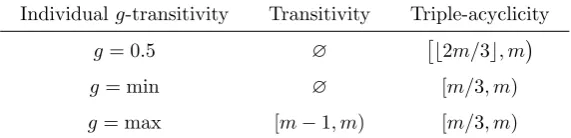
We summarize these results in Table 1, where we show the individual rationality conditions considered in the analysis of triple-acyclicity; that is, 0.5-transitivity, min-transitivity and max-transitivity.
Table 1: Values ofkfor collective transitivity and triple-acyclicity.
Individualg-transitivity Transitivity Triple-acyclicity
g= 0.5 ∅ ⌊2m/3⌋, m
g= min ∅ [m/3, m)
g= max [m−1, m) [m/3, m)
getting consistent collective decisions is. In other words, the stronger the transitivity condition on individual preferences is, the easier to reach consistent collective decisions is. Moreover, the required thresholds look more feasible in the case of triple-acyclicity than in the case of transitivity, given that no so extreme support is required. That is coherent with the fact that triple-acyclicity is a weaker rationality condition than transitivity.
The aggregation of individual reciprocal preferences under majorities based on difference in support can be understood as the aggregation of such individual preference relations through the arithmetic mean operator. Under such view, the preference Pk is reached by means of an α-cut2; i.e., an alternative is
preferred to another one if the arithmetic mean of the intensities of preferences for that alternative over the other one exceeds the value ofα. To rewritePkby means of anα-cut, letR:X×X −→[0,1] the reciprocal
preference relation defined by the arithmetic mean of the individual intensities of preference, i.e.,
R(xi, xj) = 1
m
m
X
p=1 rijp.
Then,Pk=Rα, withα= (m+k)/2m.
It is worth noting that the arithmetic mean operator has been widely used in the literature for aggregating individual intensities of preference into collective intensities of preference. But, as it has been pointed out by some authors, the choice of an alternative has to be unambiguous. Quoting Barrett et al. [1]: In real life, people often have vague preferences. . . However, when confronted with an actual choice situation, where an alternative has to be chosen from a given feasible set of alternatives, the decision maker must make an unambiguous choice, even when his preferences are fuzzy; there cannot be any vagueness about the actual act of choice itself.
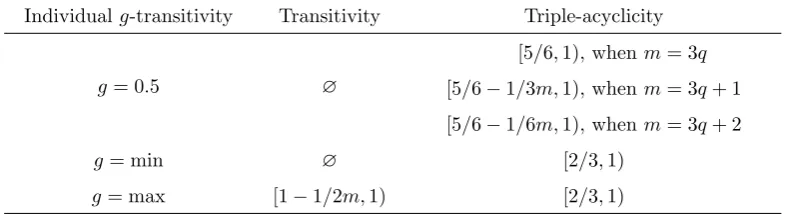
In this sense, α-cuts are a valuable tool for obtaining unambiguous choices from collective intensities of preference. The results given in this paper, together with those given by Llamazares et al. [26], allow us to know the values ofαfor which the collective decision is transitive or triple-acyclic. These values, calculated by applying the relation betweenαandk to the values in Table 1, are shown in Table 2.
Table 2: Values ofαfor collective transitivity and triple-acyclicity.
Individualg-transitivity Transitivity Triple-acyclicity
g= 0.5 ∅
[5/6,1), when m= 3q
[5/6−1/3m,1), when m= 3q+ 1 [5/6−1/6m,1), when m= 3q+ 2
g= min ∅ [2/3,1)
g= max [1−1/2m,1) [2/3,1)
Acknowledgements
The authors are grateful to Jos´e Luis Garc´ıa-Lapresta for valuable suggestions and comments. This work is partially supported by the Spanish Ministry of Economy and Competitiveness (Projects ECO2012-32178 and ECO2012-34202).
References
[1] C.R. Barrett, P.K. Pattanaik, M. Salles, On choosing rationally when preferences are fuzzy, Fuzzy Sets and Systems 34
(1990) 197–212.
[2] S. Cato, D. Hirata, Collective choice rules and collective rationality: a unified method of characterizations, Social Choice
and Welfare 34 (2010) 611–630.
[3] F. Chiclana, E. Herrera-Viedma, S. Alonso, F. Herrera, Cardinal consistency of reciprocal preference relations: A
charac-terization of multiplicative transitivity, IEEE Transactions on Fuzzy Systems 17 (2009) 14–23.
[4] F. Chiclana, E. Herrera-Viedma, S. Alonso, R.A. Marques Pereira, Preferences and consistency issues in group decision
making, in: H. Bustince, F. Herrera, J. Montero (Eds.), Fuzzy Sets and Their Extensions: Representation, Aggregation
and Models, Springer-Verlag, Berlin, 2008, pp. 219–237.
[5] M. de Condorcet, Essai sur l’Application de l’Analyse `a la Probabilit´e des D´ecisions Rendues `a la Pluralit´e des Voix,
Imprimerie Royale, Paris, 1785.
[6] M. Dasgupta, R. Deb, Transitivity and fuzzy preferences, Social Choice and Welfare 13 (1996) 305–318.
[7] B. De Baets, H. De Meyer, Transitivity frameworks for reciprocal relations: cycle-transitivity versus FG-transitivity, Fuzzy
Sets and Systems 152 (2005) 249–270.
[8] B. De Baets, H. De Meyer, B. De Schuymer, S. Jenei, Cyclic evaluation of transitivity of reciprocal relations, Social Choice
and Welfare 26 (2006) 217–238.
[9] D. Dubois, H. Prade, Fuzzy Sets and Systems: Theory and Applications, Academic Press, New York, 1980.
[10] S. Freson, B. De Baets, H. De Meyer, Closing reciprocal relations w.r.t. stochastic transitivity, Fuzzy Sets and Systems
(in press).
[11] S. Freson, H. De Meyer, B. De Baets, Opening reciprocal relations w.r.t. stochastic transitivity, in: S. Greco, B.
Bouchon-Meunier, G. Coletti, M. Fedrizzi, B. Matarazzo, R.R. Yager (Eds.), Advances in Computational Intelligence, volume 300
ofCommunications in Computer and Information Science, Springer, Berlin, 2012, pp. 306–314.
[12] J.L. Garc´ıa-Lapresta, B. Llamazares, Aggregation of fuzzy preferences: Some rules of the mean, Social Choice and Welfare
[13] J.L. Garc´ıa-Lapresta, B. Llamazares, Majority decisions based on difference of votes, Journal of Mathematical Economics
35 (2001) 463–481.
[14] J.L. Garc´ıa-Lapresta, B. Llamazares, Preference intensities and majority decisions based on difference of support between
alternatives, Group Decision and Negotiation 19 (2010) 527–542.
[15] J.L. Garc´ıa-Lapresta, L.C. Meneses, Individual-valued preferences and their aggregation: consistency analysis in a real
case, Fuzzy Sets and Systems 151 (2005) 269–284.
[16] J.L. Garc´ıa-Lapresta, J. Montero, Consistency in preference modelling, in: B. Bouchon-Meunier, G. Coletti, R.R. Yager
(Eds.), Modern Information Processing: From Theory to Applications, Elsevier, Amsterdam, 2006, pp. 87–97.
[17] S. Gen¸c, F.E. Boran, D. Akay, Z. Xu, Interval multiplicative transitivity for consistency, missing values and priority weights
of interval fuzzy preference relations, Information Sciences 180 (2010) 4877–4891.
[18] E. Herrera-Viedma, F. Herrera, F. Chiclana, M. Luque, Some issues on consistency of fuzzy preference relations, European
Journal of Operational Research 154 (2004) 98–109.
[19] N. Houy, Some further characterizations for the forgotten voting rules, Mathematical Social Sciences 53 (2007) 111–121.
[20] N. Jain, Transitivity of fuzzy relations and rational choice, Annals of Operations Research 23 (1990) 265–278.
[21] B. Llamazares, Simple and absolute special majorities generated by OWA operators, European Journal of Operational
Research 158 (2004) 707–720.
[22] B. Llamazares, The forgotten decision rules: Majority rules based on difference of votes, Mathematical Social Sciences 51
(2006) 311–326.
[23] B. Llamazares, Choosing OWA operator weights in the field of Social Choice, Information Sciences 177 (2007) 4745–4756.
[24] B. Llamazares, J.L. Garc´ıa-Lapresta, Voting systems generated by quasiarithmetic means and OWA operators, in: J. Fodor,
B. De Baets (Eds.), Principles of Fuzzy Preference Modelling and Decision Making, Academia Press, Ghent, 2003, pp.
195–213.
[25] B. Llamazares, J.L. Garc´ıa-Lapresta, Extension of some voting systems to the field of gradual preferences, in: H. Bustince,
F. Herrera, J. Montero (Eds.), Fuzzy Sets and Their Extensions: Representation, Aggregation and Models, Springer-Verlag,
Berlin, 2008, pp. 297–315.
[26] B. Llamazares, P. P´erez-Asurmendi, J.L. Garc´ıa-Lapresta, Collective transitivity in majorities based on difference in
support, Fuzzy Sets and Systems 216 (2013) 3–15.
[27] J.I. Morales, Memoria Matem´atica sobre el C´alculo de la Opinion en las Elecciones, Imprenta Real, Madrid, 1797.
[28] H. Nurmi, Approaches to collective decision making with fuzzy preference relations, Fuzzy Sets and Systems 6 (1981)
249–259.
[29] T. Schwartz, The Logic of Collective Choice, Columbia University Press, New York, 1986.
[30] A.K. Sen, Collective Choice and Social Welfare, Holden-Day, San Francisco, 1970.
[31] A.K. Sen, Social choice theory: A re-examination, Econometrica 45 (1977) 53–89.
[32] K. Suzumura, Rational Choice, Collective Decisions, and Social Welfare, Cambridge University Press, Cambridge, 1983.
[33] Z. Switalski, Rationality of fuzzy reciprocal preference relations, Fuzzy Sets and Systems 107 (1999) 187–190.
[34] Z. Switalski, General transitivity conditions for fuzzy reciprocal preference matrices, Fuzzy Sets and Systems 137 (2003)
85–100.
[35] T. Tanino, Fuzzy preference orderings in group decision making, Fuzzy Sets and Systems 12 (1984) 117–131.
[36] Y. Xu, R. Patnayakuni, H. Wang, The ordinal consistency of a fuzzy preference relation, Information Sciences 224 (2013)
152–164.