F. Iemini,1 A. Russomanno,2, 1 J. Keeling,3 M. Schir`o,4 M. Dalmonte,1 and R. Fazio1, 2 1ICTP, Strada Costiera 11, 34151 Trieste, Italy
2
NEST, Scuola Normale Superiore& Istituto Nanoscienze-CNR, I-56126, Pisa, Italy 3
SUPA, School of Physics and Astronomy, University of St Andrews, St Andrews, KY16 9SS, United Kingdom 4Institut de Physique Th´eorique, Universit´ee Paris Saclay, CNRS, CEA, F-91191 Gif-sur-Yvette, France
(Dated: June 12, 2018)
In this work we introduce boundary time-crystals. Here continuoustime-translation symmetry breaking occurs only in a macroscopic fraction of a many-body quantum system. After introducing their definition and properties, we analyse in detail a solvable model where an accurate scaling analysis can be performed. The existence of the boundary time crystals is intimately connected to the emergence of a time-periodic steady state in the thermodynamic limit of a many-body open quantum system. We also discuss connections to quantum synchronisation.
Introduction - Spontaneous symmetry breaking is a cornerstone of physics and occurs at all energy scales, in cosmology and high-energy physics as well as in con-densed matter. Thermal or quantum fluctuations can drive a system into a state that breaks, in the ther-modynamic limit, some of the symmetries present in its (thermo)-dynamical potentials [1, 2]. Can time-translation invariance be spontaneously broken? The possible existence of time crystals, first addressed by Wilczek in [3], prompted an intense discussion [4–7]. A no-go theorem [9] ruled out the existence of time-crystals in thermal equilibrium in cases for which the energy is the only constant of motion. The situation may be different in the presence of additional extended conserved quanti-ties [10], such as in superfluids [11] where time-crystalline behavior was discussed in [12]. Ordering in time can also occur, however, under non-equilibrium conditions (e.g. by preparing the system in an excited state [13]).
An important step forward in our understanding of spontaneous time-translational invariance has been achieved in [8, 14, 15] where Floquet time crystals, a.k.a. π-spin glasses, were introduced. The dynamics of these systems, subject to a periodic driving, is characterised by observables which oscillate at a multiple of the driving period. Hence they break the discrete time-translation symmetry imposed by the external drive. Floquet time crystals were intensively explored from a theoretical point of view in [16–22] and very recently experimentally ob-served [23, 24]. A comprehensive review on time crystals can be found in [25].
Here we predict a novel form of time-translation sym-metry breaking: continuous Boundary Time-Crystals
(BTCs). In the BTC phase, symmetry breaking appears in a (macroscopic) fraction of the system. Moreover a BTC breaks the continuous time-translation symmetry, i.e. the system self-organises in a time-periodic pattern with a period which only depends on its coupling con-stants. The idea borrowed from surface critical phenom-ena [26] offer a very intuitive way to visualise BTCs. Only the surface, representing the portion of the system where time crystalline behaviour appear, is ordered. The rest
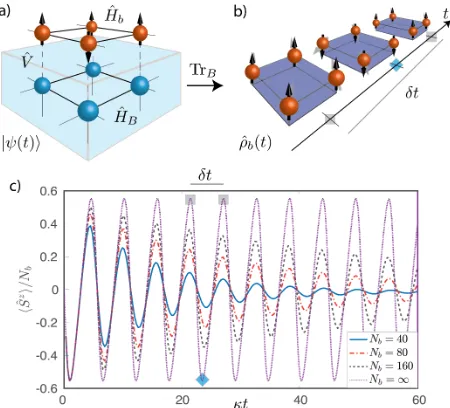
Figure 1. (Upper panel) A sketch of a boundary time crystal. The system is composed by a bulk (B) and a boundary (b) interacting trough an interaction term ˆV. The Hamiltonian of the system is time-independent. After tracing out the degrees of freedom of the bulk, the dynamics of the boundary is de-scribed by the reduced density matrix ˆρb. In the time-crystal phase, the behaviour of collective variables will show persis-tent oscillations in the thermodynamic limit. (Lower panel) The boundary magnetisation of the BTC model discussed in the paper is shown as a function of time, for different bound-ary sizes. In the asymptotic condition, spontaneous symmetry breaking appears in persistent oscillations whenNb→ ∞.
of the system, the bulk remains time-translationally in-variant, see Fig. 1. We will give a more precise meaning to this picture in the following of the paper where we will show that BTCs are intimately connected to the ex-istence of periodic motion in the steady state of open quantum many-body systems.
[image:1.612.327.552.242.446.2]ˆ
HB+ ˆHb+ ˆV, with bulk and boundary systems ˆHB and ˆ
Hb, respectively, and an interaction term ˆV. Denoting as Nb (NB) the degrees of freedom for the boundary (bulk)
systems, we consider the case in which a macroscopic fraction of the universe, the system (Nb → ∞), breaks
spontaneously time-translational invariance. The ther-modynamic limit is performed withNb, NB → ∞, with
the ratio Nb/NB → 0. In other words, it is a
macro-scopic system, but still small/infinitesimal compared to the global system. This scaling is the crucial feature in defining a boundary phenomenon. The precise identifica-tion of the boundary layer (e.g. the nature or any notion of spatial locality for its degrees of freedom) is thus irrele-vant for our purposes. The whole system evolves accord-ing to the Schr¨odinger equation |ψ(t)i = e−iHtˆ |ψ(0)i, with|ψ(0)ithe initial state of the quantum system. The boundary is fully characterised by the reduced density matrix ˆρb = TrB(|ψ(t)ihψ(t)|) obtained by tracing out the bulk degrees of freedom. Its dynamics is governed by a completely positive, trace-preserving, map ˆLwith
d
dtρˆb= ˆL[ ˆρb] . (1) Time-translation symmetry breaking at the boundary appears as a non-trivial time-dependence of a (macro-scopic) boundary order parameter ˆOb, occurring only in the thermodynamic limit. For infinitely large times its expectation oscillates, limNb,NB→∞Tr[ ˆObˆρb] = f(t)
wheref(t) is a time-periodic function. The definition of BTC closely follows the one for the standard time crys-tals [9, 16, 17]. The only, crucial, difference is that here the order parameter is defined at the boundary.
The resulting physical picture is exemplified in Fig. 1, taking a magnetic system as an illustration. In this exam-ple a macroscopic magnetisation builds up at the surface of a sample. The magnetisation shows persistent oscilla-tions even though the dynamics of the whole system is governed by a time-independent Hamiltonian. In Fig. 1 the boundary and the bulk are represented with different symbols in order to stress that they may be described by different degrees of freedom. Notice that the terms bulk and boundary are used here to easily visualise the mech-anism of spontaneous symmetry breaking and suggest an intriguing connection with boundary critical phenomena. What is really implied in the construction above is that ordering in time occurs only in a macroscopic fraction of the many-body system under consideration, rather than in the whole bulk.
The boundary nature of time-translation symmetry breaking in BTC has a number of important implica-tions. First of all, the reduced density matrix ˆρb in the steady state will be generically non-thermal, hence the no-go theorem [9] does not apply: a Hamiltonian system can spontaneously break time-translation symmetry as a boundary phase. Furthermore, given the well known correspondence of the dissipative dynamics in Eq.(1)
and a unitary dynamics governed by a time-independent Hamiltonian on an enlarged system (see e.g. [27]), the BTC appears tightly linked to the existence of a time-periodic steady state in an open quantum many-body system, appearing thoughonlyforNb→ ∞. In order to discuss concrete examples we focus on boundary systems described by Markovian maps, and comment further be-low about more general dissipative maps.
The evolution of the boundary in the Markovian case is described by a master equation where the Li-ouvillian operator ˆL[·] has Lindblad form [27], ˆL[·] =
P α
n
ˆ
`α·`ˆ†α−12{`ˆ
† α`ˆα,·}
o
with ˆ`α the Lindblad
opera-tors [33]. The emergence of a time-crystal behaviour in the long-time dynamics of the system is hidden in the properties of the Liouvillian operator in the ther-modynamic limit. In the BTC phase one should ex-pect: i) a vanishing gap in the real part of the Liou-villian eigenvalues, making the non-equilibrium steady state subspace degenerate in the thermodynamic limit with time-dependent coherences decaying over an infinite time-scale; ii) a non-zero imaginary part for some Liou-villian eigenvalues in such subspace in order to induce non-trivial oscillations. The main question now is to find a many-body system that displays the above mentioned properties. Below we will present a model of a BTC.
A BTC model - We will show that a boundary time crystal appears in a model used to describe cooperative emission in cavities (see [28–32]). The boundary Hamil-tonian ˆHb=ω0Pjσˆ
x
j consists in a collection of 1/2-spins
whose dynamics is governed by collective spin operators ˆ
Sα = 12P jσˆ
α
j. The operators ˆσ α
j (α =x, y, z) are the
Pauli matrices acting on the j-th spins, andω0 is the co-herent splitting. The terms ˆHB and ˆV (see the sketch in Fig. 1) have to be constructed in such a way to give a reduced dynamics at the boundary of the form
d
dtρˆb=iω0[ ˆρb, ˆ Sx] + κ
S
ˆ
S−ρˆbSˆ+− 1 2{
ˆ
S+Sˆ−,ρˆb}
.
(2) In the previous equation, the collective raising/lowering spin operators are given by ˆS± = ˆSx±Sˆy, κis the
ef-fective decay rate, andS =Nb/2 is the total spin. In the following the expectations of the observables are in-dicated ash·i= Tr[·ρˆb].
The specific form of ˆHB generating the dynamics in
time-independent in some specific choice of frame. As long as such a Hamiltonian exists, and is physical, our inter-pretation of the time-translation symmetry breaking as a boundary phenomenon of a closed quantum system is rea-sonable (see [34] for a detailed discussion). Moreover – as we are going to show – the BTC shows a time-dependent pattern whose period solely depends on the coupling con-stants of the system and which is in general incommen-surate with the driving period: the system breaks a con-tinuous symmetry, rather than a discrete one. The BTC is in apparent contradiction with the expectation that the density matrix of a system in contact with a sin-gle thermal reservoir attains a time-independent steady state [35]. The solution to this apparent paradox lies in the diverging boundary size,Nb → ∞, which leads to a
divergent decay time-scale for oscillations (see [34]), as we better discuss below.
The steady state diagram of the model has two distinct phases [28]. For ω0/κ < 1, the total magnetisation is finite hSˆzi. In the opposite case, ω
0/κ > 1, all spins align along the x-direction. More details are reported in [34].
-10 -5 0
Re(λ)
-20 -10 0 10
I
m
(
λ
)
-4 -2 0
-1 0 1
-10 -5 0
Re(λ)
-40 -20 0 20
I
m
(
λ
)
-0.4 -0.2 0 -5
0 5
Figure 2. The eigenvaluesλ of the Liouvillian are shown in the weak dissipative case (ω0/κ= 1.5 – right panel) and in the strong dissipative one for (ω0/κ= 0.5 – left panel), in a system withNb= 36 spins. The insets show a zoom over the eigenvalues with largest real part. The eigenvalues are plotted in units ofκ.
The BTC appears forω0/κ >1. Its emergence is em-bedded in the properties of the eigenvalues λof the Li-ouvillian ˆL. The structure of the Liouvillian spectrum is indeed different in the two phases. While forω0/κ < 1 the spectrum is gapped (Fig. 2 left panel), and the eigen-values with greatest eigen-values for their real part (i.e., the eigenvalues closest to zero, recalling that Re(λj) ≤ 0)
have no imaginary values, for ω0/κ > 1 the spectrum becomes gapless and the eigenvalues with greatest real part have a non zero imaginary part (see Fig. 2). The insets zoom on the spectrum emphasising the different behaviour in the two limits.
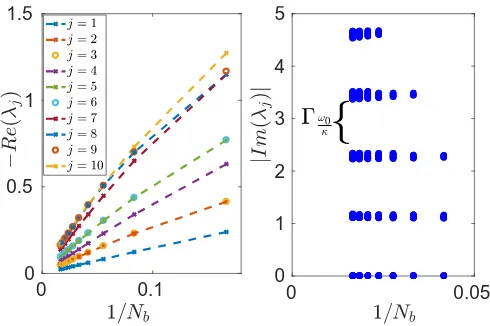
In order to obtain a quantitative picture of the develop-ment of the spontaneous symmetry breaking we perform a finite-size scaling analysis of the real and imaginary parts of the eigenvaluesλ. In Fig. 3 (left panel) we anal-yse the real part of the Liouvillian spectrum. In the weak
0 0.1
0 0.5 1 1.5
0 0.05
0 1 2 3 4 5
Figure 3. (Left) Finite size scaling for the real part of the Liouvillian eigenvalues in the BTC phase. The indexjlabels the eigenvalues. The Liouvillian eigenvaluesλjare ordered as a function of their real part (|Re(λj)| ≤ |Re(λj+1)|, andj= 0 has zero real part). In theω0/κ >1 phase they scale to zero as a power-law of the inverse system size. (Right) The imag-inary parts of the eigenvalues show a band structure, with a fundamental frequency separation Γω0/κ. For fixed excitation
thresholds (we only selectλj such that ν =j2/Nb ≤) the width of the bands remains finite in the thermodynamic limit (here we chooseν <0.025). The widths of the bands tend to decrease as we constrain to lower excitation thresholds. The eigenvalues are plotted in units ofκ.
dissipative case, the one of interest to us, the system is gapless, with the real part of the eigenvalues closing with the system size as a power law (at different rates). In Fig. 3 (right panel) we show the imaginary part of the Liouvillian spectrum. The imaginary eigenvalues of the low Liouvillian excitations are described by bands, sepa-rated by a fundamental frequency Γω0/κ, which depends
on the system parameters ω0/κ. These features of the real and imaginary parts are the key elements for the appearance of the BTC.
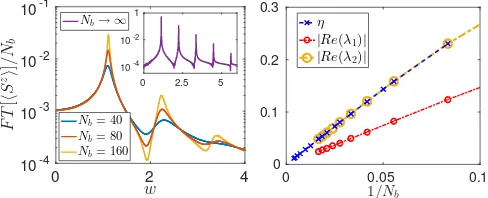
The magnetisation, for different numbers of lattice sites, is plotted in Fig. 1 (lower panel). The system is ini-tialised in the pure state with all spins aligned along the x-direction. The oscillations decay for any finite size sys-tem, the associated time scale grows with the system size and diverges in the thermodynamic limit. This behaviour is independent of the initial conditions, as e.g., starting from thermal states or all spins aligned in different direc-tions. Interestingly, the decay rate of the oscillationsη is related to the second excited eigenvalue of the Liouvil-lian, in our case, the lowest excited eigenvalue with non zero imaginary value (eigenvalues are ordered according to the absolute value of their real part). A quantita-tive analysis of the spontaneous symmetry breaking is obtained by looking at the Fourier transform of hSz(t)i
[image:3.612.317.562.49.212.2] [image:3.612.50.302.329.430.2]Fig. 3. The peaks become sharper as the system size is increased. Most importantly, the decay rate η goes to zero (right panel) as a power law L−β with the β ex-ponent dependent on the system parametersw0/κ. The finite-size scaling shows that the persistent oscillations are associated to the spontaneous time-translation sym-metry breaking because they occur only in the thermo-dynamic limit. In the example we have discussed, the thermodynamic limit incidentally coincides with an ef-fective classical dynamics (the efef-fective Planck’s constant going to zero): this is true for instance in Fig. 4 and in Fig. 1 whenNb→ ∞; details of the classical solution are discussed in [34].
0 2 4
w
10-4
10-3
10-2
10-1
F
T
[
h
S
zi]
/N
b
Nb= 40 Nb= 80 Nb= 160
0 2.5 5 10-4
10-2 1 Nb→ ∞
0 0.05 0.1
1/Nb
0 0.1 0.2 0.3
η
|Re(λ1)|
|Re(λ2)|
Figure 4. In the right panel we plot the decay rate of the os-cillations of the magnetisationηfor distinct system sizes. In the same plot we compareηwith the eigenvalues with greatest real part thus smallgreatest absolute values for the real part -of the Liouvillian. In the left panel we plot the Fourier trans-form of the average magnetisation (see lower panel in Fig. 1), highlighting the oscillation frequencies of the dynamics. The peaks are associated to the band separations in the imaginary part discussed in Fig. 3. The inset of the left panel is the solu-tion in the thermodynamic limit where the oscillasolu-tions persist indefinitely.
From the experimental point of view, a driven version of this model can be realised using an adapted Raman driving scheme [36] for cold atoms in an optical cavity, connecting two low lying states via an excited atomic state. Collective dissipation can be produced by using a bad cavity (large loss rate) combined with a single Ra-man drive: Purcell-enhanced RaRa-man scattering leads to optical pumping of the atoms, described by the same col-lective dissipation considered here. Similarly, the Hamil-tonian term ˆSx can be realised by a pair of drive lasers coupling the ground states via excited states.
The boundary time-crystal we discussed in the model of Eq.(2) is not an isolated point, but is robust to differ-ent perturbations. First of all, the time-crystalline phase appears in the whole regionω0/κ >1. Moreover it is sta-ble if additional perturbations are added to the unitary part of the evolution. With a boundary Hamiltonian of the form ˆHb=ω0Sˆx+ωx( ˆSx)2/S+ωz( ˆSz)2/S, the
time-crystal is still present for a wide range of the parameters ωx, ωz 6= 0. In fact the ωx term improves the stability
of the time crystal, which is also present for small val-ues ofωz; for ωz above some threshold, time-translation
symmetry breaking still exists but only for some initial conditions (see [34] for details). It is worth mentioning that robustness of a BTC phase refers to the persistence of a periodic evolution in the thermodynamic limit, and not necessarily to the rigidity of its period. The main difference with respect to Floquet systems is that there, since one is breaking a discrete symmetry, rigidity is in-timately related to the period of the driving; instead, in our case, since the dynamics is U(1) invariant, such timescale is not present, and the period of oscillation is allowed to change within the symmetry-broken phase. This is a direct analog of the fact that in spatial crystals, the spatial periodicity can be changed by changing the particle-particle interaction.
It is also relevant to consider perturbations of the dissi-pative part of the evolution, more specifically we focus on terms non-local in time (this is equivalent to considering a non-Markovian equation of motion). In order to have a physical bulk Hamiltonian, it must be bounded from be-low, and so it cannot have a truly flat density of states. This implies a finite memory timescale for the bath, but there is the possibility that this timescale can be ne-glected, being far smaller than all the other timescales in the system dynamics. This fact occurs if the lower bound on the bulk spectrum is at energies much lower than the frequencies of the system dynamics: in this case an approximate Markovian description holds and the use of a Markovian master equation is perfectly justified.
Other candidate systems for BTCs - An interest-ing model that should show the same phenomenol-ogy has been studied in [37]. Furthermore, many-body limit cycles have been already seen in model sys-tems of optomechanical arrays [38], coupled cavity ar-rays [39, 40], interacting Rydberg atoms [41] and inter-acting spin-systems [42]. Also in these cases the under-lying (bulk+boundary) Hamiltonian can be constructed, see Ref. [34]. In light of the analysis performed in the present work, these limit-cycles now might be classified as BTCs. It should be however kept in mind that a mean-field approximation, employed in these works, may be unable to support the very existence of limit cycles: it is not clear to which extend this phase would survive when fluctuations are included.
Other promising systems that it might be interesting to consider to seek for different forms of BTCs are dissi-pative topological systems. In this case the steady state may develop a degeneracy in the thermodynamic limit due to the presence of edge states [43, 44]. The existence of a BTC phase should emerge from the competition of the unitary and dissipative parts of the dynamics. Fur-thermore the robustness should be inherently linked to topological protection.
and quantum synchronisation. Lately there has been an intense effort to characterise synchronisation in the quan-tum realm (see e.g., the review [45]). BTCs may offer a different perspective on this problem.
Conclusions - In this work we introduced boundary time crystals. In the same spirit as in the original defini-tion given in [9], in the BTC phase the time-dependent order parameter appears only in a portion of the sam-ple (at the boundary for simplicity). The phenomenon is analogous to surface critical phenomena. On looking at the reduced dynamics at the boundary, one observes that BTCs are intimately linked to the emergence of a periodic dynamics in some macroscopic observable of an open quantum many-body system. A crucial aspect of the whole picture is that the periodic motion should ap-pearonly in the thermodynamic limit. We proposed an example of a BTC phase in a solvable model where its existence can be confirmed without resorting to any ap-proximation. We finally discussed that BTCs can also emerge from different mechanisms in topological systems. While completing this manuscript, a few works ap-peared [46, 47] analysingdiscretetime crystal phenomena in periodically driven dissipative systems.
Acknowledgements -We acknowledge enlightening dis-cussions with S. Denisov, J. Jin, L. Mazza, T. Prosen, and P. Zoller. This work was supported in part by “Pro-getti Interni - Scuola Normale Superiore” (A.R.), EU-691 QUIC (R.F. and A.R.), CRF Singapore Ministry of Education (CPR-QSYNC 692) (R.F.), EPSRC program TOPNES (EP/I031014/1) (J.K.),
[1] N. Goldenfeld , Lectures on phase transitions and the renormalization group, (Addison Wesley, New York, 1992).
[2] S. Sachdev, Quantum Phase Transitions, (Cambridge University Press, Cambridge, 2000).
[3] F. Wilczek, Phys. Rev. Lett.109, 160401 (2012). [4] T. Li, Z.-X. Gong, Z.-Q. Yin, H. T. Quan, X. Yin, P.
Zhang, L.-M. Duan, and X. Zhang, Phys. Rev. Lett.109, 163001 (2012).
[5] P. Bruno, Phys. Rev. Lett.110, 118901 (2013); ibid111, 029301 (2013); ibid111, 070402 (2013).
[6] P. Nozieres, EPL103, 57008 (2013). [7] G. E. Volovik, JETP Lett. 98, 491 (2013). [8] K. Sacha, Phys. Rev. A91, 033617 (2015).
[9] H. Watanabe and M. Oshikawa, Phys. Rev. Lett. 114, 251603 (2015).
[10] D. Huse (private communication).
[11] Hadrien Kurkjian, Yvan Castin and Alice Sinatra, Comptes Rendus Physique17, 789 (2016).
[12] Nikolay V. Prokof’ev and Boris V. Svistunov, arXiv:1710.00721.
[13] A. Syrwid, J. Zakrzewski, and K. Sacha, Phys. Rev. Lett. 119, 250602 (2017).
[14] D. V. Else, B. Bauer, and C. Nayak, Phys. Rev. Lett., 117, 090402 (2016).
[15] V. Khemani, A. Lazarides, R. Moessner, and S. L. Sondhi, Phys. Rev. Lett.116, 250401 (2016).
[16] C. W. von Keyserlingk, V. Khemani, and S. L. Sondhi, Phys. Rev. B94, 085112 (2016).
[17] V. Khemani, C. W. von Keyserlingk, S. L. Sondhi, arXiv:1612.08758.
[18] D. V. Else, B. Bauer, and C. Nayak, Phys. Rev. X7, 011026 (2017).
[19] N.Y. Yao, A.C. Potter, I.-D. Potirniche, and A. Vish-wanath, Phys. Rev. Lett.118, 030401 (2017).
[20] W. W. Ho, S. Choi, M. D. Lukin, and D.A. Abanin, Phys. Rev. Lett.119, 010602 (2017).
[21] B. Huang, Y.-H. Wu, W.V. Liu, arXiv:1703.04663. [22] A. Russomanno, F. Iemini, M. Dalmonte, and R. Fazio,
Phys. Rev. B95, 214307 (2017).
[23] J. Zhang, P. W. Hess, A. Kyprianidis, P. Becker, A. Lee,J. Smith, G. Pagano, I. D. Potirniche, A. C. Pot-ter, A.Vishwanath, N. Y. Yao, and C. Monroe, Nature 543, 217 (2017).
[24] S. Choi, J. Choi, R. Landig, G. Kucsko, H. Zhou, J.Isoya, F. Jelezko, S. Onoda, H. Sumiya, V. Khemani, C. von Keyserlingk, N. Y. Yao, E. Demler, and M. D. Lukin, Nature543, 221 (2017).
[25] K. Sacha and Jakub Zakrzewski, arXiv:1704.03735. [26] K. Binder, in Phase transitions and critical phenomena,
Vol. 8 pag 2, C. Domb and J.L. Lebowitz Eds (Academic Press, New York, 1983).
[27] M. Nielsen and I. Chuang, Quantum Computation and Quantum Communication, (Cambridge University Press, Cambridge, 2000).
[28] J. Hannukainen and J. Larson, arXiv:1703.10238. [29] D. F. Walls, P. D. Drummond, S. S. Hassan, and H. J.
Carmichael, Prog. Theo. Phys.64, 307 (1978).
[30] P. D. Drummond and H. J. Carmichael, Opt. Commun. 27, 160 (1978).
[31] R. R. Puri. and S. V. Lawande, Phys. Lett. A 72, 200 (1979).
[32] S. Schneider and G. J. Milburn, Phys. Rev. A65, 042107 (2002).
[33] It is always possible to find a Hamiltonian whose dy-namics is described by the given Lindblad equation. See e.g. A. M. Chebotarev, Math. Notes, 61, 510 (1997); M. Gregoratti, Commun. Math. Phys. 22, 181 (2001); J. Gough, Open Systems & Information Dynamics,22, 1550009 (2015); Javier Prior, Alex W. Chin, Susana F. Huelga and Martin B. Plenio, Phys. Rev. Lett. 105, 050404 (2010); Robert Rosenbach, Javier Cerrillo, Su-sana F. Huelga, Jianshu Cao and Martin B. Plenio, New. J. Phys.18, 023035 (2016).
[34] Supplementary Material
[35] J. Cresser, J. Mod. Opt.39, 2187 (1992)
[36] F. Dimer, B. Estienne, A. S. Parkins, and H. J. Carmichael, Phys. Rev. A75, 013804 (2007)
[37] M. Hartmann, D. Poletti, M. Ivanchenko, S. Denisov, and P. H¨anggi, arXiv:1606.03896.
[38] M. Ludwig and F. Marquardt, Phys. Rev. Lett. 111, 073603 420 (2013).
[39] J. Jin, D. Rossini, R. Fazio, M. Leib, and M. J. Hart-mann, Phys. Rev. Lett.110, 163605 (2013);
[40] M. Schir´o, C. Joshi, M. Bordyuh, R. Fazio, J. Keeling, and H. E. T¨ureci, Phys. Rev. Lett.116, 143603 (2016). [41] T. E. Lee, H. H¨affner, and M. C. Cross, Phys. Rev. A
84, 416, 031402 (2011).
Rev. A 91, 051601 (2015).
[43] S. Diehl, E. Rico, M. A. Baranov, and P. Zoller, Nat. Phys.7, 971 (2011).
[44] F. Iemini, D. Rossini, R. Fazio, S. Diehl and L. Mazza, Phys. Rev. B93, 115113 (2016).
[45] F. Galve, G. L. Giorgi, and R. Zambrini,
arXiv:1610.05060.
[46] Z. Gong, R. Hamazaki and M. Ueda, arXiv:1708.01472 (2017).