Han, W. McCabe, S. Wang, Y. & Chong, A. (2017). Evaluating user-generated content in social media: an effective approach to encourage greater pro-environmental behaviour in tourism? Forthcoming in the Journal of Sustainable Tourism.
http://dx.doi.org/10.1080/09669582.2017.1372442 Author final version prior to proof changes
Evaluating user-generated content in social media: an effective approach to encourage greater pro-environmental behaviour in tourism?
Key words: Pro-environmental behavior, User Generated Content, Social media, Tourism marketing, Norms
Abstract
Appealing to tourists’ intrinsic interest for high quality tourism environments, and thus encouraging them to act with a greater sense of personal responsibility towards the environment, could be critical to promoting sustainable tourism. Proliferating media channels makes the choice, style and delivery of pro-environmental messages a key issue for tourism marketers and management. Social media has become a recognized important channel for tourism information, with user-generated content (UGC) being more trusted than official channels, yet there is little knowledge about its potential role in activating pro-environmental norms. This study investigates that issue. Focusing on the conjoining aspects of personal and social norms for the first time, we propose a hypothetical model to explain the direct and indirect effects of pro-environmental UGC in activating tourists’ pro-environmental behavioral intentions. Working in a Chinese context, where social media plays an increasing role, the research, using a web based sample, (N=1043), UGC linked pro-environmental knowledge and awareness was found to have a strong role in activating environmental norms, creating a pro-environment online community, and increasing tourists’ level of engagement in pro-pro-environmental social media activity. The study highlights the effectiveness of social media channels with UGC providing persuasive communications able to impact sustainable behaviors.
1. Introduction
competitiveness and indeed, many tourist activities directly depend on the quality of natural resources of destinations. Attracting tourists who have an intrinsic interest in protecting the environment and consequently develop more pro-environmental attitudes and behavior is an important component in promoting sustainable tourism.
Efforts to understand and predict consumers’ environmental behavior have generated a large body of literature, much of which investigates the issues based on the assumption that behavior is the outcome of a linear and rational process of decision making (Hargreaves, 2011). This literature has suggested that categories of variables (e.g. social, situational and psychological) motivate pro-environmental behavior (Barr & Gilg, 2007). However, these variables have been criticized for insufficiently explaining pro-environmental behavior, because the relationship between knowledge and attitudes, attitudes and intentions, and intentions and actual behavior, are weak at best (Kollmuss & Agyeman, 2002).
Particularly, there has been intense debate concerning the gap between attitudes and intentions, which represent planned purchases and actual behavior (consumption decisions). Despite these criticisms, intentions remain the best indicator for behavior (Harland, Staats, & Wilke, 2007; March & Woodside, 2005). Additionally, moral and normative approaches have been shown to be more effective than attitudes in explaining behavioral intentions, particularly where there is environmental intent (Steg & Uneken, 2004). And so, this study focuses on norms and pro-environmental behavioral intentions, rather than attitudes. Norm Activation Theory provides a rational perspective on how personal norms can be activated through a process of generating awareness of the consequences through to the transformation of moral norms and to actual behavior change (Schwartz, 1977). However, Klöckner and Blöbaum (2010) argued that Norm Activation Theory contains limitations as it overlooks the social (situational) influences on people. Social Norm Theory is, therefore, used together with Norm Activation Theory in this study to explain the formation of pro-environmental behavioral intention.
For example, Kane, Chiru, and Ciuchete (2012) found that Facebook represents an innovative channel that could build the necessary links between tourists’ green values and behavioral change. Batat and Prentovic (2014) explored and compared the way social media is used in promoting responsible travel behavior and sustainable actions in three cultural contexts. Hardeman, Font, and Nawijn (2017) found that the online messages were more persuasive than those provided by tour operators. However, our understanding of social media’s impact on sustainable tourism is still in its infancy, especially in terms of pro-environmental behavioral intention. Although it is widely accepted that norms play a dominant role in pro-environmental tourist behavior (e.g. Doran, Hanss & Larsen, 2017), it is unclear whether new interactive communication channels can effectively activate these norms.
Focusing on a Chinese context, this study aims to investigate the effectiveness of pro-environmental travel UGC in activating pro-pro-environmental tourist norms. The number of Chinese tourists is increasing consistently, as a result of economic development and an increased number of national holidays, reaching 36.2 billion trips in 2013 (Jia & Lin, 2015). Travel platforms such as “Ctrip.com” and “Qyer.com”, are frequently used by Chinese tourists as they provide both travel services and opportunities for real-time conversations on travel communities. These online travel communities enable tourists to search for information, upload their travel experiences and make friends (Li, Zhang, Mao, & Deng, 2011). Chinese people do not share the same concept of nature as Western culture, which has been explained as “the contrast between Confucianist and Western thought” (Aoyagi-Usui, Vinken, & Kuribayashi, 2003, p. 24). By investigating how online environmental dialogues impact on Chinese tourists’ environmental behaviour by activating their norms, the findings of this study will contribute to knowledge about tourism practices in this important market. The study also contributes to the study and understanding of consumer behavior in tourism by applying norm activation theory which can be transferred to a wide range of other contexts and which potentially offers an alternative to Theory of Planner Behavior in understanding links between attitudes and behavior.
2. Theoretical background and research hypotheses 2.1 Norms and pro-environmental behavioral intentions
the ecosystem and biosphere of a destination during recreation/tourism activities” (Lee, Jan, & Yang, 2013, p. 455). This definition reflects their environmental knowledge, concern and commitment that leads to particular kinds of decisions and actions. However, some researchers have noted that whilst tourists often express concerns towards environmental issues and indicate their willingness to act to protect the environment, this does not usually coincide with their actual behavior, which can be less environmentally friendly than stated attitudes (Harris, 2006). Tourists often feel disempowered and/or unwilling to change travel behavior due to a lack of awareness of options available, or because they do not wish to make sacrifices on
holidays (Miller, Rathouse, Scarles, Holmes & Tribe, 2010; Juvan & Dolnicar, 2014).
In order to understand consumer behavior change, researchers have developed a variety of theoretical models and frameworks, of which Ajzen and Fishbein's (1980) model of Theory of Reasoned Action and Theory of Planned behavior (Ajzen, 1985, 1991) are the most influential. However, research has generally focused exclusively on the links between attitudes and behavior, which has overlooked the role of social situational factors, or norms, in the theory. Azjen and Fishbein argued that attitudes only influence behavior indirectly by influencing behavioral intentions, and that intentions are not only influenced by attitudes but also by social pressures. Therefore, the ultimate determinants of behavior are "the behavioral beliefs concerning its consequences" and "normative beliefs concerning the prescriptions of others" (Ajzen & Fishbein, 1980, p. 239).
In pro-environmental behavior research, Norm Activation Theory has been found to be a more useful route to understanding and predicting actual behavior, than attitudes and intentions (Schwartz, 1977; De Groot & Steg, 2009; Steg, Dreijerink, & Abrahamse, 2005; Steg & Groot, 2010). This is because Norm Activation Theory looks beyond surface attitudes to focus on awareness and responsibility (De Groot & Steg, 2009). Focusing on personal norms, the theory has explained and predicted pro-environmental behavior successfully in a range of empirical contexts (Zhang, Zhang, Zhang, & Cheng, 2014; Bamberg & Moser, 2007; Mehmetoglu, 2010; Sandve & Oggard, 2014). Norm Activation Theory has also been applied to the tourism context where personal norms were used to predict tourists’ pro-environmental buying, recycling and travel mode choice (Antimova, Nawijn, & Peeters, 2012).
as “obligations that are enforced through an internalized sense of duty to act and guilt or related emotions for failure to act” (Vandenbergh, 2005, p. 1104). These norms have successfully predicted low-cost environmental behaviors and good intentions, including political behavior (Gärling, Fujii, Gärling, & Jakobsson, 2003), environmental citizenship (Stern, 2000) and policy acceptability (De Groot & Steg, 2009; Steg & Uneken, 2004). In recent tourism research, personal norms were supported as a stronger predictor of pro-environmental behavior than other psychological variables, or socio-demographic characteristics (Doran, Hanss & Larsen, 2017).
Schwartz (1977) suggests that the relationship between personal norms and human behavior depends on how individuals define an action situation. He further identified two conditions that must exist before individuals identify situations under which personal norms will be “activated”. First, individuals must have awareness that their activities may impact the welfare of others. Second, individuals must accept some responsibility for their activities and their impacts (Schwartz, 1977). Although this theory has been applied as a moderator model in a few studies, it is widely argued that the norm-activation model should be best interpreted as a mediator model (e.g. De Groot & Steg 2009; Chiu, Lee, & Chen, 2014; Zhang, 2014). This means it is more useful when conceptualized that an awareness of the consequences of one’s behavior leads to a feeling of responsibility to engage in a modified way.
In this study, an awareness of consequences refers to tourists’ pro-environmental awareness and the ascription of responsibility refers to tourists’ pro-environmental responsibility. Although Norm Activity Theory links personal norms directly with behavior, a large body of literature has built up questioning the gap between intentions and actual behavior (Sheeran, 2002; Lee, Jan & Yang, 2014; Cohen, Prayag & Moital, 2014), and therefore personal norms, as perceived as responsibility and obligation, could lead to behavioral intentions, not as a predictor of actual behavior. A range of studies have found support for the theory that moral norms are a strong predictor of pro-environmental intentions (Bamberg & Moser, 2007). Specifically focusing on sustainable travel choice, Kiatkawsin and Han (2017) found that personal norms and expectancy together can explain 48.3% of the variance on the behavioral intention. Therefore, the above discussion leads to the following hypotheses.
H1: Pro-environmental personal norms have an effect on tourists’ pro-environmental
behavioral intentions.
H3: Environmental responsibility has an effect on tourists’ pro-environmental personal norms.
Social Norms
As mentioned earlier, alongside personal norms, social determinants can also significantly impact on behavior, including social norms. Social norms are defined as “rules and standards that are understood by members of a group, and that guide and constrain social behavior without the force of laws” (Cialdini & Trost, 1998, p. 152). According to the Focus Theory of Normative Conduct, individuals can enact behavior because they believe people that are important to them expect them to do so (descriptive subjective norms) or because failure to do so will lead to social sanctions (injunctive norms) (Cialdini, Reno, & Kallgren, 1990). Previous studies support the contention that social norms can predict a variety of pro-environmental behavioral intentions, including intentions leading towards recycling behavior (Thomas & Sharp, 2013), green consumption (Peattie, 2010), consumption reduction (Schultz, 2007) and eco decision making (Kane, Chiru & Ciuchete, 2012). In the tourism context, Han’s (2015) study also supports a direct positive relationship between tourists’ pro-environmental social norms and their choice of green lodging. Doran, Hanss and Larsen (2016) also found a positive relationship between social norms and eco-friendly travel choice. However, to date, there are
no studies which have investigated the joint effects of personal and social norms on
pro-environmental behavior.
Tourists’ knowledge and awareness about environmental problems are likely significant cognitive preconditions for developing both injunctive and descriptive social norms (Turaga, Howarth & Borsuk, 2010). In addition, feelings of responsibility towards the environment may also be a significant process contributing to the development of pro-environmental social norms (Turaga, Howarth, & Borsuk, 2010). The sense of responsibility for a harmful behavior usually triggers emotional reactions, namely guilt (Weiner, 2000). Feelings of guilt may not only result in a sense of obligation (personal norms), but also lead to a perceived mismatch between social norms and individual behavior (Turaga, Howarth, & Borsuk, 2010). Hence, both environmental awareness and environmental responsibility are proposed as antecedents of pro-environmental social norms.
H4: Pro-environmental social norms have an effect on tourists’ pro-environmental behavioral
H5: Pro-environmental awareness has an effect on tourists’ pro-environmental social norms.
H6: Pro-environmental responsibility has an effect on tourists’ pro-environmental social
norms.
Pro-environmental UGC engagement
Currently the Internet is an expanding network, which is used by an increasing number of people for various purposes, generating a large quantity of User Generated Content (UCG). Various online virtual communities have been established to stimulate individual’s sustainable behavior (Langley & van den Broek, 2010). These virtual communities have generated a large quantity of environmental discussion. We define these environmental dialogues generated by the users of tourism social media as pro-environmental travel UGC. This pro-environmental UGC often contain persuasive communication, which aims at influencing attitudes and behaviors by delivering information through both the core and peripheral routes. Previous studies show how effective social media can be at promoting an agenda for sustainable consumption practices and lifestyles (Luck & Ginanti, 2013). Specifically, focusing on an online travel community, Rokka and Monsanda (2009) highlighted the important role that online environmental dialogue plays in setting the stage for collective cultural production.
In a social media context, users, rather than receiving messages from web pages passively, are positively engaged in online conversations to generate collective intelligence (Hvass & Munar, 2012). By sharing travel experiences, exchanging information online and staying in touch with family and friends, travelers create what Bach and Stark (2004) refer to as incipient knowledge communities that are capable of restructuring interdependencies, and transforming relationships with the knowledge that is produced. UGC can persuade people by influencing their beliefs and attitudes, and ultimately their behavior (Spark, Perkins, & Buckley, 2013; Batat & Prentovic, 2014; Buhalis, 2002). As such we propose that the extent to which tourists engage in the pro-environmental UGC, impacts their pro-environmental personal norms.
H7: Pro-environmental travel UGC engagement enhances tourists’ pro-environmental
personal norms.
can increase a sense of in-group norms (Casaló, Flavián, & Guinalíu, 2010; Feng & Morrison, 2007; Xiang & Gretzel, 2010). Social media can not only stimulate discussion between friends, family, colleagues and neighbors, but also with strangers, which is likely to influence people’s perceived descriptive social norms and their expectations concerning the behavior (Xiang & Gretzel, 2010). The unique sharing and communication features of social media applications allow users to see others’ actions, which may stimulate them to take actions independently (Langley & van den Broek, 2010). Social feedback can nudge people to adopt certain behaviors (Nigbur, Lyons, & Uzzell, 2010). Sharing experiences gives active members recognition of their activities, which can be an incentive for other members to be active (Cummings, Butler, & Kraut, 2002). Therefore, we propose that pro-environmental UGC engagement significantly activates social norms.
H8: Pro-environmental travel UGC engagement enhances tourists’ pro-environmental social
norms.
A direct relationship between social media engagement and tourist behavioral intentions is also implied in the literature. Studies have shown that social media impacts on tourists’ destination choice (Jacobsen & Munar, 2012), hotel online booking (Ye, Law, Gu, & Chen, 2011), and accommodation choice (Gretzel, Kang, & Lee, 2008). In terms of pro-social behavior, Kane, Chiru, and Ciuchetes (2012) also found that Facebook represents a creative and innovative environment that could enhance green behavioral intentions. In a more recent study, Hardman, Font, and Nawijn (2017) found that messages with a clear focus on social and personal norms could impact holiday-makers’ preference towards opting for sustainability actions. Therefore, we assume social media engagement can impact on pro-environmental behavioral intentions.
H9: Pro-environmental travel UGC engagement enhances tourists’ pro-environmental
behavioral intentions.
pro-environmental travel UGC engagement. On the other hand, social media has been found to be able to stimulate people's participation in pro-environmental initiatives, and has an ultimate linkage with their feelings of empowerment (Langley & van den Broek, 2010; Garrett, 2006; Qu & Lee, 2011). Therefore, we assume that people with environmental responsibility may positively engage in generating pro-environmental UGC.
H10: Environmental awareness encourages tourists to actively engage in pro-environmental
travel UGC.
[image:9.595.84.512.395.602.2]H11: Tourists with environmental responsibility actively engage in pro-environmental UGC.
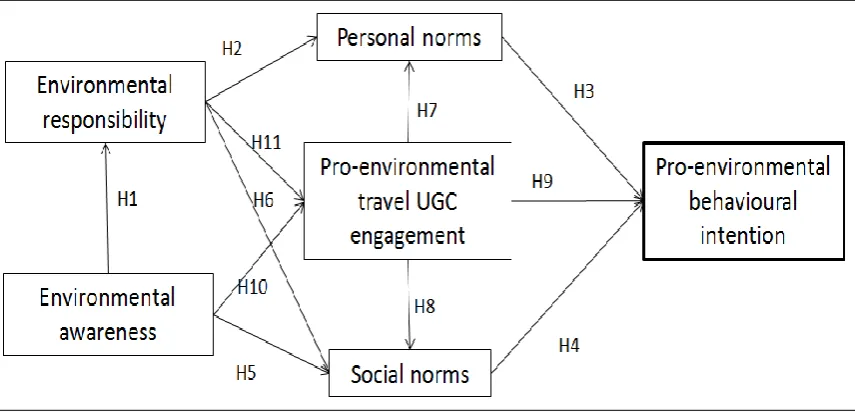
Figure 1 outlines the hypothesized model based on these conceptual discussions. Generally we propose that tourist’s pro-environmental social norms, personal norms and pro-environmental travel UGC engagement directly affects tourists’ pro-environmental behavioral intentions. Environmental awareness and environmental responsibility are two antecedents of personal norms, pro-environmental travel UGC engagement and social norms.
Fig.1 Hypothesized model
3 Methodology
3.1 Data Collection and Sampling
(1) to strongly agree (7). The initial version of the questionnaire was reviewed by an expert panel of three scholars and pre-tested. Based on feedback received, minor adjustments were made. All the items were scrutinized by the panel. They were asked to rate each scale and provide suggestions for applicable alternatives. To make the final selection of measurement items, we conducted a pilot study with a sample of 125 Chinese tourists in August 2015, which provided initial support for the hypotheses and the measures. Originally, the methodological model was to test influences on pro-environmental behavior, as Norm Activation Theory has previously been applied to predict pro-environmental behavior. Additionally, the original questionnaire utilized a 5-point Likert scale. 823 questionnaires were collected during September 2016 to January 2017, and the results analyzed. Yet in the light of criticisms of a 5-point scale and concerns about the ability to predict actual behavior, the hypotheses and model were revised, and a new set of questionnaires developed using a 7-point scale, which were distributed between May and July 2017. The questionnaire and its source literature can be found in the Supplemental Data section of the web-based version of this paper.
This study targeted individuals with social media access and who travel on a regular basis. The web platform Wenjuan.com was used to collect data. Wenjuan.com is currently the biggest free web survey platform in China. The survey was developed in English and translated into Chinese. One screening question about travel frequency helped the authors target people who had travelled at least once within the 12 months before the survey. This approach was taken to try to minimize the potential for social desirability bias given that a researcher was not present to conduct survey interviews. The survey pages first introduced the main purpose of this study, and then participants were directed to popular Chinese travel websites to gain an understanding of the meaning of pro-environmental UGC. Within 2 months of launch, the survey was terminated with 1087 Chinese people who accessed the link to the survey. After excluding unusable responses and outliers, 1043 responses met the requirements of this study and were retained for data analysis. We firstly compared the results with those generated from the first set (using the 5-point scale and measuring the relationships between norms and pro-environmental behavior), and found that the results were similar and both models supported. Whilst we do not explicitly seek to compare the validity of measures and the models, we argue that this first set of data gives stronger support to the hypotheses and validation of the measurements.
the respondents had a college/university degree. All the respondents reported that they travel at least once every year. Also, all of them reported they had visited one travel website at least once, with the majority having used popular online travel communities including, “Ctrip.com” and “Qyer.com”. “Ctrip.com” was the most frequently visited website by the respondents (39.1%). This sample represents the typical demographic profile of users of online communities in China. The younger generation is the most technologically articulate group in China and more skillful at using computers than other groups. Specifically, compared to high school students, college/university students have more control over their time and actual use of computing technology so they are able to spend more time on social media (Lu, Zhou, & Wang, 2009).
Profiles Percentage
Gender
M 48.7%
F 51.3%
Age
18-24 10.3%
25-34 37.9%
35-44 28.3%
45-54 14.9%
55-64 5.7%
More than 65 2.9%
Education
Primary school or
under
0.9%
High
School/Vocational
School
23.7%
College/University 53.9%
Master or Ph.D. 12.7%
Travel frequency(times/year) 1 32.6%
2--3 54.2%
4--10 10.1%
More than 10 3.1%
The most frequently visited travel website Qunar.com 30.7%
Qyer.com 15.9%
Ctrip.com 39.1%
Others 14.3%
Table.1 Participant profile
3.2 Measurement validity and reliability
Subsequently, we used Composite Reliability measures to test for internal consistency because this is recommended for Partial Least Squares (PLS) path models, since the Cronbach’s Alpha focuses on the internal reliability of latent variables (Henseler, Ringle, & Sinkovics, 2009). The CR tests achieved a range from 0.886 to 0.945, which meets the stipulated thresholds. The factor loadings of all the items were greater than 0.7 and significant (p<0.01), indicating an acceptable level of internal validity (Cheng, Lam, & Yeung, 2006). Therefore, the measurement model suggests that all the constructs have a high level of internal consistency.
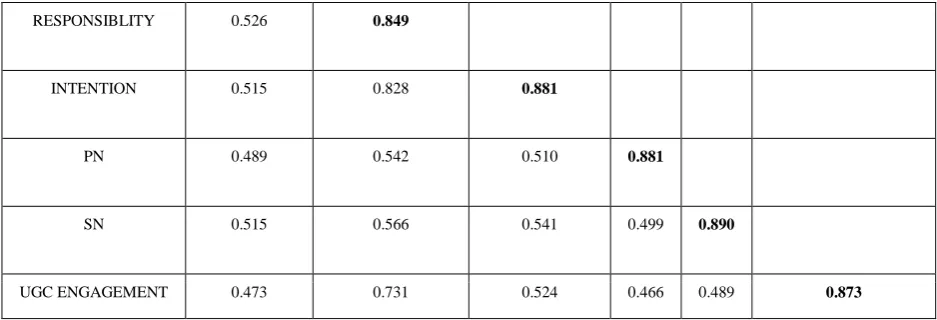
The average variance extracted (AVE) was used to analyze the convergent validity. Researchers have shown good convergent validity if AVE values are 0.5 and higher, which represents at least half of an indicator’s variance (Bagozzi & Yi, 1988). Table 2 shows that AVE values were all above 0.7, indicating a good degree of convergent validity. For discriminant validity, a latent construct should share more variance with its assigned indicators than with any other latent constructs (Fornell & Larcker, 1981). Each construct met this requirement, showing a satisfactory level of discriminant validity (table 3). Also, the analysis estimated the cross loadings and each indicator’s loadings were greater than all of its cross loadings. Therefore, the model has a high degree of discriminant validity.
Constructs Items Factor loading
Crobach’s
Alpha
AVE (0.5) Composite Reliability
PN 4 0.853-0.903 0.904 0.776 0.8933
SN 4 0.877-0.903 0.912 0.792 0.938
INTENTION 5 0.851-0.916 0.927 0.776 0.945
AWARNESS 4 0.882-0.900 0.911 0.788 0.937
RESPONSIBLITY 4 0.784-0.883 0.807 0.721 0.886
UGC ENGAGEMENT 4 0.840-0.904 0.896 0.763 0.928
Table.2 Reliability and validity tests
Construct AWARENESS RESPONSIBLITY INTENTION PN SN UGC ENGAGEMENT
RESPONSIBLITY 0.526 0.849
INTENTION 0.515 0.828 0.881
PN 0.489 0.542 0.510 0.881
SN 0.515 0.566 0.541 0.499 0.890
[image:14.595.63.532.71.231.2]UGC ENGAGEMENT 0.473 0.731 0.524 0.466 0.489 0.873
Table. 3 Discriminant validity test
3.3 Data analysis
The data were analyzed using Smartpls 3.0 software. SEM evaluates both the assumed relationships among dependent and independent variables (structural model) and the loadings of the observed measurement constructs on their expected latent variables (measurement model), which makes it is possible to understand whether measurement errors in the observed variables are an integral aspect of the model (Ayeh, Au, & Law, 2013). PLS is a soft modelling approach to SEM, which does not consider data distribution (Wong, 2013). It is especially suitable for the circumstances when sample sizes are small, or where the aim is to develop theory and where predictive accuracy is paramount (Henseler, Ringle, & Sinkovics, 2009). This study aimed to explore the role of social media on tourists’ pro-environmental norms and behavioral intentions, thus a PLS model was appropriate as the preferred method when trying to develop theories (Hair, Ringle, & Sarstedt, 2011).
According to the guidance suggested by Marcoulides and Saunders (2006), the minimum sample size required for this study would be 88 because the model contains nine arrows directed to a latent variable. Obviously, our sample of 1043 meets the minimum requirement for conducting SEM analysis (Hair, 2010). Furthermore, this sample size is sufficient to test the mediating effects since the median sample size used to test for this in previous studies was 187 (Fritz & MacKinnon, 2007).
The analysis tested the explanatory and predictive power of the proposed model, the size of the path coefficients and the significance of the hypothesized relationships. In the PLS algorithm,
the variance explained (R2) was used to evaluate the structural model. R2 values of 0.19, 0.33
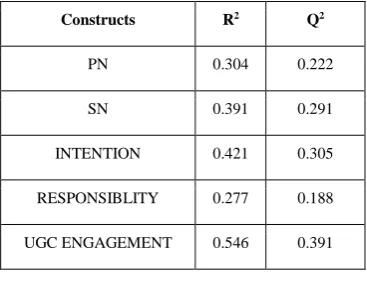
and 0.67 for endogenous latent constructs of the structural model represent the weak, moderate or substantial support for the relationships of the structural model (Chin, 1998). As shown in table 4, the model could explain 30.4% of the variance on pro-environmental personal norms, 39.1% of the variance in environmental social norms and 42.1% of the variance in pro-environmental behavioral intentions. Hence, the proposed model is sufficient to reflect tourists’
pro-environmental norms and behavioral intentions. R2 values for pro-environmental UGC
engagement were 0.546, indicating that the model does reflect tourists’ pro-environmental
UGC engagement. Gesser’s Q2 test was used to test the model’s ability to predict, which has
been widely used to assess the predictive validity of the exogenous latent variables. Q2 values
greater than zero suggests the exogenous constructs have predictive relevance for the
endogenous constructs (Chin, 1998). As shown in table 4, all Q2 values were above zero, which
indicates high predictive power of all exogenous constructs.
Constructs R2 Q2
PN 0.304 0.222
SN 0.391 0.291
INTENTION 0.421 0.305
RESPONSIBLITY 0.277 0.188
[image:15.595.206.390.390.531.2]UGC ENGAGEMENT 0.546 0.391
Table 4: R2 values and Q2 values
T values were calculated to test the path coefficients by bootstrapping. We used a non-parametric bootstrapping procedure to test 1043 cases, 5000 subsamples and individual sig changes (Hair, Ringle, & Sarstedt, 2011). The results revealed that the hypothesized relationships in the inner path model exhibited statistically significant figures (see table 5). All hypothesizes were strongly supported since the P values were below 0.001. This verifies the significant role of UGC in the model.
Variables Path coefficient P Value T Value Hypotheses
PN-INTENTION 0.239 0.000*** 9.786 H1: Accepted
AWR-RES 0.526 0.000*** 23.479 H3: Accepted
SN-INTENTION 0.289 0.000*** 11.975 H4: Accepted
AWR-SN 0.288 0.000*** 11.533 H5: Accepted
RES-SN 0.337 0.000*** 11.625 H6: Accepted
UGC-PN 0.151 0.000*** 4,449 H7: Accepted
UGC-SN 0.107 0.000*** 3.803 H8: Accepted
UGC-INTNETION 0.271 0.000*** 10.844 H9: Accepted
AWR-UGC 0.122 0.000*** 5.924 H10: Accepted
RES-UGC 0.667 0.000*** 49.115 H11: Accepted
Tab.5 Results of hypothesis testing (p<0.001***; p<0.01**; p<0.05 *; p>0.05=N.S.)
Furthermore, we tested for the mediation effect of pro-environmental travel UGC engagement. Initially, we followed the approach of Baron and Kenny (1986) to test whether pro-environmental travel UGC engagement mediates the relationship between pro-pro-environmental awareness, responsibility and pro-environmental behavioral intentions. Our results suggested that to be the case. Following that, we adopted the Sobel test values for mediation. The Sobel test is a statistical method to investigate the significance of the mediator in relation to the independent and dependent variables (Leigh & Milgrom, 2008). The Sobel test P values for our data were 0.000 and 0.000 respectively, indicating that pro-environmental travel UGC engagement is a strong mediator between environmental awareness and pro-environmental behavioral intentions as well as between environmental responsibility and pro-environmental behavioral intentions.
Mediation effect Variables P value T value Sobel test statistic
Sobel test P value
Mediating role
AWR UGC
INTENTION
AWR UGC
UGC INTENTION
AWR INTENTION
0.000*** 0.000*** 0.000*** 5.924 10.844 5.828
6.341 0.000*** Support
RES UGC
INTENTION
RES UGC
UGC INTENTION
RES INTENTION
0000*** 0.000*** 0.000*** 49.115 10.844 40.257
12.80 0.000*** Support
We then controlled for gender, age, education and income level since previous studies indicate that these factors may impact on people’s pro-environmental intentions (Barr & Silg, 2007). Two control variables were found to be significantly related, namely age and education. Young people tended to have stronger pro-environmental behavioral intentions and those who had higher education background also reported intentions towards greater environmental responsibility.
5. Discussion and conclusion
Firstly, this study found strong support for the relationships between the constructs which confirms previous studies on Norm Activation Theory and pro-environmental behavioral intentions. As such, tourists with more environmental awareness tend to bear a sense of responsibility and feel a greater moral obligation towards the environment, and thus are more likely to have the intention to act pro-environmentally in their tourism behavior. Our findings support the interpretation of Norm Activation Theory, of which awareness of consequences (AC) and ascription of responsibility (AR) are two preconditions of personal norm activation, and are best treated as mediators of personal norms (De Groot & Steg, 2009; Han & Hwang, 2016; Van Riper & Kyle, 2014; Zhang, Zhang, Zhang, & Cheng, 2014).
Additionally, we also provide further verification of the significant role of social norms in predicting pro-environmental tourist behavioral intentions, confirming recent studies (Antimova, Rawijn, & Peeters, 2012; Han 2015). This study also supports the conceptualization that environmental awareness and environmental responsibility are antecedent to pro-environmental social norms. This indicates that people with more understanding about the consequences of their behavior in regard to the environment and who feel more responsibility for their behavior, tend to link their pro-environmental behavioral intention with social sanctions or approvals. Furthermore, these indicate that tourists with pro-environmental awareness and responsibility would generally believe that their reference group should bear the same sense of awareness and responsibility. These beliefs would lead to their expectations for collective action towards greater pro-environmental actions.
literature implies that social media is an effective instrument in promoting pro-environmental behavior, no literature has examined its role in activating pro-environmental norms. Our findings also support the important and significant role of pro-environmental UGC in promoting pro-environmental behavior, which has been proposed in previous studies (Langley & van den Broek, 2010; Fischer & Reuber, 2011). This implies that social media can be an effective communication channel to motivate pro-environmental behavioral intentions. Our findings show that pro-environmental UGC activates tourists’ pro-environmental personal norms, providing empirical support to the argument of Vandenbergh (2005), that information can accelerate the process of personal norm activation, by making people aware of environmental issues and thus accepting their personal responsibility. Previous studies show that the activation of personal norms depends on the interplay of cognitive, emotional and social factors (Bierhoff, 2002). Further studies could focus on how to make online conversations target these factors to activate tourists’ pro-environmental personal norms more effectively. In addition to personal norms, pro-environmental travel UGC engagement activates tourists’ social norms, which is in accordance with the findings of Hardeman, Font, and Nawijn (2017) who found that messages focusing on personal and social norms could impact holiday makers’ preferences towards opting for sustainability actions. UGC engagement not only provides information, but more importantly creates an online community. Therefore, the more tourists engage in pro-environmental UGC, the more likelihood they will be associated with pro-environmental social groups and to help spread this type of content amongst their own networks. Luo and Zhong (2015) explained that the impact of travel-related online communications depends on the existence of a social relationship. Foster and Lawson (2013) further argued that social media effectively activates pro-environmental social norms through their case study of Facebook. They found that people are able to effectively reduce household energy consumption through competition with their friends. Our study opens up the potential for further research on the role that online persuasive communication in social media channels can play in activating environmentally responsible attitudes, intentions and behaviors.
frequently online. Therefore, they may be assumed to have a higher level of UGC engagement. However, according to Dijck (2009), among all UGC users, only a small proportion are active, whereas more are “passive spectators” (33%) and the majority “inactive” (52%). Our findings show that when people perceive they have more responsibility for the environment they not only consume online pro-environmental information, but also actively generate UGC to influence pro-environmental intentions of others. Further work on the role of opinion leaders in pro-environmental UGC could help understand how content creators could extend their influence to a wider proportion of the online travel community.
A number of theoretical and practical implications arise. Conceptually, the research identified the importance of pro-environmental knowledge and pro-environmental responsibility because they not only activate people’s pro-environmental norms, but also promote people’s contribution to online environmental dialogue. This supports the conclusion that prior knowledge is an antecedent of social media engagement, and further identifies that responsibility is significant for individuals’ activate participation in online discussion in pro-environmental issues. Therefore, our study implies that providing sufficient knowledge and engendering a sense of responsibility are effective methods of drawing public attention to environmental issues and guiding the direction of online discussion content.
Practically, this study provides implications for tourism management. By encouraging people to actively participate in tourism related social media to discuss environmental issues, pro-environmental travel UGC will be enriched, which will further activate tourists’ pro-environmental norms and increase their intentions to act more pro-environmentally. Besides the most frequently tested variables of values and attitudes, this study attests to the importance of pro-environmental norms as an additional tool for understanding how consumers can be influenced towards more pro-environmental actions.
References
Ajzen, I. (1985). From intentions to actions: A theory of planned behavior. In J. Kuhl & J.
Beckmann (Eds.), Action-control: From cognition to behavior (pp. 11-39). Heidelberg:
Springer.
Ajzen, I. (1991). The theory of planned behavior. Organizational Behavior And Human
Decision Processes, 50(2), 179-211.
Ajzen, I., & Fishbein, M. (1980). Understanding attitudes and predicting social behavior.
Englewood Cliffs, NJ: Prentice-Hall.
Antimova, R., Nawijn, J., & Peeters, P. (2012). The awareness/attitude-gap in sustainable
tourism: a theoretical perspective. Tourism Review of AIEST - International Association
of Scientific Experts in Tourism, 67(3), 7-16.
doi:http://dx.doi.org/10.1108/16605371211259795
Aoyagi-Usui, M., Vinken, H., & Kuribayashi, A. (2003). Pro-environmental attitudes and
behaviors: An international comparison. Human Ecology Review, 10(1), 23-31.
Ayeh, J. K., Au, N., & Law, R. (2013). Predicting the intention to use consumer-generated
media for travel planning. Tourism Management, 35, 132-143.
Bach, J., & Stark, D. (2004). Link, search, interact the co-evolution of NGOs and interactive
technology. Theory, Culture & Society, 21(3), 101-117.
Bagozzi, R. P., & Yi, Y. (1988). On the evaluation of structural equation models. Journal Of
The Academy Of Marketing Science, 16(1), 74-94.
Bamberg, S., Hunecke, M., & Blöbaum, A. (2007). Social context, personal norms and the use
of public transportation: Two field studies. Journal Of Environmental Psychology,
27(3), 190-203.
Barber, N., Taylor, C., & Strick, S. (2009). Wine consumers’ environmental knowledge and
attitudes: Influence on willingness to purchase. International Journal of Wine
Research, 1(1), 59-72.
Baron, R. M., & Kenny, D. A. (1986). The moderator–mediator variable distinction in social
psychological research: Conceptual, strategic, and statistical considerations. Journal of
Barr, S., & Gilg, A. W. (2007). A conceptual framework for understanding and analyzing
attitudes towards environmental behaviour. Geografiska Annaler Series B: Human
Geography, 89(4), 361-379.
Batat, W., & Prentovic, S. (2014). Towards viral systems thinking: a cross-cultural study of
sustainable tourism ads. Kybernetes, 43(3/4), 529-546.
Baumann, C., Elliott, G., & Hamin, H. (2011). Modelling customer loyalty in financial
services: a hybrid of formative and reflective constructs. International Journal of Bank
Marketing, 29(3), 247-267.
Bierhoff, H. W. (2002). Prosocial behaviour. Philadelphia, PA, Psychology Press.
Buckley, R. (2012). Sustainable tourism: Research and reality. Annals of Tourism Research,
39(2), 528-546.
Buhalis, D., & Licata, M. C. (2002). The future eTourism intermediaries. Tourism
Management, 23(3), 207-220.
Casaló, L. V., Flavián, C., & Guinalíu, M. (2010). Determinants of the intention to participate in firm-hosted online travel communities and effects on consumer behavioral
intentions. Tourism Management, 31(6), 898-911.
Charter, M. (1992). Greener marketing: A responsible approach to business. Sheffield, UK.
Greenleaf Publishing.
Cheng, T. C. E., Lam, D. Y. C., & Yeung, A. C. L. (2006). Adoption of internet banking: an
empirical study in Hong Kong. Decision Support Systems, 42(3), 1558-1572.
Chin, W. W. (1998). Commentary: Issues and opinion on structural equation modeling: MIS
Quarterly, 22(1),vii-xvi.
Chiu, Y.-T. H., Lee, W.-I., & Chen, T.-H. (2014). Environmentally responsible behavior in
ecotourism: Antecedents and implications. Tourism Management, 40(0), 321-329.
Cialdini, R. B., Reno, R. R., & Kallgren, C. A. (1990). A focus theory of normative conduct:
recycling the concept of norms to reduce littering in public places. Journal of
Personality and Social Psychology, 58(6), 1015-1026.
Cialdini, R. B., & Trost, M. R. (1998). Social influence: Social norms, conformity and
compliance. In: Gilbert D., Fiske S., Lindzey G. (eds) The Handbook of Social
Psychology, 4th edition. New York, Oxford University Press.
Cohen, S. A., Prayag, G., & Moital, M. (2014). Consumer behaviour in tourism: Concepts,
influences and opportunities. Current Issues in Tourism, 17(10), 872-909.
De Groot, J. I. M., & Steg, L. (2009). Morality and Prosocial Behavior: The Role of Awareness,
Responsibility, and Norms in the Norm Activation Model. Journal of Social
Psychology, 149(4), 425-449.
Dijck, J. V. (2009). Users like you? Theorizing agency in user-generated content. Media,
Culture and Society, 31(1), 41-58.
Doran, R., Hanss, D., & Larsen, S. (2017). Intentions to make sustainable tourism choices: do value orientations, time perspective, and efficacy beliefs explain individual
differences? Scandinavian Journal of Hospitality and Tourism, 17 (3), 223-238.
Feng, R., & Morrison, A. M. (2007). Quality and value network marketing travel clubs. Annals
of Tourism Research, 34(3), 588-609.
Fischer, E., & Reuber, A. R. (2011). Social interaction via new social media:(How) can
interactions on Twitter affect effectual thinking and behavior?. Journal of Business
Venturing, 26(1), 1-18.
Font, X. & McCabe, S. (2017) Sustainability and marketing in tourism: its contexts, paradoxes,
approaches, challenges and potential, Journal of Sustainable Tourism, 25(7), 869-883
Fornell, C., & Larcker, D. F. (1981). Structural equation models with unobservable variables
and measurement error: Algebra and statistics. Journal of Marketing Research, 39(2),
382-388.
Foster, D., & Lawson, S. (2013). ‘Liking’persuasion: case studies in social media for behaviour change. Paper presented at the ACM SIGCHI Conference on Human Factors in
Computing Systems, Paris, France. 27th April - 2nd May. Retrieved 17th August, 2017
from https://noreenkamal.files.wordpress.com/2013/03/21-liking-persuasion-v1-df.pdf Fritz, M. S., & MacKinnon, D. P. (2007). Required sample size to detect the mediated effect.
Psychological science, 18(3), 233-239.
Gärling, T., Fujii, S., Gärling, A., & Jakobsson, C. (2003). Moderating effects of social value
orientation on determinants of proenvironmental behavior intention. Journal of
Environmental Psychology, 23(1), 1-9.
Garrett, R. K. (2009). Politically motivated reinforcement seeking: Reframing the selective
exposure debate. Journal of Communication, 59(4), 676-699.
Gretzel, U., Kang, M., & Lee, W. (2008). Differences in Consumer-Generated Media Adoption
and Use: A Cross-National Perspective. Journal of Hospitality & Leisure Marketing,
17, 99-120.
Gursoy, D., & McCleary, K. W. (2004). An Integrative Model Of Tourists’ Information Search
Hair, J. F. (2010). Multivariate data analysis: A Global Perspective. Upper Saddle River, N.J., Pearson.
Hair, J. F., Ringle, C. M., & Sarstedt, M. (2011). PLS-SEM: Indeed a silver bullet. Journal of
Marketing Theory And Practice, 19(2), 139-152.
Hall, C.M. (2016) Intervening in academic interventions: framing social marketing's potential
for successful sustainable tourism behavioural change, Journal of Sustainable Tourism,
24(3), 350-375,
Han, H. (2015). Travelers' pro-environmental behavior in a green lodging context: Converging
value-belief-norm theory and the theory of planned behavior. Tourism Management,
47(0), 164-177.
Han, H., & Hwang, J. (2016). Cruise travelers’ environmentally responsible decision-making: An integrative framework of goal-directed behavior and norm activation process. International Journal of Hospitality Management, 53, 94-105.
Hardeman, G., Font, X., & Nawijn, J. (2017). The power of persuasive communication to
influence sustainable holiday choices: Appealing to self-benefits and norms. Tourism
Management, 59, 484-493.
Hargreaves, T. (2011). Practice-ing behaviour change: Applying social practice theory to
pro-environmental behaviour change. Journal of Consumer Culture, 11(1), 79-99.
Harland, P., Staats, H., & Wilke, H. A. M. (2007). Situational and Personality Factors as Direct or Personal Norm Mediated Predictors of Pro-environmental Behavior: Questions
Derived From Norm-activation Theory. Basic & Applied Social Psychology, 29(4),
323-334.
Harris, P. G. (2006). Environmental Perspectives and Behavior in China Synopsis and
Bibliography. Environment and Behavior, 38(1), 5-21.
Henseler, J., Ringle, C. M., & Sinkovics, R. R. (2009). The use of partial least squares path
modeling in international marketing. Advances In International Marketing, 20(1),
277-319.
Hvass, K. A., & Munar, A. M. (2012). The takeoff of social media in tourism. Journal of
Vacation Marketing, 18(2), 93-103.
Jacobsen, J. K. S., & Munar, A. M. (2012). Tourist information search and destination choice
in a digital age. Tourism Management Perspectives, 1, 39-47.
Jia, Y.-j., & Lin, D.-r. (2015). Influence Factors and Effects of Tourists' Environmentally
Responsible Behaviors Based on Place Theory. China Population, Resources and
Juvan, E., & Dolnicar, S. (2014). The attitude–behaviour gap in sustainable tourism. Annals of Tourism Research 48, 76-95
Kane, K., Chiru, C., & Ciuchete, S. G. (2012). Exploring the eco-attitudes and buying
behaviour of Facebook users. Amfiteatru Economic, XIV(31), 157-171.
Kiatkawsin, K. & Han, H. (2017). Young travelers' intention to behave pro-environmentally:
Merging the value-belief-norm theory and the expectancy theory. Tourism
Management, 59, 76-88.
Klöckner, C. A., & Blöbaum, A. (2010). A comprehensive action determination model: Toward a broader understanding of ecological behaviour using the example of travel mode
choice. Journal of Environmental Psychology, 30(4), 574-586.
Kollmuss, A., & Agyeman, J. (2002). Mind the gap: why do people act environmentally and
what are the barriers to pro-environmental behavior? Environmental Education
Research, 8(3), 239-260.
Langley, D., & van den Broek, T. (2010). Exploring social media as a driver of sustainable
behaviour: case analysis and policy implications. Proceedings of the Internet Politics
and Policy Conference.16-17th September, Oxford. Retrieved 17th August, 2017 from:
http://ipp.oii.ox.ac.uk/sites/ipp/files/documents/IPP2010_Langley_vandenBroek_Pape r.pdf
Lee, T. H., Jan, F. H., & Yang, C. C. (2013). Conceptualizing and measuring environmentally
responsible behaviors from the perspective of community-based tourists. Tourism
Management, 36, 454-468.
Leigh, B., & Milgrom, J. (2008). Risk factors for antenatal depression, postnatal depression
and parenting stress. BMC Psychiatry, 8(1), 24.
Li, M., Zhang, H., Mao, I., & Deng, C. (2011). Segmenting Chinese outbound tourists by
perceived constraints. Journal of Travel & Tourism Marketing, 28(6), 629-643.
Lim, J. S., Hwang, Y., Kim, S., & Biocca, F. A. (2015). How social media engagement leads to sports channel loyalty: Mediating roles of social presence and channel commitment. Computers in Human Behavior, 46, 158-167.
Lu, Y., Zhou, T., & Wang, B. (2009). Exploring Chinese users’ acceptance of instant messaging using the theory of planned behavior, the technology acceptance model, and
the flow theory. Computers in Human Behavior, 25(1), 29-39.
Luck, E., & Ginanti, A. (2013). Online environmental citizenship: Blogs, green marketing and
Luo, Q., & Zhong, D. (2015). Using social network analysis to explain communication characteristics of travel-related electronic word-of-mouth on social networking sites. Tourism Management, 46(0), 274-282.
March, R., & Woodside, A. G. (2005). Testing theory of planned versus realized tourism
behavior. Annals Of Tourism Research, 32(4), 905-924.
Marcoulides, G. A., & Saunders, C. (2006). Editor's comments: PLS: a silver bullet? MIS
Quarterly, iii-ix.
Mehmetoglu, M. (2010). Factors Influencing the Willingness to Behave Environmentally
Friendly at Home and Holiday Settings. Scandinavian Journal of Hospitality and
Tourism, 10(4), 430-447
Miller, G., Rathouse, K., Scarles, C., Holmes, K., & Tribe, J. (2010). Public understanding of
sustainable tourism. Annals of Tourism Research, 37(3), 627-645.
Narangajavana, Y., Fiol, L. J. C., Tena, M. Á. M., Artola, R. M. R., & García, J. S. (2017). The influence of social media in creating expectations. An empirical study for a tourist
destination. Annals of Tourism Research, 65, 60-70.
Nigbur, D., Lyons, E., & Uzzell, D. (2010). Attitudes, norms, identity and environmental behaviour: Using an expanded theory of planned behaviour to predict participation in a
kerbside recycling programme. British Journal of Social Psychology, 49(2), 259-284.
Peattie, K. (2010). Green Consumption: Behavior and Norms. Annual Review of Environment
and Resources, 35(1), 195-228.
Qu, H., & Lee, H. (2011). Travelers’ social identification and membership behaviors in online
travel community. Tourism Management, 32(6), 1262-1270.
Ramkissoon, H., Smith, L. D. G., & Weiler, B. (2013). Relationships between place attachment, place satisfaction and pro-environmental behaviour in an Australian
national park. Journal of Sustainable Tourism, 21(3), 434-457.
Rao, A. R., & Sieben, W. A. (1992). The effect of prior knowledge on price acceptability and
the type of information examined. Journal of Consumer Research, 19(2), 256-270.
Sandve, A., & Øgaard, T. (2014). Exploring the interaction between perceived ethical
obligation and subjective norms, and their influence on CSR-related choices. Tourism
Management, 42, 177-180.
Santos, J. R. A. (1999). Cronbach’s alpha: A tool for assessing the reliability of scales. Journal
Schultz, P. W., Nolan, J. M., Cialdini, R. B., Goldstein, N. J., & Griskevicius, V. (2007). The
constructive, destructive, and reconstructive power of social norms. Psychological
Science, 18(5), 429-434.
Schwartz, S. H. (1977). Normative Influences on Altruism1. Advances In Experimental Social
Psychology, 10, 221-279.
Sheeran, P. (2002). Intention—behavior relations: A conceptual and empirical review. European review of social psychology, 12(1), 1-36.
Solomon, S. D., & Harford, T. C. (1984). Drinking norms versus drinking behavior. Alcoholism: Clinical and experimental research, 8(5), 460-466.
Sparks, B. A., Perkins, H. E., & Buckley, R. (2013). Online travel reviews as persuasive communication: The effects of content type, source, and certification logos on
consumer behavior. Tourism Management, 39, 1-9.
Steg, L., Dreijerink, L., & Abrahamse, W. (2005). Factors influencing the acceptability of
energy policies: A test of VBN theory. Journal of Environmental Psychology, 25(4),
415-425.
Steg, L., & Groot, J. (2010). Explaining prosocial intentions: Testing causal relationships in
the norm activation model. British Journal Of Social Psychology, 49(4), 725-743.
Steg, L., & Uneken, E. (2004). Car use: lust and must. Traffic and Transport Psychology:
Theory and Application. Amsterdam:Elsevier, 443-452.
Stern, P. (2000). Toward a coherent theory of environmentally significant behavior. Journal of
Social Issues, 56(3), 407-424.
Tapon, F., & Leighton, T. (1991). Green as strategy: Lessons from the chemical industry.
Cahiers de Recherche No. 1991-17, Guelph, Department of Economics, University of Guelph
Thomas, C., & Sharp, V. (2013). Understanding the normalisation of recycling behaviour and its implications for other pro-environmental behaviours: A review of social norms and
recycling. Resources, Conservation and Recycling, 79(0), 11-20.
Turaga, R. M. R., Howarth, R. B., & Borsuk, M. E. (2010). Pro‐environmental behavior.
Annals of the New York Academy of Sciences, 1185(1), 211-224.
van Riper, C. J., & Kyle, G. T. (2014). Understanding the internal processes of behavioral engagement in a national park: a latent variable path analysis of the value-belief-norm
Vandenbergh, M. P. (2005). Order without social norms: How personal norm activation can
protect the environment. Northwestern University Law Review, 99(3), 1101-1166.
Weiner, B. (2000). Intrapersonal and interpersonal theories of motivation from an attributional
perspective. Educational Psychology Review, 12(1), 1-14.
Wong, K. K.-K. (2013). Partial least squares structural equation modeling (PLS-SEM)
techniques using SmartPLS. Marketing Bulletin, 24(1), 1-32.
Xiang, Z., & Gretzel, U. (2010). Role of social media in online travel information search. Tourism Management, 31(2), 179-188.
Ye, Q., Law, R., Gu, B., & Chen, W. (2011). The influence of user-generated content on traveler behavior: An empirical investigation on the effects of e-word-of-mouth to hotel
online bookings. Computers in Human Behavior, 27(2), 634-639.
Zhang, Y., Zhang, H.-L., Zhang, J., & Cheng, S. (2014). Predicting residents' pro-environmental behaviors at tourist sites: The role of awareness of disaster's
consequences, values, and place attachment. Journal Of Environmental Psychology,
40, 131-146.
Appendix: Questionnaire items
1.Pro-environmental norms and behavioral intention
Items’ sources
Personal norms Harland (2007); Kiatkawsin & Han (2017);
Vandenbergh (2005); Vining & Ebreo (1992)
1. I feel a strong personal obligation to protect the environment when travelling.
2. I am willing to put extra effort into pro-environmental behaviour when travelling.
4. I have the obligation to comply with destination environmental regulations and laws.
Environmental awareness Kiatawsin; Han (2017); Shaul & Tally (2006)
5. The tourism industry can casue pollution, climate change, and exhaustion of natural resources because of the infrastructures required to cater to a degree number of tourists.
6.Tourists’ pro-environmental behaviour can reduce environmental pollution.
7. Environmental quality will improve a lot if we choose more pro-environmental travel mode.
8. Tourists can casue environmental
deteriorations of the host community such as wastes and excessive use of
energy/waste/fuel.
Environmental responsibility Kiatawsin & Han (2017); Zhang, Zhang, Zhang, & Cheng (2014)
9.Not only the government and destination managers are responsible for protect the environment in tourism destination, but me too.
10. I feel jointly responsible for the
environmental issues in tourism destinations.
11. Every traveller must take responsibility for the environmental problems casued during their trip.
Social norms Doran, Hanss & Larsen (2017); Han (2015);
Rajiv Rimal & Real (2005) 12. Most people who are important to me
think I should conduct pro-environmental behaviour when travelling.
14. Most of my friends and family members protect the environment when travelling.
15.Most people who are important to me would like to pay more for a trip if this helps to protect the environment.
Pro-environmental behavioral intention Kiatawsin & Han (2017)
16.I would try to save water and electricity when travelling.
17. I would buy eco or organic products when possible.
18. I would learn about the recycling facilities and actions of the locals when travelling.
19. I would try to dispose garbage properly if possible.
20. I would try to protect local resources as much as I could when travelling.
2. Social media engagement Narangajavana, Fiol, Tena, Artola, & Garcia (2017); Lim, Hwang, Kim, & Biocca (2015) 21. I frequently visit online travel community
and see posts that related to pro-environmental travel behavior.
22. When I see pro-environmental travel related posts on online travel communities, I usually forward the posts to others, or make a comment.
23. When traveling, I usually post my feelings when I like/dislike others’ travel behavior relating to environment.