organic papers
Acta Cryst.(2006). E62, o2569–o2570 doi:10.1107/S1600536806019489 Weberet al. C18H14O
o2569
Acta Crystallographica Section EStructure Reports Online
ISSN 1600-5368
1-(Methoxymethyl)pyrene
Tobias Gruber, Wilhelm Seichter and Edwin Weber*
Institut fu¨r Organische Chemie, TU Bergakademie Freiberg, Leipziger Strasse 29, D-09596 Freiberg/Sachsen, Germany
Correspondence e-mail:
Key indicators
Single-crystal X-ray study
T= 93 K
Mean(C–C) = 0.001 A˚
Rfactor = 0.046
wRfactor = 0.142
Data-to-parameter ratio = 21.6
For details of how these key indicators were automatically derived from the article, see http://journals.iucr.org/e.
Received 20 December 2005 Accepted 24 May 2006
#2006 International Union of Crystallography All rights reserved
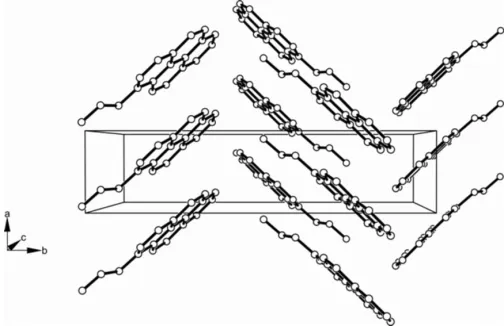
The title compound, C18H14O, crystallizes with aromatic–
stacking interactions.
Comment
With their particular electronic, optical and geometric prop-erties, pyrene and its derivatives (Garcia-Cruz et al., 2004; Takahashiet al., 2004; Borisevichet al., 1992) have attracted considerable recent interest. This is demonstrated in a great number of applications including host–guest (Vo¨gtle, 1996) and metal coordination chemistry (Arraiset al., 2004), as well as fluorescent sensor development (Bren, 2001). Although pyrenes with a functional side arm are important building blocks in this respect, reports on corresponding crystal struc-tures are limited (Foss & Stevens, 1985; Olszaket al., 1989). Here, we describe the structure of 1-(methoxymethyl)pyrene, (I), a new example of this type of compound.
The pyrene part of the molecule shows no significant deviations of bond lengths and angles compared with those of the unsubstituted analogue (Camerman & Trotter, 1965; Allmann, 1970; Hazell et al., 1972; Kai et al., 1978), and is almost planar. The largest deviation from the mean plane through the carbon framework of the pyrene unit is 0.042 (1) A˚ for atom C1. The torsion angle C2—C1—C17—O1 is 15.1 (1), indicating that the methoxymethyl group is turned away from the aromatic plane, while the C—C—O—C frag-ment itself exhibits a nearly ideal anti-periplanar conforma-tion [179.7 (1)].
the solid state structures of many aromatic compounds (Desiraju, 1989).
Experimental
The title compound, (I), was synthesized from commercially available pyrene-1-carbaldehyde, which was initially reduced with sodium borohydride in boiling methanol, following an analogous procedure described for the reduction of anthracene-9-carbaldehyde (Steward, 1960), to yield the intermediate compound 1-(hydroxymethyl)pyrene. This was transformed into 1-(bromomethyl)pyrene by the usual bromination with phosphorus tribromide in chloroform (Okamotoet al., 1990). Subsequent treatment with boiling methanol and recrystallization of the product from the same solvent yielded 60% of compound (I) as colorless needles (m.p. 322–323 K). 1H NMR spectroscopic data (400 MHz, CDCl3):8.32 (d, ArH, 1H), 8.13 (m, ArH, 4H), 8.02 (m, ArH, 4H), 5.14 (s, CH2OH, 2H), 3.49 (s, CH3, 3H).
Crystal data
C18H14O Mr= 246.29
Monoclinic,P21=n a= 4.7220 (10) A˚
b= 20.087 (4) A˚
c= 12.824 (3) A˚
= 91.13 (3)
V= 1216.1 (5) A˚3
Z= 4
Dx= 1.345 Mg m 3
MoKradiation
= 0.08 mm 1
T= 93 (2) K Prism, colorless 0.410.200.17 mm
Data collection
Bruker SMART CCD area-detector diffractometer
’and!scans
Absorption correction: multi-scan (SADABS; Sheldrick, 2000)
Tmin= 0.906,Tmax= 0.986
19573 measured reflections 3712 independent reflections 2920 reflections withI> 2(I)
Rint= 0.027 max= 30.5
Refinement
Refinement onF2 R[F2> 2(F2)] = 0.046 wR(F2) = 0.142 S= 0.97 3712 reflections 172 parameters
H-atom parameters constrained
w= 1/[2(F
o2) + (0.0988P)2
+ 0.1716P]
whereP= (Fo2+ 2Fc2)/3
(/)max= 0.001
max= 0.48 e A˚ 3
min= 0.20 e A˚ 3
H atoms were positioned geometrically (C—H = 0.95–0.99) and refined as riding, withUiso(H) = 1.2 or 1.5 timesUeq(C).
Data collection:APEX2(Bruker, 2003); cell refinement:SAINT
(Bruker, 2003); data reduction: SAINT; program(s) used to solve structure: SHELXS97(Sheldrick, 1997); program(s) used to refine structure: SHELXL97 (Sheldrick, 1997); molecular graphics:
SHELXTL (Bruker, 2003); software used to prepare material for publication:SHELXTL.
Financial support from the German Federal Ministry of Economics and Labour (BMWA) under grant No. 16IN0218 ‘ChemoChips’ is gratefully acknowledged.
References
Allmann, R. (1970).Z. Kristallogr. Kristallgeom. Kristallphys. Kristallchem. 132, 129–151.
Arrais, A., Diana, E., Gervasio, G., Gobetto, R., Marabello, D. & Stanghellini, P. L. (2004).Eur. J. Inorg. Chem.1505–1513.
Borisevich, N. A., Gruzinskii, V. V. & Kukhto, A. V. (1992).J. Mol. Liq.53, 81– 92.
Bren, V. A. (2001).Russ. Chem. Rev.70, 1017–1036.
Bruker (2003).APEX2,SMART,SAINTandSHELXTL. Bruker AXS Inc., Madison, Wisconsin, USA.
Camerman, A. & Trotter, J. (1965).Acta Cryst.18, 636–643.
Desiraju, G. (1989). Crystal Engineering – The Design of Organic Solids,
Materials Science Monographs, Vol. 54. Amsterdam: Elsevier. Foss, L. I. & Stevens, E. D. (1985).Acta Cryst.C41, 1114–1116.
Garcia-Cruz, I., Martinez-Magadan, J. M., Bofill, J. M. & Illas, F. (2004).J. Phys. Chem. A,108, 5111–5116.
Hazell, A. C., Larsen, F. K. & Lehmann, M. S. (1972).Acta Cryst.B28, 2977– 2984.
Kai, Y., Hama, F., Yasuoka, N. & Kasai, N. (1978).Acta Cryst.B34, 1263–1270. Okamoto, H., Arai, T., Sakuragi, H. & Tokumaru, K. (1990).Bull. Chem. Soc.
Jpn,63, 2881–2890.
Olszak, T. A., Willig, F., Durfee, W. S., Dreissig, W. & Bradaczek, H. (1989).
Acta Cryst.C45, 803–805.
Sheldrick, G. M. (1997). SHELXS97 and SHELXL97. University of Go¨ttingen, Germany.
Sheldrick, G. M. (2000).SADABS. University of Go¨ttingen, Germany. Steward, F. H. L. (1960).Aust. J. Chem.13, 478–487.
Takahashi, N., Gombojav, B., Yoshinari, T., Nagasaka, S., Takahashi, Y., Yamamoto, A., Goto, T. & Kasuya, A. (2004).J. Solid State Chem.177, 3479–3483.
[image:2.610.316.564.70.235.2]Vo¨gtle, F. (1996). Editor.Comprehensive Supramolecular Chemistry, Vol. 2. Oxford: Elsevier.
Figure 1
Perspective view of (I), showing 50% probability displacement ellipsoids for the non-H atoms.
Figure 2
[image:2.610.313.565.283.446.2]supporting information
sup-1 Acta Cryst. (2006). E62, o2569–o2570
supporting information
Acta Cryst. (2006). E62, o2569–o2570 [https://doi.org/10.1107/S1600536806019489]
1-(Methoxymethyl)pyrene
Tobias Gruber, Wilhelm Seichter and Edwin Weber
1-(Methoxymethyl)pyrene
Crystal data C18H14O Mr = 246.29 Monoclinic, P21/n a = 4.722 (1) Å b = 20.087 (4) Å c = 12.824 (3) Å β = 91.13 (3)° V = 1216.1 (5) Å3 Z = 4
F(000) = 520 Dx = 1.345 Mg m−3
Mo Kα radiation, λ = 0.71073 Å Cell parameters from 5632 reflections θ = 3.2–34.9°
µ = 0.08 mm−1 T = 93 K Prism, colourless 0.41 × 0.20 × 0.17 mm
Data collection
Bruker SMART CCD area-detector diffractometer
Radiation source: fine-focus sealed tube Graphite monochromator
φ and ω scans
Absorption correction: multi-scan (SADABS; Sheldrick, 2000) Tmin = 0.906, Tmax = 0.986
19573 measured reflections 3712 independent reflections 2920 reflections with I > 2σ(I) Rint = 0.027
θmax = 30.5°, θmin = 1.9° h = −6→6
k = −28→28 l = −18→18
Refinement Refinement on F2 Least-squares matrix: full R[F2 > 2σ(F2)] = 0.046 wR(F2) = 0.142 S = 0.97 3712 reflections 172 parameters 0 restraints
Primary atom site location: structure-invariant direct methods
Secondary atom site location: difference Fourier map
Hydrogen site location: inferred from neighbouring sites
H-atom parameters constrained w = 1/[σ2(F
o2) + (0.0988P)2 + 0.1716P] where P = (Fo2 + 2Fc2)/3
(Δ/σ)max = 0.001 Δρmax = 0.48 e Å−3 Δρmin = −0.20 e Å−3
Special details
Refinement. Refinement of F2 against ALL reflections. The weighted R-factor wR and goodness of fit S are based on F2, conventional R-factors R are based on F, with F set to zero for negative F2. The threshold expression of F2 > σ(F2) is used only for calculating R-factors(gt) etc. and is not relevant to the choice of reflections for refinement. R-factors based on F2 are statistically about twice as large as those based on F, and R- factors based on ALL data will be even larger.
Fractional atomic coordinates and isotropic or equivalent isotropic displacement parameters (Å2)
x y z Uiso*/Ueq
O1 0.04424 (16) −0.07123 (4) 0.63479 (6) 0.0268 (2)
C1 0.26259 (18) 0.02380 (5) 0.71549 (7) 0.01588 (19)
C2 0.36662 (19) 0.04029 (5) 0.61798 (8) 0.0181 (2)
H2 0.2986 0.0171 0.5580 0.022*
C3 0.56877 (19) 0.09023 (5) 0.60671 (8) 0.0185 (2)
H3 0.6373 0.1003 0.5394 0.022*
C4 0.67158 (17) 0.12554 (5) 0.69332 (7) 0.01566 (19)
C5 0.88425 (19) 0.17655 (5) 0.68504 (8) 0.0182 (2)
H5 0.9578 0.1869 0.6186 0.022*
C6 0.98138 (18) 0.21004 (5) 0.77007 (8) 0.0182 (2)
H6 1.1218 0.2434 0.7620 0.022*
C7 0.87668 (18) 0.19620 (4) 0.87217 (8) 0.0159 (2)
C8 0.97849 (19) 0.22947 (5) 0.96121 (8) 0.0193 (2)
H8 1.1197 0.2628 0.9546 0.023*
C9 0.8755 (2) 0.21427 (5) 1.05897 (8) 0.0204 (2)
H9 0.9479 0.2371 1.1187 0.025*
C10 0.66754 (19) 0.16598 (5) 1.07035 (8) 0.0191 (2)
H10 0.5973 0.1565 1.1376 0.023*
C11 0.56059 (18) 0.13121 (5) 0.98328 (7) 0.01564 (19)
C12 0.34717 (19) 0.08086 (5) 0.99180 (8) 0.0174 (2)
H12 0.2722 0.0711 1.0583 0.021*
C13 0.24988 (19) 0.04685 (5) 0.90723 (8) 0.0169 (2)
H13 0.1082 0.0138 0.9158 0.020*
C14 0.35606 (17) 0.05950 (4) 0.80448 (7) 0.01462 (19)
C15 0.56372 (17) 0.11044 (4) 0.79344 (7) 0.01450 (19)
C16 0.66550 (17) 0.14610 (4) 0.88302 (7) 0.01448 (19)
C17 0.05130 (19) −0.03194 (5) 0.72627 (8) 0.0176 (2)
H17A 0.1047 −0.0600 0.7870 0.021*
H17B −0.1391 −0.0132 0.7384 0.021*
C18 −0.1534 (2) −0.12402 (6) 0.64211 (9) 0.0286 (3)
H18A −0.1540 −0.1500 0.5774 0.043*
H18B −0.3429 −0.1057 0.6530 0.043*
H18C −0.1000 −0.1528 0.7009 0.043*
Atomic displacement parameters (Å2)
U11 U22 U33 U12 U13 U23
O1 0.0306 (4) 0.0255 (4) 0.0245 (4) −0.0113 (3) 0.0065 (3) −0.0091 (3)
C1 0.0141 (4) 0.0147 (4) 0.0189 (5) 0.0008 (3) 0.0003 (3) −0.0001 (3)
supporting information
sup-3 Acta Cryst. (2006). E62, o2569–o2570
C3 0.0189 (4) 0.0202 (5) 0.0166 (5) 0.0000 (3) 0.0020 (3) 0.0017 (4)
C4 0.0145 (4) 0.0158 (4) 0.0167 (4) 0.0013 (3) 0.0004 (3) 0.0025 (3)
C5 0.0166 (4) 0.0177 (4) 0.0202 (5) 0.0006 (3) 0.0011 (3) 0.0044 (4)
C6 0.0163 (4) 0.0151 (4) 0.0233 (5) −0.0013 (3) 0.0008 (3) 0.0039 (4)
C7 0.0140 (4) 0.0124 (4) 0.0211 (5) 0.0020 (3) −0.0010 (3) 0.0011 (3)
C8 0.0175 (4) 0.0148 (4) 0.0254 (5) 0.0005 (3) −0.0016 (3) −0.0012 (4)
C9 0.0198 (4) 0.0199 (5) 0.0215 (5) 0.0015 (3) −0.0031 (3) −0.0053 (4)
C10 0.0190 (4) 0.0202 (5) 0.0181 (5) 0.0024 (3) 0.0001 (3) −0.0021 (4)
C11 0.0147 (4) 0.0146 (4) 0.0176 (5) 0.0031 (3) 0.0002 (3) 0.0001 (3)
C12 0.0172 (4) 0.0180 (4) 0.0172 (5) 0.0012 (3) 0.0027 (3) 0.0017 (3)
C13 0.0153 (4) 0.0162 (4) 0.0194 (5) −0.0003 (3) 0.0024 (3) 0.0014 (3)
C14 0.0134 (4) 0.0135 (4) 0.0170 (4) 0.0012 (3) 0.0004 (3) 0.0006 (3)
C15 0.0129 (4) 0.0138 (4) 0.0168 (4) 0.0020 (3) 0.0003 (3) 0.0013 (3)
C16 0.0134 (4) 0.0126 (4) 0.0174 (4) 0.0030 (3) −0.0007 (3) 0.0008 (3)
C17 0.0177 (4) 0.0173 (4) 0.0178 (5) −0.0020 (3) 0.0006 (3) −0.0022 (3)
C18 0.0313 (5) 0.0248 (5) 0.0298 (6) −0.0113 (4) 0.0003 (4) −0.0059 (4)
Geometric parameters (Å, º)
O1—C17 1.4138 (12) C8—H8 0.9500
O1—C18 1.4168 (12) C9—C10 1.3902 (13)
C1—C2 1.3924 (14) C9—H9 0.9500
C1—C14 1.4113 (13) C10—C11 1.4026 (13)
C1—C17 1.5078 (12) C10—H10 0.9500
C2—C3 1.3941 (13) C11—C16 1.4188 (14)
C2—H2 0.9500 C11—C12 1.4335 (13)
C3—C4 1.3968 (14) C12—C13 1.3543 (14)
C3—H3 0.9500 C12—H12 0.9500
C4—C15 1.4233 (13) C13—C14 1.4416 (13)
C4—C5 1.4401 (12) C13—H13 0.9500
C5—C6 1.3536 (14) C14—C15 1.4261 (12)
C5—H5 0.9500 C15—C16 1.4289 (13)
C6—C7 1.4359 (14) C17—H17A 0.9900
C6—H6 0.9500 C17—H17B 0.9900
C7—C8 1.3999 (14) C18—H18A 0.9800
C7—C16 1.4256 (12) C18—H18B 0.9800
C8—C9 1.3875 (15) C18—H18C 0.9800
C17—O1—C18 111.57 (8) C10—C11—C16 119.33 (8)
C2—C1—C14 119.67 (8) C10—C11—C12 122.23 (9)
C2—C1—C17 120.32 (9) C16—C11—C12 118.45 (9)
C14—C1—C17 120.01 (8) C13—C12—C11 121.51 (9)
C1—C2—C3 121.24 (9) C13—C12—H12 119.2
C1—C2—H2 119.4 C11—C12—H12 119.2
C3—C2—H2 119.4 C12—C13—C14 121.63 (8)
C2—C3—C4 120.72 (9) C12—C13—H13 119.2
C2—C3—H3 119.6 C14—C13—H13 119.2
C3—C4—C15 118.95 (8) C1—C14—C13 122.73 (8)
C3—C4—C5 122.32 (9) C15—C14—C13 118.00 (8)
C15—C4—C5 118.73 (9) C4—C15—C14 120.10 (9)
C6—C5—C4 121.33 (9) C4—C15—C16 119.85 (8)
C6—C5—H5 119.3 C14—C15—C16 120.05 (8)
C4—C5—H5 119.3 C11—C16—C7 119.65 (9)
C5—C6—C7 121.41 (8) C11—C16—C15 120.33 (8)
C5—C6—H6 119.3 C7—C16—C15 120.02 (9)
C7—C6—H6 119.3 O1—C17—C1 110.08 (8)
C8—C7—C16 119.15 (9) O1—C17—H17A 109.6
C8—C7—C6 122.18 (9) C1—C17—H17A 109.6
C16—C7—C6 118.67 (9) O1—C17—H17B 109.6
C9—C8—C7 120.74 (9) C1—C17—H17B 109.6
C9—C8—H8 119.6 H17A—C17—H17B 108.2
C7—C8—H8 119.6 O1—C18—H18A 109.5
C8—C9—C10 120.61 (9) O1—C18—H18B 109.5
C8—C9—H9 119.7 H18A—C18—H18B 109.5
C10—C9—H9 119.7 O1—C18—H18C 109.5
C9—C10—C11 120.53 (9) H18A—C18—H18C 109.5
C9—C10—H10 119.7 H18B—C18—H18C 109.5
C11—C10—H10 119.7
C14—C1—C2—C3 2.01 (14) C12—C13—C14—C15 −1.50 (13)
C17—C1—C2—C3 −177.94 (8) C3—C4—C15—C14 0.63 (13)
C1—C2—C3—C4 −0.42 (14) C5—C4—C15—C14 −179.07 (7)
C2—C3—C4—C15 −0.90 (14) C3—C4—C15—C16 −179.84 (8)
C2—C3—C4—C5 178.78 (8) C5—C4—C15—C16 0.47 (13)
C3—C4—C5—C6 −179.83 (9) C1—C14—C15—C4 0.93 (13)
C15—C4—C5—C6 −0.15 (13) C13—C14—C15—C4 −178.96 (8)
C4—C5—C6—C7 −0.02 (14) C1—C14—C15—C16 −178.61 (8)
C5—C6—C7—C8 178.78 (8) C13—C14—C15—C16 1.51 (13)
C5—C6—C7—C16 −0.13 (13) C10—C11—C16—C7 −0.24 (13)
C16—C7—C8—C9 −0.20 (14) C12—C11—C16—C7 179.65 (7)
C6—C7—C8—C9 −179.11 (8) C10—C11—C16—C15 178.79 (8)
C7—C8—C9—C10 −0.46 (14) C12—C11—C16—C15 −1.32 (13)
C8—C9—C10—C11 0.77 (14) C8—C7—C16—C11 0.54 (13)
C9—C10—C11—C16 −0.42 (14) C6—C7—C16—C11 179.49 (8)
C9—C10—C11—C12 179.69 (8) C8—C7—C16—C15 −178.49 (8)
C10—C11—C12—C13 −178.75 (8) C6—C7—C16—C15 0.46 (13)
C16—C11—C12—C13 1.37 (13) C4—C15—C16—C11 −179.66 (7)
C11—C12—C13—C14 0.06 (14) C14—C15—C16—C11 −0.12 (13)
C2—C1—C14—C15 −2.23 (13) C4—C15—C16—C7 −0.63 (13)
C17—C1—C14—C15 177.72 (7) C14—C15—C16—C7 178.91 (7)
C2—C1—C14—C13 177.65 (8) C18—O1—C17—C1 −179.76 (8)
C17—C1—C14—C13 −2.40 (13) C2—C1—C17—O1 15.14 (12)