Efficient and effective utilization of limited resources:
Scheduling of MRI development test environment,
a case study at Philips Healthcare
Efficient and effective utilization of limited resources:
Scheduling
of MRI development test environment,
a case study at Philips Healthcare
Author Boyan Lazarov
Study program Business Information Technology
School of Management and Governance
Student number S1242091
E-mail [email protected]
First supervisor Dr. Klaas Sikkel
Faculty of Electrical Engineering, Mathematics and Computer Science University of Twente, Enschede, The Netherlands
Second supervisor Dr. IR. A.A.M. Spil
Department of Industrial Engineering and Business Information Systems
University of Twente, Enschede, The Netherlands [email protected]
Company supervisor Theo van Roosmalen
Acknowledgements
First and foremost, I would like to thank my family and especially my parents Kameliya and Georgi. Without their support in the most difficult times and inspiration, I would not be able to even start my education in the Netherlands. Through good and bad they were always next to me and helping me in every way they could. Thank you, mom and dad! Then, there are my brother Petyr and my sister Maria who believed in me and encourage me in every possible moment.
My biggest thank is for my supervisors Klaas Sikkel and Ton Spil. I admire your patience and teaching skills. Thank you for all your advices and recommendations that you gave me. Thank you for standing behind my interests and continuously pushing me to the end! In addition, thank you Maya Daneva. I would like to say thank you also to my supervisors from Philips – Ralph Horst and Theo van Roosmalen. I will never forget what experience that was. Thank you, Theo, for the hours and hours that we spent together talking and you teaching me how to see behind the lines.
I would like to thank also Ivelin Alexandrov, the person who I met first in the Netherlands and remain my dearest friend through the years. Thank you for sharing your house and food with me. I would like to thank also Milan Schramm and Tassos Papazoglou, my university colleagues who I met in my very first class. Thank you for all the good memories with you. I would like to mention also to mention Nelly, Iliana, Ivana, Nasko, Pavel, Marie, Johannes. Thank you all!
Executive summary
Maximizing the effectiveness and efficiency of resource utilization has been always a challenge for the industry. Organizations strive to improve the planning and scheduling of their limited resource and respectfully to increase productivity at lower costs. In the settings of research and development pipeline for complex systems such as MRI, this becomes a real challenge. During the product realization process many unexpected events could cause deviation of the original plan. These could be equipment failure, under- or overestimation of processing time, new task arrival, delay or shortage of materials, shift in priority and many more.
The purpose of this master thesis was to find a solution for the resource allocation process of a development test environment. The three main objectives are first, to increase the resource utilization efficiency why maintaining or improving the current levels of effective utilization. Second, the scheduling process has to indicate future improvements on the decision making. Third, the solution has to provide flexibility in order to cope with uncertainty, but it should not significantly disturb schedule stability.
The academic literature classifies this challenge as resource constrained project scheduling under uncertainty. There are two main domains of research that focus on this problem. The first is concerned with the use of deterministic baseline schedule. If statistical information about possible disruptions is known, then proactive scheduling procedures are incorporated. Finally, reactive scheduling procedures could be invoked during execution of the project, in the case of schedule disruptions. The second domain is the stochastic scheduling, where instead of baseline schedule, tasks are scheduled based on a set of scheduling policies. The scheduling process continues during the execution of the project and it is considered as a multi-stage decision process.
During the initial research the main stakeholders were interviewed and from these interviews it became clear that stochastic scheduling is not a viable solution to the faced challenges at this moment of time. Therefore, the proposed solution is based on the hybrid strategy of predictive-reactive scheduling. The predictive part is the construction of deterministic baseline schedules that considers possible disturbance but does not take action on them. The predictive strategy is selected before the proactive one due the lack of sufficient historical data. In addition, it is easier to adapt by the stakeholders, since it is closer to the ordinary way of working. However, once enough data is gathered a proactive approach could further increase efficiency. The reactive part is a mandatory part independently from the selection of predictive or proactive approach.
The proposed solution increases the resource utilization efficiency by mainly removing waste from the scheduling process, by standardizing the roles and information on both tactical and operational level, and the baseline schedules, by introducing modified block scheduling strategy with two types of blocks – big (allocation blocks) and small blocks (scheduled task blocks). The unification of the information also contributes to the learning aspects of the process, while the modified blocks increase significantly the flexibility.
Abbreviations
BU – Business Unit
CTM – Coil Test Module
DMADV – Define Measure Analyze Design Verify
DTE – Development Test Environment
HW – Hardware
MR(I) – Magnetic Resonance, Magnetic Resonance Imaging
NPI – New Product Introduction
PMO – Project Management Office
PRP – Product Realization Process
R&D – Research and Development
(S)RCPSP - (Stochastic) Resource-Constrained Project Scheduling Problem
STM – Software Test Machine
SW – Software
TB – Test Bay
V&V – Verification & Validation
List of tables
Table 1-1. Research methods... 6
Table 2-1. Different methods for schedule generation under uncertainty (Herroelen & Leus, 2005) . 11 Table 2-2. Summary of stochastic programming and optimization algorithms ... 12
Table 2-3. Reasons for rescheduling in project environment (Chaari et al., 2014) ... 14
Table 2-4. Rescheduling factors in machine environment (Vieira et al., 2003) ... 14
Table C-0-1. Business stakeholders ... 49
Table C-0-2. System stakeholders ... 50
List of figures
Figure 1-1. High level DTE reservation process (representation) ... 2Figure 1-2. Research model ... 5
Figure 2-1. Scheduling system (Casavant & Kuhl, 1988) ... 7
Figure 3-1. TB reservation procedure ... 19
Figure 3-2. Escalation system:... 20
Figure 4-1. Hierarchy in blocks ... 24
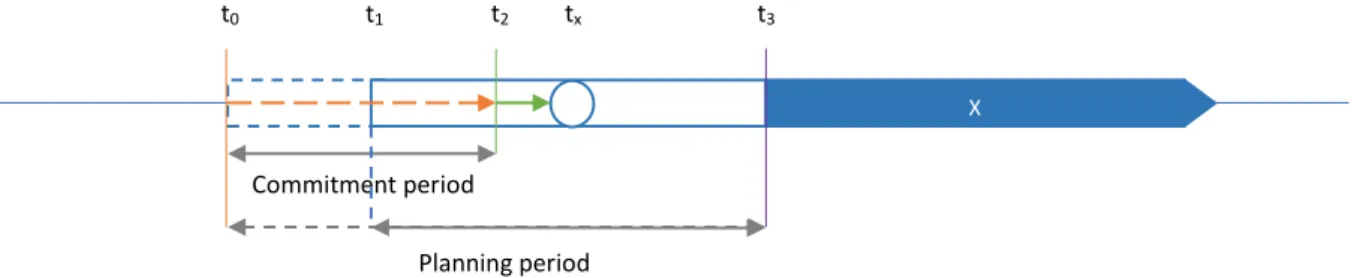
Figure 4-2. Time periods ... 26
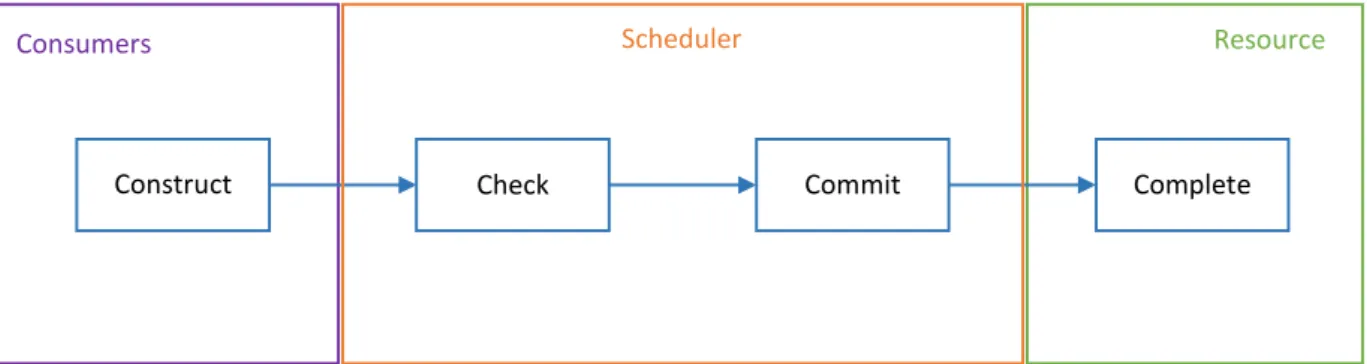
Figure 4-3. 4C process ... 28
Figure 4-4. 4C process step actions ... 29
Figure 4-5.4C tactical level deliverables... 29
Figure 4-6.4C tactical level authority and responsibility domains ... 30
Figure 4-7. 4C operational level deliverables... 30
Figure 6-1 Cyclic representation of 4C process... 34
Figure B-0-1. Section of PRP (V model) ... 47
Figure B-0-2. Hypothetical tests distribution during PRP (heat map) ... 48
Table of contents
Acknowledgements ... i
Executive summary ... ii
Abbreviations ... iii
List of tables ... iii
List of figures ... iii
1. Introduction ... 1
1.1 About Philips ... 1
1.2 Problem description ... 3
1.3 Research goal & objectives ... 4
1.4 Research questions and scope ... 4
1.5 Research model and outline of the report ... 5
1.6 Research methods ... 6
2. Scheduling literature ... 7
2.1 Fundamental elements of scheduling ... 7
2.2 Similar cases in literature ... 10
2.3 Scheduling concepts and trade-offs... 11
3. Current situation ... 17
3.1 Decision levels ... 17
3.2 Scheduling procedure ... 19
3.3 Stakeholder complains and desires ... 21
4. Scheduling process design ... 23
4.1 Hybrid scheduling strategy ... 23
4.2 Generic improvements ... 24
4.3 Four step process – 4C ... 28
5. Design evaluation ... 31
5.1 Evaluation based on the objectives ... 31
5.2 Evaluation based on stakeholder needs ... 32
6. Proposed scheduling process ... 34
6.1 4C process ... 34
6.2 Allocation procedure ... 34
6.3 Scheduling procedure ... 38
6.4 Adjustments based on stakeholder evaluation ... 39
6.5 Recommendations for Implementation ... 40
6.6 Limitations and recommendation for further improvements ... 40
References ... 43
Appendix A: Scheduling policies ... 46
Appendix B: Product Realization Process Structure ... 47
Appendix C: Stakeholder analysis ... 49
Appendix D: TBs utilization for 2013 and 2014 ... 51
1.
Introduction
Resource allocation and task scheduling is a well-researched topic in the academic literature. Many researchers from different subject areas put lately a tremendous attention on scheduling, tripling the annual scientific publications compared to the beginning of the century. The vast majority of this work is in the area of operations research (e.g. manufacturing), computer science (e.g. computing and networks) and mathematics (theoretical), which handles mainly non-human resource, such as machines and signals, whereas project scheduling is concerned mainly with human resources. Nevertheless, all of them aim to develop an optimization model for optimal or suboptimal algorithms and procedures. An optimization model addresses “the necessary decisions made on the acquisition, utilization and allocation of resource to satisfy customer needs and requirements in the most efficient and effective way” (Graves, 1999).
A well-known problem in scheduling literature is the resource-constrained project scheduling (RCPSP) under uncertainty. For instance, new product development in healthcare sector is a highly regulated process. Each product must go through series of tests related mainly to safety, efficacy and environmental impact, in order to obtain certification (Choi, Realff, & Lee, 2007). Large amount of researchers put focus on optimizing development processes of chemical products in the agricultural and pharmaceutical industries (Verderame, Elia, Li, & Floudas, 2010). However, the development process of complex and expensive high-tech systems, such as diagnostic imaging systems, did not draw so much attention. An explanation for this could be the small number of MRI manufactures compared to the chemical industry. There are only three key big companies accounted for more than three-quarters of the world medical imaging market and they are General Electric, Philips and Siemens. This master thesis is conducted at Philips Healthcare at Best, Netherlands.
1.1
About Philips
1.1.1
Philips mission and strategy
Over 120 years Koninklijke Philips N.V., commonly known only as Philips, has been dedicated on its mission to improve people’s live through meaningful innovations. The latest slogan “innovation and you” (2014) is the most simple and clear statement that symbolize the innovative and customer centric culture in the organization. Philips is a strong and trusted brand that was built through innovative solutions in lighting, consumer lifestyle and healthcare sectors that improved the quality of life of millions of people all over the world by making the world healthier and more sustainable.
1.1.2
Philips Healthcare structure
Philips Healthcare is organized around four strategic business groups (“Philips Annual Report 2013,” 2014): Imaging Systems (38% of €9.6 billion total sales), Patient Care & Clinical Informatics (22%), Home Healthcare Solutions (14%), and Customer Services (26%). The focus of this research is on the Magnetic Resonance Imaging (MRI) business unit, which is part of Advanced Diagnostic Imaging, second on sales after interventional X-Ray (iXR) in Imaging Systems.
1.1.3
DTE department
Development Test Environment provides and supports space and equipment that could be used for testing purpose of new product introduction (NPI) projects and released projects (from the field), customer visits, photo-shoots, trainings, workshops and other activities. DTE organizational structure consists of two managers - group and project leaders, logistics team, and engineers’ team, the latter is also called development support. The logistics team takes care for order and delivery of parts and equipment, while the development support maintains the testing systems.
The most expensive and scarce resource in the facility are the MRI systems, 17-20 simulated customer environments called Test Bays (TB), with total assets of more than €20 million. In addition, there are Software Test Machines (STMs), Coil Testing Modules (CTMs), Workbenches (WB), coils, phantoms and other equipment. Since the demand for test bays is bigger than the availability, a reservation process is established to handle time allocation requests. It is important to note that such a process is not clearly, nor completely defined and documented. The following section is a representation of the way of working obtained through interviews, existing documentation and observations.
1.1.4
DTE reservation process
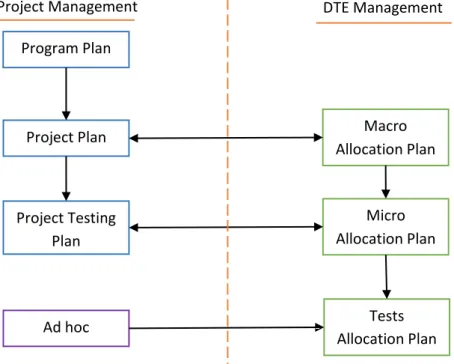
The reservation process (see Figure 1-1) spreads among two domains – project management and DTE management. The process starts from the creation of the program plan where program managers allocate priorities and create a plan for the deliverables of the different projects. Based on the program plan, project managers create the projects plans, which vary depending on the type of the project. Next, each team creates a project testing plan where it allocates main test activities in time and priority. Since every project requires different system configurations and amount of test bays (see Chapter 3), projects plans are aligned with the DTE macro allocation board.
Figure 1-1. High level DTE reservation process (representation)
The macro allocation plan arranges test bays’ system configuration in time according to projects’ requirements and it also includes test bays’ regularization (maintenance) planning. Based on the macro allocation plan and the project testing plan each project team creates a micro allocation plan where it specifies each test activity with concrete time and test bay. Next, the plan is incorporated in
Program Plan
Project Plan
Project Testing Plan
Macro Allocation Plan
Micro Allocation Plan
Tests Allocation Plan Ad hoc
the tests allocation plan as reservations in the reservation system. Any ad hoc requests are directly addressed to the tests allocation plan in the reservation system.
1.2
Problem description
The problem from scientific point of view could be classified as resource-constrained multi-project scheduling under uncertainty in new product development (R&D environment/pipeline), for unifying notation, a model, a classification scheme, such as a resource environment, activity characteristics, and objective functions see (Brucker, Drexl, Möhring, Neumann, & Pesch, 1999).
The key motivators for initiating this project are the growing demand for resource time and the expanding system configuration diversity. While in the past couple of years there were no significant process-wise changes, TB utilization on average increased from 51% for 2013 to 66% for 2014 during work hours (see Appendix D: TBs utilization for 2013 and 2014). In addition, the increase in system configuration diversity, currently 13 unique out of 16 TB configurations, significantly limits the options in choosing a resource. These evidence clearly point out the limited resource environment of this case and the need of smart decision making in efficiently utilizing these resource.
A further contribution to the complexity of the case is its scale, mainly the simultaneously running multiple projects. Currently, more than ten R&D projects are taking place globally with the allocation of more than 300 employees. Since Philips has a matrix organization, human and non-human resources are shared between different projects. This leads to further cross-project alignment on multiple hierarchy levels.
Last but not least, the R&D environment self-assumes high level of uncertainty. Strict regulations by health agencies, such as FDA in USA, requires a series of tests to be performed, in addition to the regular technology performance tests. If these test are not satisfying, all activities could be stopped until the certain milestone is not met. Moreover, MRI scanners are very complex systems, which consist of many components, for a basic overview of hardware components (Rajan, 1998). The life expectancy of a system is 7-10 years, and hardware problems on different components occur often. Some failures could be very expensive, e.g. when a system’s magnet field has to be turned off (off-field), the cooling gas (liquid helium) has to be released in the atmosphere. A refill of the cooling system could cost between €20 000 and €30 000.
Currently DTE’s reservation process, in particular the DTE reservation system, is at the end of its lifetime and it struggles to meet stakeholders’ needs. This is observed in the increased amount of communication and time it takes for completion of a task. Stakeholders have different understandings of the process workflow that they adapt to meet their needs. Information is decentralized and not standardize, which predisposes an environment of additional uncertainties and an increase of ad hoc work. Decision making becomes complex and dependent on increasing amount of variables. Stakeholders sometimes end in a conflicting situation that requires escalations in the hierarchy. Last but not least, small amount of the available data is gathered and analyzed, in order performance to be measured. All this contributes to a steady decrease in the level of efficient utilization, i.e. under- and overtime, of the limited resource.
1.3
Research goal & objectives
The aim of this research is to find a practical solution to the given problems, therefore, the main goal is to improve and optimize the DTE reservation process and procedures, and the supporting tools and technology, in order to satisfy stakeholders’ needs and requirements. Three key objectives were given in the beginning of the project. First, the new process has to maintain the current effectiveness level and to increase the efficient utilization of resources, a goal of 70% of TB utilization was set. Second, the process has to be learning, meaning to gather all relevant information for past events and decision, and based on them to indicate future improvements. Third and last key objective is the new process to provide a certain level of flexibility required to handle dynamic R&D environment. Based on these objective was formulated the main research goal as follows:
“Design a lean and flexible learning scheduling process for MRI development test environment that effectively and efficiently utilizes the limited resources and facilitates decision making.”
In addition to the main objectives, three more sub-objectives were set. The first sub-objective is the necessary information for the decision making steps to be standardized. Furthermore, communication waste in the process has to be reduced, and finally, the amount of ad hoc decisions due to junctures has to be minimized.
1.4
Research questions and scope
The focus of this master thesis will lay down on existing scheduling concepts and their application in the new environment of the given case. The development of a scheduling algorithm is left outside the research scope at this moment of time. Therefore, two main research questions were identified, in order to achieve the main goal. The first one will cover the theoretical background from scheduling literature, while the second question will deal with the practical application of the findings. The research questions are defined as follows:
RQ1: What scheduling concepts could be identified in the literature and what are their advantages and disadvantages?
We review the scheduling literature, in order to find the main scheduling concept, on which we can base the design of an improved scheduling process. To achieve this, we first answer the following two sub-questions:
SQ1-1: What are the fundamental elements and basic principles of scheduling defined in the literature?
First, we get familiar with the building blocks of scheduling and what a scheduling process is.
SQ1-2: What similar cases could be identified in the literature?
Then, we review available case studies in the literature that have similar settings and problems, as the ones described earlier.
RQ2: How to improve the current scheduling procedure by using scheduling concepts with regards to stakeholders’ complaints and desires?
After the literature review for possible solutions of the current problems, we design a scheduling process for DTE resources that also satisfies involved stakeholders’ needs. In order to propose a new process design, we first analyse the current situation and then, we evaluate the process design by answering the following sub-questions:
We collect information and analyse the current way of working with DTE resources.
SQ2-2: How stakeholders perceive the current DTE reservation process?
We investigate what stakeholders think and what possible improvements they see in the process.
SQ2-3: What are the perspectives for the new scheduling process to improve the way of working?
Finally, we evaluate the designed process and we compare it to the current situation, in order to identify the benefits of implementing it.
1.5
Research model and outline of the report
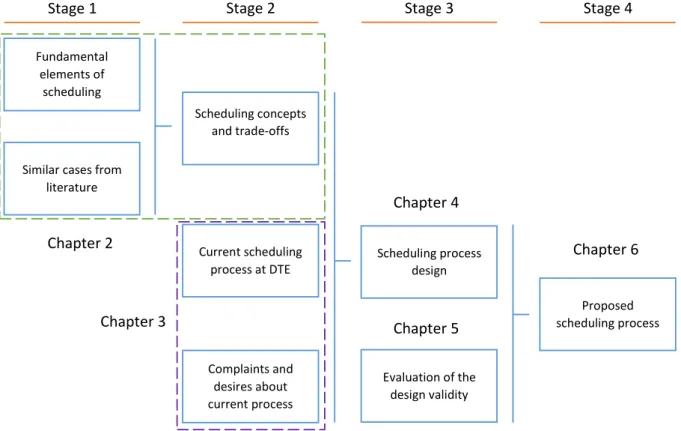
The research model (see Figure 1-2. Research model) is derived from the research questions. The necessary steps are identified and spread in four stages and five chapters (from 2 to 6). In the first stage we provide the required theoretical background, then we investigate and analyze the current situation in stage 2. In stage 3 we design and evaluate a scheduling process and in the last stage we propose the final scheduling process.
In chapter 2 we perform a literature review, where we answer SQ1-1 in section 2.1 Fundamental
elements of scheduling and SQ1-2 in section 2.2 Similar cases from literature. Based on this
information in section 2.3 Scheduling concepts and trade-offs we provide an answer to RQ1.
In chapter 3 we empirically analyze of the current situation. In section 3.1 and 3.2 we investigate the
Current scheduling process at DTE and answer SQ2-1. Next we answer SQ2-2 in section 3.3
stakeholders’ Complaints and desires about current process.
Figure 1-2. Research model Fundamental
elements of scheduling
Similar cases from literature
Scheduling concepts and trade-offs
Current scheduling process at DTE
Complaints and desires about current process
Scheduling process design
Evaluation of the design validity
Proposed scheduling process
Stage 1 Stage 2 Stage 3 Stage 4
Chapter 2
Chapter 3
Chapter 4
Chapter 5
In chapter 4 we provide Scheduling process design in order to answer RQ2. Next, in chapter 5
Evaluation of the design validity we satisfy SQ2-3. Based on the process design and the evaluation are
presented recommendations and final adjustments to the Proposed scheduling process in chapter 6.
1.6
Research methods
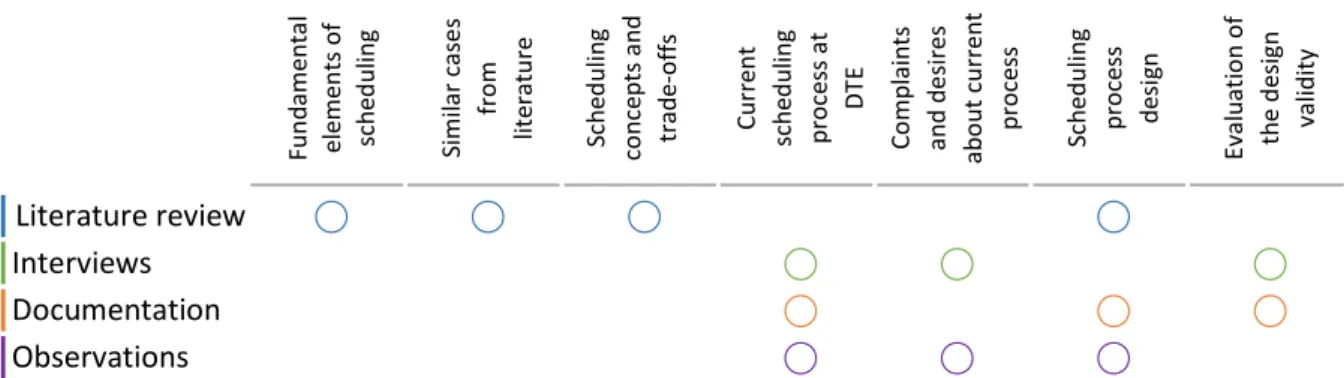
The research methods used to collect the relevant information for each step in the research model are shown in Table 1-1. Research methods
Table 1-1. Research methods
Fu n d amen ta l el eme n ts o f sc h ed u lin g Si mil ar c as e s fro m lite rat u re Sc h ed u lin g co n ce p ts an d tr ad e-o ff s Cu rr en t sc h ed u lin g p ro ce ss at DT E Co mp lain ts an d d e si re s ab o u t cur re n t p ro ce ss Sc h ed u lin g p ro ce ss d es ig n Evalu ati o n o f th e d es ig n vali d ity
Literature review ⃝ ⃝ ⃝ ⃝
Interviews ⃝ ⃝ ⃝
Documentation ⃝ ⃝ ⃝
2.
Scheduling literature
In this chapter we perform a review on the academic literature in order to answer the first research question: What scheduling concepts could be identified in the literature and what are their advantages
and disadvantages?
2.1
Fundamental elements of scheduling
2.1.1
Scheduling process
Scheduling is defined as “a decision making process that deals with the allocation of resources to tasks over given time periods and its goal is to optimize one or more objectives”1 (Pinedo, 2008) or as “a mechanism or policy used to efficiently and effectively manage the access to and use of a resource by its various consumers” (Casavant & Kuhl, 1988). The difference between both definitions is the point of view and the scope. The first definition defines scheduling through allocation, while in most cases both could be synonyms, it is important to distinguish scheduling from allocation. They are alternative formulations of the same problem, but while allocation refers to resource allocation (from resources’ point of view), scheduling applies to task scheduling (from consumers’ point of view). In both definitions could be identify that two of the main components of a schedule are the resource and policy, but the latter definition has a broader view and it also considers the consumer.
Figure 2-1. Scheduling system (Casavant & Kuhl, 1988)
In order to understand the role of a scheduler, it is important to understand how it affects the surrounding environment (see Figure 2-1.). A scheduler makes decisions based on a policy, a set of principles, objectives, and constrains, which may have impact on either or both resources and consumers. All three - consumer, scheduler and resource perspective are explained next.
A consumer evaluates the scheduling system by his/her satisfaction of the process and outcome. Casavant and Kuhl (1988) state that the goal of a consumer is to quickly and efficiently access the resource, but not to be disturbed with additional work or problems associated with the scheduler. Two properties of the scheduling system are recognized by them: performance – how well the scheduler manages the resource; and efficiency – how difficult or costly it is to access the management resource.
On the opposite, the scheduler is interested in the performance of the scheduling algorithm, which could be defined with two essential criteria (MacCarthy & Liu, 1993): effectiveness or optimality – is a relative difference between desired optimization criterion and actual performance; efficiency – is the computational resources necessary to obtain a solution. Last, the resource is interested only in its efficient utilization – minimization of resource idle time.
1 Original definition by Baker (1974): “the allocation of resource over time to perform a collection of tasks”
Consumer Scheduler Resource
Policy
Scheduling
2.1.2
Scheduling environments and models
Offline scheduling
Offline scheduling also called cyclic, static or time triggered scheduling is based on the fact that at a certain moment of time is gathered a finite set of tasks that have to be scheduled. When they are completed a new set of tasks is gathered and a new cycle starts. A requirement for offline scheduling is a thorough understanding of the scheduling system and the environment it will operate in (Fohler, 2011). If these requirements are met, very complex task and environment relations could be described. Moreover, since scheduling is done upfront multiple attempts are allowed to reach the most optimal solution. It is also static, because all necessary decisions are made upfront and they are not allowed to be changed in run time, i.e. rescheduling. The end result of static scheduling is the generation of so called baseline schedule. There are two possible environments that identify the set of jobs considered by offline scheduling – deterministic and stochastic environments.
Deterministic environment
In deterministic environment it is assumed that all information is given and it does not change in time. The output of the model is fully determined by the scheduling algorithm, which makes it highly reproducible and repeatable. Deterministic models are hard to be applied to natural world problems, therefore, they focus on solving theoretical problems. For a comprehensive review of deterministic scheduling models, see Chen, Potts, & Woeginger (1999).
Stochastic environment
Stochastic environments also include natural world’s randomness and uncertainty. As in a deterministic environment, the set of tasks is finite, however some variables are uncertain. Uncertainty could be qualified as incomplete or imprecise data (Chaari, Chaabane, Aissani, & Trentesaux, 2014). The most common example for such a variable is the task processing time, however there could be other variables, such as machine breakdowns, new task arrivals, delays and cancellations. The main aim is uncertainty to be modelled as probability distribution, in cases where this is not possible, the key objective is the estimation of worst-case performance ,e.g. see Daniels & Kouvelis (1995).
Online scheduling
Online, dynamic, reactive/adaptive or event-triggered systems do not require an initial set of tasks to generate a schedule, but it schedules tasks at the moment of their arrival. The scheduling decisions are based on predefined rules and the current state of the system. This means that task priority is determined in real time based on the current and not initial conditions (Casavant & Kuhl, 1988). Thus online scheduling cannot handle complex task relations and environments. Duo to the dynamic changes online scheduling could be very flexible, but highly unpredictable.
Hybrid scheduling
Hybrid scheduling is a combination between online and offline scheduling. It is used in environments where aperiodic tasks and events are common and the complexity of complete offline scheduling and unpredictability of complete online scheduling solutions are not suitable solutions. The offline part is the generation of a (baseline) schedule, which may consider stochastic variables. The “online” part are the schedule repairs required based on the occurrences of unexpected events.
2.1.3
Scheduling policies
First-come, first-served
First-come, first-served is one of the most applied scheduling strategies, when all tasks have the same properties, such us weight and due dates. It is used in every area where scheduling is required, due to its simplicity. In essence, the only rule is that every task is scheduled to a resource in the same order they came to the scheduler. The advantage of this approach is the minimization of overhead, since context switching could occur only after a task is completed and there is no reorganization of the queue. However, when tasks have different weights, it is often associated with frictions between different tasks. It could be said it is the easiest approach, but neither efficient, nor effective in more complicated conditions.
Round-Robin scheduling
Mainly in computer science and other areas, where preemption is allowed and there is no task priority, a variation of first-come, first-served with better balanced tasks to resources and output is the Round-Robin scheduling. In round-robin approach longer tasks are broken on the granularity of shorter tasks and then executed in circular order. A disadvantages are the possibly large overhead and that it is much fairer to shorter tasks then longer tasks. In addition, if all tasks have same duration and equal cycle time, it is the same as first-come, first-served. If the cycle time is shorter that the task duration, it has potentially lower throughput compared to first-come, first-served, since all tasks are completed at the end.
Shortest/Longest time first
In many cases the duration of a task is considered as directly proportional to the amount of uncertainty and variability. Depending on the desired objective tasks could be ordered in increasing or decreasing rate of their duration. When the longest tasks are scheduled in the beginning it gives flexibility in ordering the shorter tasks at the end, in order to fulfil the whole work load. A disadvantage of longest time first is that the output (completed tasks) is highly saturated at the end of the cycle. On the other hand, shortest time first levels the output and maximizes task throughput, but has poor flexibility. Highest success probability task first
The highest success probability task is a more general variation of shortest/longest time first, when it is possible to calculate the task variability independently from its duration. The benefits of this approach is that the impact of unpredictable tasks to stable tasks is minimized and throughput is increased.
Highest priority first
All mentioned strategies above ignore that a task may have initially set priority, however, in real world scenarios usually tasks do have different priorities. In scheduling priority is considered as a function of two variables: importance (weight) and urgency (due date). Ordering tasks using highest priority first strategy maximizes effectiveness (the reward), but neglects the efficiency (the cost).
Block scheduling
Block scheduling eliminates the issue with friction between different classes of tasks by grouping them in sequential blocks. The block size could be fixed or not. The benefit is lower overhead and clear indication of ownership, while the drawbacks are poor flexibility and often occurrence of resource idle time between tasks in a block. This decreases both schedule efficiency as well as resource efficient utilization. In addition, block scheduling has poor flexibility.
Modified block scheduling
because block scheduling is combined with one or more of the already mentioned or other scheduling strategies. For example, Breslawski & Hamilton (1991) describe it as grouping the longer tasks in a block, followed by shorter tasks in a second block. This way if a gap occurs in the former block a task from the latter could be moved forward. Another variation is when there is idle time in a block, it is either left unreserved or it is released at some known moment of time (Fei, Meskens, & Chu, 2010).
2.2
Similar cases in literature
In the literature review four scheduling problems are considered for potential similarities: stochastic resource-constrained project scheduling, operating room scheduling, computing systems scheduling, and manufacturing systems scheduling. The focus is put on the former couple, since they involve human interactions, which is an important condition.
2.2.1
Stochastic resource-constrained project scheduling problem
A project is defined as “a unique process, consisting of a set of coordinated and controlled activities with start and finish dates, undertaken to achieve an objective conforming to specific requirements, including the constraints of time, cost and resources“ (ISO 9000, 2005). Therefore, three of the most important aspects of project management are planning, scheduling and controlling. From these, scheduling and controlling are identified as the most common causes for project failure (Demeulemeester & Herroelen, 2002).
The resource-constrained project scheduling problem (RCPSP) is defined as a deterministic combinatorial optimization problem and it has many variants. In the basic variant of RCPSP there are given a fixed set of activities and resources. The activities have known durations and some constrains between them, e.g. sequence. In order to be performed, each activity requires one or more resources. The objective functions is to produce an optimal or sub-optimal schedule that minimizes the make span.
However, in real world projects the parameters are prone to errors in estimation and external unexpected influence. The stochastic resource-constrained project scheduling problem (SRCPSP) is a variant of RCPSP that copes with the unexpected events. It adds to the problem different kinds of uncertainty such as task durations, stochastic task insertion, resource availability, resource consumption, breakdowns etc. Therefore, SRCPSP best represents the settings of R&D pipeline management problem faced in this thesis.
2.2.2
Operating room scheduling problem
Operating room scheduling problem is the second similar case reviewed in the literature. The problems faced in development test environment of MRI systems represents the problems that are faced while scheduling patients for surgeries. There are multiple unexpected events that may cause rescheduling, e.g. new urgent patient, similar to machine breakdowns in DTE. Nevertheless, in both cases the environment is stochastic and resources are limited and very expensive.
In their paper Hans et al. (2008) consider the operating room scheduling problem as offline scheduling with stochastic events. They prove that by grouping surgeries with same level of duration variety could maximize capacity utilization and minimize the risk of overtime. This approach could be classified as modified block scheduling using highest success probability task first.
on theory the hybrid model could improve the efficient usage of operating rooms, if it is accepted by the staff, who has to collaborate and follow the process.
2.3
Scheduling concepts and trade-offs
Although some may argue that in the case of project scheduling under uncertainty there are two general approaches – pure reactive scheduling and proactive-reactive scheduling (Vonder, Demeulemeester, Leus, & Herroelen, 2006), other suggest that they are five – reactive scheduling, stochastic scheduling, scheduling under fuzziness, proactive (robust) scheduling, and sensitivity analysis (Herroelen & Leus, 2005). It is obvious that there is no clear consensus in the academic world about scheduling under uncertainty, there are also researchers who classify scheduling approaches as predictive, proactive, reactive methods (Brčić, Kalpić, & Fertalj, 2012) or as simple as reactive and stochastic approaches (Floudas & Lin, 2004).
Table 2-1. Different methods for schedule generation under uncertainty (Herroelen & Leus, 2005)
Prior project execution During project execution
No baseline schedule Dynamic scheduling
(scheduling policies) Baseline scheduling with no anticipation of
variability (Predictive scheduling) Reactive scheduling
Proactive (robust) scheduling Management decisions
Quality robustness Sensitivity analysis
Solution robustness
Flexibility
Regardless of this dispute, in the case of stochastic resource-constrained project scheduling the focus is put on two main concepts – stochastic (proactive) scheduling for schedule generation and predictive-reactive scheduling for schedule repair during execution. In real-world problems on seldom occasions pure stochastic (offline) or dynamic (online) methods could be used as a solution, furthermore, pure deterministic approach is completely excluded as an option. “A proactive or predictive technique will always require a reactive component to deal with schedule disruptions that cannot be absorbed by the baseline schedule” (Van De Vonder, Demeulemeester, & Herroelen, 2007). Therefore, most applied concepts in real-world situations are hybrid proactive-reactive or predictive-reactive techniques, where one or more offline methods, see left column of Table 2-1, are combined with one or more online methods, right column.
2.3.1
Stochastic scheduling
Table 2-2. Summary of stochastic programming and optimization algorithms
Stochastic programming (Sahinidis, 2004)
Stochastic optimization algorithms (Collet & Rennard, 2008)
Programming with recourse Random search
Stochastic linear programming Iterated local search
Stochastic integer programming Computational effort
Stochastic non-linear programing No free lunch theorem
Robust stochastic programming Hill-climbing
Probabilistic programming Simulated annealing
Tabu search
Neural networks
Genetic algorithms
Data-level parallelism
Particle swarm optimization
Ant colony optimization
Stochastic methods implicitly incorporate uncertainties, however, an increase in the number of uncertain variables causes exponential growth to number of generated possible scenarios. The required computational power and historical data is considered as the main drawback for considering stochastic algorithms for a solution of complex problems with large number of uncertainty parameters (Floudas & Lin, 2004). To ease this computation complexity, for example, Wu, Byeon & Storer (1999) construct a solution that partially specifies the schedule, the unspecified details are left to be clarify in later moment of time.
Proactive methods
Proactive (robust) methods, part of stochastic scheduling approaches, handle uncertainty by creating schedule robustness to unexpected events, in order the generated schedule to remain feasible under various conditions and functional in stochastic environment (Brčić et al., 2012). Moreover, stochastic scheduling does not construct a baseline schedule, while proactive methods do, for baseline schedules see section 2.3.2. Herroelen & Leus (2004a) suggest three possible proactive approaches – redundancy based methods, robust scheduling methods, and contingent scheduling. In addition, any of the solutions in Table 2-2 are also feasible, such as probabilistic methods or optimization algorithms (Chaari et al., 2014). For a review on proactive strategies and algorithms we will refer to Deblaere, Demeulemeester & Herroelen (2011) and Lambrects, Demeulemeester & Herroelen (2008).
Redundancy based methods
Redundancy based methods generate robustness by perturbations of resource and time redundancy. It is common the focus to be on time redundancy, due the higher cost of resource redundancy. These methods provide fault tolerance or temporal protection by extending tasks processing times or by inserting time buffers based on the statistics of used resources, e.g. slack time used by Hans, Wullink, & Houdenhoven (2008), or critical chain project management (Goldratt, 1997). While these methods mainly focus on feasibility, a drawback could be the neglected optimality.
Robust scheduling methods
resource usage with pair-wise float concept in (2004b), and restricted resources and robust resource allocation with resource flow network in (Leus & Herroelen, 2004). While robust scheduling achieves high level of effectiveness and low cost (compared to worst case scenario), a drawback could be inefficient resource utilization due conservative schedules.
Contingent scheduling
Contingent scheduling generates multiple schedules to handle different scenarios based on prior predicted disruptions. It could be seen as reactive strategy, since schedule is change during an execution, but it is a proactive strategy due the fact that schedules are generated upfront. It is clear that the focus is not on schedule robustness, but on schedule flexibility (Herroelen & Leus, 2005).
2.3.2
Hybrid scheduling
Predictive-reactive is a hybrid solution of offline and online methods. Some academics do not distinguish proactive from predictive (Van De Vonder et al., 2007), since the goal of both methods is to generate a baseline schedule. However, the difference is that proactive approaches consider variability, while predictive approaches do not, see Table 2-1.
Predictive scheduling
The term predictive scheduling emerged relatively soon in project scheduling literature as a part of the concept of reactive scheduling (Herroelen & Leus, 2005). The authors define predictive-reactive scheduling as “repairing the baseline schedule to take into account the unexpected events that have come up”. However, this repairing or revision activities take place in the reactive part, during project execution. The predictive part is responsible only about the generation of a baseline schedule with deterministic approach. With other words predictive methods ignore the uncertainty and rely on the information that is known at this moment of time. This ease the upfront decision making compared to proactive approaches, but it could result in projects being late, over the budget or even become infeasible. Therefore, proactive schedules serve as better approach for the generation of baseline schedule and respectively better communication basis between project entities (Brčić et al., 2012).
Baseline schedule
The baseline schedule, also called initial/original schedule, predictive schedule or preschedule, plays a vital role in project scheduling (Mehta & Uzsoy, 1999). It has a twofold function, the first is to allocate resources to the different activities, in order to optimize one or more objective functions. The second and very important function is to serve as a basis for communication and coordination of external or internal customers. “Based on the baseline schedule commitments are made to subcontractors to deliver materials, support activities are planned (setups, supporting personnel), and due dates are set for the delivery of project results” (Herroelen & Leus, 2005). The baseline schedule is considered as the best possible scenario at the moment of its creation.
Reactive scheduling
Rescheduling
Rescheduling is the main activity in the reactive process. First, it is worthy to know when a rescheduling is justified. There are four main reasons to cause a reschedule of an existing project schedule shown on Table 2-3.
Table 2-3. Reasons for rescheduling in project environment (Chaari et al., 2014)
Time-driven (Periodic) Event-driven
Regular time intervals Unexpected event appearance
New task arrival
A given threshold of number of tasks
Vieira, Herrmann & Lin (2003) present an a comprehensive list of unexpected events, also called rescheduling factors, in machine environment (see Table 2-4). In addition, the authors point out that the occurrence of a certain event could trigger another event. The moment of time when a schedule is created or revised is called a scheduling point, while the time between two scheduling points is called rescheduling period.
Once a schedule is no longer feasible and a rescheduling is required, there are two possible solutions – schedule repairs or global reschedules. Since it is assumed that the baseline schedule is a good starting point, schedule repairs are the preferred approach for minimum deviations from the original schedule. However, schedule repairs could be very limited option, therefore, most researchers focus on global reschedules.
The most elementary repair action is the right shift rule, which postpones each remaining task. It is called right shift, because time is always positive and represented as the abscissa. When a task is postponed it moves to the right. Although it is a very simple heuristic algorithm, it tends to have bad performance (Brčić et al., 2012).
Table 2-4. Rescheduling factors in machine environment (Vieira et al., 2003)
Unexpected events Triggered (follow-up) events
Machine failure Overtime
Urgent job arrival In-process subcontracting
Job cancellation Process change or re-routing
Due date change (earliness/tardiness) Machine substitution
Delay or shortage of materials Limited manpower
Job priority change Setup times
Rework or quality problems Equipment release
Over- or underestimation of processing time Operator absenteeism
not to all resources. Respectively, when there is an early task, following activities are moved earlier in time.
Activity lists or queues is an ordering of all tasks that can be transformed into a schedule at any time. At a schedule disruption, activity list are scanned for activities that have not started yet and fit the best the possible gaps in the schedule (Chen et al., 1999).
Another method for partial repair is the well-known activity crashing. The goal is to accelerate activities, in order the schedule to go back to its initial state. Similar approach is the match-up rescheduling, where the goal is again to return to the baseline schedule as soon as possible. However, tasks could be rescheduled only in certain period of time after the breakage, which is as small as possible. For more on match-up scheduling, see (Akturk & Gorgulu, 1999; Moratori, Petrovic, & Vázquez-Rodríguez, 2012).
The final reactive method mentioned in the literature is global, total, or complete rescheduling. Essentially, every task that is not processed before the next rescheduling point is rescheduled in a completely new schedule by applying the same scheduling algorithm used for the creation of the baseline schedule but with the remaining set of tasks (Van De Vonder et al., 2007). It is a reset point for the scheduling process. However, in case of contingent scheduling or sensitivity analysis, alternative schedules, which are already generated, replace the baseline schedule.
2.3.3
Trade-offs
Two main scheduling concepts for stochastic resource-constrained project scheduling were identified in this chapter – proactive-reactive scheduling and predictive-reactive scheduling. Both strategies have their strong and weak parts towards different environments and respectively, towards different objective functions. The literature is mainly focused on minimizing two key objective functions – project makespan and project cost. A different perspective for performance measures are – scheduling efficiency, schedule stability, and cost (Vieira et al., 2003).
Proactive-reactive scheduling
Proactive-reactive scheduling by far has the best performance regarding baseline schedule robustness and stability (Van De Vonder et al., 2007). These methods examine possible outcomes and develops schedules to handle uncertainty before even appear. The main goal of proactive approaches is to create a feasible schedule that prevents the worst case scenario.
However, proactive scheduling also have many drawbacks. The first and most important is that it relies on large set of historical data to be accurate, although with time, accuracy continues to improve. Furthermore, most methods focus on robustness or with other words, the successful execution of the scheduled activities. In order to achieve high level of effectiveness, time and resources are sacrificed in redundancy. Although it is done to prevent even higher costs or longer makespan of the worst case scenario, in some cases it may be unjustified solution.
Predictive-reactive scheduling
3.
Current situation
In this chapter we investigate and describe the current situation of the process of scheduling the development test environment at Philips.
3.1
Decision levels
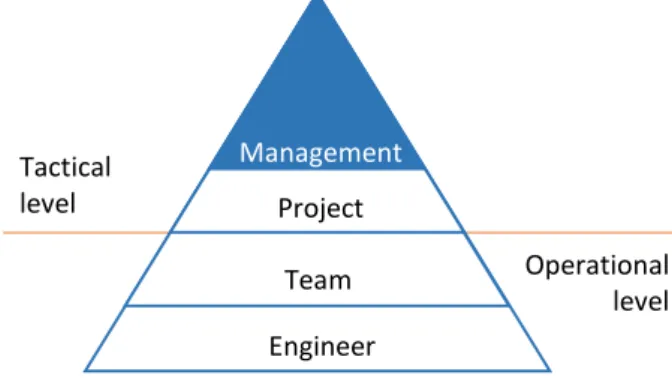
The distribution of resources is done on three decision levels – strategic, tactical and operational level. On strategic level leadership team creates a program portfolio plan, where the content is decided, capacity and priorities among different programs and key milestones for them. The strategic decisions are part of the strategic planning and their aim is to construct an attractive portfolio of R&D programs (Subramanian, Pekny, & Reklaitis, 2001). The focus will be put on the tactical and operational decisions that refer to the temporal assignment of limited resources to tasks and vice versa that are required for the actual execution of a portfolio.
3.1.1
Tactical level
On tactical level is decided the resource allocation among the different programs and respectively the configuration plan to satisfy the demand. However, there are two more plans that are independent from programs plans.
The first is the plan for customer visits, which in most cases has the highest priority in using a TB. There are 5 customer bays out of 15, each one with different configuration. Customer visits could be announced from one to several weeks upfront. These are non-elective cases and all TB schedules have to be aligned to them. They cannot be canceled or rescheduled, except if the decision comes from the
Program portfolio plan
Project A master plan
Project B master plan
Project N master plan
Macro allocation plan Regularization plan
Customer visits plan
Team A1 test plan
Team AN test plan
Team NN test plan
TB 1 schedule
TB 2 schedule
TB 3 schedule
TB N schedule Project C
master plan
Configuration plan
Strategi
c
lev
el
Tact
ical
lev
el
Operati
o
n
al le
customer, or in extreme cases, e.g. machine breakdown. Currently, customer visits plan is visible only after a reservation is made in the system.
The second plan is called “regularization plan”, which is the planned maintenance activities. Each 9 to 12 months an MR system is returned and replaced with a new one from the manufacturing department. Depending on the DTE development support capacity the regularization period for a system is from 3 to 4 weeks. Currently, the plan is visible after a block reservation is made in the reservation system for that period.
The macro allocation meeting is a monthly meeting that aims to align different program requests and build a TB configuration plan for the coming months based on their requirements. A major challenge in building this plan is the setup time required for reconfiguring a system. An MRI scanner is a complex system and even changes only in the software, requires couple of days of adjustment of the system, when a hardware change is required this time could be even higher, depending on the required change. Some of the programs work on a project specific configuration, which means that the configuration is suitable only for their needs. The level of modification depends on the project specification, but in general a TB could be not modified, partly modified, or fully modified.
There annual programs related to quality (reliability), productivity or other performance characteristic that requires continuous improvement. These projects may require multiple configurations in parallel. Another type are the new product introduction (NPI) projects, which follow the V-model (Forsberg & Mooz, 1991) process for software and hardware development. They work on new features that are not yet released in the field. Compared to the rest of the programs, these projects have the highest level of uncertainties, due the nature of their work. There is also a clear separation between the stages, where it is assumed in integration and verification stage the level of uncertainties is much higher compared to validation stage.
So far, planned or elective activities were discussed, however, there are also projects that focus on (problem) reports from the field that could be non-elective, similar to customer visits. These requests investigate issues, which could have different urgency levels. Nevertheless, all of them require a configuration that is the same or similar to the released to the customer, in order to investigate the issues.
To sum up, the output of the macro allocation meeting is a configuration plan of the test bays and a plan for the test bay allocation plan among programs, which indicates directly the task priority and high level sequencing (weeks) on each machine.
3.1.2
Operational level
3.2
Scheduling procedure
Figure 3-1. TB reservation procedure Have a request
Does it fit in the MA
plan?
Is TB available?
Make a reservation
Perform test
Sign the logging book
Start
End
Is another TB suitable? Is another
timeslot suitable?
Is it higher priority request?
Is negotiation
possible?
Free up the TB Change request requirements
yes
yes
yes yes
yes
yes
no no
no
no no
Are volunteers
required?
Request volunteers yes
no no
R
es
ervati
o
n
s
ys
te
m
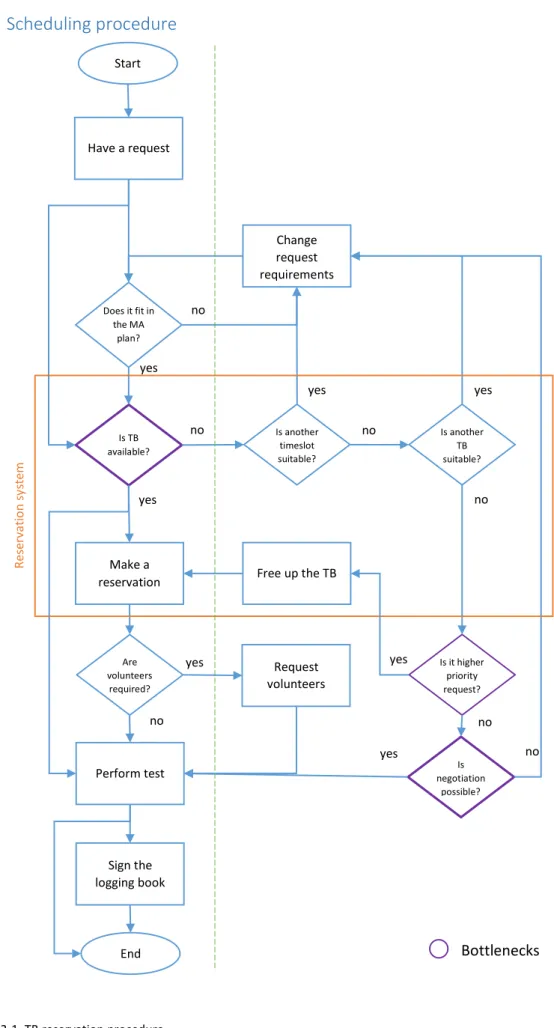
On operational level with defined macro allocation plan and configuration plan, the scheduling procedure starts when an employee has the need to use a TB, in the majority of time for testing and in rare cases for something else, such as training. Employees become aware of the macro allocation plan in different ways: they participated the macro allocation meeting, they were informed by their manager or colleague, or they saw the plan located on a shared drive. Based on the macro allocation plan, if the request fits the plan they check the reservation system for available TB, otherwise they have to refine their request to fit the plan. In rare cases, employees are not informed about the macro allocation plan and they directly proceed towards finding out if a TB is available. If it happens on the moment, some employees go directly to the TB hall to check if the TB is available, otherwise, the only way to find future TB occupation is through the reservation system. If the testbay is available, then the employee could reserve the time slot that is required, or in some cases of very short tasks to perform them on the moment without registration. When the reservation is in place, if volunteers are required for the tests, they are ordered about one week upfront. After each activity performed in a TB, employees are required to sign and write a description of the test in a logging book located at the testbay. However, duo different reasons in seldom occasions it may happen that the logging book is not signed.
In the case when a TB is not available, most frequently employees search for different timeslot in their requirements and they start the search again. However, if different time slot is not possible, then employees change their requirements towards the required machine and try to find another suitable option. If this is also not possible, then a conflict between two activities arise. The key factor for solving this problem is estimating the priority level of both activities. In some cases, it is directly inherent from the tactical or in rare cases from strategic level, on the other hand, when this is not possible, it has to be find out on the moment.
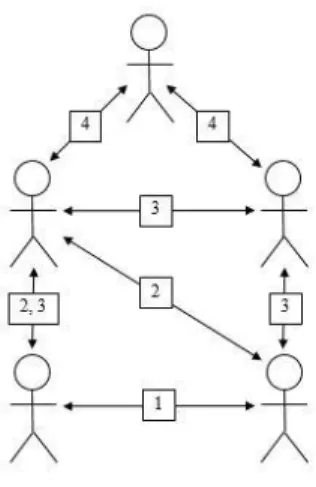
An escalation system takes place (see Figure 3-2. Escalation system:Figure 3-2), where if a decision is not achieved on the same level, then it is escalated to one level higher. In case the final decision is that the contender has higher priority, then the former reservation is canceled and replaced by the new one. In the alternative case when the request does not have higher priority, an option is to negotiate with the time slot owners to fit the new activities inside their time slot. If this is also not an option, the requester has to redefine the TB requirements of the request.
Since it is an open system, currently the way of working is FCFS with elements of pure block scheduling. The FCFS approach is the easiest and fastest way of working, if there are enough available time slots, however, in this case the resource is limited and frictions start occurring on increasing rate. This means that the non-desirable right part of the procedure (see Figure 3-1) has become more active. Cancelations have huge negative impact on the schedule, causing many rescheduling, and on the employees’ satisfaction level. In order
the bottleneck to be removed from the decision making step of priority level, a new practice of block scheduling start working. With block scheduling the priority level is clearly indicated on some TB which reduces the number of cancelations, however, it start creating a bottleneck on the next step in negotiations and even earlier on the TB availability. In order to prevent configuration changes, project teams does not release their reserved time when they do not need it, which significantly impacts the resource utilization efficiency and other employees’ satisfaction.
Figure 3-2. Escalation system: 1st case – same level
2nd case – one level higher,
same manager 3rd case – one level higher,
different managers 4th case – more than one level
3.3
Stakeholder complains and desires
Twelve interviews were performed with a representative out of 13 identified key stakeholder groups (see Appendix C: Stakeholder analysis. The first goal of these interviews was to gain domain knowledge about the workflow/processes and responsibilities/roles in the MR R&D department. Moreover, the main goal was to understand the current situation of using DTE resources. The stakeholders were asked to identify the good and bad parts of their work involvement with DTE. The settings of the interviews could be find in Appendix C: Stakeholder analysis.
Overall, stakeholders did not have serious complains, but everybody had ideas how it could be improved. The majority of stakeholders focused on the tangible part – the reservation system, but some of them addressed also the reservation process. This was expected since their work involves mainly using the tools behind the process. Moreover, almost everybody was seeing the process slightly different than the one before. A reason for this could be the fact that the process is not strictly defined and there is room for free interpretations.
The major elements that stakeholders like in the current situation are:
The reservation system is an open online tool that could be used by anybody The reservation system is stable
The reservation system is simple and easy to use
The reservation system contains most of the required information (SW & HW configurations) The macro allocation plan as part of the reservation process
There are four major points for improvement that were mentioned by everybody in some way or another:
Better overview
The key element that stakeholders would like to be improved is the overview on both tactical and operational levels. For example, high level leads would like to see different reports and long term planning, in order to make better plans. Low level leads would like to see overview of their team’s activities. Stakeholders outside PRP would like to see the macro allocation and some specific information, such as peripherals location, actual person who is currently in TBs, TB technical availability (regularization plan) and others. Some general elements are also the technical status of test machines in any moment of time, better description of what test were done and others.
Better process control
Many of the leads inside PRP would like to have better control over the reservations inside the allocated time for their team. They would like to freely allocate their team’s activities or let their team’s do it for themselves inside of the time allocated for them. In addition, they would like to be notified for any other requests outside of their team that will interfere with their work.
Better schedule stability
Many of the teams experience cancelations and rescheduling activities. Stakeholders would like to stay on the straight forward process without the complications and uncertainties of rescheduling events.
4.
Scheduling process design
In this chapter we answer the second research question: How to improve the current scheduling
procedure by using scheduling concepts with regards to stakeholders’ complaints and desires?
4.1
Hybrid scheduling strategy
4.1.1
Scheduling strategy
Based on the reviewed literature two main scheduling concepts were distinguished: proactive-reactive scheduling and predictive-reactive scheduling. The former strategy relies on a heavy set of historical data, which is analyzed using various mathematical models and algorithms. The aim is to estimate the probability of different events happening and to prevent the “worst case scenario”. On the other hand, predictive-reactive scheduling takes a deterministic approach by creating a baseline schedule on the basis of already present information. When a stochastic event happens, it is reacted to it in real-time and the schedule is adapted to the new situation. The main trade-offs of both concepts are that proactive scheduling offers robust schedules and better learning curve, while predictive scheduling has broader range and can handles very complex environments with high level of uncertainty. One of the main requirements for the new scheduling process was to be a learning process, which gives weight on choosing stochastic scheduling for a solution. However, as noted few times before, stochastic scheduling requires a significant amount of data to be effective and even more to be efficient. The current gathered data from the reservation system is not sufficient enough in quantity and quality for a stochastic algorithm to take place. In addition, in multi-project R&D environment almost every type of uncertainty exists (see Table 2-4). Therefore, predictive-reactive scheduling is selected as better solution at the current moment of time. However, due the undisputable benefits of proactive strategy, the data has to be gathered in a structure manner with the mindset of a proactive method taking place in future. Attention will be put on new task arrivals, over- and underestimation of processing time and setup times.
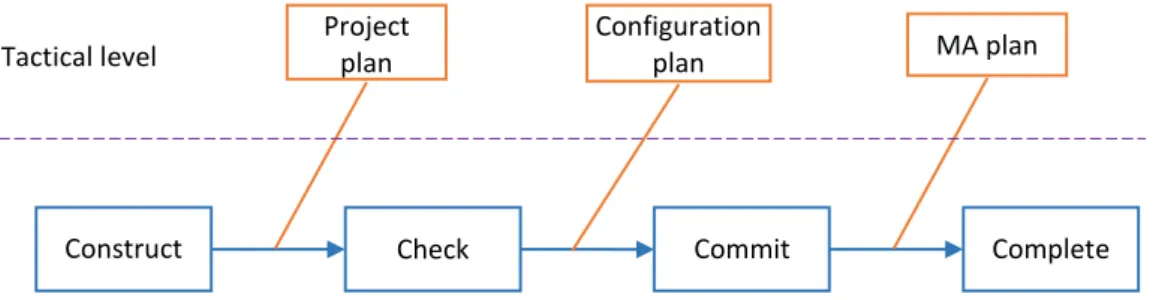
Predictive-reactive scheduling is a more appropriate solution for the current situation than stochastic scheduling for several reasons. The first already mentioned reason is the insufficient historical data. However, a significant factor is also that predictive scheduling is closer to the current situation than stochastic scheduling, meaning less effort will be spent in the transformation process. The current way of working was shaped on the basis of cyclic meetings and the construction of initial plans, which later were updated when required. Moreover, the culture at the company and desires of stakeholders are clear that the element of an open system and decentralized decision making are highly valued and appreciated. Hybrid scheduling provides flexibility that is harder to achieve with stochastic scheduling and much required in the dynamic environment of new product development.
The decentralized decision making in the manual construction of the schedule, however, also limits the implementation of a mathematical algorithm to automate the distribution of activities. This means that the output of the process will still be vulnerable to human mistakes. In order to improve and limit as possible this exposure are suggested some generic changes (see section 4.2) that could be adopted on both tactical and operational level.
4.1.2
Scheduling policy
Block scheduling