R E S E A R C H
Open Access
Development of clinical decision rules to predict
recurrent shock in dengue
Nguyen Tien Huy
1,2†, Nguyen Thanh Hong Thao
3†, Tran Thi Ngoc Ha
4, Nguyen Thi Phuong Lan
5,
Phan Thi Thanh Nga
6, Tran Thi Thuy
3, Ha Manh Tuan
3, Cao Thi Phi Nga
7, Vo Van Tuong
7, Tran Van Dat
7,
Vu Thi Que Huong
4, Juntra Karbwang
2and Kenji Hirayama
1*Abstract
Introduction:Mortality from dengue infection is mostly due to shock. Among dengue patients with shock, approximately 30% have recurrent shock that requires a treatment change. Here, we report development of a clinical rule for use during a patient’s first shock episode to predict a recurrent shock episode.
Methods:The study was conducted in Center for Preventive Medicine in Vinh Long province and the Children’s Hospital No. 2 in Ho Chi Minh City, Vietnam. We included 444 dengue patients with shock, 126 of whom had recurrent shock (28%). Univariate and multivariate analyses and a preprocessing method were used to evaluate and select 14 clinical and laboratory signs recorded at shock onset. Five variables (admission day, purpura/ecchymosis, ascites/pleural effusion, blood platelet count and pulse pressure) were finally trained and validated by a 10-fold val-idation strategy with 10 times of repetition, using a logistic regression model.
Results:The results showed that shorter admission day (fewer days prior to admission), purpura/ecchymosis, ascites/pleural effusion, low platelet count and narrow pulse pressure were independently associated with recurrent shock. Our logistic prediction model was capable of predicting recurrent shock when compared to the null method (P< 0.05) and was not outperformed by other prediction models. Our final scoring rule provided relatively good accuracy (AUC, 0.73; sensitivity and specificity, 68%). Score points derived from the logistic prediction model revealed identical accuracy with AUCs at 0.73. Using a cutoff value greater than−154.5, our simple scoring rule showed a sensitivity of 68.3% and a specificity of 68.2%.
Conclusions:Our simple clinical rule is not to replace clinical judgment, but to help clinicians predict recurrent shock during a patient’s first dengue shock episode.
Introduction
Dengue virus infection has become an important global problem. It is quickly spreading to South America and Africa [1]. It is estimated that 20,000 patients die from this disease each year from among the 2.5 billion people who are at risk for dengue in over 100 countries [2]. The pathogenesis of dengue infection is not completely under-stood. Several mechanisms have been proposed, including a virulence factor [3-5], secondary infection [5], host gen-etic factors [6,7], host immune response [8-10], memory T-cell-mediated pathogenesis [8], suppressed Th1 and/or
predominant Th2 responses [9], cytokine tsunami [10], anti-nonstructural 1 protein antibodies that cross-react with vascular endothelium [11] and host physiological factors [12].
Dengue disease, as defined according to the 1997 World Health Organization (WHO) classifications, ranges from asymptomatic or dengue fever to severe dengue hemorrhagic fever and dengue shock syndrome (DSS) [13]. Recently, in the 2009 revised dengue classifi-cation system proposed by Dengue Control, the WHO has added a classification of the severity of the disease according to the presence of dengue warning signs [14].
To date, there is no approved vaccine or antiviral drug to treat for this disease. Vector control, early appropriate treatment and educational programs are currently the only ways to reduce mortality and the global disease
* Correspondence:[email protected]
†Equal contributors 1
Department of Immunogenetics, Institute of Tropical Medicine (NEKKEN), Nagasaki University, 1-12-4 Sakamoto, Nagasaki 852-8523, Japan Full list of author information is available at the end of the article
burden [14-17]. Mortality can reach 10% to 20% without early appropriate treatment [18]. Death due to dengue infection is reportedly 50 times higher in dengue pa-tients with shock than in those without shock [19]. Among shock patients, approximately 30% have recur-rent shock that reportedly affects the therapy protocol [20]. To the best of our knowledge, however, no previous report has described a tool for prediction of patients who will develop a second dengue shock episode. In this study, we developed a model to predict, at the time of the first shock episode, patients who would develop re-current shock.
Materials and methods
Study design
The current study was performed at the Center for Pre-ventive Medicine in Vinh Long province and the Chil-dren’s Hospital No. 2 in Ho Chi Minh City, Vietnam. The study design was a prospective cohort analysis of the clinical signs and laboratory test values of children (ages 6 months to 15 years) that were recorded around the time of the first shock episode. The entry criteria were suspected clinical dengue infection with proven dengue virus on the basis of laboratory evidence and hypovolemic shock that occurred between January 2002 and December 2007. Proven dengue virus infection was diagnosed if the virus was isolated, if RNA was detected by real-time PCR assay or if the serological assay was positive, as fully described in our previous publications [7,21,22]. DSS was classified according to the WHO 1997 classification criteria [13] without fulfilling the
criterion for presence of thrombocytopenia [23]. Exclu-sion criteria were the presence of chronic illness or massive bleeding that required blood transfusion.
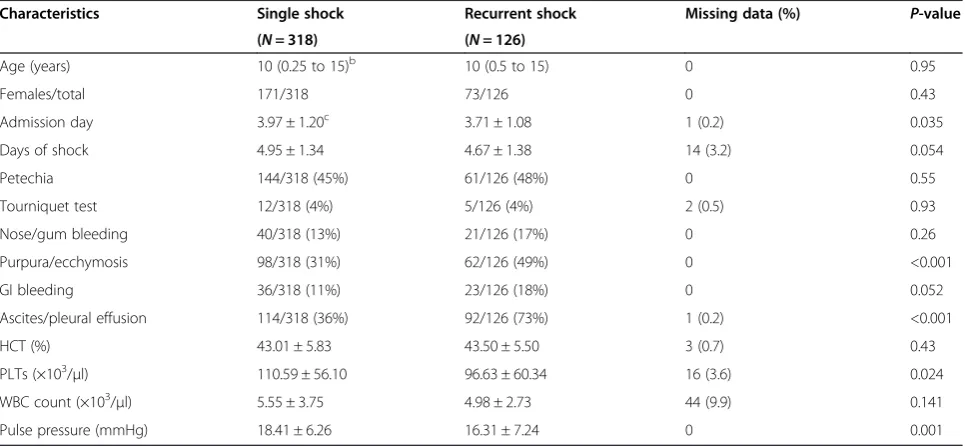
Around the time of shock, the relevant patient history regarding clinical symptoms and signs, as well as the la-boratory parameters listed in Table 1, were recorded. These variables are widely used in our hospitals for the diagnosis and monitoring of dengue shock patients. Pleural effusion and ascites were detected by chest X-ray and ultrasound. A patient was defined as having devel-oped recurrent shock if he or she had received adequate fluid according to the WHO 1997 guidelines for volume replacement [13] and had tachycardia, abnormal cool-ness of limbs and a pulse pressure≤25 mmHg that had previously reached a level≥30 mmHg [20].
The minimal required sample size was determined by rule of thumb, in which at least ten patients per group were required for each included predictive variable [24,25]. We aimed to use less than ten variables to build prediction models for ease of use in clinical practice. The required sample size was at least 100 participants per group. This study was approved by the institutional ethical review committees of the Institute of Tropical Medicine, Nagasaki University, and the Pasteur Institute in Ho Chi Minh City. Written informed consent from all participants’ parents or guardians was required upon enrollment.
Univariate and multivariate analyses
[image:2.595.57.540.485.708.2]The primary outcome variable was recurrent shock diag-nosis at the time of hospital discharge. Univariate
Table 1 Clinical characteristics, laboratory parameters and univariate analysisa
Characteristics Single shock Recurrent shock Missing data (%) P-value
(N= 318) (N= 126)
Age (years) 10 (0.25 to 15)b 10 (0.5 to 15) 0 0.95
Females/total 171/318 73/126 0 0.43
Admission day 3.97 ± 1.20c 3.71 ± 1.08 1 (0.2) 0.035
Days of shock 4.95 ± 1.34 4.67 ± 1.38 14 (3.2) 0.054
Petechia 144/318 (45%) 61/126 (48%) 0 0.55
Tourniquet test 12/318 (4%) 5/126 (4%) 2 (0.5) 0.93
Nose/gum bleeding 40/318 (13%) 21/126 (17%) 0 0.26
Purpura/ecchymosis 98/318 (31%) 62/126 (49%) 0 <0.001
GI bleeding 36/318 (11%) 23/126 (18%) 0 0.052
Ascites/pleural effusion 114/318 (36%) 92/126 (73%) 1 (0.2) <0.001
HCT (%) 43.01 ± 5.83 43.50 ± 5.50 3 (0.7) 0.43
PLTs (×103/μl) 110.59 ± 56.10 96.63 ± 60.34 16 (3.6) 0.024
WBC count (×103/μl) 5.55 ± 3.75 4.98 ± 2.73 44 (9.9) 0.141
Pulse pressure (mmHg) 18.41 ± 6.26 16.31 ± 7.24 0 0.001
a
Days of shock, number of illness days prior to the first shock; GI, gastrointestinal; HCT, hematocrit; PLTs, platelets; WBC, white blood cell. Admission day, fever days prior to admission and day 1 of illness were assigned as the day of fever onset.bMedian (minimum, maximum) calculated using the Mann–Whitney
analysis was performed using SPSS software version 16.0 (SPSS, Inc, Chicago, IL, USA). Measures of skewness and kurtosis were used to test the normal distribution of continuous variables. Student’s t-test was used for con-tinuous variables normally distributed, and the Mann– Whitney U test was used for continuous variables that were not normally distributed. χ2 analysis was used for categorical variables. A difference with a P value <0.05 was considered significant. Multivariate logistic regression analysis was used to find the independent predictors of re-current shock using MedCalc version 11.0 statistical soft-ware (MedCalc Softsoft-ware, Ostend, Belgium).
Missing data analysis
Missing data ranged from 0% to 9.9%. Little’s missing completely at random test [26] was performed using SPSS software version 16.0, which showed a nonsignifi-cant result (P> 0.10), suggesting that the data were miss-ing completely at random. Therefore, multiple imputation algorithms were used to analyze the missing data using NORM software version 2.03 [27]. The multiple logistic regression model was employed to input missing data.
Preprocessing variable selection
To increase the performance of the prediction model [28], a preprocessing method was employed to reduce the number of variables using Weka 3.7.7 software [29]. We used the assessment method in WrapperSubsetEval [30] combined with the best first search method in the forward direction [31] and the learning scheme of our logistic regression prediction model (Logistic). A ten-fold cross-validation method was used with the number of folds set at five and the seed set at one.
Training and validation of the prediction model
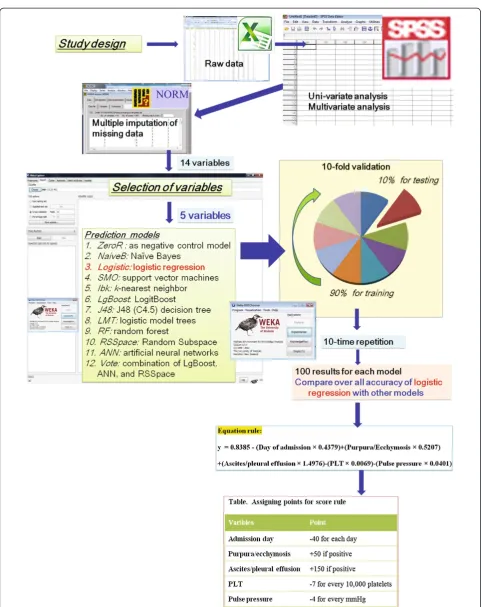
Because a simpler rule would be preferred by clinicians, particularly in remote areas, we built a simple traditional rule using a logistic regression model [32]. Logistic was built and compared to ZeroR, a baseline model without predictive power, to identify the predictive power of the Logistic model. The overall performance of the data-mining model was assessed by calculation of the area under the curve (AUC) from the receiver operating characteristic (ROC) curve [33]. Weka 3.7.7 software [29] was used to train and validate all models in a ten-fold validation strategy with ten rounds of ten repetitions as previously described [34,35]. Briefly, the whole data set was randomly split into ten equal subsets (Figure 1). For ten times, nine subsets were used to train the model and the remaining subset was used to validate the AUC of each model. The cross-validation was repeated 10 times to yield a total of 100 AUC values for each model. The overall accuracy of these models, represented by the mean and standard deviation of 100 AUC values, was compared
using the corrected, resampledt-test [36]. Differences be-tween models with P values <0.05 were considered significant.
Initially, we used the default settings of the Weka software to build the prediction model. Next, we opti-mized parameters to calculate the highest AUC value. The full description of parameter-setting is presented in Additional file 1.
Score points were derived by multiplying and rounding regression coefficients to calculate the lowest integer, then simplifying them to achieve a scoring system. The optimal cutoff value was chosen as the q value of the ROC curve, at which sensitivity equals specificity.
Comparison of logistic regression prediction model with the other ten prediction models
Ten binary prediction models (artificial neural network (ANN),k-nearest neighbors algorithm (kNN), C4.5 decision tree (J48), LogitBoost classification algorithm (LgBoost), lo-gistic regression tree (LRT), naïve Bayes classifier (NaiveB), random forests (RF), random subspace (RSSpace), sequen-tial minimal optimization (SMO) for support vector ma-chines and a combination of ANN, LgBoost and RSSpace (Vote)) were built as described above. The overall accuracy of these rules was compared using the mean and standard deviation of 100 AUC values per model by using the cor-rected, resampledt-test [36].
Results
Patient characteristics and univariate analysis
Multivariate analysis and development of clinical decision rule
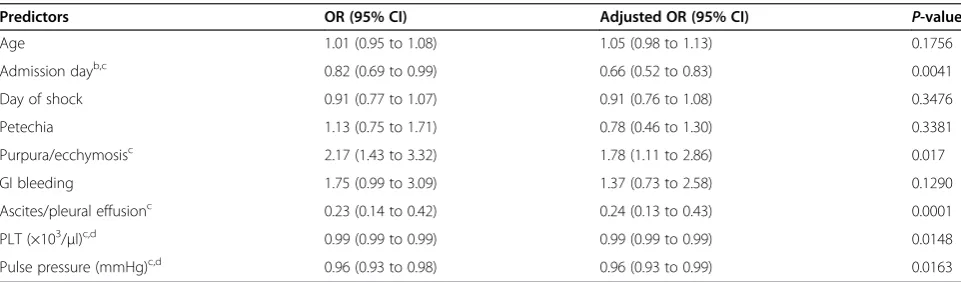
Because the clinical rule should be reliable and easy to apply [32], we aimed to develop a simple rule to predict the recurrent shock patients using the logistic regression model. After the preprocessing method of variables re-duction, nine variables, including age, admission day, day of shock, petechia, purpura/ecchymosis, gastrointes-tinal bleeding, ascites/pleural effusion, platelet count, and pulse pressure, remained and were analyzed using a multivariate logistic regression model. The results in Table 2 show that admission day, purpura/ecchymosis, ascites/pleural effusion, blood platelet count, and pulse pressure, independently correlated with recurrent shock in a multivariate model (P< 0.05).
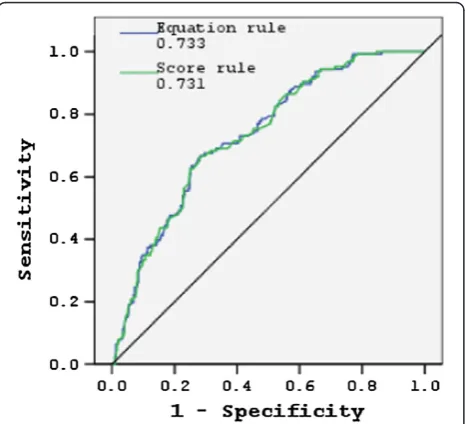
Five variables (admission day, purpura/ecchymosis, as-cites/pleural effusion, blood platelet count and pulse pressure) were further trained and validated using a ten-fold validation strategy with ten rounds of repetition [34,35] using Weka 3.7.7 software [29]. Next, scores were derived by multiplying and rounding regression co-efficients to calculate the lowest integer, then simplifying the coefficients to achieve a scoring system (Table 3). The total score for patients in the whole data set ranged from −406 points to +53 points. Figure 2 shows the per-formance of the logistic models built by using the equa-tion and the scoring systems, revealing identical accuracy with AUCs at 0.73 when the whole data set was applied. Using a cutoff value greater than−154.5, the simple point rule revealed a sensitivity of 68.3% and a specificity of 68.2%.
Comparison of 11 prediction models
In this study, 11 popular data-mining methods (ANN,
kNN, J48, LgBoost, LRT, Logistic, NaiveB, RF, RSSpace, SMO and Vote) were trained and compared to the base-line ZeroR model to identify the predictability power of
the built models. Five variables (admission day, purpura/ ecchymosis, ascites/pleural effusion, blood platelet count and pulse pressure) were computed using a ten-fold val-idation strategy. The results showed that all 11 predic-tion models possessed AUC values between 0.645 and 0.730 (Additional file 2). Compared to the baseline ZeroR method, the 11 prediction models all showed an ability to predict recurrent shock (P< 0.05). Among these models, the Vote model demonstrated the highest AUC at 0.730, followed by LgBoost (0.720), NaiveB (0.705), Logistic (0.703), LRT (0.703),kNN (0.696), SMO (0.695), ANN (0.695), RF (0.694), RSSpace (0.694) and J48 (0.645). Compared with the other four best models (Vote, LgBoost, NaiveB and Logistic), the J48 model was significantly outperformed in overall accuracy.
Discussion
Medical doctors often initiate fluid resuscitation by using normal saline solution or Ringer’s lactate solution. Most children with DSS recover from shock with this treat-ment regimen; however, 28% to 30% have recurrent shock that requires administration of colloidal solutions and more intensive care [20] (Table 1). Therefore, a clin-ical decision rule is needed to predict recurrent shock during a patient’s first dengue shock episode. In this study, we defined a simple, practical, relatively accurate clinical decision rule (sensitivity and specificity of 68%) that can be applied at the bedside [32] to predict recur-rent shock in children hospitalized for a first dengue shock episode. The rule contains a list of items with a detailed scoring system and does not require compli-cated mathematical computation.
[image:5.595.57.538.558.699.2]Our univariate analysis revealed many factors associ-ated with recurrent shock. There were more signs of purpura/ecchymosis, gastrointestinal bleeding, ascites/ pleural effusion, low platelet count and narrow pulse pressure in recurrent shock patients compared with
Table 2 Multivariate logistic regression model used to predict dengue shock syndrome and nonshock casesa
Predictors OR (95% CI) Adjusted OR (95% CI) P-value
Age 1.01 (0.95 to 1.08) 1.05 (0.98 to 1.13) 0.1756
Admission dayb,c 0.82 (0.69 to 0.99) 0.66 (0.52 to 0.83) 0.0041
Day of shock 0.91 (0.77 to 1.07) 0.91 (0.76 to 1.08) 0.3476
Petechia 1.13 (0.75 to 1.71) 0.78 (0.46 to 1.30) 0.3381
Purpura/ecchymosisc 2.17 (1.43 to 3.32) 1.78 (1.11 to 2.86) 0.017
GI bleeding 1.75 (0.99 to 3.09) 1.37 (0.73 to 2.58) 0.1290
Ascites/pleural effusionc 0.23 (0.14 to 0.42) 0.24 (0.13 to 0.43) 0.0001
PLT (×103/μl)c,d 0.99 (0.99 to 0.99) 0.99 (0.99 to 0.99) 0.0148
Pulse pressure (mmHg)c,d 0.96 (0.93 to 0.98) 0.96 (0.93 to 0.99) 0.0163
a
CI, confidence interval; GI, gastrointestinal; OR, odds ratio; PLT, platelet.Dengue shock syndromerefers to dengue hemorrhagic fever, andnonshock casesrefers to dengue fever.
b
OR represents the decremental odds of recurrent shock for every unit decrease of one day in admission days.c
patients who had a single shock, similarly to the severity signs of dengue infection [2]. A short duration of fever prior to admission was associated with recurrent shock, suggesting rapid progression of the disease in recurrent shock patients. The mechanism of this phenomenon is unknown, thus further studies are required to clarify it.
Several other data-mining techniques, such as ANN,
kNN, J48, LgBoost, LRT, NaiveB, RF, RSSpace, SMO and Vote, recently have been developed and used to help the clinician make decisions [37-42]. Though the traditional Logistic model has been used extensively to develop de-cision rules, other modern techniques are underutilized in clinical practices. It has been proposed that intensive computer-based data-mining classifiers outperform the traditional classification methods in several data sets [43-47]. However, this superiority has not been obvious in other data sets [48,49]. Thus, it is important to com-pare several models in order to find an optimal clinical decision-making model for a particular prediction [50].
In our present study, we simultaneously developed, tested and compared the traditional Logistic model with ten common prediction models for critical care in dengue infection. Our results show that all 11 models had signifi-cant power to predict, around the time of first dengue shock episode, which patients would develop a second shock episode. Five models (Vote, LgBoost, NaiveB, Logistic and LRT) had AUCs >0.7, which is considered an accept-able discrimination level [51]. Among these five models, no prediction rule had superior overall accuracy compared to the other rules. Furthermore, no prediction models were significantly better than the relatively simple logistic regres-sion model in terms of overall accuracy (AUC).
There are several limitations of this study. First, we an-alyzed data from only two hospitals in southern Vietnam. Therefore, the results would have been differ-ent if we had used data from other hospitals, particularly those in other countries, where the clinical characteris-tics, epidemiology and outcomes of dengue infection are different. Second, the overall accuracy of the final model was not so high, thus more markers are needed to im-prove the efficacy of the rule in future. Third, we did not include treatment variables at the time of first dengue shock episode (such as initial fluids and length of stay in the ICU), Pediatric Risk of Mortality or Sequential Organ Failure Assessment score variables (such as heart rate, respiratory rate and creatinine level), which might have improved the accuracy of the prediction rule. In addition, we used only one software package to build all prediction models. Other software could produce differ-ent results regarding the best model. Thus, further pro-spective studies using data from different regions are required for external validation of the results of this study.
Conclusions
Recurrent shock occurs in about 28% of dengue-infected patients with shock. We derived a simple clinical deci-sion rule with a sensitivity and specificity of 68%, which could help clinicians treating dengue patients during the early stage of a first shock episode to predict the devel-opment of recurrent shock. The usefulness of this deci-sion rule needs to be validated by several independent studies in the future.
Key messages
Several prediction models were capable of predicting reshock in children who had a first dengue shock (AUC >0.7).
[image:6.595.56.291.101.183.2]The simple traditional logistic regression model derived from five factors (admission day, purpura/ ecchymosis, ascites/pleural effusion, blood platelet count and pulse pressure) provided relatively good accuracy with an AUC of 0.73.
[image:6.595.58.291.463.675.2]Figure 2Receiver operating characteristic curves of two traditional logistic prediction rules for prediction of recurrent shock during a patient’s first dengue shock episode.The areas under the receiver operating characteristic curves were 0.733 for the equation rule and 0.731 for the scoring rule.
Table 3 Assigning score values for clinical decision rulea
Variables Pointsb
Admission day −40 for each day
Purpura/ecchymosis +50 if positive
Ascites/pleural effusion +150 if positive
PLT −7 for every 10,000 platelets
Pulse pressure −4 for every 1 mmHg
a
PLT, platelet.b
Additional files
Additional file 1:Parameters of the Weka software were optimized to obtain the highest area under the curve value for each model.
Additional file 2:Head-to-head comparisons of area under the receiver operating characteristic curves of different models for predicting recurrent shock during a patient’s first dengue shock episode.
Abbreviations
ANN:Artificial neural network; AUC: Area under the curve; DF: Dengue fever; DHF: Dengue hemorrhagic fever; DSS: Dengue shock syndrome; J48: C4.5 decision tree;kNN:k-nearest neighbor; LgBoost: LogitBoost; LRT: Logistic regression tree; NaiveB: naïve Bayes classifier; RF: Random forests; RSSpace: Random subspace, ROC, receiver operating characteristic; SMO: Sequential minimal optimization.
Competing interests
The authors have no competing interests with commercial or other affiliations.
Authors’contributions
NTH and KH conceived and planned the study. NTH, NTHT, TTNH, NTPL, PTTN, TTT, HMT, CTPN, VVT, TVD, VTQH, JK and KH carried out the study. NTH, NTHT, TTNH, NTPL, VTQH, JK and KH analyzed the data and wrote the paper. NTH, NTHT, TTNH, NTPL, TTT, HMT, CTPN, VVT, TVD, VTQH and KH contributed reagents and materials. All authors read and approved the final manuscript.
Acknowledgments
We thank all the members of the Laboratory of Arbovirus, Ho Chi Minh City, Vietnam. We also express our appreciation to the staff of Children’s Hospital No. 2 in Ho Chi Minh City and the Center for Preventive Medicine in Vinh Long Province of the Mekong Delta. This study was supported in part by the Global Centers of Excellence Program (2008–2012) and the Japan Initiative for Global Research Network on Infectious Diseases (J-GRID) (to KH). This work was also supported in part by a grant-in-aid for scientific research from Nagasaki University (2007–2009) (to NTH). The funders had no role in the study design, data collection and analysis, decision to publish or preparation of the manuscript.
Author details
1
Department of Immunogenetics, Institute of Tropical Medicine (NEKKEN), Nagasaki University, 1-12-4 Sakamoto, Nagasaki 852-8523, Japan. 2
Department of Clinical Product Development, Institute of Tropical Medicine (NEKKEN), Nagasaki University, 1-12-4 Sakamoto, Nagasaki 852-8523, Japan. 3
Children’s Hospital, No. 2, 14 Ly Tu Trong Street, Ho Chi Minh City 70000, Vietnam.4Laboratory of Arbovirus, Pasteur Institute in Ho Chi Minh City, 167 Pasteur Street, Ho Chi Minh City 70000, Vietnam.5Department of Immunology & Microbiology, Pasteur Institute in Ho Chi Minh City, 167 Pasteur Street, Ho Chi Minh City 70000, Vietnam.6University of Medicine and Pharmacy at Ho Chi Minh City, 217 Hong Bang, District 5, Ho Chi Minh City 70000, Vietnam.7Center for Preventive Medicine, 24 Hung Vuong Street, Vinh Long 91000, Vietnam.
Received: 12 July 2013 Accepted: 1 November 2013 Published: 2 December 2013
References
1. Guzman MG, Halstead SB, Artsob H, Buchy P, Farrar J, Gubler DJ, Hunsperger E, Kroeger A, Margolis HS, Martínez E, Nathan MB, Pelegrino JL, Simmons C, Yoksan S, Peeling RW:Dengue: a continuing global threat.
Nat Rev Microbiol2010,8(12 Suppl):S7–S16.
2. World Health Organization (WHO):Epidemiology, burden of disease and transmission.InDengue: Guidelines for Diagnosis, Treatment, Prevention and Control.Geneva: WHO; 2009:3–21.
3. Kurane I:Dengue hemorrhagic fever with special emphasis on immunopathogenesis.Comp Immunol Microbiol Infect Dis2007, 30:329–340.
4. White NJ:Variation in virulence of dengue virus.Lancet1999, 354:1401–1402.
5. Halstead SB:Dengue.Lancet2007,370:1644–1652.
6. Lan NT, Hirayama K:Host genetic susceptibility to severe dengue infection.Trop Med Health2011,39(4 Suppl):73–81.
7. Lan NTP, Kikuchi M, Huong VTQ, Ha DQ, Thuy TT, Tham VD, Tuan HM, Tuong VV, Nga CTP, Dat TV, Oyama T, Morita K, Yasunami M, Hirayama K: Protective and enhancing HLA alleles, DRB1*0901 and HLA-A*24, for severe forms of dengue virus infection, dengue hemorrhagic fever and dengue shock syndrome.PLoS Negl Trop Dis
2008,2:e304.
8. Mongkolsapaya J, Duangchinda T, Dejnirattisai W, Vasanawathana S, Avirutnan P, Jairungsri A, Khemnu N, Tangthawornchaikul N, Chotiyarnwong P, Sae-Jang K, Koch M, Jones Y, McMichael A, Xu X, Malasit P, Screaton G:T cell responses in dengue hemorrhagic fever: Are cross-reactive T cells suboptimal?J Immunol2006,176:3821–3829.
9. Chaturvedi UC, Nagar R, Shrivastava R:Macrophage and dengue virus: friend or foe?Indian J Med Res2006,124:23–40.
10. Chaturvedi UC, Agarwal R, Elbishbishi EA, Mustafa AS:Cytokine cascade in dengue hemorrhagic fever: implications for pathogenesis.FEMS Immunol Med Microbiol2000,28:183–188.
11. Lin CF, Chiu SC, Hsiao YL, Wan SW, Lei HY, Shiau AL, Liu HS, Yeh TM, Chen SH, Liu CC, Lin YS:Expression of cytokine, chemokine, and adhesion molecules during endothelial cell activation induced by antibodies against dengue virus nonstructural protein 1.J Immunol2005,174:395–403.
12. Whitehorn J, Simmons CP:The pathogenesis of dengue.Vaccine2011, 29:7221–7228.
13. World Health Organization (WHO):Dengue Haemorrhagic Fever: Diagnosis, Treatment, Prevention and Control.2nd edition. Geneva: WHO; 1997. 14. World Health Organization (WHO):Dengue: Guidelines for Diagnosis,
Treatment, Prevention and Control.Geneva: WHO; 2009.
15. Wilder-Smith A, Ooi EE, Vasudevan SG, Gubler DJ:Update on dengue: epidemiology, virus evolution, antiviral drugs, and vaccine development.
Curr Infect Dis Rep2010,12:157–164.
16. Kalayanarooj S:Clinical manifestations and management of dengue/DHF/ DSS.Trop Med Health2011,39(4 Suppl):83–87.
17. Al-Muhandis N, Hunter PR:The value of educational messages embedded in a community-based approach to combat dengue fever: a systematic review and meta regression analysis.PLoS Negl Trop Dis2011,5:e1278. 18. Gibbons RV, Vaughn DW:Dengue: an escalating problem.BMJ2002,
324:1563–1566.
19. Anders KL, Nguyet NM, Chau NV, Hung NT, Thuy TT, Lien LB, Farrar J, Wills B, Hien TT, Simmons CP:Epidemiological factors associated with dengue shock syndrome and mortality in hospitalized dengue patients in Ho Chi Minh City, Vietnam.Am J Trop Med Hyg2011,84:127–134.
20. Ngo NT, Cao XT, Kneen R, Wills B, Nguyen VM, Nguyen TQ, Chu VT, Nguyen TT, Simpson JA, Solomon T, White NJ, Farrar J:Acute
management of dengue shock syndrome: a randomized double-blind comparison of 4 intravenous fluid regimens in the first hour.Clin Infect Dis2001,32:204–213.
21. Ha TT, Huy NT, Murao LA, Lan NT, Thuy TT, Tuan HM, Nga CT, Tuong VV, Dat TV, Kikuchi M, Yasunami M, Morita K, Huong VT, Hirayama K:Elevated levels of cell-free circulating DNA in patients with acute dengue virus infection.PLoS One2011,6:e25969.
22. Furuta T, Murao LA, Lan NT, Huy NT, Huong VT, Thuy TT, Tham VD, Nga CT, Ha TT, Ohmoto Y, Kikuchi M, Morita K, Yasunami M, Hirayama K, Watanabe N:Association of mast cell-derived VEGF and proteases in dengue shock syndrome.PLoS Negl Trop Dis2012,6:e1505.
23. Wills BA, Oragui EE, Stephens AC, Daramola OA, Dung NM, Loan HT, Chau NV, Chambers M, Stepniewska K, Farrar JJ, Levin M:Coagulation abnormalities in dengue hemorrhagic fever: serial investigations in 167 Vietnamese children with dengue shock syndrome.Clin Infect Dis2002, 35:277–285.
24. Peduzzi P, Concato J, Kemper E, Holford TR, Feinstein AR:A simulation study of the number of events per variable in logistic regression analysis.J Clin Epidemiol1996,49:1373–1379.
25. Harrell FE Jr, Lee KL, Mark DB:Multivariable prognostic models: issues in developing models, evaluating assumptions and adequacy, and measuring and reducing errors.Stat Med1996,15:361–387.
27. Schafer JL:Multiple imputation: a primer.Stat Methods Med Res1999, 8:3–15.
28. Kumar CA, Srinivas S:Mining associations in health care data using formal concept analysis and singular value decomposition.J Biol Syst2010, 18:787–807.
29. Hall M, Frank E, Holmes G, Pfahringer B, Reutemann P, Witten IH:The WEKA data mining software: an update.SIGKDD Explor2009,11:10–18. 30. Kohavi R, John GH:Wrappers for feature subset selection.Artif Intell1997,
97:273–324.
31. Pearl J:Heuristics: Intelligent Search Strategies for Computer Problem Solving.
Boston: Addison-Wesley Longman; 1984.
32. Stiell IG, Wells GA:Methodologic standards for the development of clinical decision rules in emergency medicine.Ann Emerg Med1999, 33:437–447.
33. Huang J, Ling CX:Using AUC and accuracy in evaluating learning algorithms.IEEE Trans Knowl Data Eng2005,17:299–310.
34. Kohavi R:A study of cross-validation and bootstrap for accuracy estima-tion and model selecestima-tion. InProceedings of the 14th International Joint Conference on Artificial Intelligence, Volume 2. San Francisco: Morgan Kaufmann; IJCAI (U S); 1995:1137–1143.
35. Witten IH, Frank E:Data Mining: Practical Machine Learning Tools and Techniques.2nd edition. San Francisco: Morgan Kaufmann; 2005. 36. Nadeau C, Bengio Y:Inference for the generalization error.Mach Learn
2003,52:239–281.
37. Kerr WT, Lau EP, Owens GE, Trefler A:The future of medical diagnostics: large digitized databases.Yale J Biol Med2012,85:363–377.
38. Li L, Tang H, Wu Z, Gong J, Gruidl M, Zou J, Tockman M, Clark RA:Data mining techniques for cancer detection using serum proteomic profiling.
Artif Intell Med2004,32:71–83.
39. Denekamp Y:Clinical decision support systems for addressing information needs of physicians.Isr Med Assoc J2007,9:771–776. 40. Kong L, Milbrandt EB, Weissfeld LA:Advances in statistical methodology
and their application in critical care.Curr Opin Crit Care2004,10:391–394. 41. Moser SA, Jones WT, Brossette SE:Application of data mining to intensive
care unit microbiologic data.Emerg Infect Dis1999,5:454–457.
42. Potts JA, Gibbons RV, Rothman AL, Srikiatkhachorn A, Thomas SJ, Supradish PO, Lemon SC, Libraty DH, Green S, Kalayanarooj S:Prediction of dengue disease severity among pediatric Thai patients using early clinical laboratory indicators.PLoS Negl Trop Dis2010,4:e769.
43. Dal Moro F, Abate A, Lanckriet GR, Arandjelovic G, Gasparella P, Bassi P, Mancini M, Pagano F:A novel approach for accurate prediction of spontaneous passage of ureteral stones: support vector machines.Kidney Int2006,69:157–160.
44. Anderson B, Hardin JM, Alexander DD, Grizzle WE, Meleth S, Manne U: Comparison of the predictive qualities of three prognostic models of colorectal cancer.Front Biosci (Elite Ed)2010,2:849–856.
45. Wang CJ, Li YQ, Wang L, Li LL, Guo YR, Zhang LY, Zhang MX, Bie RH: Development and evaluation of a simple and effective prediction approach for identifying those at high risk of dyslipidemia in rural adult residents.PLoS One2012,7:e43834.
46. Takayama T, Ebinuma H, Tada S, Yamagishi Y, Wakabayashi K, Ojiro K, Kanai T, Saito H, Hibi T, Keio Association for the Study of Liver Diseases: Prediction of effect of pegylated interferonα-2b plus ribavirin combin-ation therapy in patients with chronic hepatitis C infection.PLoS One
2011,6:e27223.
47. Eller-Vainicher C, Chiodini I, Santi I, Massarotti M, Pietrogrande L, Cairoli E, Beck-Peccoz P, Longhi M, Galmarini V, Gandolini G, Bevilacqua M, Grossi E: Recognition of morphometric vertebral fractures by artificial neural networks: analysis from GISMO Lombardia Database.PLoS One2011, 6:e27277.
48. Austin PC:A comparison of regression trees, logistic regression, generalized additive models, and multivariate adaptive regression splines for predicting AMI mortality.Stat Med2007,26:2937–2957. 49. Jonsdottir T, Hvannberg ET, Sigurdsson H, Sigurdsson S:The feasibility of
constructing a Predictive Outcome Model for breast cancer using the tools of data mining.Expert Syst Appl2008,34:108–118.
50. Buri L, Hassan C, Bersani G, Anti M, Bianco MA, Cipolletta L, Di Giulio E, Di Matteo G, Familiari L, Ficano L, Loriga P, Morini S, Pietropaolo V, Zambelli A, Grossi E, Intraligi M, Buscema M, SIED Appropriateness Working Group: Appropriateness guidelines and predictive rules to select patients for upper endoscopy: a nationwide multicenter study.Am J Gastroenterol
2010,105:1327–1337.
51. Hosmer DW Jr, Lemeshow S:Assessing the fit of the model. InApplied Logistic Regression.2nd edition. New York: John Wiley & Sons; 2000:143–202.
doi:10.1186/cc13135
Cite this article as:Huyet al.:Development of clinical decision rules to
predict recurrent shock in dengue.Critical Care201317:R280.
Submit your next manuscript to BioMed Central and take full advantage of:
• Convenient online submission
• Thorough peer review
• No space constraints or color figure charges
• Immediate publication on acceptance
• Inclusion in PubMed, CAS, Scopus and Google Scholar
• Research which is freely available for redistribution