ESSAYS ON CORRUPTION AND
DEVELOPMENT ISSUES
Erven Lauw
A Thesis Submitted for the Degree of PhD at the
University of St Andrews
2015
Full metadata for this item is available in Research@StAndrews:FullText
at:
http://research-repository.st-andrews.ac.uk/
Please use this identifier to cite or link to this item:
http://hdl.handle.net/10023/7784
This item is protected by original copyright
ESSAYS ON CORRUPTION AND
DEVELOPMENT ISSUES
Erven Lauw
This thesis is submitted for the degree of
PhD (Economics)
at the
University of St Andrews
Contents
Contents i
List of Tables iii
List of Figures iii
Declaration v
Acknowledgements vii
Abstract ix
Introduction 1
1 Gender Inequality, Corruption and Economic Development:
A Theoretical Investigation 4
1.1 Introduction . . . 4
1.1.1 The Empirical Debate on the Link between Gender and Corruption . . . 6
1.1.2 Theoretical Literature on Gender and Corruption . . . 13
1.1.3 Outline of the Chapter . . . 14
1.2 The Model . . . 14
1.2.1 Private Sector . . . 17
1.2.2 Public Sector . . . 20
1.2.3 General Equilibrium . . . 27
1.3 Conclusion . . . 34
Appendix . . . 39
2 Pollution, Corruption and Economic Development: A The-oretical Investigation 41 2.1 Introduction . . . 42
2.1.2 The Impact of Pollution on Economic Development . . 47
2.1.3 The Impact of Corruption on Pollution . . . 49
2.1.4 Theoretical Literature on Pollution and Corruption . . 53
2.1.5 Outline of the Chapter . . . 54
2.2 The Model . . . 55
2.2.1 Private Sector . . . 56
2.2.2 Public Sector . . . 59
2.2.3 Pollution . . . 62
2.2.4 General Equilibrium . . . 64
2.3 Conclusion . . . 75
3 Investigating the Causal E¤ect of Women’s Share in Par-liament on Corruption: A Panel Study 79 3.1 Introduction . . . 79
3.1.1 The Link between Women’s Share in Politics and Cor-ruption . . . 81
3.1.2 The Adoption of Gender Quotas . . . 84
3.1.3 The Impact of Gender Quotas . . . 86
3.2 Data and Measures . . . 90
3.2.1 Instrumental Variables . . . 92
3.2.2 Dependent Variable: Corruption . . . 97
3.2.3 Independent Variable: Women’s Representation in Pol-itics . . . 101
3.2.4 Control Variables . . . 103
3.3 OLS . . . 106
3.3.1 Methodology . . . 106
3.3.2 Results . . . 108
3.4 TSLS . . . 113
3.4.1 Methodology . . . 113
3.4.2 Results . . . 117
3.4.3 Robustness Checks . . . 129
3.5 Conclusion . . . 132
Appendices . . . 134
A List of Countries . . . 134
B Countries and Years of Quota Adoptions . . . 136
C Countries and Legislative Quota Sizes . . . 139
D Countries and Reserved Seats Quota Sizes . . . 140
E Countries and Electoral Systems . . . 141
References 148
List of Tables
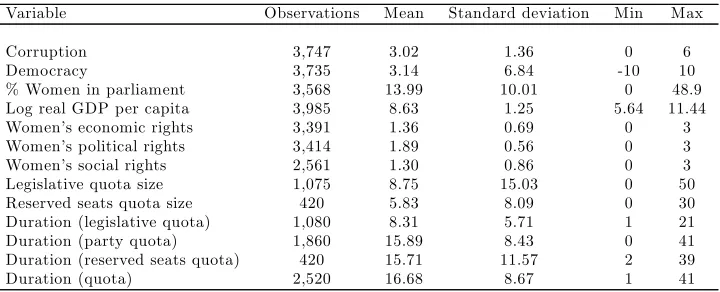
3.1 Summary Statistics - Full Sample . . . 91
3.2 Summary Statistics - Regional . . . 91
3.3 Summary Statistics - Low Corruption and High Corruption . . 104
3.4 Summary Statistics - Low Women’s Representation and High Women’s Representation . . . 104
3.5 OLS Corruption Regressions - Full Sample . . . 109
3.6 OLS Corruption Regressions - Regional . . . 112
3.7 Exogeneity Test - Full Sample . . . 116
3.8 Exogeneity Test - Regional . . . 116
3.9 TSLS Corruption Regressions (IV: Quotas (of any type)) - Full Sample . . . 118
3.10 TSLS Corruption Regressions (IV: Quotas (of any type)) -Regional . . . 120
3.11 TSLS Corruption Regressions (IVs: Party Quotas, Legislative Quota Sizes and Reserved Seats Quota Sizes) - Full Sample . . 122
3.12 TSLS Corruption Regressions (IVs: Party Quotas, Legislative Quota Sizes and Reserved Seats Quota Sizes) - Regional . . . 125
3.13 TSLS Corruption Regressions (IV: Reserved Seats Quota Sizes) - Africa and Asia . . . 127
3.14 TSLS Corruption Robustness Regressions (IV: Reserved Seats Quota Sizes) - Africa and Asia . . . 128
3.15 TSLS Corruption Robustness Regressions - Full Sample . . . 129
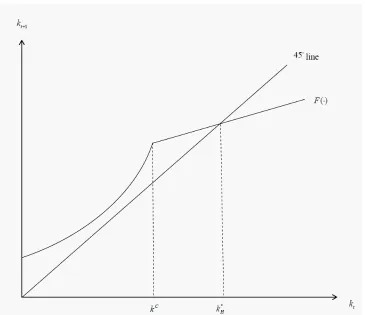
1.2 One Steady State Equilibrium . . . 32
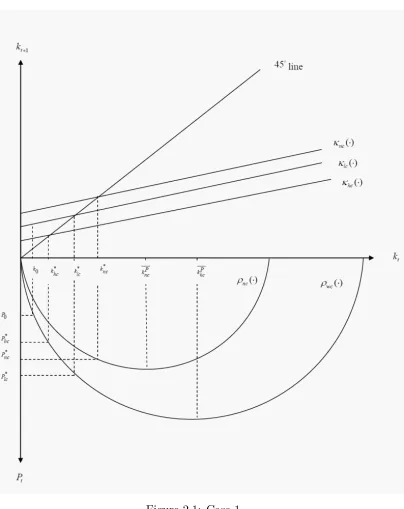
1.3 General Equilibrium with a Higher Share of Female Bureaucrats 33 2.1 Case 1 . . . 69
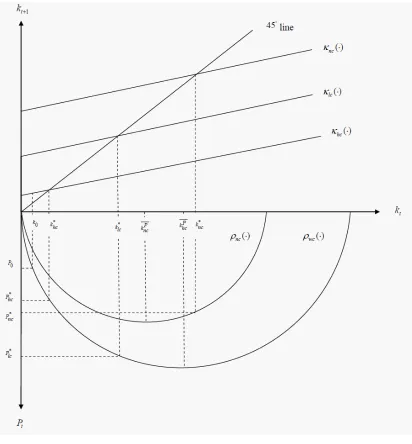
2.2 Case 2 . . . 72
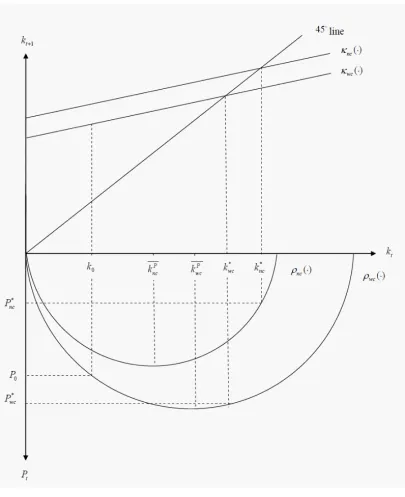
2.3 Case 3 . . . 73
3.1 Trends in Quota Adoption . . . 94
3.2 Quota Adoption by Region . . . 95
3.3 Corruption and Women in Parliament . . . 99
3.4 Trends in Corruption and Women in Parliament . . . 99
3.5 Trends in Corruption . . . 100
3.6 Trends in Women and Parliament . . . 102
Declaration
1. Candidate’s declarations:
I, Erven Lauw, hereby certify that this thesis, which is approximately 54,332 words in length, has been written by me, and that it is the record of work carried out by me, or principally by myself in collaboration with others as acknowledged, and that it has not been submitted in any previous application for a higher degree.
I was admitted as a research student in September, 2010 and as a candidate for the degree of PhD in September, 2010; the higher study for which this is a record was carried out in the University of St Andrews between 2010 and 2015.
Date 17 September 2015 signature of candidate . . . .
2. Supervisor’s declaration:
I hereby certify that the candidate has ful…lled the conditions of the Reso-lution and Regulations appropriate for the degree of PhD in the University of St Andrews and that the candidate is quali…ed to submit this thesis in application for that degree.
Date 17 September 2015 signature of supervisor . . . .
3. Permission for publication: (to be signed by both candidate and supervisor)
research worker, that my thesis will be electronically accessible for personal or research use unless exempt by award of an embargo as requested below, and that the library has the right to migrate my thesis into new electronic forms as required to ensure continued access to the thesis. I have obtained any third-party copyright permissions that may be required in order to allow such access and migration, or have requested the appropriate embargo below. The following is an agreed request by candidate and supervisor regarding the publication of this thesis: access to printed copy and electronic publication of thesis through the University of St Andrews.
Acknowledgements
First, I would like to give my special thanks to God who has been my primary source of hope and strength especially in the toughest moment. This thesis is a testimony of His love and greatness.
Next, I would like to express my special appreciation and thanks to my supervisors, Dr Gonzalo Forgues-Puccio and Dr Ian Smith. Thank you for supervising my research and for helping me to grow both intellectually and personally. Your advice on both research as well as on life have been priceless. I would also like to thank you for your encouragement, your patience and your continuous faith in me, especially during my hardship.
I would also like to thank the whole faculty of the School of Economics and Finance. I am very grateful for all the support you have given me through-out these years. I would like to especially thank the postgraduate research committee members, Professor Paola Manzini, Professor Marco Mariotti, Professor Kaushik Mitra and Professor Miguel Costa-Gomes. My special thanks also go to Dr Peter Macmillan, Angela Hodge, Caroline Moore, Bram Boskamp, Liz Perth-Davis and Eliana Wilson for all your kindness and sup-port in various ways.
me extra strength and courage to persevere.
I want to thank all my students whom I have taught during my doctoral studies. At times when I found it di¢ cult to work on my research, you have given me another reason to go on. You have inspired me to never give up, to keep improving myself and to preserve my youthful spirit and innocence.
A special thanks to the various people who have helped me greatly in di¤erent ways throughout these years: Dr Laurence Lasselle, Professor Verity Brown, Dr Grant Macaskill, Maggie Winton and Ruth Unsworth. Thank you for your support, your kind words and for being there in my times of need.
Abstract
Introduction
A signi…cant number of econometric studies have shown that corruption -de…ned as the abuse of authority by public servants for their own private gains - hinders economic development through various channels. It has also been argued that corruption may increase allocative e¢ ciency by speeding up bureaucratic procedures and introducing competition for (scarce) govern-ment resources (e.g., Shleifer and Vishny, 1994; Lui, 1985). Despite these arguments, the evidence shows that the harmful e¤ects of corruption on de-velopment cannot be ignored. Speci…cally, corruption constrains economic development by reducing total investment (Mauro, 1995), increasing inequal-ity (Gupta et al., 2002), reducing the qualinequal-ity of public investment (Tanzi and Davoodi, 1997), reducing foreign direct investment (Wei, 2000), and lowering the e¢ ciency of government services and the quality of public healthcare pro-vision (Gupta et al., 2001). Moreover, there is evidence of reverse causality. For example, corruption may be caused by inequality (You and Khagram, 2005), policy distortions (Ades and Tella, 1997), and/or low levels of de-velopment (Treisman, 2007). The objective of this thesis is to extend the current literature on corruption and development by explicitly investigating two new channels through which corruption and economic development may interact, namely women’s share in politics and pollution. The thesis com-prises three independent but related chapters. For each channel, the thesis presents a theoretical model in which corruption and economic development are determined endogenously in a dynamic general equilibrium framework. In addition, the thesis investigates empirically the causal e¤ect of women’s share in parliament on corruption using panel data and gender quotas as instruments for women’s share in parliament. To the best of our knowledge, these three investigations have not been conducted previously.
parlia-ment and bureaucratic malfeasance (e.g., Dollar et al., 2001; Swamy et al., 2001; Michailova and Melnykovska, 2009; Treisman, 2007; Samimi and Hos-seinmardi, 2011; Jha and Sarangi, 2015; Esarey and Chirillo, 2013). Nonethe-less, evidence on the existence of gender di¤erences in moral attitudes towards corruption has been mixed. On the one hand, some studies …nd evidence for gender e¤ects (e.g., Torgler and Valev, 2010; Michailova and Melnykovska, 2009; Rivas, 2013; Swamy et al., 2001). Some studies, on the other hand, …nd no such gender di¤erences (e.g., Gërxhani, 2007; Alhassan-Alolo, 2007). These contradicting results raise doubts concerning the e¤ectiveness of in-creasing women’s share in the public sector in reducing corruption. Up to now, there have been very limited theoretical investigations to understand the links between gender and corruption. This chapter aims to …ll the gap in the literature by exploring the e¤ect of women’s share in the government on cor-ruption without assuming gender di¤erences in corrupt attitudes. The analy-sis is based on evidence showing that women are more wage-discriminated against in the private sector than in the public sector (e.g., Barón and Cobb-Clark, 2010; Panizza and Qiang, 2005; Chatterji et al., 2007; Fuller, 2005; Glinskaya and Lokshin, 2007; Daoud and Shanti, 2012; Hou, 1993). Thus, female bureaucrats have a lower outside option and consequently face higher costs of corruption than male bureaucrats. The model predicts that increas-ing the share of female bureaucrats is likely to lower corruption if the public sector is a more gender-equal employer than the private sector. The model also predicts a negative relationship between corruption and development.
is above the income level at the turning point of the EKC. The total e¤ect of corruption on pollution is therefore signi…cantly determined by the econ-omy’s level of development. Our model predicts that reducing corruption is more likely to be bene…cial in lowering pollution when the economy is more developed. Our model also shows a negative relationship between corruption and development.
Chapter 1
Gender Inequality, Corruption
and Economic Development: A
Theoretical Investigation
Abstract
This chapter presents a theoretical investigation of the e¤ect of corrup-tion on economic development when women are discriminated against in the labour market. The analysis is based on a dynamic general equi-librium model in which capital accumulation drives economic devel-opment. The government appoints bureaucrats to administer public policy. Corruption may arise due to the opportunity for bureaucrats to embezzle public funds. In the event of detection and the resulting dismissal, the private sector serves as the bureaucrats’outside option. Our main results can be summarised as follows: (1) female bureau-crats commit fewer corrupt acts than male bureaubureau-crats as they have lower incentives to be corrupt; (2) there is a simultaneous causality between corruption and development; (3) corruption and poverty may be permanent features of the economy; (4) a policy to increase fe-male participation in the public sector potentially reduces corruption, fosters development and alleviates poverty.
1.1
Introduction
economies. Hence, governments have to be creative in designing and propos-ing innovative policies. In this chapter we seek to contribute to this task by explaining why a policy of increasing female participation in the gov-ernment may be an e¤ective anti-corruption policy that simultaneously may contribute to reduce gender inequality and foster economic development.
Our theory is based on the seminal studies by Dollar et al. (2001) and Swamy et al. (2001) that investigate the link between female participation in the government and corruption. They …nd that increasing female partic-ipation in the government reduces corruption. These papers use aggregate corruption and governance indices at country level. Evidence reported by such studies will be referred to as ‘macro-evidence’. Despite some critics suggesting that the relationship found in Dollar et al. (2001) and Swamy et al. (2001) might be spurious (e.g., Branisa and Ziegler, 2011; Sung, 2003), a large number of other studies provide strong support for these two seminal papers.1 However, how can we explain this? Can we con…dently say that
women are more honest than men? Is it possible that values may be gender speci…c? There are other types of studies on gender and corruption that shed some light on these questions.2 These studies use individual-level data
to measure attitudes towards corruption and incidence of corruption. Such data are gathered from surveys, interviews, experiments and case studies. Results reported by these studies will be referred to as ‘micro-evidence’. Not surprisingly, there is no consensus. Moreover, the evidence of gender dif-ferences in moral attitudes towards corruption seems to be inconclusive. In other words, we cannot con…dently argue that women are intrinsically more honest than men.
Our chapter provides an economic explanation for the observed negative correlation between female participation in the government and corruption, without relying on the existence of gender di¤erences in moral attitudes to-wards corruption. Our theory rests on the idea that the private sector serves as an outside option for dismissed bureaucrats. As women are more wage-discriminated against in the private sector than in the public sector, female bureaucrats have a lower value of outside option than their male counterparts. Consequently, female bureaucrats have lower incentives to be corrupt than male bureaucrats. There is ample evidence of wage discrimination against women in both the public and private sectors. Moreover, in a wide range of countries, there is evidence that women are less wage-discriminated against in the public sector than in the private sector (e.g., Barón and Cobb-Clark, 2010; Arulampalam et al., 2007; Panizza and Qiang, 2005; Chatterji et al.,
2007; Daoud and Shanti, 2012; Fuller, 2005; Gunderson, 1979; Mueller, 1998; Glinskaya and Lokshin, 2007; Hou, 1993; Freeman, 1987; Smith, 1976; Aslam and Kingdon, 2009; Kolberg, 1991; Gornick and Jacobs, 1998).3 The World
Bank (2012) has also recently reported the same …ndings in a wide range of countries. In addition, other studies …nd that corruption is negatively asso-ciated with the public-private sector wage ratio (e.g., Goel and Rich, 1989; Van Rijckeghem and Weder, 2001).
We establish our results within a dynamic general equilibrium framework where corruption and development are determined jointly and endogenously as the outcomes of the individuals’decision given the structure of the econ-omy. A key feature of our model is the existence of multiple development regimes and multiple (history-dependent) equilibria, including a poverty trap. The existence of a poverty trap in our chapter is consistent with some ob-servations that corruption and poverty may coexist as permanent instead of transient features of the economy (e.g., Bardhan, 1997; Sah, 2007). It has also been illustrated in many papers on the theoretical investigation of corrup-tion and development (e.g., Blackburn and Forgues-Puccio, 2011; Blackburn, 2012; Blackburn et al., 2006). To the best of our knowledge, our chapter is the …rst to present an analysis of the links between female participation in the public sector, corruption, and economic development.
Our chapter seeks to contribute in the design and formulation of anti-corruption and gender policies. As pointed out by Goetz (2007, p. 103):
“Investing in the myth of women’s incorruptible nature instead of investi-gating the reasons for that behaviour will postpone the institutional reform necessary for a transformation of public institutions in the interest of gender and social equity.”
1.1.1
The Empirical Debate on the Link between
Gen-der and Corruption
Does Increasing Female Proportion in the Government Reduce Corruption?
Motivated by earlier studies which demonstrate that women are more self-less or ethical than men (e.g., Eagly and Crowley, 1986; Eckel and Grossman, 1998; Glover and Bumpus, 1997; Goertzel, 1983; Ones and Viswesvaran, 1998;
3Although part of the gender wage gap can be explained by workers and job
Reiss and Mitra, 1998), Dollar et al. (2001) investigate if increasing women’s participation in the government reduces corruption. Their study reveals a strong and statistically signi…cant negative association between female par-ticipation in the government and corruption. Moreover, Swamy et al. (2001) …nd that corruption is not only negatively correlated with female partici-pation in the government but also with female participartici-pation in the labour market.
Other macro-studies have, however, provide evidence that the relation-ship found in Dollar et al. (2001) and Swamy et al. (2001) could be spurious. For instance, Sung (2003) demonstrates that the relationship between fe-male participation in the government and corruption loses signi…cance when measures of liberal democracy are controlled for. Sung (2003) also criticises Dollar et al. (2001) and Swamy et al. (2001) for relying on micro-evidence (that is, women are less tolerant of corruption than men) to propose a macro-hypothesis (that is, increasing female participation in the government lowers corruption). Sung (2003) argues that although increasing female partici-pation in the public sector is a just goal in itself, it may not be by itself an e¤ective tool to reduce corruption. Moreover, by arguing that both fe-male participation in the government and corruption are dependent on lib-eral democracy, he claims that he has found a macro-level explanation to a macro-level problem. Therefore, Sung (2003) argues for a “fairer system” thesis instead of a “fairer sex” claim. However, a later study by Treisman (2007) challenges this liberal democracy argument. Treisman (2007) …nds a quite robust negative correlation between female participation in politics and corruption after controlling for measures of liberal democracy.
Additionally, an analysis of developing countries by Branisa and Ziegler (2011) supports neither Sung (2003) nor Dollar et al. (2001) and Swamy et al. (2001). Branisa and Ziegler (2011) investigate if there is any association between social institutions related to gender inequality and corruption. Their analysis shows that there is a higher corruption in societies that limit women’s freedom from participating in social life, after controlling for democracy and female representation in parliament and in business. Therefore, policy to combat corruption may need more than democratic reforms and increasing female representation in political and economic life. In contrast, a recent study by Esarey and Chirillo (2013) …nds macro-evidence of the interaction between democracy and female participation in the government in relation to corruption. Speci…cally, they …nd that the negative correlation between female participation in the government and corruption is more signi…cant in democratic states than in autocratic states.
provide further supporting macro-evidence for Dollar et al. (2001) and Swamy et al. (2001). In addition, Michailova and Melnykovska (2009) …nd an un-explainable positive but insigni…cant relationship between corruption and women’s share of legislators and managers. Their analysis also reveals that whether or not their …ndings support the “fairer system” thesis by Sung (2003) depends largely on which corruption index is used.
Furthermore, there are some micro-studies generating supporting evi-dence for Dollar et al. (2001) and Swamy et al. (2001). For example, based on data from national survey in Mexico, Wängnerud (2010) …nds that the Mex-ican states with more women elected tend to display lower corruption than the Mexican states with fewer women elected. This is supported by another survey-based study of Mexico by Grimes and Wängnerud (2012) reporting that female presence in the government lowers the bribe-paying incidence. Nevertheless, Vijayalakshmi (2008) …nds no signi…cant relationship between female participation in the government and corruption in her micro-study of local government in India.
All in all, taking into account the weight of existing evidence, there ap-pears to be a considerable support for the proposition that increasing female participation in the government reduces corruption.
Why Are Women Less Corrupt than Men?
Given a lot of evidence of the negative correlation between female proportion in the government and corruption, there have been many studies conducted in the attempt to explain why women are less corrupt than men. This type of investigation is important as they will result in di¤erent policy implications. Some studies …nd evidence of gender di¤erences in moral attitudes towards or in perceptions of corruption while others …nd no such evidence. Thus, there are di¤erent theories being o¤ered to explain why women are less cor-rupt than men. These explanations include psychology/biology/experiential realities, opportunity/network, corrupt incentive, culture, risk aversion, re-sistance towards corruption, institutional context and gender dynamic. We will elaborate these explanations together with the relevant studies below.
or nurture (socialisation). They, however, suggest that gender di¤erences in tolerance for corruption will be stable, at least in the medium term, regardless of the narrowing gender inequality in the societal position and the labour force participation. If interpreted causally, this …nding suggests that policy initiatives designed to increase female participation in economic and political life will lower corruption.
Other micro-studies also …nd evidence of gender di¤erences in attitudes towards corruption (e.g., Torgler and Valev, 2010; Michailova and Melnykovska, 2009; Rivas, 2013). Moreover, Torgler and Valev (2010) report that men are more likely to approve corruption and tax evasion than women; this e¤ect remains robust even after proxies for opportunities such as education, em-ployment status and income have been included. As such, they are in favour of the theory by Gottfredson and Hirschi (1990, p. 554) that ‘attributes gen-der di¤erences to fundamental di¤erences at the cognitive, emotional and behavioural levels due to biological, psychological, and experiential realities’. Michailova and Melnykovska (2009) and Rivas (2013) also adopt a similar explanation for their …ndings.
Opportunity/Network On the contrary, Gërxhani (2007) excludes gen-der di¤erences in tax morale as an explanation for gengen-der di¤erences in tax evasion. Gërxhani (2007) aims to come out with a structural explanation of gender di¤erences in tax evasion by using a new institutional economics the-ory as a starting point. Within this framework, institutions are seen as ‘rules of the game’which are devices made by humans which constrain and guide human interaction in the society (North, 1990, p. 3-4). By adopting this framework, Gërxhani (2007) tests the hypothesis that predatory behaviours like corruption and tax evasion in changing economies occur due to the ten-sion between changing formal institutions (e.g., laws and regulations) and the persisting informal institutions (e.g., cultural norms of behaviour and tradi-tions) (see Feige, 1997). By using households survey data from Albania, she tests the hypothesis that men evade taxes more often than women because they experience a larger con‡ict between formal and informal institutions. Nevertheless, her analysis reveals that women experience larger con‡ict be-tween formal and informal institutions. In addition, Gërxhani (2007) …nds no statistically signi…cant gender di¤erences in perceptions of the informal institutions.
op-portunities to evade taxes as compared to the private sector (which includes underground economy). Moreover, Gërxhani (2007) states that women in transition economies may be drawn to the state sector due to the lower gen-der discrimination in the public sector compared with that in the private sector. In order to gain further understanding of gender di¤erences in tax evasion behaviour, she suggests looking into the reason behind these gender di¤erences in the sector concentration and modelling this sector choice si-multaneously with the tax evasion decision. Another explanation proposed by Gërxhani (2007) is that men may have better access to corrupt networks than women.
Similarly, Alhassan-Alolo (2007) …nds a lack of signi…cant gender dif-ferences in attitudes towards corruption in a micro-study of Ghana. She concludes based on her results that when men and women are exposed to similar opportunities and networks that support corrupt behaviour, they show no signi…cant di¤erences in their attitudes toward corruption. In such situations, a policy to increase female representation in the public domain based on their superior morality will not be e¤ective.
On a similar note, Goetz (2007) suggests that women may be less corrupt than men as they have limited opportunities for corruption due to the re-stricted access to the male-dominated public o¢ ce; this will change as there are more women entering the public o¢ ce. Goetz (2007) illustrates the fe-male exclusion from the public o¢ ce by using examples from South Asia on the recruitment and the treatment of women in the political parties and the state bureaucracies. In addition, based on case studies of India, Goetz (2007) concludes that women may be more likely to engage in corrupt acts when the opportunities for corruption arise in a socially acceptable environ-ment; that is, the environment with a larger number of female colleagues to cooperate with or of female clients to interact with. Mocan (2008) further il-lustrates how gender shapes opportunities for corruption. By analysing data from face-to-face and telephone interviews, Mocan (2008) …nds that men are asked for a bribe more frequently than women. This is because men gener-ally participate more in the labour market and are therefore more exposed to government o¢ cials.
women into the government only has a short-term e¤ect on corruption; …rm female integration into these political networks will equalise the opportunities for corruption across gender.
Risk Aversion An experiment by Schulze and Frank (2003) shows that women are less corrupt than men due to their higher risk aversion and not because of their superiority in honesty and cooperativeness. Another ex-periment conducted by Armantier and Boly (2010) also reveals that women respond to monitoring and punishment more than men. This risk aversion explanation is however not supported by Rivas (2013) who has ruled out risk aversion di¤erences as an explanatory variable after controlling for risk aversion di¤erences in her experiment.
Resistance towards Corruption Another experiment by Lambsdor¤ and Frank (2011) interestingly …nds that women are more resistant towards cor-ruption than men because women are more inclined to behave opportunisti-cally by cheating the bribers than to reciprocate.
Culture Based on experiments conducted in four countries: Australia, In-dia, Indonesia and Singapore, Alatas et al. (2009) …nd no signi…cant gender di¤erences in attitudes towards corruption except in Australia. As a result, they conclude that gender di¤erences in corruption may be speci…c to the country’s culture. The …nding in Australia is consistent with the earlier …nd-ings of Dollar et al. (2001) and Swamy et al. (2001) who use data mostly from Western countries (Alatas et al., 2009). In addition, due to an unexplain-able positive but insigni…cant relationship between corruption and women’s share of legislators and managers found in their study, Michailova and Mel-nykovska (2009) suggest that gender di¤erences found in the previous studies may partly be related to culture.
therefore face stricter detection and/or harsher punishment if they do not comply with that kind of standard. Esarey and Chirillo (2013) argue that such pressure is more relevant in democracies where corruption is stigmatised and of little or no existence in autocracies where corruption characterises a normal operation. This theory is consistent with the …ndings of Alhassan-Alolo (2007).
Moreover, Esarey and Chirillo (2013) provide an alternative interpreta-tion for their …ndings. They suggest that a state’s degree of instituinterpreta-tionalised gender discrimination may be connected with its democracy level. If gender discrimination presumably limits women’s ability to accomplish changes in the government, female participation will reduce corruption only in the states with low discrimination (that is, democracies) where they can e¤ect changes in the government. This theory receives support from Vijayalakshmi (2008) who maintains that gender structures in political institutions is important in explaining the gender-corruption link; that is, how much power women can exercise through elective positions.
Corrupt Incentive In contrast with Sung (2003), Wängnerud (2010) ar-gues that her …nding at the subnational level in Mexico implies that gender perspective is more relevant in explaining the relationship between female participation in the government and corruption than the liberal democracy explanation. Speci…cally, Wängnerud (2010) o¤ers a rationality perspective in explaining the connection between gender and corruption. In Mexico, female politicians commonly have a background in social movements (Ro-dríguez, 2003). These social movements often act as a monitoring guardian for public sector corruption in most societies (Grimes, 2008). Thus, engag-ing in corruption is more risky for women than it is for men as it may de-stroy their opportunities to obtain support in future elections. Consequently, women choose to engage in corruption less often than men as they have lower incentives to be corrupt when weighing the costs and bene…ts of corruption. Wängnerud (2010) also highlights that corruption requires a mutual under-standing between all parties involved which may be easier to establish if the parties belong to the same gender group.
organisation above 70% increases corruption. Therefore, corruption may be more related to the group dynamic than to gender itself; gender equality in an organisation seems to minimise corruption (Mukherjee and Gokcekus, 2004). This …nding provides empirical support for a theoretical model by Echazu (2010) which we describe next.
1.1.2
Theoretical Literature on Gender and
Corrup-tion
To date, there is only one formal theoretical investigation of the relationship between gender and corruption and the e¤ect of increasing female participa-tion in the government on corrupparticipa-tion. The model is developed by Echazu (2010) using a partial equilibrium model within a microeconomic framework. There are two important assumptions that the model relies on: (i) no intrin-sic di¤erences in moral values across gender; and (ii) the presence of gender empathy. In this model, gender empathy leads the honest prosecutor to put less e¤ort in investigating the corrupt regulator if they belong to the same gender group. Consequently, a corrupt regulator will have a lower proba-bility of being detected and hence, lower costs of corruption if his/her case is reviewed by a prosecutor of the same gender. These lower costs of cor-ruption translate into more corrupt behaviours even in the absence of any intrinsic moral di¤erences. Thus, the model concludes that given two govern-ment agencies (prosecution and regulation), increasing female participation in one agency reduces corruption as long as the other agency is dominated by males. On the other hand, increasing female participation in one agency increases corruption if the other agency is female-dominated. This outcome is achieved by agents from each gender group rationally weighing the bene-…ts and costs of corruption while taking gender empathy into consideration. To sum up, the model o¤ers an explanation which is based on the group dynamic (see Mukherjee and Gokcekus, 2004) and the cost-bene…t analysis (see Wängnerud, 2010) instead of moral di¤erences.
out-side option for the dismissed corrupt bureaucrat; (ii) female bureaucrats have a lower outside option than their male counterparts as they are more wage-discriminated against in the private sector than in the public sector. Therefore, female bureaucrats choose to be more honest than men even in the absence of both intrinsic moral di¤erences and gender empathy.
1.1.3
Outline of the Chapter
Our objectives in this chapter are twofold: (i) to resolve the con‡ict between the micro and macro-evidence on the gender-corruption nexus by showing how increasing female participation in the public sector may result in lower corruption, without assuming gender di¤erences in moral attitudes towards corruption; and (ii) to explore the dynamic general equilibrium interactions between female participation in the public sector, corruption and economic development. For this purpose, we develop a model that describes an econ-omy in which the government delegates the authority to administer public policy to public servants. The public servants are responsible to use the avail-able public funds for the provision of productive public goods and services. As a result, public servants have the opportunity to be corrupt by embezzling public funds. The e¤ect of corruption is to reduce the provision of produc-tive public goods and services resulting in a reduction in total savings and thus capital accumulation in the economy. At the same time, as the capital accumulates, female bureaucrats have smaller incentives to be corrupt and there is a critical (threshold) of capital above which female corruption disap-pears. This two-way causality between corruption and development leads to the possibility of multiple (history-dependent) equilibria, including a poverty trap equilibrium. The model is used to analyse gender di¤erences in incen-tives to be corrupt and the potential of increasing female participation in the public sector to help an economy escape from a corruption-induced poverty trap. Our approach is consistent with many theoretical studies on the link between corruption and development (e.g., Blackburn and Forgues-Puccio, 2007, 2011; Blackburn and Sarmah, 2008; Blackburn, 2012; Blackburn et al., 2006, 2010).
The remainder of this chapter will be organised as follows. In the next section we present and discuss the model, and in the last section we conclude.
1.2
The Model
of dynastic families. Population is constant and equal to x: Half of the population are male (denoted by m) and the other half are female (denoted by f). Formally, x = xm+xfand xm = xf . The size of the skilled labour
force in this economy is denoted by n and not all agents are skilled, that is, n x where n = nm +nf. Skilled agents are homogenous in terms of productivity and they can work either in the private sector or in the public sector. The private sector is divided into two sectors: modern and traditional. Firms in the modern sector hire labour from skilled agents and rent capital from all agents. Modern sector workers are denoted by h=hm+hf. There
is also a …xed number of unskilled agents denoted by l =lm+lf who work
for …rms in the traditional sector. Public sector hires labour from skilled agents to administer public funds. Public sector workers or bureaucrats are denoted byb=bm+bf. All agents are risk neutral, working only when young
and consuming only when old. Given this setting, we can express the total population, x, as follows:
x n+l h+b+l (1.1) The government o¤ers a limited number of positions b n whereas the modern sector is willing to hire an unlimited number of workers. Each skilled agent has a preference regarding the sector they would like to work in. If they work in their preferred sector, they derive an additional utility; otherwise no additional utility is derived. We assume that male and female agents derive the same additional utility from working in their preferred sector. Hence, skilled agents with a preference for public service will obtain an additional utility of b if they work in the public sector, and0if they work for a private …rm. Similarly, skilled agents with a preference for the private sector will obtain an additional utility of h if they work in the modern sector and 0 if they work in the public sector. Adding a parameter restriction on h, skilled agents with a preference for the private sector will e¤ectively choose to work in the modern sector. Speci…cally, when deciding which sector to work, agents take the public-private wage di¤erential and the additional utility derived from working in their preferred sector. In principal, the value of h should compensate for the wage di¤erential (if any) to induce skilled agents with a preference for the private sector to choose working for a …rm in the modern sector. Consequently, only skilled agents with a public sector preference will apply to work as a bureaucrat.4 We assume that there are more skilled
agents with a public sector preference than the civil service vacancies. As
4This public sector preference is similar to the public sector motivation (PSM) in
such, the public sector positions are always …lled and some skilled agents with a taste for working in the public sector have to work in the modern sector. This assumption is not crucial in deriving our result. However, it ensures that the government is always able to …ll all public sector vacancies and get the replacement for the dismissed corrupt bureaucrats. By adopting this assumption, we have excluded the government’s recruitment problem which is not the main issue of this chapter. Instead, we focus on our main concern which is gender di¤erences in corrupt incentives.
In our model, the government hires bureaucrats to administer public funds; corruption arises as a result of the opportunity of public o¢ cials to embezzle these public funds due to imperfect monitoring. Bureaucrats are delegated the task of administering public projects on behalf of the govern-ment. This task entails the provision of productive public goods and services used in the traditional sector using the revenues from taxation. Corruption may arise because of the opportunity of bureaucrats to bene…t by abusing their positions of authority. Bureaucrats have the potential to enrich them-selves illegally by embezzling public funds. An individual who does this faces a probability of being caught, in which case he/she loses everything being …ned the full amount of his/her legal and illegal income. The government seeks to eliminate corruption by using an imprecise monitoring technology which determines partly the corrupt bureaucrat’s probability of being de-tected. We assume that all corruptible bureaucrats who get caught are able to …nd a position in the modern sector. In addition, the public sector is able to …ll the empty vacancies by appealing to the skilled workers working in the modern sector. Thus, the …red bureaucrats are replaced by the skilled agents with a preference for working in the public sector; those of who did not get a position in the government in the …rst-round of hiring. Rational bureaucrats take into consideration the public-private wage di¤erential when calculating their expected utility from being corrupt.
1.2.1
Private Sector
Firms
This economy produces output in two sectors: modern sector and traditional sector. These sectors have di¤erent production technologies and use di¤erent types of inputs of production. Each sector is represented by a unit mass of …rms which hire these inputs from perfectly competitive markets.
The representative …rm in the modern sector produces output using skilled labour and capital with positive production externalities as a result of learning-by-doing (or learning by investing). Formally, units of output are produced according to the following technology:
yht = (hmt+hf t) kt1 Kt (1.2)
where 2(0;1); hit denotes skilled labour of gender i(i=f; m), kt denotes
capital andKt denotes aggregate capital which serves as the usual proxy for
the stock of disembodied knowledge.5
As the poorer and the less educated members of the society tend to gain the most bene…t from public goods provision (e.g., Anand and Ravallion, 1993; Bidani and Ravallion, 1997), to simplify the analysis, we assume that public goods only play a role in the traditional sector. Consequently, public goods and services do not enter the modern sector’s production function. As in Blackburn and Forgues-Puccio (2011), the purpose of this abstraction is to emphasise the relative importance of public goods and services provision for di¤erent groups in the society.
We assume that the government derives revenue from this sector by im-posing a constant proportional tax rate of 2 (0;1) on its output. Fur-thermore, following Becker (1971), we assume that …rms have a “taste for discrimination”.6 Firms are therefore willing to pay in terms of reduced
pro…ts to reduce their association with female workers; …rms are utility max-imisers rather than pro…t maxmax-imisers. The representative …rm is interested in …nding the level of wages wh
it that maximise its utility. In particular, the
…rm will act as if thenet cost of employing a female worker iswith(1+d)where
5This aggregate externality is a common feature of the endogenous growth model and
allows us to work with a simple technology where the social returns to capital are constant. Our results will not change if we assume diminishing returns to capital instead.
6According to Becker (1971), a taste for discrimination embodies both ignorance and
d >0is what is termed as “discrimination coe¢ cient”by Becker (1971) and assumed to be exogenous. The parameter d represents a non-monetary cost of production for the …rm with respect to hiring female workers.
Assuming that the price of output in the modern sector is equal to one, the …rm’s utility is given by the following expression:
Uth = (1 )(hmt+hf t) kt1 Kt w h
mthmt wf th(1 +d)hf t rtkt: (1.3)
The utility maximisation conditions are therefore given by:
whmt= (1 ) k
1
t Kt
h1t ; (1.4) whf t = (1 ) k
1
t Kt
(1 +d)h1t ; (1.5) rt = (1 )(1 )htkt Kt : (1.6)
Given that d > 0, that is, …rms discriminate against women, whf t = wmth
(1+d) <
wh
mt where
1
1+d 2 (0;1). To simplify the algebra in our analysis, we de…ne
1
1+d and consequently:
wf th = whmt: (1.7) As in equilibrium, ht =h and kt =Kt, the above optimality conditions may
be written as:
whmt= (1 ) kt
h1 ; (1.8)
wf th = (1 ) kt
h1 ; (1.9)
rt =r = (1 )(1 )h : (1.10)
Thus, the equilibrium wage is proportional to the capital stock while the equilibrium interest rate is constant.
would be equivalent to home production. The production function of the tra-ditional sector is given by:
ylt=ltgt; (1.11)
where lt denotes unskilled labour andgt denotes government expenditure on
public goods and services.
Each unskilled agent receives wage of wtl for providing their labour. As-suming that the price of output in the traditional sector is equal to one, pro…t is given by:
l
t= (lmt+lf t)gt wtl(lmt+lf t); (1.12)
and pro…t maximisation implies:
wtl =wlmt=wf tl =gt: (1.13)
The government is implicitly taxing skilled workers (male and female) and us-ing these resources to …nance expenditure in health and education to increase the productivity of unskilled workers. Provided the population of unskilled workers is not lower than the population of skilled agents, wages of skilled workers will always be higher than wages of unskilled agents:
wmth > wf th > wlt (1.14)
Agents
The population of agents is divided into skilled agents and unskilled agents. Each skilled agent supplies one unit of his/her labour to …rms in the modern sector, and each unskilled agent supplies one unit of his/her labour to …rms in the traditional sector. Each young agent of generationtand genderiworking as a worker type j(j = l; h) receives an income of zitj comprising a salary of
wjit from supplying inelastically one unit of his/her labour endowment to a (modern/traditional) …rm plus bequest qit which he/she saves at the market
rate of interest r to obtain a …nal level of wealth (1 +r)zitj when he/she reaches old age. An agent consumes part of its wealth and bequeaths the remainder to his/her o¤spring; the amount available for his/her consumption is given by (1 +r)(wjit+qit) qit+1.
obtains no additional utility. Agents with a private sector preference and working in the private sector derive lifetime utility of:
uhhit = (1 +r)zith + h qit+1+ (qit+1) (1.15)
and agents with a public sector preference, but working in the private sector derive lifetime utility of:
uhbit = (1 +r)zith qit+1+ (qit+1) (1.16)
Agents working in the traditional sector derive lifetime utility of:
ulit = (1 +r)zitl qit+1+ (qit+1) (1.17)
The role of bequests in the model is to ensure the existence of the non-degenerate steady state equilibrium. Thus, we adopt the simplest form of mo-tive for giving bequests which is altruism consistent with the simple ‘warm-glow’ or ‘joy of giving’; this assumption is re‡ected by a strictly concave function ( )that satis…es the usual Inada conditions. Utility is maximised by setting 0( ) = 1 , implying an optimal …xed size of bequest from one
generation to the next, qit = qit+1 = q. As the rate of interest r is
con-stant in equilibrium, the expected utility of an agent is fully determined once his/her expected income or saving is determined. Therefore, each agent saves
zitj =witj +q.
1.2.2
Public Sector
Government
The objective of the government is to foster economic development and re-duce inequality. The government achieves this by providing public goods and services, represented by gt, which contribute to the e¢ ciency of output
production in the traditional sector. Such provision may include healthcare, education, and infrastructure. The government hires bureaucrats to distrib-ute these public funds. Corruption may arise due to the opportunity of bureaucrats to bene…t by abusing their positions of authority.
The government determines the bureaucrats’salaries,wb
it, as follows. Any
bureaucrat of genderican work for a modern sector …rm to receive an income equal to the wage paid to the modern sector worker of gender i, that is,
wh
it. Any bureaucrat who is willing to accept a salary less than this wage
and Verdier, 1998; Blackburn and Forgues-Puccio, 2011, 2007; Blackburn, 2012; Blackburn et al., 2006), we assume that a corrupt bureaucrat who is caught is subject to the maximum …ne of having all of his/her income con…scated (that is, he/she is dismissed without pay). Given this, then no corruptible bureaucrat would ever reveal himself in the way described above. In addition, the government does not know the value of the public sector preference that belongs to some skilled agents. As such, the government can minimise its labour costs while ensuring complete bureaucratic participation, by setting the salaries of all bureaucrats equal to the wage paid by …rms to skilled workers in the modern sector.7
Moreover, the government also follows an anti-discriminatory policy. As we will show later, this is a critical assumption in our analysis and is based on existing empirical evidence that the public sector is less gender discrimina-tory than the private sector. These …ndings are generally taken as evidence that anti-discrimination enforcement is more e¤ectively and aggressively im-plemented in the public sector than in the private sector (Arulampalam et al., 2007; Barón and Cobb-Clark, 2010; Fuller, 2005; Melly, 2005; Panizza and Qiang, 2005). The government is more concerned with the issue of pay eq-uity and fairness than the private sector as they have di¤erent environment within which they operate. The government operates within the political market while the private sector operates within the economic market (Melly, 2005). In addition, the government is often expected to set the pace as equal employment opportunities provider (Fuller, 2005). For these reasons, the government is more likely to provide a less gender-discriminatory working environment than the private sector. Our analysis will not change if the gov-ernment also wage-discriminates the female workers. As long as the public sector wage-discriminates females less than the private sector, our results will still hold. Hence, to simplify the analysis, we assume that male and female bureaucrats are paid the same wage.
Given all the above considerations, salaries for all bureaucrats in the public sector are set as follows:
wmtb =wbf t =wbt =whmt (1.18) Assuming that the value of his uniform across gender, we set h (1 )wh
mt
such that only skilled females with public sector preference will apply to work as bureaucrats. In other words, women with private sector preference are
7This has the usual interpretation of an allocation of talent condition. Although the
willing to accept a lower wage in the modern sector provided it compensates for the extra utility they derive from working in their preferred job.
The government …nances its expenditures each period by running a bal-anced budget. Its revenue consist of the taxes collected by bureaucrats from …rms plus the income recovered from bureaucrats caught engaging in cor-ruption. The government uses the remaining public funds to pay for public goods and services after deducting the bureaucrats’salaries. Corruption oc-curs after the tax rate has been set and consequently, the government cannot replace the amount stolen by bureaucrats by raising taxes. The government is fully aware when corruption is occurring but it cannot retrieve all stolen income due to its imperfect power of detection.8 The government uses an imprecise monitoring technology. This technology implies that each corrupt bureaucrat faces a probability of detection for each individual corrupt act,
p2(0;1).
Bureaucrats
The population of bureaucrats is a measure of massb. Each bureaucrat sup-plies one unit of labour to the government for the purpose of administering public funds for the procurement of public goods and services. Such dele-gation of authority leads to opportunity for corruption as the bureaucrats may be tempted to appropriate a fraction of public funds under their re-sponsibility. As our focus is on gender di¤erences in incentives to be corrupt, we assume for simplicity that all bureaucrats are corrupt.9 Generally, bu-reaucrats may try to avoid detection in various ways, including hiding their illegal income and investing it di¤erently from their legal income. Similar to Blackburn and Sarmah (2008) and Blackburn and Forgues-Puccio (2011), we consider a simple scenario where the bureaucrats hide their illegal income instead of investing it in capital in order to minimise the risk of detection. As such, this illegal income does not derive any interest and does not form part of productive saving and investment in the economy. However, while the above two papers assume that such e¤ort to avoid detection is costly, we
8The government knows how much tax revenues would be collected as it knows how
many taxable …rms are in this economy. Given that the government knows the amount of bureaucrats’salaries, it also knows the amount of public funds available for the procure-ment of public goods and services in the absence of corruption. Any shortfall below this amount is an immediate indication that corruption is occurring.
9Our focus in this paper is not to analyse the environment with or without corruption.
assume that such e¤ort is costless.10 Furthermore, the above mentioned two
papers assume that a corrupt bureaucrat can avoid immediate detection by putting such (costly) e¤ort. In our chapter, however, by putting such (cost-less) e¤ort, a corrupt bureaucrat minimises their probability of being caught but still faces a certain probability of detection.
Furthermore, we assume that all bureaucrats who get caught will work for …rms in the modern sector. We adopt this assumption owing to the evidence which shows a relationship between public-private sector wage ratio and cor-ruption. Speci…cally, the higher the public-private sector wage ratio is, the lower the corruption is. For instance, Van Rijckeghem and Weder (2001) …nd a statistically signi…cant negative relationship between the relative civil service pay and corruption in a sample of developing and low-income OECD countries. In particular, the corruption index improves by at least 0.5 points as a result of increasing civil service pay from 100% to 200% of the manufac-turing wage. This result is supported by an earlier study by Goel and Rich (1989) that …nds a positive relationship between the relative private sector earnings and bribe taking by public o¢ cials in the US. A more recent study on Ukraine by Gorodnichenko and Sabirianova Peter (2007) is also in line with these …ndings. This study …nds that despite the fact that the public sector employees earn 24-32% less salaries than the private sector employees, there are no essential di¤erences between their consumption expenditures and asset holdings. In relation to this, the non-reported compensation for public sector employees is estimated to be in between 460 million and 580 million US dollars (Gorodnichenko and Sabirianova Peter, 2007). Such evi-dence supports our argument that working in the modern sector is an outside option for a bureaucrat.
Next, after the dismissal of corrupt bureaucrats who are caught, the ernment conducts a second hiring to …ll in the empty vacancies. The gov-ernment will therefore replace a dismissed bureaucrat with a skilled agent with public sector preference who is currently working in the private sector because he/she did not get a position in the civil service in the …rst round of hiring. To simplify and preserve the clarity of our subsequent analysis, we assume that the government keeps the gender ratio constant in the …rst and second hiring. In other words, the government maintains the same gen-der ratio policy before and after corruption takes place. As a result, it will
10As our focus is on the gender di¤erences in corruption, this assumption is adopted
replace a dismissed corrupt bureaucrat with another bureaucrat of the same gender. This assumption simpli…es our subsequent analysis when we analyse the impact of increasing female participation in government on corruption. Moreover, we assume that after uncovering and dismissing corrupt bureau-crats, the government will monitor very closely the public projects that were under their supervision. As such, the replacement bureaucrats face tacitly a probability of detection equal to one (that is, replacement bureaucrats do not engage in corruption).
Bureaucrats’incentives to be corrupt are modelled as in Van Rijckeghem and Weder (2001).11 In the model, bureaucrats are responsible to administer
public projects for the provision of public goods and services. They have in-centives to engage in corruption given that the government cannot perfectly monitor their actions. Their expected income from being corrupt is deter-mined by the amount of embezzlement, the number of times the embezzle-ment takes place, probability of being detected, and the penalties incurred in the event of detection. Corrupt bureaucrats can commit embezzlement more than once during their service and the embezzled amount is exogenous and normalised to one. The level of corruption is therefore determined by the number of corrupt acts. With probability pCit 2 (0;1) a bureaucrat of
genderiwho engages in corruption gets caught and with probability1 pCit
he/she avoids detection. The overall probability of detection, pCit, equals
to probability of detection for each individual corrupt act, p, multiplied by the number of times the corrupt act is being committed by a bureaucrat of gender i,Cit. If a bureaucrat is found engaging in corruption then he/she is
…red and subsequently he/she has to …nd a job in the modern sector. Based on our speci…cation, the modern sector is always hiring. Thus, dismissed bureaucrats will always be able to …nd a job in the modern sector.
Each young bureaucrat of generationtand genderireceives an income of
zitb comprising of a salary of witb from supplying their labour inelastically to the government plus bequest qit which they save at the market interest rate
r to obtain a …nal level of wealth of (1 +r)zb
it+Cit when they reach old age.
A bureaucrat consumes part of their wealth and bequeaths the remainder to their o¤spring. As all bureaucrats are skilled agents who prefer to work in public sector, they derive an additional utility of bfrom working in the public sector. With probability1 pCita corrupt bureaucrat of genderiis successful
and obtains a lifetime utility of(1+r)(wb
it+qit)+Cit+ b qit+1+ (qit+1). With
probability pCit a corrupt bureaucrat of gender i is caught and goes to the
modern sector and obtains a lifetime utility of(1+r)(with+qit) qit+1+ (qit+1).
A corruptible bureaucrat will choose the optimum number of corrupt acts by
maximising their expected utility while balancing the costs and bene…ts from corruption. We assume that all bureaucrats are risk-neutral. The expected utility of a corruptible bureaucrat is therefore given by:
E(ubit) = (1 pCit) (1 +r)(witb +qit) +Cit+ b qit+1+ (qit+1)
+pCit (1 +r)(whit+qit) qit+1+ (qit+1) (1.19)
As for the private agents, ( )is a strictly concave function that satis…es the usual Inada conditions; utility is maximised by setting 0( ) = 1, implying an optimal …xed size of bequest from one generation to the next,qit =qit+1 =
q. Maximising expression (1.19) with respect to Cit yields:
Cit =
1 2
1
p
b
(1 +r)(witb with) (1.20) From equation (1.20), it is evident that ifwb
mt wmth wbf t wf th and all other
variables are the same across gender, then Cmt Cf t. Since wmtb whmt
wb
f t wf th can be re-written as wbmt wf tb whmt wf th, equation (1.20) tells
us that if the gender wage gap in the public sector is smaller than the gender wage gap in the private sector, ceteris paribus, male bureaucrats will commit more corrupt acts than female bureaucrats.
Furthermore, taking derivative of equation (1.20) with respect topyields:
@Cit
@p =
1
2p2 <0 (1.21)
Expression (1.21) implies that ceteris paribus, the higher the probability of being detected for each individual corrupt act, the lower the number of cor-rupt acts committed. As such, if female bureaucrats face higher probability of being caught as suggested by Wängnerud (2010) in the case of Mexico, this higher probability of detection serves to further reduce women’s incentives to be corrupt in the public sector. This is also true if p represents perceived instead of actual probability of detection and if women in fact perceive higher probability of detection as suggested by Richards and Tittle (1981).
By combining equations (1.7), (1.18) and (1.20), we obtain the number of corrupt acts of male and female bureaucrats respectively as follows:
Cmt =
1 2
1
p
b
Cf t =
1 2
1
p
b
(1 +r)(1 )whmt (1.23) By choosing optimumCit, a bureaucrat of genderimaximises his/her
ex-pected utility; this maximum exex-pected utility is higher than the bureaucrat’s utility from being honest (see Appendix). By comparing expressions (1.22) and (1.23), and taking into account that 2 (0;1), it should be clear that
Cmt Cf t for any given value of p and b. In particular:
Cmt Cf t =
1
2(1 +r)(1 )w
h
mt 0 (1.24)
Expression (1.24) reveals that the higher the gender discrimination women face in the private sector relative to the public sector (that is, lower ), the fewer the corrupt acts that female bureaucrats commit relative to their male counterparts. The economic intuition behind this is that female bureaucrats face lower incentives to be corrupt than male bureaucrats when the value of their outside option relative to their earning in the public sector is lower. Ex-pressions (1.23) and (1.24) also tell us that as the economy develops (that is, higherktand consequently higherwhmt), female bureaucrats reduce their
num-ber of corrupt acts resulting in higher gender gap in corrupt acts.12 Higher
whmt decreases the value of the female bureaucrats’outside option relative to their earning in public sector thereby lowering their incentives to be corrupt. This is because female and male bureaucrats are paid the same wage as male workers in the modern sector (that is,whmt ) but female workers in the mod-ern sector earn only a fraction ofwh
mt (that is, whf t= wmth ; 2(0;1)) due to
gender discrimination.
Moreover, depending on the value ofpwhich is exogenously given and the same across gender, it is possible that for a certain value of p all corruptible female bureaucrats choose to be honest while male bureaucrats still choose to be corrupt. Male bureaucrats need a higher threshold value of p than female bureaucrats to behave honestly. We can …nd these threshold values for bureaucrats of gender i, pit, by setting Cmt= 0 and Cf t = 0 to obtain:
pmt= 1b (1.25)
pf t= b 1
+ (1 +r)(1 )wh
mt
(1.26)
12From (1.8), we can see that wage level is driven by capital accumulation. Higher wages
Comparing (1.25) and (1.26) reveals that pmt pf t for any given value of
b
. This implies that for any given value of b, male bureaucrats need higher probability of being detected than female bureaucrats to behave honestly. To ensure that pmt; pf t 2(0;1), we set b 1.
Also, if pf t < p < pmt, all women in the public sector behave honestly while all men in the public sector are corrupt (that is,Cf t = 0;Cmt >0). As
pf t is a decreasing function of wh
mt, there exist a critical level of wage below
whichCf t; Cmt >0 and above which Cf t= 0;Cmt >0:
wmh C =
1
p b
(1 +r)(1 ) (1.27)
Moreover, as the wage level is driven by capital accumulation (see (1.8)), we may express (1.27) in terms of the critical level of capital as follows:
kC =
h1 1
p b
(1 )(1 +r)(1 ) (1.28)
To ensure that wh m
C
; kC >0, we set 1
p
b >0. Consequently, we establish
a relationship between corruption and development where higher develop-ment reduces corruption by inducing female bureaucrats to be less corrupt.
In equilibrium, total bureaucrats are composed of the successful corrupt bureaucrats (that is, those who are not caught) and the replacement bureau-crats. As mentioned earlier, the replacement bureaucrats are honest as they face p= 1. The utility of a replacement bureaucrat of genderi is given by:
urbit = (1 +r)zbit qit+1+ (qit+1) (1.29)
and the utility of a successful corruptible bureaucrat of gender iis given by:
usbit = (1 +r)zbit+Cit qit+1+ (qit+1) (1.30)
As indicated earlier, (i) each successful corrupt bureaucrat of gender i hides their illegal income,Cit, instead of saving it as part of productive investment;
(ii)qit =qit+1 =q. On reaching old age, a bureaucrat retires and consumes all
of his/her remaining wealth. Each bureaucrat’s productive saving is therefore
zb
it =wmth +q.
1.2.3
General Equilibrium
development takes place is summarised by the dynamic path of capital ac-cumulation, obtained from the equilibrium condition that the total demand for capital by …rms is equal to the total supply of savings by agents. To determine the latter, it is necessary to take into account of public …nances to establish the level of government expenditure on public goods and services.
The government’s budget constraint is derived as follows. The govern-ment’s only source of revenue is tax from the (private) modern sector …rms of yht = htkt1 Kt. In equilibrium, kt = Kt and ht = h, therefore
yh
t = h kt. The government uses these tax revenues to pay bureaucrats’
salaries of bwh
mtand to provide public goods and services to home production
agents, gt. In addition, due to the opportunity for corruption, an amount
of Et is lost in the hands of corrupt bureaucrats. Consequently, corruption
a¤ects this economy through its impact ongt. Speci…cally, corruption causes
the public goods provision gt to be reduced by Et. The government runs a
balanced budget by equating revenues and expenditures. As such,
gt = h kt bwmth Et (1.31)
where
Et=
(
(1 pCmt)Cmtbmt+ (1 pCf t)Cf tbf t if kt< kC;
(1 pCmt)Cmtbmt if kt kC:
(1.32) Substituting optimumCmt and Cf t into (1.32) yields:
Et=
8 > > < > > :
b
4 h
1
p p( b
)2i
bf t
4 [p(1 +r)(1 )w
h
mt]2 + 2p(1 +r)(1 )whmt b
if kt< kC; bmt
4 h
1
p p(
b)2i if k
t kC:
(1.33) By substituting (1.4) and (1.33) into (1.31), we get the …nal expression for
gt:
gt =
8 > > > < > > > :
pbf t
4
h(1+r)(1 )(1 )
h1
i2
kt2
+n h (1 )[b 12p(1+r)(1 )
bb
f t]
h1
o
kt 4b
h 1
p p(
b)2i if k
t< kC;
h h b(1 )
h1
i
kt bmt4
h 1
p p( b
)2i if kt kC:
overall probability of being detected and at the same time increases the total amount successfully embezzled. Consequently, in the case where kt <
kC the net e¤ect of increasing female proportion in the public sector (who
commit fewer corrupt acts than their male counterparts) on the total amount successfully embezzled is not obvious. However, we will prove below that increasing female proportion in the public sector reduces the total amount successfully embezzled. By …nding the derivative of (1.33) with respect to
bf t and taking into account that bmt =b bf t, we obtain:
@Et
@bf t
=
8 < :
(1+r)(1 )(1 )p kt
4h1
h
(1+r)(1 )(1 ) kt
h1 + 2
bi<0 if k
t < kC;
1 4
h 1
p p( b
)2i<0 if kt kC:
(1.35) Also, considering (1.31) and (1.35), the higher the number of female bureau-crats (that is, higher bf t), the higher is the actual provision of public goods
and services (that is, highergt) by means of reducing the amount successfully
embezzled from the public funds. We will return to this discussion in our subsequent analysis.
Next, we will now proceed to deduce total savings in the economy and with this, the dynamic equation for capital accumulation. Traditional sector agents of whom there are l each saves gt+q. Male agents in the modern
sector, of whom there are hmt, each saves wmth +q. Female agents in the
modern sector, of whom there are hf t, each saveswhf t+q. All bureaucrats of
whom there are b each saves wh
mt+q. By collecting all these terms together
we can …nd total savings in the economy:
st=l(gt+q) +hmt(wmth +q) +hf t(whf t+q) +b(w h
mt+q) (1.36)
We obtain the following dynamic capital accumulation equation by further combining (1.1), (1.4), (1.7), (1.36) and the equilibrium condition kt+1 =st:
kt+1 =F(kt) = lgt+
(1 )(hmt+ hf t+b) kt
h1 +xq (1.37)
From (1.37), we can see thatgta¤ects capital accumulation and therefore
development. As corruption a¤ects this economy by reducinggt(see equation