Lexicographic Constant-Weight Equidistant Codes over
the Alphabet of Three, Four and Five Elements
Todor Todorov, Galina Bogdanova, Teodora Yorgova
Institute of Mathematics and Informatics, Bulgarian Academy of Sciences, Bulgaria E-mail: [email protected], [email protected], [email protected] Received October 13, 2009; revised November 17, 2009; accepted December 21, 2009
Abstract
In this paper we consider the problem of finding bounds on the size of lexicographic constant-weight equi-distant codes over the alphabet of three, four and five elements with 2 ≤ w < n ≤ 10. Computer search of lexicographic constant-weight equidistant codes is performed. Tables with bounds on the size of lexico-graphic constant-weight equidistant codes are presented.
Keywords:Lexicographic Codes, Equidistant Codes, Constant-Weight Codes, Bounds of Codes
1. Introduction
Consider a finite set of q elements and containing a dis-tinguished element “zero”. The choice of a set does not matter in our context and we will use the set Zq of
in-tegers modulo q. Let n q
Z be the set of n-tuples (or vec-tors) over Zq and Zqn w, be the set of n-tuples over Zq
of Hamming weight w.
A code is called equidistant if all the Hamming dis-tances between distinct codewords are d. A code is called constant-weight if all the codewords have the same Hamming weight w. Let denote the maximum number of codewords in an equidistant code over
( , )
q
B n d
q
Z of
length n and distance d (called an equidistant code or EC) and denote the maximum number of codewords in an constant-weight equidistant code over
( ,n M d, )q
( , , )d w
q
B n
q
Z of length n, distance d, and weight w (called an constant-weight equidistant code or ECWC). Equidistant codes have been investigated by a large number of authors, mainly as examples of designs and other combinatorial objects
( ,n M, ,d w)q
[1]. Some works pub-lished on this topic are [2–5].
Constant-weight codes have been studied by many authors. For some references for the binary case, see Brouwer et al. [6], Agrell [7] and for the ternary case, see Bogdanova [8] and Svanström [9]. A few papers study codes which are both equidistant and of constant
weight, for example [10,11].
Let B be an ordered base b b1, , ,2 bn over Zqn and let
1 2 n
x b b b
n q
and be
vectors from
1 b2 bn
y b
Z .
Definition 1 We say that x precedes y in lexicographical order if ( , 1 2, , n) precedes in lexicographical order, i.e.
1 2 ( , , , n)
2 2
, , n n
1 1
. Lexicographic codes of length n and Hamming dis-tance d are obtained by considering all q-ary vectors with weight w in lexicographic order, and adding them to the code if they are at a distance exactly d from the words that have been added earlier. Lexicographic codes were introduced by Conway and Sloane in [12,13]. These codes may be regarded as a heuristically good “approxi-mation” to the optimal codes because of their good pa-rameters and coding performance. Brualdi and Pless [14] have examined a similar generalization of lexicographic codes, known as greedy codes, and presented certain bounds on their parameters.
In the present paper is considered the problem of find-ing bounds on the size of lexicographic constant-weight equidistant codes over the alphabet of three, four and five elements. Some general bounds for equidistant and constant-weight equidistant codes are presented in Sec-tion 2. In SecSec-tion 3 are described computer search meth-ods used in our research. Section 4 presents main results in obtained in this paper. In Section 5 are described some aspects of future work in this area. In Section 6 are shown tables with bounds on the size of lexicographic constant-weight equidistant codes over the alphabet of three, four and five elements.
T. TODOROV ET AL. 184
WC and EC are given by the fol-wing theorems:
Theorem 2 (Plotkin) [4,15]
2. Preliminaries
Some bounds for EC lo
Theorem 1 [11]
Bq( , ) 1n d B n d dq( , , )
( , )
q
B n d dq
( 1)
dq n q
if the denominator is positive. Theorem 3 (Delsarte) [16]
Theorem 4
The proof of Theorem 4 is easy and we o it it here. Theorem 5 (Trivial values)
Theorem 6 (the Johnson bounds for EC C)
The maximum number of codewords i q-ary ECWC ( , ) ( 1
B n dq q )n1.
( , , )
q
B n n w q,
( 1, , ) ( , )
q q
B n d w B n,d w ,
( 1, , 1) ( , ,
q q
B n d w B n d w).
m
3( , , ) 1 2
B n d w if d w,
1 ( , , ) ( , )
q q
B n d n B n d .
W n a satisfies the inequalities:
( , , )
q
n
B n d w B nq( 1, , )d w
n w ,
( 1)
( , , ) ( 1, , 1)
q q
n q
B n d w B n d w
w
.
The proof of the Theorem 6 is the same as th of Johnson bound for constant-weight codes [9]. e proof Theorem 7 [11] For k=1,2,...,n, if 2( ) ( ) (0)
k k k
P w P d P , then
2(0)
k k
P P
2
( ) (0) ( , , )
( ) ( ) (0)
k q
k k k
d P B n d w
P w P d P
Here P xk( ) is the Krawtchouk polynomial defined by
( ) k ( 1) ( 1) 0
x n x i k i
k i k i
P x q
i and
Definition 2 [5] A balanced incom ck design with parameters (v,b,k,r,λ) (BIB design (v,b,k,r,λ) is de-fined as an array of v different symbols or elements in b subsets or blocks such that every block contains k<v
ach repetition.
ode, then
(0) n ( 1)k
k k
P q
plete blo
different elements, each element occurs in r blocks, and each pair of elements occurs in λ blocks.
Definition 3 [5] A BIB design is called resolvable (an RBIB design), if its b blocks can be separated into r groups or repetitions of q blocks in such a way that each of the v elements occurs exactly once in e
Theorem 8 [5] The optimal equidistant ( , , )n qt d q
codes and RBIB designs (v=qk,b,k,r,λ) are equivalent to one another and their parameters are connected by the conditions v=M, b=nq, k=t, r=n, λ =n-d.
Theorem 9 If there exists an ( ,n M d w, , )qc
there exists a ( ,n M d w, , )q code for all integers
1 .
3. Computer Search of Lexicographic
Constant-Weight Equidistant Codes
In the present paper is considered the problem of bounds on the size of lexicographic constan uidistant codes using computer search method
finding t-weight
eq s. We
pply greedy search beginning with an empty array and
lled a se
a
while looping through all possible codewords, we add one if it has weight w and is on distance d from every member of the current code. In order to restrict our search and to compare founded lexico-graphic codes with optimal constant-weight equidistant codes we use theorems from Section 2 and results from [17,18].
For improving the results we use lexicographic codes with seed. Lexicographic codes with a seed are obtained in a similar way as the standard lexicographic codes. The difference is that we use an initial set of vectors (ca
ed) instead of the empty set. In order to find lexico- graphic codes we can start the search in the following ways:
Without seeds: As a result, we construct lexicographic code where the first codeword is the first word in the set of vectors n
q
Z ;
With seeds: In this case, it is important to choose a proper seed from one or more vectors. We apply the fol-lowing methods: exhaustive search, consecutively choosing t phe ossible seeds from restricted area of n
q
Z
and search with randomly selected seed.
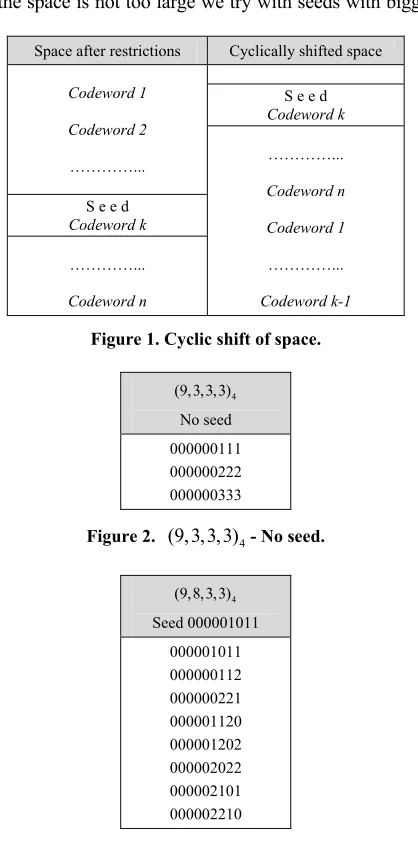
Remark: In some cases of searching with seed with one codeword we are applying cyclic shift of the space before start searching (see Figure 1). Codewords fr first to the index of the codeword included in the seed are om moved at the end of the space. Thus we have two parts of lexicographically ordered spaces. Then we obtain greedy search. This search produces better results in some cases. Example: We consider searching of (9,8,3,3)4 lexi-cographic constant-weight equidistant code.
can obtain dewords of
c ds. We use searching methods described in section. These methods are included in But if we use search with a seed we code with eight codewords (which is number of co
optimal code with such parameters) (see Figure 3).
4. Results
We obtain bounds for constant-weight equidistant codes sing standard lexicographic codes or lexicographi u
codes with see he previous t
coding theory computer package QPlus [19]. This soft-ware includes options for searching with or without a seed and seed size choosing. Also it offers searching with manually selected seed or automatically trying all possible seeds to find best code with given parameters. QPlus includes option for cyclic shift of the searching space. We perform search with all possible seeds with size one in order to find the best possible code. If the size of the space is not too large we try with seeds with bigger
Space after restrictions Cyclically shifted space
Codeword 1
Codeword 2
…………...
d S e e Codeword k
…………...
Codeword
S e e d Codeword k
n
…………...
C dewordo n
Codeword 1
…………...
[image:3.595.69.278.287.710.2]Cod word k-1e
Figure 1. Cyclic shift o f sp ce.a
4 (9,3,3,3)
No seed
000000111 000000222 000000333
Figure 2. (9,3,3,3)4- No seed.
4 (9,8,3,3)
Seed 000001011 000001011 000000112 000000221
000001202 000002022 000002101 000002210 000001120
Figure 3. - Seed 000001011.
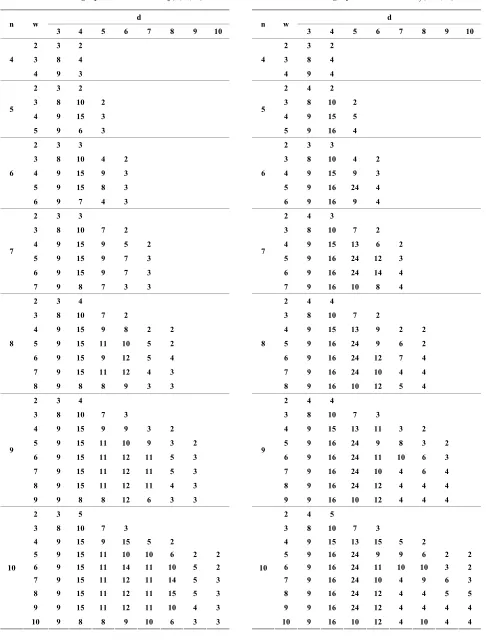
size. Results shown o bles are obtained using lexicographic code un Tables with bounds on the size of lexicogr ant-weight equidistant codes for q=3, q=4 a for 2 ≤ w < n ≤ 10 are presented in tables, in ix.
5. Conclusions
We use computer search methods in order to solve the
problem ounds o graphic
4 (9,8,3,3)
n the next ta it of QPlus. aphic const nd q=5 and the Append
of finding b n the size of lexico
constant-weight equidistant codes over the alphabet of three, four and five elements with 2 ≤ w < n ≤ 10. Inter-esting fact that could be used for future work is that in most of the cases lexicographic codes coincide with op-timal such codes [17,18].
6. Appendix
[image:3.595.305.537.343.721.2]In Tables 1, 2 and 3 are shown bounds on the size of lexicographic constant-weight equidistant codes over the alphabet of three, four and five elements.
Table 1. Lexicographic bounds for B n d w3( , , ).
d
n w
3 4 5 6 7 8 109
2 3 2 4
3 8 2 2 3 2
3 8 5 2
5
4 8 5 2
2 3 3
3 8 5 4 2
4 8 6 4 3
6
2 3 3
5 8 6 3 2
3 4
8 7 4 2
6 3 2
7 2 2
8 7 7 3 2
5 8 6 7
6 8 6 2 3 4
3 8 7 4 2
5 2 2
7 8 3 2
3 2
8
2 2
4 8 7 7
5 8 8
6 8 6 7 8
7 8 8 8 4
2 3 4
3 8 7 4 3
3 2
3 2
3 3
3 2
8 9 3 2 2
4 8 7 7 9
5 8 8 7 9 5
6 8 8 117 6
7 8 8 128 5
9
8 8 8 2 3 5
3 8 7 4 3
4 8 7 157 5 2
5 8 8 117 8 4 2 2
3 2
8 12 9 5 3 2
10 5 2 2
10
2 2
6 8 8 147 8 5
7 8 8
8 8 8 128
T. TODOROV ET AL. 186
le 2. Le o r h bounds r
Tab xic g ap ic fo B n d w4( , , ).
d
n w
4 6 7 8
3 5 109
2 3 2
3 8 4
4
4 9 3
2 3 2
3 18 5
5 9 6 3
0 2
4 159 3
2 3 3
3 108 4 2
9 3
8 3
4 3
4 159 5 15 9 6
6 9 7
2 3 3
3 108 7 2
2
9 7 3
3 7
7 3
4 159 9 5
5 15 9
6 159 9 7
7 9 8 3
2 3 4
3 108 7 2
4 159 9 8 2 2
5 2
4 11 12
8
8 5 159 11 10 6 159 129 5
7 159 4 3
8 9 8 9 3 3
2 3 4
3 108 7 3
3 2
11 10 11
3
3 9
3
4 159 9 9
5 159 9 3 2
6 159 11 12 5 3
7 159 11 12 11 5
8 159 11 12 11 4
9 9 8 128 6 3
2 3 5
3 108 7 3
4 159 159 5 2
5 9
6
15 9
11 11
10 14
10
2 3 3
3 3
6 2
10
2 5
15 11
7 159 11 12 11 14 5 8 159 11 12 11 15 5
9 159 11 12 11 10 4 10
[image:4.595.57.543.90.731.2]10 9 8 8 9 10 6 3
Table 3. Lexic raphic bounds or
d
og f B n d w5( , , ).
n w
5 6 7 8
3 4 109
2 3 2
3 8 4
4
4 9 4
2 4 2
3 108 2
5
5 169 4
3
4 159 5
2 3
3 8
9 3
24 4 6
9 4
10 4 2
4 159 5 169
6 169
2 4 3
3 108 7 2
6 2
12 3 24 14 4 7
4 4 159 13
5 169 24 6 169
7 169 10 8
2 4 4
3 108 7 2
2
24 9 6
7 4 8
4
4 159 13 9 2
5 169 2
6 169 24 12 4
7 169 24 10 4
8 169 10 12 5
2 4 4
3 108 7 3
13 11 3
8 2
3 4
4 9
4
4 159 2
5 169 24 9 3
6 169 24 11 10 6
7 169 24 10 4 6
8 169 24 12 4 4
9 169 10 12 4 4
2 4 5
3 108 7 3
5
9 2 2
2
9 3
5
4 4
4 159 13 15 2
5 169 24 9 6
6 169 24 11 10 10 3
7 169 24 10 4 6
8 169 24 12 4 4 5
9 169 24 12 4 4 4
10
7. References
[1] C. J. Colbourn Dinitz, handbook of c in t ial ign B n C ress, FL, 1996.
[2 J. I. Hall, “Bou s f tan de d p
jective planes,” scr M m s, 1 , . 5 4 1977.
[3] J a , A. J. . sen, A.W. K . . n Lint, “Equidistant codes with distance 12,” Discrete
V 17 . 71–83 1 7.
t, “A theorem on equidistant codes,”
Dis-“A new table of constant-weight codes,” IEEE
0.
rd, and G. T. Bogdanova,
nd V. K. Wei., “On
IEEE
Trans-RE Transactions on Information Theory, Vol. 6,
linear
pro-ht codes over the alphabet of three,
n-d and J. H.
des “The CRC
[10
omb a or s,” oca Rato , CR P
] nd or equidis t co s an artial Di ete athe atic Vol. 7 pp 8 –9 ,
dis
. I. H ll E. M Jan J. olen, and J H va [12]
M m s,
] J. H. van Lin
athe atic ol. , pp , 97 [4
crete Mathematics, Vol. 67, pp. 353–358, 1973.
[5] N. V. Semakov and V. A. Zinoviev, “Equidistant q-ary codes with maximal distance and resolvable balanced in-complete block designs,” Problemi peredachi Informatsii, Vol. 4, No. 2, pp. 3–10, 1968.
[6] A. E. Brouwer, J. B. Shearer, N. J. A. Sloane, and W. D. Smith,
[14]
Transactions on Information Theory, Vol. 36, pp. 1344– 1380, 1990.
E. Agrell, A. Vardy, and K. Zeger, “U
[7] pper bounds for
constant-weight codes,” IEEE Transactions on Informa-tion and Theory, Vol. IT-46, pp. 2373–2395, 200
gram
[8] G. T. Bogdanova, “New bounds for the maximum size of ternary constant weight codes,” Serdica Mathematics Journal, Vol. 26, pp. 5–12, 2000.
[9] M. Svanström, P. R. J. Östergå appl
“Bounds and constructions for ternary constant-composition codes,” IEEE Transactions on Information Theory, Vol. 48, No. 1, pp. 101–111, 2002.
] D. R. Stinson and G. H. J. van Rees, “The equivalence of certain equidistant binary codes and symmetric BIBDs,” Combinatorica, Vol. 4, pp. 357–362, 1984.
[11] F. W. Fu, T. Klove, Y. Luo, a
tant constant weight codes,” In Proceedings WCC’2001 Workshop on Coding and Cryptography, Paris, France, pp. 225–232, January 2001.
J. H. Conway, “Integral lexicographic codes,” Discrete Mathematics, Vol. 83, pp. 219–235, 1990.
[13] J. H. Conway and N. J. A. Sloane, “Lexicographic codes: Error-correcting codes from game theory,”
actions on Information Theory, Vol. 32, pp. 337–348, 1986.
R. A. Brualdi and V. S. Pless, “Greedy codes,” Journal of Combinatorial Theory (A), September 1993.
[15] M. Plotkin, “Binary codes with specified minimum dis-tance,” I
pp. 445–450, 1960.
[16] P. Delsarte, “Bounds for unrestricted codes, by ming,” Philips Research, Vol. 27, pp. 47–64, 1972. [17] G. Bogdanova, T. Todorov, and T. Pagkou, “New
equi-distant constant weig
four and five elements,” Preprint №1/2008, BAS, 2008. [18] G. Bogdanova, T. Todorov, and V. Zinoviev, “On co struction of q-ary equidistant codes,” Problems of Infor-mation Transmission, Vol. 43, pp. 13–36, 2007.