CONSTRUCTING UNIFORM CENTRAL GRAPHS AND EMBEDDING INTO THEM
Sandi Klavˇzar∗,∗∗,∗∗∗, Kishori P. Narayankar∗∗∗∗and S. B. Lokesh∗∗∗∗
∗Faculty of Mathematics and Physics, University of Ljubljana, Slovenia
∗∗Faculty of Natural Sciences and Mathematics, University of Maribor, Slovenia
∗∗∗Institute of Mathematics, Physics and Mechanics, Ljubljana, Slovenia
∗∗∗∗Department of Mathematics, Mangalore University, Mangalagangothri,
Mangalore 574199, India
e-mails: [email protected]; kishori [email protected];
(Received 26 January 2017; after final revision 1 September 2017;
accepted 10 July 2018)
A graph is called uniform central (UC) if all its central vertices have the same set of eccentric vertices. It is proved that ifGis a UC graph with radius at least3, then substituting a central vertexuofGwith an arbitrary graphHand connecting the vertices ofHto all neighbors ofu(in
G), yields a UC graph again. This construction extends several earlier ones and enables a simple argument for the fact that for anyr≥2and anyr+ 1 ≤d≤2r, there exists a non-trivial UC graphGwithrad(G) = randdiam(G) = d. Embeddings of graphs into UC graphs are also considered. It is shown that ifGis an arbitrary graph with at least one edge then at most three additional vertices suffice to embedGinto anr-UC graph withr≥2. It is also proved thatP3is the only UC graph among almost self-centered graphs.
Key words : Radius; diameter; uniform central graph; (almost) self-centered graph; central ap-pendage number.
1. INTRODUCTION
Graphs considered in this paper are finite, simple and connected. IfGis a graph, then the distance
dG(u, v) (ord(u, v)for short if the graph is clear from the context) between verticesuandvis the
standard shortest-path distance. The eccentricity eccG(u) (or ecc(u) for short) of the vertexu is max{dG(u, x) : x ∈ V(G)}. The minimum eccentricity and the maximum eccentricity over all
vertices ofG, respectively, are its radiusrad(G)and its diameterdiam(G). The centerC(G)ofG
Central vertices are important in location theory because when assigning resources to facilities
it is often desirable that the resources are located such that eccentricities of related vertices are as
small (or, sometimes also as large) as possible. In the extreme case when every vertex is central, that
is, whenC(G) = V(G)holds,Gis called a self-centered graph [3, 4, 15, 20]. IfC(G) 6= V(G),
thenGcontains at least two non-central vertices; graphs with exactly two non-central vertices were
introduced in [17] and named almost self-centered (ASC) graphs. Further properties of these graphs
were determined in [1, 16]. On the other extreme one finds the so-called almost-peripheral (AP)
graphs that were introduced in [18] as the graphs in which all but one vertex are peripheral, see also
[16]. (A vertex is peripheral if its eccentricity is maximum.) We point out that recently a measure
of non-self-centrality was introduced in [22], where ASC graphs and AP graphs (as well as a newly
introduced weakly AP graphs) play a significant role as extremal graphs. For some recent studies of
the (average) eccentricity of graphs we refer to [5, 8, 10, 11, 13, 14] while for an additional role of
the eccentricity in network theory see [2, 19, 21].
Sometimes it is desirable that the central vertices of a graph are indistinguishable because in such
a network selecting randomly one of the central vertices for a location of a resource makes an optimal
choice. A natural way how to give a meaning to “indistinguishable” was proposed in [6] as follows.
IfGis a graph andu∈V(G), then letEcc(u) ={x: d(u, x) = ecc(u)}; we say thatEcc(u)is the
periphery ofuinG. The graphGis a uniform central graph, UC graph for short, if u, v ∈ C(G)
implies thatEcc(u) = Ecc(v). In words, a graph is a UC graph if all its central vertices have the
same periphery. Ifrad(G) = r, then we will say thatGis an r-UC graph. If|C(G)| = 1, that is,
whenGhas a unique central vertex, thenGis trivially a UC graph. We will therefore call such graphs
trivial UC graphs.
Clearly, no self-centered graph on at least two vertices is a UC graph. The variety of UC graphs
among the almost-self centered graphs is only a fraction larger as the next result asserts.
Proposition 1.1 — LetGbe an ASC graph. ThenGis a UC graph if and only ifG=P3.
PROOF: By anr-ASC graph we mean an ASC graph of radiusr.
Assume first thatGis anr-ASC graph,r≥2. Assume further thatGis a UC graph and suppose
that|V(G)| ≥ 4. Letu andv be the two non-central vertices ofG. ThendG(u, v) = r+ 1 ≥ 3.
LetP be a shortestu, v-path, and letxandybe the neighbors ofuandvon P, respectively. Then
x, y ∈C(G)and becausedG(u, v) ≥3, we infer thatx 6= y. But then clearlyxandy do not have
the same periphery. So|V(G)| ≤3must hold and hence we are left withG=P3which is a1-ASC
Let nowGbe a1-ASC graph. According to [17],Gmust be isomorphic toKn−e, that is, to the
complete graphKnwith one edge removed. Now,K3−e=P3, whileKn−e,n≥4, is not a UC
graph. 2
The rest of the paper is organized as follows. In the next section we give a construction of UC
central graphs and apply it to show that for anyr ≥ 2and anyr+ 1 ≤d≤ 2r, there exists a
non-trivialr-UC graph Gwith diam(G) = d. This result has been first proved in [7], the advantage of
our construction is its simplicity. Then, in Section 3, we show that the construction from the previous
section covers several earlier ones, for instance a couple of results from [12] on the so-called central
appendage number of a graph. We also consider minimal embeddings of graphs into UC graphs and
prove that any graph can be embedded into anr-UC graph,r ≥2, with the addition of at most three
vertices.
2. CONSTRUCTINGUC GRAPHS
LetGandHbe graphs and letu∈V(G). Then the graphG⊗uHis obtained fromGby replacing
the vertexuwith the graphH and joining all the vertices ofH with all the neighbors of u(inG).
In other words, G⊗u H is obtained from the disjoint union of G− {u} andH by making a join
betweenHand the open neighborhoodN(u)ofuinG. Using this operation, we can construct many
UC graphs as follows.
Theorem 2.1 — LetGbe anr-UC graph,r ≥3, and letH be an arbitrary graph. Ifu∈C(G)
andX = G⊗u H, thenX is anr-UC graph with C(X) = (C(G)− {u})∪V(H). Moreover, rad(X) = rad(G)anddiam(X) = diam(G).
PROOF : We start with the following:
Claim A : The vertices inHare not capable of shortening the shortest paths inG.
LetP be a shortest path inXwith|P| ≥3. Note first thatP cannot lie completely inH. Indeed,
for otherwiseP is not a shortest path because |P| ≥ 3 and the first and the last vertex of P are
adjacent to (at least one) common vertex inN(u). Hence we may assume without loss of generality
that the first vertex fromV(P)∩V(H)has a neighborx0inN(u). IfP contains another vertex of
H, then,x0 being adjacent to another vertex ofV(P)∩V(H), we see again thatP is not a shortest
path. We have thus proved that if|P| ≥3, then|V(P)∩V(H)| ≤1. So letP be a shortest path inX
andx∈V(P)∩V(H). By the above,xis onP adjacent tox0, x00∈N(u). But then thex0−x−x00
subpath ofP can be replaced withx0−u−x00to obtain a path inGof the same length. Claim A is
Consider now the eccentricity of a typical vertexxofX. Suppose first thatx ∈C(G). (Clearly,
asxis a vertex ofX, we havex6= u.) Lety ∈V(G). IfdX(x, y) < dG(x, y)would hold, then by
Claim A a shortestx, y-pathPwould necessarily contain exactly one vertex fromH, but then anx, y
-path inGwould exist of the same length asP. Indeed, just replace the vertex ofPfromHwithu. It
follows thatdX(x, y) =dG(x, y)holds for any vertexy ∈V(G). In addition,dX(x, y) = dG(x, u)
holds for any vertexy∈V(H). It follows thateccX(x) = eccG(x) =r.
Consider next the situation whenx ∈V(H). Note that thendX(x, y) ≤2holds for any vertex
y ∈ V(H), y 6= x. Furthermore, if y ∈ V(G), thendX(x, y) = dG(u, y) ≤ r, where the last
inequality holds sinceu ∈ C(G). Moreover, since rad(G) = r, we find that also in this case eccX(x) =r.
Assume finally thatx∈V(G)−C(G). Then there exists a vertexy∈V(G)such thatdG(x, y)>
r. But then, using Claim A again, alsodX(x, y)> r and sox /∈C(X). We conclude thatC(X) = (C(G)− {u})∪V(H).
Note that above arguments in particular imply thatrad(X) = rad(G)anddiam(X) = diam(G).
It remains to prove thatXis a UC graph. Ifx∈C(G), thenuis not in the periphery ofx(cf. [6,
Theorem 3]), and consequently no vertex ofHis in the periphery ofx. It follows thatxhas the same
periphery inXas in G. Let nowx ∈ V(H). Then no vertexy ∈ V(H)is in periphery ofxsince
dX(x, y)≤2andr≥3. But then the periphery ofxinXis the same as the periphery ofuinG. We
conclude that all the vertices fromC(X) = (C(G)− {u})∪V(H)have the same periphery. 2
Note that Theorem 2.1 enables us to transform a trivial r-UC graph into a non-trivial one by
choosing anHwith|V(H)|>1.
The reason that we have defined G⊗u H such that the vertexu is removed is that in the case
when|C(G)|= 1, the constructed graphX =G⊗uHhas the propertyC(X) = V(H). This will
be useful to us in the sequel. On the other hand, the construction can be made a bit simpler by adding
HtoGwithout removing a vertex ofG. Also in this case the conclusion holds, more precisely, we
have the following:
Corollary 2.2 — LetGbe anr-UC graph,r ≥3, letH be an arbitrary graph, and letu∈C(G).
LetXbe the graph obtained from the disjoint union ofGandHby making a join betweenHand the
open neighborhood ofuinG. ThenXis anr-UC graph withC(X) =C(G)∪V(H).
PROOF: LetH0 =H∪K1. ThenX is isomorphic toG⊗uH0 because the vertex ofK1 plays
As observed in [6], all1-UC graphs are trivial UC-graphs. But as soonr ≥ 2, there exist
non-trivialr-UC graphs for any possible diameter, that is, for any diameter betweenr+ 1and2r. This
result was first proved by Choi and Guan in [7] in order to demonstrate that a conjecture from [6]
asserting that anr-UC graph has diameter at leastr+b(r+ 1)/2cdoes not hold.
Let us briefly describe the construction of Choi and Guan. For given radiusr and diameter d,
wherer < d ≤2r, setm =d−r. Start with the cycleC4m. Then take4mdisjoint paths of length
r−1and respectively identify an end-vertex of each with a vertex ofC4m. LetX be the set of4m
vertices of degree1in the so far constructed graph. Finally add two more verticesaandb, and add
the edge between them as well as all edges betweenaandband the vertices fromX.
Using Theorem 2.1 we now reprove the above result since our construction is simpler and the
result is stronger.
Theorem 2.3 — For anyr ≥2and anyr+ 1≤d≤2rthere exists a non-trivialr-UC graphG
withdiam(G) = d. Moreover, ifr ≥ 3, andHis an arbitrary graph, thenGcan be selected such
thatHis an induced subgraph ofG.
PROOF: LetQ−3 be the graph obtained from the3-cubeQ3by removing one of its vertices. Then
it is straightforward to verify thatQ−3 ⊗uK2is a non-trivial 2-UC graph of diameter3, whereuis the
center ofQ−3, and thatP5⊗uK2is a non-trivial 2-UC graph of diameter4, whereuis the center of
P5. In the rest of the proof we may hence assume thatr≥3.
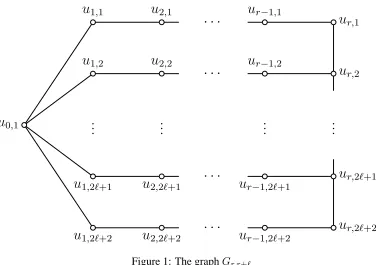
Let Gr,r+`, r ≥ 3, 1 ≤ ` ≤ r, be the graph constructed as follows. Take 2`+ 2 disjoint
paths of lengthr, select one end-vertex in each of them, and identify these vertices. In other words,
the graph so far is obtained from K1,2`+2 by subdividing r −1 times each of its edges. Finally,
connect the pendant vertices of this temporary graph such that they induce a path. The graphGr,r+`
is schematically presented in Fig. 1, where the notation for its vertices to be used in the sequel is also
introduced.
To shorten the notation setG=Gr,r+`for the rest of the proof. We claim thatdiam(G) =r+`.
For1≤i < j ≤2`+ 2, letCij be the following cycle ofG:
Ci,j : u0,i, u1,i, . . . , ur,i, ur,i+1, . . . , ur,j, ur−1,j, . . . , u1,j, u0,1.
The longest of these cycles isC1,2`+2, its length is2(k+`) + 1. Since each pair of verticesx, yofG
lies on some cycleCi,j, we infer thatdG(x, y)≤dCi,jx, y≤k+`. Moreover,
dG(ur−(r−`),1, ur,2`+1) = dG(ur−(r−`),1, u0,1) +dG(u0,1, ur,2`+1)
which proves thatdiam(G) =r+`.
r,r+`
It is straightforward to see that the vertex vertexu0,1is the unique central vertex ofG=Gr,r+`.
Consequently,Gr,r+` is a trivialr-UC graph. Using Theorem 2.1 we can construct a non-trivialr
-UC graphGr,r+`⊗u Hwhich containsH as an induced subgraph. Finally,diam(Gr,r+`⊗uH) =
diam(Gr,r+`) =r+`. 2
3. EARLIER CONSTRUCTIONS ANDEMBEDDINGSINTOUC GRAPHS
Note that Theorem 2.1 does not hold forr = 2. Consider for instanceP5 which is a trivial 2-UC
graph, and denote withuits central vertex. Then the graphP5⊗uK2is not a 2-UC graph, the reason
being that the vertices ofK2(two independent vertices) are pairwise peripheral inP5⊗uK2. On the
other hand, the construction works also forr = 2if the graphH is complete. ThenP5⊗uKn is a
2-UC graph. We also note that the 2-UC graphQ−3 ⊗uK2from the proof of Theorem 2.3 is the graph
from [6, Fig. 1].
In [12] the central appendage number Aucg(G) of a graph G was introduced as the smallest
number of vertices to be added toGsuch that the resulting graph H is a UC graph with C(H) =
V(G). It was proved that for any connected graph G of order at least two, 4 ≤ Aucg(G) ≤ 6.
[image:6.612.140.516.154.419.2]Moreover,Aucg(G) = 4if and only ifGis a complete graph, while for any non-complete graphG, Figure 1: The graphG
· · ·
· · ·
· · ·
· · ·
..
.
..
.
..
.
..
.
u
0,1u
1,1u
2,1ur
−1,1ur,
1u
1,2u
2,2ur
−1,2ur,
2u
1,2ℓ+1u
2,2ℓ+1ur
−1,2ℓ+1ur,
2ℓ+1u
1,2ℓ+2u
2,2ℓ+2ur
−1,2ℓ+2Aucg(G) = 6holds. To prove that ifGis an arbitrary graph on at least two vertices, thenAucg(G)≤6
holds, Gu actually considered
X=P7⊗uG ,
whereuis the center ofP7. As Theorem 2.1 implies,Xis then a3-UC graph withC(X) =C(G)as
required. Moreover, Gu also considered
Y =P5⊗uKn,
whereuis the center ofP5. Then by the discussion in the first paragraph of this section,Y is a2-UC
graph withKnas its center.
The requirement thatC(H) = C(G)can be relaxed by changing the condition thatV(G)is the
center of the UC graph that containsGto the condition thatGis an induced subgraph of it. Hence
we setAbucg(G)to be the smallest number of vertices to be added toGsuch that the resulting graph
His anr-UC graph for somer≥2, that is,
b
Aucg(G) = min{|V(H)| − |V(G)|: Ginduced inH, H r-UC graph, r≥2}.
We impose the latter technical condition (that is,r ≥ 2) to avoid trivialities. For instance, ifG
contains a vertexxadjacent to all other vertices, then attaching toxa pendant vertex yields a1-UC
graph. For this new graph invariant we have:
Theorem 3.1 — IfGis an arbitrary graph with at least one edge, thenAbucg(G)≤3. Moreover,
the bound is sharp.
PROOF: Letuv be an edge ofG. LetH be the graph obtained fromGby adding the verticesx,
y,z, the edgesux,xy,yz, and the edges{xw: w∈V(G), dG(w, u)≥2}. It is now straightforward
to check thateccH(x) = 2whileeccH(w) ≥3holds for any vertexw6=x. This means thatHis a 2-UC graph and soAbucg(G)≤3.
To demonstrate that the bound is sharp we are going to prove thatAbucg(Kn) = 3holds for any
n ≥ 2. Since Kn is self-centered, Abucg(Kn) ≥ 1. If we add a new vertex and connect it to at
least one vertex ofKn, we obtain a graph of radius1. Therefore,Abucg(Kn) ≥2. Assume now that
b
Aucg(Kn) = 2holds and letHbe anr-UC graph,r≥2, with the vertex setV(H) =V(G)∪ {x, y}.
Suppose first that x andy both have a neighbor inKn, sayx0 and y0, respectively. Note first that
x0 6=y0, for otherwiserad(H) = 1. From the same reason,x0y /∈E(H)andxy0 ∈/ E(H). But now
dH(x, y) = 3,x∈Ecc(y0), andx /∈Ecc(x0), which is not possible sincex0, y0 ∈C(H). It remains
Then clearlyxy ∈E(H). But nowx0andxmust lie inC(H)and sinceyis in the periphery ofx0but
not in the periphery ofx, we conclude that this case is also impossible. It follows thatAbucg(Kn)≥3
and hence by the first paragraphAbucg(Kn) = 3. The bound is thus sharp. 2
Note that the graphH from the proof of Theorem 3.1 which demonstrates that Abucg(G) ≤ 3
holds for any graphGhas a unique central vertexx. HenceHis a trivial UC graph. One might prefer
that the super graph ofGwould be a non-trivial UC graph. In the case thatHis anr-UC graph with
r ≥3, then in view of Theorem 2.1, a non-trivial UC-graph can be constructed with the addition of
a single additional vertex. In general, however, we leave the investigation of such embeddings for
future research.
4. CONCLUDINGREMARKS
In Section 3 we have considered embeddings of graphs into UC graphs in view of the least number of
vertices required to be added to a given graph in order to turn into an UC graph. This definition is in
lines with several earlier related investigations; the central appendage number [12] was our primary
motivation, but see also [9, 17, 18] where the same approach has been followed. On the other hand,
adding few additional vertices might require that a lot of edges must be added. Hence we pose the
following:
Problem 4.1 : Study the problem of determining the least number of edges which need to be added
to a given graph in order the obtained graph is an UC graph. In particular, compare the efficiency of
such embeddings with the ones from Section 3.
Note that the embedding concept from the above problem is well-defined since in the worst case
we end up with a complete graph on the same vertex set.
The graphHfrom the proof of Theorem 3.1 which demonstrates thatAbucg(G)≤3holds for any
graphGhas a unique central vertexx. HenceHis a trivial UC graph. One might prefer that the super
graph ofGwould be a non-trivial UC graph. Hence we pose:
Problem 4.2 : Prove a general upper bound on the number of vertices needed to be added to an
arbitrary graph such that the obtained graph is a non-trivial UC graph.
ACKNOWLEDGEMENT
We are grateful to a referee for numerous helpful suggestions.
Nos. P1-0297 and N1-0043). KN thanks Department of Science and Technology (SERB),
Govern-ment of India for supporting through SB/EMEQ-119/2013.
REFERENCES
1. K. Balakrishnan, B. Breˇsar, M. Changat, S. Klavˇzar, I. Peterin, and A. R. Subhamathi, Almost self-centered median and chordal graphs, Taiwanese J. Math., 16 (2012), 1911-1922.
2. J.-C. Bermond, Z. Liu, and M. Syska, Mean eccentricities of de Bruijn networks, Networks, 30 (1997), 187-203.
3. F. Buckley, Self-centered graphs, Ann. New York Acad. Sci., 576 (1989), 71-78.
4. G. Chartrand, W. Gu, M. Schultz, and S. J. Winters, Eccentric graphs, Networks, 34 (1999), 115-121.
5. C. T. Cheng, E. McDermid, and I. Suzuki, Eccentricity, center and radius computations on the cover graphs of distributive lattices with applications to stable matchings, Discrete Appl. Math., 205 (2016), 27-34.
6. S.-y. Choi and N. Maickam, Uniform central graph, Congr. Numer., 130 (1998), 89-94.
7. S.-y. Choi and P. Guan, Construction of a family of uniform central graphs, Congr. Numer., 173 (2005), 75-78.
8. P. Dankelmann and S. Mukwembi, Upper bounds on the average eccentricity, Discrete Appl. Math., 167 (2014), 72-79.
9. P. Dankelmann and G. Sabidussi, Embedding graphs as isometric medians, Discrete Appl. Math., 156 (2008), 2420-2422.
10. Z. Du, Further results regarding the sum of domination number and average eccentricity, Appl. Math. Comput., 294 (2017), 299-309.
11. Z. Du and A. Ili´c, A proof of the conjecture regarding the sum of domination number and average eccentricity, Discrete Appl. Math., 201 (2016), 105-113.
12. W. Gu, On central appendage number of a uniform central graph, Congr. Numer., 159 (2002), 69-75.
13. A. M. Hinz and D. Parisse, The average eccentricity of Sierpi´nski graphs, Graphs Combin., 28 (2012), 671-686.
14. M.-j. Hu and L.-b. Wang, Remarks on the sum of squares of eccentricity of graphs, Util. Math., 93 (2014), 375-381.
15. T. N. Janakiraman, M. Bhanumathi, and S. Muthammai, Self-centered super graph of a graph and center number of a graph, Ars Combin., 87 (2008), 271-290.
17. S. Klavˇzar, K. P. Narayankar, and H. B. Walikar, Almost self-centered graphs, Acta Math. Sin. (Engl. Ser.), 27 (2011), 2343-2350.
18. S. Klavˇzar, K. P. Narayankar, H. B. Walikar, and S. B. Lokesh, Almost peripheral graphs, Taiwanese J. Math., 18 (2014), 463-471.
19. S. Li and W. Wei, Some edge-grafting transformations on the eccentricity resistance-distance sum and their applications, Discrete Appl. Math., 211 (2016), 130-142.
20. Z. Stani´c, Some notes on minimal self-centered graphs, AKCE Int. J. Graphs Comb., 7 (2010), 97-102.
21. F. W. Takes and W. A. Kosters, Computing the eccentricity distribution of large graphs, Algorithms (Basel), 6 (2013), 100-118.