1 The Role of Auditory Perceptual Gestalts on the Processing of Phrase Structure
Antony Scott Trotter
This thesis is submitted in partial fulfilment of the requirements for the degree of Doctor of Philosophy
Lancaster University Department of Psychology
2 Table of Contents
Table of contents………2
Alternative format forms………3
Declaration……….3
List of Tables……….4
List of Figures………7
List of Abbreviations………10
Acknowledgements………...11
Thesis Abstract………12
1. Introduction………...14
Chapter 2: Exploring variation between artificial grammar learning experiments: Outlining a meta-analysis approach ………37
Chapter 3: Chained Melody: Low-level acoustic cues as a guide to phrase structure in comprehension………..67
Chapter 4: Multiple natural language cues assist the processing of hierarchical structure………..113
Chapter 5: Auditory-perceptual Gestalts affect the acquisition of hierarchical structure………..153
Chapter 6: Gaze behaviour in the visual world suggests auditory-perceptual Gestalts facilitate the comprehension of hierarchical structure………...192
7.General Discussion……….262
3 Declaration
4 List of Tables
Chapter 2
Table 1 Contributions of each moderating variable to account for variance in effect sizes across studies.
Table 2 Moderator effects for human adults studies. Table 3 Moderator effects for human infants studies. Table 4 Moderator effects for non-human primate studies.
Table 5 Moderator effects for avian studies. Table S1 Forest Plot Key.
Table S2 Moderator effects for looking time studies
Table S3 Moderator effects for two-alternate forced choice studies. Table S4 Moderator effects for go no-go studies.
Table S5 Moderator effects for looking preference studies. Chapter 3
Table 1 Results of the final mixed-effects model predicting a given words F0hz from phrasal
position, and syntactic form
5 Table 3 Results of final mixed-effects model predicting pause duration from pause location and syntactic form.
Table 4 Results of mixed-effects model predicting pause likelihood from pause location and syntactic form. The model contained random intercepts but no random slopes.
Chapter 4
Table 1 Accuracy Final Model Outcomes. Table 2 A’ Final Model Outcomes.
Table 3 Response Bias Final Model Outcomes. Chapter 5
Table 1 Accuracy Final Model Outcomes Table 2 A’ Analysis Final Model Outcomes
Table 3 Response Bias Final Model Outcomes Chapter 6
Table 1 Pitch and temporal dynamics by sentence structure Table 2 GLMER model outcomes for response accuracy Table 3 Analysis region onsets and offsets by syntactic form
Table 4 GLMER Model outcomes for target fixation likelihood in analysis region 1 Table 5GLMER model outcomes for target fixation likelihood in analysis region 2 Table 6 GLMER model outcomes for target fixation likelihood in analysis region 3
6 Table 9 GLMER model outcomes predicting target fixation likelihood in analysis region 3
Table 10Onsets and offsets for analysis regions by prosodic form
Table 11GLMER model outcomes predicting target fixation likelihood in analysis region 1 Table 12GLMER model outcomes predicting target fixation likelihood in analysis region 2 Table 13GLMER model outcomes predicting target fixation likelihood in analysis region 3 Table 14Onsets and offsets for analysis regions by prosodic form
7 List of Figures
Chapter 2
Figure 1. A forest plot containing effect sizes and 95% confidence intervals for artificial grammar learning across studies, indexed by paper, experiment and contrast.
Chapter 3
Figure 1. Adapted from Cooper, Paccia, and Lapointe (1978), tree representations for an indirect question interpretation (top), and a relative clause interpretation (bottom) of the test sentence. Figure 2.Example stimuli from Montag & MacDonald (2014).
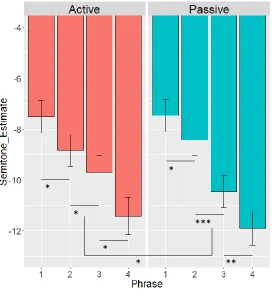
Figure 3. Syntactic trees for reduced active-object (right) and passive (left) relative clauses. Figure 4. Model estimates of phrasal pitch (F0hz) on the basis of syntactic form and phrasal
position.
Figure 5. Model estimates of semitone distance from middle C on the basis of syntactic form and phrasal position
Figure 6. Model estimates of log duration for pause location by syntactic form. Figure 7. The proportion of non-zero vs. zero-pauses on the basis of syntactic form.
Chapter 4
Figure 1. Peak F0Hz on the first word of each phrase for HCE structures (adapted from Fery &
Schubö, 2010).
Figure 2. Structure of the experimental grammars.
8
Figure 4. This figure displays mean A’ by block and LoR.
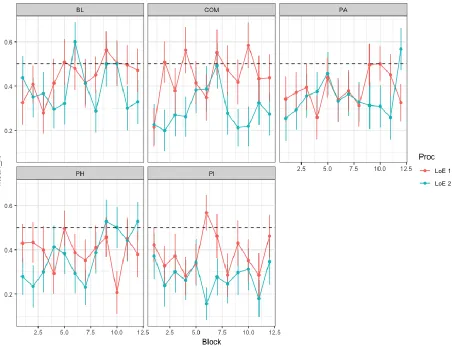
Figure 5. This figure displays mean Response Bias by Condition and LoE
Chapter 5
Figure 1. The top sentence illustrates a sentence without (top) and with (bottom) crossing dependencies.
Figure 2: Example structures from language 1.
Figure 3. Displays the mean judgement accuracy per condition, block, and LoE. Figure 4. Mean A’ by LoE
Figure 5. The figure displays Respone bias by LoE Chapter 6
Figure 1. Example experimental display, for the sentence, “The boy the girl kicks runs”.
Figure 2. Model estimates of probability of making a correct response split by syntactic form and condition.
Figure 3. Mean proportion of looks to target by prosodic condition, for active structures.
Figure 4. Model estimates of the likelihood of fixating the target over the analysis region. Figure 5. Model estimates of the likelihood of fixating the target over the analysis region.
Figure 6. Mean proportion of looks to target by prosodic condition, for passive structures. Figure 7. Model estimates of the likelihood of fixating the target over the analysis region.
9 Figure 10. Model estimates of the likelihood of fixating the target over the analysis region.
Figure 11. Mean proportion of looks to target by prosodic condition, for passive structures. Figure 12. Model estimates of the likelihood of fixating the target over the analysis region.
10 List of Abbreviations
AGL Artificial grammar learning
FSG Finite state grammar
G Grammatical
HCE Hierarchical centre-embedded structures
LoE Levels of embedding
PSG Phrase structure grammar
U Ungrammatical
11 Acknowledgements
I would firstly like to thank my two supervisors, Professors Padraic Monaghan and Gert Westermann for their support, guidance, and many stimulating conversations over the years. I also thank my lab group, who were always willing to chip in to solve any design or analysis problems, and who were patient when I raised the minutiae of some statistics or why violin plots are simply wonderful (much to Padraic’s vexation). Though we might be scattered across a vast swathe of the world now, it will always be wonderful to catch up. A special thank you goes to Rebecca Frost, who’s diligent editing has been immeasurably helpful, and who’s plucky, tireless attitude never fails to inspire. James Brand also deserves an honourable mention. Without his help, many an R script would be far, far more clunky, and his academic curiosity led to some wonderful interrogations of theory. Plus, he once stopped a chap from pick-pocketing me in Brussels.
I also want to thank my friends, particularly David Elliott and Rebecca Iversen. David gets me thinking about complex methods and new skills, while Rebecca keeps me grounded, and reminds me that not everyone understands me when I speak a million miles an hour about my work. I think it’s safe to say I wouldn’t have made it through writing up without my partner, Shal. Tirelessly supportive, and ever patient, she deserves the biggest thanks. So, Shal: Thanks, you’re a diamond!
12 Abstract
Hierarchical centre embeddings (HCEs) in natural language have been taken as evidence that language is not processed as a finite state system (Chomsky, 1957). While phrase structure may be necessary to produce HCEs, finite state, sequential processing may underlie their comprehension (Frank, Bod, & Christiansen, 2012). Under this account, listeners employ surface level cues (e.g. semantic content) to determine the dependencies within an utterance, instead of processing the words in a hierarchy. The acoustic structure of speech reflects the speaker’s syntactic representation during production (Cooper, Paccia & Lapointe, 1978). In comprehension, temporal (Snedeker & Trueswell, 2003) and pitch (Watson, Tanenhaus, & Gunlogson, 2008) cues rapidly influence processing. Therefore, temporal and pitch variation in speech could contain cues to dependencies. We examine whether grouping behaviour may be driven by Gestalt principles. Temporal proximity suggests that individuals group sequential words that occur closer together in time. Pitch similarity states that individuals group sequential words that are similar in pitch. In this thesis, I examine whether these Gestalts support dependency detection in speech, providing a mechanism through which hierarchical structure can be processed non-hierarchically.
13 Two artificial grammar learning studies assessed whether pitch similarity and temporal proximity cues support the acquisition of phrase structure grammar. Chapter 4 emphasised temporal proximity cues, while chapter 5 emphasised pitch similarity cues. In Chapter 5, pitch similarity cues improved classification performance for structures with two levels of embedding. In both, participants did not benefit from temporal proximity cues. However, the results of a cross-species meta-analysis of artificial grammar learning studies (Chapter 2) raised the possibility that reflection-based measures (e.g. grammaticality judgements) are not well suited for assessing processing-based learning, such as online speech processing (Christiansen, 2018). To properly assess the role of Gestalt cues in speech processing therefore requires processing-based measures. To assess the influence of auditory Gestalts on online speech processing, in Chapter 6 we analysed participants’ gaze behaviour in response to pitch similarity and temporal proximity cues using the visual world paradigm. Participants heard speech-synthesised active-object and passive relative clauses, whilst viewing four potential targets. Each sentence had a prosodic structure consistent with either syntactic form (Chapter 3), or two control prosodic structures. Pitch similarity results indicated that these cues facilitated processing. Temporal proximity cues consistent with syntactic structure did not facilitate processing, instead results suggested a general benefit of increased processing time.
14 1. Introduction
1.1The theoretical importance of hierarchical structure
Determining the mechanisms that underpin human language processing remains a key focus of psycholinguistic research. Chomsky (1957; 1959) proposed a generative hierarchy of rule systems capable of generating an infinite number of sequences by defining increasing constraints on possible structures. At the lowest level of this hierarchy lie finite state grammars. Finite state grammar sequences can be fully specified by transitional probabilities between a finite number of states (Hauser & Fitch, 2004). The resulting sequences require only a large enough memory stack to hold sequential states, and the transitions between them, in order to concatenate them into longer sequences. An example of a finite state grammar sequences would be, “[C-1 Rebecca cooks,] [C-2
Dave cleans]”. Phrase structure grammars are the next level of the hierarchy. Much like finite state grammars they can concatenate items. Crucially, it has recently been proposed that through the recursive application of the merge operation (Chomsky, 1995), phrase structure grammars can embed strings within other strings, resulting in phrase structures and long-distance dependencies, e.g. “[C-1 The man [C-2 the doctor treated] was in pain]”. The mechanisms required to generate and
15 Chomsky, & Fitch, 2002). Probing the processing differences between sequences generated by these two grammars provides insights into the mechanisms of human language processing.
1.2Hierarchical centre-embedded structures in comprehension
The existence of hierarchical centre-embeddings (HCE) in natural language has been taken as evidence that language is not a finite state system. However, whilst individuals can process hierarchical-centre embeddings, their ability to do so is limited. HCEs with more than three levels of embedding are challenging to process, even for proficient, native speakers (e.g. e.g. Bach, Brown, & Marslen-Wilson, 1986; Hudson, 1996; Newmeyer, 1988). This statute from s.1 of the British Road Traffic Act (1972) is a fairly typical example of a three level of embedding construct; “A person [C-1 who, [C-2 when riding a cycle, [C-3 not being a motor vehicle,] on a road or other
public place,] is unfit to ride through drink or drugs,] shall be guilty of an offence.” As more clauses are embedded, the distance between dependent constituents increases, together with the difficulty of relating them to one another (Lai & Poletiek, 2011). Recent computational work reinforces this idea. In a large sample of syntactic trees taken from the Prague and Stanford corpora, Ferrer-i-Cancho and Gomez-Rodriquez (2016) found a positive correlation between the sum of dependency lengths in a sentence, and the number of crossings a sentence would contain; as dependency lengths increase, the amount of centre-embeddings produced becomes less frequent. Taken together, this suggests that humans’ capacity to generate and process hierarchical structure is limited.
16 memory (WM) (Karlsson, 2010). As more embeddings are included in a sentence, the more information needs to be stored. WM cost, here, is specifically quantified in terms of the number of syntactic categories that are necessary to complete the current input as a grammatical sentence (Gibson, 1998). Maintaining open syntactic dependencies increases WM cost, therefore, increased distance between the start and end of a dependency results in increased maintenance costs, effectively setting a resource-based cap on the maximum number of embeddings a sentence can contain. WM costs have been used to explain the missing verb effect, whereby centre-embeddings lacking a verb-phrase are viewed as acceptable (e.g. “The patient who the nurse who the clinic hired met jack”) (Gibson & Thomas, 1999). However, this effect is not universal; the missing verb effect is not present in speakers of German (Vasishth et al., 2010) and Dutch (Frank et al., 2015), who find the grammatical versions of these sentences easier to process. Verb-final constructions are common in German and Dutch, and require the listener to track dependency relations over long distances, suggesting that experience results in language-specific processing improvements (Christiansen & Chater, 2015). Usage-based accounts (Christiansen & Chater, 2015) could thus account for the difficulties English speakers face with centre-embedded structures.
1.3Hierarchical centre-embedded structures in production
17 probe questions relating to particular objects in each scene. Scenes contained two competing depictions of events involving the same action, and two competing depictions of the target object, one animate, one inanimate. For example, a scene might depict a nursery room, with a girl hugging a man wearing a green jacket, another girl hugging a white bear, a brown bear on a table, and a man wearing a brown shirt reading in the background. Participants responded to probe questions (e.g. animate-target, “Which man is wearing green?”; inanimate-target “Which bear is white?”). Participants were more likely to produce active-object relative clauses when asked to describe an animate agent interacting with an inanimate object (e.g. “The bear the girl is hugging is brown), and more likely to produce a passive relative clause when an animate agent interacts with an animate target (e.g. “The man being hugged by the girl is wearing green”). This suggests that, first, visual competition biases production towards relative clause structures, and that animacy factors create a bias towards active-object structures.
1.4 Sequential processing accounts
18 models) and third (echo state networks) class of models had access only to sequential structure. The phrase structure grammar models failed to estimate variance in reading time data over and above all sequential structure models, suggesting that hierarchical sentence structure did not effectively predict response times associated with the generation of expectations about upcoming words.
Recently, Frank, Bod, and Christiansen (2012) have proposed that the comprehension of hierarchical structure is potentially achieved through sequential processing. Under this account, to comprehend a hierarchical structure in a rapidly unfolding temporal context (i.e. incoming speech), the listener would need to rely on superficial surface level cues to determine the dependencies within an utterance, instead of processing the incoming sequence of words hierarchically, in accord with the structure of the sentence. Returning to our example from the British Road Traffic Act (1972), world knowledge can be used to determine the dependencies. Bicycles can neither be guilty of a criminal offence, nor can they be inebriated, but they are ridden on roads and in public spaces. On the other hand, humans ride bikes, imbibe drink and drugs, feel their effects, and can be guilty of offences. Through semantic knowledge, then, you can generate the following units, “person riding bike” “(if) bike is on road”, “(if) person drunk”, “(then) person is guilty”.
1.5 The relationship between syntax and prosody
19 speech – has been shown to relate to syntactic structure. For instance, in English, clauses are often cued with phrase-initial pitch-resetting, phrase-final declining pitch contour (Pierrehumber, 1979), increased duration on phrase final words (Langus, Marchetto, Hoffman, Bion, & Nespor, 2012), as well as increased duration syllable-finally within words (Cooper, Paccia, & Lapointe, 1978). Based on studies of language production, it has been suggested that the tonal and temporal structure of utterances is generated by the speaker’s syntactic representation.
1.5.1 Syntax and prosody in production
Cooper and Sorensen (1977) demonstrated that the pitch dynamics of a sentence reflect its hierarchical structure. In this study, speakers were presented with sentences to read aloud, and were first asked to read them silently, in isolation, and consider their semantic interpretation. Speakers then practiced the sentence aloud, receiving corrective feedback about their stress pattern, before reading the sentence aloud again for recoding. In experiment 1, the materials were sentences that either included two main clauses (“[C-1 Marie was listening to the song] [C-2 and Del
was playing]”), or a main clause and an embedded clause (“[C-1 Marie was listening to the song [ C-2 Adelle was playing]]”), matched for total number of syllables and approximate stress contour. In
the former, the internal syntactic boundary is between the end of the first, main clause, and the onset of the second. In the latter, it is only the onset of the embedded clause. The authors measured the peak F0 value in song (P1), the lowest value in the same syllable (V), and the peak value in the
stressed syllable (Del/Delle) following the boundary (P2). Critically, there was a pitch difference
between the sentences; sentences with two conjoined clauses had a larger F0 reduction between P1
20 embedding. As the sentences were matched on stress pattern and phonological environment, it suggested that the differences in pitch variation are syntactically driven.
This theory extends to durational cues at syntactic boundaries. Cooper, Paccia, and Lapointe (1978) conducted a series of experiments to study the influence of several syntactic ambiguities on durational cues produced by speakers. The authors utilized several ambiguities that arise due to hierarchical structure, for example, in experiment 5, the sentence “Pam asked the cop who Jake confronted” can have two interpretations; (a) “who did Jake confront?”, and (b) “which cop? The cop that Jake confronted?”. When cop occurs in the indirect question interpretation, it is produced at the third level of the syntactic hierarchy; it is a noun-phrase, nested within a prepositional phrase, which in turn is nested within the complex verb-phrase. When cop occurs as part of a relative clause interpretation, it is only at the second level of the hierarchy; a noun, occurring within a complex noun-phrase. The results – across six ambiguities – demonstrated that when the critical syllable (e.g. /ka/ in “cop”) occurred at a deeper level of the syntactic hierarchy, participants lengthened the syllable more, and paused for a longer duration following the boundary final word.
21 phrases, e.g. “pick X up”. Building a sentence thus corresponds to creating a sequence out of these constructions. Frank, Bod, and Christiansen (2012) suggest this occurs by switching between multiple sequential streams that run in parallel, where one stream may contain put x down, a second knife and fork – corresponding to x – and a third, including your, the combination of which results in put your knife and fork down. Constructing utterances would involve generating phrases through this process and combining them.
22 provide a useful error detection cue. While this may be the case, at present, this assumption has not been empirically tested, and should only be assumed with caution.
If prosodic cues are generated during speech production, then it follows that they may have some kind of functional purpose in language processing. Indeed, the literature has demonstrated their utility in language comprehension, and the speed at which acoustic structure becomes available to listeners.
1.5.2 Syntax and prosody in comprehension
23 fixations to all potential referents with names consistent with the input, regardless of whether they were previously mentioned (camel), or new to the discourse (candle). This provides evidence that listeners can use pitch cues present in the input to form expectations about upcoming material.
24 Given the sequential processing account, speech comprehension can be conceptualised as rapidly computing dependencies between sequential units utilising low-level cues. Prosody provides a plausible mechanism with which to do so. The human auditory cortex is tonotopically organised (Pantev, Hoke, Lehnertz, Lutkenhoner, Anogianakis, & Wittkowski, 1988; Elberling, Bak, Kofoed, Lebech, & Saermark, 1982; Tiitinen, Alho, Huotilainen, Ilmoniemi, Simola, & Naatanen, 1993; Yamamoto, Uemaura, Llinas, 1992; Yamamoto, Williamsen, Kaufman, Nicholson, Llinas, 1988; Bertrand, Perrin, Pernier, 1991), and processing of the spectral and temporal aspects is underpinned by specialised hemispheric processing (Flinker, Doyle, Mehta, Devinsky, & Poeppel, 2019): Low-level grouping cues in speech are easily detectable in primary auditory areas of the cortex. Changes in pitch, such as those noted in Cooper and Sorensen (1977) will be processed in adjacent, fine-tuned areas of the auditory cortex, which in turn will project to the language processing network. The right superior temporal gyrus (Flinker, Doyle, Mehta, Devinsky, & Poeppel, 2019) is uniquely sensitive to the temporal aspects of speech, providing a potential mechanism to detect temporal cues to clausal boundaries. Provided prosodic cues co-occur with syntactic boundaries, or sequential chunks, bottom-up information from the speech signal will provide useful information about their onset and closure.
1.5.3 Prosody and the acquisition of syntax
25 hypothesis has received much support. Nazzi, Kemler Nelson, Jusczyk, and Jusczyk (2000) tested 6-month-old infants’ ability to utilise prosodic cues present at clausal boundaries using a Head-turn Preference Procedure. The familiarization sentences were extracted from passages that were read aloud. Sentences were either well-formed, entire utterances (“Leafy vegetables taste so good”) or ill-formed and made up of two distinct utterances (“…leafy vegetables. Taste so good”), and thus contained a syntactic and prosodic boundary. At test, infants heard both passages containing the familiarization sentences. Infants looked longer to the passage containing the well-formed sentence. The infants also listened significantly longer to novel well-well-formed test stimuli than novel ill-formed sequences taken from new passages, demonstrating that 6-month-olds infants can recognize prosodic cues consistent with syntactic boundaries.
Similarly, Juczyk, Hirsh-Pasek, Kemler Nelson, Kennedy, Woodward, and Piwoz (1992) tested whether 9-month-old infants prefer to listen to speech that contains pauses consistent with phrase boundaries (e.g. “What happened? Did you / spill your cereal”) over passages containing pauses that occur elsewhere in the sentence (e.g. “What happened? Did you spill / your cereal?”). The results demonstrated infants preferentially attended to versions consistent with syntactic boundaries, providing evidence that 9-month-olds are sensitive to temporal makers of clauses. In line with the prosodic bootstrapping hypothesis, these findings suggest that infants are sensitive to prosodic boundary cues, resulting in a preference for syntactically well-formed groupings. Adult learners can also benefit from prosodic cues that reinforce syntactic structure.
26 descending pitch contour, and transitional probabilities favoured adjacent dependencies. Critically, participants were either trained with prosodic cues modelled on their native (Italian) or a non-native language (Japanese). Learning was assessed using a two-alternon-native forced choice task. Regardless of whether participants received native or non-native prosodic cues, they chose novel rule-phrases and sentences over part-phrases, suggesting that participants relied on prosodic over distributional cues. Notably, the results suggest that prosodic cues are salient to participants, whether they reflect their prior language experience or not.
Overall, the finding that prosody is useful in acquisition may reflect the underlying neural architecture of the auditory system. As mentioned above, the human auditory cortex is organised tonotopically, allowing pitch changes to be detected in the primary auditory cortex, hence the rise-fall pattern of pitch prosody over syntactic structures will be naturally salient; small changes will make use of adjacent areas of the auditory cortex, large changes will make use of spatially distant areas of the auditory cortex. Thus, to the language acquiring brain, these differences will be easily detected, and salient. This should occur regardless of language-specific variation, potentially explaining the findings of Langus et a. (2012). As a result, it seems reasonable to assume that these bottom-up processing biases will enable infants to decompose the complex acoustic structure of speech into syntax-like units. Whilst not perfectly reliable, as prosodic structure may rely on factors other than syntax (Kraljic & Brennan, 2005), it will permit a rudimentary chunking, and allow infants to recognize proper linguistic units, explaining the findings of Nazzi et al. (2000) and Juczyk et al. (1992).
27 In sum, research indicates that prosodic cues rapidly affect processing, are highly salient across development, and result from the speaker’s representation of the utterance’s syntactic structure. Under sequential processing accounts, individuals use salient, superficial cues to determine the dependencies of incoming speech, instead of processing incoming words in a hierarchy. This suggests that prosodic cues provide a plausible mechanism through which sequential processing could be achieved. Further, if speakers can employ both native and non-native prosody to support processing, this raises the question of whether domain-general auditory processing behaviours may support the processing of prosodic structure.
In the preceding sections we have also reviewed evidence suggesting that prosodic processing may be underpinned by the neural architecture of the auditory system, explaining the ability of infants to process basic prosodic groupings. During production planning, if groupings are computed sequentially, prosodic boundaries may inserted at the end of syntactic chunks, and if so, may provide useful information for speech error detection; if participants fail to signal the end of a syntactic grouping, low-level perceptual information will allow individuals to rapidly detect, and subsequently correct their speech. In adult comprehension, sensitivity to acoustic grouping cues will allow participants to rapidly detect prosodic (and therefore syntactic) boundaries utilising bottom-up information. A question remains, however, as to how these three aspects of prosody interact.
28 likely that linguistic features driven by domain-general processes (such as underlying auditory processing biases) will be more salient, and robust to change (Christiansen & Chater, 2016). Thus, if prosodic structure is driven by low-level computations rooted in the architecture of the auditory system, they are likely to be salient, robust, and useful for language acquisition.
1.6 Domain-general structural processing
It is important to consider the processing of musical structure in comparison to language, due to several similar features. Musical and linguistic structure are similarly organised; speech and music are both auditory stimuli that adhere to hierarchical structural rules (Zhang, Jiang, Zhou, & Yang, 2016), however music does not have a formal semantics. Speech and music also have similar structural acoustic cues; both are grouped into phrases marked by pauses, differences in tone height, and the durations of beats or syllables (Patel, 2003). Due to theses similarities, several authors have proposed that shared perceptual or cognitive mechanisms are recruited in the acquisition (McMullen & Saffran, 2004) or processing (Patel & Iversen, 2007) of musical and linguistic structure. The question of interest therefore becomes; how do listeners group speech and musical stimuli into coherent sub-sequences?
1.6.1 The Gestalt principle of pitch similarity
29 that are close in pitch, and to distinguish between those that are further apart (Deutsch, 2013). Miller and Heise (1950) provide an excellent demonstration of this effect. Participants were presented with two tone frequencies (A and B), delivered at a rate of 10 tones per second in an ABAB pattern. When the frequency difference between A and B was small, participants perceived the sequence as a trill; a single percept. When there was a large tone difference, participants perceived two interrupted and unrelated tones; i.e. two unique acoustic structures. This provides a demonstration that pitch similarity can be a powerful factor in the context of grouping acoustic structures.
1.6.2 The Gestalt principle of temporal proximity
The temporal proximity Gestalt states that individuals form sequential links between tones that occur closer in time, and distinguish between those that are further apart (Deutsch, 2013). Lerdahl and Jackendoff (1983) proposed that musical grouping boundaries are placed at longer intervals between note onsets, and at changes in values of attributes including the pitch range. Deliège (1987) demonstrated this by presenting participants with Western classical music, and asking them to mark boundaries between musical groupings. The boundaries participants chose corresponded with Lerdahl and Jackendoff’s (1983) grouping cues; the strongest effects were present following long notes (i.e. iambic groupings), with changes in timbre and dynamics also exerting influence. This, in turn raises the question of how tonal and temporal cues interact during auditory perception.
30 Hamaoui and Deutsch (2010) assessed the interplay of temporal proximity and pitch similarity in a grouping preference study, in which the two Gestalt mechanisms were in conflict. Participants were presented with twelve-tone sequences, where pitch similarity suggested four groups of three tones, and temporal proximity suggested three groups of four tones. Tonal groups were separated by two, five or eleven semitones, and temporal groups were separated by pauses 15, 30, 45, or 60ms. With increased tonal differences, participants grouped the sequences based on pitch similarity. However, participants were more likely to rely on temporal cues with pause durations over 30ms, even with large pitch differences. In a second experiment in this study, Hamaoui and Deutsch (2010) presented new sequences, where the tones could be either hierarchically structured or unstructured but were otherwise matched in pitch. Here, participants grouped sub-sequences on the basis of the hierarchical pitch structure, and these groupings were more robust to conflicting temporal cues than unstructured sequences. This suggests top-down preferences based on experience influence grouping behaviour.
1.6.4 The neural bases of auditory Gestalt perception
31 Alho, Huotilainen, Ilmoniemi, Simola, & Naatanen, 1993; Yamamoto, Uemaura, Llinas, 1992; Yamamoto, Williamsen, Kaufman, Nicholson, Llinas, 1988; Bertrand, Perrin, Pernier, 1991), with a posteromedial to anterolateral representation of increasing sound frequencies. A highly detailed, single-unit level examination of tonotopic mappings has been conducted in epileptic patients using implanted microelectrodes (Howard, Volkov, Abbas, Damasio, Ollendieck, & Granner, 1996). Each unit corresponds to an electrode site, and the authors discovered that the units responding to sounds exhibited a frequency-dependent response pattern. Around three quarters of the units generated finely tuned, frequency-related excitatory responses, while the remaining quarter exhibited large receptive fields, and excitatory responses to nearly the whole range of frequencies. Whilst it typically quite difficult to conduct detailed analyses of the neural correlates of auditory processing with functional magnetic resonance imaging (fMRI) due to its inherently noisy scanning environment, several studies have supported the tonotopic organisation of the auditory cortex (Bilcecen, Scheffler, Schmid, Tschopp, & Seelig, 1998; Wessinger, Buonocore, Kussmaul, & Mangun, 1997; Lantos, Liu, Shafer, Knuth, & Vaughan, 1997; Strainer, Ulmer, Yetkin, Haughton, Daniels, & Millen, 1997; Talavage, Ledden, Sereno, Rosen, & Dale, 1997; Talavage, Benson, Galaburda, & Rosen, 1996; Yang, Engelien, Engelien, Xu, Stern, & Silbersweig, 2000). In addition to this tonal sensitivity, recent MEG evidence has suggested a left-hemisphere dominant sensitivity to temporal modulations in the superior temporal gyrus (Flinker, Doyle, Mehta, Devinsky, & Poeppel, 2019). While these studies suggest the neural architecture that may permit allow Gestalt processing of auditory stimuli, they do not provide direct evidence for a mechanism to do so.
32 participants were required to attend to a melody embedded within a longer sequence of tones, and judge their duration, and count the number of tones comprising the sequence. In other words, in ambiguous tone sequences, participants were required to attend to a target melody, and ignore others. The results indicated that brain oscillations concurrently entrained to the rate of all competing sound patterns. Critically, however, entrainment to the ignored sequence was restricted to auditory regions, whilst entrainment to the attended sequence was spread across the auditory-motor network. In other words, the entrainment was gated based on participants attention. This may suggest that auditory grouping behaviour is reliant upon task or environmentally specific demands. This observation is backed up by research in animals (Kuchibhotla & Batherllier, 2018), wherein cognitively demanding tasks can both suppress, and facilitate auditory cortical responses (Kuchibhotla, Gill, Lindsay, Papdoyannis, Field, Sten, Miller, & Froemke, 2017; Carcea, Insanally, & Froemke, 2017; Rodgers & DeWeese, 2014; Runyan, Piasini, Panzeri, & Harvey, 2017): Anticipatory top-down inputs from the prefrontal cortex prepares the auditory cortex to receive incoming sensory information based on behavioural conditions.
1.7 Research objectives of the Thesis
33 comprehend hierarchical structure non-hierarchically. In the present thesis, we aim to test these claims, using several methodologies.
Trotter, Monaghan, Beckers, and Christiansen (Chapter 2) conducted a meta-analysis of key artificial grammar learning experiments in humans and non-human animals. The artificial grammar learning paradigm is a frequently employed, versatile technique for investigating grammatical processing in humans and non-human animals. However, studies have employed a wide range of participants (human adults, infants, several species of primates and birds), methods (e.g. two alternate forced choice, eye-tracking paradigms, serial reaction time, head-turn preference procedures) and grammatical structures (AnBn, ABn, AxC), making it difficult to
determine which aspects of these studies influence learning. Thus, the primary question addressed by this study was whether differences in performance can be attributed to learners acquiring the artificial grammar, or to sensitivity to surface level features of the language, training regime, or testing methodology.
34 hugs…”). Thus, temporal proximity and pitch similarity reinforce syntactic structure by supporting grouping of the phrases of the embedded clause, distinguishing them from the phrases of the main clause. However, this was not the case for passives, where a large pitch reduction and pause occurred between the embedded verb- and noun-phrase (The man being hugged [pause/pitch reduction] by the girl…”). Thus, for passive structures, pitch similarity and temporal proximity cues were inconsistent with syntactic structure.
35 on grammatical structures, after which their learning was assessed with a grammaticality judgement task performed on novel grammatical and ungrammatical sequences.
Trotter, Monaghan and Frost (Chapter 5) conducted a follow-up study to assess whether tonal and temporal grouping cues consistent with an English-speaking corpus (Trotter, Frost, and Monaghan, Chapter 3) would improve learning of the same artificial phrase structure grammar. In comparison to Trotter, Frost, and Monaghan (Chapter 4), pitch variation was higher, increasing the salience of pitch cues, whilst the duration of pauses was reduced, resulting in lower salience.
Chapters 4 and 5 investigated how prosodic cues can assist the acquisition of hierarchical structure. However, to determine the mechanisms of language processing, it is helpful to consider how natural language is processed. Artificial grammar learning studies typically - and in Chapter 4 and 5 – assess participant learning using grammaticality judgement, or two-alternate forced choice tasks. Critically, both of these tasks rely on having participants make explicit decisions after stimulus delivery; they are offline, reflection-based tasks. Speech processing, however, is an online, processing-based task. Recently, the literature (e.g. Christiansen, 2018) has suggested that reflection-based measures are ill-suited for assessing processing-based tasks. This questions the extent to which the results of Chapters 4 and 5 can be explained by use of a reflection-based task, and whether a processing-based task would be more sensitive to any processing benefit of prosodic cues.
36 ignores the boy), a scene containing a patient-verb violation (e.g. the boy squats instead of running), and one in which their roles are reversed (the boy kicks the walking girl). Based on the results of Trotter, Frost, and Monaghan (Chapter 3), sentences could contain a number of prosodic boundaries; immediately preceding the first phrase of the embedded clause (active-congruent), immediately following the first phrase of the embedded clause (passive-congruent), in both locations (a high variance control), or no prosodic boundaries (a low variance control). A pitch boundary was defined as a 15Hz reduction in F0, while a temporal boundary was comprised of a
111ms pause.
37 Chapter 2: Exploring variation between artificial grammar learning experiments:
Outlining a meta-analysis approach
Antony S. Trotter1, Padraic Monaghan1, 2, 3, Gabriël Beckers4, & Morten H. Christiansen5 1. Lancaster University
2. Max Planck Institute for Psycholinguistics 3. University of Amsterdam
4. Utrecht University 5. Cornell University
Text as it appears in Trotter, Monaghan, Beckers, & Christiansen (2019). Exploring variation between artificial grammar learning experiments: Outlining a meta-analysis approach.. Manuscript accepted.
38 Statement of Author Contribution
In the Chapter entitled, "What do humans and animals learn in artificial grammar learning experiments?
A focused meta-analysis", the authors agree to the following contributions:
Antony S. Trotter — 65% (Writing, data collection, and analysis)
Signed: Date:
Professor Padraic Monaghan — 25% (Experimental design, writing, and review)
Signed: Date: 21/2/19
Professor Gabriel Beckers — 5% (Review)
Signed: Date: 22/2 // 13
Professor Morten H. Christiansen — 5% (Review)
39 Abstract………..41
1. Introduction………..42
2. Methods………46
3. Results………..52
40 Abstract
41 Introduction
Artificial grammar learning (AGL) studies present learners with sequences of stimuli that inhere particular structural properties (Miller, 1958) of differing complexity (e.g., Reber, 1967), and then test learners on their ability to respond to sequences that incorporate aspects of this structure. Such an approach has been a very powerful method enabling investigations within a species into the possibilities and constraints on structural learning, such as distinctions between phrase-structure grammars or finite state grammars (e.g., Bahlmann, Schubotz, & Friederici, 2008), or the extent to which adjacent or non-adjacent dependencies in sequences are available to the learner (e.g., Conway et al., 2010; Gomez & Gerken, 1999; Jamieson & Mewhort, 2005; Lai & Poletiek, 2011; Vuong, Meier & Christiansen, 2016). The paradigm is also of great potential use across species, and has been extensively used to address questions about what structures are learnable by which species, and under what conditions (e.g., Abe & Watanabe, 2011; Chen et al., 2015; Fitch & Hauser, 2004; Saffran et al., 2008).
There has already been substantial progress made in addressing these questions, resulting in an intensive array of studies of learning in birds (e.g., Abe & Watanabe, 2011; Chen & ten Cate, 2015; Gentner et al., 2006; Spierings et al., 2015, 2017), non-human primates (e.g., Endress et al., 2010; Heimbauer et al., 2018; Wilson, Smith, & Petkov, 2015), as well as human children and adults (e.g., Frost & Monaghan, 2017; Gomez & Gerken, 1999; Saffran et al., 2008), addressing acquisition of multiple grammatical structures across these species. The other papers in this special issue provides a host of further examples of the paradigm in use.
42 past in terms of the validity of conclusions being drawn from studies (e.g., Beckers et al., 2012, 2017; de Vries et al., 2008; Perruchet & Pacteau, 1990; Perruchet et al., 2004), such as determining exactly what aspect of the structure is being responded to – whether that be the actual structures themselves, or some other feature of the stimuli (see, e.g., Knowlton & Squires, 1996). However, by using current meta-analysis techniques, the presence of these potential confounds can actually provide valuable opportunities for teasing apart some of the multiple factors that may contribute to learning. Thus, the pattern of such confounds across studies provides a backdrop against which the contribution of specific experimental design decisions can be assessed in terms of their effect on participant learning. Critically, meta-analysis permits researchers to quantify the effects of different kinds of stimuli within a species, but also differences across species in how they may respond to different grammatical structures. In the present study, we present an analysis of a subset of AGL studies, providing a framework that more comprehensive analyses can follow.
43 An ideal, perfectly-controlled methodological study would isolate a particular grammatical structure and test learning of that particular structure without influence from other properties of the stimulus. However, the complexity of language structure and the practical challenges of training and testing different species on language-like structures introduces variation into the actual tasks being conducted. Ensuring that only one particular aspect of language structure is tested, and tested in the same way across studies involving different species, remains a substantial, potentially insoluble, challenge.
In a recent small-scale review of cross-species studies of artificial grammar learning, Beckers et al. (2017) identified several characteristics that could have biased learning toward accepting the grammatical structure being tested without necessarily indicating learning of the structure. These included the extent to which the test sequence had previously occurred in the same form during exposure to the training sequences (either wholly or in part), whether the test sequence shared the same onset as the training sequences, and whether the test and training sequences were cross-correlated even if they did not contain exactly the same sequences or subsequences. Thus, in a study containing one or more of these specific properties, it would be impossible to conclusively demonstrate that the grammatical rule was acquired by the learner. Such questions have been raised for almost as long as artificial grammar learning studies have been conducted – the extent to which learning is of particular grammatical structures or instead responding to lower-level fragments in the sequences (cf. Knowlton & Squire, 1996; Perruchet & Pacteau, 1990—see Frost, Armstrong, Siegelman & Christiansen, 2015, for a review).
44 number of distinct stimulus elements that sequences contain, and the number of different categories to which these stimulus elements belong. An artificial grammar with a larger versus a smaller vocabulary, or a larger versus smaller set of grammatical categories, may affect learning distinctly. Learning studies can also vary in terms of the modality of the stimuli – whether they are auditory or visual (Heimbauer et al., 2018). For example, whilst cotton-top tamarins are often trained on auditory (e.g. human non-words, monkey calls; Neiworth et al., 2017) and visual materials (e.g. structured visuospatial sequences; Locurto, Fox, & Mazzella, 2015), zebra finches only receive auditory materials consisting of manipulations of species-specific birdsong (e.g. Chen and ten Cate, 2015; van Heijningen et al., 2009). Modality is known to have distinctive effects on learning sequence structure (for reviews, see Frost et al., 2015; Milne, Wilson & Christiansen, 2018), and for these reasons modality is taken as a focus of the literature that we will analyse.
45 As we have summarised, studies of artificial grammar learning may vary along several of these dimensions simultaneously. In this paper, we present a blueprint for how a meta-analysis approach could proceed to quantify how various design features of AGL studies might influence performance. We analyse a subset of AGL studies that have focused on presenting stimuli in either auditory or visual modalities, as reflected in the key words used within these articles. As we focus only on a subset of AGL studies, the conclusions drawn within the analysis may not generalise to the wider literature. The primary aim of our study is thus to provide a meta-analytic framework that a more comprehensive study may adopt. We show how meta-analytical methods enable us to measure the relative contributions of multiple potential confounds – reconsidered here as moderators – in influencing the size of the observed effects. This means that what was once considered a confound can actually be reinterpreted as providing a valuable and interesting source of data towards determining the limits and constraints on learning within and across species.
Method
Literature Search
46 abstracts of articles. In the first, we searched the keywords “artificial grammar learning” and “vision” OR “visual”. In the second, we used the keywords “artificial grammar learning” and “auditory” or “audio” or “audiovisual”. The results were then merged into a master list, and submitted to study selection criteria.
The search we performed avoided bias in selecting publications for analysis, in accordance with PRISMA guidelines, but it is important to note that the results of the search were not comprehensive in including all papers that conducted AGL studies with auditory or visual stimuli. The literature search for instance failed to include several influential artificial grammar learning studies (e.g., Gentner et al., 2006; Hauser & Fitch, 2004; Reber, 1967; Saffran et al., 2001, 2008). Our approach therefore outlines a blueprint for conducting meta-analyses of potential design differences in AGL research, rather than to provide a final, comprehensive answer as to the size of effects of learning in AGL studies.
Study selection
47 Figure 1. Flowchart of the PRISMA literature search criteria used in the current meta-analysis.
Data extraction and effect size calculation
The effect size for each study was initially computed as Cohen’s d, and subsequently corrected to Hedge’s g, with the variance of g computed in accordance with Borenstein et al. (2009). Formula (1) provides correction factor J, which is multiplied with Cohen’s d to provide Hedge’s g (2). The variance of Hedge’s g, Vg, was provided by (3), where the variance of Cohen’s d is computed, and corrected by J.
(1) 𝐽 = (1 − 3 4𝑑𝑓 − 1)
48
(3) 𝑉𝑔 = (1 𝑛+
𝑑2
2 × 𝑛) × 𝐽 2
Cohen’s d was derived for each type of dependent variable, the dependent variable for each study is shown in the Supplementary Materials. For studies reporting the number correct, numbers endorsed or responded to, or go/no-go responses as dependent variable, the effect size was computed from the difference to chance responding in a one sample test (see Equation 4):
(4) 𝑑 = 𝑀𝑒𝑎𝑛 − 𝐶ℎ𝑎𝑛𝑐𝑒 𝑆𝐷𝑊𝑖𝑡ℎ𝑖𝑛
In cases where tests and language structures were similar over different test sessions or conditions (e.g. Cope et al., 2017; Goranskaya et al., 2016; Mueller et al., 2010), we combined the means and SDs from each of the multiple test sessions, and computed the one sample difference from chance. The pooled mean was simply computed as the arithmetic mean across the sessions, weighted by number of participants in the session. For pooled SD, we took the average SD using equation (5), where n1 is the number of items in test session 1, n2 is the number of items in test
session 2, etc., and SD1is the observed standard deviation of the test session 1 response accuracy,
etc. (see van Witteloostuijn, Boersma, Wijnen, & Rispens, 2017):
(5) 𝑆𝐷𝐴𝑣𝑒𝑟𝑎𝑔𝑒= √
49 Subsequently, we computed d using equation (4), with the pooled mean, 50% as chance, divided by the SD Average. In serial reaction time studies, the effect was measured as the standardised
mean difference in RT between presentations of a trained vs. an untrained structure, with SDAverage
computed as in (5), which assumes conservatively that there is a correlation of 1 between the trained and untrained structure responses across participants (a lower correlation would result in a lower SD, so this formula provides a conservative upper limit for the effect size). For instance, for Kemeny and Nemeth’s (2017) data represented in Figure 3, presenting the mean response time (RT) and SEM per testing block. In this case, we pooled the mean RT for the grammatical blocks 4 and 6 weighted by the number of participants in the session, and computed d as the difference to the mean RT for the ungrammatical block 5, with SD computed as the SD Average across blocks 4,
5, and 6, using (5).
For sequence reproduction tasks, the effect size was computed as difference in mean accuracy for grammatical sequences and ungrammatical sequences, with SD as the SD Average
computed using (5).
In head-turn preference paradigms (e.g. Gomez & Gerken, 1999), effect size was the proportion of trials where the participant turned towards the grammatical violation sequences over the grammatical sequences, indicating observation of the violation. These values were compared to chance and d computed in the same way as for response accuracy measures.
50 generally computed as longer looking to ungrammatical than grammatical sequences (a novelty effect). However, in cases where the interpretation of the authors suggested that longer looking times to grammatical stimuli (or preferences in head-turn to grammatical sequences) reflected greater learning (i.e., a familiarity effect), we re-signed these effects.
In studies where means and variance were reported only in figures, we contacted authors for data, and utilized the Digitizeit digitizer software (available from: http://www.digitizeit.de/)
when such data was not available, to extract the means and SDs. In cases where graphs displayed the mean and 95% confidence intervals (Hall et al., 2018), confidence intervals were converted into SDs according to (6), which assumes that the authors had computed the confidence intervals using the t-distribution (which is more conservative than assuming confidence intervals based on the Z-distribution), where tcrit is the critical value of the t-distribution for n-1 degrees of freedom at p = .05:
(6) 𝑆𝐷 = √𝑛 ×𝑢𝑝𝑝𝑒𝑟𝑙𝑖𝑚𝑖𝑡 − 𝑙𝑜𝑤𝑒𝑟𝑙𝑖𝑚𝑖𝑡 2 × 𝑡𝑐𝑟𝑖𝑡[𝑛 − 1]
Each study was encoded for several features in order to test their influence on learning performance. We encoded the animal class and species that was tested, and in the case of human studies, distinguished whether the study was on children (<18 years) or adults.
51 artificial grammar contained non-adjacent dependencies or did not contain non-adjacent dependencies.
For characteristics of training and testing, we encoded the type of test response that was being collected – whether this was a Yes versus No judgment, a go or no-go task, a scale judgment, a forced choice test between two or more alternatives, serial reaction time, head-turn preference, looking time, sequence production, or frequency estimation task. We subsequently grouped these variables into whether they required reflection on the grammatical structure (reflection-based; forced choice tests, yes versus no judgement, go/no-go, scale judgement), or more directly tapped into the underlying processing of the grammatical structure (processing-based; looking time, head-turn preference, serial reaction time, sequence production) (Christiansen, in press). We encoded the amount of exposure to the artificial grammar that participants experienced in terms of the total number of stimulus tokens from the grammar during exposure (training length).
Importantly, we also encoded a number of surface features of the AGL, including whether the stimuli were visual, auditory, or a combination of both visual and auditory, in order to determine whether learning varied according to the modality of the task. Further, we also encoded the size of the artificial grammar in terms of the size of the vocabulary in the grammar (or the number of distinct items), as well as the number of different categories in the grammar (e.g., for a phrase-structure grammar with four nouns, two verbs, two adjectives, and two determiners, the number of categories is 4 (noun/verb/adjective/determiner) and the size of the vocabulary is 14.
Results
52 The overall effect size across the studies, and the extent to which each of the encoded study variables predicted differences in effect sizes across the studies, was determined by conducting a random effects meta-analysis of effect sizes, using the R package metafor (Viechtbauer, 2010). This approach takes into account inconsistencies between the studies analysed, provides an estimate of sampling error, and also permits a measurement of the effects of each of the variables in moderating the size of the overall behavioural effect (Borenstein, Hedges, Higgins, & Rothstein, 2010; Borenstein, Higgins, & Rothstein, 2009). We encoded each experiment in an article and each test in an experiment as a separate study, and as these cannot be assumed to result in effect sizes independent from one another, we encoded article as a nested multilevel variable in the analysis (Konstantopoulos, 2011).
The model was run using the rma.mv function with the restricted maximum likelihood (REML) method. We utilised the t method to generate test statistics and confidence intervals. The model was run using the rma.mv function with restricted likelihood (REML) method, and the t-adjustment to calculate the model estimates of standard errors, p values and confidence intervals. Effect sizes for individual studies and the overall average weighted effect sizes are presented in Figure 2. A positive effect size indicates greater preference for stimuli conforming to the AGL structure, while a negative effect size indicates preference for non-conforming stimuli (except in the case of the looking studies, where a positive effect indicates longer looking to violating stimuli – as this was the predicted effect of such studies in reflecting AGL acquisition, e.g., Gomez & Gerken, 1999).
53 3.2 Publication bias
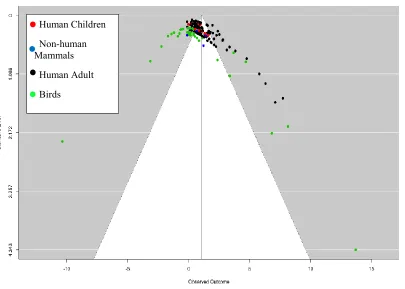
54
[image:54.612.79.484.92.381.2]
Figure 2. Funnel plot showing the relationship between the standard error and the effect size of the individual studies. Points are colour-coded according to animal class. Black points illustrate Human Adult Studies, blue illustrate Non-human mammals studies, red are Human Child studies, and green are Bird studies.
3.3 Heterogeneity in effect size variance associated with study variables
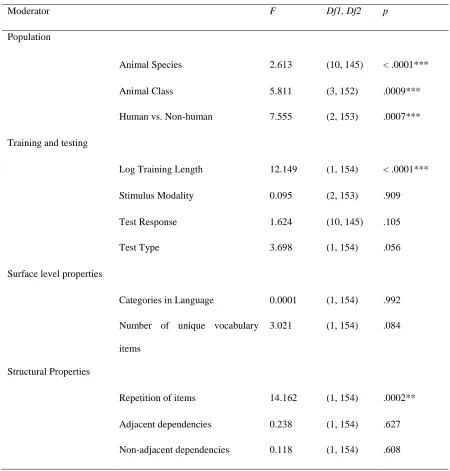
Cohran’s Q-test for heterogeneity was significant (Q(155) = 1185.657, p < .0001), indicating that variance in the data cannot be explained by random measurement error, but that different aspects of studies are contributing to the effect size. We thus analysed the effects of each of the set of variables we encoded from each of the studies as moderators, shown in Table 1.
Human Children
Non-human Mammals
Human Adult
55 For the effect of animal class (but also distinguishing human adults and human children from non-human mammals), there were significant differences on the size of effect of learning between different species. For human adults, the overall effect size was 1.252 (SE = .148, 95% CI [0.958, 1.545], p < .0001). For human children, the overall effect size was 0.615 (SE = .231, 95% CI [.101, 1.129], p = .0237). For non-human mammals, the overall effect size was 0.626 (SE = .172, 95% CI [.221, .1.032], p = .008). For birds, the overall effect size was 0.428 (SE = 0.533, 95% CI [-0.653, 1.509], p = .427).
Properties of training and testing of AGL studies were found to produce significant differences in effect sizes. Log-transformed number of training trials related negatively to effect size, -0.188 (SE = 0.054, 95% CI [-0.295, -0.0815], p = .0006). Further, repetition of trained items at test resulted in larger effects 1.051 (SE = 0.279, 95% CI [0.499, 1.602], p = .0002).
Surface level features of the language did not significantly moderate the variance of effect sizes (see Table 1), and this included also the modality of stimulus delivery. The number of categories, the vocabulary size, and critically, whether the stimuli were visual or auditory were not found to affect the overall effect size.
For the structural properties of the language, there were moderating effects. The presence of repetition of items from training to test positively influenced effect sizes, with an overall effect of 1.051 (SE = 0.279, 95% CI [0.499, 1.602], p = .0002).
56 Table 1. Contributions of each moderating variable to account for variance in effect sizes across studies.
Moderator F Df1, Df2 p
Population
Animal Species 2.613 (10, 145) < .0001***
Animal Class 5.811 (3, 152) .0009***
Human vs. Non-human 7.555 (2, 153) .0007***
Training and testing
Log Training Length 12.149 (1, 154) < .0001***
Stimulus Modality 0.095 (2, 153) .909
Test Response 1.624 (10, 145) .105
Test Type 3.698 (1, 154) .056
Surface level properties
Categories in Language 0.0001 (1, 154) .992
Number of unique vocabulary
items
3.021 (1, 154) .084
Structural Properties
Repetition of items 14.162 (1, 154) .0002**
Adjacent dependencies 0.238 (1, 154) .627
Non-adjacent dependencies 0.118 (1, 154) .608
3.4 Moderator Analysis of Human Adults
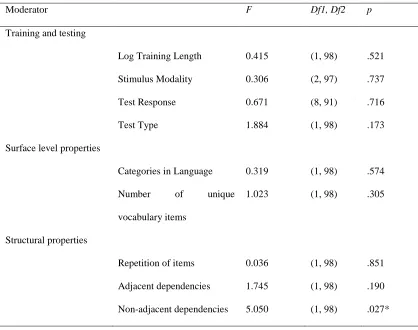
57 There was significant heterogeneity of variance in the effect size in studies testing human adults (Q(99) = 707.273, p < .001), so we analysed the effect of each moderator (see Table 2 for the significance of each moderator). There was a significant effect of the presence of non-adjacent dependencies (effect = 0.582, SE = 0.259, 95% CI [0.068, 1.096], p = .027), suggesting that adult human participants are overall successful in learning non-adjacencies in artificial grammars.
Table 2. Contributions of each moderating variable to account for variance in effect sizes in Human Adult studies.
Moderator F Df1, Df2 p
Training and testing
Log Training Length 0.415 (1, 98) .521
Stimulus Modality 0.306 (2, 97) .737
Test Response 0.671 (8, 91) .716
Test Type 1.884 (1, 98) .173
Surface level properties
Categories in Language 0.319 (1, 98) .574
Number of unique
vocabulary items
1.023 (1, 98) .305
Structural properties
Repetition of items 0.036 (1, 98) .851
Adjacent dependencies 1.745 (1, 98) .190
Non-adjacent dependencies 5.050 (1, 98) .027*
3.5 Moderator Analysis of Human Children
58 test response participants made. This analysis indicated that head-turn preference paradigms produced an overall effect of 1.301 (SE = 0.1663, 95% CI [0.772, 1.831], p = .004). Sequence production paradigms, by comparison, produced an effect that failed to statistically differ from 0 (effect size = 0.150, SE = 0.144, 95% CI [-0.433, 0.721], p = .395). Finally, binary yes-no judgement tasks produced an overall effect of 0.822 (SE = 0.099, 95% CI [0.506, 1.137], p = .004).
Table 3. Contributions of each moderating variable to account for variance in effect sizes in human child studies.
Moderator Analysis of Non-human Mammals
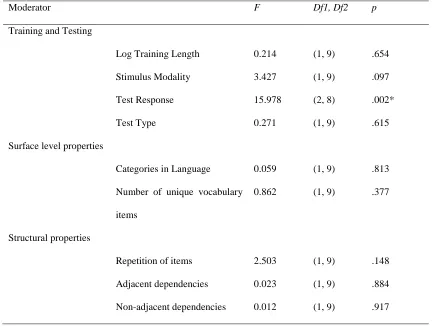
Moderator F Df1, Df2 p
Training and Testing
Log Training Length 0.214 (1, 9) .654
Stimulus Modality 3.427 (1, 9) .097
Test Response 15.978 (2, 8) .002*
Test Type 0.271 (1, 9) .615
Surface level properties
Categories in Language 0.059 (1, 9) .813
Number of unique vocabulary
items
0.862 (1, 9) .377
Structural properties
Repetition of items 2.503 (1, 9) .148
Adjacent dependencies 0.023 (1, 9) .884
59 There was significant heterogeneity (Q(7) = 15.928, p < .026), therefore we analysed the effect of each moderator (see Table 4). Non-human mammals only took part in studies delivered in the auditory modality, and all of which were processing based, included adjacent dependencies, and did not include repetitions at test, and hence we did not include a moderator analysis of testing modality, repetition of items, adjacency, and testing type. No moderator accounted for a significant proportion of variance in this dataset.
Table 4. Contributions of each moderating variable to account for variance in effect sizes in non-human mammal studies.
Moderator Analysis of Birds Studies
There was again significant heterogeneity (Q(36) = 259.498, p < .0001), therefore we analysed the effect of each moderator (see Table 5). Birds, however only took part in classification-based tasks, and thus, we did not analyse the effect of test type. Log training length accounted for a significant portion of the variance, increased training resulted in a lower effect size -0.739 (SE =
Moderator F Df1, Df2 p
Training and testing
Log Training Length 1.121 (1, 6) .331
Test Response 1.262 (1, 6) .304
Surface level properties
Categories in Language 0.760 (1, 6) .418
Number of unique vocabulary items 0.365 (1, 6) .567
Structural properties
60 .268, 95% CI [-1.283, -0.195], p = .009). Increased vocabulary sizes tended to increase effect sizes (effect size = 0.099, SE = 0.038, 95% CI [0.022, 0.177], p = .014). Stimulus modality explained a significant portion of variance, with visual stimuli producing larger effects (effect size = 1.993, SE = 0.788, 95% CI [0.395, 3.592], p = .016) than auditory stimuli. The response task used also accounted for a significant portion of variance of effect sizes, however, the meta-analytic estimate for both 2AFC tasks (effect size = 2.288, SE = .135, 95% CI [-0.488, 5.065], p = .090) and go/no-go tasks (effect size = -0.042, SE = 0.294, 95% CI [-0.642, 0.559], p = .889) failed to significantly differ from 0. This reflects the fact that variance of effect sizes in birds was large; to properly account for the moderating effect of task type on the variance in effect size for bird studies, a larger set of studies for inclusion would be helpful. Finally, the repetition of items accounted for a significant portion of the variance of effect sizes, whereby repeating items at test resulting in an effect size of 5.013 (SE = 0.740, 95% CI [3.511, 6.515], p < .0001). This effect is explained by the only study including repetitions of whole strings at test (Spierings & ten Cate, 2016) produced large effect sizes.
Table 5. Contributions of each moderating variable to account for variance in effect sizes in birds studies.
Moderator F Df1, Df2 p
Training and testing
Log Training Length 7.609 (1, 35) .009**
Stimulus Modality 6.407 (1, 35) .016*
Test Response 6.407 (1, 35) .016*