4710
Learning Attention-based Embeddings for Relation Prediction in
Knowledge Graphs
Deepak Nathani∗ Jatin Chauhan∗ Charu Sharma∗ Manohar Kaul
Department of Computer Science and Engineering, IIT Hyderabad
{deepakn1019,chauhanjatin100,charusharma1991}@gmail.com, [email protected]
Abstract
The recent proliferation of knowledge graphs (KGs) coupled with incomplete or partial in-formation, in the form of missing relations (links) between entities, has fueled a lot of research on knowledge base completion (also known as relation prediction). Several re-cent works suggest that convolutional neural network (CNN) based models generate richer and more expressive feature embeddings and hence also perform well on relation prediction. However, we observe that these KG embed-dings treat triples independently and thus fail to cover the complex and hidden information that is inherently implicit in the local neighbor-hood surrounding a triple. To this effect, our paper proposes a novel attention-based feature embedding that captures both entity and rela-tion features in any given entity’s neighbor-hood. Additionally, we also encapsulate re-lation clusters and multi-hop rere-lations in our model. Our empirical study offers insights into the efficacy of our attention-based model and we show marked performance gains in comparison to state-of-the-art methods on all datasets.
1 Introduction
Knowledge graphs (KGs) represent knowledge bases (KBs) as a directed graph whosenodesand
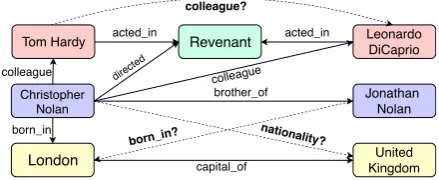
edgesrepresententitiesandrelations between en-tities, respectively. For example, in Figure 1, a triple (London, capital of, United Kingdom)is represented as two entities: London and United Kingdomalong with a relation(capital of)linking them. KGs find uses in a wide variety of applica-tions such as semantic search (Berant et al.,2013; Berant and Liang,2014), dialogue generation (He et al.,2017;Keizer et al.,2017), and question an-swering (Zhang et al., 2016; Diefenbach et al., 2018), to name a few. However, KGs typically
∗
Equal Contribution
suffer from missing relations (Socher et al.,2013a; West et al.,2014). This problem gives rise to the task ofknowledge base completion (also referred to asrelation prediction), which entails predicting whether a given triple is valid or not.
State-of-the-art relation prediction methods are known to be primarily knowledge embedding
based models. They are broadly classified as
translational models (Bordes et al., 2013; Yang et al., 2015; Trouillon et al., 2016) and convo-lutional neural network (CNN) (Nguyen et al., 2018;Dettmers et al.,2018) based models. While translational models learn embeddings using sim-ple operations and limited parameters, they pro-duce low quality embeddings. In contrast, CNN based models learn more expressive embeddings due to their parameter efficiency and consideration of complex relations. However, both translational and CNN based models process each triple inde-pendently and hence fail to encapsulate the seman-tically rich and latent relations that are inherently present in the vicinity of a given entity in a KG.
Motivated by the aforementioned observa-tions, we propose a generalized attention-based graph embedding for relation prediction. For node classification, graph attention networks
(GATs) (Veliˇckovi´c et al.,2018) have been shown to focus on the most relevant portions of the graph, namely the node features in a 1-hop neighborhood. Given a KG and the task of relation prediction, our modelgeneralizesandextendsthe attention mech-anism by guiding attention to both entity (node) and relation (edge) features in a multi-hop neigh-borhood of a given entity / node.
and de Andrade Lopes,2012). Our model achieves these objectives by assigning different weight mass (attention) to nodes in a neighborhood and by propagating attention via layers in an iterative fashion. However, as the model depth increases, the contribution of distant entities decreases ex-ponentially. To resolve this issue, we use re-lation composition as proposed by (Lin et al., 2015) to introduce an auxiliary edge between n-hop neighbors, which then readily allows the flow of knowledge between entities. Our architecture is an encoder-decoder model where ourgeneralized graph attention modelandConvKB(Nguyen et al., 2018) play the roles of anencoderanddecoder, re-spectively. Moreover, this method can be extended for learning effective embeddings for Textual En-tailment Graphs (Kotlerman et al., 2015), where global learning has proven effective in the past as shown by (Berant et al.,2015) and (Berant et al., 2010).
Our contributions are as follows. To the best of our knowledge, we are the first to learn new graph attention based embeddings that specifically target relation prediction on KGs. Secondly, we generalize and extend graph attention mechanisms to capture both entity and relation features in a multi-hop neighborhood of a given entity. Fi-nally, we evaluate our model on challenging re-lation prediction tasks for a wide variety of real-world datasets. Our experimental results indicate a clear and substantial improvement over state-of-the-art relation prediction methods. For in-stance, our attention-based embedding achieves an improvement of104%over the state-of-the-art method for the Hits@1metric on the popular Free-base (FB15K-237)dataset.
The rest of the paper is structured as follows. We first provide a review of related work in Sec-tion2and then our detailed approach in Section3. Experimental results and dataset descriptions are reported in Section4followed by our conclusion and future research directions in Section5.
2 Related Work
Recently, several variants of KG embeddings have been proposed for relation prediction. These methods can be broadly classified as: (i) composi-tional, (ii) translacomposi-tional, (iii) CNN based, and (iv) graph based models.
RESCAL (Nickel et al., 2011), NTN (Socher et al., 2013b), and the Holographic embedding
Christopher Nolan
Revenant
Tom Hardy Leonardo
DiCaprio
United Kingdom
London
Jonathan Nolan
colleague
born_in nationality?
colleague?
acted_in acted_in
born_in?
capital_of
directed colleague
[image:2.595.307.527.64.154.2]brother_of
Figure 1: Subgraph of a knowledge graph contains ac-tual relations between entities (solid lines) and inferred relations that are initially hidden (dashed lines).
model (HOLE) (Nickel et al.,2016) are examples of compositional based models. Both RESCAL and NTN use tensor products which capture rich interactions, but require a large number of parame-ters to model relations and are thus cumbersome to compute. To combat these drawbacks, HOLE cre-ates more efficient and scalable compositional rep-resentations using the circular correlation of entity embeddings.
In comparison, translational models like TransE (Bordes et al., 2013), DISTMULT (Yang et al.,2015) and ComplEx (Trouillon et al.,2016) propose arguably simpler models. TransE consid-ers the translation operation between head and tail entities for relations. DISTMULT (Yang et al., 2015) learns embeddings using abilinear diago-nal modelwhich is a special case of the bilinear objective used in NTN and TransE. DISTMULT uses weighted element-wise dot products to model entity relations. ComplEx (Trouillon et al.,2016) generalizes DISTMULT (Yang et al., 2015) by using complex embeddings and Hermitian dot products instead. These translational models are faster, require fewer parameters and are relatively easier to train, but result in less expressive KG embeddings.
A graph based neural network model called R-GCN (Schlichtkrull et al., 2018) is an exten-sion of applying graph convolutional networks
(GCNs) (Kipf and Welling, 2017) to relational data. It applies a convolution operation to the neighborhood of each entity and assigns them equal weights. This graph based model does not outperform the CNN based models.
Existing methods either learn KG embeddings by solely focusing on entity features or by taking into account the features of entities and relations in a disjoint manner. Instead, our proposed graph at-tention model holistically captures multi-hop and semantically similar relations in then-hop neigh-borhood of any given entity in the KG.
3 Our Approach
We begin this section by introducing the notations and definitions used in the rest of the paper, fol-lowed by a brief background on graph attention networks (GATs) (Veliˇckovi´c et al., 2018). Fi-nally, we describe our proposed attention archi-tecture for knowledge graphs followed by our de-coder network.
3.1 Background
A knowledge graph is denoted by G = (E, R), where E and R represent the set of entities (nodes) and relations (edges), respectively. A triple (es, r, eo) is represented as an edge r be-tween nodeses ander inG1. Embedding models try to learn an effective representation of entities, relations, and a scoring function f, such that for a given input triplet = (es, r, eo),f(t)gives the likelihood oftbeing a valid triple. For example, Figure 1 shows the subgraph from a KG which infers missing links represented by dashed lines using existing triples such as(London, captial of, United Kingdom).
3.2 Graph Attention Networks (GATs)
Graph convolutional networks(GCNs) (Kipf and Welling, 2017) gather information from the en-tity’s neighborhood and all neighbors contribute equally in the information passing. To ad-dress the shortcomings of GCNs, (Veliˇckovi´c et al.,2018) introducedgraph attention networks
(GATs). GATs learn to assign varying levels of importance to nodes in every node’s
neighbor-1 From here onwards, the pairs “
node/entity” and “edge/ relation” will be used interchangeably
hood, rather than treating all neighboring nodes with equal importance, as is done in GCN.
The input feature set of nodes to a layer isx =
{~x1, ~x2, ..., ~xN}. A layer produces a transformed
set of node feature vectorsx0 = {~x01, ~x02, ..., ~x0N}, where ~xi and ~x0i are input and output embed-dings of the entityei, andN is number of entities (nodes). A single GAT layer can be described as
eij =a(Wx~i,Wx~j) (1)
whereeij is the attention value of the edge(ei, ej) in G, W is a parametrized linear transformation matrix mapping the input features to a higher di-mensional output feature space, andais any atten-tion funcatten-tionof our choosing.
Attention values for each edge are the impor-tance of the edge (ei, ej)
0
s features for a source node ei. Here, the relative attention αij is com-puted using a softmax function over all the val-ues in the neighborhood. Equation 2 shows the output of a layer. GAT employsmulti-head atten-tionto stabilize the learning process as credited to (Vaswani et al.,2017).
~
x0i=σ X
j∈Ni
αijWx~j
!
(2)
The multihead attention process of concatenating Kattention heads is shown as follows in Equation 3.
~
x0i =
K k=1
σ X
j∈Ni
αkijWkx~j
!
(3)
where k represents concatenation, σ represents any non-linear function,αkij are normalized atten-tion coefficients of edge(ei, ej)calculated by the
k-th attention mechanism, andWk represents the
corresponding linear transformation matrix of the k-th attention mechanism. The output embedding in the final layer is calculated usingaveraging, in-stead of the concatenation operation, to achieve multi-head attention, as is shown in the following Equation4.
~
x0i =σ 1
K K X
k=1
X
j∈Ni
αijkWkx~j
!
(4)
3.3 Relations are Important
U.S.
Chevrolet
Ethan Horvath
Barack Obama
Washington D.C Samuel L.
Jackson Michelle Obama
wife_of president_of
plays_for
brand_of
capital_of
born_in
native_of first_lady
αi1
αi2 αi3
αi4 αi5
[image:4.595.318.503.63.259.2]αi6 ei
Figure 2: This figure shows the aggregation process of our graph attentional layer. αij represents relative
attention values of the edge. The dashed lines represent anauxiliaryedge from an-hop neighbors, in this case n= 2.
which are an integral part of KGs. In KGs, enti-ties play different roles depending on therelation
they are associated with. For example, in Figure 1, entityChristopher Nolanappears in two differ-ent triples assuming the roles of a brother and a
director. To this end, we propose a novel embed-ding approach to incorporate relation and neigh-boring node featuresin the attention mechanism. We define a single attentional layer, which is the building block of our model. Similar to GAT, our framework is agnostic to the particular choice of attention mechanism.
Each layer in our model takes two embedding matrices as input. Entity embeddings are repre-sented by a matrix H ∈ RNe×T, where the i-th row is the embedding of entityei,Ne is the total number of entities, andT is the feature dimension of each entity embedding. With a similar construc-tion, therelation embeddingsare represented by a matrixG ∈ RNr×P. The layer then outputs the
corresponding embedding matrices,H0 ∈RNe×T0
andG0 ∈RNr×P
0
.
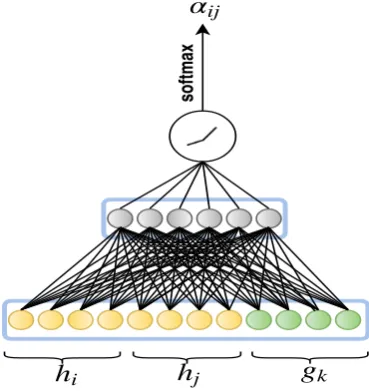
In order to obtain the new embedding for an entity ei, a representation of each triple associ-ated with ei is learned. We learn these embed-dings by performing a linear transformation over the concatenation of entity and relation feature vectors corresponding to a particular triple tkij = (ei, rk, ej), as is shown in Equation5. This oper-ation is also illustrated in the initial block of Fig-ure4.
~
cijk=W1[~hik~hjk~gk] (5)
wherec~ijk is the vector representation of a triple tkij. Vectors~hi, ~hj, and~gk denote embeddings of entitiesei, ej and relationrk, respectively. Addi-tionally,W1denotes the linear transformation
ma-trix. Similar to (Veliˇckovi´c et al.,2018), we learn
softmax
αij
[image:4.595.72.280.63.161.2]hi
hj
gk
Figure 3: Attention Mechanism
theimportanceof each tripletkij denoted bybijk. We perform a linear transformation parameterized by a weight matrixW2 followed by application of
the LeakyRelu non-linearity to get the absolute at-tention value of the triple (Equation6).
bijk=LeakyReLU
W2cijk
(6)
To get the relative attention valuessoftmaxis ap-plied overbijk as shown in Equation7. Figure3 shows the computation of relative attention values αijkfor a single triple.
αijk =softmaxjk(bijk) (7)
= P exp(bijk) n∈Ni
P
r∈Rinexp(binr)
where Ni denotes the neighborhood of entity ei andRijdenotes the set of relations connecting en-titiesei andej. The new embedding of the entity eiis the sum of each triple representation weighted by their attention values as shown in Equation8.
~
h0i=σ X
j∈Ni
X
k∈Rij
αijkc~ijk
!
(8)
As suggested by (Veliˇckovi´c et al., 2018), multi-head attention which was first introduced by (Vaswani et al., 2017), is used to stabilize the learning process and encapsulate more informa-tion about the neighborhood. Essentially, M in-dependent attention mechanisms calculate the em-beddings, which are then concatenated, resulting in the following representation:
~
h0i =
M m=1
σ X
j∈Ni
αmijkcmijk
!
Graph Attention Layer 1
Triple N
Christian Bale
acted_in
The Machinist Triple 1
Barack Obama
president_of
United States
Attention Head 1
Attention Head 2
Graph Attention
[image:5.595.76.526.62.211.2]Layer 2 TrainingLoss
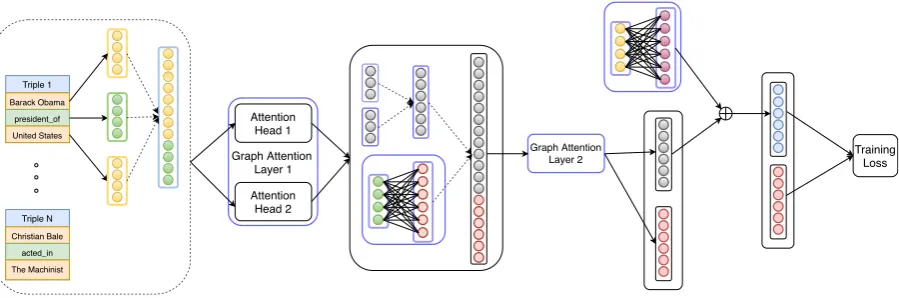
Figure 4: This figure shows end-to-end architecture of our model. Dashed arrows in the figure represent concate-nation operation. Green circles represents initial entity embedding vectors and yellow circles represents initial relation embedding vectors.
This is the graph attention layer shown in Fig-ure 4. We perform a linear transformation on in-put relation embedding matrix G, parameterized by a weight matrix WR ∈ RT×T0
, where T0 is the dimensionality of outputrelation embeddings
(Equation10).
G0 =G.WR (10)
In the final layer of our model, instead of concate-nating the embeddings from multiple heads we employ averaging to get final embedding vectors for entities as shown in Equation11.
~
h0i =σ 1
M M X
m=1
X
j∈Ni
X
k∈Rij
αmijkcmijk
!
(11)
However, while learning new embeddings, entities lose their initial embedding information. To re-solve this issue, we linearly transformHito obtain Htusing a weight matrixWE ∈ RTi×Tf, where Hi represents the input entity embeddings to our model, Ht represents the transformed entity em-beddings, Ti denotes the dimension of an initial entity embedding, and Tf denotes the dimension of the final entity embedding. We add this ini-tial entity embedding information to the entity em-beddings obtained from the final attentional layer, Hf ∈RNe×Tf
as shown in Equation12.
H00=WEHt+Hf (12)
In our architecture, we extend the notion of an
edge to a directed path by introducing an aux-iliary relation for n-hop neighbors between two entities. The embedding of this auxiliary rela-tion is the summarela-tion of embeddings of all the
relations in the path. Our model iteratively ac-cumulates knowledge from distant neighbors of an entity. As illustrated in figure 2, in the first layer of our model, all entities capture informa-tion from theirdirect in-flowing neighbors. In the second layer, U.S gathers information from en-tities Barack Obama, Ethan Horvath, Chevrolet, and Washington D.C, which already possess infor-mation about their neighborsMichelle Obamaand
Samuel L. Jackson, from a previous layer. In gen-eral, for a n layer model the incoming informa-tion is accumulated over a n-hop neighborhood. The aggregation process to learn new entity em-beddings and the introduction of an auxiliary edge betweenn-hop neighbors is also shown in Figure 2. We normalize the entity embeddings after every generalized GAT layer and prior to the first layer, for every main iteration.
3.4 Training Objective
Our model borrows the idea of a translational scoring functionfrom (Bordes et al.,2013), which learns embeddings such that for a givenvalidtriple tkij = (ei, rk, ej), the condition~hi+~gk≈~hjholds, i.e.,ej is the nearest neighbor ofeiconnected via relationrk. Specifically, we try to learnentityand
relationembeddings to minimize the L1-norm dis-similarity measure given bydtij =kh~i+g~k−h~jk1.
We train our model using hinge-loss which is given by the following expression
L(Ω) = X
tij∈S
X
t0ij∈S0
max{dt0
ij−dtij+γ,0} (13)
triples, given formally as
S0={tki0j |e0i ∈ E \ei}
| {z }
replace head entity
∪ {tkij0 |e0j ∈ E \ej}
| {z }
replace tail entity
3.5 Decoder
Our model uses ConvKB (Nguyen et al.,2018) as a decoder. The aim of the convolutional layer is to analyze the global embedding properties of a tripletkij across each dimension and to generalize the transitional characteristics in our model. The score function with multiple feature maps can be written formally as:
f(tkij) =
Ω
m=1
ReLU([~hi, ~gk, ~hj]∗ωm) !
.W
whereωm represents themthconvolutional filter,
Ωis a hyper-parameter denoting number of filters used,∗is a convolution operator, andW∈RΩk×1
represents a linear transformation matrix used to compute the final score of the triple. The model is trained using soft-margin loss as
L= X
tkij∈{S∪S0}
log(1 +exp(ltk ij.f(t
k ij))) +
λ
2kWk
2 2
whereltk ij =
(
1 fortk ij ∈S
−1 fortkij ∈S0
4 Experiments and Results
4.1 Datasets
To evaluate our proposed method, we use five benchmark datasets: WN18RR (Dettmers et al., 2018), FB15k-237 (Toutanova et al., 2015),
NELL-995 (Xiong et al., 2017), Unified Medi-cal Language Systems (UMLS)(Kok and Domin-gos, 2007) and Alyawarra Kinship (Lin et al., 2018). Previous works (Toutanova et al., 2015; Dettmers et al., 2018) suggest that the task of relation prediction in WN18 and FB15K suffers from the problem of inverse relations, whereby one can achieve state-of-the-art results using a simple reversal rule based model, as shown by (Dettmers et al., 2018). Therefore, correspond-ing subset datasetsWN18RRandFB15k-237were created to resolve the reversible relation problem inWN18andFB15K. We used the data splits pro-vided by (Nguyen et al.,2018). Table1provides statistics of all datasets used.
4.2 Training Protocol
We create two sets of invalid triples, each time re-placing either the head or tail entity in a triple by an invalid entity. We randomly sample equal num-ber of invalid triples from both the sets to ensure robust performance on detecting both head and tail entity. Entity and relation embeddings produced by TransE (Bordes et al., 2013; Nguyen et al., 2018) are used to initialize our embeddings.
We follow a two-step training procedure, i.e., we first train our generalized GAT to encode infor-mation about the graph entities and relations and then train a decoder model like ConvKB (Nguyen et al.,2018) to perform the relation prediction task. The original GAT update Equation 3only aggre-gates information passed from 1-hop neighbor-hood, while our generalized GAT uses informa-tion from then-hop neighborhood. We use auxil-iary relations to aggregate more information about the neighborhood in sparse graphs. We use Adam to optimize all the parameters with initial learn-ing rate set at0.001. Both the entity and relation embeddings of the final layer are set to200. The optimal hyper-parameters set for each dataset are mentioned in our supplementary section.
4.3 Evaluation Protocol
In the relation prediction task, the aim is to predict a triple(ei, rk, ej)withei orej missing, i.e., pre-dictei given (rk, ej) or predictej given(ei, rk). We generate a set of (N −1) corrupt triplesfor each entityei by replacing it with every other en-tityei0 ∈ E \ei, then we assign a score to each such triple. Subsequently, we sort these scores in ascending order and get the rank of a correct triple(ei, rk, ej). Similar to previous work ((
Bor-des et al.,2013), (Nguyen et al.,2018), (Dettmers et al.,2018)), we evaluate all the models in a fil-tered setting, i.e, during ranking we remove cor-rupt triples which are already present in one of the training, validation, or test sets. This whole pro-cess is repeated by replacing the tail entityej, and averaged metrics are reported. We report mean reciprocal rank (MRR), mean rank (MR) and the proportion of correct entities in the top N ranks (Hits@N) forN = 1,3,and10.
4.4 Results and Analysis
Tables 2 and 3 present the prediction results on the test sets of all the datasets. The results clearly demonstrate that our proposed method2
2
# Edges
Dataset # Entities # Relations Training Validation Test Total Mean in-degree Median in-degree
WN18RR 40,943 11 86,835 3034 3134 93,003 2.12 1
FB15k-237 14,541 237 272,115 17,535 20,466 310,116 18.71 8
NELL-995 75,492 200 149,678 543 3992 154,213 1.98 0
Kinship 104 25 8544 1068 1074 10,686 82.15 82.5
[image:7.595.125.477.64.114.2]UMLS 135 46 5216 652 661 6529 38.63 20
Table 1: Dataset statistics
WN18RR FB15K-237
Hits@N Hits@N
MR MRR @1 @3 @10 MR MRR @1 @3 @10
DistMult (Yang et al.,2015) 7000 0.444 41.2 47 50.4 512 0.281 19.9 30.1 44.6
ComplEx (Trouillon et al.,2016) 7882 0.449 40.9 46.9 53 546 0.278 19.4 29.7 45
ConvE (Dettmers et al.,2018) 4464 0.456 41.9 47 53.1 245 0.312 22.5 34.1 49.7
TransE (Bordes et al.,2013) 2300 0.243 4.27 44.1 53.2 323 0.279 19.8 37.6 44.1
ConvKB (Nguyen et al.,2018) 1295 0.265 5.82 44.5 55.8 216 0.289 19.8 32.4 47.1
R-GCN (Schlichtkrull et al.,2018) 6700 0.123 8 13.7 20.7 600 0.164 10 18.1 30
Our work 1940 0.440 36.1 48.3 58.1 210 0.518 46 54 62.6
Table 2: Experimental results on WN18RR and FB15K-237 test sets. Hits@N values are in percentage. The best score is inboldand second best score is underlined.
NELL-995 Kinship
Hits@N Hits@N
MR MRR @1 @3 @10 MR MRR @1 @3 @10
DistMult (Yang et al.,2015) 4213 0.485 40.1 52.4 61 5.26 0.516 36.7 58.1 86.7
ComplEx (Trouillon et al.,2016) 4600 0.482 39.9 52.8 60.6 2.48 0.823 73.3 89.9 97.11
ConvE (Dettmers et al.,2018) 3560 0.491 40.3 53.1 61.3 2.03 0.833 73.8 91.7 98.14
TransE (Bordes et al.,2013) 2100 0.401 34.4 47.2 50.1 6.8 0.309 0.9 64.3 84.1
ConvKB (Nguyen et al.,2018) 600 0.43 37.0 47 54.5 3.3 0.614 43.62 75.5 95.3
R-GCN (Schlichtkrull et al.,2018) 7600 0.12 8.2 12.6 18.8 25.92 0.109 3 8.8 23.9
Our work 965 0.530 44.7 56.4 69.5 1.94 0.904 85.9 94.1 98
Table 3: Experimental results on NELL-995 and Kinship test sets. Hits@N values are in percentage. The best score is inboldand second best score is underlined.
significantly outperforms state-of-the-art results on five metrics forFB15k-237, and on two metrics for WN18RR. We downloaded publicly available source codes to reproduce results of the state-of-the-art methods345678on all the datasets.
Attention Values vs Epochs: We study the
dis-tribution of attention with increasing epochs for a particular node. Figure 5 shows this distribution on FB15k-237. In the initial stages of the learn-ing process, the attention is distributed randomly. As the training progresses and our model gathers more information from the neighborhood, it as-signs more attention to direct neighbors and takes minor information from the more distant neigh-bors. Once the model converges, it learns to gather multi-hop and clustered relation information from
then-hop neighborhood of the node.
PageRank Analysis: We hypothesize that
com-plex and hidden multi-hop relations among enti-ties are captured more succinctly in dense graphs
3 TransE 4 DistMult 5 ComplEx 6 R-GCN 7 ConvE 8
ConvKB
as opposed to sparse graphs. To test this hypoth-esis, we perform an analysis similar to ConvE, where they study the correlation between mean PageRank andincrease in MRR relative to Dist-Mult. We notice a strong correlation coefficient ofr = 0.808. Table 4 indicates that when there is an increase in PageRank values, there is also a corresponding increase in MRR values. We ob-serve an anomaly to our obob-served correlation in case of NELL-995 versus WN18RRand attribute this to the highly sparse and hierarchical struc-tureofWN18RRwhich poses as a challenge to our method that does not capture information in a top-down recursive fashion.
4.5 Ablation Study
1hop n-hop value2hop 3hop 10.8-11.5 10.1-10.8 9.48-10.1 8.81-9.48 8.14-8.81
attention values ( X 1e-5 )
0.0 0.2 0.4 0.6 0.8 1.0
(a) Epoch 0
1hop n-hop value2hop 3hop 17.4-20.6
14.3-17.4
11.1-14.3
8.02-11.1
4.88-8.02
attention values ( X 1e-5 )
0.0 0.2 0.4 0.6 0.8 1.0
(b) Epoch 1200
1hop n-hop value2hop 3hop 17.3-20.3
14.3-17.3
11.3-14.3
8.39-11.3
5.41-8.39
attention values ( X 1e-5 )
0.0 0.2 0.4 0.6 0.8 1.0
[image:8.595.77.530.73.188.2](c) Epoch 2400
Figure 5: Learning process of our model on FB15K-237 dataset. Y-axis represents attention values×1e−5.
1hop n-hop value2hop 3hop 255-269
241-255
228-241
214-228
200-214
attention values ( X 1e-5 )
0.0 0.2 0.4 0.6 0.8 1.0
(a) Epoch 0
1hop n-hop value2hop 3hop 691-827
555-691
419-555
282-419
146-282
attention values ( X 1e-5 )
0.0 0.2 0.4 0.6 0.8 1.0
(b) Epoch 1800
1hop n-hop value2hop 3hop 383-448
318-383
253-318
188-253
122-188
attention values ( X 1e-5 )
0.0 0.2 0.4 0.6 0.8 1.0
[image:8.595.77.529.231.348.2](c) Epoch 3600
Figure 6: Learning process of our model on WN18RR dataset. Y-axis represents attention values×1e−5
Dataset PageRank Relative Increase
NELL-995 1.32 0.025
WN18RR 2.44 -0.01
FB15k-237 6.87 0.237
UMLS 740 0.247
Kinship 961 0.388
Table 4: Mean PageRank×10−5vs relative increase in MRR wrt. DistMult.
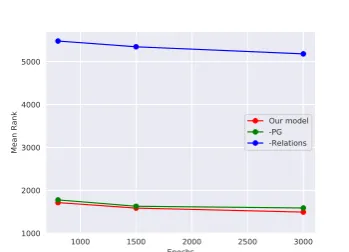
than the two ablated models and we see a signifi-cant drop in the results when using ablated models on NELL-995. Removing the relations from the proposed model has a huge impact on the results which suggests that the relation embeddings play a pivotal role in relation prediction.
5 Conclusion and Future Work
In this paper, we propose a novel approach for relation prediction. Our approach improves over the state-of-the-art models by significant margins. Our proposed model learns new graph attention-based embeddings that specifically cater to rela-tion predicrela-tion on KGs. Addirela-tionally, we gener-alize and extend graph attention mechanisms to capture both entity and relation features in a multi-hop neighborhood of a given entity. Our detailed
1000 1500 2000 2500 3000 Epochs 1000 2000 3000 4000 5000 Mean Rank Our model -PG -Relations
Figure 7: Epochs vs Mean Rank for our model and two ablated models onNELL-995. −PG (green) rep-resents the model after removingn-hop auxiliary rela-tions orpath generalization,−Relations (blue) repre-sents model without taking relations into account and Our model (red) represents the entire model.
and exhaustive empirical analysis gives more in-sight into our method’s superiority for relation pre-diction on KGs. The proposed model can be ex-tended to learn embeddings for various tasks us-ing KGs such as dialogue generation (He et al., 2017;Keizer et al., 2017), and question answer-ing (Zhang et al.,2016;Diefenbach et al.,2018).
[image:8.595.75.287.388.471.2] [image:8.595.328.503.389.515.2]mo-tifs) in our graph attention model.
Acknowledgments
We gratefully acknowledge the support of NVIDIA Corporation with the donation of the Titan Xp GPU used for this research.
References
Jonathan Berant, Noga Alon, Ido Dagan, and Ja-cob Goldberger. 2015. Efficient global learning of entailment graphs. Computational Linguistics, 41(2):221–263.
Jonathan Berant, Andrew Chou, Roy Frostig, and Percy Liang. 2013. Semantic parsing on freebase from question-answer pairs. In Proceedings of the 2013 Conference on Empirical Methods in Natural Lan-guage Processing (EMNLP), 2013, pages 1533– 1544.
Jonathan Berant, Ido Dagan, and Jacob Goldberger. 2010. Global learning of focused entailment graphs. In Proceedings of the 48th Annual Meet-ing of the Association for Computational LMeet-inguis- Linguis-tics, pages 1220–1229, Uppsala, Sweden. Associa-tion for ComputaAssocia-tional Linguistics.
Jonathan Berant and Percy Liang. 2014. Semantic parsing via paraphrasing. In Proceedings of the 52nd Annual Meeting of the Association for Com-putational Linguistics (ACL), 2014.
Antoine Bordes, Nicolas Usunier, Alberto Garcia-Duran, Jason Weston, and Oksana Yakhnenko. 2013. Translating embeddings for modeling multi-relational data. In C. J. C. Burges, L. Bottou, M. Welling, Z. Ghahramani, and K. Q. Weinberger, editors,Advances in Neural Information Processing Systems (NIPS), 2013, pages 2787–2795.
Tim Dettmers, Pasquale Minervini, Pontus Stenetorp, and Sebastian Riedel. 2018. Convolutional 2d knowledge graph embeddings. In Thirty-Second AAAI Conference on Artificial Intelligence (AAAI), 2018.
Dennis Diefenbach, Kamal Singh, and Pierre Maret. 2018. Wdaqua-core1: a question answering ser-vice for rdf knowledge bases. In Companion of the The Web Conference 2018 on The Web Confer-ence (WWW), 2018, pages 1087–1091. International World Wide Web Conferences Steering Committee.
He He, Anusha Balakrishnan, Mihail Eric, and Percy Liang. 2017. Learning symmetric collaborative di-alogue agents with dynamic knowledge graph em-beddings. InProceedings of the 55th Annual Meet-ing of the Association for Computational LMeet-inguistics (ACL), 2017.
Simon Keizer, Markus Guhe, Heriberto Cuayahuitl, Ioannis Efstathiou, Klaus-Peter Engelbrecht, Mi-hai Dobre, Alex Lascarides, and Oliver Lemon. 2017. Evaluating persuasion strategies and deep re-inforcement learning methods for negotiation dia-logue agents. In Proceedings of the 15th Confer-ence of the European Chapter of the Association for Computational Linguistics (ACL), 2017.
Thomas N. Kipf and Max Welling. 2017. Semi-supervised classification with graph convolutional networks. InInternational Conference on Learning Representations (ICLR), 2017.
Stanley Kok and Pedro Domingos. 2007. Statisti-cal predicate invention. In Proceedings of the 24th International Conference on Machine Learn-ing, (ICML), 2007.
Lili Kotlerman, Ido Dagan, Bernardo Magnini, and Luisa Bentivogli. 2015. Textual entailment graphs.
Natural Language Engineering, 21(5):699–724.
Xi Victoria Lin, Richard Socher, and Caiming Xiong. 2018. Multi-hop knowledge graph reasoning with reward shaping. In Proceedings of the 2018 Con-ference on Empirical Methods in Natural Language Processing (EMNLP), 2018.
Yankai Lin, Zhiyuan Liu, Huanbo Luan, Maosong Sun, Siwei Rao, and Song Liu. 2015. Modeling rela-tion paths for representarela-tion learning of knowledge bases. In Proceedings of the 2015 Conference on Empirical Methods in Natural Language Processing (EMNLP), 2015.
Dai Quoc Nguyen, Tu Dinh Nguyen, Dat Quoc Nguyen, and Dinh Phung. 2018. A novel embed-ding model for knowledge base completion based on convolutional neural network. InProceedings of the 2018 Conference of the North American Chapter of the Association for Computational Linguistics: Hu-man Language Technologies (NAACL), 2018, vol-ume 2, pages 327–333.
Maximilian Nickel, Lorenzo Rosasco, Tomaso A Pog-gio, et al. 2016. Holographic embeddings of knowl-edge graphs. In(AAAI), 2016, volume 2, pages 3–2.
Maximilian Nickel, Volker Tresp, and Hans-Peter Kriegel. 2011. A three-way model for collective learning on multi-relational data. InProceedings of the 28th International Conference on International Conference on Machine Learning, (ICML), 2011.
Michael Schlichtkrull, Thomas N Kipf, Peter Bloem, Rianne van den Berg, Ivan Titov, and Max Welling. 2018. Modeling relational data with graph convolu-tional networks. InEuropean Semantic Web Confer-ence (ESWC), 2018, pages 593–607.
Neural Information Processing Systems 26 (NIPS), 2013, pages 926–934.
Richard Socher, Danqi Chen, Christopher D Manning, and Andrew Ng. 2013b. Reasoning with neural ten-sor networks for knowledge base completion. In
Advances in neural information processing systems (NIPS), 2013, pages 926–934.
Kristina Toutanova, Danqi Chen, Patrick Pantel, Hoi-fung Poon, Pallavi Choudhury, and Michael Ga-mon. 2015. Representing text for joint embedding of text and knowledge bases. InProceedings of the 2015 Conference on Empirical Methods in Natural Language Processing (EMNLP), 2015, pages 1499– 1509.
Th´eo Trouillon, Johannes Welbl, Sebastian Riedel, ´Eric Gaussier, and Guillaume Bouchard. 2016. Complex embeddings for simple link prediction. In Inter-national Conference on Machine Learning (ICML), 2016, pages 2071–2080.
Jorge Carlos Valverde-Rebaza and Alneu de An-drade Lopes. 2012. Link prediction in complex net-works based on cluster information. InProceedings of the 21st Brazilian Conference on Advances in Ar-tificial Intelligence, (SBIA), 2012, pages 92–101.
Ashish Vaswani, Noam Shazeer, Niki Parmar, Jakob Uszkoreit, Llion Jones, Aidan N Gomez, Ł ukasz Kaiser, and Illia Polosukhin. 2017. Attention is all you need. In I. Guyon, U. V. Luxburg, S. Bengio, H. Wallach, R. Fergus, S. Vishwanathan, and R. Gar-nett, editors, Advances in Neural Information Pro-cessing Systems (NIPS), 2017, pages 5998–6008.
Petar Veliˇckovi´c, Guillem Cucurull, Arantxa Casanova, Adriana Romero, Pietro Li`o, and Yoshua Bengio. 2018. Graph Attention Networks. International Conference on Learning Representations (ICLR), 2018.
Robert West, Evgeniy Gabrilovich, Kevin Murphy, Shaohua Sun, Rahul Gupta, and Dekang Lin. 2014. Knowledge base completion via search-based ques-tion answering. In Proceedings of the 23rd Inter-national Conference on World Wide Web, (WWW), 2014, pages 515–526.
Wenhan Xiong, Thien Hoang, and William Yang Wang. 2017. Deeppath: A reinforcement learning method for knowledge graph reasoning. In Proceed-ings of the 2017 Conference on Empirical Methods in Natural Language Processing (EMNLP), 2017.
Bishan Yang, Wen-tau Yih, Xiaodong He, Jianfeng Gao, and Li Deng. 2015. Embedding Entities and Relations for Learning and Inference in Knowledge Bases. International Conference on Learning Rep-resentations (ICLR), 2015.
Yuanzhe Zhang, Kang Liu, Shizhu He, Guoliang Ji, Zhanyi Liu, Hua Wu, and Jun Zhao. 2016. Ques-tion answering over knowledge base with neural at-tention combining global knowledge information.
A Results on UMLS dataset
We report results of our model on UMLSdataset in Table 5. UMLS is a relatively smaller knowl-edge graph with only135entities and46relations. Although this dataset is comparable toKinshipin size, it is relatively much sparser thanKinshipwith mean in-degree being38.63, as opposed to82.15
inKinship. We show that despite the small size of the dataset, our model outperforms the baselines which indicates the robustness of our model.
B Indegree versus Attention
We analyze the attention flow of our encoder ar-chitecture for both the datasets. For each of these datasets we select two entities, one with higher in-degree (high-node) and the other one having lower in-degree (low-node). We visualize the attention values forn-hop neighbors of these entities, where
n= 1,2,3.
In FB15k-237, the low-node has 10 direct neighbors and the high-node has50direct neigh-bors. For the low-node, the number of 2-hop neighbors is439and3-hop neighbors is1543. For the high-node, the number of 2-hop and 3-hop neighbors are 2939 and 6915, respectively. Fig-ure8ashows that a significant proportion of the1 -hop neighbors of our low-node have high attention values. However, this proportion increases as we move farther from the low-node. Figure8bshows a reversal in this trend. For the high node, it can be seen that a significant proportion of entities in the
1-hop neighborhood get assigned higher attention values than2or3-hop neighbors. As the low-node has just10direct neighbors, it tries to gather more information from its 2-hop and 3-hop neighbors, whereas in the case of the high-node most of the information is collected from its direct neighbors. In WN18RR, the low-node has 5 direct neigh-bors and a high-node has25direct neighbors. For the low-node, the number of 2-hop neighbors is
19and3-hop neighbors is57. For the high-node, the number of 2-hop and3-hop neighbors are 67
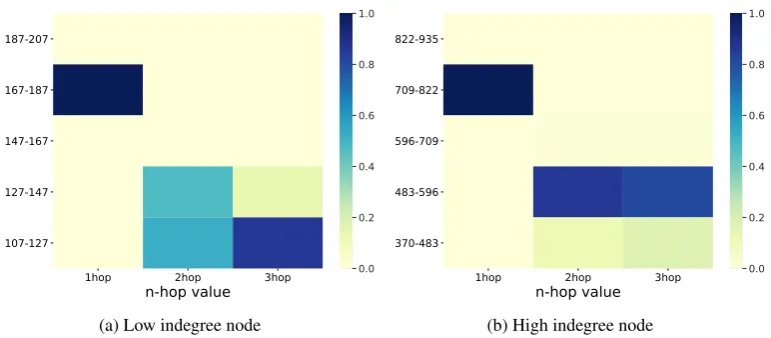
and84, respectively. Figure9 shows that unlike inFB15k-237, the distribution of attention values is similar in the case of the low and high-node. Higher proportion of direct neighbors are being as-signed higher attention values, and decreases with increase in distance from the node. Explanation of this behavior can be found in the inherent struc-ture of theWN18RRdataset. WN18RRfollows a strictly hierarchical structure which ensures that
relatively more information is present at the first level rather than lower levels. Our model priori-tizes the aggregation of information from the di-rect neighbors of the node, but at the same time makes use of the auxiliary information provided by auxiliary edges to learn the structure.
C Optimal Hyper-parameters
In this section we report the optimal set of hyper-parameters for both our attention model (table6) and ConvKB (table 7). We use grid search over
Hits@10 to find these optimal parameters. We do not use batch training for our attention model, whereas we use a batch size of 128 for every dataset in our decoder model. Also, we use of a step learning rate scheduler which decays the learning rate by a factor of 0.5, after every 500
epochs in our attention model and after every25
epochs in the decoder model. Some of the pa-rameters reported in tables6and7are as follows: negative ratio is the ratio of negative and positive triples in the training set, i.e., we sample nega-tive ratio neganega-tive triples per posinega-tive triple in the set. Margin corresponds to the value of γ in the hinge loss equation.
D N-hop Paths
Table8shows the number ofn-hop paths existing in all datasets. We report unique paths between two entities n = {2,3,4,5}, i.e., if there exist multiple paths between two entities of length n, we count it just once. For n = 1, we report all the paths present. Essentially this boils down to counting pairs of entities having a shortest path of lengthnbetween them.
We make use of these paths to introduce auxil-iary edges as discussed in the paper, so if a dataset has more n-paths, theoretically we can use the excess information to further improve the perfor-mance of our model. However, in datasets like
FB15k-237,KinshipandUMLS, where the KG is already dense, the use of extra information can be safely neglected.
E Degree Distribution
UMLS Hits@N
MR MRR @1 @3 @10
DistMult (Yang et al.,2015) 512 0.281 19.9 30.1 44.6 ComplEx (Trouillon et al.,2016) 3.21 0.743 65.7 78.3 92.5 ConvE (Dettmers et al.,2018) 1.38 0.935 89.8 96.7 99 TransE (Bordes et al.,2013) 1.77 0.797 64.1 92.1 99.24 ConvKB (Nguyen et al.,2018) 1.66 0.785 60.8 96.14 99.25 R-GCN (Schlichtkrull et al.,2018) 24.9 0.204 12.6 20.8 32.5
[image:12.595.143.455.62.216.2]KBGAT(this work) 1.11 0.990 98.6 99.5 99.8
Table 5: Experimental results on UMLS test sets. Hits@N values are in percentage. The best score is inboldand second best score is underlined.
1hop 2hop 3hop
n-hop value
53.3-59.2
47.3-53.3
41.4-47.3
35.5-41.4
29.5-35.5
0.0 0.2 0.4 0.6 0.8 1.0
(a) Low indegree node
1hop 2hop 3hop
n-hop value
17.3-20.3
14.3-17.3
11.3-14.3
8.3-11.3
5.3-8.3
0.0 0.2 0.4 0.6 0.8 1.0
[image:12.595.109.507.272.437.2](b) High indegree node
Figure 8: This figure shows relation betweenn-hop paths of a node to its attention values in FB15k-237.
1hop 2hop 3hop
n-hop value
187-207
167-187
147-167
127-147
107-127
0.0 0.2 0.4 0.6 0.8 1.0
(a) Low indegree node
1hop 2hop 3hop
n-hop value
822-935
709-822
596-709
483-596
370-483
0.0 0.2 0.4 0.6 0.8 1.0
(b) High indegree node
Figure 9: This figure shows relation betweenn-hop paths of a node to its attention values in WN18RR.
Weight decay Epochs negative ratio Learning Rate Dropouts Leaky Relu nheads Final dimensions Margin
FB15k-237 1e−5 3000 2 1e−3 0.3 0.2 2 200 1 WN18RR 5e−6 3600 2 1e−3 0.3 0.2 2 200 5 NELL-995 1e−5 3000 2 1e−3 0.3 0.2 2 200 5 Kinship 1e−5 3000 2 1e−3 0.3 0.2 2 400 1 UMLS 1e−5 3000 2 1e−3 0.3 0.2 2 200 3
[image:12.595.111.497.485.654.2] [image:12.595.133.463.685.742.2]Weight decay Epochs negative ratio Learning Rate Dropout Filters
FB15k-237 1e−5 200 40 1e−3 0.3 50
WN18RR 1e−5 200 40 1e−3 0.0 500
NELL-995 1e−5 200 40 1e−3 0.0 500
Kinship 1e−5 400 10 1e−3 0.3 50
[image:13.595.135.464.90.167.2]UMLS 1e−5 400 10 1e−3 0.3 50
Table 7: Optimal values of hyperparameters for decoder(ConvKB) are reported on all datasets.
1-hop 2-hop 3-hop 4-hop 5-hop
FB15k-237 272,115 12,792,938 46,019,137 60,756,091 31,825,944
WN18RR 86,835 207,376 450,748 979,522 2,100,993
NELL-995 149,678 3,736,186 21,561,431 67,455,032 99,591,081
Kinship 8544 2,168 0 0 0
[image:13.595.136.463.254.352.2]UMLS 5216 6,941 4,572 976 190
Table 8: This table shows number ofn-hop paths in all datasets. We report unique paths for all values ofnexcept n= 1.
(a) FB15k-237 (b) WN18RR (c) NELL-995
(d) Kinship (e) UMLS
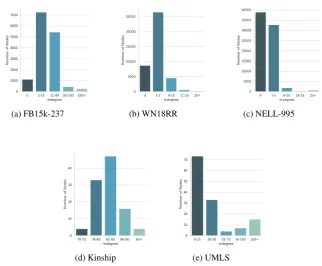
[image:13.595.145.468.448.714.2]hypothesize that inWN18RR, the sparse and hier-archical nature makes it a relatively harder dataset.
FB15k-237also has few rooted nodes in the KG, but since most of the nodes have many connec-tions, the information flow is relatively effective in this case. In Kinship and UMLS, as we can see that there are no rooted nodes and both of these datasets are really dense in nature, especially