warwick.ac.uk/lib-publications
Original citation:
Harrenstein, Paul, Turrini, Paolo and Wooldridge, Michael (2014) Hard and soft equilibria in
Boolean games. In: AAMAS '14 Proceedings of the 2014 international conference on
Autonomous agents and multi-agent systems, Paris, France, 5-9 May 2014. Published in:
Proceedings of the 2014 international conference on Autonomous agents and multi-agent
systems pp. 845-852. ISBN 9781450327381.
Permanent WRAP URL:
http://wrap.warwick.ac.uk/97673
Copyright and reuse:
The Warwick Research Archive Portal (WRAP) makes this work by researchers of the
University of Warwick available open access under the following conditions. Copyright ©
and all moral rights to the version of the paper presented here belong to the individual
author(s) and/or other copyright owners. To the extent reasonable and practicable the
material made available in WRAP has been checked for eligibility before being made
available.
Copies of full items can be used for personal research or study, educational, or not-for profit
purposes without prior permission or charge. Provided that the authors, title and full
bibliographic details are credited, a hyperlink and/or URL is given for the original metadata
page and the content is not changed in any way.
Publisher’s statement:
"© ACM, 2014. This is the author's version of the work. It is posted here by permission of
ACM for your personal use. Not for redistribution. The definitive version was published in
Proceedings of the 2014 international conference on Autonomous agents and multi-agent
systems pp. 845-852. ISBN 9781450327381.2014.
https://dl.acm.org/citation.cfm?id=2615867
A note on versions:
The version presented here may differ from the published version or, version of record, if
you wish to cite this item you are advised to consult the publisher’s version. Please see the
‘permanent WRAP url’ above for details on accessing the published version and note that
access may require a subscription.
Hard and Soft Equilibria in Boolean Games
Paul Harrenstein
Dept. of Computer Science University of Oxford
[email protected]
Paolo Turrini
Department of Computing Imperial College London
[email protected]
Michael Wooldridge
Dept. of Computer Science University of Oxford
[email protected]
ABSTRACT
A fundamental problem in game theory is the possibility of reach-ing equilibrium outcomes with undesirable properties, e.g., ineffi-ciency. The economics literature abounds with models that attempt to modify games in order to eliminate such undesirable equilibria, for example through the use of subsidies and taxation, or by allow-ing players to undergo a preplay negotiation phase. In this paper, we consider the effect of such transformations in Boolean games with costs, where players are primarily motivated to seek the satis-faction of some goal, and are secondarily motivated to minimise the costs of their actions. The preference structure of these games al-lows us to distinguish betweenhardandsoftequilibria, where hard equilibria arise from goal-seeking behaviour, and cannot be elimi-nated from games by, e.g., taxes or subsidies, while soft equilibria are those that arise from the desire of agents to minimise costs. We investigate several mechanisms which allow groups of players to form coalitions and eliminate undesirable equilibria from the game, even when taxes or subsidies are not a possibility.
Categories and Subject Descriptors
I.2.11 [Distributed Artificial Intelligence]: Multiagent Systems; J.4 [Computer Applications]: Social and Behavioral Sciences -Economics
General Terms
Economics, Theory
Keywords
Game theory (cooperative and non-cooperative), Boolean games, Nash equilibria, Externalities
1.
INTRODUCTION
A fundamental problem in the theory of games is that a game may contain Nash equilibria with undesirable properties. To take a famous example, in the Prisoner’s Dilemma the unique pure strat-egy Nash equilibrium, i.e., mutual defection, is the only outcome of the game that is not Pareto optimal, and it is besides strictly worse for both players than the alternative solution of mutual cooperation. From an outside perspective, mechanisms can be devised to incen-tivise the players to play certain actions, e.g., by means of subsi-dies, or to disincentivise them to do so, e.g., by imposing taxes, de facto modifying the game. Likewise, the situation may allow for various ways in which the players themselves can modify the game they are playing, e.g., by making agreements, transferring money to one other, or joining forces in coalitions to their mutual benefit.
Both these solutions have been studied in the economic literature since its early stages [3, 2, 8, 11].
Boolean games (of the form studied in [12, 10]) represent an im-portant domain for investigating these issues, because preferences in such games have a particular structure: players are primarily mo-tivated to achieve a goal and they are only secondarily momo-tivated to minimise the cost of actions required to achieve that goal. In par-ticular, it is assumed that a player will alwaysprefer to achieve her goal than otherwise. Such so-calledquasi-dichotomous prefer-ences, besides inducing nonstandard properties in game play [10], are quite natural in many application domains for multi-agent sys-tems. For example, consider a robot programmed to perform a par-ticular task in an automated warehouse. Operating the robot in-volves energy consumption, which we might want to minimise, but at the same time we do not want to compromise the successful ex-ecution of the task. In other words, weprimarilywant the robot to successfully carry out the task, and onlysecondarilyto minimise its energy consumption. Given such preference structures, it turns out there are limits on way such a game can be manipulated. A player
cannotbe incentivised to choose a course of action that would not lead to his goal to be satisfied over a course of action that would.
Following an introduction to the formal framework of Boolean games with costs, we distinguish betweenhardandsoft equilib-ria in our games. A hard equilibrium is one that will remain an equilibrium no matter what costs are being imposed. In contrast, a soft equilibrium is one that can be eliminated from or introduced to a game by the introduction of some cost incentive. Clearly, the presence of hard equilibria with undesirable properties would be bad news, as it would be impossible to incentivise players not to choose this outcome if they want to. However, we show that hard equilibria are in fact rather rare in the sense that the conditions re-quired for their presence are rather strong. In addition, we show that hard equilibria, when present, do in fact have desirable social properties.
We give logical classifications of both hard and soft equilibria and discuss their properties. We then turn to the issue of managing equilibria, using well-known ideas from the economics literature [11, 3, 2, 8, 7]. We first consider the possibility of groups of play-ers to engineer side-payments so as to motivate another player to act in a way that is beneficial to the group. This is the idea of (a group of) players encouraging another player to increase the posi-tive externalities or reduce the negaposi-tive externalities it induces [3, 8, 7]. Second, we study the possibility of a player taking into ac-count the undesirable consequences his choices have for others by
players to merge in coalitions hard equilibria can be eliminated.
2.
BOOLEAN GAMES WITH COSTS
Boolean games are based on propositional logic, and have a nat-ural computational interpretation, which is highly relevant to the multi-agent systems domain (see, e.g., [5, 1, 4, 12, 10]). In this pa-per, we use the Boolean games model with cost functions, in which the players have quasi-dichotomous preferences, as in [12]. Thus, each player is primarily interested in satisfying a goal, which is expressed by a Boolean formula, classifying each outcome as de-sirable or undede-sirable. A player’s secondary concern is with costs: if two outcomes both satisfy or both do not satisfy a player’s goal, the one is preferred that has the lower cost. This quasi-dichotomous character of the preferences allows us to accentuate certain aspects of the effects of side-payments and coalition merging in the context of externalities.
LetB= {>,⊥}be the set of Boolean truth values, with “>” being truth and “⊥” being falsity. Let, furthermore,Φ ={p,q, . . .} be a fixed, finite, and non-empty vocabulary of Boolean variables andLthe set of well-formed formulae of propositional logic overΦ with the conventional Boolean operators (“∧”, “∨”, “→”, “↔”, “¬”) as well as the truth constants “>” and “⊥”. Avaluationis a functionv : Φ→B, assigning truth or falsity to every Boolean variable. We writev|=ϕto mean thatϕis true under, or satisfied by, valuationv, where the satisfaction relation “|=” is defined in the standard way. LetVdenote the set of all valuations overΦ.
The games we consider are populated by a setN={1, . . . ,n} ofagents, the players of the game. Each agenti∈ Nis assumed to have agoal, which is characterised by anL-formulaγi. Each agenti ∈ N controlsa (possibly empty) subsetΦi of the overall set of Boolean variables. By “control”, we mean thatihas the unique ability within the game to set the value (either>or⊥) of each variablep ∈ Φi. We will require thatΦ1, . . . ,Φn forms a partition ofΦ, i.e.,Φi∩Φj=∅fori6=jandΦ1∪ · · · ∪Φn= Φ. Every variable is controlled by precisely one agent. Achoicefor agenti∈Nis defined by a functionvi: Φi→B, i.e., an allocation of truth or falsity to all the variables underi’s control. IfΦi =∅, playerihas only one action and is called adummy player. LetVi denote the set of choices for agenti. The intuitive interpretation we give toViis that it defines theactionsorstrategiesavailable to agenti, i.e., thechoicesavailable to the agent.
Anoutcome~v= (v1, . . . ,vn)inV1× · · · × Vnis a collection of choices, one for each agent. Clearly, every outcome uniquely de-fines a valuation, and we will abuse notation by treating outcomes as valuations and valuations as outcomes. So, for example, we will write~v |=ϕto mean that the valuation defined by the outcome~v
satisfies formulaϕ. We letV~ denote the set of outcomes, and we write(~v−i,v0i)for the outcome(v1, . . . ,vi−1,v0i,vi+1, . . . ,v0n).
When playing a Boolean game, the primary aim of an agentiwill be to choose an assignment of values for the variablesΦiunder her control so as to satisfy her goalγi. The difficulty is thatγi may contain variables controlled by other agentsj6=i, who will also be trying to choose values for their variablesΦjso as to get their goals satisfied. As their goals in turn may be dependent on the variables inΦi, they may have to take into account how playeriwill act when making their choice. And so on. In our setting, moreover, outcomes are associated with costs to the players. Minimising these costs is another important, but secondary, concern to the players. Thus, if an agent has multiple ways of getting his goal achieved, thenhe will prefer to choose one that minimises his costs, whereas, if an agent cannot get his goal achieved, thenhe simply chooses to minimise his costs.
To capture these preferences, we introduce two types of cost
function:global cost functionsandlocal cost functions. The former associate with each outcome a cost for each of the players, whereas the latter associate costs with setting propositional variables to one of the two truth-values. Formally, we define aglobal cost function
as a function
c:N×V →~ Q≥,
which associates each player iand each outcome~v with a non-negative rational number, intuitively representing the amount by which playeriis taxed when~vis the outcome of the game. We also writeci(~v) forc(i,~v). Wooldridgeet al.[12] assumed a natural
additive (and more concise) model for costs given bylocal cost functionsof the form
ˆc: Φ×B→Q≥.
Intuitively,ˆc(p,b)is the marginal cost of assigning the valueb∈B to variablep∈ Φ. Given this definition, we can extend the local cost functionˆcto outcomes~v= (v1, . . . ,vn), as follows:
ˆc(i,~v) =
(P
p∈Φiˆc(p,vi(p)) ifΦi 6=∅,
0 otherwise.
Notice that this model implies that the cost a player incurs only depends on the choice that this player makes. With a slight abuse of notation, we therefore also writeˆci(vi)forcˆ(i,~v) where~v = (v1, . . . ,vn)andˆcis induced by a local cost function. Observe that every local cost function defines a global cost function, but not necessarily the other way round. In particular, the local costs for a playeriwill be the same for any two outcomes~v= (v1, . . . ,vn) and~v0= (v01, . . . ,v0n)whenevervi=v0i. This need not be the case for global cost functions.
We can now introduce the utility functions that model the play-ers’ preferences. Let~ve be an outcome with maximal cost for playeri, and letµidenote the cost toiof this most expensive out-come, i.e.,
~ve∈arg max ~v∈V~
ci(~v) and µi=ci(~ve).
Theutilityto agentiof an outcome~v= (v1, . . . ,vi, . . . ,vn)is then defined as follows:
ui(~v) =
(
1 +µi−ci(~v) if~v|=γi, −ci(~v) otherwise.
Thus, utility to agentiwill range from1 +µi (for an outcome in whichigets his goal achieved at the lowest cost) down to−µi(for outcomes with the highest cost toiin whichi’s goal is not satisfied). Formally, aBoolean game (with costs)is then given by a struc-ture
G= (N,Φ,c,(γi)i∈N,(Φi)i∈N),
whereN = {1, . . . ,n}is a set of agents,Φ = {p,q, . . .}is a finite set of Boolean variables,cis a (global or local) cost function,
γi ∈ Lis the goal of agenti∈ N, andΦ1, . . . ,Φnis a partition ofΦoverN, with the intended interpretation thatΦiis the set of Boolean variables under the unique control ofi∈N.
Boolean games represent games in strategic form, with choices of players as their actions and the utility function as defined above representing their preferences. Accordingly, the standard game-theoretic solution concepts are available for the analysis of Boolean games [9]. We focus on Nash equilibrium. An outcome~v = (v1, . . . ,vn)is a(pure) Nash equilibriumif for all agentsi∈ N, there is nov0i∈ Visuch that
q∧r q∧ ¬r ¬q∧r ¬q∧ ¬r
1,2,3 1,2,3 2
p 1,11,0 1,11,0 1,2,0 1,2,0
1,2,3 1,2,3 2
¬p 1,11,0 1,11,0 1,2,0 1,2,0
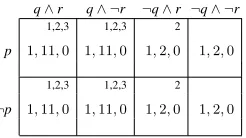
Figure 1: The game of Example 1, in which player1chooses rows and player2columns. Player3is a dummy player. The figures in the top right corners of the cells indicate the players that have their goals satisfied in the respective outcome. The three figuresx,y,zin the centre of each cell denote thecoststo player1, player2, and player3, respectively.
LetNE(G)denote the set of all Nash equilibria of the gameG. Let us consider an example.
EXAMPLE 1. Suppose we have a game G1with N={1,2,3},
Φ = {p,q,r}, Φ1 = {p},Φ2 = {q,r}, Φ3 = ∅, and a local
cost function. The cost for player2of setting q=>is10and all other costs in the game are1. Finally, we haveγ1 =γ3 =q, and
γ2=q∨r. Also see Figure 1. Now, although player2couldchoose
an action that satisfies not only his goal but also those of players1
and3—e.g., setting q and r both to true—he will not rationally do so: by setting q to true and r to false he would achieve his goal at a lower cost. Then, however, players1and3are left without their goals being satisfied. It is easy to see that for all~v∈NE(G1)we
have~v |=¬γ1∧γ2∧ ¬γ3, i.e., in all Nash equilibria, players1
and3fail to get their goals achieved. This is a simple example of a Nash equilibrium with undesirable social properties. More-over, this equilibrium is troubling, because there is an alternative outcome of the game in whichallplayers’s goals are satisfied.
3.
HARD AND SOFT EQUILIBRIA
Recall that an agent’s preferences are driven by two components: the primary one is her goalγi, the secondary one is cost minimisa-tion. It is important to emphasise that cost minimisation is strictly secondary to goal achievement: an agent willalwaysprefer an out-come that satisfies her goal over one that does not, irrespective of what the cost implications are.
In this section, we will show that the fact that there are two dis-tinct drivers behind an agent’s preferences gives a two-tier structure to the Nash equilibria of Boolean games. Specifically, we distin-guish betweenhardandsoftequilibria. Informally, a hard equilib-rium is one that is present in game irrespective of the cost function of the game. In contrast, a soft equilibrium is one whose pres-ence in a game is contingent upon the cost function of the game. As a consequence, if an equilibrium is soft, then it can potentially be eliminated from the game if it is viewed as undesirable—e.g., through taxes [11, p.656]—or introduced to the game by providing appropriate incentives, if it is seen as desirable. To formalise this intuition, we need some more notation.
First, given a gameGwith cost functionc, we denote byGc0the game obtained fromGby replacing the cost functioncwith cost functionc0. Thus, inGc0, the primary drivers behind each player’s preferences (i.e., goal achievement) remain the same as inG, but the secondary drivers (i.e., cost reduction) may be different.
Important in the discussion that follows is thezero cost func-tion c0, which assigns cost0to all players in all outcomes. Thus, in a gameGwith cost functionc0, which we will also denote byG0,
HARD(G) ⊆ NE(G) ⊆ INIT(G)
⊆ ⊆
PRESENT(G) ⊆ SOFT(G)
⊆
[image:4.612.116.239.60.129.2]ABSENT(G)
Figure 2: Containment relations between types of equilibria.
players are indifferent between outcomes on the basis of costs: the
onlydriver for an agent is to achieve his goal.
Let us now define the setINIT(G)ofinitial equilibriaof a gameG
to consist of those equilibria that are present in the gameG0, i.e.,
INIT(G) =NE(G0).
The reason for singling out this set and giving it its name is illus-trated by the following observation.
OBSERVATION2 ([12]). For all games G,NE(G)⊆INIT(G).
Thus, the gameG0contains amaximal set of Nash equilibria with respect toG. In particular, if for some outcome~vwe have
~v6∈NE(G0), then there is no possibility of introducing it toGvia the imposition of some cost function. Marginal costs defined within cost functionscserve toeliminateNash equilibria from a gameG0. We can now define the hard equilibria of a gameG. Formally, the set of hard equilibria ofGare those equilibria that are present inGno matter what cost function we assign to the game, i.e.,
HARD(G) = \ c:N×V→~ Q≥
NE(Gc).
Thus, if~v∈HARD(G), then~vis “immune” to any cost considera-tions, because no matter what we do to the cost function ofG, the outcome~vwill remain an equilibrium in the game.
In contrast, a soft equilibrium is one that is present in a game for some assignment of costs in the game, but is absent for some other assignment of costs. We can thus think of soft equilibria as being the “malleable” part of a game: it is these equilibria that we can eliminate from or introduce to games. Formally,SOFT(G)denotes the set of soft equilibria ofG, i.e.,
SOFT(G) =INIT(G)\HARD(G).
To understand this definition, recall thatINIT(G)is the maximal set of Nash equilibria that could be present in a game. Accordingly, an outcome can be a soft equilibrium in a game without being a Nash equilibrium. It will, however, be a Nash equilibrium for the game with another cost function. For this reason, we will distinguish between soft equilibria that are present and those that are absent in a game. Thus, we letPRESENT(G)denote the set of soft equilibria ofGthat are present inG, and letABSENT(G)denote the set of soft equilibria that are not present inG, i.e.,
PRESENT(G) =NE(G)\HARD(G),
ABSENT(G) =SOFT(G)\PRESENT(G).
Figure 2 illustrates the containment relations between these sets; these all follow directly from the definitions presented above to-gether with Observation 2. Let us see an example.
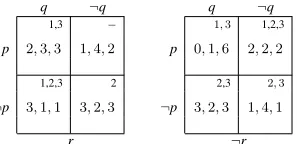
EXAMPLE 3. Consider the Boolean game in Figure 3 with N= {1,2,3},Φ1 ={p},Φ2 ={q}, andΦ3 ={r}. The goals of the
q ¬q
1,3 −
p 2,3,3 1,4,2
1,2,3 2
¬p 3,1,1 3,2,3
r
q ¬q
1,3 1,2,3
p 0,1,6 2,2,2
2,3 2,3
¬p 3,2,3 1,4,1
[image:5.612.104.253.61.133.2]¬r
Figure 3: A three-player game, in which player1controlsp, player2 controlsq, and player3controlsr. The notational conventions are as in Figure 1.
(¬q∧ ¬r), andγ3=r→q. Here, as in the further examples, we
will refer to the outcome satisfying p∧ ¬q∧r as~vp¬qrand for the other other outcomes similarly.
The game has two Nash equilibria, viz.,~vpqrand~vp¬q¬r. The for-mer is soft and present, whereas the latter is hard. Outcome~v¬pqr is the third initial equilibrium and is achieved by the empty cost function c0. It is, however, soft and absent.
The concept of a hard equilibrium is defined with respect toall
(global) cost functions. The following lemma, however, shows that one only need to consider thelocalcost functions to decide whether an outcome is a hard equilibrium. As the zero cost functionc0can obviously be seen as being induced by the local cost function that assigns cost zero to every variable, this also holds for the initial, soft, absent, and present equilibria.1
LEMMA 4. Let G be a game and~v an outcome. Then,~v ∈
HARD(G)if and only if~v∈NE(Gc)for alllocalcost functions c. Notice that in the gameG1of Example 1 there are no hard
equi-libria. The following proposition establishes that this is in fact no coincidence: hard equilibria are rather scarce in Boolean games. For an outcome to be a hard equilibrium, every player must get their goal achieved in that outcome, and any deviation from that outcome by a player must result in that player’s goal being unsatis-fied. The following proposition states this fact more formally.
PROPOSITION 5. Let~v = (v1, . . . ,vi, . . . ,vn)be an outcome
of a game G. Then,~v∈HARD(G)if and only if both of the follow-ing conditions are satisfied:
(i) ~v|=γi for all non-dummy players i in G, and
(ii) for all players i in G and all choices v0i ∈ Viwith v0i 6=vi, we
have(~v−i,v0i)6|=γi.
PROOF. For the “only if”-direction, we show that, if either of the right-hand side conditions is not satisfied, then~v6∈HARD(G). Suppose condition(i) is not satisfied and letibe a non-dummy player for which~v6|=γi. Letv0i ∈ Viwithv0i 6=vi and fix a local cost functionˆcsuch that thatv0iis strictly the cheapest choice fori. Thenv0i represents a beneficial deviation forifrom~vinGˆc, and so
~v6∈ HARD(G). Now suppose condition(ii)is not satisfied. Then, some playerihas a choicev0i 6= vi, such that(~v−i,v0i) |=γi. Fix a (local) cost functionˆcthat makesv0i the strictly cheapest choice fori. Then,v0i is a beneficial deviation fori: if~v 6|= γi, then the deviation tov0i benefitsibecause she gets her goal achieved, while, if~v |= γi, then deviating tov0i benefitsibecause it reduces costs compared tovi.
1
Some of the proofs in this paper we omit due to space restrictions.
For the opposite direction, suppose(i)and(ii)are satisfied but that~v6∈HARD(G). From the latter assumption, there is a cost func-tionc: Φ×B →Rsuch that~v 6∈NE(Gc). Then, some playeri
has a beneficial deviationv0i from~vinGc. Now, by(i), all non-dummy players have their goals achieved with~v, and, by(ii), any deviation, in particular tov0i, would result in their goals being un-satisfied. Hence,v0i cannot be a beneficial deviation and we obtain a contradiction.
The significance of Proposition 5 may not be immediately ap-parent. We argue, however, that it is a positive result rather than a negative one. Hard equilibria cannot be eliminated from games through cost functions, and so the presence of hard equilibria with undesirable properties would be bad news indeed. But Proposi-tion 5 establishes that, first, hard equilibria are rare in games, in the sense that the condition required for their presence is very strong, and second, where they are present, hard equilibria in fact have properties that can be viewed as very desirable: all players have their goals achieved, and hence obtain positive utility. Thus, hard equilibria can be understood as maximisingqualitative social wel-fare [12]. Also notice that Proposition 5 ispurely logical. The condition on the right-hand side is expressed solely in terms of val-uations and goal formulae; no reference is made to cost functions.
The following proposition characterises the set of soft equilibria.
PROPOSITION 6. Let~v = (v1, . . . ,vi, . . . ,vn)be an outcome
of a game G. Then,~v∈ SOFT(G)if and only if both~v∈ INIT(G)
and there is a player i and an outcome~v0 = (v01, . . . ,v0n) with
~v06=~v such that the following conditions are satisfied:
(i)~v|=γi if and only if ~v0|=γi, and (ii)~v−i =~v0−i.
PROOF. For the “if”-direction, assume~v0satisfies the right-hand side of the condition. Define a local cost functionˆcsuch that, for each propositional variablepand booleanb∈ {⊥,>},
ˆc(p,b) =
(
0 if~v0(p) =b, 1 otherwise. .
With this cost function, the least-cost choice for an agentiis to choose his partv0i of~v
0
; any other choice will incur higher cost. In this case, since~v|=γi if and only if~v0 |=γi, theniwill have a beneficial deviation from~vto~v0, and so~v 6∈ NE(Gˆc). Since
~v∈NE(G0)and~v6∈NE(Gˆc), then~v∈SOFT(G).
For the opposite direction, assume~v ∈ SOFT(G). Then, there is a cost functionc : Φ×B → Q≥such that~v ∈ INIT(G)but
~v6∈NE(Gc). Since~v6∈NE(Gc), then some playerihas a beneficial deviationv0i from~vinGc. We claim that~v |= γi if and only if
~v0|=γi. For suppose not, then either (a)~v|=γiand~v06|=γi, or else (b)~v6|=γiand~v0|=γi. In case (a), we would haveui(~v−i,v0i)<
ui(~v)inGc, and sov0i cannot be a beneficial deviation. In case (b), sinceiwould not get her goal achieved in~vbut would with(~v−i,v0i), choicev0i would be a beneficial deviation from~vfor playeriin the gameG0. Hence,~v6∈NE(G0), i.e.,~v6∈INIT(G). In both cases we have a contradiction. Hence,~v|=γiif and only if~v0 |=γi. Thus, the conditions of the right-hand side are satisfied.
Again, this characterisation is purely logical and makes no refer-ence to cost functions.
4. EXTERNALITIES IN BOOLEAN GAMES
games. The term “externality” in economics is used to refer to a situation where the actions of one agent can affect the well-being of one or more other agents [11]. An example of (negative) external-ity is a factory discharging industrial effluent into a river upstream of a fish farm, thereby reducing the quality and quantity of the fish that the farm can produce. An example of (positive) externality is a honey producer keeping bee hives in a field that happens to be close to an orchard [8, 7]: the orchard owner benefits from the presence of the bees, who pollinate the apple trees.
There are two standard approaches in economics to deal with ex-ternalities. The first is to allow players to provide monetary com-pensation, orside-payments, to encourage or discourage certain ac-tions to be taken. In the example of the beekeeper and the apple grower, if side-payments are allowed, the apple grower will com-pensate the beekeeper for his positive externality, provided the bee-keeper is effectively able to prevent his bees from pollinating the apple trees [7]. Economic theorists like Coase, Meade, and Maskin have studied under what conditions this possibility allows efficient outcomes to be reached [3, 8, 7, 6]. The second approach to deal-ing with externalities is to have playersinternaliseexternalities, that is, to somehow incentivise them to take externalities into con-sideration when they make their choices. In the factory-fish farm example, above, if wemergethe fish farm and factory into a sin-gle company, then it is in this company’s own interest to take into account the negative effects of the pollution it causes. As such, merging players can be seen as one way to internalise externalities. Neither of these approaches is always realisable in practice, e.g., due to the absence of communication channels among the parties involved or the lack of appropriate legislation. It is, however, inter-esting to study the many cases in which they are.
In Boolean games, externalities arise from the fact that the sat-isfaction of one player’s goal can depend on the choices made by the other players. By choosing a particular valuation, a player can either help or hinder other players achieving their goals. In the next section we adapt the two approaches described above to the frame-work of Boolean games.
4.1
Side-payments
In this section, we investigate what groups of players can achieve if, before the game starts, they are allowed to make binding offers to their fellow coalition members to persuade them to play des-ignated strategies. Turrini [10] studied a preplay phase preceding a Boolean game as a second game taking place before the actual game starts. Our approach here is different: given a Boolean game, we focus on the ability ofcoalitionsto engineer side-payments in order to escape unsatisfactory outcomes. The question we are espe-cially interested in is which equilibria—hard or soft—can be elim-inated from the game in this manner. Consider, for example, the game in Figure 3. There, player2does not have her goal achieved in the equilibrium satisfyingp∧q∧r, but she could try to incen-tivise player1to setpto⊥by offering him compensation for the additional costs he incurs if he were to do so.
Following [6, 10], we formalise side-payments by means of so-calledtransfer functions, i.e., functions of the form
τ:N×N×V →~ Q≥.
Intuitively,τ(i,j,~v)is the compensation playerjreceives from play-erifor the costsjincurs at outcome~v. Thus, after the transfer, playeri’s cost at~vis increased byτ(i,j,~v), whereas playerj’s cost at the same outcome is decreased by the same amount. Importantly, it may very well be thatτ(i,j,~v)6=τ(j,i,~v).
We say that a transfer functionτonly involves coalition Cif all transfers to and from players not inCare zero at all outcomes, i.e.,
if, for all playersi∈Nandj∈N\Cand all outcomes~v,
τ(i,j,~v) =τ(j,i,~v) = 0. Furthermore, we letτi(~v)abbreviate the term
X
j∈N
τ(j,i,~v)−X j∈N
τ(i,j,~v),
i.e., the net transfer received by playeriunderτ. It is important to observe that every transfer to a player means an equally large transfer from the other player. Therefore, each transferτ(i,j,~v) occurs once (negatively) inτi(~v)and once (positively) inτj(~v). In particular, ifτonly involvesC, we have
X
i∈C
τi(~v) = 0.
We restrict our attention toadmissibletransfer functions, i.e., transfer functions such that, for all playersiand all outcomes~v,
τi(~v)≤ci(~v).
In words, at no outcome the amount of what a player receives from others minus what he gives to them can exceed his cost. Thus, the cost a player incurs at an outcome cannot be overcompensated, i.e., it cannot end up being negative as result of preplay negotia-tion. For instance, if playeri’s costci(~v) = 3and playerjis the only other player in the game, then it cannot be thatτ(j,i,~v) = 5 andτ(i,j,~v) = 1. This restriction is mainly of a technical nature and preserves the quasi-dichotomous character of the preferences in games transformed by transfer functions.2
Thus, a transfer function transforms the cost function of a Bool-ean game. Letτbe a transfer function. ForGa Boolean game with cost functionc, we then definecτas the cost function such that, for all playersiand all outcomes~v,3
cτi(~v) =ci(~v)−τi(~v).
The utility function of playeriin gameGwith cost functioncτwe will henceforth denote byuτi.
We are particularly interested in the equilibria of a game that can be eliminated by groups of players making side-payments to one another. Intuitively, an equilibrium~vcan be eliminated if a coalition can engineer a transfer function that makes it attractive for one of its membersito deviate from~vto another outcome(~v−i,v0i). Moreover, such a side-payment scheme has to benefit all players of the coalition. That is, all coalition members should prefer(~v−i,v0i) after the side-payments have been made to~vbefore. Formally, we say that a coalitionC blocks outcome~vif there is some transfer functionτonly involvingC, some playeri∈C, and somev0i ∈ Vi such that the following two conditions hold:
(i) uτi(~v−i,v0i)>u τ i(~v), and
(ii) uτj(~v−i,vi0)>uj(~v) for all playersj∈C.
Condition(i)ensures that playeriis incentivised to deviate from~v
to(~v−i,v0i)aftertransfers have taken place, whereas condition(ii) guarantees that all players inCare better of in(~v−i,v0i)after trans-fers have taken place than they were in~v before. Furthermore, we say an outcome~visblocked (via side-payments)if there is a coali-tion blocking ~v. In case a coalition blocks an initial equilibrium~v, we also say that~viseliminable via side-payments.
2One could also assume a base level of unavoidable costs and
modelrewards(as distinguished fromreparations) as compensa-tion beyond this level.
3
EXAMPLE 7. Consider again the game in Figure 3. At out-come~vpqrplayer2’s goal is not satisfied, whereas she is at~v¬pqr
. Letτbe such that
τ(i,j,~v) =
(
x if i= 2, j= 1, and~v=~v¬pqr,
0 otherwise.
Then,τ would incentivise player1to deviate to~v¬pqr provided that x>1. Moreover, player2would gladly make any such trans-fer in order to satisfy her goal. Accordingly,{1,2}is a coalition blocking the outcome~vpqr. In a similar way, player1might want
to induce player3 to deviate to outcome~vpq¬r. That, however, would require compensating player3for the additional costs of3
that player3incurs at~vpq¬r. Player1, having his goals achieved at both~vpqr and~vpq¬r, however, is not prepared to do so, as his marginal gain in costs (before transfer) would only be2. Still, player2would also like to see player3deviate to~vpq¬r. More-over, together players1and2can compensate player3sufficiently for him to do so. For instance, this could be achieved by the transfer functionτ0, defined as
τ0(i,j,~v) =
(
13
4 if i∈ {1,2}, j= 3, and~v=~v
pq¬r
,
0 otherwise.
Accordingly,{1,2,3}is also a coalition blocking outcome~vpqr. We may therefore conclude that~vpqris eliminable by side-payments. As transfer functions operate on cost functions only, it is immediate that hard equilibria cannot be eliminated via side-payments.
OBSERVATION 8. Let~v be a hard equilibrium of a game G, i.e.,
~v∈HARD(G). Then,~v cannot be eliminated via side-payments.
Moreover, if an outcome~vfails to be a Nash equilibrium, there is some playeriand somev0i ∈ Viwithui(~v−i,v0i)>ui(~v). Then~v is eliminable by the singleton coalition{i}via the transfer function that assigns cost zero to all players at all outcomes.
OBSERVATION 9. Let~v be an outcome of game G such that~v is not a Nash equilibrium. Then~v is eliminable via side-payments.
The previous two observations show that in every game there is a class of outcomes that can never be eliminated via side-payments (the hard equilibria) as well as a class of outcomes that can always be eliminated via side-payments (the outcomes that are not Nash equilibria). There may, however, very well be outcomes in a game that do not belong to either of these classes. Together with Observa-tions 8 and 9, the following result establishes a full characterisation of all outcomes that are eliminable via side-payments in a game.
PROPOSITION 10. Let~v be a present equilibrium of a Boolean game G with aglobalcost function c. Then,~v is eliminable via side-payments if and only if there is a coalition C, a player i∈C with ci(~v) >0, and a v0i ∈ Visuch that~v|=γjimplies(~v−i,v0i) |=γj
for all j∈C, and one of the following conditions holds:
(i) ~v6|=γjand(~v−i,v0i)|=γj for some player j∈C, or (ii) X
j∈C
cj(~v−i,v0i)<
X
j∈C
cj(~v).
PROOF. First assume that~vis eliminable via side-payments. Then, there is some coalitionC, somei ∈ C, somev0i ∈ Vi, and some admissible transfer functionτonly involvingCsuch that,
uτi(~v−i,v0i)>u τ i(~v), and
uτj(~v−i,v0i)>uj(~v) for all playersj∈C.
From the latter follows that~v|=γj implies(~v−i,v0i) |=γjfor all
j ∈ C. Assume that~v 6|= γjand(~v−i,v0i) |= γjfor noj ∈ C. It follows that~v6|=γjif and only if(~v−i,v0i)|=γjfor allj∈C. Since
uτj(~v−i,v0i)>uj(~v)for all playersj∈C, we also have that,
X
j∈C
cτj(~v−i,v0i)<
X
j∈C
cj(~v).
By admissibility ofτ, in particular,cτi(~v−i,v0i) ≥0. Hence, also
ci(~v)>0. Recall thatPj∈Cτj(~v−i,v0i) = 0. Therefore,
X
j∈C
cτj(~v−i,v0i) =
X
j∈C
(cj(~v−i,v0i)−τj(~v−i,v0i))
=X
j∈C
cj(~v−i,v0i)−
X
j∈C
τj(~v−i,v0i)
=X
j∈C
cj(~v−i,v0i).
Thus, finally we obtain that
X
j∈C
cj(~v−i,v0i)<
X
j∈C
cj(~v).
For the opposite direction, assumeci(~v) > 0 and letC be a coalition,i ∈ C, andv0i ∈ Vi. Also assume that~v |=γjimplies (~v−i,v0i)|=γj for allj∈ C. First, let~v 6|=γjand(~v−i,v0i) |=γj for some playerj∈C. Observe thatj6=i, otherwise~vwould not be a present equilibrium ofG. As~v|=γiimplies(~v−i,v0i) |=γi, we may also assume thatci(~v−i,v0i)−ci(~v)≥0. Letbe such that 0< ≤ci(~v)and define the transfer functionτsuch that
τ(j,i,(~v−i,v0i)) =ci(~v−i,v0i)−ci(~v) +
and τ(k,k0, ~w) = 0for allk 6= j, k0 6= i, and ~w 6= (~v−i,v0i). Observe thatτ is admissible. Then, coalition{i,j}blocks~vviaτ. Finally, we may assume that~v|= γjif and only if(~v−i,v0i) |=γj for allj∈Cand thatP
j∈Ccj(~v−i,v0i)<
P
j∈Ccj(~v). Without loss of generality we may assume thatcj(~v)−cj(~v−i,v0i) > 0for all
j∈C\ {i}. As~vis a present equilibrium, moreover,ci(~v−i,v0i)−
ci(~v))>0. Now, for some positive,
ci(~v−i,v0i)−ci(~v) +=
X
j∈C\{i}
cj(~v)−cj(~v−i,v0i).
Let0< δ≤min(ci(~v), )and define the transfer functionτsuch that for everyj∈C\ {i},
τ(j,i,w) = (ci(~v−i,v 0
i)−ci(~v) +δ)(cj(~v)−cj(~v−i,v0i)
X
k∈C\{i}
(ck(v)−ck(~v−i,v0i)) .
and τ(k,k0, ~w) = 0for allk 6= j, k0 6= i, and ~w 6= (~v−i,v0i). Observe thatτis admissible. Moreover, it can now easily be estab-lished that for everyj∈C, we have thatuτj(~v−i,v0i)>uj(~v). As, moreover,cτi(~v) =ci(~v), we may conclude that~vcan be eliminated by coalitionCviaτ.
Notice that this result characterises present equilibria that are elim-inable via side-paymentswithout making reference to transfer func-tions.Also, a closer inspection of the proof shows that, if a present equilibrium can be eliminated, then a coalition need compensate only one of its members. This is exactly the player that has to be incentivised to deviate from the equilibrium in question.
q ¬q 1,3 3
p 4,3,3 1,5,2
− 1,2,3
¬p 2,3,1 3,2,2
r
q ¬q
2 2,3
p 1,1,3 3,1,2
1,2,3 −
¬p 1,3,1 1,1,1
[image:8.612.380.498.60.131.2]¬r
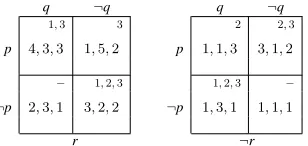
Figure 4: A three-player game illustrating some features of coalition merging
The corollary tells us something about the number of coalition members receiving the transfer, but it says very little about the num-ber of coalition memnum-bers making the payments. In fact, the com-pensation costs required to bring about the intended deviation may be so high that we need many players to bear them. In some specific cases, however, also the number of coalition members compensat-ing the deviatcompensat-ing player can be extremely small.
PROPOSITION 12. Let~v be a present equilibrium of a Boolean game G with alocal cost functionˆc. Then,~v is eliminable via side-payments if and only if there are two distinct players i and j, and some v0i ∈ Visuch that both
(i) ~v|=γi if and only if (~v−i,v0i)|=γi, and (ii) ~v6|=γj and (~v−i,v0i)|=γj.
The main idea underlying this proposition is that, if a playerican be incentivised to deviate from a present equilibrium~vto(~v−i,v0i) by some coalitionC, thenimust receive some compensation to do so. Some other playerjinCmust then be willing to carry at least part of this cost. As the cost functionˆcis local, however, we have ˆcj(~v) = ˆcj(~v−i,vi0). Thus, the costs forjin(~v−i,v0i)arehigherafter the side-payments took place than before. Therefore, forjto be willing to participate in the coalitionC, he should have his goalγj satisfied at(~v−i,v0i), but not at~v. Then, however, playerjwould be prepared to pay any price to makeideviate from~vto(~v−i,v0i). It follows that the two-player coalition{i,j}would also block out-come~v.
It is worth observing that the right-hand side of Proposition 12 only involves conditions relating to the realisation of players’ goals. In the setting with local cost functions, whether an outcome is elim-inable via side-payments is quite independent of the actual cost function.
Summarising, Corollary 11 tells us that blocking coalitions can begreedy, i.e., they can design such transfers only paying one player and without transferring money among themselves. Propo-sition 12 tells us that, when goal realisation is at stake, blocking coalitions can besmall: a playeriwhose goal is not satisfied is prepared to compensate any additional costs that another playerj
incurs ifj(unilaterally) were to deviate to an outcome that does satisfyi’s goal.
4.2
Coalition merging
In this section, we explore the idea ofinternalisingexternalities by forming large enough coalitions to eliminate the potential inter-ference among the players in a Boolean game. In particular, we consider the extent to which we can facilitate positive externalities and eliminate negative externalities by merging players.
Just as we do when imposing taxation schemes on games or by allowing coalitions to make side-payments, by merging players we
q∧r q∧ ¬r ¬q∧r ¬q∧ ¬r
1 − − d(C)
p 4,6 1,4 1,7 3,3
− 1,d(C) 1,d(C) −
¬p 2,4 1,4 3,4 1,2
Figure 5: The reduced game resulting from the game in Fig-ure 4 by merging players2and3into one playerd(C)
can transform the structure of the game. In particular, we can mod-ify its original equilibria. To explore the properties of coalition merging, we need to establish some notational conventions first.
LetG= (N,Φ,c,(γi)i∈N,(Φi)i∈N)be a Boolean game andCa subset of players inG. We denote byGCthe game obtained from G
by merging the players in C into a single player. In this context merging the players inCmeans that the coalitionC operates as a single playerd(C)aiming to satisfy all its members’ goals at the same time, while controlling all their variables simultaneously. The costs incurred byCare then the joint costs ofC. Formally,
GC= (N 0
,Φ,c0,(γi0)i∈N0,(Φ0i)i∈N0),
whereN0= (N\C)∪ {d(C)}for somed(C)∈/N, and Φ0d(C)=
[
j∈C
Φj γ
0 d(C)=
^
i∈C
γi.
For alli∈/C, we haveΦ0j = Φjandγj0=γj. The cost functionc 0
is such that, for all outcomes~v,
c0i(~v) =
( P
i∈Cci(~v) ifi=d(C),
ci(~v) otherwise.
In words, the cost function of playeriin the updated gameGC yields, at each outcome, the sum of costs of all members of coali-tionCat that outcome, if playeriis the playerd(C), i.e., if playeri
is the result of the merging of coalitionC. Otherwise, it leaves the costs for playeriunchanged.
We refer toGCas areducedgame, and the gameGfrom whichGC is derived as theoriginalgame. Let us first consider an example to illustrate the concept.
EXAMPLE 13. Consider the game depicted in Figure 4, where player1chooses values for p, player2for q, and player3for r. The original game has three Nash equilibria, viz., the outcomes
~vpqr,~v¬p¬qr, and~v¬pq¬r, the latter two of which are hard. By merg-ing all players into one, only~v¬pq¬rremains as an equilibrium. It satisfies all players’ goals and, hence also d(N)’s. Although out-come~v¬p¬qrdoes this as well, it does so at a considerably higher cost to d(N), viz.,7versus5. This shows that coalition merging can eliminate hard equilibria as well as the hardness of equilibria: both~v¬p¬qrand~vpq¬rare soft equilibria in GN.
Now, consider the (soft) equilibrium~vpqr. Observe that this
equi-librium cannot be eliminated via side-payments. Player1will have part nor parcel in any blocking coalition. Player3cannot be incen-tivised to deviate to~vpq¬r nor would he be willing to compensate player2sufficiently if she were to deviate to~vp¬qr. Observe, how-ever, that, if player2and3were to merge, as depicted in Figure 5, they could deviate to~vp¬q¬r, benefitting both players.
[image:8.612.100.254.61.134.2]OBSERVATION 14. Coalition merging does not preserve hard equilibria, i.e., there are games G, outcomes~v, and coalitions C such that~v∈HARD(G)and~v∈/NE(GC).
In the extreme case in which the grand coalition of all players are merged, we find that the conditions for a hard equilibrium in gameGto be preserved as a hard equilibrium inGNare very re-strictive indeed. This is shown by the following proposition, which is an almost immediate consequence of Proposition 5.
PROPOSITION 15. Let G be a game and~v an outcome. Then,~v is a hard equilibrium in GNif and only if~v is theonlyoutcome in G
such that~v|=γifor all i∈N.
The operation GC applied to an original game Gis well de-fined for every coalitionC. One might, however, consider only the classes of games where a certain group of players have compatible objectives. We will say that a group of playersCarecompatible
if they have mutually consistent goals, i.e., the formulaV
i∈Cγiis satisfiable. We believe that focusing on coalitions that have com-patible goals—and even impose compatibility as a requirement for coalition merging—is a desirable and intuitive feature. While we leave a thorough exploration of goal-compatible coalition merging to future work, we provide a result for theGNcase next.
PROPOSITION 16. For every game G in which the set of all players N is compatible, we have NE(GN) 6= ∅, and for every
~v∈NE(GN)we have~v|=Vi∈Nγi.
Finally, we focus on the relation of equilibrium eliminability via coalition merging and via side-payments. Observation 14, together with Observation 8, immediately shows that coalition merging can eliminate equilibria that cannot be eliminated via side-payments.
OBSERVATION 17. There are games with equilibria that can be eliminated by merging coalitions but not by side-payments.
Thus, one might suspect that every equilibrium that can be elim-inated via side-payments can also be elimelim-inated by merging coali-tions. Example 18 shows that this is not the case.
EXAMPLE 18. Consider again the game in Figure 4, but now assume that in~v¬p¬qronly player1achieves his goal and in and in~v¬pq¬r only players1and3theirs. Then, outcome~v¬p¬q¬r is an equilibrium, be it one in which none of the players’ goals is satisfied. Clearly, this outcome can eliminated via side-payments. In fact, every non-singleton coalition is blocking outcome~v¬p¬q¬r and contains players who are prepared to compensate fully the costs incurred by some player deviating from~v¬p¬q¬r. However, no matter how you merge coalitions, outcome~v¬p¬q¬rwill remain a Nash equilibrium in the reduced game due to its low costs.
Thus, we can make the following final observation, showing that side-payments and coalition merging are complementary tools to eliminate undesirable equilibria.
OBSERVATION 19. There are games with equilibria that can be eliminated via side-payments but not by merging coalitions.
5.
SUMMARY
The problems of eliminating undesirable equilibria and facilitating desirable equilibria are fundamental in economics and multi-agent systems. By focussing on Boolean games with costs, in which the players have quasi-dichotomous preferences, we were able to dis-tinguish between hard and soft equilibria in games, i.e., equilibria
that are equilibria irrespective of the cost function and those that may or may not be equilibria, depending on the cost function. We studied techniques by which undesirable equilibria can be elimi-nated, i.e., ways in which the game can be modified so that these outcomes are no longer stable: coalitions making side-payments and merging coalitions. We found that these two ways behave quite differently. In particular, even if by coalition merging hard equi-libria may get eliminated, coalition merging is not stronger than side-payments: there may be equilibria that can be eliminated via side-payments but not via coalition merging.
Acknowledgments
Michael Wooldridge and Paul Harrenstein are supported by the ERC under Advanced Grant 291528 (“RACE”). Paolo Turrini ac-knowledges the support of the IEF Marie Curie fellowship “Norms in Action: Designing and Comparing Regulatory Mechanisms for Multi-Agent Systems” (FP7- PEOPLE-2012-IEF, 327424 “NINA”).
6.
REFERENCES
[1] E. Bonzon, M. Lagasquie, J. Lang, and B. Zanuttini. Boolean games revisited. InProceedings of the Seventeenth European Conference on Artificial Intelligence (ECAI-2006), Riva del Garda, Italy, 2006.
[2] R. H. Coase. The nature of the firm.Economica, 4(16):386–405, 1937.
[3] R. H. Coase. The problem of social cost.Journal of Law and Economics, pages 1–44, 1960.
[4] P. E. Dunne, S. Kraus, W. van der Hoek, and M. Wooldridge. Cooperative boolean games. InProceedings of the Seventh International Joint Conference on Autonomous Agents and Multiagent Systems (AAMAS-2008), Estoril, Portugal, 2008. [5] P. Harrenstein, W. van der Hoek, J.-J. Meyer, and
C. Witteveen. Boolean games. In J. van Benthem, editor,
Proceeding of the Eighth Conference on Theoretical Aspects of Rationality and Knowledge (TARK VIII), pages 287–298, Siena, Italy, 2001.
[6] M. O. Jackson and S. Wilkie. Endogenous games and mechanisms: Side payments among players.Review of Economic Studies, 72(2):543–566, 2005.
[7] E. S. Maskin. The invisible hand and externalities.American Economic Review, 84(2):333–337, 1994.
[8] J. Meade. External economies and diseconomies in a competitive situation.Economic Journal, 62(245):54–67, 1952.
[9] M. J. Osborne and A. Rubinstein.A Course in Game Theory. The MIT Press: Cambridge, MA, 1994.
[10] P. Turrini. Endogenous boolean games. InProceedings of the Twenty-Third International Joint Conference on Artificial Intelligence (IJCAI-13), Beijing, China, 2013.
[11] H. Varian.Microeconomic Analysis (3rd edition). W. W. Norton & Co., Inc.: New York, 1992.