Deterministic Parsing using PCFGs
Mark-Jan Nederhof and Martin McCaffery School of Computer Science
University of St Andrews, UK
Abstract
We propose the design of deterministic constituent parsers that choose parser ac-tions according to the probabilities of parses of a given probabilistic context-free grammar. Several variants are presented. One of these deterministically constructs a parse structure while postponing commit-ment to labels. We investigate theoretical time complexities and report experiments.
1 Introduction
Transition-based dependency parsing (Yamada and Matsumoto, 2003; Nivre, 2008) has attracted considerable attention, not only due to its high ac-curacy but also due to its small running time. The latter is often realized through determinism, i.e. for each configuration a unique next action is cho-sen. The action may be a shift of the next word onto the stack, or it may be the addition of a de-pendency link between words.
Because of the determinism, the running time is often linear or close to linear; most of the time and space resources are spent on deciding the next parser action. Generalizations that allow nonde-terminism, while maintaining polynomial running time, were proposed by (Huang and Sagae, 2010; Kuhlmann et al., 2011).
This work has influenced, and has been in-fluenced by, similar developments in constituent parsing. The challenge here is to deterministi-cally choose a shift or reduce action. As in the case of dependency parsing, solutions to this prob-lem are often expressed in terms of classifiers of some kind. Common approaches involve maxi-mum entropy (Ratnaparkhi, 1997; Tsuruoka and Tsujii, 2005), decision trees (Wong and Wu, 1999; Kalt, 2004), and support vector machines (Sagae and Lavie, 2005).
The programming-languages community rec-ognized early on that large classes of gram-mars allow deterministic, i.e. linear-time, pars-ing, provided parsing decisions are postponed as long as possible. This has led to (deterministic) LR(k) parsing (Knuth, 1965; Sippu and Soisalon-Soininen, 1990), which is a form of shift-reduce parsing. Here the parser needs to commit to a grammar rule only after all input covered by the right-hand side of that rule has been processed, while it may consult the next k symbols (the lookahead). LR is the optimal, i.e. most determin-istic, parsing strategy that has this property. De-terministic LR parsing has also been considered relevant to psycholinguistics (Shieber, 1983).
Nondeterministic variants of LR(k) parsing, for use in natural language processing, have been proposed as well, some using tabulation to en-sure polynomial running time in the length of the input string (Tomita, 1988; Billot and Lang, 1989). However, nondeterministic LR(k) pars-ing is potentially as expensive as, and possibly more expensive than, traditional tabular parsing algorithms such as CKY parsing (Younger, 1967; Aho and Ullman, 1972), as shown by for exam-ple (Shann, 1991); greater values ofkmake mat-ters worse (Lankhorst, 1991). For this reason, LR parsing is sometimes enhanced by attaching prob-abilities to transitions (Briscoe and Carroll, 1993), which allows pruning of the search space (Lavie and Tomita, 1993). This by itself is not uncon-troversial, for several reasons. First, the space of probability distributions expressible by a LR au-tomaton is incomparable to that expressible by a CFG (Nederhof and Satta, 2004). Second, because an LR automaton may have many more transitions than rules, more training data may be needed to accurately estimate all parameters.
The approach we propose here retains some im-portant properties of the above work on LR pars-ing. First, parser actions are delayed as long as
possible, under the constraint that a rule is com-mitted to no later than when the input covered by its right-hand side has been processed. Second, the parser action that is performed at each step is the most likely one, given the left context, the looka-head, and a probability distribution over parses given by a PCFG.
There are two differences with traditional LR parsing however. First, there is no explicit repre-sentation of LR states, and second, probabilities of actions are computed dynamically from a PCFG rather than retrieved as part of static transitions. In particular, this is unlike some other early ap-proaches to probabilistic LR parsing such as (Ng and Tomita, 1991).
The mathematical framework is reminiscent of that used to compute prefix probabilities (Jelinek and Lafferty, 1991; Stolcke, 1995). One major dif-ference is that instead of a prefix string, we now have a stack, which does not need to be parsed. In the first instance, this seems to make our problem easier. For our purposes however, we need to add new mechanisms in order to take lookahead into consideration.
It is known, e.g. from (Cer et al., 2010; Candito et al., 2010), that constituent parsing can be used effectively to achieve dependency parsing. It is therefore to be expected that our algorithms can be used for dependency parsing as well. The parsing steps of shift-reduce parsing with a binary gram-mar are in fact very close to those of many depen-dency parsing models. The major difference is, again, that instead of general-purpose classifiers to determine the next step, we would rely directly on a PCFG.
The emphasis of this paper is on deriving the necessary equations to build several variants of deterministic shift-reduce parsers, all guided by a PCFG. We also offer experimental results.
2 Shift-reduce parsing
In this section, we summarize the theory of LR parsing. As usual, acontext-free grammar(CFG) is represented by a 4-tuple (Σ, N, S, P), where
Σand N are two disjoint finite sets of terminals
andnonterminals, respectively,S ∈N is thestart symbol, and P is a finite set ofrules, each of the formA → α, whereA ∈ N andα ∈ (Σ∪N)∗.
Bygrammar symbol we mean a terminal or non-terminal. We use symbols A, B, C, . . . for non-terminals,a, b, c, . . .for terminals,v, w, x, . . .for
strings of terminals,Xfor grammar symbols, and α, β, γ, . . . for strings of grammar symbols. For technical reasons, a CFG is often augmented by an additional ruleS† → S$, whereS† ∈/ N and $ ∈/ Σ. The symbol$acts as an end-of-sentence marker.
As usual, we have a (right-most) ‘derives’ re-lation ⇒rm, ⇒∗rm denotes derivation in zero or
more steps, and ⇒+
rm denotes derivation in one
or more steps. If dis a string of rulesπ1· · ·πk, thenα ⇒drm β means thatβ can be derived from
αby applying this list of rules in right-most order. A stringα such thatS ⇒∗
rm α is called a right-sentential form.
The last rule A → β used in a derivation S ⇒+
rm α together with the position of (the
rel-evant occurrence of) β in α we call the han-dle of the derivation. In more detail, such a derivation can be written as S = A0 ⇒rm
α1A1β1 ⇒∗rm α1A1v1 ⇒rm α1α2A2β2v2 ⇒∗rm
. . . ⇒∗
rm α1· · ·αk−1Ak−1vk−1· · ·v1 ⇒rm
α1· · ·αk−1βvk−1· · ·v1, where k ≥ 1, and Ai−1 →αiAiβi(1≤i < k) andAk−1→βare in P. The underlined symbols are those that are (re-cursively) rewritten to terminal strings within the following relation⇒rm or⇒∗rm. The handle here
isAk−1 → β, together with the position ofβ in the right-sentential form, just afterα1· · ·αk−1. A prefix ofα1· · ·αk−1β is called aviable prefix in the derivation.
Given an input string w, ashift-reduce parser
finds a right-most derivation ofw, but in reverse order, identifying the last rules first. It manipulates configurations of the form (α, v$), where α is a viable prefix (in at least one derivation) andv is a suffix ofw. The initial configuration is(ε, w$), where ε is the empty string. The two allowable steps are(α, av$) ` (αa, v$), which is called a
shift, and(αβ, v$)`(αA, v$)whereA→βis in P, which is called areduce. Acceptance happens upon reaching a configuration(S,$).
A1-itemhas the form[A → α • β, a], where A → αβis a rule. The bullet separates the right-hand side into two parts, the first of which has been matched to processed input. The symbola∈Σ∪ {$}is called thefollower.
In order to decide whether to apply a shift or reduce after reaching a configuration
(X1· · ·Xk, w), one may construct the setsI0, . . . , Ik, inductively defined as follows, with0≤i≤k:
• if[A → α • Bβ, a] ∈Ii,B → γ inP, and β ⇒∗
rm x, then[B → • γ, b] ∈ Ii, where b= 1 :xa,
• if [A → α • Xiβ, a] ∈ Ii−1 then [A → αXi•β, a]∈Ii.
(The expression 1 : y denotes a if y = az, for someaandz; we leave it undefined for y = ε.) Exhaustive application of the second clause above will be referred to as theclosureof a set of items.
It is not difficult to show that if[A →α•, a]∈
Ik, then α is of the form Xj+1· · ·Xk, some j, andA → αat position j+ 1is the handle of at least one derivation S ⇒∗
rm X1· · ·Xkax, some x. If furthermore a = 1 : w, where 1 : w is called the lookahead of the current configuration
(X1· · ·Xk, w), then this justifies a reduce with A → α, as a step that potentially leads to a com-plete derivation; this is only ‘potentially’ because the actual remaining input w may be unlike ax, apart from the matching one-symbol lookahead.
Similarly, if [A → α • aβ, b] ∈ Ik, then α = Xj+1· · ·Xk, some j, and if furthermore a= 1 :w, then a shift of symbolais a justifiable step. Potentially, ifais followed by somexsuch thatβ ⇒∗
rm x, then we may eventually obtain a
stackX1· · ·Xjαaβ, which is a prefix of a right-sentential form, with the handle beingA → αaβ at positionj+ 1.
For a fixed grammar, the collection of all pos-sible sets of 1-items that may arise in processing any viable prefix is a finite set. The technique ofLR(1) parsingrelies on a precomputation of all such sets of items, each of which is turned into a state of theLR(1) automaton. The initial state con-sists ofclosure({[S → • σ,$] | S → σ ∈ P}). The automaton has a transition labeled X from I to J if goto(I, X) = J, where goto(I, X) = closure({[A → αX • β, a] | [A → α •
Xβ, a]∈I}). In the present study, we do not pre-compute all possible states of the LR(1) automa-ton, as this would require prohibitive amounts of time and memory. Instead, our parsers are best understood as computing LR states dynamically, while furthermore attaching probabilities to indi-vidual items.
In the sequel we will assume that all rules either have the (lexical) formA → a, the (binary) form A → BC, or the (unary) form A → B. This means that A ⇒∗
rm ε is not possible for any A.
The end-of-sentence marker is now introduced by two augmented rulesS†→SS$andS$ →$.
3 Probabilistic shift-reduce parsing AprobabilisticCFG (PCFG) is a 5-tuple (Σ, N, S, P, p), where the extra element p maps rules to probabilities. The probability of a derivation α ⇒drm β, withd = π1· · ·πk, is defined to be p(d) =Qip(πi). The probabilityp(w)of a string wis defined to be the sum of p(d) for alldwith S⇒drm w.
We assume properness, i.e. Pπ=A→αp(π) = 1 for all A, and consistency, i.e. Pwp(w) = 1. Properness and consistency together imply that for each nonterminalA, the sum ofp(d)for alldwith
∃wA⇒drm wequals 1. We will further assume an
augmented PCFG with extra rulesS†→SS$ and S$ →$both having probability 1.
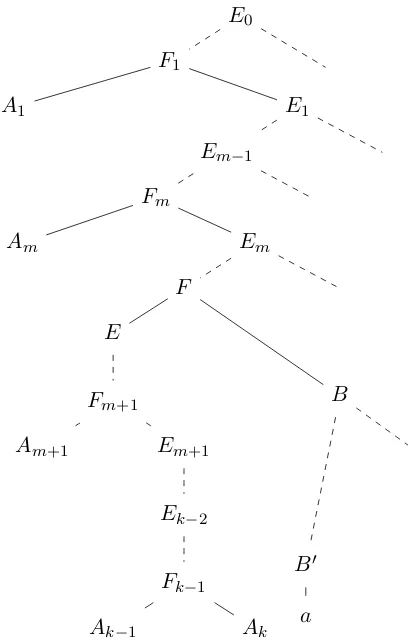
Consider a viable prefixA1· · ·Akon the stack of a shift-reduce parser, and lookahead a. Each right-most derivation in which the handle isA →
Ak−1Ak at position k −1 must be of the form sketched in Figure 1.
Because of properness and consistency, we may assume that all possible subderivations generat-ing strgenerat-ings entirely to the right of the lookahead have probabilities summing to 1. To compactly express the remaining probabilities, we need addi-tional notation. First we define:
V(C, D) = X
d:∃wC ⇒drm Dw
p(d)
for any pair of nonterminalsC andD. This will be used later to ‘factor out’ a common term in a (potentially infinite) sum of probabilities of sub-derivations; thewin the expression above corre-sponds to a substring of the unknown input beyond the lookahead. In order to compute such values, we fix an ordering of the nonterminals by N = {C1, . . . , Cr}, withr = |N|. We then construct a matrixM, such thatMi,j =Pπ=Ci→Cjαp(π).
In words, we sum the probabilities of all rules that have left-hand sideCiand a right-hand side begin-ning withCj.
A downward path in a parse tree from an oc-currence of C to an occurrence of D, restricted to following always the first child, can be of any lengthn, includingn = 0ifC =D. This means we need to obtain the matrixM∗=P
0≤nMn, and
We further define:
U(C, D) = X
d:C⇒drm D
p(d)
much as above, but restricting attention to unit rules.
The expected number of times a handle A →
Ak−1Ak at positionk−1 occurs in a right-most derivation with viable prefixA1· · ·Akand looka-headais now given by:
E(A1· · ·Ak, a, A→AkX−1Ak) =
S†=E0, . . . , Ek−2, F1, . . . , Fk−1 =A, F, E, B, B0, m: 0≤m < k−1
Y
i: 1≤i≤m
V(Ei−1, Fi)·p(Fi→AiEi)·
V(EYm, F)·p(F →EB)· U(E, Fm+1)·
i:m<i<k−1
p(Fi →AiEi)· U(Ei, Fi+1)·
p(Fk−1 →Ak−1Ak)· V(B, B0)·p(B0→a) Note that the value above is not a probability and may exceed 1. This is because the same viable prefix may occur several times in a single right-most derivation.
At first sight, the computation ofEseems to re-quire an exponential number of steps in k. How-ever, we can use an idea similar to that commonly used for computation of forward probabilities for HMMs (Rabiner, 1989). We first defineF:
F(ε, E) =
1ifE =S† 0otherwise
F(αA, E) = X
E0,π=F→AE
F(α, E0)· V(E0, F)·p(π)
This corresponds to the part of the definition of E involving A1, . . . , Am, E0, . . . , Em and F1, . . . , Fm. We build on this by defining:
G(α, E, B) = X
E0,π=F→EB
F(α, E0)· V(E0, F)·p(π)
One more recursive function is needed for what wasAm+1, . . . , Ak−2,Em+1, . . . , Ek−2 and Fm+1, . . . , Fk−2 in the earlier definition ofE:
H(ε, E, B) =G(ε, E, B) H(αA, E, B) =X
E0,π=F→AE
H(α, E0, B)· U(E0, F)·p(π)
+G(αA, E, B)
E0 F1
A1 E1
Em−1 Fm
Am Em
F E
Fm+1
Am+1 Em+1
Ek−2
Fk−1
Ak−1 Ak
B
B0
[image:4.595.315.519.65.386.2]a
Figure 1: Right-most derivation leading to Fk−1 → Ak−1Ak in viable prefixA1· · ·Akwith lookaheada.
Finally, we can expressE in terms of these re-cursive functions, considering the more general case of any ruleπ=F →β:
E(αβ, a, FX→β) =
E,B
H(α, E, B)· U(E, F)·p(π)· L(B, a)
E(α, a, F →β) = 0 if¬∃γα=γβ where:
L(B, a) = X
π=B0→a
V(B, B0)·p(π)
The expected number of times the handle is to be found to the right ofα, with the stack beingα and the lookahead symbol beinga, is:
E(α, a,shift) = X
B
F(α, B)· L(B, a)
The expected number of times we see a stackα with lookaheadais:
E(α, a) = E(α, a,shift) +X
π
The probability that a reduce with rule π is the correct action when the stack isα and the looka-head isa is naturallyE(α, a, π)/E(α, a) and the probability that a shift is the correct action is
E(α, a,shift)/E(α, a). For determining the most likely action we do not need to computeE(α, a); it suffices to identify the maximum value among
E(α, a,shift)andE(α, a, π)for each ruleπ. A deterministic shift-reduce parser can now be constructed that always chooses the most likely next action. For a given input string, the number of actions performed by this parser is linear in the input length.
A call ofE may lead to a number of recursive calls of F andH that is linear in the stack size and thereby in the input length. Note however that by remembering the values returned by these func-tion between parser acfunc-tions, one can ensure that each additional element pushed on the stack re-quires a bounded number of additional calls of the auxiliary functions. Because only linearly many elements are pushed on the stack, the time com-plexity becomes linear in the input length.
Complexity analysis seems less favorable if we consider the number of nonterminals. The defi-nitions of G and H each involve four nontermi-nals excluding the stack symbol A, so that the time complexity is O(|w| · |N|4), where |w| is the length of the inputw. A finer analysis gives
O(|w| ·(|N| · |P|+|N|2· kPk)), where kPk is the maximum for all A of the number of rules of the form F → AE. By splitting up G and
H into smaller functions, we obtain complexity
O(|w| · |N|3), which can still be prohibitive. Therefore we have implemented an alternative that has a time complexity that is only quadratic in the size of the grammar, at the expense of a quadratic complexity in the length of the input string, as detailed in Appendix A. This is still better in practice if the number of nonterminals is much greater than the length of the input string, as in the case of the grammars we investigated.
4 Structural determinism
We have assumed so far that a deterministic shift-reduce parser chooses a unique next action in each configuration, an action being a shift or reduce. Implicit in this was that if the next action is a re-duce, then also a unique rule is chosen. However, if we assume for now that all non-lexical rules are binary, then we can easily generalize the
pars-ing algorithm to considerallpossible rules whose right-hand sides match the top-most two stack el-ements, and postpone commitment to any of the nonterminals in the left-hand sides. This requires that stack elements now containsetsof grammar symbols. Each of these is associated with the probability of the most likely subderivation con-sistent with the relevant substring of the input.
Each reduce with a binary rule is implicitly fol-lowed by zero or more reduces with unary rules. Similarly, each shift is implicitly followed by a re-duce with a lexical rule and zero or more rere-duces with unary rules; see also (Graham et al., 1980). This uses a precompiled table similar toU, but us-ing maximization in place of summation, defined by:
Umax(C, D) = max d:C ⇒drm D
p(d)
More concretely, configurations have the form
(Z1. . . Zk, v$),k≥0, where eachZi(1≤i≤k) is a set of pairs(A, p), whereA is a nonterminal andp is a (non-zero) probability; each A occurs at most once in Zi. A shift turns (α, av$) into
(αZ, v$), whereZconsists of all pairs(E, p)such thatp = maxFUmax(E, F)·p(F → a). A gen-eralized binary reduce now turns(αZ1Z2, v$)into
(αZ, v$), whereZconsists of all pairs(E, p)such that:
p = max
π =F →A1A2,
(A1, p1)∈Z1,(A2, p2)∈Z2
Umax(E, F)·p(π)·p1·p2
We characterize this parsing procedure as struc-turally deterministic, as an unlabeled structure is built deterministically in the first instance. The exact choices of rules can be postponed until af-ter reaching the end of the sentence. Then follows a straightforward process of ‘backtracing’, which builds the derivation that led to the computed prob-ability associated with the start symbol.
The time complexity is now O(|w| · |N|5) in the most straightforward implementation, but we can reduce this to quadratic in the size of the gram-mar provided we allow an additional factor|w|as before. For more details see Appendix B.
5 Other variants
Yet another variant investigates only the top-most n stack symbols when choosing the next parser action. In combination with Appendix A, this brings the time complexity down again to lin-ear time in the length of the input string. The re-quired changes to the formulas are given in Ap-pendix D. There is a slight similarity to (Schuler, 2009), in that no stack elements beyond a bounded depth are considered at each parsing step, but in our case the stack can still have arbitrary height.
Whereas we have concentrated on determinism in this paper, one can also introduce a limited de-gree of nondeterminism and allow some of the most promising configurations at each input posi-tion to compete, applying techniques such as beam search (Roark, 2001; Zhang and Clark, 2009; Zhu et al., 2013), best-first search (Sagae and Lavie, 2006), or A∗ search (Klein and Manning, 2003)
in order to keep the running time low. For com-paring different configurations, one would need to multiply the valuesE(α, a)as in Section 3 by the probabilities of the subderivations associated with occurrences of grammar symbols in stackα.
Further variants are obtained by replacing the parsing strategy. One obvious candidate is left-corner parsing (Rosenkrantz and Lewis II, 1970), which is considerably simpler than LR parsing. The resulting algorithm would be very different from the left-corner models of e.g. (Henderson, 2003), which rely on neural networks instead of PCFGs.
6 Experiments
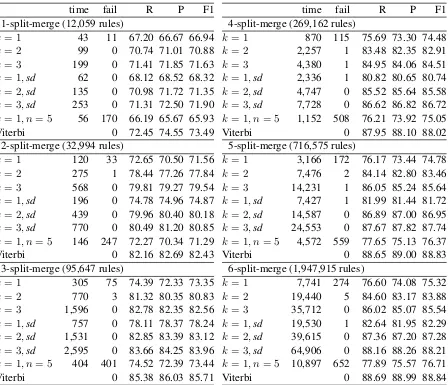
We used the WSJ treebank from OntoNotes 4.0 (Hovy et al., 2006), with Sections 2-21 for train-ing and the 2228 sentences of up to 40 words from Section 23 for testing. Grammars with different sizes, and in the required binary form, were ex-tracted by using the tools from the Berkeley parser (Petrov et al., 2006), with between 1 and 6 split-merge cycles. These tools offer a framework for handling unknown words, which we have adopted. The implementation of the parsing algorithms is in C++, running on a desktop with four 3.1GHz Intel Core i5 CPUs. The main algorithm is that of Appendix C, with lookaheadkbetween 1 and 3, also in combination with structural determinism (Appendix B), which is indicated here bysd. The variant that consults the stack down to bounded depth n (Appendix D) will only be reported for k= 1andn= 5.
Bracketing recall, precision and F-measure, are computed using evalb, with settings as in (Collins, 1997), except that punctuation was deleted.1 Ta-ble 1 reports results.
A nonterminal B in the stack may occur in a small number of rules of the formA→ BC. The C of one such rule is needed next in order to al-low a reduction. If future input does not deliver thisC, then parsing may fail. This problem be-comes more severe as nonterminals become more specific, which is what happens with an increase of the number of split-merge cycles. Even more fail-ures are introduced by removing the ability to con-sult the complete stack, which explains the poor results in the case ofk = 1, n = 5; lower values ofnlead to even more failures, and higher values further increase the running time. That the running time exceeds that ofk= 1is explained by the fact that with the variant from Appendix D, every pop or push requires a complete recomputation of all function values.
Parse failures can be almost completely elimi-nated however by choosing higher values ofkand by using structural determinism. A combination thereof leads to high accuracy, not far below that of the Viterbi parses. Note that one cannot expect the accuracy of our deterministic parsers toexceed
that of Viterbi parses. Both rely on the same model (a PCFG), but the first is forced to make local deci-sions without access to the input string that follows the bounded lookahead.
7 Conclusions
We have shown that deterministic parsers can be constructed from a given PCFG. Much of the ac-curacy of the grammar can be retained by choosing a large lookahead in combination with ‘structural determinism’, which postpones commitment to nonterminals until the end of the input is reached. Parsers of this nature potentially run in linear time in the length of the input, but our parsers are better implemented to run in quadratic time. In terms of the grammar size, the experiments sug-gest that the number of rules is the dominating fac-tor. The size of the lookahead strongly affects run-ning time. The extra time costs of structural deter-minism are compensated by an increase in accu-racy and a sharp decrease of the parse failures.
1Evalb otherwise stumbles over e.g. a part of speech
Table 1: Total time required (seconds), number of parse failures, recall, precision, F-measure, for deter-ministic parsing, compared to the Viterbi parses as computed with the Berkeley parser.
time fail R P F1
1-split-merge (12,059 rules)
k= 1 43 11 67.20 66.67 66.94 k= 2 99 0 70.74 71.01 70.88 k= 3 199 0 71.41 71.85 71.63 k= 1,sd 62 0 68.12 68.52 68.32 k= 2,sd 135 0 70.98 71.72 71.35 k= 3,sd 253 0 71.31 72.50 71.90 k= 1, n= 5 56 170 66.19 65.67 65.93 Viterbi 0 72.45 74.55 73.49
2-split-merge (32,994 rules)
k= 1 120 33 72.65 70.50 71.56 k= 2 275 1 78.44 77.26 77.84 k= 3 568 0 79.81 79.27 79.54 k= 1,sd 196 0 74.78 74.96 74.87 k= 2,sd 439 0 79.96 80.40 80.18 k= 3,sd 770 0 80.49 81.20 80.85 k= 1, n= 5 146 247 72.27 70.34 71.29 Viterbi 0 82.16 82.69 82.43
3-split-merge (95,647 rules)
k= 1 305 75 74.39 72.33 73.35 k= 2 770 3 81.32 80.35 80.83 k= 3 1,596 0 82.78 82.35 82.56 k= 1,sd 757 0 78.11 78.37 78.24 k= 2,sd 1,531 0 82.85 83.39 83.12 k= 3,sd 2,595 0 83.66 84.25 83.96 k= 1, n= 5 404 401 74.52 72.39 73.44 Viterbi 0 85.38 86.03 85.71
time fail R P F1
4-split-merge (269,162 rules)
k= 1 870 115 75.69 73.30 74.48 k= 2 2,257 1 83.48 82.35 82.91 k= 3 4,380 1 84.95 84.06 84.51 k= 1,sd 2,336 1 80.82 80.65 80.74 k= 2,sd 4,747 0 85.52 85.64 85.58 k= 3,sd 7,728 0 86.62 86.82 86.72 k= 1, n= 5 1,152 508 76.21 73.92 75.05 Viterbi 0 87.95 88.10 88.02
5-split-merge (716,575 rules)
k= 1 3,166 172 76.17 73.44 74.78 k= 2 7,476 2 84.14 82.80 83.46 k= 3 14,231 1 86.05 85.24 85.64 k= 1,sd 7,427 1 81.99 81.44 81.72 k= 2,sd 14,587 0 86.89 87.00 86.95 k= 3,sd 24,553 0 87.67 87.82 87.74 k= 1, n= 5 4,572 559 77.65 75.13 76.37 Viterbi 0 88.65 89.00 88.83
6-split-merge (1,947,915 rules)
k= 1 7,741 274 76.60 74.08 75.32 k= 2 19,440 5 84.60 83.17 83.88 k= 3 35,712 0 86.02 85.07 85.54 k= 1,sd 19,530 1 82.64 81.95 82.29 k= 2,sd 39,615 0 87.36 87.20 87.28 k= 3,sd 64,906 0 88.16 88.26 88.21 k= 1, n= 5 10,897 652 77.89 75.57 76.71 Viterbi 0 88.69 88.99 88.84
There are many advantages over other ap-proaches to deterministic parsing that rely on general-purpose classifiers. First, some state-of-the-art language models are readily available as PCFGs. Second, most classifiers require tree-banks, whereas our algorithms are also applicable to PCFGs that were obtained in any other way, for example through intersection of language models. Lastly, our algorithms fit within well understood automata theory.
AcknowledgmentsWe thank the reviewers.
A Formulas for quadratic time complexity
The following are the formulas that correspond to the first implemented variant. Relative to Sec-tion 3, some auxiliary funcSec-tions are broken up, and associating the lookahead a with an appropriate
nonterminalBis now done inG:
F(ε, E) =
1ifE=S† 0otherwise
F(αA, E) = X
π=F→AE
F0(α, F)·p(π)
F0(α, F) = X
E
F(α, E)· V(E, F)
G(α, E, a) = X
F
F0(α, F)· G0(F, E, a)
G0(F, E, a) = X
π=F→EB
p(π)· L(B, a)
H(ε, E, a) = G(ε, E, a) H(αA, E, a) = X
π=F→AE
H0(α, F, a)·p(π)
+G(αA, E, a) H0(α, F, a) = X
E
E(αβ, a, F →β) = H0(α, F, a)·p(F →β) E(α, a, F →β) = 0 if¬∃γα=γβ
E(αA, a,shift) = G(α, A, a) E(ε, a,shift) = L(S†, a)
These equations correspond to a time complex-ity ofO(|w|2· |N|2+|w| · |P|). Each definition except that ofG0involves one stack (of linear size)
and, at most, one terminal plus two arbitrary non-terminals. The full grammar is only considered once for every input position, in the definition of
G0.
The values are stored as vectors and matrices. For example, for each distinct lookahead symbol a, there is a (sparse) matrix containing the value of
G0(F, E, a) at a row and a column uniquely
iden-tified byF andE, respectively.
B Formulas for structural determinism For the variant from Section 4, we need to change only two definitions of auxiliary functions:
F(αZ, E) = X
(A,p)∈Z,π=F→AE
F0(α, F)·p(π)·p
H(αZ, E, a) = X
(A,p)∈Z,π=F→AE
H0(α, F, a)·p(π)·p
+G(αZ, E, a)
The only actions are shift and generalized bi-nary reducered. The definition ofEbecomes:
E(αZ1Z2, a,red) = X
(A1,p1)∈Z1,(A2,p2)∈Z2
π=F→A1A2
H0(α, F, a)·p(π)·p
1·p2
E(αZ, a,shift) = X
(A,p)∈Z
G(α, A, a)·p
The time complexity now increases to
O(|w|2·(|N|2+|P|))due to the newH. C Formulas for larger lookahead
In order to handlek symbols of lookahead (Sec-tion 5) some technical problems are best avoided by havingkcopies of the end-of-sentence marker appended behind the input string, with a corre-sponding augmentation of the grammar. We gen-eralize L(B, v) to be the sum of p(d) for all d such that B ⇒drm vx, some x. We let I(B, v)
be the sum ofp(d)for alldsuch thatB ⇒drm v.
IfI is given for all prefixes of a fixed lookahead string of lengthk (this requires cubic time ink), we can computeLin linear time for all suffixes of the same string:
L(B, v) = X
B0
V(B, B0)· L0(B0, v)
L0(B, v) =X
π=B→B1B2,v1,v2:
v=v1v2,1≤|v1|,1≤|v2|
p(π)· I(B1, v1)· L(B2, v2) if|v|>1
L0(B, a) = X
π=B→a p(π)
The function H is generalized straightforwardly by letting it pass on a stringv(1 ≤ |v| ≤ k) in-stead of a single terminala. The same holds forE. The functionGrequires a slightly bigger modifica-tion, leading back toHif not all of the lookahead has been matched yet:
G(α, E, v) = X
F
F0(α, F)· G0(F, E, v) +
X
F,v1,v2:v=v1v2,|v2|>0
H0(α, F, v2)· G00(F, E, v1)
G0(F, E, v) = X
π=F→EB
p(π)· L(B, v)
G00(F, E, v) = X
π=F→EB
p(π)· I(B, v)
The time complexity is nowO(k· |w|2· |N|2+ k3· |w| · |P|).
D Investigation of top-mostnstack symbols only
As discussed in Section 5, we want to predict the next parser action without consulting any symbols in α, when the current stack is αβ, with |β| =
n. This is achieved by approximatingF(α, E)by the outside value of E, that is, the sum of p(d)
for alldsuch that∃α,wS ⇒drm αEw. Similarly, H0(α, F, v) is approximated by P
EG(α, E, v) ·
W(E, F)where:
W(C, D) = X
d:∃δC⇒drm δD
p(d)
The time complexity (with lookahead k) is now
References
A.V. Aho and J.D. Ullman. 1972. Parsing, volume 1 of
The Theory of Parsing, Translation and Compiling.
Prentice-Hall, Englewood Cliffs, N.J.
S. Billot and B. Lang. 1989. The structure of shared forests in ambiguous parsing. In 27th An-nual Meeting of the ACL, Proceedings of the Confer-ence, pages 143–151, Vancouver, British Columbia, Canada, June.
T. Briscoe and J. Carroll. 1993. Generalized prob-abilistic LR parsing of natural language (corpora) with unification-based grammars. Computational Linguistics, 19(1):25–59.
M. Candito, J. Nivre, P. Denis, and E. Henestroza An-guiano. 2010. Benchmarking of statistical de-pendency parsers for French. In The 23rd
Inter-national Conference on Computational Linguistics,
pages 108–116, Beijing, China, August.
D. Cer, M.-C. de Marneffe, D. Jurafsky, and C. Man-ning. 2010. Parsing to Stanford dependen-cies: Trade-offs between speed and accuracy. In
LREC 2010: Seventh International Conference on
Language Resources and Evaluation, Proceedings,
pages 1628–1632, Valletta , Malta, May.
M. Collins. 1997. Three generative, lexicalised models for statistical parsing. In35th Annual Meeting of the
ACL, Proceedings of the Conference, pages 16–23,
Madrid, Spain, July.
S.L. Graham, M.A. Harrison, and W.L. Ruzzo. 1980. An improved context-free recognizer. ACM
Trans-actions on Programming Languages and Systems,
2:415–462.
J. Henderson. 2003. Generative versus discrimina-tive models for statistical left-corner parsing. In
8th International Workshop on Parsing Technolo-gies, pages 115–126, LORIA, Nancy, France, April. E. Hovy, M. Marcus, M. Palmer, L. Ramshaw, and R. Weischedel. 2006. OntoNotes: The 90% solu-tion. InProceedings of the Human Language
Tech-nology Conference of the NAACL, Main Conference,
pages 57–60, New York, USA, June.
L. Huang and K. Sagae. 2010. Dynamic programming for linear-time incremental parsing. InProceedings of the 48th Annual Meeting of the ACL, pages 1077– 1086, Uppsala, Sweden, July.
F. Jelinek and J.D. Lafferty. 1991. Computation of the probability of initial substring generation by stochastic context-free grammars. Computational Linguistics, 17(3):315–323.
T. Kalt. 2004. Induction of greedy controllers for de-terministic treebank parsers. InConference on
Em-pirical Methods in Natural Language Processing,
pages 17–24, Barcelona, Spain, July.
D. Klein and C.D. Manning. 2003. A∗parsing: Fast
exact Viterbi parse selection. InProceedings of the 2003 Human Language Technology Conference of
the North American Chapter of the ACL, pages 40–
47, Edmonton, Canada, May–June.
D.E. Knuth. 1965. On the translation of languages from left to right. Information and Control, 8:607– 639.
M. Kuhlmann, C. G´omez-Rodr´ıguez, and G. Satta. 2011. Dynamic programming algorithms for transition-based dependency parsers. In 49th An-nual Meeting of the ACL, Proceedings of the Con-ference, pages 673–682, Portland, Oregon, June.
M. Lankhorst. 1991. An empirical comparison of gen-eralized LR tables. In R. Heemels, A. Nijholt, and K. Sikkel, editors, Tomita’s Algorithm: Extensions
and Applications, Proc. of the first Twente
Work-shop on Language Technology, pages 87–93. Uni-versity of Twente, September.
A. Lavie and M. Tomita. 1993. GLR∗ – an
effi-cient noise-skipping parsing algorithm for context free grammars. InThird International Workshop on
Parsing Technologies, pages 123–134, Tilburg (The
Netherlands) and Durbuy (Belgium), August.
M.-J. Nederhof and G. Satta. 2004. An alternative method of training probabilistic LR parsers. In42nd Annual Meeting of the ACL, Proceedings of the Con-ference, pages 551–558, Barcelona, Spain, July.
S.-K. Ng and M. Tomita. 1991. Probabilistic LR pars-ing for general context-free grammars. In Proc. of the Second International Workshop on Parsing
Tech-nologies, pages 154–163, Cancun, Mexico,
Febru-ary.
J. Nivre. 2008. Algorithms for deterministic incremen-tal dependency parsing. Computational Linguistics, 34(4):513–553.
S. Petrov, L. Barrett, R. Thibaux, and D. Klein. 2006. Learning accurate, compact, and interpretable tree annotation. InProceedings of the 21st International Conference on Computational Linguistics and 44th
Annual Meeting of the ACL, pages 433–440, Sydney,
Australia, July.
L.R. Rabiner. 1989. A tutorial on hidden Markov mod-els and selected applications in speech recognition.
Proceedings of the IEEE, 77(2):257–286, February.
A. Ratnaparkhi. 1997. A linear observed time statis-tical parser based on maximum entropy models. In
Proceedings of the Second Conference on Empirical
Methods in Natural Language Processing, pages 1–
10, Providence, Rhode Island, USA, August.
D.J. Rosenkrantz and P.M. Lewis II. 1970. Determin-istic left corner parsing. InIEEE Conference Record of the 11th Annual Symposium on Switching and
Au-tomata Theory, pages 139–152.
K. Sagae and A. Lavie. 2005. A classifier-based parser with linear run-time complexity. In Proceed-ings of the Ninth International Workshop on Parsing
Technologies, pages 125–132, Vancouver, British
Columbia, Canada, October.
K. Sagae and A. Lavie. 2006. A best-first probabilistic shift-reduce parser. InProceedings of the 21st Inter-national Conference on Computational Linguistics
and 44th Annual Meeting of the ACL, pages 691–
698, Sydney, Australia, July.
W. Schuler. 2009. Positive results for parsing with a bounded stack using a model-based right-corner transform. In Proceedings of Human Language Technologies: The 2009 Annual Conference of the
North American Chapter of the ACL, pages 344–
352, Boulder, Colorado, May–June.
P. Shann. 1991. Experiments with GLR and chart pars-ing. In M. Tomita, editor,Generalized LR Parsing, chapter 2, pages 17–34. Kluwer Academic Publish-ers.
S.M. Shieber. 1983. Sentence disambiguation by a shift-reduce parsing technique. In 21st Annual Meeting of the ACL, Proceedings of the Conference, pages 113–118, Cambridge, Massachusetts, July. S. Sippu and E. Soisalon-Soininen. 1990.Parsing
The-ory, Vol. II: LR(k) and LL(k) Parsing, volume 20 of
EATCS Monographs on Theoretical Computer Sci-ence. Springer-Verlag.
A. Stolcke. 1995. An efficient probabilistic context-free parsing algorithm that computes prefix proba-bilities. Computational Linguistics, 21(2):167–201. M. Tomita. 1988. Graph-structured stack and natu-ral language parsing. In 26th Annual Meeting of the ACL, Proceedings of the Conference, pages 249– 257, Buffalo, New York, June.
Y. Tsuruoka and J. Tsujii. 2005. Chunk parsing re-visited. In Proceedings of the Ninth International
Workshop on Parsing Technologies, pages 133–140,
Vancouver, British Columbia, Canada, October. A. Wong and D. Wu. 1999. Learning a lightweight
robust deterministic parser. InSixth European
Con-ference on Speech Communication and Technology,
pages 2047–2050.
H. Yamada and Y. Matsumoto. 2003. Statistical de-pendency analysis with support vector machines. In
8th International Workshop on Parsing Technolo-gies, pages 195–206, LORIA, Nancy, France, April. D.H. Younger. 1967. Recognition and parsing of context-free languages in timen3. Information and
Control, 10:189–208.
Y. Zhang and S. Clark. 2009. Transition-based pars-ing of the Chinese treebank uspars-ing a global discrimi-native model. In Proceedings of the 11th
Interna-tional Conference on Parsing Technologies, pages
162–171, Paris, France, October.
M. Zhu, Y. Zhang, W. Chen, M. Zhang, and J. Zhu. 2013. Fast and accurate shift-reduce constituent parsing. In 51st Annual Meeting of the ACL,
Pro-ceedings of the Conference, volume 1, pages 434–