21
Abstractive Timeline Summarization
Julius Steen and Katja Markert Department of Computational Linguistics
Heidelberg University 69120 Heidelberg, Germany
(steen|markert)@cl.uni-heidelberg.de
Abstract
Timeline summarization (TLS) automatically identifies key dates of major events and pro-vides short descriptions of what happened on these dates. Previous approaches to TLS have focused on extractive methods. In contrast, we suggest an abstractive timeline summarization system. Our system is entirely unsupervised, which makes it especially suited to TLS where there are very few gold summaries available for training of supervised systems. In addition, we present the first abstractive oracle exper-iments for TLS. Our system outperforms ex-tractive competitors in terms of ROUGE when the number of input documents is high and the output requires strong compression. In these cases, our oracle experiments confirm that our approach also has a higher upper bound for ROUGE scores than extractive methods. A study with human judges shows that our ab-stractive system also produces output that is easy to read and understand.
1 Introduction
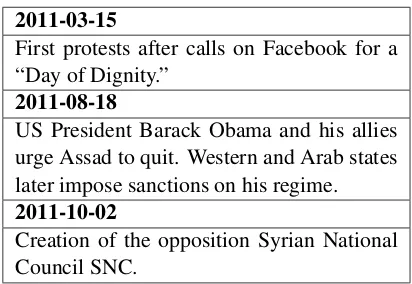
Many newsworthy events are not isolated inci-dents but part of long-lasting developments. For example, the events of the Syrian civil war in 2019 are intrinsically linked to events that happened during the beginning of that war in 2011. As the amount of reporting grows, it can be difficult to keep track of important events that may have hap-pened a long time ago. Timeline summarization (TLS) alleviates this problem by providing users with automatically generated timelines that iden-tify key dates in a larger development along with short summaries of the events on these dates. Ta-ble1shows an example of a timeline.
Prior TLS systems are extractive, i.e. they identify important sentences in a corpus and copy them directly to the timeline (Nguyen et al.,2014;
Chieu and Lee, 2004;Yan et al., 2011b,a; Wang
2011-03-15
First protests after calls on Facebook for a “Day of Dignity.”
2011-08-18
US President Barack Obama and his allies urge Assad to quit. Western and Arab states later impose sanctions on his regime. 2011-10-02
[image:1.595.313.519.219.361.2]Creation of the opposition Syrian National Council SNC.
Table 1: Beginning of an example timeline about the Syrian civil war. (Source: Crisis dataset (Tran et al., 2015))
et al.,2016;Tran et al.,2015,2013b,a;Martschat
and Markert, 2018). However, TLS aggregates
information from input corpora that are orders of magnitude larger than for traditional multi-document summarization (MDS) tasks. In addi-tion, documents typically come from many differ-ent sources. In this setting, it might be advanta-geous to generateabstractivesummaries that com-bine information from different sentences. While the state of the art in abstractive summarization is achieved by neural networks (Celikyilmaz et al.,
2018), these systems require many document/gold summary pairs for training. TLS datasets, on the other hand, have many input documents, but only contain very few gold-standard timelines (between 19 and 22) (Tran et al., 2015, 2013b). Thus, very few input/gold timeline pairs are available for training.
We therefore introduce an unsupervised ab-stractive TLS systemthat is inspired by the abstrac-tive MDS system in Banerjee et al. (2015). We make the following contributions:
ex-tractive TLS systems such asMartschat and
Markert (2018) when the input corpora are
large with low compression rate.1
2. We show that our system delivers signifi-cantly better performance than an abstractive neural model not adapted for TLS.
3. We conduct the first abstractive oracle exper-iments for TLS. Our abstractive approach im-proves the ROUGE upper bound on large cor-pora with low compression rate.
A human evaluation confirms that our sys-tem outputs readable sentences. Our system does not need any supervision and only requires lightweight preprocessing. This makes it easy to adapt to other languages. The source code for our system is available online.2
2 Task
2.1 Definition
We follow the formalization of TLS ofMartschat
and Markert (2018). Given a collection of news
documents D about the topic for the timeline (such as the Syrian civil war), we seek to gener-ate a timeline that summarizes the most important events related to the topic in D. The timeline is a sequence of datesd1, . . . dnand their associated
daily summariesv1, . . . vn. As in most prior work,
we require thatd1, . . . dnrefer to a specific day.
We constrain the maximum number of dates that may be included in the timeline, the maxi-mum number of sentences or tokens per daily sum-mary, and the time span the timeline is supposed to cover. We discuss how we set these constraints in Section4.2.
2.2 Differences to MDS
While both TLS and Multi-Document Summariza-tion (MDS) generate summaries from multiple in-put documents, there are substantial differences between the two tasks. Specifically,Martschat and
Markert(2018) cite the following differences:
1. MDS does not have a temporal dimension.
2. Typical MDS datasets do not require systems to summarize multiple events instead focus-ing on non-event topics or sfocus-ingular events.
1
In summarization, a low compression rate means that a long input must be condensed to a short summary.
2github.com/julmaxi/
Abstractive-Timeline-Summarization
Corpus
...
Step 1: Clustering Step 2: Generation Date: 2017-12-24
Date: 2017-01-08
Date: 2017-12-24
Date: 2017-01-08 Date: 2017-01-08 0.2 0.6 0.3
Date: 2017-12-24 0.4 0.5 0.9 Step 3a: Scoring
Date: 2017-01-08
... ...
... ... ... ... Date: 2017-12-24
Step 3b: Selection ...
Date: 2017-09-04 Date: 2017-09-04 Date: 2017-09-04
... ...
[image:2.595.313.518.60.180.2]0.1 0.0 0.2
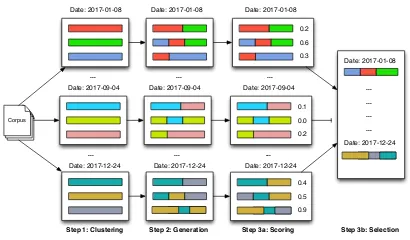
Figure 1: A graphical overview of our system. We can see that not all clusters are included in the timeline.
Even where MDS systems are evaluated on corpora with multiple events, evaluation does not consider the temporal dimension.
3. TLS corpora are larger than MDS corpora with lower compression rates, making con-tent selection and scalability more important.
3 Architecture
We generate timelines in a three step process, out-lined in Figure 1. We first cluster sentences that are likely to describe the same event. We then use Multi-Sentence-Compression (MSC) to gener-ate candidgener-ate sentences to summarize each cluster. Finally, we score the candidates and select the best ones up to a length limit. Each of our steps is com-pletely unsupervised, which allows us to sidestep the lack of training data in TLS and also makes our system readily adaptable to different datasets.
3.1 Clustering
We need to cluster sentences that describe the same event (such as the formation of the Syrian national council in Table1) so that the MSC sys-tem can generate concise summaries from the re-sulting clusters. We use Affinity Propagation (AP) clustering (Frey and Dueck, 2007) for this pur-pose. AP is able to automatically determine the appropriate number of clusters for a dataset. This is advantageous, as different inputs contain differ-ent numbers of evdiffer-ents. By choosing the number of clusters dynamically, our system can adapt to that without supervision.
pick-ing itemjas an exemplar. The diagonal of the ma-trixA, the so-calledpreference values, determines how suitable an item is to become an exemplar and thus regulates the number of exemplars.
We construct A using TF-IDF vector cosine similarity between the input sentences, which has been shown to be a useful similarity metric for TLS (Martschat and Markert, 2018; Chieu and Lee,2004). However, sentences in the same clus-ter should not only be similar but also describe the same dates. To determine which date a sentence refers to, we make the following assumptions:
• Every sentence can refer to the document cre-ation time (DCT).
• Sentences with one or more time expressions can refer either to one of the dates in the ex-pressions or to the DCT
• Time expressions that refer to a range of days, such as a month, may refer to any date within that range.
The set of possible references for a sentence s is calleddates(s). A date reference d1 contains
another referenced2if one of the following holds:
1. d1,d2refer to the same exact day.
2. d1 refers to a range of dates which contains
d2, andd2is an exact date.
A sentences2 may select a sentence s1 as an
ex-emplar if there is a d1 ∈ dates(s1) and a d2 ∈
dates(s2) so thatd2 contains d1. We set Aij =
cos(s~i, ~sj), ifsi may select sj, and Aij = −∞
otherwise. Preference values are the median of in-coming similarities (Frey and Dueck,2007).
This procedure can still form ”incorrect” clus-ters. If an exemplar sentence contains two or more incompatible date referencesd1, d2, the resulting
cluster can contain sentences tagged with onlyd1
or onlyd2. However, this is an infrequent problem
as sentences need to be similar to be clustered. To determine the date of the event a cluster C describes, we let
date(C) = arg max
d∈S
s∈C{dates(s)|dexact}
cnt(C, d) (1)
wherecnt(C, d)is the frequency ofdbeing men-tioned as a time expression in the sentences inC.
3.2 Sentence Generation
FollowingBanerjee et al.(2015), we use the un-supervised, low-cost MSC-system by Filippova
(2010) to generate summary candidates for each cluster.
Given the sentence clusterC, the algorithm con-structs a word-adjacency graph. The nodes are POS-tagged tokens and directed edges indicate ad-jacency of these tokens in one of the sentences. Occurrences of the same content word in different sentences are mapped to the same node. Given an edgeeij, its weightw(eij)is:
w(eij) =
freq(i) +freq(j)
freq(i)∗freq(j)∗P
s∈Cdiff(s, i, j)
(2) wherefreq(i)is the number of tokens that have been mapped to node ianddiff(s, i, j) indicates whether the words that were mapped to the nodes i, jin the sentencesappear close together. This is defined in terms of the positionpos(s, i)of a token iin the sentences:
diff(s, i, j) = max(0,(pos(s, j)−pos(s, i))−1)
(3) We generate new sentences from this graph by finding paths from the sentence start node to the sentence end node. We use the shortest path algorithm of Yen (1971) as implemented in the networkx-library (Hagberg et al., 2008) to gener-ate up to 2500 candidgener-ate summary sentences per cluster. FollowingFilippova(2010), we filter out sentences that do not contain a verb or are shorter than eight tokens. We also include the original sentences in the selection candidates. Each can-didateg is assigned the date of the cluster it was generated from:date(g) :=date(cluster(g)).
To prevent ungrammatical or spurious sentence merges, we introduce additional filtering based on dependency parses. Specifically, we only accept a pathP through the word-adjacency graph if for every node i ∈ P at least one of the following holds:
1. iis a stopword node
2. At least one token mapped to i is the root node in its dependency tree
3. The head of at least one token mapped toiis contained in the path
An armed attack on a government build-ing was met with international shock .
The people responsible for the attack have yet to be determined.
Without the constraint, it is valid to generateAn armed attack have yet to be determined. The con-straint prevents this as none of the heads ofattack
(i.e. metandfor) are in the path.
3.3 Sentence Scoring and Selection
Given the set of generated sentences, we wish to find sentences that are well-formed and informa-tive about important dates and events. We encode these aspects into multiple scoring functions.
3.3.1 Linguistic Quality
To encourage a readable output, we compute a lin-guistic quality score for each candidate sentence g by using the average probability of the tokens according to a 3-gram language model (Banerjee
et al.,2015). We use the KenLM library (Heafield,
2011) with a pretrained model3. We compute the LM-scorefLM as follows:
fLM(g) =
1 1−P
wi∈glog(p(wi|wi−1:i−3))/|g|
(4) Additionally, we include information from the MSC system by preferring sentences which were generated from shorter paths. We letfpath(g) =
(1 + w(g))−1 where w(g) is the length of the weighted path that generated candidateg.
3.3.2 Date Importance
We determine the importancedimp(d)of a dated by counting how often it is mentioned in the input
(Martschat and Markert,2018). The scorefdateof
a sentencegisfdate(g) =dimp(date(g)).
3.3.3 Informativeness
We construct a keyword-based scoring function using TextRank (Mihalcea and Tarau,2004) to ef-ficiently score the importance of our candidates. TextRank scores keywords by constructing an undirected graph of content words where words are connected if they appear near each other. A score is computed for each node similarly to the PageRank algorithm (Page et al.,1999) using the
3 www.keithv.com/software/giga/lm_giga_
20k_nvp_3gram.zip
following iterative formula:
T R(t+1)(wi) = (1−α)+α·
X
wj∈adj(wi)
T R(t)(wj)
|adj(wj)|
(5) whereadj(wi)is the set of nodes neighbouringwi
andα= 0.85is the dampening factor.
Let Dd be the set of all sentences s in the
in-put corpus D whose cluster cluster(s) was as-signed the datedas per Equation1. We compute one TextRank vectorT Rdfor each datedby
run-ning TextRank over all sentences inDd. To make
scores comparable across differentDd, we rescale
the scores inT Rdto a0to1range. The
TextRank-scorefT R(g)for a candidate gis then defined as
the sum of the scores of its tokens.
We also hypothesize that larger clusters are as-sociated with more important events. We thus use the cluster size as a scoring function:fcluster(g) =
|cluster(g)|
maxC∈Cˆ|C| where
ˆ
Cis the set of all clusters.
3.3.4 Selection
We determine the final score of each candidateg as the product of the scoring functions:
score(g) = Y
f∈F
f(g) (6)
whereF is the set of scoring functions, i.e. F =
{fpath, fLM, fT R, fdate, fcluster}.
We select sentences greedily starting with the highest scoring ones as long as selecting them does not break any constraints. To reduce redun-dancy, we select at most one candidate from each cluster (Banerjee et al.,2015) and skip sentences with a cosine similarity of more than0.5to a pre-viously selected sentence.
4 Evaluation
4.1 Data
We evaluate on the only two publicly available TLS datasets: Crisis (Tran et al.,2015) and Time-line 17 (TL17) (Tran et al.,2013b). Both contain human written timelines about topics such as civil wars or the BP oil disaster, collected from major news outlets. Each topic also has a set of related news articles scraped from the web (see Table2).
Corp. #Tops #TLs #Sen/Top. Comp. Spr. TL17 13 19 27,222 0.0019 0.279 Crisis 4 22 150,429 0.0002 0.081
Table 2: Dataset statistics, including number of topics, timelines and the average number of sentences to be summarized for each topic. We also report the median compression and spread of the timelines.
ratio of dates with summaries in the timeline to the number of dates in the timeline span. Low compression rate and spread are typically indica-tive of a more difficult TLS instance (Martschat
and Markert,2018). We find that the datasets have
very different characteristics, with Crisis having lower compression rate and spread.
4.1.1 Corpus Cleaning and Preporcessing
We found that some of the news articles to be sum-marised in both datasets contained full or partial gold timelines. This might cause TLS systems to inadvertently ”cheat” by using the leaked gold timelines. We have manually removed 19 such documents in TL17 and28in Crisis.4
We preprocess all corpora with Stanford CoreNLP (Manning et al., 2014) and use Hei-deltime (Str¨otgen and Gertz, 2013) for resolving time expressions. Unlike several other TLS sys-tems (Martschat and Markert, 2018; Chieu and Lee,2004), we do not filter sentences with topic-specific keywords (e.g. war or Syria) to be less dependent on additional human input.5
4.2 Experimental Setup and Constraints
LikeMartschat and Markert (2018), we generate
one timeline per reference. We limit the number of dates to that in the reference, while the number of sentences per summary is set to the average num-ber of sentences per summary in the reference.
As abstractive systems generate new text, they could exploit sentence limits by generating very long sentences. We control for this by limiting the number of tokens instead in one algorithm varia-tion. We estimate the maximum number of tokens in the same way as for the sentence constraint.
4.3 Evaluation Metrics
Summarization is usually evaluated with ROUGE (Lin,2004). This, however, ignores the temporal
4
The corresponding document ids can be found at
www.cl.uni-heidelberg.de/˜steen/tls/ docids.txt.
5However, we do let the competitor systems use filtering.
dimension of TLS. We thus use the two TLS mea-sures proposed byMartschat and Markert(2017):
agree Compute ROUGE only between daily sum-maries which have the same dates.
align Align summaries in the output with those in the reference based on similarity and the dis-tance between their dates, then compute the ROUGE score between aligned summaries. Distant alignments are punished.
We also report ROUGEconcat, where we con-catenate all entries in gold and system timeline and compute ROUGE between the results discarding all date information. While this measure is sub-optimal for TLS (Martschat and Markert, 2017), it has been previously used as an evaluation mea-sure (Yan et al.,2011b,a;Wang et al.,2016). We report the F1 score for all ROUGE metrics. To as-sess how well the systems are at date selection, we compute the F1 score between the dates that have a summary in the gold timeline and in the system timeline. Finally, we report the copy rate as the proportion of sentences copied directly from the corpus into the summary. We use an approximate randomization test (Noreen,1989) to check statis-tical significance and the Bonferroni correction to correct for comparing on two datasets (Dror et al.,
2018).
4.4 Oracle Summaries
One advantage of abstractive summarization is its potential to increase the maximum attainable scores by forming more succinct sentences. We investigate this potential with an oracle to estab-lish an upper bound on summary scores, follow-ing similar work for generic summarization (Hirao
et al.,2017). As an oracle over all summaries is
in-tractable, we approximate it by replacing the scor-ing function (Equation6) with an oracle that pre-dicts the ROUGE-1-agree F1-score of sentences. The rest of our pipeline remains unchanged.
For the extractive oracle, we greedily select from all sentences in the input documents instead. The date of a sentence is the first exact time ex-pression that appears in the sentence, or its DCT if there is none (Chieu and Lee,2004).
4.5 Comparison Systems
4.5.1 Extractive Systems
col-lection of TLS systems created byMartschat and
Markert(2018).6
Chieu is a reimplementation ofChieu and Lee
(2004), which uses the average cosine similarity of a sentence in a time-window around its date to determine importance and greedy selection. This system is often seen as a baseline for TLS systems
(Martschat and Markert,2018;Tran et al.,2015).
Submod is the state-of-the-art submodular sys-tem inMartschat and Markert (2018). Addition-ally, we have created a version of Submod with a token constraint. The same is not possible for
Chieu, as it always selects one sentence per date.
Extractive is an extractive version of our sys-tem. It uses fT R and fdate to score sentences.
Dates are determined as for the extractive oracle
4.5.2 Neural Baseline
As an abstractive comparison, we use the pop-ular Pointer Generator (See et al., 2017) ( Neu-ral). It was trained on the CCN/Daily Mail single document summarization corpus (Hermann et al.,
2015). We adapt it to TLS as follows:
1. We select the dates for the timeline by rank-ing them by their frequencydimp(d).
2. For each selected date d, we collect all sen-tencesSdfrom the corpus that refer tod.
3. For each collectionSd, we construct a pseudo
document for the summarizer. Following
Zhang et al.(2018) we use the LexRank score
(Erkan and Radev, 2004) to rank the
sen-tences inSd. We add the top sentences to the
document until we reach the maximum input size for the pointer generator (400 tokens).7
During our experiments, we found that the self-stopping nature of the pointer generator causes it to generate daily summaries that exceed the token length constraint described in Section4.2in 83%
of daily summaries. To see if this disadvantages the pointer generator, we tried applying this to-ken constraint to its output. However, this results in lower scores, so we only report results without length constraint.
6github.com/smartschat/tilse
7In an alternative setup, we tried selecting the centroid
document for each date and then summarize it. This performs comparably or worse, depending on the corpus.
5 Results
5.1 Oracle Results
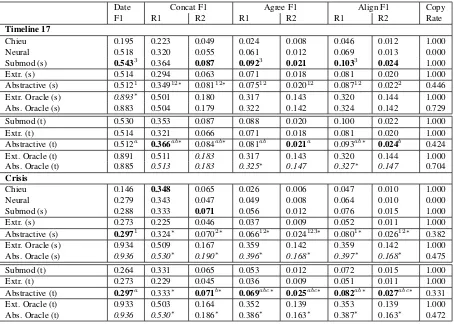
While both the extractive and the abstractive cle perform equally on TL17, the abstractive ora-cle outperforms the extractive oraora-cle significantly on Crisis. The abstractive copy rate on TL17 is also much higher than on Crisis. (73.7% vs 38.3% for sentence constraints). We hypothesize that this is related to the lower compression rate and greater size of Crisis (see Table2). Abstractive TLS can only achieve its full potential when a variety of dif-ferent texts needs to be compressed to short sum-maries. We investigate this in Section5.5.
5.2 System Results
5.2.1 Extractive Systems
Our system outperforms Extractive, demonstrat-ing the importance of our abstractive components. While Chieu performs better than our system in ROUGE-1 concat on Crisis, it is much worse in all date-sensitive measures and on TL17.
When comparing Submod and our abstractive system, we see behaviour similar to the oracles. On TL17,Submodachieves higher scores, though the differences are mostly not significant. On Cri-sis, however, we outperform Submod across all date-sensitive metrics and almost double the score in ROUGE-2 for agree and align. All improve-ments are significant except for ROUGE-1 align.
5.2.2 Neural
Neuralperforms slightly better than our system on the ROUGE-1 concat metric on Crisis, but per-forms significantly worse than us on almost all other content measures. This underlines the im-portance of TLS specific approaches.
5.2.3 Effect of Length Constraints
The token constraint has a small positive influence on our system while resulting in lower results for
Submod. This shows that our system does not un-fairly exploit the sentence constraint.
5.3 Example Timeline
Date Concat F1 Agree F1 Align F1 Copy
F1 R1 R2 R1 R2 R1 R2 Rate
Timeline 17
Chieu 0.195 0.223 0.049 0.024 0.008 0.046 0.012 1.000
Neural 0.518 0.320 0.055 0.061 0.012 0.069 0.013 0.000
Submod (s) 0.5433 0.364 0.087 0.0923 0.021 0.1033 0.024 1.000 Extr. (s) 0.514 0.294 0.063 0.071 0.018 0.081 0.020 1.000 Abstractive (s) 0.5121 0.34912∗ 0.08112∗ 0.07512 0.02012 0.08712 0.0222 0.446 Extr. Oracle (s) 0.893∗ 0.501 0.180 0.317 0.143 0.320 0.144 1.000 Abs. Oracle (s) 0.883 0.504 0.179 0.322 0.142 0.324 0.142 0.729 Submod (t) 0.530 0.353 0.087 0.088 0.020 0.100 0.022 1.000 Extr. (t) 0.514 0.321 0.066 0.071 0.018 0.081 0.020 1.000 Abstractive (t) 0.512a 0.366ab∗ 0.084ab∗ 0.081ab 0.021a 0.093ab∗ 0.024b 0.424 Ext. Oracle (t) 0.891 0.511 0.183 0.317 0.143 0.320 0.144 1.000 Abs. Oracle (t) 0.885 0.513 0.183 0.325∗ 0.147 0.327∗ 0.147 0.704
Crisis
Chieu 0.146 0.348 0.065 0.026 0.006 0.047 0.010 1.000
Neural 0.279 0.343 0.047 0.049 0.008 0.064 0.010 0.000
[image:7.595.73.527.61.385.2]Submod (s) 0.288 0.333 0.071 0.056 0.012 0.076 0.015 1.000 Extr. (s) 0.273 0.225 0.046 0.037 0.009 0.052 0.011 1.000 Abstractive (s) 0.2971 0.324∗ 0.0702∗ 0.06612∗ 0.024123∗ 0.0801∗ 0.02612∗ 0.382 Extr. Oracle (s) 0.934 0.509 0.167 0.359 0.142 0.359 0.142 1.000 Abs. Oracle (s) 0.936 0.530∗ 0.190∗ 0.396∗ 0.168∗ 0.397∗ 0.168∗ 0.475 Submod (t) 0.264 0.331 0.065 0.053 0.012 0.072 0.015 1.000 Extr. (t) 0.273 0.229 0.045 0.036 0.009 0.051 0.011 1.000 Abstractive (t) 0.297a 0.333∗ 0.071b∗ 0.069abc∗ 0.025abc∗ 0.082ab∗ 0.027abc∗ 0.331 Ext. Oracle (t) 0.933 0.503 0.164 0.352 0.139 0.353 0.139 1.000 Abs. Oracle (t) 0.936 0.530∗ 0.186∗ 0.386∗ 0.163∗ 0.387∗ 0.163∗ 0.472
Table 3: Result of our system, the oracles, and comparison systems. (s) and (t) indicate sentence or token constraint where applicable. ∗ indicates statistically significant difference between abstractive and extractive oracle and our abstractive system andExtractiverespectively. 123indicate significant differences between our system with sentence constraint andChieu,Neural, andSubmod with sentence constraint respectively. abc indicate the same for the token constraint(p <0.05). Bold entries indicate best non-oracle results, italic ones best oracle results.
same topic can vary widely (Martschat and
Mark-ert,2018;Tran et al.,2013b).
Most sentences have been edited by the MSC al-gorithm. We can observe some minor ungrammat-icalities resulting from this process, like the phrase ”on march” in the first daily summary. The time-line also exhibits some redundancy as the state-ment about the Red Cross is repeated twice.
5.4 Ablation Experiments
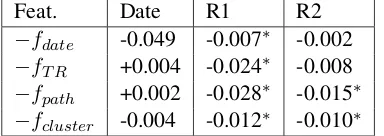
To study the effects of our scoring functions, we conduct an ablation study where we remove one scoring function at a time and rerun our system. The results can be found in Table5.8 We find all features contribute to ROUGE scores. Removing fT Randfpathhas a small negative effect on date
F1 but a big effect on ROUGE, whilefdatemostly
affects date F1. It appears that content and date
8To preserve space, we focus on the Crisis dataset with
sentence constraint. Results are similar on TL17, but remov-ing features there has generally a smaller effect.
selection can to some extent be improved inde-pendently even with date-sensitive metrics. This might warrant future investigation.
5.5 Utility analysis
Our experiments show that the usefulness of our system is corpus-dependent. We investigate three factors that might explain this difference in perfor-mance: The number of input sentences, the com-pression rate, and the spread (see Section4.1).
be-2011-03-15
the conflict erupted on march 2011 when protesters inspired by arab world uprisings took to the streets to call for democratic change.
2012-02-04
russia and china vetoed a draft resolution that backed an arab plan to facilitate polit-ical transition in syria.
2012-06-13
talk of civil war in syria is not consistent with reality... what is happening in syria is a war against armed groups that choose terror-ism, ”syrian state news agency sana quoted a foreign ministry statement as saying.
2012-07-15
red cross said sunday it now considers the conflict a civil war, meaning international humanitarian law applies throughout the country.
2012-07-16
the international committee of the red cross declared the conflict a civil war.
2012-07-18
[image:8.595.82.284.53.462.2]on july blast at the syrian national security building in damascus during a high - level government crisis meeting killed four top regime officials, including the defense min-ister.
Table 4: Beginning of the timeline generated by our ab-stractive system with sentence constraint for the time-line in Table1. Red color indicates sentences that were copied directly from the input corpus. Blue color indi-cates events which can also be found in the reference timeline.
Feat. Date R1 R2
−fdate -0.049 -0.007∗ -0.002
−fT R +0.004 -0.024∗ -0.008
−fpath +0.002 -0.028∗ -0.015∗
[image:8.595.87.279.558.626.2]−fcluster -0.004 -0.012∗ -0.010∗
Table 5: Ablation results on Crisis, showing changes of ROUGE align and date selection F1.∗indicates signif-icant differences to the full model (p <0.05).
Comparison ]sents Compr. Spread Abs. Or. - Ext. Or. 0.48 -0.61 -0.31
Abs. - Submod 0.45 -0.41 -0.24
Table 6: Spearman correlation of the score difference between systems and timeline properties.
tween our system andSubmodexhibits similar, al-though less extreme behaviour. These results, to-gether with the difference in size and compression rate between the datasets observed in Table2, ex-plain why our system outperforms the state of the art only on the more compressive Crisis dataset.
6 Readability Analysis
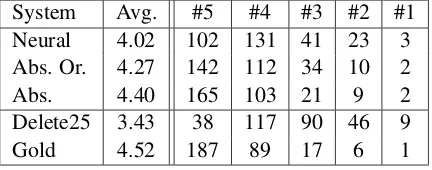
We assess the readability of the summaries gen-erated by our abstractive system, the abstractive oracle (both with sentence constraint) andNeural. We sampled 100 daily summaries for each sys-tem and from the gold summaries. We ensured that an approximately equal number of summaries was sampled from each generated timeline. Addi-tionally, we sampled another 100 gold summaries and randomly deleted25%of their tokens to sim-ulate a compressive system without regard for lin-guistic quality. We call these summariesDelete25. We asked annotators from Amazon Mechanical Turk9to rate how well they are able to understand the summaries on a scale from 1 (completely un-understandable) to 5 (easily understood). The de-scriptions of the rating scale presented to the work-ers can be seen in Table7. Items were grouped in randomly ordered batches, so that each batch had one summary from each system.
Table 8 shows readability results. Unsurpris-ingly, Gold receives the highest score. Delete25 receives an unexpectedly high score, though no-tably lower than other systems. We find many sen-tences remain understandable even after deletions as in the following example: Saif al-islam has been detained several bodyguards near the town obari by fighters in town of zintan, the justice min-ister and other officials said. He not wounded.
Among the systems, ours receives the highest score. The oracle performs slightly worse. We speculate that this is due to the fact that the oracle does not include language model information. In both cases, over 80% of the sentences are easily understood (4 or 5). We also outperformNeural. This might be a result of its higher abstractiveness, which allows more errors.
7 Related Work
7.1 TLS
To the best of our knowledge, all systems pro-posed specifically for TLS have been extractive
[image:8.595.72.294.684.727.2]5 I can understand the text without prob-lems. It does not have any grammatical-ity or fluency issues.
4 The text has some minor grammatical-ity or fluency issues but I can still un-derstand it without problems.
3 I can understand the entire text, but it is difficult to do so.
[image:9.595.79.285.62.203.2]2 I can understand the text only partially. 1 I can not understand the text at all.
Table 7: Rating scale for the readability task.
System Avg. #5 #4 #3 #2 #1
Neural 4.02 102 131 41 23 3
Abs. Or. 4.27 142 112 34 10 2
Abs. 4.40 165 103 21 9 2
Delete25 3.43 38 117 90 46 9
Gold 4.52 187 89 17 6 1
Table 8: Results of the readability evaluation. We also report the number of times each category was chosen.
(Nguyen et al., 2014; Chieu and Lee, 2004; Yan
et al.,2011b,a;Wang et al.,2016;Tran et al.,2015,
2013b,a; Martschat and Markert, 2018). Several
of these evaluate on corpora that are not pub-licly available (Chieu and Lee, 2004; Yan et al.,
2011a,b) so that we cannot compare to their
re-sults. Since the advent of TL17 and Crisis, several evaluations have been performed on these datasets
(Tran et al.,2015,2013b,a;Martschat and
Mark-ert, 2018;Wang et al.,2016), but onlyMartschat
and Markert(2018) evaluate with appropriate TLS
measures. As code and original output are mostly unavailable, it is difficult to compare to them.
7.2 TLS-related Tasks
TLS is related to the TREC real-time summariza-tion task (Lin et al.,2016). Unlike TLS, this task focuses on detecting novel information in a stream of social media posts in real time. TLS, on the other hand, assumes an offline setting and gener-ates timelines for much longer timespans, focus-ing on the challenges of date selection and datfocus-ing of information, which are not present in TREC.
There are also several papers that produce time-lines by generating a summary for every single date in a given timespan, thus timeline generation without date selection (Wang et al., 2015; Allan
et al.,2001). In these cases, the overall
compres-sion rate is not as low as for our setting and not
comparable to the human timelines in our corpora. TLS is also related to Task 4 in SEMEVAL 2015
(Minard et al., 2015). In this task, systems need
to extract all events a query entity participates in. Unlike TLS the output is not a textual summary but a complete collection of the events in the
in-put. Barros et al.(2019) have proposed narrative
abstractive timeline summarization (NATSUM) in which they generate abstractive textual descrip-tions for the events in the SEMEVAL dataset. However, their work is markedly different from TLS in that ”NATSUM [...] aims to generate nar-rative summaries and not timelines” (Barros et al.,
2019, page 15). As a consequence, they do not perform any date selection and do not evaluate with appropriate date-sensitive metrics.
7.3 Generic Summarization
We have already described the differences be-tween TLS and MDS and the limited direct appli-cability of MDS systems to TLS in Section 2.2. However, our methodology is inspired by the MDS system ofBanerjee et al.(2015). We made major adaptations to this system for TLS by (i) us-ing AP clusterus-ing to cluster sentences in a date-sensitive way that dynamically adapts to the cor-pus size and (ii) augmenting sentence scoring and selection to the needs of TLS. Our system is also related to neural abstractive summarization (See
et al.,2017;Gehrmann et al.,2018;Cohan et al.,
2018;Paulus et al., 2018). However, these
meth-ods require large training corpora unavailable for TLS.
8 Conclusion
We have presented a system for abstractive TLS which outperforms the state-of-the-art extractive TLS system when corpora are large and need sub-stantial compression. Our analysis reveals a corre-lation between the difficulty of a TLS instance (as measured by compression and spread) and the ad-vantage of an abstractive over a purely extractive approach.
[image:9.595.74.290.235.320.2]References
James Allan, Rahul Gupta, and Vikas Khandelwal. 2001. Temporal summaries of new topics. In Proceedings of the 24th Annual International ACM SIGIR Conference on Research and Development in Information Retrieval, SIGIR ’01, pages 10–18, New York, NY, USA. ACM.
Siddhartha Banerjee, Prasenjit Mitra, and Kazunari Sugiyama. 2015. Multi-document abstractive sum-marization using ilp based multi-sentence compres-sion. InProceedings of the 24th International Con-ference on Artificial Intelligence, IJCAI’15, pages 1208–1214. AAAI Press.
Cristina Barros, Elena Lloret, Estela Saquete, and Borja Navarro-Colorado. 2019. Natsum: Narrative abstractive summarization through cross-document timeline generation. Information Processing & Management.
Asli Celikyilmaz, Antoine Bosselut, Xiaodong He, and Yejin Choi. 2018. Deep communicating agents for abstractive summarization. In Proceedings of the 2018 Conference of the North American Chapter of the Association for Computational Linguistics: Hu-man Language Technologies, Volume 1 (Long Pa-pers), pages 1662–1675. Association for Computa-tional Linguistics.
Hai Leong Chieu and Yoong Keok Lee. 2004. Query based event extraction along a timeline. In Proceed-ings of the 27th annual international ACM SIGIR conference on Research and development in infor-mation retrieval, pages 425–432. ACM.
Arman Cohan, Franck Dernoncourt, Doo Soon Kim, Trung Bui, Seokhwan Kim, Walter Chang, and Nazli Goharian. 2018. A discourse-aware attention model for abstractive summarization of long documents. In Proceedings of the 2018 Conference of the North American Chapter of the Association for Computa-tional Linguistics: Human Language Technologies, Volume 2 (Short Papers), pages 615–621. Associa-tion for ComputaAssocia-tional Linguistics.
Rotem Dror, Gili Baumer, Segev Shlomov, and Roi Re-ichart. 2018. The hitchhiker’s guide to testing statis-tical significance in natural language processing. In Proceedings of the 56th Annual Meeting of the As-sociation for Computational Linguistics (Volume 1: Long Papers), pages 1383–1392, Melbourne, Aus-tralia. Association for Computational Linguistics.
G¨unes Erkan and Dragomir R Radev. 2004. Lexrank: Graph-based lexical centrality as salience in text summarization. Journal of artificial intelligence re-search, 22:457–479.
Katja Filippova. 2010. Multi-sentence compression: Finding shortest paths in word graphs. In Proceed-ings of the 23rd International Conference on Com-putational Linguistics, COLING ’10, pages 322– 330, Stroudsburg, PA, USA. Association for Com-putational Linguistics.
Brendan J. Frey and Delbert Dueck. 2007. Clustering by passing messages between data points. Science, 315:972–976.
Sebastian Gehrmann, Yuntian Deng, and Alexander Rush. 2018. Bottom-up abstractive summarization. In Proceedings of the 2018 Conference on Empiri-cal Methods in Natural Language Processing, pages 4098–4109. Association for Computational Linguis-tics.
Aric A. Hagberg, Daniel A. Schult, and Pieter J. Swart. 2008. Exploring network structure, dynamics, and function using NetworkX. InProceedings of the 7th Python in Science Conference (SciPy2008), pages 11–15, Pasadena, CA USA.
Kenneth Heafield. 2011. Kenlm: Faster and smaller language model queries. InProceedings of the Sixth Workshop on Statistical Machine Translation, WMT ’11, pages 187–197, Stroudsburg, PA, USA. Associ-ation for ComputAssoci-ational Linguistics.
Karl Moritz Hermann, Tom´aˇs Koˇcisk´y, Edward Grefenstette, Lasse Espeholt, Will Kay, Mustafa Su-leyman, and Phil Blunsom. 2015. Teaching ma-chines to read and comprehend. InProceedings of the 28th International Conference on Neural Infor-mation Processing Systems - Volume 1, NIPS’15, pages 1693–1701, Cambridge, MA, USA. MIT Press.
Tsutomu Hirao, Masaaki Nishino, and Masaaki Na-gata. 2017. Oracle summaries of compressive sum-marization. In Proceedings of the 55th Annual Meeting of the Association for Computational Lin-guistics (Volume 2: Short Papers), pages 275–280. Association for Computational Linguistics.
Chin-Yew Lin. 2004. ROUGE: A package for auto-matic evaluation of summaries. In Text Summa-rization Branches Out: Proceedings of the ACL-04 Workshop, pages 74–81, Barcelona, Spain. Associa-tion for ComputaAssocia-tional Linguistics.
Jimmy Lin, Adam Roegiest, Luchen Tan, Richard Mc-Creadie, Ellen Voorhees, and Fernando Diaz. 2016. Overview of the trec 2016 real-time summarization track. InProceedings of the 25th text retrieval con-ference, TREC, volume 16.
Christopher Manning, Mihai Surdeanu, John Bauer, Jenny Finkel, Steven Bethard, and David McClosky. 2014. The stanford corenlp natural language pro-cessing toolkit. In Proceedings of 52nd annual meeting of the association for computational lin-guistics: system demonstrations, pages 55–60.
Sebastian Martschat and Katja Markert. 2018. A tem-porally sensitive submodularity framework for time-line summarization. In Proceedings of the 22nd Conference on Computational Natural Language Learning, pages 230–240. Association for Compu-tational Linguistics.
Rada Mihalcea and Paul Tarau. 2004. TextRank: Bringing order into text. InProceedings of EMNLP 2004, pages 404–411, Barcelona, Spain. Associa-tion for ComputaAssocia-tional Linguistics.
Anne-Lyse Minard, Manuela Speranza, Eneko Agirre, Itziar Aldabe, Marieke van Erp, Bernardo Magnini, German Rigau, and Ruben Urizar. 2015. SemEval-2015 task 4: TimeLine: Cross-document event or-dering. In Proceedings of the 9th International Workshop on Semantic Evaluation (SemEval 2015), pages 778–786, Denver, Colorado. Association for Computational Linguistics.
Kiem-Hieu Nguyen, Xavier Tannier, and V´eronique Moriceau. 2014. Ranking multidocument event de-scriptions for building thematic timelines. In Pro-ceedings of COLING 2014, the 25th International Conference on Computational Linguistics: Tech-nical Papers, pages 1208–1217, Dublin, Ireland. Dublin City University and Association for Compu-tational Linguistics.
Eric W Noreen. 1989. Computer-intensive methods for testing hypotheses. Wiley New York.
Lawrence Page, Sergey Brin, Rajeev Motwani, and Terry Winograd. 1999. The pagerank citation rank-ing brrank-ingrank-ing order to the web. Technical report, Stanford InfoLab.
Romain Paulus, Caiming Xiong, and Richard Socher. 2018. A deep reinforced model for abstractive sum-marization. InInternational Conference on Learn-ing Representations.
Abigail See, Peter J. Liu, and Christopher D. Manning. 2017. Get to the point: Summarization with pointer-generator networks. InProceedings of the 55th An-nual Meeting of the Association for Computational Linguistics (Volume 1: Long Papers), pages 1073– 1083. Association for Computational Linguistics.
Jannik Str¨otgen and Michael Gertz. 2013. Multilingual and cross-domain temporal tagging. Language Re-sources and Evaluation, 47(2):269–298.
Giang Tran, Mohammad Alrifai, and Eelco Herder. 2015. Timeline summarization from relevant head-lines. InEuropean Conference on Information Re-trieval, pages 245–256. Springer.
Giang Binh Tran, Mohammad Alrifai, and Dat Quoc Nguyen. 2013a. Predicting relevant news events for timeline summaries. In Proceedings of the 22nd International Conference on World Wide Web, pages 91–92. ACM.
Giang Binh Tran, Tuan A Tran, Nam-Khanh Tran, Mohammad Alrifai, and Nattiya Kanhabua. 2013b. Leveraging learning to rank in an optimization framework for timeline summarization. In SIGIR 2013 Workshop on Time-aware Information Access (TAIA.
Lu Wang, Claire Cardie, and Galen Marchetti. 2015. Socially-informed timeline generation for complex events. InProceedings of the 2015 Conference of the North American Chapter of the Association for Computational Linguistics: Human Language Tech-nologies, pages 1055–1065, Denver, Colorado. As-sociation for Computational Linguistics.
William Yang Wang, Yashar Mehdad, Dragomir R. Radev, and Amanda Stent. 2016. A low-rank ap-proximation approach to learning joint embeddings of news stories and images for timeline summariza-tion. In Proceedings of the 2016 Conference of the North American Chapter of the Association for Computational Linguistics: Human Language Tech-nologies, pages 58–68, San Diego, California. Asso-ciation for Computational Linguistics.
Rui Yan, Liang Kong, Congrui Huang, Xiaojun Wan, Xiaoming Li, and Yan Zhang. 2011a. Timeline gen-eration through evolutionary trans-temporal sum-marization. In Proceedings of the Conference on Empirical Methods in Natural Language Process-ing, EMNLP ’11, pages 433–443, Stroudsburg, PA, USA. Association for Computational Linguistics.
Rui Yan, Xiaojun Wan, Jahna Otterbacher, Liang Kong, Xiaoming Li, and Yan Zhang. 2011b. Evolution-ary timeline summarization: a balanced optimiza-tion framework via iterative substituoptimiza-tion. In Pro-ceedings of the 34th international ACM SIGIR con-ference on Research and development in Information Retrieval, pages 745–754. ACM.
Jin Y. Yen. 1971. Finding the k shortest loopless paths in a network. Management Science, 17(11):712– 716.