Improving Neural Abstractive Document Summarization
with Structural Regularization
∗Wei Li1,2,3 Xinyan Xiao2 Yajuan Lyu2 Yuanzhuo Wang1
1Institute of Computing Technology, Chinese Academy of Sciences, Beijing, China
2Baidu Inc., Beijing, China
3University of Chinese Academy of Sciences, Beijing, China
[email protected],{xiaoxinyan,lvyajan}@baidu.com,
Abstract
Recent neural sequence-to-sequence models have shown significant progress on short text summarization. However, for document sum-marization, they fail to capture the long-term structure of both documents and multi-sentence summaries, resulting in information loss and repetitions. In this paper, we pro-pose to leverage the structural information of both documents and multi-sentence sum-maries to improve the document summariza-tion performance. Specifically, we import both structural-compression and structural-coverage regularization into the summariza-tion process in order to capture the infor-mation compression and inforinfor-mation cover-age properties, which are the two most im-portant structural properties of document sum-marization. Experimental results demonstrate that the structural regularization improves the document summarization performance signif-icantly, which enables our model to generate more informative and concise summaries, and thus significantly outperforms state-of-the-art neural abstractive methods.
1 Introduction
Document summarization is the task of generat-ing a fluent and condensed summary for a docu-ment while retaining the gist information. Recent success of neural sequence-to-sequence (seq2seq) architecture on text generation tasks like ma-chine translation (Bahdanau et al.,2014) and im-age caption (Vinyals et al., 2015), has attracted growing attention to abstractive summarization research. Huge success has been witnessed in abstractive sentence summarization (Rush et al.,
2015;Takase et al.,2016;Chopra et al.,2016;Cao
et al.,2017;Zhou et al.,2017), which builds
one-sentence summaries from one or two-one-sentence
in-∗
This work was done while the first author was doing in-ternship at Baidu Inc.
(a) Gold Reference
I1 I2I3I4I5I6I7 I8I9I10I11I12I13I14 I15I16I17I18I19I20 O1
O2 O3
O4 O5
(b) Seq2Seq-baseline
O1 O2 O3
(d) Hierarchical-baseline
O1 O2 O3 O4
(c) Point-gen-cov
O1 O2
(e) Our Method
O1 O2 O3
I1 I2I3I4I5I6I7 I8I9I10I11I12I13I14 I15I16I17I18I19I20
I1 I2I3I4I5I6I7 I8I9I10I11I12I13I14 I15I16I17I18I19I20
I1 I2I3I4I5I6I7 I8I9I10I11I12I13I14 I15I16I17I18I19I20
[image:1.595.317.516.220.438.2]I1 I2I3I4I5I6I7 I8I9I10I11I12I13I14 I15I16I17I18I19I20
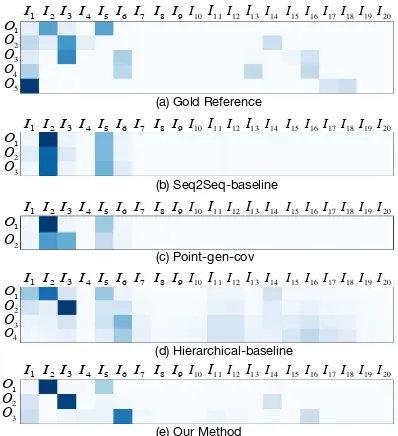
Figure 1: Comparison of sentence-level attention distribu-tions for the summaries in Table1on a news article. (a) is the heatmap for the gold reference summary, (b) is for the
Seq2seq-baseline system, (c) is for thePoint-gen-cov(See et al.,2017) system, (d) is for theHierarchical-baseline sys-tem and (e) is for our syssys-tem. Ii andOiindicate the i-th sentence of the input and output, respectively. Obviously, the seq2seq models, including theSeq2seq-baselinemodel and the Point-gen-covmodel, lose much salient information of the input document and focus on the same set of sentences repeatedly. TheHierarchical-baselinemodel fails to detect several specific sentences that are salient and relevant for each summary sentence and focuses on the same set of sentences repeatedly. On the contrary, our method with structural regu-larizations focuses on different sets of source sentences when generating different summary sentences and discovers more salient information from the document.
put. However, the extension of sentence abstrac-tive methods to document summarization task is not straightforward.
As long-distance dependencies are difficult to be captured in the recurrent framework (Bengio
et al.,1994), the seq2seq models are not yet able
Original Text (truncated):the family of conjoined twin sisters who died 19 days after they were born have been left mortified(2)after they arrived at their gravesite to find cemetery
staff had cleared the baby section of all mementos and tossed them in the rubbish(3). faith and hope howie were dubbed the miracle twins when they were born on may 8 last year with one body and two faces due to an extremely rare conditionknown as disrosopus(1). they died in hospital less than a month after they were born and their parents, simon howie and renee young ,laid them to rest at pinegrove memorial park in sydney ’s west(2). scroll down for video . faith and hope howie were dubbed the miracle twins when they were born
on may 8 last year with one body and two faces due to an extremely rare conditionknown as disrosopus(1). family members have visited the grave every week to leave mementos and flowers for faith and hope , but when mr howie and ms young arrived on thursday they found the site completely bare(3). ’ we took renee’s aunts to see the girls for the first time and we found everything had been stripped away , ’ mr howie told daily mail australia . ’ we were devastated and mortified . we ’ve had a little shrine set up and we ’ve been adding to it since the funeral . ’ it ’s heartbreaking to know we ’ve set this up and it has been treated like rubbish . ’ faith and hope were buried in a pink coffin and their family and friends released doves and pink and white balloons at their funeral . their family and friends had built up a small memorial with pink and white statues , flowers , pebbles and toys over the past 11 months . when they arrived on thursday , everything had been removed apart from a bunch of flowers . the twins were buried at pinegrove memorial park in western sydney after they died after just 19 days(2). their family and friends had built a small shrine at their gravesite , which they have added to since the funeral . family members have visited the grave every
week to leave mementos and flowers for faith and hope , but when parents simon howie and renee young arrived on thursday they found the site completely bare(3).
Gold Reference:faith and hope howie were born with one body and two faces on may 8. they tragically died in hospital just 19 days after they were born . parents simon howie and renee young visit their grave at pinegrove in western sydney fortnightly . they arrived on thursday to find the grave bare of all the girls ’ mementos . staff had cleared entire baby section and thrown belongings in rubbish .
Seq2seq-baseline:faith and hope howie were dubbed the miracle twins when they were born on may 8 last year with one body and two faces due to an extremely rare condition known as disrosopus .faith and hope howie were dubbed the miracle twins when they were born on may 8 last year with one body and two faces due to an extremely rare condition known as disrosopus.faith and hope howie were dubbed the miracle twins when they were born on may 8 last year with one body and two faces due to an extremely rare condition known as disrosopus.
Point-cov (See et al.,2017):faith and hope howie were dubbed the miracle twins when they were born on may 8 last year with one body and two faces due to an extremely rare condition known as disrosopus . they died in hospital less than a month after they were born and their parents , simon howie and renee young , laid them to rest at pinegrove memorial park in sydney ’s west.
Hierarchical-baseline:faith and hope howie were dubbed the miracle twins when they were born on may 8 last year with one body and two faces due to an extremely rare condition .they died in hospital less than a month after they died in hospital less than a month after they were born and laid them to rest at pinegrove memorial park in sydney ’s west.family members have visited the grave every week to leave mementos and flowers for faith and hope,but when they were born on thursday they found the site completely bare.family members have visited the grave every week to leave mementos and flowers for faith and hope,but when they found the site completely bare.
Our Method:faith and hope howie were dubbed the miracle twins when they were born on may 8 last year with one body and two faces due to an extremely rare condition(1). they died in hospital less than a month after they were born and their parents laid them to rest at pinegrove memorial park in sydney ’s west(2).family members have visited the grave every week to leave mementos and flowers for faith and hope , but when mr howie and ms young arrived on thursday they found the site completely bare(3).
Table 1: Comparison of the generated summaries of four abstractive summarization models and the gold reference summary on a news article. The summaries generated by the seq2seq models, both the Seq2seq-baseline model and the Point-cov model, losesome salient information. The Seq2seq-baseline model even containsserious information repetitions. The Hierarchical-baseline model not onlycontains serious repetitions, but also makes non-grammatical or non-coherent sentences. On the contrary, the summary generated by our model contains more salient information and is more concise. Our model also shows the ability to generate a summary sentence by compressing several source sentences, such asshortening a long sentence.
2017). In document summarization, it is also diffi-cult for the seq2seq models to discover important information from too much input content of a doc-ument (Tan et al.,2017a,b). The summary gener-ated by the seq2seq models usually loses salient information of the original document or even con-tains repetitions (see Table1).
In fact, both document and summary naturally have document-sentence hierarchical structure, in-stead of being a flat sequence of words. It is widely aware that the hierarchical structure is nec-essary and useful for neural document modeling. Hierarchical neural models have already been suc-cessfully used in document-level language mod-eling (Lin et al., 2015) and document classifi-cation (Yang et al., 2016). However, few work makes use of the hierarchical structure of docu-ment and multi-sentence summary in docudocu-ment summarization. The basic hierarchical encoder-decoder model (Li et al.,2015) is also not yet able to capture the structural properties of both docu-ment and summary (see Figure 11), resulting in
1
To simulate the sentence-level attention mechanism on the gold reference summary, we compute the words-matching similarities (based on TF-IDF cosine similarity) between a reference-summary sentence and the corresponding source document sentences and normalize them into attention dis-tributions. The sentence-level attention distributions of the Seq2seq-baseline model and the Point-gen-cov model are computed by summing the attention weights of all words in each sentence and then normalized across sentences.
more serious repetitions and even nonsensical sen-tences (see Table1).
In document summarization, information com-pression and information coverage are the two most important structural properties. Based on the hierarchical structure of document and sum-mary, they can be realized at the sentence-level as: (1) Structural-compression: each sum-mary sentence is generated by compressing sev-eral specific source sentences; (2)
Structural-coverage: different summary sentences usually
focus on different sets of source sentences to cover more salient information of the original doc-ument. Figure 1(a) intuitively shows the two properties in human-written gold reference sum-maries. We import both structural-compression and structural-coverage regularizations into the document summarization process based on a hi-erarchical encoder-decoder with hybrid
sentence-word attention model. Typically, we design
an effective learning and inference algorithm to explicitly model the structural-compression and structural-coverage properties of document sum-marization process, so as to generate more infor-mative and concise summaries (see Table1).
We conduct our experiments on benchmark datasets and the results demonstrate that prop-erly modeling the structural-compression and
hier-sentence-level encoder
wor
d-level encoder
hierarchical decoder
Sentence-level Attention
Word-level Attention cts
GRU
cts−1 xt−1 ' dts
ct,kw
GRU
ct,k−1w et,k−1 dt,kw
γt,k
Structural Compression
Structural Coverage
αt
h1 h2 h3
h1,1
h1,2
h1,3
h2,1
h2,2
h2,3
h3,1
h3,2
h3,3
ht'−1
ht,k−1 '
[image:3.595.74.291.63.163.2]α1...t
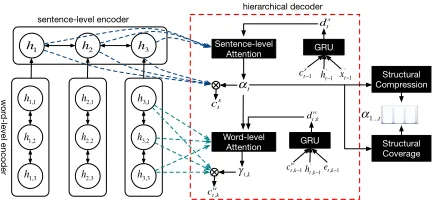
Figure 2: Our hierarchical encoder-decoder model with structural regularization for abstractive document summa-rization.
archical structure of document and summary, im-proves document summarization performance sig-nificantly. Our model is able to generate more informative and concise summaries by enhancing sentences compression and coverage, and signifi-cantly outperforms state-of-the-art seq2seq-based abstractive methods, especially on summarizing long documents with long summaries.
2 Hierarchical Encoder-Decoder Model
In this section, we introduce our baseline hierar-chical encoder-decoder model which consists of two parts: a hierarchical encoder and a hierarchi-cal decoder, as shown in Figure2. Similar to (Li
et al.,2015), both the encoder and decoder consists
of two levels: a sentence level and a word level. The main distinction is that we design a hybrid sentence-word attention mechanism on the hierar-chical decoder to help organize summary content and realize summary sentences.
2.1 Hierarchical Encoder
The goal of the encoder is to map the input doc-ument to a hidden vector representation. We con-sider a source documentX as a sequence of sen-tences: X = {si}, and each sentence si as a
sequence of words: si = {wij}. The
word-level encoder encodes the words of a sentence into a sentence representation, and the sentence-level encoder encodes the sentences of a docu-ment into the docudocu-ment representation. In this work, both the word-level encoder and sentence-level encoder use the bidirectional Gated Recur-rent Unit (BiGRU) (Chung et al., 2014). The word-level encoder sequentially updates its hid-den state upon each received word, as hi,j =
BiGRU(hi,j−1, ei,j) where hi,j and ei,j denote
the hidden state and the embedding of wordwi,j,
respectively. The concatenation of the forward and
backward final hidden states in the word-level en-coder is indicated as the vector representationriof
sentencesi, which is used as input to the
sentence-level encoder. The sentence-sentence-level encoder updates its hidden state after receiving each sentence rep-resentation, as hi = BiGRU(hi−1, ri)where hi
denotes the hidden state of sentencesi. The
con-catenation of the forward and backward final states in the sentence-level encoder is used as the vector representation of documentd.
In the hierarchical encoder architecture, long dependency problem will be largely reduced at both the sentence level and the word level, so it can better capture the structural information of the input document.
2.2 Hierarchical Decoder with Hybrid
Sentence-Word Attention
The goal of the decoder is to generate output sum-mary according to the representation of the in-put document. Let Y = {s′i} indicates a candi-date summary of documentX, and each sentence
s′i consists of a sequence of words s′i = {wij′ }. The hierarchical decoder organizes summary Y
sentence by sentence, and realizes each sentence word by word. In this work, both the sentence-level decoder and word-sentence-level decoder use a single layer of unidirectional GRU. The sentence-level decoder receives the document representation d
as initial stateh′0 and predicts sentence represen-tations sequentially by h′t = GRU(ht′−1, rt′−1), whereh′tdenotes the hidden state of thetth sum-mary sentence s′t and r′t−1 denotes the encoded representation of the previously generated sen-tences′t−1. The word-level decoder receives a sen-tence representationh′tas initial stateh′t,0and pre-dicts word representations sequentially byh′t,k =
GRU(h′t,k−1, et,k−1) whereh′t,k denotes the
hid-den state of wordw′t,kin sentences′tandet,k−1
de-notes the embedding of previously generated word
w′t,k−1in sentences′t.
In this work, we design a hybrid sentence-word attention mechanism based on the hierarchi-cal encoder-decoder architecture, which contains
bothsentence-level attentionandword-level
at-tention, to better exploit both the sentence-level
information and word-level information from the input document and the output summary.
2.2.1 Sentence-level Attention
which is used to help our model to detect impor-tant and relevant source sentences in each sen-tence generation step. αit indicates how much the t-th summary sentence attends to the i-th source sentence, which is computed by αit =
ef(hi,h′t)/∑
lef(hl,h
′
t) where f is the function modeling the relation betweenhi andh′t. We use
the function f(a,b) = vTtanh(Waa+ Wbb),
where v, Wa, Wb are all learnable parameters.
Then the sentence level context vector cst when generating the tth sentence s′t can be computed as: cst = ∑iαithi, which is incorporated into the
sentence-level decoding process.
2.2.2 Word-level Attention with
Sentence-level Normalization
The level attention is designed on the word-level encoder and decoder, which is used to help our model to realize the summary sentence by lo-cating relevant words in the selected source sen-tences in each word generation step. Let βi,jt,k
denotes how much the j-th word in source sen-tence si contributes to generating the k-th word
in summary sentence s′t, which is computed by
βt,ki,j =ef(hi,j,h′t,k)/∑
le
f(hi,l,h′t,k).
Since the word-level attention above is within each source sentence, we normalize it by sentence-level attentions to get word attention over all source words, asγi
t,k = βt,ki αit. Then the
word-level context vector when generating word w′t,k
can be computed as: cw
t,k =
∑
i
∑
jγ i,j t,khi,j,
which is also incorporated into the word-level de-coding process.
At each word generation step, the vocabulary distribution is calculated from the context vector
cwt,kand the decoder stateh′t,kby:
Pvocab(wt,k′ ) =sof tmax(Wv(Wc[h
′
t,k, cwt,k] +bc) +bv)
(1) where Wv, Wc, bc and bv are learned
parame-ters. We also incorporate the copy mechanism
(See et al., 2017) based on the normalized
word-level attention to help generate out-of-vocabulary (OOV) words during the sentence realization pro-cess.
3 Structural Regularization
Although the above hierarchical encoder-decoder model is designed based on the document-sentence hierarchical structure, it can’t capture the basic structural properties of document sum-marization (see Figure 1(d) and Table 1).
How-ever, the hierarchical architecture makes it possi-ble for importing structural regularization to cap-ture the sentence-level characteristics of docu-ment summarization process. In this work, we propose to model the structural-compressionand
structural-coverage properties based on the
hier-archical encoder-decoder model by adding struc-tural regularization during both the model learning phase and inference phase.
3.1 Structural Compression
Compression is a basic property of document sum-marization, which has been widely explored in tra-ditional document summarization research, such as sentence compression-based methods which shorten sentences by removing non-salient parts
(Li et al.,2013;Durrett et al.,2016) and sentence
fusion-based methods which merge information from several different source sentences (Barzilay
and McKeown, 2005; Cheung and Penn, 2014).
As shown in Figure1, each summary sentence in the human-written reference summary is also cre-ated by compressing several specific source sen-tences.
In this paper, we propose to model the
structural-compression property of document
summarization based on sentence-level attention distributions by:
strCom(αt) = 1−
1
logN
N
∑
i=1
αitlogαit (2)
whereαtdenotes the sentence-level attention
dis-tribution when generating the tth summary sen-tence and N denotes the length of distribution
αt. The right part in the above formula is
actu-ally the entropy of the distributionαt. As the
at-tention distribution becomes sparser, the entropy of the distribution becomes lower, so the value
ofstrCom(αt)defined above will become larger.
Sparse sentence-level attentions help the model compress and generalize several specific source sentences which are salient and relevant in the sentence generation process. Note that, 0 ≤
strCom(αt)≤1.
3.2 Structural Coverage
used as a measure in many traditional document summarization research, such as the submodular-based methods which optimize the information coverage of the summary with similarity-based coverage metrics (Lin and Bilmes, 2011; Chali et al.,2017).
In this work, we simply model the
structural-coverage property of summary based on the
hi-erarchical architecture by encouraging different summary sentences to focus on different sets of source sentences so that the summary can cover more salient sentences of the input document. We measure the structural-coverageof summary based on the sentence-level attention distributions:
strCov(αt) = 1−
∑
i
min(αit,
t−1
∑
t′=0
αti′) (3)
which is used to encourage different summary tences to focus on different sets of source sen-tences during the summary generation process. As the sentence-level attention distributions of dif-ferent summary sentences become more diversi-fied, the summary will cover more source sen-tences, which is effective to improve the informa-tiveness and conciseness of summaries. Note that,
0≤strCov(αt)≤1.
3.3 Model Learning
Experimental results reveal that the properties of
structural-compression and structural-coverage
are hard to be captured by both the seq2seq mod-els and the hierarchical encoder-decoder baseline model, which largely restricts their performance (Section 4). In this work, we model them ex-plicitly by regulating the sentence-level attention distributions based on the hierarchical
encoder-decoder framework. The loss function L of
the model is the mix of negative log-likelihood of generating summaries over training set T, the compression loss and the structural-coverage loss:
L= ∑
(X,Y)∈T
{−logP(Y|X;θ) + λ1
∑
t
strCom(αt)
| {z }
structural−compression loss
+ λ2
∑
t
strCov(αt)
| {z }
structural−coverage loss }
(4)
where λ1 and λ2 are hyper-parameters tuned on
the validation set. We use Adagrad (Duchi et al.,
2011) with learning rate 0.1 and an initial accumu-lator value 0.1 to optimize the model parametersθ.
3.4 Hierarchical Decoding Algorithm
The traditional beam search algorithm that widely used for text generation can only help generate fluent sentence, and is not easy to extend to the sentence level. The reason is that theK-best sen-tences generated by a word decoder will mostly be similar to each other (Li et al., 2016; Tan
et al., 2017a). We propose a hierarchical beam
search algorithm withstructural-compressionand
structural-coverageregularization.
The hierarchical decoding algorithm has two levels:K-best word-level beam search andN-best sentence-level beam search. At the word-level, the vanilla beam search algorithm is used to max-imize the accumulated scorePˆ(s′t) of generating current summary sentence s′t. At the sentence-level, N-best beam search is realized by maxi-mizing the accumulated score scoret of all the
sentences generated, including the sentences gen-eration score, structural-compression score and structural-coverage score, which are defined as:
scoret=
t
∑
t′=0 {Pˆ(s′
t′) +ζ1strCom(αt′) +ζ2strCov(αt′)}
(5) where ζ1 and ζ2 are factors introduced to
con-trol the influence of structural regularization dur-ing the decoddur-ing process.
4 Experiments
4.1 Experimental Settings
We conduct our experiments on the CNN/Daily Mail dataset (Hermann et al., 2015), which has been widely used for exploration on summarizing documents with multi-sentence summaries (
Nal-lapati et al., 2016; See et al., 2017; Tan et al.,
2017a;Paulus et al.,2017). The CNN/DailyMail
dataset contains input sequences of about 800 to-kens in average and multi-sentence summaries of up to 200 tokens. The average number of sen-tences in documents and summaries are 42.1 and 3.8, respectively. We use the same version of non-anonymized data (the original text without pre-processing) as See et al. (2017), which has 287,226 training pairs, 13,368 validation pairs and 11,490 test pairs.
Method Rouge-1 Rouge-2 Rouge-L SummaRuNNer-abs 37.5 14.5 33.4
SummaRuNNer 39.6 16.2 35.3
Seq2seq-baseline 36.64 15.66 33.42 ABS-temp-attn 35.46 13.30 32.65 Graph-attention 38.1 13.9 34.0
Point-cov 39.53 17.28 36.38
Hierachical-baseline 34.95 14.79 32.68
[image:6.595.71.307.61.158.2]Our Model 40.30 18.02 37.36
Table 2: RougeF1scores on the test set. All our ROUGE
scores have a95% confidence interval of at most±0.25
as reported by the official ROUGE script.
use 512-dimensional hidden states. The dimen-sion of word embeddings is 128, which is learned from scratch during training. We use a vocabulary of 50k words for both the encoder and decoder.
We trained our model on a single Tesla K40m GPU with a batch size of 16 and an epoch is set containing 10,000 randomly sampled documents. Convergence is reached within 300 epochs. After tuning on the validation set, parametersλ1,λ2,ζ1
andζ2, are set as -0.5, -1.0, 1.2 and 1.4,
respec-tively. At the test time, we use the hierarchical decoding algorithm with sentence-level beam size 4 and word-level beam size 8.
4.2 Evaluation
ROUGE Evaluation. We evaluate our models
with the widely used ROUGE (Lin,2004) toolkit. We compare our system’s results with the re-sults of state-of-the-art neural summarization ap-proaches reported in recent papers, including both abstractive models and extractive models. The ex-tractive models includeSummaRuNNer(
Nallap-ati et al.,2017) andSummaRuNNer-abswhich is
similar to SummaRuNNer but is trained directly on the abstractive summaries. The abstractive models include:
1) Seq2seq-baseline, which uses the basic
seq2seq encoder-decoder architecture with attention mechanism, and incorporates with copy mechanism (See et al.,2017) to allevi-ate the OOV problem.
2) ABS-temp-attn (Nallapati et al., 2016),
which uses Temporal Attention on the
seq2seq architecture to overcome the repeti-tion problem.
3) Point-cov(See et al.,2017), which is an ex-tension of the Seq2seq-baseline model by im-porting word-coverage mechanism to reduce repetitions in summary.
4) Graph-attention(Tan et al., 2017a), which
length Method Rouge-1 Rouge-2 R.-L
<100 Our M. 39.66 17.28 36.69
(94.47%) Point-cov 39.44 17.20 36.30
[100,125) Our M. 43.07 19.96 39.47
(4.00%) Point-cov 41.78 19.00 38.41
[125,150) Our M. 43.25 19.21 40.08
(1.07%) Point-cov 41.31 18.02 37.75
>150 Our M. 40.64 18.30 38.00
(0.46%) Point-cov 35.64 17.76 33.12
Table 3: Comparison results w.r.t different length of refer-ence summary. <100indicates the reference summary has less than 100 words (occupy 94.47% of test set).
uses a graph-ranking based attention mecha-nism based on a hierarchical architecture to identify important sentences.
5) Hierachical-baseline, which just uses the
basic hierarchical encoder-decoder with hy-brid attention model proposed in this paper.
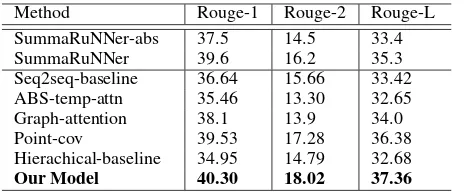
Results in Table 2 show that our model sig-nificantly outperforms all the neural abstractive baselines and extractive baselines. An inter-esting observation is that the performance of
the Hierarchical-baseline model are lower than
theSeq2seq-baselinemodel, which demonstrates
the difficulty for a traditional model to iden-tify the structural properties of document sum-marization process. Our model outperforms the
Hierarchical-baseline model by more than 4
ROUGE points, which demonstrates that the struc-tural regularization improves the document sum-marization performance significantly.
To verify the superiority of our model on gen-erating long summaries, we also compare our method with the best seq2seq model Point-cov
(See et al.,2017) by evaluating them on a test set
w.r.t. different length of reference summaries. The results are shown in Table 3, which demonstrate that our model is better at generating long sum-mary than the seq2seq model. As the sumsum-mary becomes longer, our system will obtain larger ad-vantages over the baseline (from +0.22 Rouge-1, +0.08 Rouge-2 and +0.39 Rouge-L for summary less than 100 words, rising to +5.00 Rouge-1, +0.54 Rouge-2 and +4.88 Rouge-L for summaries more than 150 words).
Human Evaluation. In addition to the ROUGE
evaluation, we also conducted human evaluation on 50 random samples from CNN/DailyMail test set and compared the summaries generated by our method with the outputs ofSeq2seq-baselineand
[image:6.595.296.527.61.159.2]Method Informat. Concise Coherent Fluent Seq2seq-b. 2.79∗ 2.52∗ 2.68∗ 3.57 Point-cov 3.17∗ 2.92∗ 3.00∗ 3.54
[image:7.595.338.489.59.223.2]Our Model 3.67 3.39 3.51 3.70
Table 4: Human evaluation results.∗indicates the difference betweenOur Modeland other models are statistic significant (p <0.05) by two-tailed t-test.
Method R-1 R-2 R-L strCom strCov
Hierarchical-b. 34.95 14.79 32.68 0.22 0.31
+strCom 37.03 16.21 34.44 0.64 0.71
+strCov 39.52 17.12 36.44 0.65 0.87
+hierD 40.30 18.02 37.36 0.68 0.93
Table 5: Results of adding different components of our method in terms of ROUGE-1, ROUGE-2, ROUGE-L, str-Com (Equation 1) and strCov (Equation 2) scores.
with the human summaries, and assess each sum-mary from four independent perspectives: (1)
In-formative: How informative the summary is? (2)
Concise: How concise the summary is? (3)
Co-herent: How coherent (between sentences) the
summary is? (4)Fluent: How fluent, grammatical the sentences of a summary are? Each property is assessed with a score from 1(worst) to 5(best). The average results are presented in Table4.
The results show that our model consistently outperforms theSeq2seq-baselinemodel and the previous state-of-the-art method Point-cov. As shown in Table 1, the summary generated by
Seq2Seq-Baseline usually contains repetition of
sentences or phrases, which seriously affects its informativeness, conciseness as well as coherence.
ThePoint-covmodel effectively alleviates the
in-formation repetition problem, however, it usually loses some salient information and mainly copies original sentences directly from the input docu-ment. The summaries generated by our method obviously contains more salient information and are more concise through sentences compression, which shows the effectiveness of the structural regularization in our model. The results also show that the sentence-level modeling of document and summary in our model makes the generated sum-maries achieve better inter-sentence coherence.
5 Discussion
5.1 Model Validation
To verify the effectiveness of each component in our model, we conduct several ablation ex-periments. Based on the Hierarchical-baseline model, several different structural
regulariza-tions are added one by one: +strCom
indi-sparsity
diversity
sparsity
diversity
(a) gold reference summary (b) Seq2seq-baseline
sparsity
diversity
(c) Hierarchical-baseline
sparsity
diversity
[image:7.595.74.292.62.108.2](d) Our model with structural regularizations
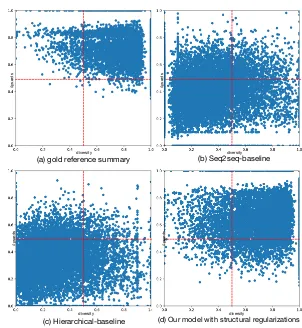
Figure 3: Comparisons of structural-compression and structural-coverage analysis results on random samples from CNN/Daily Mail datasets, which demonstrate that both the Seq2seq-baseline model and the Hierarchical-baseline model are not yet able to capture them properly, but our model with structural regularizations achieves similar behavior with the gold reference summary.
cates adding structural-compression regulariza-tion during model learning, +strCov indicates adding structural-coverage regularization during model learning, +hierD indicates using the hier-archical decoding algorithm with both structural-compression and structural-coverage regulariza-tions during inference.
Results on the test set are shown in Table 5. Our method much outperforms all the compared systems, which verifies the effectiveness of each component of our model. Note that, both the structural-compression and structural-coverage regularization significantly affect the summa-rization performance. The higher structural-compression and structural-coverage scores will
lead to higher ROUGE scores. Therefore, we
can conclude that the structural-compression and structural-coverage regularization based on our hi-erarchical model have significant contributions to the increase of ROUGE scores.
5.2 Structural Properties Analysis
We further compare the ability of different models in capturing the structural-compression and structural-coverage properties of document
summarization. Figure 3 shows the
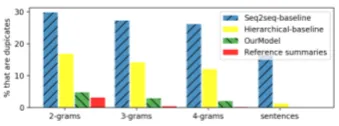
[image:7.595.73.290.156.212.2]structural-Figure 4: The structural regularization reduces undesirable repetitions while summaries from the Seq2seq-baseline and the Hierarchical-baseline contains many n-gram repetitions.
coverage scores. However, Figure 3 (b) and (c) show that in both the Seq2seq-baseline model and the Hierarchical-baseline model, most sam-ples fall into the left-bottom area (low structural-compression and structural-coverage), and only about 13% and 7% samples fall into the right-top area, respectively. Figure 3 (d) shows that our system with structural regularization achieves similar behaviors to human-made summaries (over
80%samples fall into the right-top area). The re-sults demonstrate that the structural-compression and structural-coverage properties are common in document summarization, but both the seq2seq models and the basic hierarchical encoder-decoder models are not yet able to capture them properly.
5.3 Effects of Structural Regularization
The structural regularization based on our hi-erarchical encoder-decoder with hybrid attention model improves the quality of summaries from two aspects: (1) The summary covers more salient information and contains very few repetitions, which can be seen both qualitatively (Table1and Figure 1) and quantitatively (Table 5 and Figure
4). (2) The model has the ability to shorten a long sentence to generate a more concise one or compress several different sentences to generate a more informative one by merging the informa-tion from them. Table6shows several examples of abstractive summaries produced by sentence com-pression in our model.
6 Related Work
Recently some work explored the seq2seq mod-els on document summarization, which exhibit some undesirable behaviors, such as inaccurately reproducing factual details, OOVs and repetitions. To alleviate these issues, copying mechanism (Gu et al.,2016;Gulcehre et al.,2016;Nallapati et al.,
2016) has been incorporated into the encoder-decoder architecture to help generate informa-tion correctly. Distracinforma-tion-based atteninforma-tion model
Original Text:luke lazarus, a 23-year-old former private school boy ,was jailed for at least three years on march 27 for raping an 18-year-old virgin in an alleyway outside his father ’s soho nightclubin kings cross , inner sydneyin may 2013 .(...) Summary:luke lazarus was jailed for at least three years on march 27 for raping an 18-year-old virgin in an alleyway outside his father ’s soho nightclub in may 2013 . Original Text:(...) amywilkinson, 28 , claimed housing benefit and council tax benefit even thoughshewas living in a home owned by her mother and her partner, who was also working.wilkinson, who was a british airways cabin crew attendant ,was ordered to pay back a total of 17,604 that she claimed over two years when she appeared at south and east cheshire magistrates court last week . (...) Summary:amy wilkinson , 28 , claimed housing benefit and council tax benefit even though she was living in a home owned by her mother and her partner .she was ordered to pay back a total of 17,604 that she claimed over two years when she appeared at south and east cheshire magistrates court last week .
Original Text:(...) a grand jurycharged durst with possession of a firearm by a felon , and possession of both a firearm and an illegal drug : 5 ounces of marijuana , said assistant district attorney chris bowman , spokesman for the district attorney . millionaire real estate heir robert durst was indicted wednesday onthe two weapons charges that have kept him in new orleans even though his lawyers say he wants to go to los angeles as soon as possible to face a murder charge there. his arrest related to those charges has kept durst from being extradited to los angeles , where he ’s charged in the december 2000 death of longtime friend susan berman.(...) Summary:durst entered his plea during an arraignment in a new orleans court on weapons charges that accused him of possessing both a firearm and an illegal drug , marijuana.the weapons arrest has kept durst in new orleans even though he is charged in the december 2000 death of a longtime friend.
Table 6: Examples of sentences compression or fusion by our model. Thelink-throughdenotes deleting the non-salient part of the original text. Theitalicdenotes novel words or sentences generated by sentences fusion or compression.
(Chen et al.,2016) and word-level coverage
mech-anism (See et al., 2017) have also been investi-gated to alleviate the repetition problem. Rein-forcement learning has also been studied to im-prove the document summarization performance from global sequence level (Paulus et al.,2017).
Hierarchical Encoder-Decoder architecture is first proposed by Li et al. (2015) to train an auto-encoder to reconstruct multi-sentence para-graphs. In summarization field, hierarchical en-coder has first been used to alleviate the long de-pendency problem for long inputs (Cheng and
La-pata, 2016; Nallapati et al., 2016). Tan et al.
(2017b) also propose to use a hierarchical encoder
to encode multiple summaries produced by several extractive summarization methods, and then de-code them into a headline. However, these models don’t model the decoding process hierarchically.
[image:8.595.96.266.64.127.2]7 Conclusions
In this paper we analyze and verify the neces-sity of leveraging document structure in docu-ment summarization, and explore the effective-ness of capturing structural properties of docu-ment summarization by importing both
structural-compression and structural-coverage
regulariza-tion based on the proposed hierarchical encoder-decoder with hybrid attention model. Experimen-tal results demonstrate that the structural regular-ization enables our model to generate more in-formative and concise summaries by enhancing sentences compression and coverage. Our model achieves considerable improvement over state-of-the-art seq2seq-based abstractive methods, espe-cially on long document with long summary.
Acknowledgments
This work was supported by National Key Re-search and Development Program of China under grants 2016YFB1000902 and 2017YFC0820404, and National Natural Science Foundation of China under grants 61572469, 91646120, 61772501 and 61572473. We thank the anonymous reviewers for their helpful comments about this work.
References
Dzmitry Bahdanau, Kyunghyun Cho, and Yoshua Ben-gio. 2014. Neural machine translation by jointly learning to align and translate. arXiv preprint arXiv:1409.0473.
Regina Barzilay and Kathleen R McKeown. 2005. Sentence fusion for multidocument news summa-rization. Computational Linguistics, 31(3):297– 328.
Yoshua Bengio, Patrice Simard, and Paolo Frasconi. 1994. Learning long-term dependencies with gradi-ent descgradi-ent is difficult. IEEE transactions on neural networks, 5(2):157–166.
Ziqiang Cao, Furu Wei, Wenjie Li, and Sujian Li. 2017. Faithful to the original: Fact aware neu-ral abstractive summarization. arXiv preprint arXiv:1711.04434.
Yllias Chali, Moin Tanvee, and Mir Tafseer Nayeem. 2017. Towards abstractive multi-document sum-marization using submodular function-based frame-work, sentence compression and merging. In Pro-ceedings of the Eighth International Joint Confer-ence on Natural Language Processing (Volume 2: Short Papers), volume 2, pages 418–424.
Huadong Chen, Shujian Huang, David Chiang, and Ji-ajun Chen. 2017. Improved neural machine transla-tion with a syntax-aware encoder and decoder. arXiv preprint arXiv:1707.05436.
Qian Chen, Xiaodan Zhu, Zhenhua Ling, Si Wei, and Hui Jiang. 2016. Distraction-based neural net-works for document summarization. arXiv preprint arXiv:1610.08462.
Jianpeng Cheng and Mirella Lapata. 2016. Neural summarization by extracting sentences and words. arXiv preprint arXiv:1603.07252.
Jackie Chi Kit Cheung and Gerald Penn. 2014. Unsu-pervised sentence enhancement for automatic sum-marization. InProceedings of the 2014 Conference on Empirical Methods in Natural Language Pro-cessing (EMNLP), pages 775–786.
Sumit Chopra, Michael Auli, and Alexander M Rush. 2016. Abstractive sentence summarization with at-tentive recurrent neural networks. InProceedings of the 2016 Conference of the North American Chap-ter of the Association for Computational Linguistics: Human Language Technologies, pages 93–98.
Junyoung Chung, Caglar Gulcehre, KyungHyun Cho, and Yoshua Bengio. 2014. Empirical evaluation of gated recurrent neural networks on sequence model-ing.arXiv preprint arXiv:1412.3555.
John Duchi, Elad Hazan, and Yoram Singer. 2011. Adaptive subgradient methods for online learning and stochastic optimization. Journal of Machine Learning Research, 12(Jul):2121–2159.
Greg Durrett, Taylor Berg-Kirkpatrick, and Dan Klein. 2016. Learning-based single-document summariza-tion with compression and anaphoricity constraints. arXiv preprint arXiv:1603.08887.
Jiatao Gu, Zhengdong Lu, Hang Li, and Victor OK Li. 2016. Incorporating copying mechanism in sequence-to-sequence learning. arXiv preprint arXiv:1603.06393.
Caglar Gulcehre, Sungjin Ahn, Ramesh Nallap-ati, Bowen Zhou, and Yoshua Bengio. 2016. Pointing the unknown words. arXiv preprint arXiv:1603.08148.
Karl Moritz Hermann, Tomas Kocisky, Edward Grefenstette, Lasse Espeholt, Will Kay, Mustafa Su-leyman, and Phil Blunsom. 2015. Teaching ma-chines to read and comprehend. InAdvances in Neu-ral Information Processing Systems, pages 1693– 1701.
Philipp Koehn and Rebecca Knowles. 2017. Six challenges for neural machine translation. arXiv preprint arXiv:1706.03872.
Empirical Methods in Natural Language Process-ing, pages 490–500.
Jiwei Li, Minh-Thang Luong, and Dan Jurafsky. 2015. A hierarchical neural autoencoder for paragraphs and documents. arXiv preprint arXiv:1506.01057.
Jiwei Li, Will Monroe, and Dan Jurafsky. 2016. A sim-ple, fast diverse decoding algorithm for neural gen-eration. arXiv preprint arXiv:1611.08562.
Chin-Yew Lin. 2004. Rouge: A package for auto-matic evaluation of summaries. InText summariza-tion branches out: Proceedings of the ACL-04 work-shop, volume 8. Barcelona, Spain.
Hui Lin and Jeff Bilmes. 2011. A class of submodu-lar functions for document summarization. In Pro-ceedings of the 49th Annual Meeting of the Associ-ation for ComputAssoci-ational Linguistics: Human Lan-guage Technologies-Volume 1, pages 510–520. As-sociation for Computational Linguistics.
Rui Lin, Shujie Liu, Muyun Yang, Mu Li, Ming Zhou, and Sheng Li. 2015. Hierarchical recurrent neural network for document modeling.
Ramesh Nallapati, Feifei Zhai, and Bowen Zhou. 2017. Summarunner: A recurrent neural network based se-quence model for extractive summarization of docu-ments. AAAI, 1:1.
Ramesh Nallapati, Bowen Zhou, Caglar Gulcehre, Bing Xiang, et al. 2016. Abstractive text summa-rization using sequence-to-sequence rnns and be-yond.arXiv preprint arXiv:1602.06023.
Romain Paulus, Caiming Xiong, and Richard Socher. 2017. A deep reinforced model for abstractive sum-marization.arXiv preprint arXiv:1705.04304.
Alexander M Rush, Sumit Chopra, and Jason We-ston. 2015. A neural attention model for ab-stractive sentence summarization. arXiv preprint arXiv:1509.00685.
Abigail See, Peter J Liu, and Christopher D Man-ning. 2017. Get to the point: Summarization with pointer-generator networks. arXiv preprint arXiv:1704.04368.
Sho Takase, Jun Suzuki, Naoaki Okazaki, Tsutomu Hi-rao, and Masaaki Nagata. 2016. Neural headline generation on abstract meaning representation. In EMNLP, pages 1054–1059.
Jiwei Tan, Xiaojun Wan, and Jianguo Xiao. 2017a. Abstractive document summarization with a graph-based attentional neural model. InProceedings of the 55th Annual Meeting of the Association for Com-putational Linguistics (Volume 1: Long Papers), volume 1, pages 1171–1181.
Jiwei Tan, Xiaojun Wan, and Jianguo Xiao. 2017b. From neural sentence summarization to headline generation: A coarse-to-fine approach. IJCAI.
Oriol Vinyals, Alexander Toshev, Samy Bengio, and Dumitru Erhan. 2015. Show and tell: A neural im-age caption generator. InProceedings of the IEEE conference on computer vision and pattern recogni-tion, pages 3156–3164.
Zichao Yang, Diyi Yang, Chris Dyer, Xiaodong He, Alexander J Smola, and Eduard H Hovy. 2016. Hi-erarchical attention networks for document classifi-cation. InHLT-NAACL, pages 1480–1489.