2440
On Difficulties of Cross-Lingual Transfer with Order Differences:
A Case Study on Dependency Parsing
Wasi Uddin Ahmad1∗, Zhisong Zhang2∗, Xuezhe Ma2
[email protected],{zhisongz,xuezhem}@cs.cmu.edu
Eduard Hovy2,Kai-Wei Chang1,Nanyun Peng3†
[email protected],[email protected],[email protected]
1University of California, Los Angeles,2Carnegie Mellon University
3University of Southern California
Abstract
Different languages might have different word orders. In this paper, we investigate cross-lingual transfer and posit that an order-agnostic model will perform better when trans-ferring to distant foreign languages. To test our hypothesis, we train dependency parsers on an English corpus and evaluate their transfer per-formance on 30 other languages. Specifically, we compare encoders and decoders based on Recurrent Neural Networks (RNNs) and mod-ified self-attentive architectures. The former relies on sequential information while the lat-ter is more flexible at modeling word order. Rigorous experiments and detailed analysis shows that RNN-based architectures transfer well to languages that are close to English, while self-attentive models have better overall cross-lingual transferability and perform espe-cially well on distant languages.
1 Introduction
Cross-lingual transfer, which transfers models across languages, has tremendous practical value. It reduces the requirement of annotated data for a target language and is especially useful when the target language is lack of resources. Recently, this technique has been applied to many NLP tasks such as text categorization (Zhou et al., 2016a), tagging (Kim et al., 2017), dependency parsing (Guo et al., 2015,2016) and machine translation (Zoph et al.,2016). Despite the preliminary suc-cess, transferring across languages is challenging as it requires understanding and handling differ-ences between languages at levels of morphology, syntax, and semantics. It is especially difficult to learn invariant features that can robustly transfer to distant languages.
∗
Equal contribution. Listed by alphabetical order.
†
Corresponding author.
Prior work on cross-lingual transfer mainly fo-cused on sharing word-level information by lever-aging multi-lingual word embeddings (Xiao and Guo, 2014; Guo et al., 2016; Sil et al., 2018). However, words are not independent in sentences; their combinations form larger linguistic units, known as context. Encoding context information is vital for many NLP tasks, and a variety of ap-proaches (e.g., convolutional neural networks and recurrent neural networks) have been proposed to encode context as a high-level feature for down-stream tasks. In this paper, we study how to transfer generic contextual information across lan-guages.
For cross-language transfer, one of the key chal-lenges is the variation in word order among differ-ent languages. For example, the Verb-Object pat-tern in English can hardly be found in Japanese. This challenge should be taken into considera-tion in model design. RNN is a prevalent family of models for many NLP tasks and has demon-strated compelling performances (Mikolov et al.,
2010;Sutskever et al.,2014;Peters et al.,2018). However, its sequential nature makes it heavily re-liant on word order information, which exposes to the risk of encoding language-specific order in-formation that cannot generalize across languages. We characterize this as the “order-sensitive” prop-erty. Another family of models known as “Trans-former” uses self-attention mechanisms to capture context and was shown to be effective in various NLP tasks (Vaswani et al.,2017;Liu et al.,2018;
Kitaev and Klein, 2018). With modification in position representations, the self-attention mecha-nism can be more robust than RNNs to the change of word order. We refer to this as the “order-free” property.
Language Families
Languages
Afro-Asiatic Arabic (ar), Hebrew (he) Austronesian Indonesian (id)
IE.Baltic Latvian (lv)
IE.Germanic Danish (da), Dutch (nl), English (en), German (de), Norwegian (no),
Swedish (sv) IE.Indic Hindi (hi) IE.Latin Latin (la)
IE.Romance Catalan (ca), French (fr), Italian (it), Portuguese (pt), Romanian (ro),
Spanish (es)
IE.Slavic Bulgarian (bg), Croatian (hr), Czech (cs), Polish (pl), Russian (ru), Slovak (sk), Slovenian (sl), Ukrainian (uk) Japanese Japanese (ja)
Korean Korean (ko) Sino-Tibetan Chinese (zh)
[image:2.595.77.287.59.267.2]Uralic Estonian (et), Finnish (fi)
Table 1: The selected languages grouped by language families. “IE” is the abbreviation of Indo-European.
language-specific word order features. To test our hypothesis, we first quantify language dis-tance in terms of word order typology, and then systematically study the transferability of order-sensitive and order-free neural architectures on cross-lingual dependency parsing.
We use dependency parsing as a test bed pri-marily because of the availability of unified an-notations across a broad spectrum of languages (Nivre et al.,2018). Besides, word order typology is found to influence dependency parsing (Naseem et al., 2012; T¨ackstr¨om et al., 2013; Zhang and Barzilay,2015;Ammar et al.,2016;Aufrant et al.,
2016). Moreover, parsing is a low-level NLP task (Hashimoto et al., 2017) that can benefit many downstream applications (McClosky et al.,2011;
Gamallo et al.,2012;Jie et al.,2017).
We conduct evaluations on 31 languages across a broad spectrum of language families, as shown in Table1. Our empirical results show that order-freeencoding and decoding models generally per-form better than theorder-sensitiveones for cross-lingual transfer, especially when the source and target languages are distant.
2 Quantifying Language Distance
We first verify that we can measure “language dis-tance” base on word order since it is a signifi-cant distinctive feature to differentiate languages (Dryer, 2007). The World Atlas of Language Structures (WALS) (Dryer and Haspelmath,2013) provides a great reference for word order typology
'LVWDQFH
MD KL NROD DU ]KHW IL KHLG OY GD VY HQ QR VNSO QO GH EJ XN UX FV KUVO URLW IU SW FDHV
/DQJXDJHV
[image:2.595.310.532.61.198.2],(*HUPDQLF ,(5RPDQFH ,(6ODYLF 8UDOLF 2WKHUV
Figure 1: Hierarchical clustering (with the Nearest Point Algorithm) dendrogram of the languages by their word-ordering vectors.
and can be used to construct feature vectors for languages (Littell et al., 2017). But since we al-ready have the universal dependency annotations, we take an empirical way and directly extract word order features using directed dependency relations (Liu,2010).
We conduct our study using the Universal De-pendencies (UD) Treebanks (v2.2) (Nivre et al.,
2018). We select 31 languages for evaluation and analysis, with the selection criterion being that the total token number in the treebanks of that lan-guage is over 100K. We group these lanlan-guages by their language families in Table 1. Detailed sta-tistical information of the selected languages and treebanks can be found in Appendix A1.
We look at finer-grained dependency types than the 37 universal dependency labels2 in UD v2 by augmenting the dependency labels with the universal part-of-speech (POS) tags of the head and modifier3 nodes. Specifically, we use triples “(ModifierPOS, HeadPOS, DependencyLabel)” as the augmented dependency types. With this, we can investigate language differences in a fine-grained way by defining directions on these triples (i.e. modifier before head or modifier after head).
We conduct feature selection by filtering out rare types as they can be unstable. We defer the results in 52 selected types and more details to Ap-pendix C. For each dependency type, we collect the statistics of directionality (Liu, 2010; Wang and Eisner, 2017). Since there can be only two directions for an edge, for each dependency type,
1
Please refer to the supplementary materials for all the appendices of this paper.
2
http://universaldependencies.org/u/dep/index.html
3In this paper, we use the term of “modifier”, which can
we use the relative frequency of the left-direction (modifier before head) as the directional feature. By concatenating the directional features of all se-lected triples, we obtain a word-ordering feature vector for each language. We calculate the
word-ordering distance using these vectors. In this
work, we simply use Manhattan distance, which works well as shown in our analysis (Section4.3). We perform hierarchical clustering based on the word-ordering vectors for the selected languages, followingOstling¨ (2015). As shown in Figure1, the grouping of the ground truth language fami-lies is almost recovered. The two outliers, Ger-man (de) and Dutch (nl), are indeed different from English. For instance, German and Dutch adopt a larger portion of Object-Verb order in embedded clauses. The above analysis shows that word order is an important feature to characterize differences between languages. Therefore, it should be taken into consideration in the model design.
3 Models
Our primary goal is to conduct cross-lingual trans-fer of syntactic dependencies without providing any annotation in the target languages. The over-all architecture of models that are studied in this research is described as follows. The first layer is an input embedding layer, for which we simply concatenate word and POS embeddings. The POS embeddings are trained from scratch, while the word embeddings are fixed and initialized with the multilingual embeddings by Smith et al. (2017). These inputs are fed to the encoder to get contex-tual representations, which is further used by the decoder for predicting parse trees.
For the cross-lingual transfer, we hypothesize that the models capturing less language-specific information of the source language will have bet-ter transferability. We focus on the word order in-formation, and explore different encoders and de-coders that are considered as order-sensitive and
order-free, respectively.
3.1 Contextual Encoders
Considering the sequential nature of languages, RNN is a natural choice for the encoder. However, modeling sentences word by word in the sequence inevitably encodes word order information, which may be specific to the source language. To allevi-ate this problem, we adopt the self-attention based encoder (Vaswani et al., 2017) for cross-lingual
parsing. It can be less sensitive to word order but not necessarily less potent at capturing contextual information, which makes it suitable for our study.
RNNs Encoder Following prior work ( Kiper-wasser and Goldberg,2016;Dozat and Manning,
2017), we employ k-layer bidirectional LSTMs (Hochreiter and Schmidhuber,1997) on top of the input vectors to obtain contextual representations. Since it explicitly depends on word order, we will refer it as anorder-sensitiveencoder.
Self-Attention Encoder The original self-attention encoder (Transformer) takes absolute positional embeddings as inputs, which capture much order information. To mitigate this, we utilize relative position representations (Shaw et al., 2018), with further simple modification to make it order-agnostic: the original relative position representations discriminate left and right contexts by adding signs to distances, while we discard the directional information.
We directly base our descriptions on those in (Shaw et al.,2018). For the relative positional self-attention encoder, each layer calculates multiple attention heads. In each head, the input sequence of vectorsx = (x1, . . . , xn)are transformed into
the output sequence of vectorsz = (z1, . . . , zn), based on the self-attention mechanism:
zi =
n X
j=1
αij(xjWV +aVij)
αij = Pnexpeij
k=1expeik
eij =
xiWQ(xjWK+aKij)T
√
dz
Here,aV
ij andaKij are relative positional represen-tations for the two positioniandj. Similarly, we clip the distance with a maximum threshold ofk (which is empirically set to 10), but we do not discriminate positive and negative values. Instead, since we do not want the model to be aware of di-rectional information, we use the absolute values of the position differences:
aKij =wKclip(|j−i|,k) aVij =wVclip(|j−i|,k)
clip(x, k) = min(|x|, k)
Therefore, the learnable relative postion represen-tations havek+1types rather than2k+1: we have
wK = (w0K, . . . , wkK), andwV = (w0V, . . . , wVk).
self-attention encoder is less sensitive to word or-der, we refer to it as anorder-freeencoder.
3.2 Structured Decoders
With the contextual representations from the en-coder, the decoder predicts the output tree struc-tures. We also investigate two types of decoders with different sensitivity to ordering information.
Stack-Pointer Decoder Recently, Ma et al.
(2018) proposed a top-down transition-based de-coder and obtained state-of-the-art results. Thus, we select it as our transition-based decoder. To be noted, in this Stack-Pointer decoder, RNN is utilized to record the decoding trajectory and also can be sensitive to word order. Therefore, we will refer to it as anorder-sensitivedecoder.
Graph-based Decoder Graph-based decoders assume simple factorization and can search glob-ally for the best structure. Recently, with a deep biaffine attentional scorer, Dozat and Manning
(2017) obtained state-of-the-art results with sim-ple first-order factorization (Eisner, 1996; Mc-Donald et al.,2005). This method resembles the self-attention encoder and can be regarded as a self-attention output layer. Since it does not de-pend on ordering information, we refer to it as an
order-freedecoder.
4 Experiments and Analysis
In this section, we compare four architectures for cross-lingual transfer dependency parsing with a different combination of free and order-sensitive encoder and decoder. We conduct sev-eral detailed analyses showing the pros and cons of both types of models.
4.1 Setup
Settings In our main experiments4 (those ex-cept Section4.3.5), we take English as the source language and 30 other languages as target lan-guages. We only use the source language for both training and hyper-parameter tuning. Dur-ing testDur-ing, we directly apply the trained model to target languages with the inputs from target lan-guages passed through pretrained multilingual em-beddings that are projected into a common space as the source language. The projection is done by the offline transformation method (Smith et al.,
4Our implementation is publicly available at:
https://github.com/uclanlp/CrossLingualDepParser
2017) with pre-trained 300dmonolingual embed-dings from FastText (Bojanowski et al.,2017). We freeze word embeddings since fine-tuning on them may disturb the multi-lingual alignments. We also adopt gold UPOS tags for the inputs.
For other hyper-parameters, we adopted similar ones as in the Biaffine Graph Parser (Dozat and Manning,2017) and the Stack-Pointer Parser (Ma et al., 2018). Detailed hyper-parameter settings can be found in Appendix B. Throughout our ex-periments, we adopted the language-independent UD labels and a sentence length threshold of 140. The evaluation metrics are Unlabeled attach-ment score (UAS) and labeled attachattach-ment score (LAS) with punctuations excluded5. We trained our cross-lingual models five times with different initializations and reported average scores.
Systems As described before, we have an
order-free(Self-Attention) and anorder-sensitive
(BiLSTM-RNN) encoder, as well as anorder-free (Biaffine Attention Graph-based) and an
order-sensitive (Stack-Pointer) decoder. The
combina-tion gives us four different models, named in the format of “Encoder” plus “Decoder”. For clar-ity, we also mark each model with their encoder-decoder order sensitivity characteristics. For ex-ample, “SelfAtt-Graph (OF-OF)” refers to the model with self-attention order-free encoder and graph-based order-free decoder. We benchmark our models with a baseline shift-reduce transition-based parser, which gave previous state-of-the-art results for single-source zero-resource cross-lingual parsing (Guo et al., 2015). Since they used older datasets, we re-trained the model on our datasets with their implementation6. We also list
the supervised learning results using the “RNN-Graph” model on each language as a reference of the upper-line for cross-lingual parsing.
4.2 Results
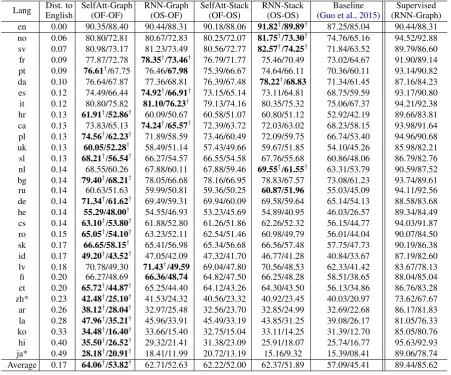
The results on the test sets are shown in Table2. The languages are ordered by their order typology distance to English. In preliminary experiments, we found our lexicalized models performed poorly
5In our evaluations, we exclude tokens whose POS tags
are “PUNCT” or “SYM”. This setting is different from the one adopted in the CoNLL shared task (Zeman et al.,2018). However, the patterns are similar as shown in Appendix D where we report the punctuation-included test evaluations.
6https://github.com/jiangfeng1124/acl15-clnndep. We
Lang Dist. to SelfAtt-Graph RNN-Graph SelfAtt-Stack RNN-Stack Baseline Supervised English (OF-OF) (OS-OF) (OF-OS) (OS-OS) (Guo et al.,2015) (RNN-Graph) en 0.00 90.35/88.40 90.44/88.31 90.18/88.06 91.82†/89.89† 87.25/85.04 90.44/88.31 no 0.06 80.80/72.81 80.67/72.83 80.25/72.07 81.75†/73.30† 74.76/65.16 94.52/92.88 sv 0.07 80.98/73.17 81.23/73.49 80.56/72.77 82.57†/74.25† 71.84/63.52 89.79/86.60 fr 0.09 77.87/72.78 78.35†/73.46† 76.79/71.77 75.46/70.49 73.02/64.67 91.90/89.14
pt 0.09 76.61†/67.75 76.46/67.98 75.39/66.67 74.64/66.11 70.36/60.11 93.14/90.82
da 0.10 76.64/67.87 77.36/68.81 76.39/67.48 78.22†/68.83 71.34/61.45 87.16/84.23 es 0.12 74.49/66.44 74.92†/66.91† 73.15/65.14 73.11/64.81 68.75/59.59 93.17/90.80 it 0.12 80.80/75.82 81.10/76.23† 79.13/74.16 80.35/75.32 75.06/67.37 94.21/92.38
hr 0.13 61.91†/52.86† 60.09/50.67 60.58/51.07 60.80/51.12 52.92/42.19 89.66/83.81
ca 0.13 73.83/65.13 74.24†/65.57† 72.39/63.72 72.03/63.02 68.23/58.15 93.98/91.64
pl 0.13 74.56†/62.23† 71.89/58.59 73.46/60.49 72.09/59.75 66.74/53.40 94.96/90.68
uk 0.13 60.05/52.28† 58.49/51.14 57.43/49.66 59.67/51.85 54.10/45.26 85.98/82.21
sl 0.13 68.21†/56.54† 66.27/54.57 66.55/54.58 67.76/55.68 60.86/48.06 86.79/82.76
nl 0.14 68.55/60.26 67.88/60.11 67.88/59.46 69.55†/61.55† 63.31/53.79 90.59/87.52
bg 0.14 79.40†/68.21† 78.05/66.68 78.16/66.95 78.83/67.57 73.08/61.23 93.74/89.61
ru 0.14 60.63/51.63 59.99/50.81 59.36/50.25 60.87/51.96 55.03/45.09 94.11/92.56
de 0.14 71.34†/61.62† 69.49/59.31 69.94/60.09 69.58/59.64 65.14/54.13 88.58/83.68
he 0.14 55.29/48.00† 54.55/46.93 53.23/45.69 54.89/40.95 46.03/26.57 89.34/84.49
cs 0.14 63.10†/53.80† 61.88/52.80 61.26/51.86 62.26/52.32 56.15/44.77 94.03/91.87
ro 0.15 65.05†/54.10† 63.23/52.11 62.54/51.46 60.98/49.79 56.01/44.04 90.07/84.50
sk 0.17 66.65/58.15† 65.41/56.98 65.34/56.68 66.56/57.48 57.75/47.73 90.19/86.38
id 0.17 49.20†/43.52† 47.05/42.09 47.32/41.70 46.77/41.28 40.84/33.67 87.19/82.60
lv 0.18 70.78/49.30 71.43†/49.59 69.04/47.80 70.56/48.53 62.33/41.42 83.67/78.13 fi 0.20 66.27/48.69 66.36/48.74 64.82/47.50 66.25/48.28 58.51/38.65 88.04/85.04
et 0.20 65.72†/44.87† 65.25/44.40 64.12/43.26 64.30/43.50 56.13/34.86 86.76/83.28
zh* 0.23 42.48†/25.10† 41.53/24.32 40.56/23.32 40.92/23.45 40.03/20.97 73.62/67.67
ar 0.26 38.12†/28.04† 32.97/25.48 32.56/23.70 32.85/24.99 32.69/22.68 86.17/81.83
la 0.28 47.96†/35.21† 45.96/33.91 45.49/33.19 43.85/31.25 39.08/26.17 81.05/76.33
ko 0.33 34.48†/16.40† 33.66/15.40 32.75/15.04 33.11/14.25 31.39/12.70 85.05/80.76
hi 0.40 35.50†/26.52† 29.32/21.41 31.38/23.09 25.91/18.07 25.74/16.77 95.63/92.93
ja* 0.49 28.18†/20.91† 18.41/11.99 20.72/13.19 15.16/9.32 15.39/08.41 89.06/78.74
[image:5.595.74.526.62.437.2]Average 0.17 64.06†/53.82† 62.71/52.63 62.22/52.00 62.37/51.89 57.09/45.41 89.44/85.62
Table 2: Results (UAS%/LAS%, excluding punctuation) on the test sets. Languages are sorted by the word-ordering distance to English, as shown in the second column. ‘*’ refers to results of delexicalized models, ‘†’ means that the best transfer model is statistically significantly better (by paired bootstrap test, p<0.05) than all other transfer models. Models are marked with their encoder and decoder order sensitivity, OF denotes order-free and OS denotes order-sensitive.
on Chinese (zh) and Japanese (ja). We found the main reason was that their embeddings were not well aligned to English. Therefore, we use delex-icalized models, where only POS tags are used as inputs. The delexicalized results7for Chinese and Japanese are listed in the rows marked with “*”.
Overall, the “SelfAtt-Graph” model performs the best in over half of the languages and beats the runner-up “RNN-Graph” by around 1.3 in UAS and 1.2 in LAS on average. When compared with “RNN-Stack” and “SelfAtt-Stack”, the av-erage difference is larger than 1.5 points. This shows that models capture less word order
infor-7
We found delexicalized models to be better only at zh and ja, for about 5 and 10 points respectively. For other lan-guages, they performed worse for about 2 to 5 points. We also tried models without POS, and found them worse for about 10 points on average. We leave further investigation of input representations to future work.
mation generally perform better at cross-lingual parsing. Compared with the baseline, our supe-rior results show the importance of the contextual encoder. Compared with the supervised models, the cross-lingual results are still lower by a large gap, indicating space for improvements.
Model UAS% LAS% SelfAtt-Relative (Ours) 64.57 54.14
[image:6.595.96.268.61.124.2]SelfAtt-Relative+Dir 63.93 53.62 RNN 63.25 52.94 SelfAtt-Absolute 61.76 51.71 SelfAtt-NoPosi 28.18 21.45
Table 3: Comparisons of different encoders (averaged results over all languages on the original training sets).
4.3 Analysis
We further analyze how different modeling choices influence cross-lingual transfer. Since we have not touched the training sets for languages other than English, in this subsection, we evaluate and analyze the performance of target languages using training splits in UD. Performance of En-glish is evaluated on the test set. We verify that the trends observed in test set are similar to those on the training sets. As mentioned in the previous section, the bilingual embeddings for Chinese and Japanese do not align well with English. There-fore, we report the results with delexicalizing. In the following, we discuss our observations, and detailed results are listed in Appendix E.
4.3.1 Encoder Architecture
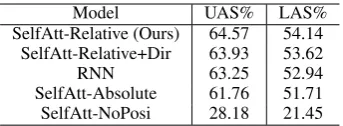
We assume models that are less sensitive to word order perform better when transfer to distant lan-guages. To empirically verify this point, we con-duct controlled comparisons on various encoders with the same graph-based decoder. Table3shows the average performances in all languages.
To compare models with various degrees of sen-sitivity to word order, we include several vari-ations of self-attention models. The “SelfAtt-NoPosi” is the self-attention model without any positional information. Although it is most insen-sitive to word order, it performs poorly possibly because of the lack of access to the locality of contexts. The self-attention model with absolute positional embeddings (“SelfAtt-Absolute”) also does not perform well. In the case of parsing, relative positional representations may be more useful as indicated by the improvements brought by the directional relative position representa-tions (“SelfAtt-Relative+Dir”) (Shaw et al.,2018). Interestingly, the RNN encoder ranks between “SelfAtt-Relative+Dir” and “SelfAtt-Absolute”; all these three encoders explicitly capture word or-der information in some way. Finally, by discard-ing the information of directions, our relative posi-tion representaposi-tion (“SelfAtt-Relative”) performs the best (significantly better at p<0.05).
(QFRGLQJ
'LII6HOI$WW(QF2)511(QF26
HQ QR VY IU SW GD HV LW KU FD SO XN VO QO EJ UX GH KH FV UR VN LG OY IL HW ]K DU OD NR KL MD
'HFRGLQJ
'LII*UDSK'HF2)6WDFN'HF26
Figure 2: Evaluation score differences between Order-Free (OF) and Order Sensitive (OS) modules. We show results of both encoder (blue solid curve) and decoder (dashed red curve). Languages are sorted by their word-ordering distances to English from left to right. The position of English is marked with a green bar.
One crucial observation we have is that the pat-terns of breakdown performances for “SelfAtt-Relative+Dir” are similar to those of RNN: on closer languages, the direction-aware model per-forms better, while on distant languages the non-directional one generally obtains better re-sults. Since the only difference between our pro-posed Relative” model and the “SelfAtt-Relative+Dir” model is the directional encoding, we believe the better performances should credit to its effectiveness in capturing useful context in-formation without depending too much on the language-specific order information.
These results suggest that a model’s sensitivity to word order indeed affects its cross-lingual trans-fer performances. In later sections, we stick to our “SelfAtt-Relative” variation of the self-attentive encoder and focus on the comparisons among the four main models.
4.3.2 Performance v.s. Language Distance
We posit that order-free models can do better than order-sensitive ones on cross-lingual transfer pars-ing when the target languages have different word orders to the source language. Now we can ana-lyze this with the word-ordering distance.
For each target language, we collect two types of distances when comparing it to English: one is
theword-ordering distanceas described in Section
2, the other is theperformance distance, which is the gap of evaluation scores8 between the target
language and English. The performance distance can represent the general transferability from
En-8In the rest of this paper, we simply average UAS and
[image:6.595.300.522.62.186.2]OD LW EJ IU FV KU VN VO SW ]K XN HQ KH UR UX QR SO HV VY QO FD DU GD GH OY LG HW IL KL MD
(YDOXDWLRQ'LIIHUHQFH
'LII6HOI$WW(QF2)511(QF26 'LII*UDSK'HF2)6WDFN'HF26
5HODWLYH)UHTXHQF\
)UHT
(a) Adposition & Noun (ADP, NOUN, case)
]K KL IL OY VY GH NR HW QO KU HQ UX VO EJ GD VN QR XN FV SO OD LW SW IU HV FD UR LG DU KH
(YDOXDWLRQ'LIIHUHQFH
'LII6HOI$WW(QF2)511(QF26 'LII*UDSK'HF2)6WDFN'HF26
5HODWLYH)UHTXHQF\
)UHT
(b) Adjective & Noun (ADJ, NOUN, amod)
]K IU QR UR LW VY SW IL OY HQ FD HV GD EJ HW UX VO QO FV KU GH VN SO OD NR KL MD
(YDOXDWLRQ'LIIHUHQFH
'LII6HOI$WW(QF2)511(QF26 'LII*UDSK'HF2)6WDFN'HF26
5HODWLYH)UHTXHQF\
)UHT
(c) Auxiliary & Verb (AUX, VERB, aux)
MD NR KL QO OD GH HW IL VO FV OY XN SO VN UX KU EJ VY ]K LW FD GD KH UR HV QR HQ SW IU LG DU
(YDOXDWLRQ'LIIHUHQFH
'LII6HOI$WW(QF2)511(QF26 'LII*UDSK'HF2)6WDFN'HF26
5HODWLYH)UHTXHQF\
)UHT
[image:7.595.72.525.72.294.2](d) Object & Verb (NOUN, VERB, obj)
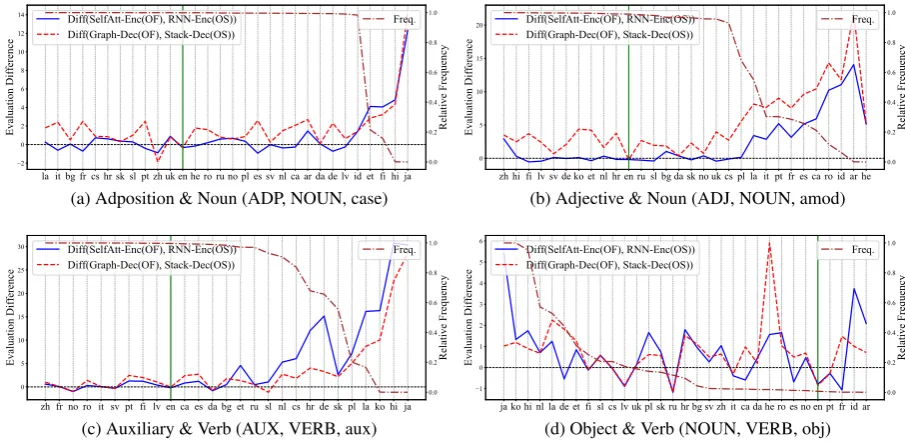
Figure 3: Analysis on specific dependency types. To save space, we merge the curves of encoders and decoders into one figure. The blue and red curves and lefty-axis represent the differences in evaluation scores, the brown curve and righty-axis represents the relative frequency of left-direction (modifier before head) on this type. The languages (x-axis) are sorted by this relative frequency from high to low.
glish to this language. We calculate the correla-tion of these two distances on all the concerned languages, and the results turn to be quite high: the Pearson and Spearman correlations arearound
0.90 and 0.87 respectively, using the evaluations
of any of our four cross-lingual transfer models. This suggests that word order can be an important factor of cross-lingual transferability.
Furthermore, we individually analyze the en-coders and deen-coders of the dependency parsers. Since we have two architectures for each of the modules, when examining one, we take the high-est scores obtained by any of the other mod-ules. For example, when comparing RNN and Self-Attention encoders, we take the best evalu-ation scores of “RNN-Graph” and “RNN-Stack” for RNN and the best of “SelfAtt-Graph” and “SelfAtt-Stack” for Self-Attention. Figure 2
shows the score differences of encoding and de-coding architectures against the languages’ dis-tances to English. For both the encoding and decoding module, we observe a similar overall pattern: the order-free models, in general, per-form better than order-sensitive ones in the lan-guages that are distant from the source language English. On the other hand, for some languages that are closer to English, order-sensitive mod-els perform better, possibly benefiting from be-ing able to capture similar word orderbe-ing infor-mation. The performance gap between order-free
and order-sensitive models are positively corre-lated with language distance.
4.3.3 Performance Breakdown by Types
Moreover, we compare the results on specific de-pendency types using concrete examples. For each type, we sort the languages by their relative fre-quencies of left-direction (modifier before head) and plot the performance differences for encoders and decoders. We highlight the source language English in green. Figure3shows four typical ex-ample types: Adposition and Noun, Adjective and Noun, Auxiliary and Verb, and Object and Verb. In Figure3a, we examine the “case” dependency type between adpositions and nouns. The pattern is similar to the overall pattern. For languages that mainly use prepositions as in English, differ-ent models perform similarly, while for languages that use postpositions, order-free models get better results. The patterns of adjective modifier (Figure
d English Average
<-2 14.36 12.93 -2 15.45 11.83 -1 31.55 30.42 1 7.51 14.22 2 9.84 10.49
[image:8.595.129.234.61.135.2]>2 21.29 20.11
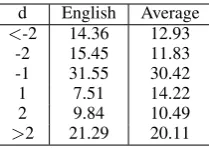
Table 4: Relative frequencies (%) of dependency dis-tances. English differs from the Average atd=1.
less than 0.9 when considering all types. There-fore, although Verb-Object ordering is a typical example, we cannot take it as the whole story of word order. Secondly, Verb-Object dependen-cies can often be difficult to decide. They some-times are long-ranged and have complex interac-tions with other words. Therefore, merely reduc-ing modelreduc-ing order information can have compli-cated effects. Moreover, although our relative-position self-attention encoder does not explicitly encode word positions, it may still capture some positional information with relative distances. For example, the words in the middle of a sentence will have different distance patterns from those at the beginning or the end. With this knowledge, the model can still prefer the pattern where a verb is in the middle as in English’s Subject-Verb-Object or-dering and may find sentences in Subject-Object-Verb languages strange. It will be interesting to explore more ways to weaken or remove this bias.
4.3.4 Analysis on Dependency Distances
We now look into dependency lengths and di-rections. Here, we combine dependency length and direction into dependency distance d, by us-ing negative signs for dependencies with left-direction (modifier before head) and positive for right-direction (head before modifier). We find a seemingly strange pattern at dependency distances |d|=1: for all transfer models, evaluation scores on d=-1 can reach about 80, but ond=1, the scores are only around 40. This may be explained by the relative frequencies of dependency distances as shown in Table 4, where there is a discrep-ancy between English and the average of other lan-guages at d=1. About 80% of the dependencies with |d|=1 in English is the left direction (mod-ifier before head), while overall other languages have more right directions at|d|=1. This suggests an interesting future direction of training on more source languages with different dependency dis-tance distributions.
We further compare the four models on thed=1
GH HQ VY QR OY IU SW QO LW HV EJ FD NR GD ]K VO XN HW KH FV IL UX KU VN UR OD SO KL LG MD DU
(YDOXDWLRQ'LIIHUHQFH
'LII6HOI$WW(QF2)511(QF26 'LII*UDSK'HF2)6WDFN'HF26
5HODWLYH)UHTXHQF\
[image:8.595.299.525.62.154.2])UHT
Figure 4: Evaluation differences of models ond=1 de-pendencies. Annotations are the same as in Figure3, languages are sorted by percentages (represented by the brown curve and righty-axis) ofd=1 dependencies.
KU VO SW EJ UX FV XN GH HV QO FD LW VY IU SO UR QR HQ VN OY GD KH HW LG IL OD ]K DU NR KL MD
$YHUDJH(YDOXDWLRQ5HVXOW
$V6RXUFH $V7DUJHW
$YHUDJH'LVWDQFH
$YJ'LVWDQFH
Figure 5: Transfer performance of all source-target lan-guage pairs. The blue and red curves show the averages over columns and over rows of the source-target pair performance matrix (see text for details). The brown curve and the righty-axis legend represent the average language distance between one language and all others.
dependencies and as shown in Figure 4, the fa-miliar pattern appears again. The order-free mod-els perform better at the languages which have more d=1 dependencies. Such finding indicates that our model design of reducing the ability to capture word order information can help on short-ranged dependencies of different directions to the source language. However, the improvements are still limited. One of the most challenging parts of unsupervised cross-lingual parsing is modeling cross-lingually shareable and language-unspecific information. In other words, we want flexible yet powerful models. Our exploration of the order-free self-attentive models is the first step.
4.3.5 Transfer between All Language Pairs
Finally, we investigate the transfer performance of all source-target language pairs.9 We first gen-erate a performance matrix A, where each en-try (i, j) records the transfer performance from a source language i to a target language j. We then report the following two aggregate
perfor-9Because the size of training corpus for each language
[image:8.595.309.530.219.324.2]mance measures on A in Figure 5: 1) As-source reports the average over columns of A for each row of the source language and 2) As-target re-ports the average over rows ofAfor each column of the target language. As a reference, we also plot the average word-order distance between one language to other languages. Results show that
bothAs-source(blue line) andAs-target(red line)
highly are anti-correlated (Pearson correlation co-efficients are−0.90and−0.87, respectively) with average language distance (brown line).
5 Related Work
Cross-language transfer learning employing deep neural networks has widely been studied in the ar-eas of natural language processing (Ma and Xia,
2014; Guo et al., 2015; Kim et al., 2017; Kann et al., 2017; Cotterell and Duh, 2017), speech recognition (Xu et al.,2014;Huang et al.,2013), and information retrieval (Vuli´c and Moens,2015;
Sasaki et al.,2018;Litschko et al.,2018). Learn-ing the language structure (e.g., morphology, syn-tax) and transferring knowledge from the source language to the target language is the main under-neath challenge, and has been thoroughly investi-gated for a wide variety of NLP applications, in-cluding sequence tagging (Yang et al.,2016;Buys and Botha, 2016), name entity recognition (Xie et al., 2018), dependency parsing (Tiedemann,
2015;Agi´c et al.,2014), entity coreference reso-lution and linking (Kundu et al.,2018;Sil et al.,
2018), sentiment classification (Zhou et al.,2015,
2016b), and question answering (Joty et al.,2017). Existing work on unsupervised cross-lingual dependency parsing, in general, trains a depen-dency parser on the source language and then directly run on the target languages. Training of the monolingual parsers are often delexical-ized, i.e., removing all lexical features from the source treebank (Zeman and Resnik, 2008; Mc-Donald et al., 2013), and the underlying feature model is selected from a shared part-of-speech (POS) representation utilizing the Universal POS Tagset (Petrov et al.,2012). Another pool of prior work improves the delexicalized approaches by adapting the model to fit the target languages bet-ter. Cross-lingual approaches that facilitate the usage of lexical features includes choosing the source language data points suitable for the tar-get language (Søgaard, 2011; T¨ackstr¨om et al.,
2013), transferring from multiple sources (
Mc-Donald et al.,2011;Guo et al., 2016;T¨ackstr¨om et al., 2013), using cross-lingual word clusters (T¨ackstr¨om et al., 2012) and lexicon mapping (Xiao and Guo, 2014; Guo et al., 2015). In this paper, we consider single-source transfer–train a parser on a single source language, and evaluate it on the target languages to test the transferability of neural architectures.
Multilingual transfer (Ammar et al., 2016;
Naseem et al., 2012; Zhang and Barzilay, 2015) is another broad category of techniques applied to parsing where knowledge from many languages having a common linguistic typology is utilized. Recent works (Aufrant et al.,2016;Wang and Eis-ner,2018a,b) demonstrated the significance of ex-plicitly extracting and modeling linguistic prop-erties of the target languages to improve cross-lingual dependency parsing. Our work is different in that we focus on the neural architectures and explore their influences on cross-lingual transfer.
6 Conclusion
In this work, we conduct a comprehensive study on how the design of neural architectures affects cross-lingual transfer learning. We examine two notable families of neural architectures (sequential RNN v.s. self-attention) using dependency parsing as the evaluation task. We show that order-free models perform better than order-sensitive ones when there is a significant difference in the word order typology between the target and source lan-guage. In the future, we plan to explore multi-source transfer and incorporating prior linguistic knowledge into the models for better cross-lingual transfer.
Acknowledgments
References
ˇ
Zeljko Agi´c, J¨org Tiedemann, Kaja Dobrovoljc, Si-mon Krek, Danijela Merkler, and Sara Moˇze. 2014. Cross-lingual dependency parsing of related lan-guages with rich morphosyntactic tagsets. In
EMNLP 2014 Workshop on Language Technology for Closely Related Languages and Language Vari-ants.
Waleed Ammar, George Mulcaire, Miguel Ballesteros, Chris Dyer, and Noah Smith. 2016. Many lan-guages, one parser. Transactions of the Association for Computational Linguistics4:431–444.
Lauriane Aufrant, Guillaume Wisniewski, and Franc¸ois Yvon. 2016. Zero-resource dependency parsing: Boosting delexicalized cross-lingual transfer with linguistic knowledge. In Proceedings of COLING 2016, the 26th International Conference on Compu-tational Linguistics: Technical Papers. The COL-ING 2016 Organizing Committee, Osaka, Japan, pages 119–130.
Piotr Bojanowski, Edouard Grave, Armand Joulin, and Tomas Mikolov. 2017. Enriching word vectors with subword information. Transactions of the Associa-tion for ComputaAssocia-tional Linguistics5:135–146.
Jan Buys and Jan A. Botha. 2016. Cross-lingual mor-phological tagging for low-resource languages. In
Proceedings of the 54th Annual Meeting of the As-sociation for Computational Linguistics (Volume 1: Long Papers). Association for Computational Lin-guistics, Berlin, Germany, pages 1954–1964.
Ryan Cotterell and Kevin Duh. 2017. Low-resource named entity recognition with cross-lingual, character-level neural conditional random fields. In Proceedings of the Eighth International Joint Conference on Natural Language Processing (Volume 2: Short Papers). volume 2, pages 91–96.
Timothy Dozat and Christopher D Manning. 2017. Deep biaffine attention for neural dependency pars-ing. Internation Conference on Learning Represen-tations.
Matthew S Dryer. 2007. Word order. Language typol-ogy and syntactic description1:61–131.
Matthew S. Dryer and Martin Haspelmath, editors. 2013. WALS Online. Max Planck Institute for Evo-lutionary Anthropology, Leipzig.
Jason M Eisner. 1996. Three new probabilistic models for dependency parsing: An exploration. In Pro-ceedings of the 16th conference on Computational linguistics-Volume 1. Association for Computational Linguistics, pages 340–345.
Pablo Gamallo, Marcos Garcia, and Santiago Fern´andez-Lanza. 2012. Dependency-based open information extraction. InProceedings of the joint workshop on unsupervised and semi-supervised learning in NLP. Association for Computational Linguistics, pages 10–18.
Jiang Guo, Wanxiang Che, David Yarowsky, Haifeng Wang, and Ting Liu. 2015. Cross-lingual depen-dency parsing based on distributed representations. In Proceedings of the 53rd Annual Meeting of the Association for Computational Linguistics and the 7th International Joint Conference on Natural Lan-guage Processing (Volume 1: Long Papers). vol-ume 1, pages 1234–1244.
Jiang Guo, Wanxiang Che, David Yarowsky, Haifeng Wang, and Ting Liu. 2016. A representation learn-ing framework for multi-source transfer parslearn-ing. In
Proceedings of the Thirtieth AAAI Conference on Artificial Intelligence. AAAI’16, pages 2734–2740.
Kazuma Hashimoto, caiming xiong, Yoshimasa Tsu-ruoka, and Richard Socher. 2017. A joint many-task model: Growing a neural network for multiple nlp tasks. InProceedings of the 2017 Conference on Empirical Methods in Natural Language Pro-cessing. Association for Computational Linguistics, pages 1923–1933.
Sepp Hochreiter and J¨urgen Schmidhuber. 1997. Long short-term memory. Neural computation
9(8):1735–1780.
Jui-Ting Huang, Jinyu Li, Dong Yu, Li Deng, and Yi-fan Gong. 2013. Cross-language knowledge transfer using multilingual deep neural network with shared hidden layers. InAcoustics, Speech and Signal Pro-cessing (ICASSP), 2013 IEEE International Confer-ence on. IEEE, pages 7304–7308.
Zhanming Jie, Aldrian Obaja Muis, and Wei Lu. 2017. Efficient dependency-guided named entity recogni-tion. InProceedings of the Thirty-First AAAI Con-ference on Artificial Intelligence. pages 3457–3465.
Shafiq Joty, Preslav Nakov, Llu´ıs M`arquez, and Israa Jaradat. 2017. Cross-language learning with ad-versarial neural networks. In Proceedings of the 21st Conference on Computational Natural Lan-guage Learning (CoNLL 2017). pages 226–237.
Katharina Kann, Ryan Cotterell, and Hinrich Sch¨utze. 2017. One-shot neural cross-lingual transfer for paradigm completion. Proceedings of the 55th An-nual Meeting of the Association for Computational Linguisticspage 19932003.
Joo-Kyung Kim, Young-Bum Kim, Ruhi Sarikaya, and Eric Fosler-Lussier. 2017. Cross-lingual transfer learning for pos tagging without cross-lingual re-sources. InProceedings of the 2017 Conference on Empirical Methods in Natural Language Process-ing. pages 2832–2838.
Eliyahu Kiperwasser and Yoav Goldberg. 2016. Sim-ple and accurate dependency parsing using bidirec-tional lstm feature representations. Transactions of the Association for Computational Linguistics
Nikita Kitaev and Dan Klein. 2018. Constituency parsing with a self-attentive encoder. In Proceed-ings of the 56th Annual Meeting of the Associa-tion for ComputaAssocia-tional Linguistics (Volume 1: Long Papers). Association for Computational Linguistics, pages 2676–2686.
Gourab Kundu, Avi Sil, Radu Florian, and Wael Hamza. 2018. Neural cross-lingual coreference res-olution and its application to entity linking. In Pro-ceedings of the 56th Annual Meeting of the Associa-tion for ComputaAssocia-tional Linguistics (Volume 2: Short Papers). Association for Computational Linguistics, pages 395–400.
Robert Litschko, Goran Glavaˇs, Simone Paolo Ponzetto, and Ivan Vuli´c. 2018. Unsupervised cross-lingual information retrieval using monocross-lingual data only. InThe 41st International ACM SIGIR Confer-ence on Research & Development in Informa-tion Retrieval. SIGIR ’18, pages 1253–1256.
Patrick Littell, David R. Mortensen, Ke Lin, Kather-ine Kairis, Carlisle Turner, and Lori Levin. 2017. Uriel and lang2vec: Representing languages as ty-pological, geographical, and phylogenetic vectors. InProceedings of the 15th Conference of the Euro-pean Chapter of the Association for Computational Linguistics: Volume 2, Short Papers. Association for Computational Linguistics, Valencia, Spain, pages 8–14.
Haitao Liu. 2010. Dependency direction as a means of word-order typology: A method based on depen-dency treebanks. Lingua120(6):1567–1578.
Peter J Liu, Mohammad Saleh, Etienne Pot, Ben Goodrich, Ryan Sepassi, Lukasz Kaiser, and Noam Shazeer. 2018. Generating wikipedia by summa-rizing long sequences. Internation Conference on Learning Representations.
Xuezhe Ma, Zecong Hu, Jingzhou Liu, Nanyun Peng, Graham Neubig, and Eduard Hovy. 2018. Stack-pointer networks for dependency parsing. In Pro-ceedings of the 56th Annual Meeting of the Associa-tion for ComputaAssocia-tional Linguistics (Volume 1: Long Papers).
Xuezhe Ma and Fei Xia. 2014. Unsupervised depen-dency parsing with transferring distribution via par-allel guidance and entropy regularization. In Pro-ceedings of ACL 2014. Baltimore, Maryland, pages 1337–1348.
David McClosky, Mihai Surdeanu, and Christopher D Manning. 2011. Event extraction as dependency parsing. InProceedings of the 49th Annual Meeting of the Association for Computational Linguistics: Human Language Technologies-Volume 1. Associ-ation for ComputAssoci-ational Linguistics, pages 1626– 1635.
Ryan McDonald, Koby Crammer, and Fernando Pereira. 2005. Online large-margin training of de-pendency parsers. In Proceedings of ACL-2005. Ann Arbor, Michigan, USA, pages 91–98.
Ryan McDonald, Joakim Nivre, Yvonne Quirmbach-Brundage, Yoav Goldberg, Dipanjan Das, Kuzman Ganchev, Keith Hall, Slav Petrov, Hao Zhang, Os-car T¨ackstr¨om, et al. 2013. Universal dependency annotation for multilingual parsing. In Proceed-ings of the 51st Annual Meeting of the Association for Computational Linguistics (Volume 2: Short Pa-pers). volume 2, pages 92–97.
Ryan McDonald, Slav Petrov, and Keith Hall. 2011. Multi-source transfer of delexicalized dependency parsers. InProceedings of the conference on empir-ical methods in natural language processing. Asso-ciation for Computational Linguistics, pages 62–72.
Tom´aˇs Mikolov, Martin Karafi´at, Luk´aˇs Burget, Jan ˇ
Cernock`y, and Sanjeev Khudanpur. 2010. Recur-rent neural network based language model. In
Eleventh Annual Conference of the International Speech Communication Association.
Tahira Naseem, Regina Barzilay, and Amir Globerson. 2012. Selective sharing for multilingual dependency parsing. InProceedings of the 50th Annual Meet-ing of the Association for Computational LMeet-inguistics (Volume 1: Long Papers). Association for Compu-tational Linguistics, Jeju Island, Korea, pages 629– 637.
Joakim Nivre, Mitchell Abrams, ˇZeljko Agi´c, and et al. 2018. Universal dependencies 2.2. LIN-DAT/CLARIN digital library at the Institute of For-mal and Applied Linguistics ( ´UFAL), Faculty of Mathematics and Physics, Charles University.
Robert ¨Ostling. 2015. Word order typology through multilingual word alignment. InProceedings of the 53rd Annual Meeting of the Association for Compu-tational Linguistics and the 7th International Joint Conference on Natural Language Processing (Vol-ume 2: Short Papers). volume 2, pages 205–211.
Matthew Peters, Mark Neumann, Mohit Iyyer, Matt Gardner, Christopher Clark, Kenton Lee, and Luke Zettlemoyer. 2018. Deep contextualized word repre-sentations. InProceedings of the 2018 Conference of the North American Chapter of the Association for Computational Linguistics: Human Language Technologies, Volume 1 (Long Papers). Association for Computational Linguistics, pages 2227–2237.
Slav Petrov, Dipanjan Das, and Ryan McDonald. 2012. A universal part-of-speech tagset. InProceedings of LREC-2012. Istanbul, Turkey, pages 2089–2096.
Shota Sasaki, Shuo Sun, Shigehiko Schamoni, Kevin Duh, and Kentaro Inui. 2018. Cross-lingual learning-to-rank with shared representations. In
Proceedings of the 2018 Conference of the North American Chapter of the Association for Computa-tional Linguistics: Human Language Technologies, Volume 2 (Short Papers). volume 2, pages 458–463.
the North American Chapter of the Association for Computational Linguistics: Human Language Tech-nologies, Volume 2 (Short Papers). Association for Computational Linguistics, pages 464–468.
Avirup Sil, Gourab Kundu, Radu Florian, and Wael Hamza. 2018. Neural cross-lingual entity link-ing. In Proceedings of the Thirty-Second AAAI Conference on Artificial Intelligence, (AAAI-18), the 30th innovative Applications of Artificial Intel-ligence (IAAI-18), and the 8th AAAI Symposium on Educational Advances in Artificial Intelligence (EAAI-18), New Orleans, Louisiana, USA, February 2-7, 2018. pages 5464–5472.
Samuel L Smith, David HP Turban, Steven Hamblin, and Nils Y Hammerla. 2017. Offline bilingual word vectors, orthogonal transformations and the inverted softmax. Internation Conference on Learning Rep-resentations.
Anders Søgaard. 2011. Data point selection for cross-language adaptation of dependency parsers. In Pro-ceedings of the 49th Annual Meeting of the Associ-ation for ComputAssoci-ational Linguistics: Human Lan-guage Technologies: short papers-Volume 2. Asso-ciation for Computational Linguistics, pages 682– 686.
Ilya Sutskever, Oriol Vinyals, and Quoc V Le. 2014. Sequence to sequence learning with neural net-works. InAdvances in neural information process-ing systems. pages 3104–3112.
Oscar T¨ackstr¨om, Ryan McDonald, and Joakim Nivre. 2013. Target language adaptation of discriminative transfer parsers. In Proceedings of the 2013 Con-ference of the North American Chapter of the Asso-ciation for Computational Linguistics: Human Lan-guage Technologies. Association for Computational Linguistics, Atlanta, Georgia, pages 1061–1071.
Oscar T¨ackstr¨om, Ryan McDonald, and Joakim Nivre. 2013. Target language adaptation of discriminative transfer parsers. In Proceedings of the 2013 Con-ference of the North American Chapter of the Asso-ciation for Computational Linguistics: Human Lan-guage Technologies. Association for Computational Linguistics, pages 1061–1071.
Oscar T¨ackstr¨om, Ryan McDonald, and Jakob Uszko-reit. 2012. Cross-lingual word clusters for direct transfer of linguistic structure. InProceedings of the 2012 conference of the North American chapter of the association for computational linguistics: Hu-man language technologies. Association for Com-putational Linguistics, pages 477–487.
J¨org Tiedemann. 2015. Cross-lingual dependency parsing with universal dependencies and predicted pos labels. InProceedings of the Third International Conference on Dependency Linguistics (Depling 2015). pages 340–349.
Ashish Vaswani, Noam Shazeer, Niki Parmar, Jakob Uszkoreit, Llion Jones, Aidan N Gomez, Łukasz Kaiser, and Illia Polosukhin. 2017. Attention is all you need. InAdvances in Neural Information Pro-cessing Systems. pages 5998–6008.
Ivan Vuli´c and Marie-Francine Moens. 2015. Mono-lingual and cross-Mono-lingual information retrieval mod-els based on (bilingual) word embeddings. In Pro-ceedings of the 38th international ACM SIGIR con-ference on research and development in information retrieval. ACM, pages 363–372.
Dingquan Wang and Jason Eisner. 2017. Fine-grained prediction of syntactic typology: Discovering la-tent structure with supervised learning. Transac-tions of the Association for Computational Linguis-tics5:147–161.
Dingquan Wang and Jason Eisner. 2018a. Surface statistics of an unknown language indicate how to parse it. Transactions of the Association for Compu-tational Linguistics (TACL).
Dingquan Wang and Jason Eisner. 2018b. Synthetic data made to order: The case of parsing. In Proceed-ings of the 2018 Conference on Empirical Methods in Natural Language Processing. pages 1325–1337.
Min Xiao and Yuhong Guo. 2014. Distributed word representation learning for cross-lingual dependency parsing. In Proceedings of the Eighteenth Confer-ence on Computational Natural Language Learning. pages 119–129.
Jiateng Xie, Zhilin Yang, Graham Neubig, Noah A. Smith, and Jaime Carbonell. 2018. Neural cross-lingual named entity recognition with minimal re-sources. In Proceedings of the 2018 Conference on Empirical Methods in Natural Language Pro-cessing. Association for Computational Linguistics, pages 369–379.
Yong Xu, Jun Du, Li-Rong Dai, and Chin-Hui Lee. 2014. Cross-language transfer learning for deep neural network based speech enhancement. In Chi-nese Spoken Language Processing (ISCSLP), 2014 9th International Symposium on. IEEE, pages 336– 340.
Zhilin Yang, Ruslan Salakhutdinov, and William Co-hen. 2016. Multi-task cross-lingual sequence tag-ging from scratch. arXiv preprint arXiv:1603.06270
.
Daniel Zeman and Philip Resnik. 2008. Cross-language parser adaptation between related lan-guages. InProceedings of the IJCNLP-08 Workshop on NLP for Less Privileged Languages.
Yuan Zhang and Regina Barzilay. 2015. Hierarchical low-rank tensors for multilingual transfer parsing. InProceedings of the 2015 Conference on Empirical Methods in Natural Language Processing. Associa-tion for ComputaAssocia-tional Linguistics, Lisbon, Portu-gal, pages 1857–1867.
Huiwei Zhou, Long Chen, Fulin Shi, and Degen Huang. 2015. Learning bilingual sentiment word embeddings for cross-language sentiment classifica-tion. InProceedings of the 53rd Annual Meeting of the Association for Computational Linguistics and the 7th International Joint Conference on Natural Language Processing (Volume 1: Long Papers). vol-ume 1, pages 430–440.
Joey Tianyi Zhou, Sinno Jialin Pan, Ivor W. Tsang, and Shen-Shyang Ho. 2016a. Transfer learning for cross-language text categorization through active correspondences construction. InProceedings of the Thirtieth AAAI Conference on Artificial Intelligence. AAAI’16, pages 2400–2406.
Xinjie Zhou, Xiaojun Wan, and Jianguo Xiao. 2016b. Cross-lingual sentiment classification with bilingual document representation learning. In Proceedings of the 54th Annual Meeting of the Association for Computational Linguistics (Volume 1: Long Pa-pers). volume 1, pages 1403–1412.